
AKA Australian Music Month. The things you learn, thanks to other bloggers! It was kimbofo’s post of last Monday that brought this month to my attention, though I now see that our ABC is celebrating it, along with other musical organisations. I should have been aware. Anyhow, as kimbofo wrote, it offers an opportunity to “celebrate music of all persuasions — rock, pop, classical, country and so on — made by Australian musicians”. Kimbofo, as you’ll see from her post, did so by sharing ten Australian music biographies. Do check her post if you are interested.
Clearly, I can’t do the same. That would add nothing to the discussion. So, I’m going to go broad and share a variety of ways in which music is reflected in my Australian reading. First though, I have written Monday Musings on music-related AusLit topics before – Pianos in Australian literature, and Musician’s memoirs – so there will be some overlap. However, I will avoid duplicating too much, and hope, instead, that the posts will be complementary.

Of course, as kimbofo ably shows, there are many memoirs/autobiographies written by musicians. Fortunately, I have read some different ones to those kimbofo lists: Emma Ayres’ (now Ed Le Brocq’s) Cadence: Travels with music (my review), Anna Goldsworthy’s Piano lessons (my review). Linda Neil’s All is given (my review), and Archie Roach’s Tell me why: The story of my life and my music (my review). These musicians vary, from classical performers to singer-songwriters, and so do their stories. Anna Goldsworthy is particularly relevant this month, because she delivered the first of this year’s Boyer Lectures. The overall theme is Future Classic (or, classical music for the contemporary age) and Goldworthy’s topic was Kairos, “the right shared moment” or “the right time”. You can listen to the lecture here.
Then there are novels which specifically feature music, musicians and/or musical instruments, including Murray Bail’s The voyage (my review) about a piano inventor trying to sell his new-style piano in Vienna; Christine Balint’s Water music (my review) about a music school for orphans in Venice; Carmel Bird’s Field of poppies (my review) in which an eccentric musician goes missing; Diana Blackwood’s Chaconne (my review) about a young woman finding connection through music in Europe; and Henry Handel Richardson’s classic Maurice Guest (on my TBR) about a music student in Leipzig.
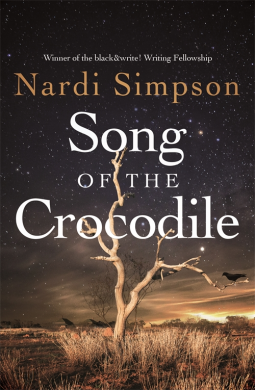
There are novels written by musicians who have branched out into novel writing, like singer Nadi Simpson, whose Song of the crocodile I’ve read and reviewed, and who has now published Bellburd. Both titles suggest music in some way. In Song of the crocodile, a spirit songman, Jakybird, plays a significant role in the resolution. Another musician is the solo artist, Holly Throsby, whose third novel, the non-music “bush noir” Clarke I’ve reviewed. And there are more, such as indie rock band member, Peggy Frew, whose Hope farm won the Barbara Jefferis Award.
Short stories often feature music and musicians. One anthology in particular comes to mind, Red hot notes (on my TBR), edited by Carmel Bird. This book contains stories by some of our best-known writers from the end of the 20th century, like Thea Astley, Robert Dessaix, Helen Garner and Marion Halligan, exploring some aspect of music in their lives. I have written about music-focused short stories, including Myra Morris’ “The inspiration” (my review). Stephen Orr’s long short story or novella, “Datsunland“, in his collection Datsunland (my review), includes a struggling musician who ends up teaching in a “poor” elite school.

There are also books that aren’t necessarily about music but whose titles are inspired by it. Nigel Featherstone’s Fall on me (my review) is titled for an R.E.M song, while the title of and chapters in Julie Thorndyke’s Mrs Rickaby’s Lullaby (my review) reference music.
Finally, I must mention this year’s spoken-word-and-music album, The Wreck Event (my post) which was created by the Hell Herons, a new “spoken-word/music collective” comprising poet-writers Melinda Smith, CJ Bowerbird, Stuart Barnes and Nigel Featherstone. I have also written about Nigel Featherstone’s foray into art song, The weight of light (my post).
And this, I think, is perfect place for my final point. A pay-walled article in The Spectator (14 June 2023) commences with
Haruki Murakami said that ‘I feel that most of what I know about writing fiction I learned from music.’ Music and literature enjoy a close relationship. Authors rely on rhythm and tone for their writing.

As I thought about this post last night, this was the point that I wanted to make. I love books about musicians and music. After all, creativity is inherently interesting, and music can be used in so many ways. But, this topic also makes me think about writing. I care about tone, and I love writing that is rhythmic. Some of the writers at this year’s Canberra Writers Festival talked about the craft of writing, and how the craft provides the “propulsive” element, rather than the more obvious aspects like plot that they tended to focus on when they were beginners. These writers – like Emily Maguire, Charlotte Wood and Robbie Arnott – concentrate, then, on their sentences. In my review of Arnott’s Limberlost, I shared an excerpt and wrote that “the rolling, breathlessly joyful rhythm of this description is very different to that in the next paragraph where Ned’s old fears return, and the sentences become clipped, and staccato-like”. I love it when the writing itself supports, if not carries, the meaning.
Anyhow, my point is that music meets literature in all sorts of ways. I’ve only touched some of them, and superficially at that, but now I want to pass it over to you.
Do you love music in literature or literature about music? If so, I’d love to hear your thoughts or examples.


The one music novel I’ve read that you haven’t mentioned is Henry Handel Richardson’s The Young Cosima. Miles Franklin desperately wanted to be an opera singer, and a couple of her books feature a girl standing in for her taking lessons, particularly Cockatoos.
Of course they would be the case Bill wouldn’t it? I knew of that book but had to be selective so chose her better known one. I didn’t know those MF ones though. Could Cockatoos be read as a standalone?
Thanks for adding all these to the list.
Lovely post and I agree with your comments about Limberlost
Thanks Cathy … really glad you like this.
What a superb roundup of works of Australian literature where music is brought to the fore. And your closing remarks about the relationship between writing and music are so very apposite and welcome. In a recent event in the tiny Victorian goldfields’ town of Maldon, Arnold Zable made a similar point. I could only paraphrase what he said – but it was similar to your comments. A writer must find the RHYTHM of the prose. And I know from experience that when that happens, the writer and the reader are in step, in tune, and the story sings.
Oh thanks very much Carmel … and particularly for sharing that remark by Arnold Zable. I would love to have heard him. I know of course that this is important to you.
Yes you would have loved it. In an old church hall, with vivid stained glass windows, a bright red sofa, wine, and laughter. Arnold was in conversation with Bruno Lettieri who has known him for a long time. Bruno is a dynamo, and the conversation was electric. I will send you a photo on email. I have in fact never seen an author interview quite like it.
Oh that’s so great Carmel … sounds invigorating.
Magic
The best sort, I reckon.
Hi Sue, you certainly covered a lot of books about music. Some I do not know. I do not go looking for books with music in them. I can see how listening to music would inspire one to write. I liked Music and Freedom by Zoe Morrison, even though it was rather sad. I enjoyed You are Here by Dave Nicholls, which was a happy story. Music plays a part in both stories. Recently I read Sisters Under the Rising Sun, where a nurse forms a vocal choir without instruments. Music is a healing or relief way to accept life.
Sorry I didn’t reply to this earlier Meg. I had to retrieve it from moderation for some reason, and I thought I responded then but something happened.
Thankyou as always for your thoughts and contribution. Sisters under the rising sun sounds like a fictional version of Bruce Beresford’s film, Paradise Road which was based on a memoir by an Australian nurse Betty Jeffrey about just this vocal orchestra. It’s one of those inspiring stories, isn’t it?
Glad to see I inspired you, Sue! Lisa also took up the baton and wrote a fascinating post.
Haha, thanks Kimbofo. You inspired both of us I know.
I have just read Maestro by Peter Goldsworthy as you have seen (Anna’s father, of course). Playing music is an important part of Tim Winton’s Dirt Music as well while piano music was a bit part of Ada Cambridge’s novel, the Three Miss Kings.
Music and singing are often part of First Nation storytelling, many FN writers chose to write verse novels to capture the rhythm and cadence of storytelling.
And Patrick O’Brian’s Master & Commander series is not only about sailing and war, but music. In fact, Jack and Stephen meet each other for the first time at a music recital. Which then leads me to Jane Austen…. 🙂
Great examples, thanks Brona … this is what I hoped for from my post.
Doesn’t it seem as though the classics all have some woman in a corner playing the pianoforte? But, what about Willa Cather’s Song of the Lark (for classical)? Or Jennifer Egan’s A Visit from the Goon Squad (for rock)?
Haha, yes Marcie. Pianos were such a significant part of life in the days before we had TV and before radio too.
Of course I was doing Aussie books but I love that you have named those two from North American literature.
I absolutely loved Dave Grohl’s memoir titled Storyteller, and it was even better when it was read by him in the audio version. However, it’s come to light recently that he has a child out of wedlock on the way, which has absolutely destroyed his persona as the rock god/family man, so he’s falling out of favor in the US.
I also know that people lost their minds when Bob Dylan won the 2016 Pulitzer prize for poetry. He didn’t actually write any poetry, he got it because he had “new creative expression.”
I wondered at first, Melanie, why having a child out of wedlock was a problem, since so many people don’t marry these days, at least in Australia, but I looked up Wikipedia and I see that he is still married. So, his being unfaithful is the issue?
Oh yes, I know Bob Dylan’s prize was controversial. I believe it was for Literature, and I can accept songwriting as literature. I thought it was an interesting choice for a long body of work that has impacted a couple of generations of people at least.
Grohl really positioned himself as this great husband and dad, and his kids are now in their late teens….and this new baby is coming from some strange woman he hooked up with. Grohl has been a big supporter of kids and families, so it feels like a betrayal to everyone. It’s not common to give a rock star family man status because typically there are not.
I think people were mad about Dylan because there are music prizes and not much recognition for poetry in general, so it felt like punching down.
I thought they were mad because they didn’t think he was “high” literature! That was the vibe in the circles I read. How interesting.