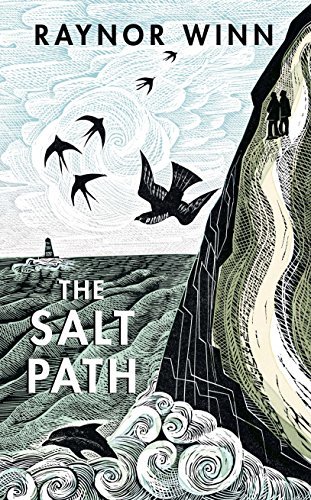
While my reading group’s main fare is fiction, we do include nonfiction in the mix. In fact, this year has been unusual as we’ve scheduled three nonfiction books – Richard Flanagan’s Question 7 (my review), Anna Funder’s Wifedom (my review), and, last month, Raynor Winn’s The salt path. I can’t recollect how The salt path came to be chosen, and nor could the 8 (of our 11) members who attended the meeting, but we weren’t about to complain.
Many of you will know this book already, given it became a bestseller after its publication in 2018. It was shortlisted for some major awards, and won the inaugural RSL Christopher Bland Prize (which I would call a “late bloomer” prize.) However, in case it escaped your notice, I will briefly summarise it. The book opens with two disasters befalling author Raynor and and her husband of 32 years, Moth. He is diagnosed with a rare, terminal degenerative disease called CBD (corticobasal degeneration) and, in an ultimately unjust court case, they lose their home which was also their livelihood. They have nothing but each other (and their two children who, fortunately, are young adults linving away from home). What do you do in a situation like this? You decide to walk England’s challenging 630-mile South West Coast Path, wild camping most of the way. That’s what.
Although it’s essentially a memoir, The salt path is better described as a road story that combines memoir, nature writing and social commentary. I would also argue that it’s a work of creative nonfiction, partly because of its strong narrative arc (albeit this is not uncommon in memoir and travel writing) but also because it includes dialogue (which, given there’s no evidence to the contrary, has presumably been recreated for the book). The result is a book which interweaves description, anecdote, personal reflection, social commentary and dialogue in a way that maintains our interest because it never bogs down in one mode or another. The balance Winn achieves is not only between these modes, but also in tone, which moves between serious and scared, melancholic and thoughtful, and light and humorous.
“you’ve felt the hand of nature … you’re salted” (woman on path)
I want to explore a little more how the combination of memoir and road story works to tell Winn’s story. Memoir, by definition, deals with a particular issue or time period in a person’s life. This gives the story a natural trajectory which conveys how that issue is handled or progresses – and/or what happens over that chosen time – until some sort of resolution or conclusion is reached. A road story has an even more obvious or natural narrative arc – the beginning of the trip, the middle with all the events and challenges met on the way, and the trip’s end (which may or may not be the originally intended one.)
So, in The salt path, the memoir, with its central issues being Moth’s illness and their homelessness, is framed by the road story, which describes the physical journey, that is, the landscape they walk through, and their experience of walking and wild camping. As in most road stories, we meet characters along the way, some positive or helpful, some amusing, and others negative or obstructive. And, as is also common in travel literature, we are introduced to issues that are relevant to the places travelled through. In this case they include conflicting ideas about heritage, conservation and the role of the National Trust in the communities and regions along the path.
There is, then, a lot to this book and while it works well as a coherent whole, some parts, of course, left a stronger impression than others. The strongest was their experience of the path, particularly given its recognised toughness combined with their impecunious state, inexpert preparation, and Moth’s ill-health. They were often hungry, wet and cold, and they walked at half the pace of Paddy Dillon whose guidebook they followed, but as time wore on Moth’s health improved. Why is a question never fully answered because they didn’t know why. Years later, he is still alive, still with the condition. Their strong interpersonal connection sustains them when little else does! And there is always the nature. This is Winn’s first book but she can clearly write. Her descriptions of the environment – the wildlife, the landscape, the vegetation, the sea – and of their feelings as they walk through it are perfect, like:
“A hidden land of weather and rock, remote and isolated. Unchanged through millennia yet constantly changed by the sea and the sky, a contradiction at the western edge. Unmoved by time or man, this ancient land was draining our strength and self-will, bending us to acceptance of the shaping elements.”
“The moon climbed into a clear sky, just past full, polishing the landscape in tones of grey and silver.”
After some time of walking the path, they start to look weathered – peeling skin, ragged clothes, and so on. It is around this time that they meet a woman who recognises the look. She tells them “you’ve felt the hand of nature … you’re salted”. Winn’s title is more than a literal description of a sea-swept path. It is also about being part of the nature, the life, they walk through.
From early in the book, however, another theme is introduced that threads through the book – homelessness. Obviously, it occupied Winn’s mind because they were suddenly homeless, but as the book progresses, she supplements their personal experience of being homeless with facts and figures. The facts are sobering, but they are made powerful by Raynor and Moth’s firsthand experience. For example, very quickly they became cautious about being honest about their circumstances, because it affected people’s attitudes to them:
“We could be homeless, having sold our home and put money in the bank, and be inspirational. Or we could be homeless, having lost our home and become penniless, and be social pariahs.”
All sorts of other thoughts and issues arise, as you would expect on a long walk. Another is the aformentioned issue of protecting heritage and the environment, and the role of the National Trust. Locals complain about National Trust restrictions affecting their traditional jobs, but she also sees all the money coming in from the resultant tourism and senses “a strong whiff of hypocrisy”. In an area dug up for clay-mines, she discusses the various approaches taken after the mines have gone. One is creating an attraction like the Eden Project. Returning the land to its original state seems the least likely option, because “no tourist is going to pay to walk over a meadow with a leaflet that says, ‘You’d never know it, but this used to be a mine.’” By contrast, there’s the town of Tyneham that had been requisitioned during World War Two, and where
Strangely enough, limited public access, a lack of intensive farming and the occasional blasting by small-arms fire has allowed wildlife and vegetation to thrive throughout the ranges. A form of khaki conservation that no one expected to be the outcome when the villagers left their homes as part of the war effort.
Of course, insights into the land – into the many ways it has been used, modified and re-used – are common to those who walk, and land-loving Raynor Winn is no exception. Her observations are idiosyncratic to her. Readers may not always agree, but she is real and honest.
There is much more to say, but I’ll conclude on the personal, because this is ultimately a personal journey as much as a physical one. Winn starts off, somewhat angry but mostly scared (very scared about her beloved Moth dying) and deeply worried about the future and whether they are doing the right thing. Slowly though, as Moth’s symptoms seem to subside, and as time passes, she senses change in herself
I was no longer striving, fighting to change the unchangeable, not clenching in anxiety at the life we’d been unable to hold on to, or angry at an authoritarian system too bureaucratic to see the truth. A new season had crept into me, a softer season of acceptance.
I don’t think it’s a spoiler to say that The salt path is a book about reality, not miracles but not tragedy either. Its interest lies in the particular situation this couple finds themselves in, in the path itself, and in Winn’s ability to write about it all with warmth, humour and honesty.
So, how did my reading group like it? Very much overall. Depending on our own experiences and perspectives, we varied in our reaction to the different decisions they took, but as lovers of the environment we all appreciated the description of the walk, and as lovers of “stories” we enjoyed the anecdotes about the people they met. Of course, we had questions, and there were little niggles – some didn’t always like the tone, and some couldn’t believe the couple’s poor preparation and apparent lack of sunscreen! But the discussion we had was excellent. So, a good book all round.
Brona also reviewed this book (nearer its publication!)
Raynor Winn
The salt path
Penguin, 2018
273pp
ASIN: B0793GXSBL
ISBN: 9781405937528
 Whispering Gums
I also really enjoyed this book. It is hard to forget. I still think of them. I have the sequel but not read it yet.
Thanks Pam … My American friend read it with her reading group a while ago and she still remembers it.
Yes, I still remember the fudge for breakfast, lunch, and dinner, the rationed ramen, and of course the forgotten sunscreen. I admired her thoughtful commentary about homelessness too.
Haha Carolyn, why am I not surprised about the fudge! That part of their diet was pretty amazing I must say but I guess it’s cheap energy! And yes, the homelessness discussion from
various angles was very interesting.
My book group also read with similar comments to your group. Their lack of preparation was astounding, but perhaps also understandable given the state they were both in at the start of the book as everything in their life seemed to fall apart at the same time.
I confess that I did not find the second book as interesting – it felt like more of the same, just a different walking track/adventure/misadventure.
Thanks for the link 🙂
Thanks Brona … yes, I wasn’t as astounded as some in the group because I could understand the stress they were under, and I guess when it comes to hats and sunburn the Brits may not be as aware as we are of the potential for serious repercussions. The thing that surprised me most – though I didn’t mention it in my post – was that they didn’t seem to do as much foraging as I thought they might. It was mentioned a couple of times, but not a lot. Maybe they were not walking through wild enough areas to find mushrooms, berries, edible greens etc so instead it was fudge and noodles.
Reading your review had me keen to lay my hands on the audiobook, ST …
Unhappily, Raynor’s reading voice isn’t one I could conceivably listen to for its duration.
No, I nearly mentioned that MR – sorry. The person in my reading group who least liked the book listened to it and didn’t like the voice at all. Such a shame.
A propos audiobook reading: my favourite British author of detective books is Peter Grainger, whose two (related) series are almost indescribably good. But it’s the narrator whose work pushes them even higher, a man called Gildart Jackson. In the most recent, <i>The Late Lord Thorpe</i> – a truly brilliant piece of detective fiction ! – is a wonderful side theme about the reading of audiobooks ! It’s absolutely delightful. 🙂
Oh that sounds like fun MR. I’ll try to remember that.
I really enjoyed this book (and I listened to the audio!). I think it raised interesting issues around homelessness and security for older people.
I haven’t read Raynor’s second book – might get to it one day, but in the meantime, I’m looking forward to seeing the movie version of Salt Path in a few weeks (it’s part of the British Film Festival).
Oh that’s interesting Kate re the audio. BUT yes, it did raise some issues about homelessness and security. I think those forest living people were an interesting aspect too – people being priced out of their own rural communities.
She covers a lot in a relatively short book.
Some of the most popular nature/travel stories in the US are ones in which the person has lost nearly everything, or thinks they have lost everything, and then they go on a long trek, typically by foot, and almost always ill-prepared and naively. I always wonder if this person feels so broken down internally that they’re trying to break down their body externally. To lose the fat of sitting and living in a place where we don’t encourage movement. Americans drive everywhere unless they live in a massive place like New York City. We’re so sedentary.
Thanks Melanie … that’s interesting … I haven’t read many American travel stories but now you mention it I’ve heard of some and your comment makes sense. I’m
guessing you mean books like Cheryl Strayed’s Wild?
Cheryl Strayed’s Wild, Bill Bryson’s A Walk in the Woods, Jon Krakauer’s Into the Wild
Thanks Melanie I didn’t know Bryson’ was in this style too.
I enjoyed the set-up, and your consideration of how the story is framed, but what really gave me a giggle was that none of you in your group could remember exactly how it was that you came up on the idea to select this book in the first place. I’ve had that very conversation myself. heheh
Thanks Marcie … glad I gave you a giggle!
I guess there were two reasons – the positive one being that the person wasn’t at the meeting, and the worrying one being that they were there but had forgotten!
HAH, good point! 🙂
My best friend and I have read all three of her books and got increasingly cross about Raynor’s lack of preparation with her walking boots! The second one is a bit disappointing but has interesting stuff about the writing and reception of this book and we enjoyed the third one again.
Wow Liz … I would have thought with the experience of this walk they’d have learnt the importance of preparation! But I’d be interested in reading about the writing and reception of this one.
Thank you for this wonderfully insightful review Sue. I’d never thought of it as a “road book” but that combination with memoir now makes so much sense.
I’ve since read both follow ups. The middle one didn’t wow me as much, I think because it didn’t have that momentum of the walk from A to B. Book three is much stronger though it will astound the people in your group who were frustrated by their lack of preparation. Despite all their experience she sets off on a gruelling walk wearing new books – of course that ends badly
Thanks Karen … I’m glad I offered something new to thinking about this book. A couple in my group had read the second – or started it – and had mixed feelings. I’ll tell them about book 3, but to be prepared.