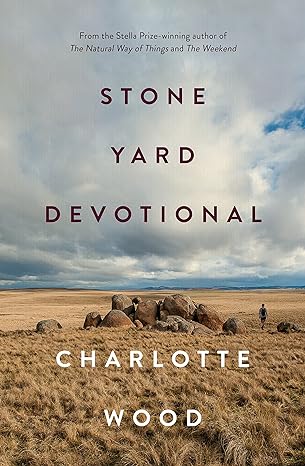
Charlotte Wood’s most recent novel, Stone Yard devotional, is set in the Monaro, a region just south of where I live. It’s a landscape that is much loved by many of us, including Nigel Featherstone, whose My heart is a little wild thing (my review) is also set there. The Monaro is expansive country, a dry, golden-brown plateau, characterised by rocky outcrops here and there, much as the cover shows. There are also hills in the distance, and big skies. Perfect country for contemplation, I’d say, which is exactly what Wood’s unnamed protagonist is doing there. (In fact, it’s also what Featherstone’s protagonist went there to do, for a very different reason – although, coincidentally, both books have something to do with mothers).
Stone Yard devotional is a quiet and warm-hearted read, one that asks its readers to not rush ahead looking for a plot, but to think about the deeper things that confront us all at one time or another. These things are hinted at by the two epigraphs, one being Australian musician Nick Cave’s “I felt chastened by the world”, and the other American writer Elizabeth Hardwick‘s “This is what I have decided to do with my life just now. I will do this work of transformed and even distorted memory and lead this life, the one I am leading today”. Add these to the title – with its hardscrabble sounding “Stone Yard” set against the gentle, inwardness of “devotional” – and you have a sense of the intensity to be found within.
“a place of industry, not recreation”
While this is not a plot-driven novel, there is a definite narrative arc. Taking the form of undated journal entries, the novel covers a period in the life of a middle-aged woman who has left her city life – her husband, her job in threatened species conservation, and her friends – to live in an abbey on the Monaro. It starts with a five-day stay, which is followed by more stays until the time comes when she arrives and doesn’t leave. Why she does this is not explicitly explained but through her contemplations we come to see that there’s unresolved grief in her life over the death of her parents some three decades earlier and, alongside this, a level of existential despair which has built up over time.
This is the set up. The narrative arc comes from three “visitations” to the abbey – a mouse plague which ramps up as the novel progresses, and the celebrity “environmental activist nun” Helen Parry, who accompanies the bones of the murdered Sister Jenny who had left the abbey decades ago to work among poor women in Thailand. These three events, both real and metaphoric in import, present practical and moral challenges, “a rupture” but also “a frisson of change”, for our narrator, and for all at the abbey.
So, we follow Wood’s narrator as she settles into life at the abbey, taking on the role of cooking for the group, and, as their non-religious member, the shopping and other errands that need to be done. Much industry is required to keep the place running when there is no financial help from the church, but the main industry is emotional and spiritual (in its wider meaning). Early on, our narrator recognises that prayer and contemplation “is the work … is the doing”. For her, as an atheist, this is not religious in origin or intent, but nonetheless contemplation is the real work she does while living at the abbey.
Much of this contemplation is invoked by flashbacks to and memories of events from the past, some experienced by her and others that happened around her (like the suicide of a farmer). Many involve her beloved and humane mother, who, like nuns Helen and Jenny, was an “unconventional”, determined to continue along her path despite what others thought. Such contemplation is hard, and our narrator is tested by the “visitations”, particularly Helen Parry with whom she has history involving bullying at school. Our narrator wishes to apologise but, as she comes to see, the hard work is in coming to that point of apology, not in having the apology accepted. But, forgiveness and atonement are only part of the bigger questions posed in this novel. Grief, despair and, ultimately, how to live are also part of its ambit – and are set against the shadow of climate change and its implications for our lives and choices.
This sort of exploration, however, can only work if we like the telling, and I found it thoroughly compelling. Stone Yard devotional is delicious for its details about life in an abbey on the “high, dry, Monaro plains, far from anywhere”, and for its insights into the women living there. No character is fully developed, but each, from the “business-like but soft-looking” leader Sister Simone to the distressed Sister Bonaventure, feels real in the role she’s been given in the narrative. While there’s not a lot of dialogue, our narrator reports on interactions between the women, and these contribute to her contemplations about life. She is not perfect and admits to moments of pettiness and poor judgement in her dealings with her co-habitants. Contrasting this little community is local farmer Richard Gittens, who supports the abbey in many practical ways and who represents, as our narrator recognises, “decency”.
All this is told in spare but expressive writing that maintains a tone which is serious and reflective, but which never becomes bleak.
There is no single, final enlightenment, but rather, as the narrator says earlier in the novel, “an incomplete, unhurried emergence of understanding, [a] sitting with questions that are sometimes never answered”. This is the sort of writing I love to read. In some fundamental way, it reminded me of my favourite Wallace Stegner quote. In Angle of repose, he wrote that “civilisations grow by agreements and accommodations and accretions, not by repudiations”. Through living this life in retreat, Wood’s narrator comes to know herself better. In so doing, she is able to lay some of her demons to rest, not through any major crisis but through quiet contemplation. The abbey does, indeed, turn out to be a “place of refuge, of steadiness. Not agitation”.
Interestingly, and perhaps pointedly, the novel ends on an anecdote about the narrator’s mother and her “reverence for the earth itself”. Ultimately, Wood invites us, without exhortation, to not be “chastened by the world” but to do the hard work of thinking about what is really important. A compassionate, and gently provocative, book.
Kimbofo (Reading Matters) also liked this book.
Charlotte Wood
Stone Yard devotional
Crows Nest: Allen & Unwin, 2023
297pp.
ISBN: 9781761069499
 Whispering Gums
You have to be the best reviewer around, ST: you can make a book seem exactly what I want to read when in fact it isn’t my jam at all !
Oh I hate it when my comments don’t “take”, MR. Yours was the first I replied to but I don’t see it here. (It’s the WP app on the phone that seems to be the problem.) Anyhow, I was thrilled with your comment. Thanks so much. I take it as a great compliment that I managed to make a book that you don’t think is for you sound interesting.
I enjoyed this book and always admire how Wood writes very different stories each time, yet maintains her distinct style.
Yes exactly Kate… She’s one of that rare band isn’t she, who can turn her hand to quite different forms and do it well each time.
I had the same response to this lovely book. which I approached reluctantly, expecting, like MR that it would not be my jam at all.
Oh thinks Desley. Was it the title that made you reluctant or just the whole idea of a retreat? Or? I was drawn to it immediately, partly because of the setting of course, but also because of Wood and the subject matter which intrigues me.
You can add me to the list of readers who tentatively waded in, thinking it wouldn’t be my thing at all, and who emerged with a completely different mindset about the book. I loved it so much. I think it’s Wood’s best work. And this is one of your best reviews Sue – so good!
Oh thanks Michelle… I tweaked it over a few days so I’m glad it was worth the tweaking… There’s so much to say about it but I didn’t want to ramble. It is a beautiful book isn’t it? I’m intrigued by all the hesitancy but am glad you, Desley and others overcame it sbd found it worth you while!
I was more middle of the road on this book. There are so many books out there about grief, especially with mothers. I have my own as many of us do. I did like the writing but the story just didn’t do it though I found the contrast between the ‘three visitors’ interesting. Such different challenges.
Thanks Pam… I think this was very different about grief, not like much else I’ve read, and about so much more as well. But, each to their own, eh?
You are right about different challenges… The mice!!
Thanks for linking to my review, Sue. Yours is excellent. So glad you enjoyed the novel. If you haven’t read The Submerged Cathedral then that’s the next Charlotte Wood I would r commend reading. There’s certainly echoes of it in Stone Yard Devotional…
Yes, I saw your reference to that kimbofo, and have noted it because I haven’t read it and am now intrigued.
Dear Sue
Thank you for this review. You have given me a gift – as did the book itself. You’ ll remember in our text discussion that I found it meditative, engrossing and beautiful.
As always you’ve done the hard work for me of analysing and articulating why I might have found it that way.
You have really hit the nail on the head in a review that is itself, beautifully written. Your love of the prose shines through when you describe “ the telling “.
Heartfelt thanks
Paula. Xxx
Thanks so much Paula, I’m really glad that what I’ve written makes sense to you. It took me a few days of sitting with my draft, and tweaking it to get to what I wanted to say without writing a treatise!
Don’t look for a plot: fine advice for so many of my favourite books!
Absolutely agree Marcie … but so many do, don’t they?
Hi Sue, I waited to finish Stone Yard Devotional before reading your review and had much the same response to the book. Being staunchly post-Catholic (and the product of a convent school education) I wasn’t sure how much the subject matter would grab me, but it did, and the writing is utterly absorbing.
I have the honour of interviewing Charlotte at Mildura Writers Festival later this month and I will be joking with her about her first foray into horror fiction – which was my reaction to the mouse plague scenes! Seriously, though, I think the reason the book has not (so far) sparked nightmares on this front is because it stirred deeper emotions in me than fear.
Haha Angela re horror fiction! The mouse plague scenes were visceral weren’t they, though they weren’t so much for my friends who grew up on farms!
I didn’t grow up Catholic but I have many friends who did. Their childhood experiences were so different to mine, and I thought about them a lot as I was reading. She doesn’t really delve into it a lot but you can feel that experience in the background. I’ve been picking up the book on and off over the last few days and loving whatever page I’ve opened it on. I don’t really want to put out on the shelves.
Carrying the novel around like a prayerbook, perhaps… 😉
Good one Angela! I can tell you are a writer. But strangely it does have a calming feel every time I look at it (notwithstanding the mice.)
I don’t necessarily need a plot, but I need to feel some kind of predictable rhythm, like the cycles of the moon. If I don’t get the sense that something is building, something has peaked, something is wanning, and the end is near, then I feel restless with a book and feel I have little reason for finishing it. Kurt Vonnegut famously said that every character has to have something they want, even if it’s a glass of water, and I think that captures it for me.
Then I think this book satisfies your need Melanie. There is a rhythm, and it surrounds the visitations – the mice increase in number and it gets to crisis point. Sister Jenny’s remains must be buried but when will permission come? Sister Helen behaves remotely and our narrator is uncomfortable about their past. Will it be resolved? Our main character does want something though it’s not simple as it’s to do with loss of hope/ despair.
I’m going to try to remember that Vonnegut quote. My reading group is going to read a Vonnegut this year.
Breakfast of Champions is my favorite.
I’ll remember that. We have decided people can choose to read Slaughterhouse 5 or Cat’s cradle, just because these were the two most recommended and we couldn’t decide. I’ve read the latter, but a long time ago. I’ll probably read Slaughterhouse 5 but I will remember your recommendation.
Love your reference to Wallace Stenger in this review, which definitely piques my interest. Is this the same Charlotte Wood who wrote The Weekend? I remember reading some very positive reviews of that novel, and it was a hit in the bookshop, too.
Yes, Jacqui, the same one. Her last three novels have been very different in style and tone, but there is one thing that links them – each deals with a group of women.
I’m glad the Stegner quote works for you. It’s one of my favourite quotes.
I haven’t really got on with Woods’ fiction in the past, but you do make this one sound very appealing Sue.
That’s a great placement of a Stegner quote too.
Interesting Brona … I find her really interesting. I’ve only read her most recent three novels (including this one) and I’d say that it is different enough from the previous two to say I wouldn’t take those as a guide to whether you’d like this one. But I guess it’s why you don’t warm to her writing. That aspect might still be there but on the surface I’d say give it a go if you get time opportunity.
Love your review… I also loved this book. I think at first I was so surprised by the book, as I had expectations, based on the back cover, but they were not what I found in the pages between and, what I found was so rich. I found many parts of the book, quite light and funny and instantly I wanted to share the book with my sister. Though as I got to the end I did want to understand more about why she had made the choices she did… anyway my review is here:
https://yarrabookclub.wordpress.com/2024/09/24/stone-yard-devotional-charlotte-wood/
Nice to hear from you Rach … it’s a book that really makes you think, isn’t it, and that does leave you with questions but ones that I sometimes like to be left with. I’ll check your review.
I found this book because it was a Booker Prize finalist and said, “Australian nuns? I’m all in.” Well, I have finished it, and it wasn’t the book for me. But your review made it very clear that this book is for someone–many someones–whose experience is analogous to the narrator’s. The language is both spare and rich simultaneously, and that plus the seemingly random placement of thoughts and flashbacks made me read to the end to see what, if any, conflict would emerge. I expected some dramatic secret about Jenny’s past or Helen’s would somehow dovetail with the narrator’s in a surprising way. Well, that doesn’t really happen, and the ending oddly enough made me wanting more even as I realized I didn’t actually love the book. But thank you for describing your joy in reading it. Every book is for someone, and no book is for everyone, I always say.
I’m sorry I’ve take a while to reply Carl. I’ve been on the road, and haven’t checked my spam folder where your comment was incorrectly sent by the blogging software. It should have gone into my “for moderation” folder which is where new valid comments go. I see nothing about your email address or comment that implies anything other than that yours was a valid comment.
I really appreciate your thoughtful response to my post, that you took the time to explain what was missing for you. I think because it is not a dramatic plot-driven book, it relies more on what readers look for in their reading, and perhaps a bit more on where readers are at personally when they are reading it. It’s hard for me to explain now, given quite a bit of time has past, but it just mesmerised me. While I wouldn’t say exactly that my experience is analogous to the narrator’s, I think I understood where she might have been coming from, her need to just escape into quietness and how complex that quietness can be because it never is, probably, fully quiet?
No worries. My next book after this one was the actual winner, “Flesh.” To say that I hated it would be a slight exaggeration, but how anyone thought that such a formless pointless novel was better than the introspective work done in Stone Yard Devotional is beyond me. I haven’t read, nor am I likely to, any of the other shortlisted books this year. I hope as an Australian you’ve read Peter Carey’s Jack Maggs, a rather wicked reimagining of Great Expectations from Magwitch’s point of view–sort of. More fun than Barbara Kingsolver’s rather labored (although very good) novel also inspired by Dickens– Demon Copperhead. I had more fun than Kingsolver writing two cozy mysteries ten years ago inspired by Dickens novels–The Christmas Carol Murders and The Edwin Drood Murders, both under a nom de plume, Christopher Lord. I could have written thirteen or more additional ones, but the market wasn’t clamoring for the books I wanted to write, so I stopped beating my head against that wall and now lead seminars on 19th century British and American novels for an Oregon non profit Literary Arts organizati
Oh I love all this Carl. And I have a good Californian friend who was born in Portland. It’s a lovely city.
And yes, I’ve read both Jack Maggs and Demon Copperhead. I loved Jack Maggs but it’s been a long time. Not every one does but i like Carey and I liked it. Demon Copperhead was my reading group’s top book in 2024, but while I did like it, it wasn’t one of my top three that year – we each choose three. One of mine was Stone Yard devotional! I haven’t read Flesh. Sounds like that was a reasonable decision.
Good on you for trying your hand at cosy mysteries. I’m not really a reader of that genre though have read the odd book. I tend not to read mysteries mainly because of the time I have for reading! Too little!