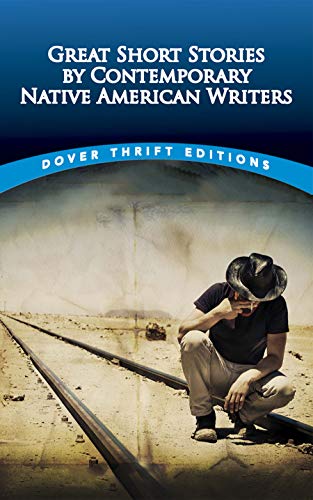
Eli Funaro’s “The dog pit” is the twelfth of fourteen stories in the anthology, Great short stories by contemporary Native American writers. Like the previous stories by Thomas King and Duane Niatum, it was written in the 1990s.
Eli Funaro
Anthology editor Bob Blaisdell provides very little information about Funaro, and I have to say that I have very little more to add. Blaisdell says that he “seems to hail from Minnesota, where he is a video director” and that his “plain-spoken and shocking story was written for a program at the Institute of American Indian Arts at Santa Fe”. That’s it.
All I’ve found is that someone called Eli Funaro – presumably the same one – is part of a media company called A Tribe Called Geek, which describes itself as
an award-winning media platform for Indigenous Geek Culture and Stem. But we are more than just a media platform. We are a community of intelligent, imaginative, innovative and creative Indigenerds acknowledging and advancing the visibility of our contributions to pop culture and STEM. From indigenous superheroes to Harry Potter and more, our podcasts, website and social media are a celebration of Indigenous Representation and Geekery.
When I tried to enter the “A Tribe Called Geek” website, I got one of those “Not Secure” warnings. While it’s probably OK to proceed, I’m not prepared to take the risk.
So, all I have is a list of 35 articles by Eli Funaro at a site called Muck Rack. Clicking on the articles takes me to that website with its “not secure” warning, and to find out more about Funaro at Muck Rack I have to join, which I’m not going to do. Funaro is not in Wikipedia, and nor is A Tribe Called Geek, but Muck Rack is. It’s a software program that “connects public relation offices and journalist listing on social media”.
What all this says to me is that Funaro seems to be more a journalist than a writer of fiction, and that his affiliation and ongoing interest is Indigenous. His articles – some of which are dated “three months ago” – seem to be mostly reviews, such as of the Wolverine movie, and of Marvel comics. The list provides a brief summary, or the opening sentence, and it’s clear that most reference “Indigenous” issues. For example, on Marvel’s Echo comics, Funaro writes that “of all the Indigenous Heroes appearing in the Marvel Universe, Echo stands out as one of the more unique comic book characters”. Echo – or Maya Lopez – is a Cheyenne woman.
“The dog pit”
“The dog pit” is one of the shortest stories in the anthology. It is told first person in the voice of an eight-year old boy who lives on the “rez” – reservation – where, he tells us, “no garbage trucks … came to pick up your trash”, the implication being that other people had this service. So, Saturday is Garbage Day, and our narrator and his dad’s job is to haul their garbage to the dump.
The story opens with “It was a sunny Saturday, the day that dog died”. A few paragraphs in we are introduced to our boy’s dog Corky, for which his father seems to have little time. “You fed that mutt yesterday” he says, when the boy wants to feed his dog before they head off. But soon they are on their way, along “untitled roads”. Another indication of their second-class status.
The boy finds a pink ball in the glove-box and starts playing with it. However, when his father, having told him he can have it, also tells him he’d taken it from a dead man at the hospital where he works as a janitor, the boy is not so sure he wants it. His father, we are learning, is a practical man. Life is tough and he doesn’t have time for sentiment.
So they get to the dump, with its piles of burning trash and rancid smell, empty their bins, and go through their routine of bleaching their bins before they leave for home. While this is happening, the boy picks up the ball again, only to be told by his dad that the old man who had died holding the ball had probably not been the only person to have died holding it. This makes him anxious; he fears there will be many dead people angry with him if he keeps the ball.
Then we get to the death of the dog mentioned in the opening sentence. It involves the titular dog pit, and is cruel. The boy doesn’t know what to make of it, but doesn’t want his dog to end up there. HIs father, who might be practical, is not hard and says this wouldn’t have to happen. The story concludes with the boy creating his own stories about death with his new Zartan and Stormshadow toys, but also on a sense of a childish ability to put it aside. This is where I come a bit unstuck, because a point is being made in referencing these GI Joe-series figures, but there are cultural nuances that I am not fully across.
On the surface, “The dog pit” is a story about the innocence-versus-experience aspect of youth, on the gradual way we become aware of the darker side of life without taking it all in at once, but there are deeper socioeconomic and sociocultural issues being explored here, ones that Funaro seems to have continued to explore.
It’s not a perfect story. The language doesn’t always stay true to an eight-year-old’s voice, but this is probably the work of a young writer. It works overall, however, because it’s tightly told.
Eli Funaro
“The dog pit” (orig. pub. 1994)
in Bob Blaisdell (ed.), Great short stories by contemporary Native American writers
Garden City: Dover Publications, 2014
pp. 95-99
ISBN: 9780486490953
 Whispering Gums
Well the title put me off–but after reading te review, there is NO WAY I’d read this
I thought of you Guy when I was reading and writing this… The dog pit part is not pleasant. You would not want to read it as you’ve worked out.
That little story sure packed a punch. I liked it a lot and got curious about this Eli Funaro. I couldn’t get into the tribe called geek website either, but found a documentary he did about language and cultural programs for the Dakota tribe and also the Instagram and Facebook sites for The tribe called geek.
Thanks Carolyn… I was hoping you’d comment. I did see the Facebook and Instagram pages for them but didn’t find it enlightening in terms of him, and they all link to that site which I’m sure would be ok to visit but we need to be cautious don’t we?I didn’t find that documentary – perhaps my location results in different search results? That would be interesting.
You’re unenthusiastic about this, ST: why did you bother ?
Oh no, I didn’t mean to sound unenthusiastic MR. It’s not my favourite story in the book, but I found it intriguing, and I’m sorry if I’ve not conveyed that. I’d love to understand more about where the author is coming from in terms of the dogs and death, the action figures – and Indigenous culture. There’s something here about the boy living on a reservation where they are disadvantaged though not in poverty (as his father has a job and can buy him toys) and his fascination with GI Joe figures.
The boy’s dog is loved, Pam, but there is a sad dog story too. And yes, I’d love to know more about the author.
I googled around for this guy and his affiliate groups and was able to find https://atcgbooksandcomics.com/pages/about-1
This is an online comic book store that I think is affiliated with your author. They used to have a brick-and-mortar store, but it closed. There is also a comic book called Indiginerds that should be published in August 2024.
Thanks very much Melanie. I hoped you might take interest. I saw that they refer to themselves as Indiginerds. Love it.
PS I’ve just noticed that ATCG… sells that graphic novel version of Borders.
Yes! I saw that and thought of you because you just reviewed that book!
Love that.
In general I don’t like kids’ voices for stories, but I can see that it is a way into describing this situation. Do you think Funaro is describing a slice of his childhood, or childhoods he has observed, or is he trying to say, to tell us white guys, something about First Nations life?
Thanks Bill, I’m glad you can see some value in these voices. My guess is that he’s speaking from some experience, but how much is hard to say. He certainly wants to make a point about First Nations life. Wish I knew more about him but it’s his right to be private isn’t it?