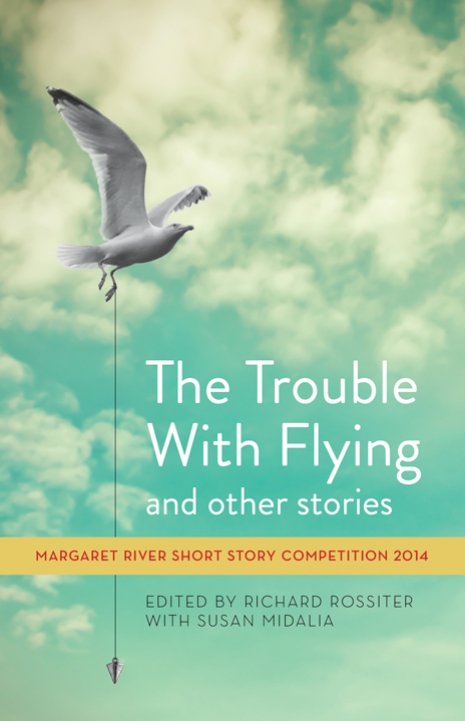
Courtesy: Margaret River Press
The trouble with flying and other stories is the second collection I’ve read from the Margaret River Short Story Competition. I greatly enjoyed last year’s collection, Knitting and other stories, so was very happy to read this one. I’m pleased to see Margaret Press maintain its commitment to publishing stories from the competition, and hope that annual publication will help both the competition and the press, itself.
There were apparently 218 entries for the 2014 competition, which is somewhat fewer than last year’s 260 entries. Stories came from every state in Australia, as well as one from New Zealand. They include both new and experienced writers, many of whom have won awards and/or been published in some of Australia’s best literary journals. I was pleased to see that four of the 24 writers included in this volume, appeared in last year’s collection.
Last year, 20 of the 24 stories were by women, and the trend continues this year with 21 being by women. Presumably this roughly reflects the gender ratio of the overall entries. I wonder why this is? Is writing short stories something women who want to write feel they can juggle more easily with other responsibilities? Or? I’d love to know whether this is a common pattern, and why it might be.
Finally, before I get to the stories, I should say that of course the collection includes the winner, runner-up, and five highly commendeds, as well as the winner and two highly commendeds in the special award for writers from the South West (where Margaret River is located). They didn’t all accord with my favourites, but that’s the subjectivity of reading isn’t it?
Like last year’s collection, the title comes from winning story, Ruth Wyer’s “The trouble with flying”. In the bios, we are told that Wyer is “a fledgling writer from south-west Sydney”. Fledgling she may be, but she has a delightful way with words. It’s a story about transitions, about Rita, an unconfident young girl, moving from high school to TAFE. Intriguingly, Rita doesn’t appear until a few paragraphs in, which disconcerts the reader somewhat as to who this story is about. It is in fact quite an unsettling story, combining humour with pathos and a sense at the end that Rita may not break free of “the loosely bound fog” that she feels envelops her. Flying, in other words, is not easy. It’s a bit cute to say, I suppose, but in many of the stories the characters struggle to fly, to escape the concerns that mire them – and, in fact, some don’t.
One who doesn’t is the immigrant mother in Linda Brucesmith’s “A bedtime story”. Ridiculed by her husband one too many times, she leaves the house after midnight. Another mother in trouble is Annika in Cassie Hamer’s “A life in her hands”. Overwhelmed by a colicky baby – and oh, how I related to that – she decides that “escaping together would make them both much happier”. So, like the mother in “A bedtime story”, she heads to the sea. There, the kindness of one young man and the near tragedy of another shocks her to her senses and she feels “the euphoria of a lucky escape, a second chance”. Life for some, we realise, can often hang on little chances that determine the decisions we make.
A mother of a different kind is Tara in Lauren Foley’s entertainingly titled “Squiggly arse crack”. This is a bright, breezy story about an older single mother enjoying her “staycation”, that is, a brief shopping expedition away from her beloved child, Squig. To ensure she doesn’t change her mind about leaving him with her friend, she “sashays” out the front door without looking back, “pretending her neck is in an Elizabethan collar or pet lampshade”.
This is just one of the stories that departs from the resigned or melancholic tone that seems to be more common in short stories. Another upbeat story is Chinese-born Australian writer Isabelle Li’s “Red Saffron” about a feisty woman prepared to go after love. No shrinking violet, she. Announcing at the beginning of the story that
If poetry is language making love, then cooking must be food making love
she tells us that she’s cooking for Walter. She’s a poet and editor of a poetry magazine, and her aim is to seduce fellow poet Walter while her current lover, Richard, is away. This is a woman in charge of her destiny:
I know how sweet I am, in men’s eyes that follow my movements. I look younger than my age, with my dense hair and lustrous skin. I know they want to taste me on their tongue. But they are wrong: I’m no honeysuckle.
Glen Hunting’s Martha in “Martha and the Lesters” is spirited too. The story is told by Martha’s lodger, who is – no, not Lester. The Lesters are the spiders which proliferate in elderly Martha’s rather untidy home. Our narrator Roland, for that’s his name, describes the Lesters going about the business of life – reproducing, eating, sometimes other insects, sometimes each other. They play a complex role in the story. Martha feels blessed by their presence, and yet, as we see, their lives represent “gluttony and violence writ small”. Perhaps that’s the point. Unlike Martha’s children, they accept her, don’t judge her, and don’t pretend to be other than they are!
Continuing in the vein of positive stories is Kate Rotterham’s “Potholes” about a rather curmudgeonly, recently retired husband and father, Les, “who was surprisingly confident in diagnosing a range of mental disorders” in those around him, but who, delightfully, does a complete about-face at the end.
There are, though, some devastating stories such as Bindy Pritchard’s second-prize winner “Dying” about a rural mother with terminal cancer, and Leslie Thiele’s portrait of a man with dementia in “Catching trains to Frankston”. The challenge of ageing, in fact, appears several times in the collection. I enjoyed Kathy George’s story, “Walking the dog”, about a lonely old widower who, like Martha in Hunting’s story, is confronting the limits of his independence.
Not surprisingly, the collection encompasses many concerns currently facing Australians, with issues like ageing, cancer and fire appearing in several stories. Indigenous issues and our multicultural make-up also appear, albeit way less frequently, reflecting I’m guessing the backgrounds of the writers. It would be good to see more diversity here – but that is another discussion methinks.
And now for the apology. I would love to comment on every story in this collection, not only because each has something to offer but because I know writers (like all of us) love feedback. I can imagine, if I were a writer, coming to a review like this wondering whether my story would be featured. All I can say is that many of the stories, besides those I’ve chosen to write about here, touched me. I’m sorry I couldn’t mention them all.
“Practise senseless acts of beauty” is one of the instructions Harry (“Potholes”) reads in Ten Ways to a Happier Life. I’m so glad the writers in this volume had a go at their own “acts of beauty”. They’ve given me much to ponder.
Richard Rossiter, with Susan Midalia (Eds)
The trouble with flying and other stories: Margaret River Short Story Competition 2014
Witchcliffe: Margaret River Press, 2014
348pp.
ISBN: 9780987561527
(Review copy supplied by Margaret River Press)
 Whispering Gums