Shelley Burr, Vanish (#BookReview)

With Vanish, the third novel in her Lane Holland series, Burr mixes it up yet again, which appeals to me because my main reason for not liking genre fiction is that it can be formulaic. I know this is why many like it, and I understand that need for comforting reading. It’s just not my need.

So, a brief recap. In Wake (my review), we are introduced to a private investigator, Lane Holland, who arrives in a remote, outback, fictional town to investigate an old missing persons case. He’s keen and caring, but he also has his own agenda – and the resolution is shocking. The next book, Ripper aka Murder town (my review), is set in a different country town. It initially looked like something different, as Lane is in prison from Wake‘s fallout, but it soon becomes a dual investigation story that coalesces when it turns into both a murder and a missing persons case.

And now, book 3. It seems you really can’t keep a good PI down, even if he is in prison! Vanish is set a few years later. Lane is still in prison but, because of prison governor Carver’s vested interest, he soon manages to get himself on a pre-parole release program in order to continue the unsolved investigation from Ripper. If you’ve read Ripper you’ll know what that is, and if you haven’t, it becomes clear very soon. My point, though, is that once again Burr has produced a highly readable crime novel that manages to be a bit different from the preceding book, while retaining enough familiarity for those invested in her characters and worldview. It’s a fine balance that Burr has trodden nicely.

Like its predecessors, Vanish belongs to the rural noir sub-genre, and is consequently, noir-ish – or Australian Gothic – in tone. It features characters we have met in the previous novels, including Lane Holland, his sister Lynnie, and his first client Mina McCreery. Further, its plot centres again on a missing person. In Vanish, however, there’s more than one missing person. A serial missing persons case!

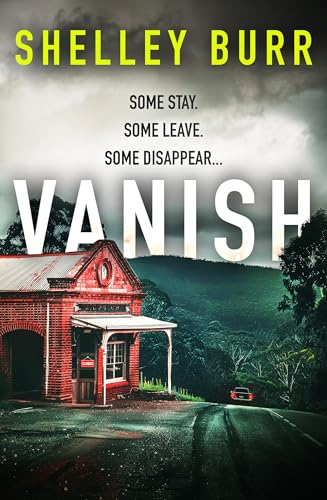
Some stay. Some leave. Some disappear.

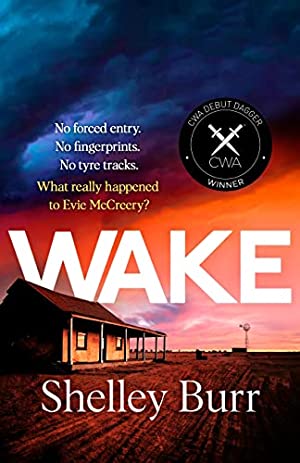
“Some stay. Some leave. Some disappear” appears above the title in the book’s first Australian edition (as you can see in the cover pic above). What it references is the main setting of the novel – a farm near Hume Weir, southeast of Albury, an area Burr knows well. At the novel’s opening, Lane has tracked down several missing people as having visited this farm, then disappearing from view – hence the tag line. What is this farm, and why have some people disappeared? Lane wants to find out and Carver, with his daughter still missing, is happy to help him do so.

Consequently, with ankle bracelet, a prison guard minder, and an agreement for him to work at the farm, Lane arrives – but not without a mysterious-sounding death having just happened on the road in. This, of course, captures Lane’s attention – and we’re off.

Now Lane is, of course, your suspicious type. He takes nothing at face value, and he closely observes all that’s going on around him. There’s something about this farm that doesn’t feel right. Is it a community of like-minded people who want to escape their old lives and live more simply, growing their own food and reducing their energy impact on the world? Or is it a cult? How genuine is the owner Sam Karpathy, not to mention his recently deceased father? What do the people in the nearby township know, and why do they seem evasive when Lane tries to find out? And, why is a certain person from a previous novel there too?

Oh, and who is the trapped, sick, or injured person whose story is told in short italicised sections interspersed with the main narrative? (It added to the intrigue, and I didn’t guess it at all.)

As in her previous novel, Burr’s builds her crime story around wider issues. In Ripper for example it was “dark tourism”. Here, it is the idea of people wishing to live eco-minded, sustainable lives. So, as the investigation progresses, Burr also interrogates what this sort of life means in terms of whether or not you compromise and why, whether you stockpile for an end-of-world scenario, whether you eschew western medicine, and so on. These are questions Lane considers as he tries to understand the community he is living in. And it starts with the controlling Karpathy.

Lane, as he needs to be, is a trustworthy narrator for us. The novel is told third person, through his eyes, and he brings us along with him, sharing his thoughts and explaining his processes. His awareness of body language and his experience of human behaviour guide his actions. I loved those details. There’s risk and tension, some creeping around the farm at night, a locked room, magic mushrooms, and more. I didn’t find it edge-of-the-seat suspenseful, but I don’t like that anyhow, so the level of stress was just about right for me. The plot builds slowly, sending us off in various directions, and keeping us uncertain as we consider what Lane sees and questions. Is Karpathy, for example, coercive or simply wanting to keep control of a dream he is vested in. The denouement, when it comes, unfolds quickly, and at just the right time.

I enjoyed the read. I have been invested in Lane from the beginning, and he continued to interest me in this book. He’s conscientious, intelligent and decent, but, appealingly, is not always sure of himself, particularly when it comes to relationships. Also, Burr evokes place well. The farm, which is set in mountains just far enough from a little town to feel isolated, feels believable, as do the natural disasters – flood and bushfire – which threaten it.

My only question now is, will we see more of Lane? As a convicted felon he will not be able to renew his investigator licence. There is a hint at the end that there might be a way around it. Time will tell, but if you are a Lane Holland fan, I think you can have hope.

Shelley Burr
Vanish
Sydney: Hachette Australia, 2023
384pp.
ISBN: 9780733652158

(Review copy – an uncorrected book proof, hence no quotes – courtesy Hachette Australia)
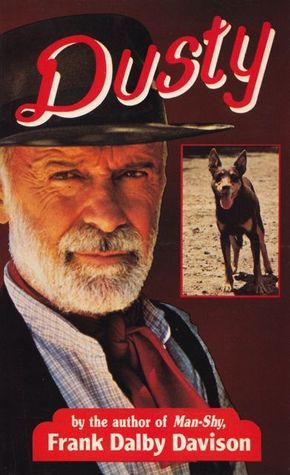
Frank Dalby Davison, Dusty (#BookReview)

It’s a strange coincidence that my second review for Bill’s Gen 1-3 Aussie male writers week is for a novel titled Dusty, when my first was for a short story titled “Dust”. One of those funny little readerly synchronicities. The title, however, is about the only synchronicity because, although both stories allude to the dusty Australian landscape, Casey’s short story is about miners’ lung dust disease while Davison’s novel is about a part-kelpie part-dingo named Dusty.

A bit about Frank Dalby Davison

Davison (1893-1970) was best known as a novelist and short story writer, and was a significant figure in Australian literary circles of his time. There are useful articles for him in Wikipedia, and the Australian dictionary of biography, and I plan to devote a Monday Musings to him soon. Meanwhile, as background to this post, it’s relevant to say that he was born and schooled in Melbourne, but left school in his early teens to work on his father’s farm near Kinglake. The family moved to the United States in 1909, when he was 16. After working there in the printing trade, he travelled more, eventually enlisting for World War 1 in England. After the war, he took up a Soldier Settlement selection near Injune, in central western Queensland. 

Davison wrote several novels, but his best known is probably Man-shy (1931), which won the Australian Literature Society Gold Medal. Featuring a red heifer, it was my introduction to Davison in my first year of high school in the 1960s. Dusty (1946) is also about an animal – this time a dog – and has been in my sights for some time. Both novels drew on his experiences in Injune. AustLit reports that the manuscript of Dusty, ‘entered under the title “Stranger”, and the pen-name “Tarboy”, won the Melbourne Argus and Australasian Post 500 pound Novel Competition in 1946′. 

Dusty

At the end of my edition of Dusty is a promotion for Man-shy which quotes from H.M. Green, the literary historian who inspired Bill’s “generations”. Green writes:

Although other novelists have made animals their principal characters and drawn them realistically, Davison is the first to make a serious attempt to get inside their minds. The red heifer and the mob of wild cattle to which she belongs stand for the spirit of freedom and dogged, untameable resistance; their struggle is made extraordinarily real to us … Davison has a genuine and individual talent.

This could equally apply to Dusty, which tells the story of a dog, sired by a kelpie to a dingo mother. Violently wrenched from his lair when he was a few weeks old, he is sold to a decent man, a bushman named Tom. Tom is no fool. He recognises the mixed blood, but also sees potential in the pup, and trains him to become a champion sheep dog. Their bond is strong but is tested when Dusty’s “dingo blood” starts asserting itself, and he turns sheep-killer by night. This will not do, and Tom knows it. The novel, however, does not play out quite the way you’d expect, and we are left guessing until the end about what will, indeed, happen to Dusty.

That’s the plot, but like many plots it doesn’t tell you much about what the book is really about, or what makes it a good read. Told in three parts, Dusty is a realist novel, detailing life on Australian sheep stations and cattle properties, and told mostly through the perspectives of Tom and Dusty. Yes, you heard right, Dusty, the dog. I was completely engaged because not only is there none of the sentimentality common in stories about a man and a dog, but there’s also nothing anthropomorphic in the dog’s point-of-view. He feels pure dog, which I thought quite a feat. Early on, for example, Tom, having previously given Dusty his dinner without ceremony, puts the food down and starts some training:

Then followed a series of mystifying events. A hand appeared just above the dish and twitched, giving forth a series of soft snapping sounds; then there was a little soft whispering, and then a voice that, like the hand, kept repeating a small noise over and over again. He could make nothing of it …

This dog’s-eye view of the world, based on his experiences to date, continues through the novel.

Soon, though, bigger issues are at play involving the two parts of Dusty’s being, “the ancient battle between conflicting heredities, and between early influence and present environment; the mother against the father, nature against art”. Then Davison adds something interesting. The dingo is the product of nature, while the kelpie, the working dog, is “a product of art”. But, Davison adds, “nature, if man fails in toil or vigilance, hastens to reclaim her own”.

In other words, beneath this deeply interesting story about a man, his dog and outback farming, is a wider story about “nature”, or the essence of our beings. Contained within Dusty is the struggle between the two forces – that of freedom, of following his instinct, and that of living by his training, by rules and responsibilities. After Dusty’s dingo side becomes apparent to all, Tom knows what must be done but chooses to change his life rather than kill his dog. He becomes a self-employed possum scalper in cattle country, and finds, “without meaning any ingratitude for past kindnesses”, that he relishes his new situation in which he is invited to share a meal as “a guest and not just the hired man”. In other words, as a possum scalper, Tom is freer to be his own man.

But, while I think Tom’s life is part of this wider theme, the main focus is animals, and the idea that, in them, “is a whole scheme of values outside those familiar” to us.

There is no easy ending for Tom and Dusty, and we are left, three paragraphs from the end, with a dingo howl, “a cry of mournfulness and dark mirth, of drollery and love and hate and longing, of the joy and sorrow of life, of the will to live, of mockery and despair”.

Dusty is not a didactic book. There is no moralising, no subjective pronouncements about choices. Instead, with its objective tone, and plain but expressive prose, it feels more elemental, something that examines the essence of who we are and what we do to live. And that makes it feel timeless.

Frank Dalby Davison
Dusty
Sydney: Angus & Robertson, 1983 (Arkon ed., orig. 1946)
244pp.
ISBN: 0207133891


Shelley Burr, Wake (#BookReview)

Regular readers here will know a few things about me. One is that I don’t regularly read crime, and another is that for three years, before the pandemic struck, I was the litblogging mentor for an ACT Writers Centre program. One of the last two participants in that program was Shelley Burr, author of the just-published crime novel Wake.

In my post on that 2019 program, I introduced Shelley as follows:

Shelley Burr is working on a novel, and took part in the ACT Writers Centre’s well-regarded Hard Copy program last year … She is particularly interested in what she calls “drought noir”, which term sounds perfect for some of the crime coming out of Australia at present. Shelley has had her writing place well in the Stockholm Writers Festival First Pages program.

That novel she was writing was Wake. It won the CWA Debut Dagger in 2019. It was also shortlisted for the 2019 Kill Your Darlings Unpublished Manuscript Award, which gave her a Varuna fellowship, and the 2020 Bath Novel Awards, which is an international award for emerging writers. Judge for the Bath award, literary agent Jenny Savill, wrote of Wake:

With forensic attention to detail, the reader is effortlessly drawn into the small town, rural Australian setting and a community in mourning. Immersive and riveting.

Savill was right on all fronts. Burr’s attention to detail is forensic, and readers (even non-crime readers like me) are “effortlessly drawn in”. I was thoroughly engaged from the opening pages, and this is because, besides being a crime novel, it’s a novel about character, and what happens to people when terrible things happen to them. How do people respond, and why do different people respond differently? It confronts readers to think about our own responses. How would we respond if it happened to us? And, how would, or do, we respond when it happens to others?

Wake is about a cold-case that took place on a remote farm some twenty years before the novel opens. Nine-year-old Evelyn (Evie) McCreery disappeared from her bed one night, never to be seen again. This means the novel alludes to a longstanding Australian writing tradition, that concerning the lost child. However, this motif has layers of cultural complexity that are not central to this novel, so I’m just mentioning it and moving on.

Now, the plot … as the book’s promotion says, “no forced entry, no fingerprints, no footprints, no tyre tracks”. Evie’s twin sister, Mina, has grown up in the wake (pun intended!) of that disappearance. She has never fully recovered and is quietly trying to solve the mystery on her own. The novel opens with the clearly fragile Mina doing her shopping under the kindly eye of a local shopkeeper. A stranger, who turns out to be private investigator Lane Holland, approaches her, but she is not interested. The novel progresses from this point with the twists and turns typical of the genre until its inevitable – though not completely expected – resolution.

Wake is carefully plotted, with, for example, hints concerning Lane Holland and why he has chased this particular case being gradually shared. Wake is also well-paced, starting slowly, and gradually building intrigue until near the end when the pace hots up. Suddenly, the chapters become shorter, causing the alternating perspectives, which characterise the narrative, to become more urgent.

As I mentioned above, the characters are a major strength of the novel. Mina and Lane are sensitively developed. Both are driven by past trauma, and can be tough and prickly, but both also exhibit moments of vulnerability and tenderness which help us care about them. There are a few other characters, the main ones being Mina’s more together friend Alanna whose sister had also disappeared around the same time as Mina’s, and Lane’s much younger sister Lynnie. Though minor, they too have flesh.

The narrative is chronological, with occasional flashbacks filling in some gaps. Other gaps are cleverly filled in by entries on a social media forum, MyMurder, which open some of the chapters. They add a thoughtful layer to the story, by conveying how such mysterious cases catch the public attention and how obsession with them can play out. They show how crime aficionados, conspiracy theorists, and others, can spear wildly away from the truth and potentially, if not actually, cause mental harm to those most touched by the crime.

So, yes, I was impressed. The writing and plotting is so sure, and Burr’s exploration of the crime is considered, sympathetic, and grounded in reality. There is drama – of course – but it properly serves the story and the complexity of the emotions, reactions and consequences that Burr is exploring. This made for engrossing reading for a non-crime reader like me, but Wake is also, if the awards tell us anything, great crime reading. It’s a page turner, with depth.

Now, I’d better at least mention the setting, given I’ve referenced Burr’s interest in “drought noir”. Wake is set in rural central New South Wales. Burr, herself, grew up in regional New South Wales, and her grandparents had a farm in regional Victoria, so her writing of place and country life felt authentic. The setting adds tension because Mina and her father Liam’s property is remote, remote enough that they have installed alarms on the gates to announce the arrival of visitors. You can’t be too careful when you live so far away from help.

However, the property also neatly reflect the challenges being faced by Australian farmers in climate-change-affected times. It was a working farm, but the disappearance of Evie consumed the family’s energy so much that viable farming fell by the wayside. In a nice political touch that speaks to our times, Burr has Mina and her father moving into working it as a conservation project.

Wake earned Shelley a two-book deal with Hachette, and is about to be published in the USA. Having now read it, I’m not surprised. I recommend it.

Shelley Burr
Wake
Hachette Australia: Gadigal Country/Sydney, 2022
360pp.
ISBN: 9780733647826

(Uncorrected proof courtesy Hachette Australia)

Katharine Susannah Prichard, Christmas tree (#Review)

Katharine Susannah Prichard

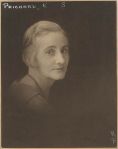
Prichard, by May Moore (Presumed Public Domain, State Library of NSW)

Commenting on my recent post on Katharine Susannah Prichard’s short story “The bridge”, Prichard biographer Nathan Hobby, pointed us to an online version in Trove of her short story, “Christmas Tree”, which he describes as the best of her early work. It’s about farmers, droughts and banks. Seemed very appropriate (to us in Australia right now, anyhow) so of course I checked it out. (And I corrected the OCR-introduced errors while doing so – hope I caught them all.)

So, “Christmas tree”. Published in The Australasian in 1919, it was, according to writer Glen Phillips, the first of Prichard’s stories to be translated – into Chinese in the 1920s! Fascinating eh? It would be interesting to know who read it and what they made of it.

“Christmas tree” tells the story of Western Australian wheatbelt famers Jinny and George Gillard, and is told third person, primarily through the eyes of Jinny who, at the start, is standing at her back door, reminiscing about their thirty years on the farm. The story starts:

Against the dim blue of the summer sky the Christmas trees had thrown their blossoming crests; they lay along the horizon like a drift of clouds, fluted and curled, pure gold.

The trees stood irregularly in the dry, scrubby land of the plain beyond Gillard’s fences to the north of Laughing Lakes homestead. Their trunks were not visible from the backdoor of the house to where Jinny Gillard stood, her eyes on that distant line of yellow blossom. But she was not thinking of the dark, heavy trees which put on an appearance of such opulent beauty at Christmas time. Her thoughts glanced from them and wandered listlessly, ravelling and unravellin, fretted, anxious, thoughts, old hopes, despairs, bitter, weary, and faint, sweet memories.

This year’s crops were, in fact, better than they had been for years, but it’s all too late – it is not they who will be benefiting from this year’s wheat but the bank.

It’s a sad story, but realistic rather than melodramatic. It’s about hard work and bad luck. Jinny knows they are not the only ones who have struggled. Some have had better luck than George who had sown “lightly when a good season happened along, or heavily when the rain kept off, and so had lost both ways” but some are also in George and Jinny’s predicament. The second part of the story concerns a Christmas party underwritten by one Christopher Tregear, who was chairman of the Great Western’s board of directors and “supposed to be one of the wealthiest men in the State”. Many farmers did business with Great Western, “thinking Tregear’s position in it would guarantee them from harsh treatment. But it had not.” Not for George, not for many others, and yet, here they all are, sees Jinny, dancing and singing with him, though “he was not a good friend of theirs.” Of course, we don’t get Tregear’s point of view, but there’s a sense that with the good season coming, compromises could have been reached.

This story is enjoyable on several fronts. Its realism means it conveys the facts without the histrionics that can sometimes distance readers. The realism also makes more effective the underlying theme that with more loyalty and less greed from the men with money, more farmers could survive the bad seasons. But it’s also enjoyable because of the tight, focused writing – from the sly irony behind the parasitic Christmas trees, and the names of the Gillards’ properties, Laughing Lakes and Everlasting, through the evocative descriptive writing, to the pointed repetition of the Gillards’ mantra “Crack hardy … I’m crackin'”.

“Christmas tree” is a story that hasn’t dated. It’s as relevant now as it was 100 years ago when it was first published – stoicism and dignity never go out of date, and we are still challenged by the role capitalist structures play in people’s lives and livelihoods. Another good read from Prichard – but that’s not surprising.

AWW Badge 2018Katharine Susannah Prichard
“Christmas tree”
First published: The Australasian, 20 December 1919
Also published in Potch and colour, Angus & Robertson, 1944
Available: Online at Trove

Apology: I posted this an hour or so ago with the wrong short story title, so have deleted that post, and republished with the right title, otherwise we’ll all get confused (including Google!)

Katharine Susannah Prichard, The bridge (#Review)

Time for another post on a short story available online, but not, this time, from the Library of America. Indeed, it’s not even American, but one of our own – Katharine Susannah Prichard’s (KSP) “The bridge”. As far as I can tell it has been published at least three times: in 1917 in the Weekly Times Annual; in 1940 in The ABC Weekly, which is where I found it; and in 1944 in a collection titled Potch and colour, about which Prichard biographer Nathan Hobby has posted.

Writing about Potch and colour, Hobby says that

Katharine wrote some incredible short stories. I would go as far as to say that I think the form suited her better than the novel, even if she is not as remembered for it. This collection mainly includes stories originally published in journals after her first collection, Kiss On the Lips (1932), but the first appearance of some of them still needs to be established. One story, at least, is quite early – “The Bridge”; I found a newspaper copy of it on Trove from 1917 (unfortunately, it’s not one of her “incredible” stories…).

Hobby then identifies three short stories from the collection as particularly worth commenting on. The first is titled “The siren on Sandy’s Gap” and Hobby says it “manages to be both humorous and an astute critique of marriage.” It’s about Susan – the siren – and her refusal to do “what they [men] say.” The second, “Flight”, is about the forced removal of mixed-race Aboriginal children from their homes, and the third, “The Christmas tree”, is about banks failing wheatfarmers during the Depression.

Now, before I get to “The bridge” a little from KSP herself. In 1967, Angus and Robertson published Happiness: Selected short stories by Katharine Susannah Prichard. It includes two of Hobby’s favourite stories from Potch and colour, but not “The bridge”. Most interesting, though, is Prichard’s Foreword. She talks of her various inspirations, including Thomas Carlyle, and says that Guy de Maupassant’s “Contes Normands” gave her “the short story technique, which, more or less unconsciously” influenced her story telling.

Defending herself against a criticism of her “loose and slipshod English”, she says that she purposefully used “the living speech of our people … making the context of a sentence give the meaning of an unusual word or phrase.” She quotes a Professor Holme who praises her style as responding to the need of her characters, and Nettie Palmer’s statement that her writing “made us remember that there was nothing so well worth writing about as the loves, conflicts, and sufferings of our own people”. Including all this in her short Foreword suggests that she felt the need to defend herself. Anyhow, she concludes with:

All the stories were inspired by an intimate sympathy with men and women in the comedy and tragedy of their lives.

So, “The bridge.” It’s not, perhaps, “incredible”, but it is moving – and reminds me, a little, of some stories by Kate Chopin and Edith Wharton. It’s a brief story about the building of a bridge in southeast Victoria by a young man called Bryant and his off-sider Charley. The main action concerns the opening of the bridge, and the wedding that takes place immediately afterwards.

The story commences with Bryant and Charley reminiscing about some of the challenges they faced in building the bridge. It had taken a year to build, and without any loss of life:

“They’ve got a notion in some parts of the world, a life’s got to go into a bridge if she’s to going to wear,” he [Bryant] mused. “I’m mighty glad no one’s been killed or hurt on our bridge, Charley … and she’s a good bridge … as good a little wooden bridge as there is in the country.”

However, a flood crisis had threatened the bridge. To save it, Bryant needed horses but local farmer Joe Gaines would not help out – until Bryant tried a bit of psychology involving a pretty young woman working in Gaines’ kitchen. He got his horses, but at a great cost to that young woman, unbeknownst to him but discovered by Charley later at the wedding.

It’s a tight little story – about single-minded ambition and sexual jealousy set against female generosity and sacrifice – with a sting in the tail that ironically comments on Bryant’s belief about his bridge. I can see the influence of Guy de Maupassant here – and Prichard’s interest in the lives of women. You can read it at the link below.

AWW Badge 2018Katharine Susannah Prichard
“The bridge”
First published: Weekly Times Annual, 3 November 1917
Also published in The ABC Weekly, 24 August 1940, and in the collection,
Potch and colour, Angus & Robertson, 1944
Available: Online at Trove

Jenny Ackland, Little gods (#BookReview)

Jenny Ackland, Little godsThe universe is telling me something. Jenny Ackland’s Little gods is the second novel I’ve read in a few months that is set in the Mallee region of northwestern Victoria, the other being Charlie Archbold’s Mallee boys (my review). Interestingly, both are coming-of-age novels, both involve farms, and both have a death at the centre. However, this is where the similarity ends, because Ackland’s protagonist, Olive, is female – and younger than Archbold’s – and Ackland’s death is a mystery to Olive, whereas in Archbold’s novel it’s the mother’s death which precipitates the narrative.

There’s another difference too, and it’s that Mallee boys slots into YA fiction*, albeit also a good read for adults, whereas Ackland’s book, while seen primarily through Olive’s point of view, is adult fiction. This is because although it’s about Olive’s journey, the main focus is on the way children see adults and the way adults completely miss what is going on in children’s minds, on the decisions adults make about what to tell children and how children respond to what they sense isn’t being told.

So, the story. Set in the 1980s, it’s about Olive and her extended family in which two of the sisters, Audra and Rue, had married two brothers, Bruce and William, with a third sister and brother on each side left over. Thistle, the oldest (and left-over sister), lives with Rue and William and their three children, Sebastian, Archie and Mandy, on the sisters’ family farm. Audra and Bruce, with Olive, live close by in town. The action is split between the farm, which Olive’s family visits regularly, and Olive’s home in the neighbouring town.

The novel starts with a little un-named “prologue” which tells us that the book is about the year Olive turned 12, when she was “trapped in the savage act of growing up”. It’s about a time when, uncertain about what was going on, she reached back into her memory, only to find that memory can be deceptive. It all could have ended up far worse than it did. (We know it didn’t because here she is at the beginning, alive, apparently well, but contemplative!)

She is fierce

Anyhow, from this point, the novel proper starts with Olive knowing that the local community thinks her family – the whole family, I mean – “odd”, which entrenches her sense of outsiderness but also fires her sense of agency. The novel starts slowly, with the plot not picking up until we are well in. Before that, Olivia’s character and the family’s complicated relationships, particularly between the sisters, are carefully developed. Olive, we soon learn, is independent and, outwardly at least, sure of herself. She’s “fierce”, as the epigraph from Shakespeare warns us, and bosses her best friend, Peter, and her cousins around. But she is needy too. And for this there is Grace, a wild raven who provides her with the affection that she doesn’t get from her stylish but withdrawn mother. For all her faults, we like her.

And so, here’s Olive, on the cusp of adulthood, wanting to understand the world. She knows which adults in her life will nurture her, mainly Rue, and which are likely to answer her questions, and that’s mostly Thistle. However, Thistle has her own issues and sees life through a particular prism which is not always useful to Olive. It all starts to unravel when Olive finds pictures of her parents and Thistle all holding a baby which is not her. Through insistent questioning, she discovers that the baby had been her sister and had drowned. But, with no more details forthcoming, she decides the baby had been murdered and that she knows who is responsible. She determines on revenge, but needs help. Meanwhile, Thistle is working through her own lost baby problem … You could see this novel as a modern take on the Aussie “lost child” motif.

At times, as the narrative plays out, we are called on to suspend disbelief, but never quite beyond the point of no return. Some shocking things happen but others are diverted, so that by the end Olive has found some answers and also learnt some valuable lessons.

There are several joys in reading this book, one of which is the writing. Ackland’s descriptions of the Mallee, though brief, are evocative:

Sunday morning and the sun rose on the bleached Mallee landscape and lit the distressed greens and greys.

Even lovelier are the ways she captures people, their thoughts and relationships, particularly Olive’s of course:

Olive crept back to the bathroom. It was a startling thing to know that Cleg could be tender with Thistle the sister he seemed to like the least. Standing in front of the mirror it was as if there was an opening inside her mind. A plant, a tall one, with a green stem that was thick all the way around. At the top of it, a tightly bunched bloom, an enormous head of closed, wrapped petals. She didn’t know the colour of the flower yet but it was bright as if illuminated by special lights, and inside the heard of the flower was a quavering, shimmering sensation of coming movement and understanding.

Perfect.

Water also features throughout the novel, which is appropriate given the drowning, but it is also presented as a positive thing. For Olive, water provides respite. At the pool, “her body feels real in the water”, and, submerging herself in the dam she stays “under just to be in that cool distant place for a while longer.” The novel, in fact, opens and closes with references to Olive jumping off the high board – an effective image for the gutsy way she approached life, though the suggestion in the prologue is that having grown up she “was no longer a girl bombing off the high board.”

So, the book is about the challenges of growing up. Olive, the child, sees the world simplistically. People are “little gods” who “have power to do things, like make baddies pay”. She is shocked when lawyer Cleg sees it a little differently, is not so categorical about “bad people”. Ackland explores the clash between child and adult world views by teasing out responses to a family tragedy. As the secret comes out, as the truth is told, some family wounds heal and some lessons are learnt – but at what cost? I thoroughly enjoyed this book.

Oh, and as for what the universe is telling me … it’s that I need to make good my plan of some years’ standing to visit the Mallee!

Lisa (ANZLitLovers) also enjoyed this book.

AWW Badge 2018Jenny Ackland
Little gods
Sydney: Allen & Unwin, 2018
345pp.
ISBN: 9781760297114

(Review copy courtesy Allen & Unwin)

* Mallee boys has just been commended as an Honour Book in the Children’s Book Council of Australia Book of the Year for Older Readers Award

Charlie Archbold, Mallee boys (#BookReview)

Charlie Archbold, Mallee boysReading synchronicities strike again. Both my last read, John Clanchy’s Sisters, and this one, Charlie Archbold’s Mallee boys, are family stories with a guilt about the death of a family member at their centre. Both, too, are set in non-urban areas, Clanchy’s in coastal New South Wales and Archbold’s in the dry Mallee region of western Victoria. Here, though, the similarities end. Clanchy’s book chronicles a month in the lives of three late-middle-aged sisters, and the person who died was their four-year-old baby brother – a long time ago. Also, Clanchy is a male writer, writing about women, in third person voice. Archbold, on the other hand, is a female writer writing about men. Her subjects are farmer, Tom, and his two sons, Sandy and Red, 15 and 18 at the beginning. The death they are dealing with is their wife and mother, who died just a year before the book opens. This novel, which spans a year, is told in the alternating first person voices of the two brothers.

Mallee boys, however, also reminds me of another book about a farming father and two sons whose wife and mother had died, Stephen Orr’s The hands (my review), but while Orr’s book sits squarely in the literary adult fiction fold, Mallee boys is Young Adult fiction. Its concerns are, therefore, a little different, but it is worth looking at. It won the 2016 Adelaide Festival Unpublished Manuscript Award, and has now been shortlisted for the Children’s Book Council of Australia Book of the Year for Older Readers Award.

Now, that was a long intro – even for me – but I have managed, I think, to include in it a fair introduction to book and its main storyline. I’ll add that while the story is told in the alternating voices of Sandy and Red, the main protagonist is Sandy. He starts and ends the story, and he is presented as the more thoughtful, more reflective, of the two boys. Also, he is not the one carrying the guilt. This is his brother, who was with his mother when she, a pedestrian, was hit by a car.

Like Clanchy with his women characters, Archbold captures the voices of the boys and their father well, their tensions, their squabbles, and most of all the challenges they face in running their home without a mother’s touch! “Chops” for dinner again tonight says it all. Late in the novel, the father Tom admits to being lonely, but his pain is not the focus, this being a YA novel. Sandy is in Year 10, and as a rural boy, is at schooling cross-roads. Their farm can’t afford to send him to boarding school in the city, but can he get a scholarship? Red, on the other hand, is not the scholastic type. He has left school and works the farm with his father, with the usual father-son tensions. Added to this are the boys’ relationships with their friends – not all of whom are “suitable” but Red, in particular, can’t be told and needs to learn the hard way. And, of course, there are girls.

This is all told naturally, neither sensationalised nor sentimentalised, but with enough drama, and humour, to keep readers, particularly the intended audience, interested. I wouldn’t call this a crossover novel exactly, but I did enjoy the read despite its YA intent.

Underpinning the narrative, the plot, is the setting, and this also the London-born Archbold, who has lived and worked as a teacher in the area, evokes beautifully. The setting is the Mallee, which borders the riverland area in which Laguna’s The choke (my review) is set. It’s a dry area, known for sheep and dryland crops like wheat. Farming is tough here, but communities are close. This comes through too, with locals helping each other out, in the natural way people do, something which is surely good for young readers to see and relate to. I do love to see good – but realistic – role modelling in media!

In addition to this, there’s the language. I enjoyed the descriptions of the Mallee, such as Sandy’s of Lake Bonney:

When the river runs low, the water in the lake huddles to the middle, leaving it fringed with smelly sticky mud. It’s a strange place. Because of the drought a lot of the trees around the edge have died. Bony old river red gums stick in the ground like a perching cafe for pelicans and kookaburras.

Tom, the father, tells Red what’s kept him going, despite his loneliness:

“I know it’s the rhythms of nature that have kept me going. This isn’t a glamorous landscape, but it’s in my veins.”

And I enjoyed how the boys describe feelings. Here’s Sandy describing his brother Red:

He acts hard because it gives him control but I know he’s all mushed up inside. Like a beetle with soft guts crammed in under the shell.

And here’s Red, just after his girl has suddenly broken up with him without explaining why:

And so she’s left me hanging, like a daggy bit of wool caught on a fence. Knotted in with no way to break free.

As you’d expect in a coming-of-age story, lessons are learnt, wisdom gained. Sandy says near the end, and this is surely one of the novel’s themes:

… because time doesn’t heal all wounds, like Dad once told me, but it does scab over them.

It sure does. And every now and then those scabs break off and have to re-form, n’est-ce pas? An effective metaphor I think.

Mallee boys, then, is an engaging book about growing up, about facing some of the hardest challenges, and most of all about being male. It’s a book that has something to offer both rural and urban young Australians, and I hope it gets widely read.

AWW Badge 2018Charlie Archbold
Mallee boys 
Mile End: Wakefield Press, 2017
285pp.
ISBN: 9781743055007

(Review copy courtesy Wakefield Press)

Sofie Laguna, The choke (#BookReview)

Sofie Laguna, The chokeThere are many reasons why I wanted to read Sofie Laguna’s latest book The choke. Firstly, I was inspired by a very engaging author conversation I attended late last year. Secondly, she won the Miles Franklin with her previous book The eye of the sheep (which I still haven’t read). Thirdly, its setting, the Murray River, is one of my favourite parts of Australia. For these and other reasons, I finally slotted it in this month, despite my growing backlog of review copies, and I’m glad I did. It’s an engrossing, moving read.

The novel is divided into two parts, the first set in 1971 when its first person protagonist Justine is 10 years old, and the second set three years later when she is thirteen years old and starting high school. It’s an effective structure. The first part sets up Justine and her physically and emotionally impoverished situation. She lives with her war-traumatised grandfather Pop on a struggling farm on the banks of the Murray. Her mother is long gone, and her father returns erratically. She has regular contact with her two older half-brothers who live nearby with her father’s first wife. Pop loves Justine, but he does not have the wisdom or emotional resources to guide – or even provide for – her as she needs. She is undernourished and poorly groomed. We are therefore unsurprised when Part 2 unfolds the way it does.

Now, I am a little cautious about first person narratives. It’s not that I don’t like them. In fact they can be highly engaging, but it did seem, for a while at least, that first person was becoming the voice du jour. However, Laguna’s choice here is inspired. She’s known for her ability to write young people and it’s well demonstrated here. Telling the story in Justine’s voice enables her to show Justine’s situation, without resorting to telling, which can so easily turn to moralising. Justine is the perfect naive narrator. She can only describe and explain the world as she knows it, so we readers must read between the lines to work out what is really going on. We work out, for example, that she is dyslexic by the way she describes her inability to read. We learn about the quality (often poor) of the relationships that surround her through her observations.

When I looked at [half-brother] Steve it was as if there was a ditch all around him too wide to jump. If you shone a torch into it, you’d never see the bottom. Steve couldn’t get across by himself; it was only Dad who could help him.

She might not understand the world – and it is this, along with her loneliness, which drives the crisis when it comes – but she’s attuned to the feelings between people.

One of the reasons this book so engaged me, in fact, is that it’s all about character. In the conversation we attended, Laguna said a couple of things about this. She said that it’s the characters and the tensions between and within them that drive the narrative and that character IS the plot.

“I got it wrong from the start”

So, who are these characters who drive the narrative? Justine is the main one, of course. She tells us that she was a breech birth – “I thought that was the right way to come out.” She understands by this that she “wrong from the start”, and she blames herself for her mother’s departure three years later. Her sense of being wrong – and feeling somehow responsible – is a recurring refrain in the novel. The other characters – her Pop, her sometimes-present father Ray, her mostly absent but significant aunt Rita, her friend Michael, her half-brothers, and the similarly dysfunctional neighbouring Worlleys – are all seen through her eyes. It is the tensions, stated and unstated, between them and their impact on her, that drive the narrative and the decisions she makes.

As well as a coming-of-age story, The choke is also a classic outsider story. Part one sets up Justine’s outsiderness, and chronicles, among other things, the friendship that develops between her and another outsider at school, Michael, who is taunted, bullied, because of his physical disability. Justine doesn’t have the words, but his disability appears to be cerebral palsy. The end of this friendship with Michael’s departure for the city ends Part One. This friendship plays multiple roles in the narrative. It helps develop Justine’s character. Her decision to stand up for Michael, having earlier wanted nothing to do with him, not only brings her a friend and marks her outsiderness from the cohort, but also shows her own sense of social justice. However, this friendship also exposes her low self-expectations and further reveals her neglect, because Michael’s family is a “normal” middle-class family. There’s a mum and dad, two kids, a proper house, regular meals and proper care. Justine is intitially embarrassed by the gap between their lives and hers, but when Michael eventually visits her home, she discovers he loves visiting it. He loves, for example, the chooks, Cockyboy and the Isa Browns.

By the time Part Two starts, her father Ray is in jail and Justine is starting high school. With Michael gone, she’s isolated at school and, while loved at home, continues to be neglected. The crisis is revenge-driven for something her father had done, but Justine, as the vulnerable female, is, of course, the target. It’s a gut-wrenching story of damage, neglect, abuse and, yes, also just simple misguidedness. Her Pop means well but is ill-equipped for the caring role thrust upon him. In the end, the story is also one of a failure of people and systems – including education – to identify Justine’s real situation.

And then there’s “the choke” of the title. I don’t always discuss a book’s title, particularly given that the author doesn’t always have last say on this, but for this book it’s highly relevant:

Down at The Choke the river pushed its way between the banks. The water knew the way it wanted to go. Past our hideouts, past our ring of stones, past the red gums leaning close enough to touch – it flowed forward all the way to the sea.

The “choke”, then, is a bottleneck in the river, a place, Justine says elsewhere, “where it would push through and keep going”. It is a physical place (based on the actual Barmah Choke) and a metaphorical one. Physically, it is a place of tranquility, of respite, for Justine. However, it also symbolises the things that threaten to “choke” her life, while at the same time hinting at hope, at the possibility of pushing through.

The choke is a book written by someone who knows exactly what she is doing. As I flipped through it to write this post, I noticed again and again the crumbs laid for us, the signs, in other words, that prepare the groundwork for what comes later. There is nothing wasted here. It is a grim story, but it is enlivened by its resilient young protagonist who finds the resources within herself to “push through” when life threatens to overwhelm. It may not have been shortlisted for the Stella Prize but I’m glad I decided to read it.

AWW Badge 2018Sofie Laguna
The choke
Sydney: Allen & Unwin, 2017
369pp.
ISBN: 9781760297244

Delicious descriptions: Stephen Orr’s farm family

When I reviewed Stephen Orr’s farm-set novel, The hands, last week, I didn’t share many quotes as the post was getting rather long. I decided I’d use my Delicious Descriptions series instead! So, here are three excerpts to show you more of what I so enjoyed about Orr’s writing.

One aspect I really enjoyed was his dialogue, but it’s tricky choosing something that works out of context. However, here’s a discussion between parents Trevor and Carelyn, and their eldest son Aiden about whether he continues school to Year 12. Young brother Harry is there too:

‘Maybe there’s no point starting Year Twelve,’ Aiden suggested, looking at his parents.
‘Why not?’ Trevor asked, not entirely surprised.
‘Not if I’m gonna fail things.’
‘Why are you going to fail?’ Carelyn asked.
‘Maybe not fail, but get through with Cs.’
She crossed her arms. ‘You’re not a C student.’
‘It’s getting harder.’
‘So? You work harder. Year Twelve is minimum for anyone now.’
‘But what’s the point if —’
‘You. Will. Continue.’ She decided  against the lecture. How he (Yes, you, look at me when I’m talking to you) was, for seven years, the best student in his School of the Air class; how he used to finish maths worksheets in minutes and spend half an hour waiting for others; always scored an A on tests and had a spelling age five years above his actual age.
‘It’s only another year,’ Harry said to his brother.
Aiden gave him his shut up, Shit-for-brains look. ‘It’s none of your business.’
‘You’re meant to set a good example.’

I don’t know about you, but I love this. It’s so “true”. I love the “gonna” for Aiden, and the “going to” for his Mum; I love big brother’s condescending-irritated-but-love-you-all-the-same “shit-for-brains” response to  his brother; and I love the whole set up of the argument regarding the importance of education.

And here, without spoiling anything, is a description of what comes after an affair:

… It was more a case of what came next: the small wedding, in a small park; the moving van; the bathroom reclaimed by lavender soap and fresh towels; her, inserted into his life like a deep splinter; opinions floating through the air and settling on the floor like talc; fine words butter no parsnips; her laugh; bright dresses on the line beside their overalls and pyjamas …

A little north of Orr's "Bundeena" but you get the picture.

A little north of Orr’s “Bundeena” but you get the picture.

But finally, of course, you need a description of the land:

Bundeena was marginal country. It could carry cattle, sparsely. To Trevor, this was where Australia became desert, where man — following the east-west railway, before it seriously set its sights on the Nullarbor — had given up on agriculture. Most men, at least. Except for them: sixth generation Beef Shorthorn producers who’d wrestled with the land for 130 years. This was country that hadn’t asked for farmers but had got them anyway. On the southern edge, the railway line, and to the north, nothing. They had neighbours to the east and west, but they may as well have been living in New Zealand.

So evocative.

Stephen Orr, The hands: An Australian pastoral (Review)

OrrHandsWakefieldAs promised, here is my review of a farm novel, Adelaide-based Stephen Orr’s The hands: An Australian pastoral. It is his sixth novel but the first that I’ve read. Where have I been? The hands is such a good read I wonder why I haven’t read him before.

Among the review excerpts for his previous novels provided at the beginning of my edition is one for his fourth, Dissonance. It says the book prompts us “to ponder the deep nature of familial relationships and their hold over one’s life”. This must be Orr’s milieu because I could write exactly the same about this book. It is set on a remote cattle property called Bundeena, in western South Australia. At the start of the novel, six people live there: 74-year-old Murray who holds the deed to the farm; his sister Fay and her not-quite-right son Chris; and Murray’s son Trevor, his wife Carelyn, and their 11-year-old son Harry. The seventh member of the family, 17-year-old Aiden, is at boarding school. In the first of the novel’s three chronologically titled (2004, 2005, 2006) parts, we shift between the third person perspectives of those at Bundeena, and that of Aiden at school.

Like most farm novels I’ve read – such as Alice Robinson’s Anchor point (my review), Jessica White’s Entitlement (my review) and Gillian Mears’ Foal’s bread (my review) – The hands, depicts the hard life of the farmer, the struggle to survive, and the uncompromising emotions that often attend such lives. You have to be tough to survive is the implication. But, do you? Sometimes, perhaps, you can be too tough. Orr’s characters have to contend with much – not just ongoing drought and debt, but grief that is layered upon layer through the generations, from the World War 1 related suicide of Murray’s grandfather, through the farm accident which damages Chris, to another accident which rocks the family and sparks the tension that finally brings it all to a head. Secrets will out and truths, emotional and practical, must be faced.

This sounds pretty thickly laid on, doesn’t it? World War 1, suicide, farm accidents, drought, and more. How believable is it all? Fortunately, Orr’s control of his plot is sure, and the tone never shifts into melodrama. The story elements fit logically, with the necessary groundwork carefully laid. It pays to notice the details. Is there a hint, for example, in the first film we find movie-mad Chris watching, The Great Escape?

The hands is not a challenging novel to read, and it doesn’t break ground in terms of the form, but from the first page I was fully engaged – because it’s authentic. We reviewers can throw that term around rather loosely, but you’d better believe me when I use it for this novel. Orr’s ability to capture characters and the way they interact with each other is truly impressive. The uneasy relationship between Trevor and his unbending father, the love and loyalty between Aiden and Harry that lies behind the teasing and bickering, Trevor’s conversations with his sons. It’s pretty darn perfect.

Orr’s control of his story starts with the title. “It’s all in the hands” we read, and hands feature consistently throughout the novel – working on the farm, driving, sculpting. Sculpting? Yes, Trevor sculpts son Harry’s hands. Fittingly, the novel concludes as the sculpture is completed. And then there’s the subtitle. I love the use of the word “pastoral” and its multiple connotations. There’s the literal meaning relating to land used for grazing sheep and cattle. That describes this book. Then there’s the Christian church sense of providing spiritual guidance. Hmm, there’s a dearth of good guidance (spiritual, emotional, however you like to frame it) offered in this novel, particularly by patriarch Murray. In the end it’s Murray’s powerless, down-trodden sister Fay who comes good. And then there’s “pastoral” used to describe works of art which portray country life in a romantic or idealised way. But, this is not a romantic or idealised story, making the subtitle pointedly ironic.

This is a novel about a lot of things. Specifically, it’s about farms and farm families, about how farms and the responsibility for them are handed down through families. It’s about the expectation that succeeding generations will farm, and it’s about one generation letting go to allow the next to continue. The trouble is that at Bundeena, Murray will not let go. He holds the deed, and Trevor feels trapped. More than that, he feels unvalued and without autonomy. Aiden notices it too:

The word was with Murray, and Murray was the word … There wasn’t much love or compassion in him. He was a sort of farmer shell, a hollow man full of regrets and knowledge and skills he couldn’t use any more, except as a sort of walking opinion that no one wanted to hear.

Talking with him, feels Trevor, is like “arguing with a rock”.

The specific farm themes, though, encompass bigger themes to do with familial love and responsibility, choices and autonomy, guilt and shame. It is these that lift The hands from a good, but exotic to most of us, farm story to something that applies to us all. In this context, though, it must be said that women play only a small role, and the role they play could be seen to be a little idealised, in that much of the warmth or perception comes from them. However, this is not overdone. They are not sentimentalised, and their relative absence is not a flaw: this is a book about men, about generations of farming men, their lives and their decisions.

Still, it’s to Fay that I’d like to give the last word:

Family, she realised, was the most difficult thing of all. It never reached a point of completion and what was there never seemed satisfactory. But one thing, she realised: there was always a pivot, one person at the centre holding it all together.

In The hands, this turns out to be Trevor. It is he who must make the tough decisions for himself and his sons. This novel is satisfying on so many levels – story, style and subject matter. I comment it to you.

Lisa (ANZLitLovers) loved the novel too.

Stephen Orr
The hands: An Australian pastoral
Mile End: Wakefield Press, 2015
351pp
ISBN: 9781743053430

(Review copy courtesy Wakefield Press)