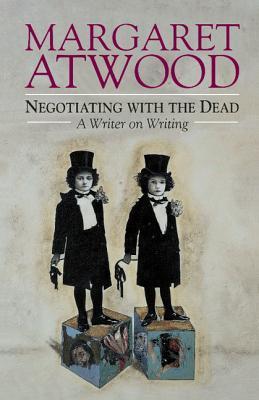
Margaret Atwood, Negotiating with the dead: A writer on writing (#BookReview)

My reading for Buried in Print Marcie’s annual MARM month has been both sporadic and minimal, to say the least, but this year I finally got to read a book that has been on my TBR shelves for a long time and that I have planned to read over the last few MARMs. It’s Atwood’s treatise (or manifesto or just plain ponderings) on writing, Negotiating with the dead. Interestingly, in 2003 it won the Independent Publisher Book Award (IPPY) for Autobiography/Memoir. I hadn’t quite thought of it that way, though on reflection I can see it does have a strong element of memoir.

Its origins, however, are not in memoir but in the series of lectures she delivered at the University of Cambridge in 2000, the Empson Lectures, which commemorate literary critic, William Empson. (I recently – and sadly – downsized his most famous book, Seven types of ambiguity, out of my library). Atwood turned those lectures into this set of essays that was published by Cambridge University Press in 2002 (and that I leapt on when I saw it remaindered in 2010).

Subtitled “A writer on writing”, this book is probably not quite what most of us would expect, unless we really know Atwood. As she says in her Introduction, it is not so much about writing as about something more abstract, more existential even, about what is writing, who is the writer, and what are the writer’s relationships with writing, with the reader, with other writers, and with themself. It’s also about the relationship between writing and other art forms, like painting and composing. She says in her Introduction that “it’s about the position the writer find himself in; or herself, which is always a little different”. (Love the little gender reference here.) It’s about what exactly is the writer “up to, why and for whom?”

I rarely do this, but I’m sharing the table of contents for the flavour it gives:

  • Introduction: Into the labyrinth
  • Prologue
  • Orientation: Who do you think you are? What is “a writer,” and how did I become one?
  • Duplicity: The jekyll hand, the hyde hand, and the slippery double Why there are always two?
  • Dedication: The Great God Pen Apollo vs. Mammon: at whose altar should the writer worship?
  • Temptation: Prospero, the Wizard of Oz, Mephisto & Co. Who waves the wand, pulls the strings, or signs the Devil’s book?
  • Communion: Nobody to Nobody The eternal triangle: the writer, the reader, and the book as go-between
  • Descent: Negotiating with the dead Who makes the trip to the Underworld, and why?

There is way too much in the book for me to comment on, but I don’t want to do a general overview either, so I’m just going to share a couple of the ideas that interested me.

One of her main threads concerns “duality” and “doubleness” in writers’ lives. There’s a fundamental duality for a writer – a novelist anyhow – between “the real and the imagined”. She suggests that an inability to distinguish between the two may have had something to do with why she became a writer. This interested me, but it’s not what interested me most in this book. Rather, it was the idea of the writer’s “doubleness”, which she introduces in chapter 2, “Duplicity”, the idea that there is the person who writes and the other person who lives life (walking the dog, eating bran “as a sensible precaution”, and so on). She explains it this way:

All writers are double, for the simple reason that you can never actually meet the author of the book you have just read. Too much time has elapsed between composition and publication, and the person who wrote the book is now a different person.

It’s obvious, of course, but we don’t often think about it. Writers do, though. Take Sofie Laguna, for example. In the recent conversation I attended, she said she wished she’d kept a diary when she was writing her novel to capture the “dance” she’d had between the conscious and the subconscious as she worked through the issues she was confronting. In other words, the Sofie in front of us was not the Sofie who had written that book. In chapter 5, “Communion”, Atwood addresses this issue from a different angle when she talks about the relationship between writers and readers.

Back to the writer, though, Atwood talks about, gives examples of, how different writers handle this doubleness, the degree to which they consciously separate their two selves or don’t. This brought to my mind Brian Castro’s Chinese postman (my review) in which he regularly – consciously of course – shifts between first person and third for the same character, a character who owes much to Castro himself but is not Castro. This may be similar to the example she gives, Jorge Luis Borges’ short story “Borges and I”. It’s also something Helen Garner has often discussed, such as in her essay “I” published in Meanjin in Autumn 2002. Even in her nonfiction works, she “creates a persona”, one that “only a very naive reader would suppose … is exactly, precisely and totally identical with the Helen Garner you might see before you”. My point in saying all this is that I think Atwood is exploring something interesting here. Is it new? I don’t know, but it captures ideas I’m seeing both in statements like those of Laguna and Garner, and in recent fiction where I’m noticing an increasing self-consciousness in writers who are explicitly striving for new forms of expression.

Another double Atwood discusses – one related to but also different from the above – is that between the writer and the writing. The writer dies, for example, but the writing lives on. It brought to mind that murky issue concerning posthumous publication (which was discussed on 746 Books Cathy’s Novellas in November post about Marquez’s Until August). It’s a bit tangential, I guess, but Atwood’s separation of the writer and the writing, her sense of the doubleness of writers, puts another spin on this conundrum.

She discusses other issues too, including that of purpose, to which she gives two chapters (3 and 4), setting the art-for-art’s sake supporters against the moral purpose/social relevance proponents, and which of course touches on that grubby issue of writing to earn money!

It’s an erudite book, in that she marshals many writers, known and unknown to me, to illustrate her ideas, but the arguments are also accessible and invite engagement. I did have questions as I read, but she managed to answer most of them. A good read.

Read for Marcie’s #MARM2025

Margaret Atwood
Negotiating with the dead: A writer on writing
Cambridge: Cambridge University Press, 2002
219pp.
ISBN: 9780521662604
Margaret Atwood, Widows (#Review)

Marcie’s (Buried in Print) MARM (Margaret Atwood Reading Month) event is now seven years old, but this is only my second contribution. I read a reasonable amount of Atwood before blogging, and since then have let her slide somewhat, though I have reviewed a couple of books here. You can’t read it all – but, I do like her voice …

So, I decided to join in again this year, as I knew I had a collection of short stories in my TBR pile. The only problem is that my non-Australian TBRs are still in boxes somewhere. What to do? Maybe, I thought, there’s a short story online somewhere, and sure enough I found one in The Guardian. Titled “Widows” it features Nell and (the late) Tig. From Marcie’s blog I learnt that this couple first appeared in Atwood’s collection of linked stories titled Moral disorder, and appeared again in her recent collection Old babes in the wood, from which this story comes. However, I’ve not read either of these collections, and I didn’t recollect those characters or their names.

Then a strange thing happened. According to Wikipedia, Moral disorder contains eleven connected short stories, the second last one being “The Labrador fiasco”. This is the story I read for last year’s MARM, but it was in a 1996-published Bloomsbury Quid edition. I had no idea it was later included in the 2006-published Moral disorder. Oh these writers can be tricksy. Did she change it in any way – such as to name the then unnamed character – for version in the collection? Anyhow, moving on, Wikipedia tells me that the 2023-published Old babes in the wood comprises fifteen stories in three parts: “Tig & Nell” (three), “My Evil Mother” (eight), and “Nell & Tig” (four). “Widows” is the thirteenth story in the collection, so presumably the second one in that last group of four.

I won’t rehash “The Labrador fiasco”, except to say that it is a “story-within-a-story” story, and that the framing story concerns the unnamed narrator (who is apparently Nell) visiting her aging father and mother. The father, in particular, is declining, having experienced a stroke six years before the story’s opening. It is told first person by the daughter, who regularly visits her parents and is becoming aware of aging and our inevitable decline. Some years have clearly passed, and in “Widows” Nell has recently lost her husband “Tig”. It’s an epistolary story, I guess you could say, though it contains only two letters, both by Nell to a friend named Stevie.

The first, and main, letter is a delight – and pure Atwood. It’s partly in what she covers, as this short short story manages to encompass Atwood’s recurring themes – women (their position in society, and their relationships), language, aging, social conventions, and the state of the world. But it’s also in the sly way she makes her sharp little points. For example, talking about widows, she has a dig at the modern penchant for creating increasingly complicated gender-neutral descriptions:

I’m hanging out with a clutch of other widows. Some of them are widowers: we have not yet got around to a gender-neutral term for those who have lost their life partners. Maybe TWHLTLP will appear shortly, but it hasn’t yet. Some are women who have lost women or men who have lost men, but mostly they are women who have lost men.

Similarly, there is a sly reference to world politics and climate change, when she says to Stevie, who is much younger, that:

if you live another thirty years and are still enjoying it, or most of it – if anyone will be enjoying, or indeed living, considering the huge unknown wave that is already rolling toward us – I expect you will look at a picture of yourself as you are today, supposing your personal effects have survived flood, fire, famine, plague, insurrection, invasion, or whatever …

Of course, Nell talks about grief, about the forms, assumptions and cliches that surround it. She’s quietly scathing about “checking the boxes of the prescribed grief process” and eschews the well-intended offers of casseroles and suggestions that she go on a cruise.

When I read writing like this, I can’t help being reminded of Jane Austen, because both have the ability to see through our conventions and pretensions to the truths beneath, and to make us chuckle as they do so.

However, for all the cheeky barbs and social commentary, there is also something heartfelt in her discussion of grief. She speaks of how it skews one’s experience of time, how it affects one’s relationship with the person who has died, and what grieving people really talk about and deal with. Atwood knows whereof she speaks having lost her husband of 46 years in 2019.

If I thought this first letter was both clever and moving, the second letter just nailed it. In fact, if I were writing criticism and not a review, I would discuss what Atwood does here, but that would spoil the whole experience, and I don’t want to do that because you can read it yourself at the link below. Suffice it to say that, while “Widows” is a short story, it does a lot in its few words, and its ending signs off with aplomb.

Read for MARM 2024

Margaret Atwood
“Widows”
The Guardian, 25 February, 2023 (also pub. Old babes in the wood, 2023)
Available online at The Guardian, 2023

Thomas King and Natasha Donovan, Borders (#BookReview)

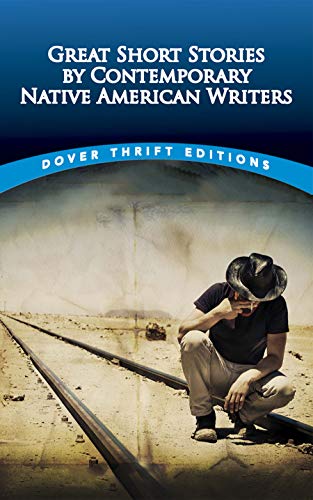
Earlier this year I posted on Thomas King’s short story “Borders” from Bob Blaisdell’s anthology, Great short stories by contemporary Native American writers. The story was written in 1991, but as I noted in my post, it has also been adapted into a teleplay for the CBC, and turned into a graphic novel for younger readers. I was intrigued, and because I loved the story, I bought the graphic novel, on the assumption that we will share it with our grandchildren in a few years.

To recap a little from my original post. Wikipedia describes King as an “American-born Canadian writer and broadcast presenter who most often writes about First Nations”. Born in California in 1943, he “self-identifies as being of Cherokee, Greek, and German descent”, and has written novels, children’s books, and short stories. I also shared from Wikipedia a quote they include from King’s book, The inconvenient Indian, because it’s relevant to Borders:

“The issue has always been land. It will always be land, until there isn’t a square foot of land left in North America that is controlled by Native people”.

In that post I summarised the story, and I’ll repeat that here too. The narrative comprises two alternating storylines, both of which are told first person through the eyes of a young boy. One storyline concerns his much older sister, Laetitia, leaving home at the age of 17 to live in Salt Lake City, Utah, while the other tells of a trip he makes with his mother some five or so years later to visit this sister.

The crux of the story lies in what happens at the US-Canada border. Asked to give her “citizenship”, the mother insists “Blackfoot” and is denied entry. She refuses to offer anything else. As a result, she and her son get caught in a no-man’s land when, attempting to return to Canada, the same response to the same question results in her being refused entry there too. As one of the border officials tries to explain to her, “it’s a legal technicality, that’s all”. Of course, that’s not all. Blackfoot people ranged across the great northwest of America in what is now known as America and Canada. For our narrator’s mother, that land is her “citizenship”, not that she is American or Canadian, and she will not back down.

So, to the graphic novel. The illustrator is Natasha Donovan, who is described at the back of the book as “a Métis illustrator, originally from Vancouver, Canada”. She has illustrated, among other books, “the award-winning graphic novel Surviving the city, as well as the award-winning Mothers of Xsan children’s book series.”

This graphic novel version of Borders is beautiful. It turns what is a perfectly suitable story for pre-adult readers into a book that should appeal to and engage these readers. It contains King’s full text as far as I can tell, enhanced (if I can use that word) with Donovan’s gorgeous drawings. Because it is designed for younger readers, the drawings are simple enough to appeal to younger readers, but they offer a subtle depth which make the story well worth reading in this form by older readers too. The original story is told in a spare style, which leaves the reader to imagine (work out) the ideas and emotions behind the words. In this graphic version, sometimes the illustrations replicate the words, but in many cases they value add. This is not to say that value-adding is necessary, as it’s a gem of a story, but that the drawings encourage the reader to stop, think, and consider what the words might be saying.

An example: of their second night stuck in border-limbo, our narrator says that “The second night in the car was not as much fun as the first, but my mother seemed in good spirits and, all in all, it was as much an adventure as an inconvenience”. The panel following this depicts chicken wire in the foreground with a flock of birds flying off in the background, conveying some of the tension between the constraint of borders and the idea of freedom. The next panel, also textless, shows mother and son companionably sitting on the boot of their car, eating their sandwiches. In the border-guard scenes, the narrator mentions their guns. Donovan picks this up, providing frequent close-ups of guns, gun belts and holsters when the guards are present, which suggests authority and, perhaps, menace without overplaying the idea of fear.

What I liked about this graphic version, too, is how much it encouraged me to “see” things from our young protagonist’s perspective. I saw it in the text, but it becomes more vivid and immediate in this version. We see him report what he is seeing, and his own thoughts; we see him inserting his boy-ish wishes and perspectives. There is a running theme, from the beginning, about food which marks his focus on the concrete, on his needs. He asks Mel, the duty-free shopkeeper, for a hamburger, which he doesn’t get, but the next day:

Mel came over and gave us a bag of peanut brittle and told us that justice was a damn hard thing to get, but that we shouldn’t give up.

I would have preferred lemon drops, but it was nice of Mel anyway.

In this way, King conveys the truth as experienced by our young boy, but the wider truth that is happening around him – the strength of the mother’s identity and her determination to preserve it. Occasionally, our young narrator perceives some of these truths too. He sees the pride – and yes, the not always positive stubbornness – displayed by his mother and sister, but concludes:

Pride is a good thing to have, you know. Laetitia had a lot of pride, and so did my mother. I figured that someday I’d have it too.

Hachette’s promo for the graphic novel version describes it as resonating “with themes of identity, justice, and belonging”. It is exactly that – and conveys so much that is both personal and political, making it a rich book for any age to think about and consider.

Thomas King (story) and Natasha Donovan (Illustrator)
Borders (text from the 1993 published version)
New York and Boston: Little, Brown and Company, 2021
[192pp.]
ISBN: 9780316593052

Thomas King, Borders (#Review)

Thomas King’s “Borders” is the eleventh of fourteen stories in the anthology, Great short stories by contemporary Native American writers. Like the previous story by Duane Niatum, it was also written in the 1990s.

Thomas King

Anthology editor Bob Blaisdell provides some basic information about King, but I am supplementing that with information from Wikipedia which introduces him as an “American-born Canadian writer and broadcast presenter who most often writes about First Nations”. He was born in California in 1943, and “self-identifies as being of Cherokee, Greek, and German descent”. He has written novels, children’s books, and short stories. 

King studied in Californian schools and universities, before earning his PhD at the University of Utah. Between his various degrees, he worked in many jobs, including spending three years in New Zealand. He moved to Canada in 1980, where he worked as an academic until he retired.

In terms of his First Nations activity, our main interest here, Wikipedia says that “his 1986 PhD dissertation was on Native American studies, one of the earliest works to explore the oral storytelling tradition as literature”. He is committed to a wide range of issues concerning First Nations rights, prospects and culture, but most relevant to his story, “Borders”, is a statement Wikipedia shares from his book, The inconvenient Indian:

“The issue has always been land. It will always be land, until there isn’t a square foot of land left in North America that is controlled by Native people”.

“Borders”

According to Blaisdell, “Borders” appears in King’s 1993 short story collection, One good story, that one, which was a best-seller in Canada. “Borders” is one of those frequently anthologised stories, apparently, which doesn’t surprise me because it is a ripper. From what I’ve read about King’s writing, “Borders” feels typical of his approach, with its conversational style and use of humour to convey a serious message. King adapted this story into a teleplay for a CBC anthology drama series, and it has also, recently, been turned into a graphic novel for a younger readers.

The narrative comprises two storylines which are alternated with each other. It is told first person through the eyes of a young boy. One storyline concerns his much older sister, Laetitia, leaving home at the age of 17 to live in Salt Lake City, Utah, while the other tells of a trip he makes with his mother some five or so years later to visit this sister. The crux of the story, though, lies in what happens at the US-Canada border. Asked to give her “citizenship”, the mother insists “Blackfoot” and is denied entry. She refuses to offer anything else. As a result, she and her son get caught in a no-man’s land when, attempting to return to Canada, the same response to the same question results in her being refused entry there too. As one of the border officials tries to explain to her, “it’s a legal technicality, that’s all”.

Of course, that’s not all. Blackfoot people ranged across the great northwest of America in what is now known as America and Canada. For our narrator’s mother, that land is her “citizenship”, not that she is American or Canadian, and she will not back down.

From the opening, the mother is established as sensible, no-nonsense. She doesn’t want Laetitia to go to Utah, and she doesn’t give in easily, pointing out the negatives right until they leave her at the border. But Laetitia will go and her mother is eventually proud of her, because she hadn’t “gone floating after some man like a balloon on a string” nor had she “snuck out of the house … to chase rainbows down alleys. And she hadn’t been pregnant.”

We first meet the border, as mentioned above, when the mother and son (our narrator) take Laetitia there, from where she’ll get a bus to Salt Lake City. We see the border, but mother and son don’t attempt to cross it at this point. The writing, at this early point, captures the obstinacy and strength in both mother and daughter, alongside the love between them::

The wind had come up and it blew Laetitia’s hair across her face. Mum reached out and pulled the strands out of Laetitia’s eyes, and Laetitia let her.

“Laetitia let her”. Conveys so much, doesn’t it?

Anyhow, it’s a few years later, when mother and son set off to visit Laetitia that the fun starts. Our narrator sets it up beautifully, his “mom” packing food for the trip, while he plaintively hopes they can “stop at one of those restaurants too, right?” The pacing of the border conversations is perfect. We chuckle, but we see the point too. When the mother gives up trying to get into the USA, and tries to return to Canada, the humour continues. The Canadian border guard, after some friendly small talk, asks

“Where are you coming from?”
“Standoff”.
“Is that in Montana?”
“No.”
“Where are you going?”
“Standoff.”
The woman’s name was Carol and I don’t guess she was any older than Laetitia. “Wow, you both Canadians?”
“Blackfoot.”

And it starts again. It’s just delicious. “Mom” is polite, but also determined to make her point and not. give. in. There are no histrionics, there’s no violence. Just polite behaviour on all sides. (But, the description of the few days they spend in this limbo region, visiting the duty free shop and sleeping in the car, did remind me of that Kath and Kim episode when Kath and Kel spend their honeymoon at the airport.)

The language is direct and spare, told from a pre-teen’s point of view. He reports rather than comments, but in that reportage we see the truth – of the strength of the mother’s identity and determination to preserve it, and of her wisdom in dealing with her daughter.

Hachette’s promo for the graphic novel version describes it as resonating “with themes of identity, justice, and belonging”. It is exactly that. I imagine the graphic novel is a winner, because the short story sure is.

Thomas King
“Borders” (orig. pub. 1991)
in Bob Blaisdell (ed.), Great short stories by contemporary Native American writers
Garden City: Dover Publications, 2014
pp. 84-94
ISBN: 9780486490953

Rebecca Campbell, Arboreality (#BookReview)

Arboreality, by Canadian writer Rebecca Campbell, won the 2023 Ursula K. Le Guin Prize. However, not being much of a speculative fiction reader, I didn’t discover this book through this award. Fortunately, some bloggers I follow, like Bill (The Australian Legend), do follow this genre, and his review convinced me that this climate change dystopian work fits into the sort of speculative fiction that does interest me.

Before I talk about the book, however, a little about the prize. It was established in 2022, in honor of Ursula K. Le Guin, and is currently worth $25,000. It has some specific criteria: it’s an English-language award for a single work of “imaginative fiction”, and intends to honour authors who “can imagine real grounds for hope and see alternatives to how we live now”. This last bit is interesting – “real grounds for hope”. It reminds me of the Barbara Jefferis Award, which now seems to be in abeyance, but which was controversial because it stipulated that the winning work had to depict “women and girls in a positive way [my emph] or otherwise empowers the status of women and girls in society”. I don’t believe literature must offer hope or be positive, but I have no problem with awards sponsors making such stipulations.

So now, that out of the way, the book. It is set on Vancouver Island, a beautiful part of the world that I have visited. It’s novella in size, but, structurally, is best described as a collection of six inter-connected short stories:

  • “Special collections”
  • “Controlled burn”
  • “An important failure”
  • “Scion and root stocks”
  • “Pub food”
  • “Cathedral arboreal”

These stories are presented more or less chronologically, starting with the first two stories being set in the very near future (up to around 2050) with the last encompassing 2100. They are linked in various ways – by location; by characters (encompassing family and friends, ancestors and descendants, over time); and, as you’d expect, given the title, by trees, particularly but not exclusively, the arbutus and its mutant version, the golden arbutus. Each story focuses on a specific issue or idea and plays it out through personal stories, such as an academic saving books from a “crumbling” library (“Special collections”); a suburbanite trying to revive a devastated garden with local plants, as one-by-one his neighbours leave (“Controlled burn”); a luthier hunting for seasoned tonewood, via the black market if necessary, to make a Cremona-worthy violin (“An important failure”). These highly personalised stories are placed in context, through the addition of another voice – an omniscient narrator, in italicised sections – which conveys the wider ecological, economic and political picture. We see the land change through fire and rising sealevels; we hear of space colonisation; we learn of pandemics. It’s cleverly done, and although it requires concentration, I was more than willing to go with it because the vision Campbell presents is compelling in its awful believability. That, I think, is what telling a near-future story can achieve. It’s hard to pretend it won’t happen.

“What are we going to do?”

What makes this book so beautiful, however, is the way Campbell manages convey both absolute horror alongside a sense of hope born of human ingenuity, resilience, and sheer doggedness. Jude and Berenice, fighting a losing battle in their mission to save books, must constantly downgrade their expectations, which means becoming more and more selective about what is saved (and therefore also what is lost to human knowledge), but they don’t give up, and these books are seen in 2100. Similarly, Bernard, in his now empty suburb where gardens have died due to a watering ban, doggedly works to find plants that will live in his and neighbouring gardens, which we see, a few generations later in “Cathedral Arboreal”, has become a forest. And Mason’s “secret history” violin also appears in this last story in another generation. These people will not let go even though they are very aware of what has been lost, of what they have lost.

We’ve lived here for ten thousand years. Someone survived everything history threw at them, the fires and tsunamis, the earthquakes, the smallpox, the settlers. Empire. Capitalism. Someone’s going to survive this. (Benno, c. 2071, in “Scions and Root Stocks”)

The ecological story Campbell tells, alongside the human one, is fascinating, albeit probably more challenging to those of us who don’t know the plants of the region and their significance – the garry oak, the arbutus, the camas (lily), fireweed, Douglas fir, and so on. I know some of the plants she names, but I don’t know their particular role in the culture, their horticultural essence and value, or their symbolic meaning (if any any). Some I looked up, and some I didn’t, but certainly Campbell’s story is rich with interconnections here too, between past, present and future, and between Indigenous and non-Indigenous practices.

One of the meanings of “arboreality” is “of, relating to, or resembling a tree” which makes it a good literal title for a book in which trees stand for so much that is important to life – ecologically, culturally, and psychologically. But Campbell is also, perhaps, playing with the “sheltering” notion implied in “arbor” and “reality”.

The Ursula K. LeGuin Prize’s selection panel wrote:

Arboreality is a eulogy for the world as we know it. Rebecca Campbell’s extraordinary, deeply felt book explores the difficulties of the long hard project of survival. There are no heroes or villains here—only people making brave, difficult choices, out of hope and love for their community, for art, knowledge, and beauty. Arboreality imagines things that we haven’t yet considered about what can and will go wrong with our gardens, libraries, and archives if we don’t act now (maybe even if we do). In her masterful and profoundly ethical stories, Campbell asks us what might be saved, what must be saved, and what it will take to do so. 

‘What are we going to do?” asks Jude in the opening story, “Special collections”. Well might he ask. Arboreality is an astonishing book because of the way it imagines the dire, with all its attendant griefs, side-by-side with survival (and its attendant, hope). This makes it a bit discombobulating because we are constantly surprised by what happens next. The world is not beautiful, and life is tough, but people are surviving and working their way through what life has thrown at them. I don’t imagine Campbell intends us to think, “it’s alright then, let’s continue along our merry, destructive ways” but more that when (because we are, it seems, past “if”) we are confronted with the worst, humans can, and hopefully will, find ways through. The question is: is this the future we want?

Rebecca Campbell
Arboreality
Hamilton, Ca: Stelliform Press, 2022
128pp.
ISBN: 9781777682330 (eBook)

Margaret Atwood, The Labrador fiasco (#Review)

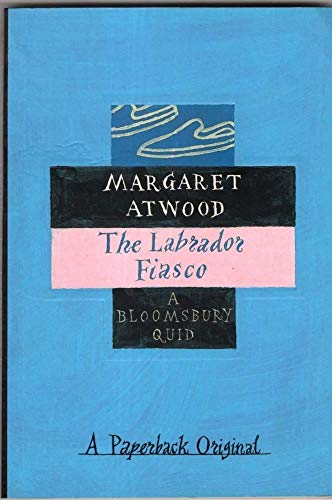
Although I am an Atwood fan from way back, I haven’t, to date, taken part in Marcie’s (Buried in Print) MARM (Margaret Atwood Reading Month) event. But I promised her I would this month, albeit with just one little short story probably, this one. I have had The Labrador fiasco on my “little book” TBR shelf since it was produced as a Bloomsbury Quid back in the 1996. I have no idea why I have not read all my little books, but, there you go!

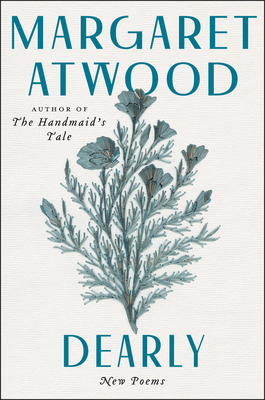
Most of you will know Margaret Atwood (b. 1939). I read several of her books before blogging – including her dystopian novel, The handmaid’s tale; her historical fiction novels, Alias Grace and The blind assassin; and her more contemporary novels Cat’s eye and The robber bride – and I have more on my TBR. But, I have only reviewed her twice here, her novella, The Penelopiad (my review), and her recent poetry collection, Dearly (my review). Now, I bring you a short story. This woman is versatile.

As far as I can tell, “The Labrador fiasco” was first published in this edition. Many of my “little books” comprise previously published short prose works, but this doesn’t seem to be the case here. I have three other Bloomsbury Quids, two of which were previously published, with the other, Nadine Gordimer’s Harald, Claudia and the son Duncan (my review), also seeming to have been first published as a Quid. Interesting, but not relevant to my discussion of Atwood’s story, so let’s move on. The Quids, though, are gorgeous little books.

“The Labrador fiasco” is a “story-within-a-story” story. (Ha!) The framing story concerns the narrator and her aging father and mother. (The narrator’s sex is not provided, but let’s go with female as Atwood is female.) The father, in particular, is declining, having experienced a stroke six years before the story’s opening. It is told first person by the daughter, who regularly visits her parents.

The story within comes from Dillon Wallace’s The lure of the Labrador wild, published in 1905. Wallace was, says Wikipedia, “an American lawyer, outdoorsman, author of non-fiction, fiction and magazine articles” and this, his first book, was a bestseller. It tells of an exploratory trip through Labrador undertaken by Wallace and a man called Leonidas Hubbard, with their Cree Indian guide, George. The Cree bit is important as the Cree are not from the region they were travelling in. Anyhow, the aim was to explore a part of Labrador that hadn’t been explored by Europeans, with Hubbard wanting to “make his name”. However, as Wikipedia (and Atwood’s story) explains, they took the wrong river from the start, with tragic consequences.

Atwood’s story opens with:

It’s October; but which October? One of those Octobers, with quick intensities of light, their diminuendos, their red and orange leaves. My father is sitting in his armchair by the fire. He has on his black and white checked dressing gown, over his other clothes, and his old leather slippers, with his feet, propped up on a hassock. Therefore it must be evening.

There’s so much going on here, besides the gorgeously structure sentences. We are immediately put on the back foot with “which October”, and “it must be evening”, but at least the father is very much present. The uncertainty suggests that the story is being told from a later time. Whichever October it is, however, it is autumn – or fall – and that means the season of decline. Within a couple of paragraphs, we learn of the father’s stroke, and know he is declining. But, the question, “which October”, also hints at the October in the Wallace-Hubbard story when things have really started to sour – because not only is it cold of course, but our explorers have taken the wrong route and are running out of supplies.

This is the set up. As the story progresses, the narrator’s father, who was an experienced outdoorsman himself in his day, provides a running commentary on the explorers, with the narrator adding her own layer. “They took the wrong supplies”, the father says, pleased because he would have known what to take. However, our narrator wonders “what supplies could they have taken other than the wrong ones” … “No freeze-drying then” or “nylon vests”, for example.

“harsh and unmarked and jumbled”

What Margaret Atwood does in this story, then, is parallel the deterioration in the condition of the explorers as their expedition goes awry, with the narrator’s father’s decline as he ages. The explorers leave things behind, their feet suffer because they don’t have effective footwear. The father leaves hobbies behind, and says his feet are too sore to walk. The father thinks he would have done the expedition better, but he faces his own “forest” and in fact, like the explorers, he and his supporters are not fully equipped to deal with it.

And so it goes. In under 40 (very small) pages, Atwood combines commentary on a failed (colonial) expedition, conveying the poor planning and hubris of those involved, with a tender family story of an adult child and mother coping with a failing father. To do this she calls on her obvious love and knowledge of Canada’s history and “wilderness” (a contested term now, I know), and her keen interest in humans and how our lives play out.

We are all explorers, I think Atwood is saying, and the way, at least some of the time, can be “harsh and unmarked and jumbled”. It takes all our energy to traverse it. Good planning and the help of others can ease the way, but in the end, we each have to do it on our own. A clear-eyed, clever and tight story with an ending that encompasses genuine warmth with an acceptance of life’s realities. Beautiful.

Read for MARM 2023

Margaret Atwood
“The Labrador fiasco”
London: Bloomsbury, 1996 (A Bloomsbury Quid)
64pp.
ISBN: 9780747528890
Available online at Independent, 1996

Pauline Johnson, A red girl’s reasoning (#Review)

As some of you know, I have a close American friend, Carolyn, with whom I correspond weekly. We met in the early 1990s when I was living in California. During that time we started a reading group, so you won’t be surprised that our correspondence always includes reference to what we are – or are not – reading. What we recently realised is that we are not reading Native American literature. I was consequently thrilled to find Great short stories by contemporary Native American writers in my last Christmas parcel from her. I have now read the first three stories but today’s post is on the first one, “A red girl’s reasoning” by Pauline Johnson.

Pauline Johnson

The anthology’s editor, Bob Blaisdell, in his brief intro to the story, writes that Emily Pauline Johnson (1861-1913) was born on Six Nations Reserve near Brantford, Ontario. Her father, he says, was a Mohawk chief, and she was related to the American novelist, William Dean Howells, on her mother’s side. Wikipedia expands on this. It describes her as a Canadian poet, author, and performer. Regarding her parents, it says that “her father was a hereditary Mohawk chief of mixed ancestry and her mother was an English immigrant”.

Blaisdell says that Johnson started writing fiction after her father died to support the family, but Wikipedia again tells us more, focusing on her significance. It says that her poetry was published in Canada, the United States, and Great Britain, and that she was “among a generation of widely-read writers who began to define Canadian literature. She was a key figure … and has made an indelible mark on Indigenous women’s writing and performance as a whole”. Unfortunately, as so often happens, her literary reputation declined after her death, but, Wikipedia says, there has been renewed interest in her since the late 20th century.

If you are interested in her, do read the Wikipedia article because it’s reasonably thorough. Meanwhile, I will move on to …

“A red girl’s reasoning”

CanLit (where you can read the text online at the link below) says that “Red Girl’s Reasoning” was first published in Montreal’s Dominion Illustrated, in February 1893, and then, later that month, as “A Sweet Wild Flower” in Toronto’s Evening Star. Interestingly, CanLit’s online text, and the version in my anthology, both give it as “A red girl’s reasoning”. CanLit gives the author as E. Pauline Johnson. All details perhaps, but they do raise questions.

So, what’s our red girl’s reasoning? The story concerns the marriage between Christine, who is mixed-race (our ‘red girl”), and Charlie, a young white man. It starts with Christine’s white father counselling his “brand new son-in-law” to “Be pretty good to her, Charlie, my boy, or she’ll balk sure as shooting”. Charlie, as any new husband should, reassures him that of course he will, “there’s no danger of much else”. And all goes smoothly – for a while. She’s an asset to him … but, hold this thought because I want to digress to something else Pauline Johnson wrote, an essay titled “A strong race opinion: On the Indian girl in modern fiction”. It was published the year before this story, in 1892 (and is also available online).

In this essay, Johnson argues that people do not equate with their race, even though there are racial characteristics. “The American book heroine”, she writes, is allowed to be an individual. She does not have to have “American-coloured eyes” or an “American mode of dying”. She is allowed “an individuality ungoverned by nationalism”. This is not the case for “the Indian girl in modern fiction”. In an aside, she makes the point re “Indian”, that “there seems to be an impression amongst authors that such a thing as tribal distinction does not exist among the North American aborigines”. She continues:

The term “Indian” signifies about as much as the term “European,” but I cannot recall ever having read a story where the heroine was describes as “a European.” The Indian girl we meet in cold type, however, is rarely distressed by having to belong
to any tribe, or to reflect any band existing between the Mic Macs of Gaspé and the Kwaw-Kewlths of British Columbia…

She wrote this back in 1892 – how much has changed? Anyhow, her point is well-made. Johnson then details the stereotyping of “the Indian Girl” in fiction. She is always “Winona” or a name that ‘has a “Winona” sound to it’; she never has a surname; and her father is always a chief (like, in fact, Johnson’s father.) Further, this “Winona” is often suicidal, even though “suicide is an evil positively unknown among Indians”. She is always in love with “the young white hero”, and will betray her own people, but he “never marries her”. There’s more, but I think you’ve got the gist. (She does provide an exception, Charles Mair’s Tecumseh, in which the Indian Girl Iena “is the one book Indian Girl that has Indian life, Indian character, Indian beauty” – but, like her stereotyped sisters, she is not allowed to live.)

Needless to say, Johnson’s “red girl” does not have a Winona-sounding name and her white hero does marry her. Not only that, she stands up for herself when … but, I get ahead of myself. Before this, there is the wedding, which, Johnson writes, was not much, but fortunately groom Charlie didn’t mind:

in his heart he was deeply thankful to escape the flower-pelting, white gloves, rice-throwing, and ponderous stupidity of a breakfast, and indeed all the regulation gimcracks of the usual marriage celebrations …

This is significant to what follows, because the crisis, when it comes, is about Indian versus Canadian (western) marriage customs. Christine’s parents were married the “Indian” way, that is, there was a feast, but no other ritual. Charlie is aghast because he suddenly realises he has married someone “illegally born”! Her response – her “reasoning” – is that if he can’t accept that her parents are married by her mother’s customs, then she can’t accept that she and Charlie are married by his. And so the rift is wrought.

The story’s progression from here is fairly typical of nineteenth century short stories, but to say more would spoil the plot. I will say, though, that Christine does not die!

Blaisdell concludes his intro to the story that “while stagy” it “achieves some degree of pathos and delivers a strong comeuppance to Christian prejudices”. Yes, it is “stagy” (or, melodramatic, as I wrote in my margin) – but that’s fairly typical of its time. And it does deliver that comeuppance. But there is more to it. There is, for example, satire of white pretentious and superiority, a mockery of white storytelling even, in the way she uses the tropes of western rich man-poor girl stories:

She was “all the rage” that winter at the provincial capital. The men called her a “deuced fine little woman.” The ladies said she was “just the sweetest wildflower.” Whereas she was really but an ordinary, pale, dark girl who spoke slowly and with a strong accent, who danced fairly well, sang acceptably, and never stirred outside the door without her husband.

You can see the tongue firmly planted in Johnson’s cheek here.

Johnson’s story made a great opening to the anthology. It is somewhat dated in style and terminology, but its core concern, cultural clash, still holds true, and it is told with a light touch and a warmth towards its characters that engaged me.

Pauline Johnson
“A red girl’s reasoning” (1893)
in Bob Blaisdell (ed.), Great short stories by contemporary Native American writers
Garden City: Dover Publications, 2014
pp. 1-16
ISBN: 9780486490953
Available online at canlit

Margaret Atwood, Dearly (#BookReview)

Earlier this year, I decided to try audiobooks more regularly – and thought short stories would be a good way to go. Julie Koh’s Portable curiosities was my choice. It was, overall, a positive experience. Then I thought poetry might be worth trying given it’s such an aural form. I chose Margaret Atwood’s latest collection Dearly for my first foray into audio poetry since, although I’ve been an Atwood fan, I’ve only reviewed her once on my blog. Also, Atwood was a poet before she was a novelist. An added benefit was that the audio version was read by her. 

It worked really well – as a reading experience. For blogging, it was tricky. I found it difficult to capture the details I like to have for a review, much harder than remembering the plot, characters and themes of a novel experienced in audio form. Short stories fall somewhere in the middle. Anyhow, all this is to say that this post will share my overall thoughts, and a little about a few poems that I managed to jot down notes about or find online.

Overall, the collection came across as melancholic in tone, which is not to say the poems are uniformly grim, as there’s also plenty of Atwood’s cheeky humour. The worldview tends to the dystopian, reflecting Atwood’s concerns, but it felt realistic rather than hopeless. The subject matter is both political, dealing with issues like climate change and war, and personal, exploring ageing, grief and mortality. All of these speak to me.

Many of the poems draw on nature for their imagery, if not their subject matter. There’s a sense that nature is bearing the brunt of our wilfulness, that it shows evidence of our wilfulness, and, conversely, that it may also provide the answer. But, there are other poems which explore her themes through worlds I know nothing about, like zombies, aliens and werewolves.

And, of course, there’s Atwood’s love of language. The poems are accessible rather than obscure, but they’re not simple, because Atwood understands the weight of words and loves to play with them. This comes across really well in the audio version.

The collection is broken into five parts, starting, perhaps counter-intuitively, with “Late poems”. Many of the ideas here appealed to me, such as the idea in “Salt” that we don’t recognise the past was good until later. But, the poem that most touched me in this part was “Blizzard” in which Atwood talks about her nearly centenarian mother, asking “why can’t I let her go”? I could tell her why.

I enjoyed poems in Part 2, like “Health class (1953)” and “A genre painting”, but in Part 3, we find many poems inspired by nature. “September mushrooms” talks of fungi bringing “cryptic news of what goes on down there”. Halloween is the ostensible subject of “Carving the jacks”, which concludes with such a great line, “After we’re gone, the work of our knives survive us”. Atwood can do last lines.

In “Update on werewolves” (read it online), Atwood riffs on the masculine threat inherent in werewolves, then expands it to explore the empowerment of women. “Zombie” is prefaced by a lovely epigraph by Rilke, that “poetry is the past that breaks out in our hearts”. In “The aliens arrive”, Atwood runs through various movie aliens and their actions:

We like the part where we get saved.
We like the part where we get destroyed.
Why do those feel so similar? 

I love these pointed, paradoxical lines.

“At the translation conference” toys with language and culture, and how different cultures have words (or don’t) for different things. Some languages have “no word for him her … have no future tense”. There’s a wry reference to women and the word “no”, and, more scarily, to translation as a dangerous activity where punishment can result if the translation is “wrong”.

Part 4 also contains many nature-inspired poems. It continues the concerns and questions about where we are going, particularly regarding the environment. Finding a “Feather” causes Atwood to think of the “calligraphy of wrecked wings” and of the feather’s owner being “a high flyer once as we all were”. (This is one of many references to birds, which are a particular passion of Atwood’s.) “Improvisation on a first line by Yeats” continues the exploration of our rapacious attitude to land, as does “Plasticine Suite” with its word play on ages – the Pleistocene, the Myocene, now the Plasticine, “evidence of our cleverness, our thoughtlessness”. It addresses the arrogance of proselytising developed nations disregarding the needs of the less rich. “Oh children” ends with “Oh children … will you grow up in a world without ice … will you grow up?”

The collection concludes on the personal, with Part 5 devoted to ageing and loss, largely inspired by the death of Atwood’s husband in 2019 from dementia. There are some really lovely meditations here. In “Sad utensils” she writes of “the word reft/ who says that anymore?” despite its being honed over years and used by many. As words pass, so do our own lives, and the people we love. In “Silver slippers” she reflects on ageing and the things we give up along the way, “no dancing anymore … all my wishes used up … where did you go and when/ it wasn’t to Kansas”.

The second last poem is the titular poem, and it speaks directly to her loss of her husband, starting with the loss of the word “dearly”:

It’s an old word, fading now:
Dearly did I wish.
Dearly did I long for:
I loved him dearly.

Moving, and to the point – as is the final line of the book, from the poem “Blackberries”: “the best ones grow in shadow”. More paradox. I will leave my thoughts there and pass you over to Margaret Atwood herself in her essay for The Guardian on this collection. She says it all far more eloquently than I ever could.

Margaret Atwood
Dearly
(Read by Margaret Atwood)
Bolinda Audio, 2020 (Orig. pub. 2020)
1hr 48mins (Unabridged)
ISBN: 9781867504009

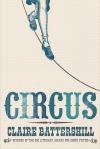
Claire Battershill, Circus (Review)

Claire Battershill, Circus

Metaphors and allusions can be dangerous. The inside-front-flap-blurb for Claire Battershill’s debut collection of short stories, Circus, concludes that the book “is a beautiful reminder that sometimes everyday life can be the greatest show on earth”. A reviewer on the back cover describes it as “the kind of book you’ll want to run away with”. As I finished it, however, my first thought was that “life is a circus”, meaning it can be disconcerting and unpredictable. Luckily for Battershill, all these work, and are encompassed by her epigraph from ee cummings’ play Him which says “Damn everything but the circus … damn everything that won’t […] throw its heart into tension, surprise, fear and delight of the circus, the round world, the full existence.”

A selection of stories from this book co-won the 2013 Canadian Authors Association Emerging Writer Award, and, before that in 2008, the title story won the CBC Literary Award for Short Fiction. It has some cred in other words, but you might be wondering how I came to it. It was, in fact, a Mothers Day gift from Daughter Gums (DG) back in 2014. She and I had seen the book on a Canadian authors stand in a Toronto bookshop a couple of months earlier that year, and she noticed that it was one that I had eyed particularly covetously. (It helped that it is a beautifully designed book and is lovely to hold!) I was thrilled when I opened my gift, and apologise to DG for taking so long to complete it.

There are nine stories in the book, with the titular story “Circus” occupying the middle. Two are told first person, the rest third. I do like short story authors to mix their voices up a bit and to not be afraid of third person, as sometimes new writers can seem to be. Battershill uses the voices well. The guide in the Hendricks Memorial Miniature Museum (“Each small thing”) talks to the reader as though we are in her tour group. First person was needed here to effectively convey the guide’s self-absorption. It’s perhaps not so critical in “Two-man luge: A love story”, but the first person voice does enable us to feel the narrator’s uncertainty and longing for connection.

What I love about this collection is the variety of her characters and the often bizarre situations they find themselves. We have Henry Bottlesworth (“A gentle luxury”) who “has given himself  thirty-one days to find love on the internet” after ten years of enduring the matchmaking efforts of friends and family. This is not so unusual a situation, and the ending is probably the most predictable, and yet Battershill injects such warmth into what could be a frustrating character. The next story (“Sensation”) switches gear completely to a story about a single father and the tent he buys for his daughter’s 16th birthday. They pitch it in the living room:

Annie loves it … She loves how the energy saver-light bulb glows like a dying star through the waterproof nylon, how scents from the rest of the house filter in, from time to time, through the mesh windows … She is open to the elements, but there’s no danger of rain or mosquitoes, no need for thermal underwear or finicky gas lanterns. This is camping at its finest.

Haha, love it. From here, the tent becomes a conduit first to a closer relationship between father and daughter, and then with the neighbourhood, and then … well, I don’t want to spoil it, but it is a gorgeous story that manages to be warm while also having a little dig about art, fads and fame.

And so the stories continue. Here are some more. There’s the couple who buy a house in the country (“Brothers”) only to find that they’ve also acquired two elderly brothers, shepherds, one blind, the other deaf. Or the widowed grandfather who listens to the Northern Lights and wants to share this love with his grandson (“The collective name for Ninjas”). Or the wife who goes to New York with her husband for their first no-children holiday, only to return alone (“Quite everyday looking”).

The stories are warm, and humane, sometimes humorous, but all about relationships (with partners, parents, children, others) and the decisions made and not made. They are written with a lovely eye for those details that can lift them out of the ordinary:

Henry has, with time and experience, learned a thing or two about the culinary ins and outs of first dates. Sushi, for instance, invites a rice explosion. Ordering a saucy noodle dish or a dressing-laden salad is asking for a spill, and Chinese broccoli is impossible to eat all in one bite without losing one’s dignity. (“A gentle luxury”)

Karen has the face of someone who has swan-dived into love and never hit bottom. (“Brothers”)

The New York version of her was slim, with bare, smooth legs rather than thick, sturdy calves in support socks. And surely as soon as the plane touched down at JFK, she would instantly know how to apply liquid eyeliner precisely and her hair would emerge in elegant finger waves when she lifted her head from the neck pillow. (“Quite everyday looking”)

So, “greatest show on earth”? Not if you think this means fireworks and high drama. But if it means for you the idea that seemingly ordinary lives can be surprisingly varied and rich, then, yes, Circus fills the bill – and fills it with confidence and aplomb.

Endings are hard. Everyone knows it – the end of life, the end of a holiday, and of course the end of a novel. EM Forster knew it – and wrote about it in Aspects of the novel. Endings are particularly important in short stories, I’d argue, and Claire Battershill’s endings are good ones. There are no twists or neat resolutions here. Just a sense that characters have reached some point in life, major or minor, and are now moving on – in a direction that is usually clear to the reader but not completely spelled out. I like that.

POSTSCRIPT: It seems that Circus is out of print, but you can read one of the short stories, “Two-man luge: A love story”, online.

Claire Battershill
Circus
Toronto: McClelland & Stewart, 2014
207pp.
ISBN: 9780771012785

On the literary road, in Ontario

I’m back from my North American trip and, as you can tell, didn’t find much time to post while I was there. It was a packed three and a half weeks, catching up with our daughter, sightseeing, and meeting people, many of whom I’d got to know via online reading groups. I didn’t find much time (or, indeed, energy) to read, but would like to share some literary tidbits from our trip.

Chapters Indigo Bookshop

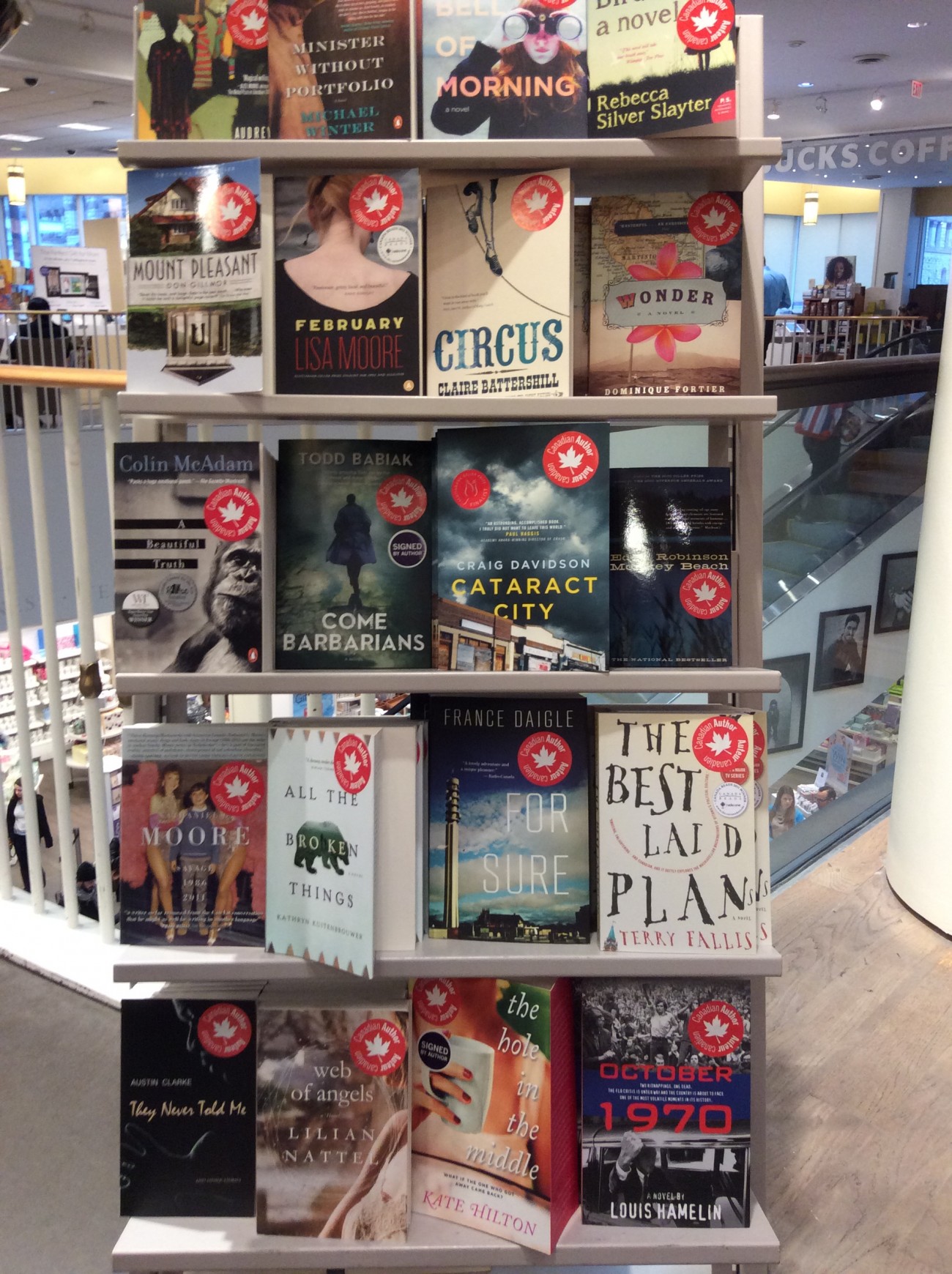
Canadian authors stand, Chapters Indigo, Eaton Centre, Toronto

I had hoped to check out a local independent bookshop or two but things – including weather that didn’t encourage meandering – conspired against me, so the only bookshop I visited in the end was a chain, Chapters Indigo. I was intrigued to see how much it had diversified into all sorts of products, including personal and household goods. I guess this is how a bookshop survives these days. My main aim in visiting was, of course, to check out Canadian authors. Unfortunately the shop, while fine in its way, was just like a chain. The staff did their best but were not really able to provide the sort of advice I wanted, like, you know, the names of Canadian authors besides the well-known ones like Margaret Atwood and Alice Munro. They had a lot of the latter’s books, the willing sales assistant said, since she’d just won the Pulitzer! I didn’t bother to correct him but simply smiled, because he had done his best –  and then I noticed that we were actually standing next to a little display stand of just what we were looking for, that is, a stand in which all the books were tagged “Canadian author” and were all new authors to me! I was attracted to Circus, a book of short stories by Claire Battershill, but didn’t buy it then. Instead, I bought a book by another author I know, Margaret Laurence, for Ma Gums.

Toronto Book Awards

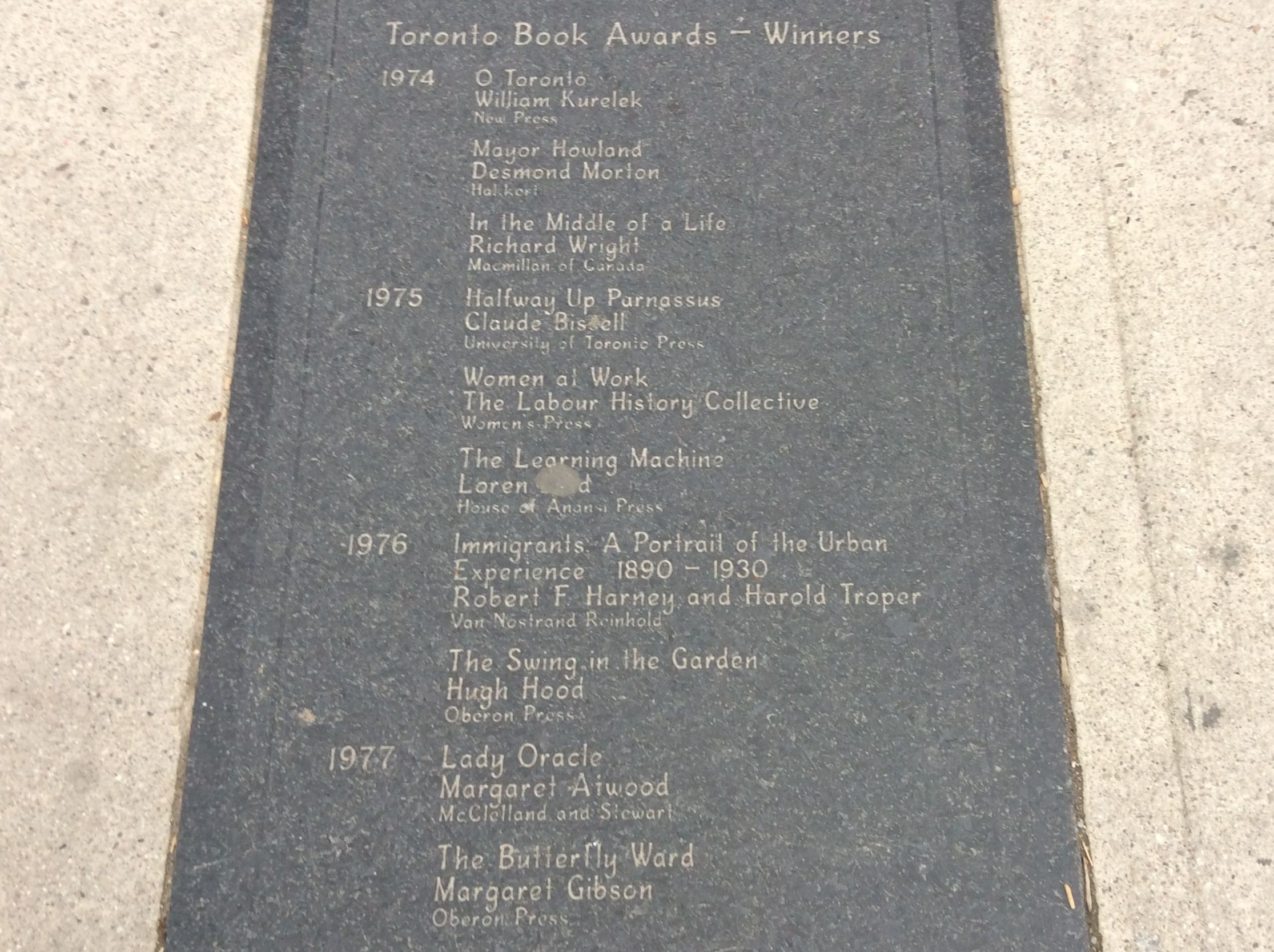
photo 2 croppedAnd then, quite serendipitously on the same day, my daughter and I were walking down Queen Street West and walked right over plaques embedded in the pavement for the Toronto Book Awards Authors Walk of Fame. The awards were established by the City of Toronto in 1974 and are awarded each year for the year’s best fiction or non-fiction book or books “that are evocative of Toronto”. All shortlisted authors receive $1000, with the winning author receiving an extra $10000.

I was intrigued to see that one of the winners of the first award – in the early years there were often multiple winners – was William Kurelek whose art we’d come across at the Art Gallery of Ontario. He was the son of Ukrainian immigrants, and the book he won for is called O Toronto which contained his series of paintings of Toronto. The other two inaugural winners were historian Desmond Morton’s Mayor Howland and novelist Richard Wright’s In the middle of a life. I have his best known work, Clara Callan, on my TBR pile.

William Campbell

We visited Toronto’s historic Campbell House, the home of Chief Justice William Campbell from 1822 until he died in 1834. His Georgian-style house is the oldest surviving building from the original town of York, but the reason I am including him here is that he presided in 1826 over the trial of the rioters who destroyed William Lyon Mackenzie’s printing press on which he printed his newspaper, the Colonial Advocate. The house museum suggests the case is a significant early test for freedom of the press in Canada. Mackenzie went on to become a politician, and in 1834, the first mayor of the new city of Toronto (as York was renamed when it was incorporated).

Stratford Festival

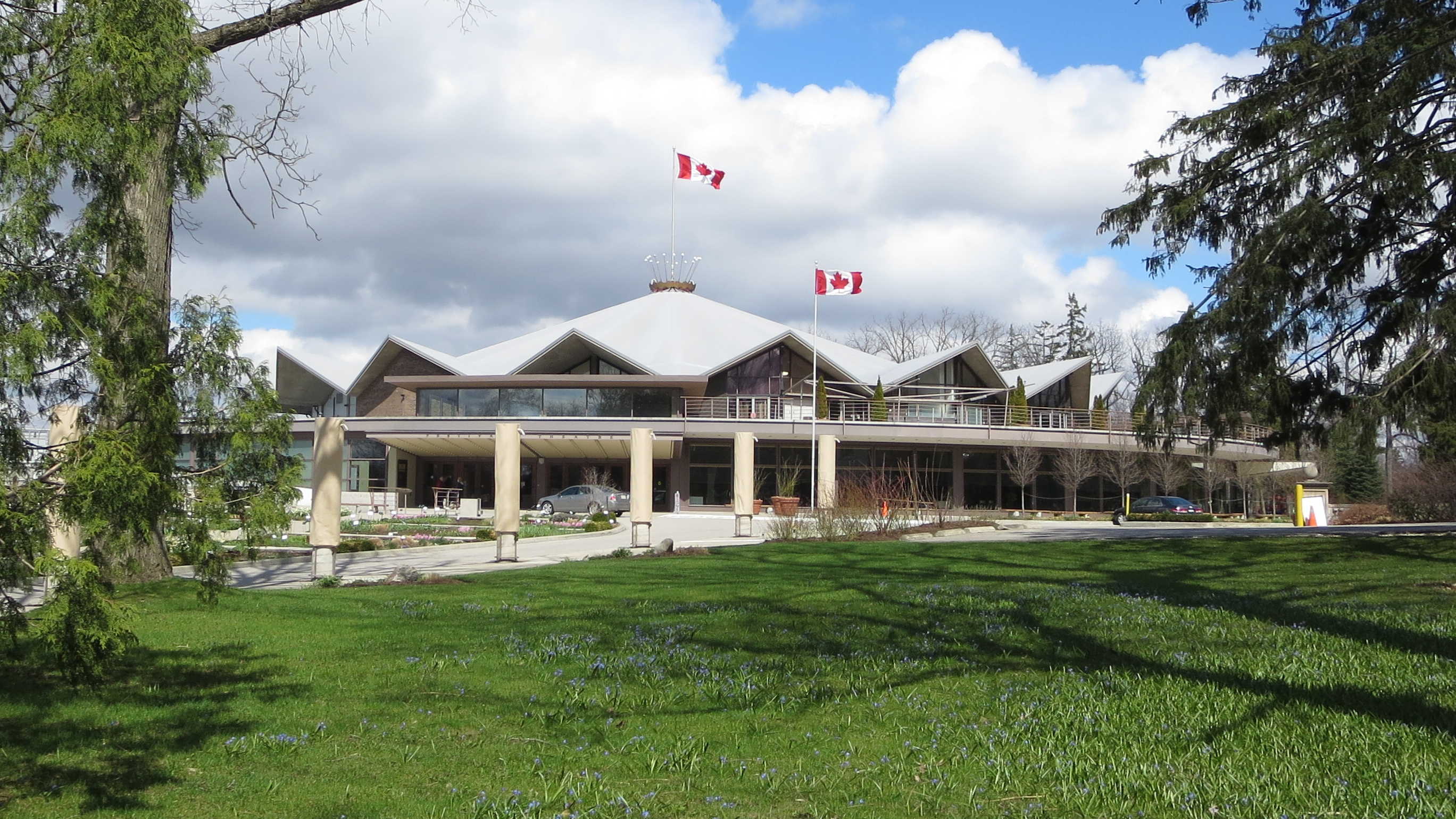
Festival Theatre, Stratford

Festival theatre, Stratford

This festival, previously known as the Stratford Shakespearean and then Shakespeare Festival, is, according to Wikipedia, an internationally-recognized annual celebration of theatre running from April to October in Stratford, which is about 2-hours drive west of Toronto. It’s a very pretty little town, on the Avon River, and has a replica Globe Theatre. I was intrigued to discover yet another Shakespeare based or inspired festival. They seem to abound, and Wikipedia has quite a list of them. Many, like this one, don’t  focus exclusively on Shakespeare but his works form their backbone. Daughter Gums has been a keen attendee over the last two years of the Utah Shakespeare Festival, and several of my online reading group friends love the Oregon Shakespeare Festival.

But back to Stratford. I was given a beautiful coffee table book, Robert Cushman’s Fifty seasons at Stratford, by Emmy whom I met for the first time on this trip but have “known” for many years through online reading groups. The book is organised chronologically with each chapter named for that period’s artistic director. And, it has an introduction by another Canadian author I’ve read, Timothy Findley, who acted at the very first festival at Stratford in 1953. The first director was Tyrone Guthrie, and some of the actors Findley worked alongside were Alex Guinness, Irene Worth and Douglas Campbell. This was clearly no amateur undertaking! Cushman, in his preface, mentions that another Canadian novelist (I’ve read), Robertson Davies, had played a role in establishing the Festival, had been on its board, and had written about its early history. This is a gorgeously produced book, with an excellent index and a chronological list at the back of every play performed at the festival from 1953 to 2002.

… and now, with jet lag making its presence felt, that is about all I have for you tonight, but at least I have given you a taste of some of the things that have occupied my mind over the past three weeks or so.