Margaret Rose Stringer, And then like my dreams (Review)

Margaret Rose Stringer, And then like my dreams

Courtesy: Fremantle Press

I was, I have to admit, predisposed to like Margaret Rose Stringer’s memoir, And then like my dreams, before I opened the cover. Fortunately, I wasn’t disappointed, but not, as it turned out, for the reason I expected. Here’s why. Margaret Rose Stringer once worked as a continuity girl in the Australian film industry and she was married to stillsman (film stills photographer), Chic (Charles) Stringer. I spent many years of my career working with film stills, and I loved it. I was therefore looking forward to hearing an insider’s story. However, the book didn’t really spend a lot of time on industry talk, but Stringer is such an engaging writer that I didn’t care because, by the time I realised it, I was fully invested in her story about the love of her life.

“The love of her life”. This could suggest something rather schmaltzy but while Stringer is totally one-eyed about CS, as she calls her late husband, this is not a schmaltzy book, not really, not despite frequent adulatory proclamations of love. Part love-story, part grief-memoir, the book works because of Stringer herself – her honesty and her writing style. I don’t make a practice of reading about grief. However, over the years I have read Isabel Allende’s Paula (1994), Joan Didion’s The year of magical thinking (2005), and Marion Halligan’s autobiographical novel, The fog garden (2001), and haven’t regretted any of them. Of course, Didion, Allende and Halligan were all established writers when they wrote about their grief, whereas Stringer was not.

But, she could have been, because this book has a fresh, lively style despite its subject matter. In fact, I did say it was only part grief-memoir: while we are told in the first chapter – one-page long and simply titled “All of it” – that she met Chic Stringer when she was 31 years old and that he died 31 years later, much of the book is about these 31 years, of which only the last couple encompassed his dying. Theirs was, it seems, the perfect love story. Stringer briefly describes her childhood, particularly her difficult relationship with her mother, then her undirected, rather wild and unsettled early adulthood in which she was dogged by anxiety, panic attacks and clinical depression. She discovered late in her much-loved father’s life that he too suffered but apparently, while he recognised that Stringer, the fourth of five daughters, was similarly afflicted, he did not have the wisdom or knowledge to effectively help her. Chic, though, did – through love, patience and tolerance. Stringer visualises their relationship as a “truth tree” with the trunk comprising the fundamental fact that:

Chic really, really wanted and needed to look after me; and I really, really wanted and needed him to do it.

My feminist self was a little taken aback by this, but it became clear that Stringer is not, as this might suggest, submissive so much as in need of love and nurturing, which Chic provides. In fact she says:

The point is that I didn’t simply go along with  everything Chic wanted, because I loved him. Nono! – I retained my behavioural traits, because they were mine and they comprised me, even if they were less than totally attractive and desirable as traits go. After all, it was me he loved – not some paragon ….

She could, she said, be stroppy and unreasonable, and he could be bossy, but they made it work. I did feel she was a little too self-deprecating, too willing to put herself down at times, but she’s so thoroughly genuine that these niggles subsided.

Most of the book is about their life together: their work, particularly in the film industry and then the video production business they established when long-sightedness forced Chic out of his career; their various homes, including the one Chic built on Dangar Island in the Hawkesbury River; and their European travels, with some lovely stories about their passion for Placido Domingo. She refers us to their site European Travels with a Spouse for further information on their trips because, as she was reminded by her advisers, she was not writing a travel diary! Chic’s dying and her subsequent grief occupies only a small proportion of the whole.

What makes this memoir especially engaging is the style. Firstly, there’s her friendly, open voice. And then there are the quirky features, one of which is the use of script form to convey key scenes. Most of the book is written in first person, as you would expect, but these script scenes are written in third person. They relieve the intensity of the book and are, in fact, a little whimsical even when the point she wants to convey is serious. It’s the reverse what of Francesca Rendle-Short did in her fictional memoir Bite your tongue which she wrote primarily in the third person, using another name for herself, but occasionally inserted some first person commentary. For her, writing in third person enabled a distancing from the emotional intensity of a story she found “hard to tell”, whereas Stringer often uses these third person scenes to make an emotional point. Or, sometimes, just to tell a funny story. Stringer also uses footnotes entertainingly; she openly discusses the advice she received about memoir writing; and she tells her story through mostly short chapters with inspired titles like “Crust (Daily)”,  “Joy”, and  the ironic “Silver Tongue” in which she discusses Chic’s dislike of her “coarse utterance”.

Stringer is, of course, particularly moving when describing her grief, from her initial denial, through the last months of caring for a terminally ill partner, to feelings of “utter confusion” and madness afterwards. Joan Didion also wrote in her memoir of the mad – aka magical – thinking that attends grief. Stringer, in her inimitable style, is more direct and writes of her “mad-soup” brain.

Late in the book, Stringer says that part of her reason for writing was “to travel all the roads and pathways and sidealleys leading to and from grief”. She has achieved that, and more, because what she has written is a sad yet humorous, and ultimately wise book about the most meaningful thing in our lives – love.

awwchallenge2014Margaret Rose Stringer
And then like my dreams: A memoir
Fremantle: Fremantle Press, 2013
323pp.
ISBN: 9781922089021

(Review copy supplied by Fremantle Press)
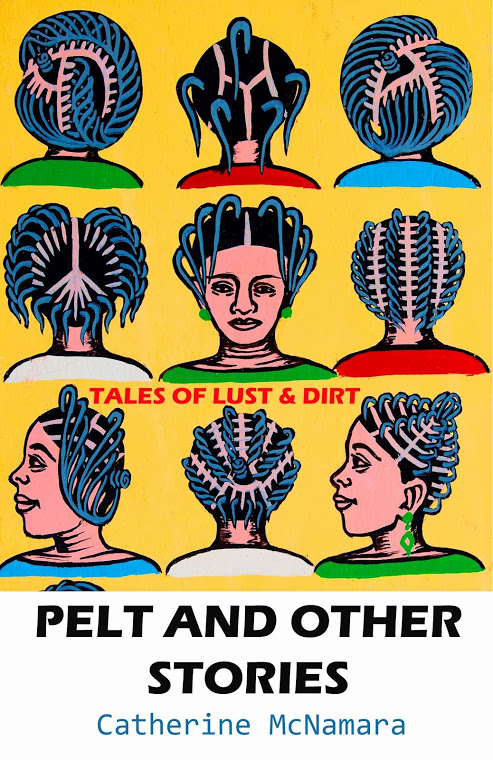
Catherine McNamara, Pelt and other stories (Review)

Catherine McNamara, PeltIt seems fitting that my first review of the year be for a book of short stories by one of this blog’s regular commenters, Catherine McNamara. I have reviewed McNamara before, her first published novel, The divorced lady’s companion to living in Italy. McNamara  describes that book as commercial fiction. It is, to describe it differently, chicklit for the mature woman – and is a fun read. However, Pelt and other stories is a different thing altogether. It represents, McNamara has said, where her real writing love is – literary short stories.

You will hear from Catherine herself soon in the form of an author interview on the blog, but by way of introduction now, she is an Aussie expat who left Australia as a student a couple of decades ago. She now lives in Italy but has lived in other parts of Europe and for several years Africa. All this is reflected in her stories which have Australian, European and African settings. As with many short story collections, several of the stories have been published elsewhere, on-line and in print. Her story “Coptic Bride” was published in Giramondo‘s now-defunct, but admired, literary magazine Heat.

The first thing to say about McNamara’s writing is that it is not spare. Her exuberant use of imagery reminds me at times of  the early writings of Thea Astley and another expat, Janette Turner Hospital, both writers who have reveled in colourful, figurative language, albeit to different purposes. Occasionally the imagery can feel a little overdone, but I love their freshness, love the risks McNamara takes. The next thing to say is that her subject matter tends to revolve around sex. The book is, after all, subtitled “tales of lust and dirt”. In McNamara’s work, sexual passion represents the best and worst of what life has to offer. And, given that there’s more drama in the worst or the problematic, it is this – in the form of violence, incest, jealousy and infidelity – that we mostly find in Pelt and other stories. Thirdly, McNamara mixes up her narrative voice. She uses first and third person, and she writes in a variety of voices, including, for example, a white gay male and a black female. This keeps you on your toes. You never know who the next characters will be, and where they’ll be from. I like that.

While Pelt and other stories is a collection, several stories are connected, which makes the order of the stories particularly interesting. I suspect ordering stories in a collection, which I discussed briefly in my review of Knitting and other stories, is one of the trials of preparing a short story collection (or anthology). Do you match or contrast tone or themes? Do you put related stories together? The truth is that it probably matters less to the reader than the writer/editor thinks, as readers will often pick and choose. However, with single-author collections, my practice is to read, from the beginning, in the order presented. And this is where the fun started with Pelt and other stories. There are, for example, sly connections in which a character – Nathalie for example – is an important subject in one story (“Nathalie”), but then appears as a passing reference elsewhere. Other stories have stronger connections. I was particularly intrigued by McNamara’s presentation of three of these – “Opaque”, “Where the wounded go” and “Volta”. They don’t appear consecutively, and when they do appear it is not chronological. I’m not sure what McNamara’s intention was in this, but for me it replicates the way we get to know people. We meet them at a point in time, getting to know their current lives, while gradually learning their back story. In a collection that ranges widely in character and location, the connections can be grounding.

What I particularly like about the stories is their honesty. McNamara doesn’t flinch from letting her characters express their (our) meanest, least generous thoughts. Love, McNamara shows, can make us selfish, desperate, and sometimes cruel. In the first story, “Pelt”, the animality of lust is palpable as a pregnant black mistress stands her ground, fighting for her rather weak, German lover against his barren wife. Many of her stories are about compromised relationships and the accommodations made, by one or both parties, to keep them going. “The Coptic Bride” is one of these, as is “Opaque” in which a woman’s love for her man is tested against her sense of morality, of what is right:

But if she called, it would perforate all that she held close to her. It would cost her her life.

Do you think she made that call?

awwchallenge2014These are unsettling stories about characters struggling to survive in a precarious world. Europe’s colonisation of Africa shadows the book. Many of the relationships are mixed, and in most stories there is power imbalance, and hints of exploitation. It’s there in “Pelt”. In “Janet and the Angry Trees” a sex-worker is taken to her Italian lover’s family home to look after his parents, and seems to accept the pittance of attention she gets from her still-married lover. It’s in the little piece “Innocent” about a taxi driver, his white employer and his pregnant teenage girlfriend, and in “Infection” in which a brother receives a western education while his sister “received no education, cursory love, much admonishment”. There’s a suggestion in some stories of stereotyping – you know, the lusty, sensual black woman and the unfaithful white man looking for “a bit” on the side – but the relationships are more complex than that. Overall, I’d say that the stories are more about humanity than about politics, while recognising that politics has contributed to the uncertainty of the world the characters inhabit.

A recurring motif in the book is the photographer. McNamara seems to view photographers with suspicion. At least they tend not to be the most admirable characters in the stories in which they appear. They represent the disconnect between appearance and reality, and perhaps also the idea of exploitation. In “Gorgeous Eyes”, the narrator views photographs by the visiting famous photographer, Nina Cooke, seeing the truth behind the idealised images of “Dinka men – erotic in beaded body corsets”. He reflects that those in the know see something else, “a crucible of sadness”, in these images and concludes:

If Nina Cooke’s gift ever needed an honest name it would be the invasive branding of humble detail. It appears she is at the vanguard of a vulgar world trait.

These stories are not comfortable reading. Some make more sense to me than others. But McNamara’s voice is strong, her writing lively and her characters real. Pelt and other stories will linger with me for some time.

Catherine McNamara
Pelt and other stories: Tales of lust and dirt
Beaworthy: Indigo Dreams Publishing, 2013
204pp.
ISBN: 9781909357099

(Review copy courtesy the author)

Meanjin’s Tournament of Books 2013, Final, or the Winner is announced

One of the best things about blogging is the conversation it can engender. I was consequently pleased then when my last post on the Meanjin Tournament got some conversation going about the tournament itself – some thoughtful, respectful conversation. So, before I report on the final round, I thought I’d discuss this a little …

This year is the third time Meanjin has run the Tournament of Books. The first, in 2011, focussed on books by women writers, while last year’s focused on short stories. This year, they chose a, I guess you could call it, topic, the sea. The tournament was inspired by the American Morning News Tournament of Books, which is now 9 years old. Blogger Kerry of Hungry Like the Wolf has, for a few years, shadowed the tournament. That was my first introduction to the concept, so when Meanjin decided to emulate the idea – including the comic commentary – I decided to report on it.

However, some commenters – commenters I respect like blogger Lisa (ANZLItLovers) and novelist/artist Sara Dowse – are uncomfortable about the tournament. Similar concerns were expressed during my reporting on the first round. I wrote a post then on my understanding of the tournament, which is that I:

  • don’t take literary competition seriously. (Australian writer Christos Tsiolkas has said that “he envied the surety of the outcome in most sport – unlike with books, when prize judging is largely subjective”. Winning an award, or having great sales, does not necessarily reassure you as a definition of success, he has said. This, I think, says it all.)
  • think that literary competitions can promote literature, can get a conversation going.

The thing about the Tournament of Books is that it has a tongue-in-cheek aspect. It recognises, I believe, that literary competitions are fundamentally questionable as identifiers of “best”. But, humour is difficult to get right, and we don’t all see humour as appropriate in all situations. I’d be very sorry, as I responded to Sara on my last post, if this competition caused distress to the writers involved or worked in any way to undermine their achievements or sense of self.

In response to these concerns, I posted a question on one of the judge’s blogs – Belinda Rule’s barking dogmouth – regarding her understanding of the tournament. Here is part of her response:

it’s an organised series of comparative book reviews, with the intention of being light-hearted and entertaining (or so the judging brief tells us!), and starting a conversation about the books involved. I guess the high-level objective is to promote Australian fiction in an entertaining way.

I’d be interested to know what you think. I’d also love to know what Meanjin thinks it is doing and what if any evaluation it is doing of the “event”.

But now, the last round between Tim Winton’s Breath and Margo Lanagan’s Sea hearts. As for last year, the final adjudications involved three judges:

Judge 1: David Mence, a Melbourne based writer and playwright, saw it as a battle between David (Margo Lanagan) and Goliath (Tim Winton). He opted for Margo Lanagan’s Sea hearts because: Winton

is without a doubt the jaeger (or MechWarrior) of Australian literature, the champion defender of all that we stand for. But then again, I have always loved monsters from the deep—I would not want to live in a world without monsters—and it seems to me that Lanagan’s book is, among other things, a homage to that which is strange, difficult and monstrous in our world.

Judge 2: Bethanie Blanchard, a Melbourne based freelance writer and literary critic, who decided on the basis of which book was most about the sea. She gave it to Winton:

In Lanagan’s work the sea is an abiding presence in the background, but the tale is less about the ocean than the inhabitants who spring from and long to return to it. It is Breaththat is more truly steeped in the ocean, in its changeable hardness and lure. Winton writes powerfully of the beauty of the water when riding high upon it, ‘for a moment—just a brief second of enchantment—I felt weightless, a moth riding light,’ as well as the danger and impossibility of its conflict between the fear of not breathing and the desire to stay immersed.

And so it came down to the deciding vote of:

Judge 3: Belinda Rule, who describes herself on her blog as “a Melbourne writer of fiction and poetry”, says she loves and defends Tim Winton. However, like Sara Dowse who commented on my previous Meanjin post, she’s bothered by the “mean sexy lady” in Winton’s fiction. She gives her vote to Lanagan:

It’s Lanagan for me! I love Winton’s miscellany of things to do with breath, but I don’t want it nearly as badly as I want Lanagan to get me on the ground and kick me in the heart again.

There is, as yet, no commentary from Melbourne comedians Ben and Jess on this final round, but I believe it is coming …

However, just to confirm, the winner of the 2013 sea-themed Meanjin Tournament of Books is Margo Lanagan’s Sea hearts. I wasn’t expecting that at the beginning, but there you go. Serious or not, this tournament can raise readers’ awareness of works they may or may not have heard of, or may have heard of but decided wasn’t for them.

You can read the full judgements for 2013 here.

Meanjin’s Tournament of Books 2013, Round 2

Round two of this year’s Meanjin Tournament of Books has now been played – as of a couple of days before Christmas. Here are the winners

Round 2 Match 1: Tim Winton’s Breath defeated Kim Scott’s That deadman dance

Well, I must say I’m surprised. Much as I love both these books – both of which won the Miles Franklin Award in their year – I thought That deadman dance would be the eventual winner. But, as in all exciting competitions, it was not to be – and who am I to argue with the judge Maxine Benebe Clarke. I don’t know her but she’s apparently “a widely published Australian writer and slam poetry champion”. Interestingly, she, a poet, found Winton’s Breath easy to read but “early on in the reading of this book [That deadman dance], I confessed to a fellow poet and voracious reader that I’d re-read the first sixty or so pages three times, because I felt them so inaccessible”. I understand how that might happen, though I didn’t find it so myself. She did come to enjoy Scott’s novel, once she let go of her expectations of historical fiction which are that it should give her knowledge of the era or event without her being aware it’s happening. Hmm … sounds to me like her definition of historical fiction is a little narrow. She said she enjoyed the novel when she “stopped aching for this to happen”. However, as she chose another book that I love and that has stuck with me since I read it, I won’t complain. She chose Winton because:

I found myself, despite my lack of knowledge of surfing culture, fighting for air, caught in a crazed obsession, the book which almost suffocated me under the deep blue, before landing me back on shore, face-grazed, foamy and gasping for Breath.

I know exactly what she means. It’s a breath-taking (sorry!) book.

Round 2 Match 2: Margo Lanagan’s Sea hearts defeated Jaya Savidge’s Surface to air

This match was also judged by someone I don’t know. Clearly I’m not up on the Melbourne scene. Adolfo Aranjuez edited Award Winning Australian Writing, and is editor of Metro magazine, sub-editor of Screen Education, and deputy editor of Voiceworks. He found judging hard, particularly because he really was judging apples and oranges, that is, a collection of poems versus a novel. Moreover, he says that:

Thematically, Savige’s poems aren’t all about the ocean, either, handicapping it slightly. And then there was the pre-existing problem of bias: I’ve adored Lanagan for years, though I tried to summon as much impartiality as my Lanagan-fan heart could muster.

I haven’t read either of these books so can’t comment. Our judge discovered why Savidge is recognised as a great poet, but for him the selkie myth won out. His reasoning makes sense:

Lanagan’s nods to miscegenation and multiculturalism highlight the issues that I and those like me face as ‘mongrels’, unable to explain to largely-monocultural Australians where we ‘come from’. These intercultural themes raise questions that are increasingly relevant in our society, where arranged marriages aren’t uncommon, some are forced by circumstance to leave their homes, and the rhetoric of ‘assimilation’ continues to have currency.

I have been thinking for some time that I should read this book. Aranjuez’s adjudication has strengthened my resolve.

And so … we are left with a Final that will be between

  • Tim Winton‘s Breath; and
  • Margo Lanagan’s Sea hearts

I’ll be very surprised if Tim Winton doesn’t win at this point, but I’ve been known to be wrong before. As they say, it isn’t over until … as usual, watch this space, soon!

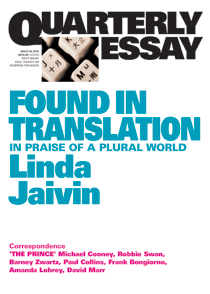
Linda Jaivin, Found in translation: In praise of a plural world (Review)

Linda Jaivin, Found in translation Book cover

Courtesy: Black Inc

Reading synchronicity strikes again! In the last couple of months, the issue of language, translation and culture has been crossing my path – in Diego Marani‘s The last of the Vostyachs, in Gabrielle Gouch’s Once, only the swallows were free, and on Lisa’s blog post about the AALITRA Symposium on Translation. I was consequently more than happy to accept a review copy of the latest Quarterly Essay, Linda Jaivin’s Found in translation.

Now, as some of you know, I have mixed feelings about reading books in translation. I want to read them because I want to read not just about but from other cultures. Not being fluent in all the languages of the world, the only way I can do this is to read works in translation, but when I read a translated work I am very conscious that there is a mediator between me and the work. This bothers me. Linda Jaivin, herself a translator, knows exactly what I mean:

… it is absurd to speak of issues of literary style, rhythm – or any aspect of a translated work aside from its structure, characters and plot – without acknowledging that the language of the text is at once a creation of the translator and an interpretation of the author …

And she gives good examples to support her statement. I was pleased to see her acknowledge this, because she knows of what she speaks! But, this little point is only a very small part of Jaivin’s wide-ranging, entertaining but also passionate essay. Jaivin, if you haven’t heard of her, is a multi-skilled woman: she subtitles Chinese film and television and translates Chinese text; she has worked as an interpreter; and she has written novels, stories, plays and essays.

As a reader and lover of words, I enjoyed Jaivin’s discussion of the technical and philosophical challenges faced by translators. She peppers her discussion with an eclectic but fascinating array of examples. And she quotes other translators, such as Edith Grossman who wrote that

a translation is not made with tracing paper. It is an act of critical interpretation … no two languages, with all their accretions of tradition and culture, ever dovetail perfectly.

Take swearing for example. How we swear is highly cultural. Swear words, Jaivin writes, “expose what is forbidden, what is permitted and what is held sacred” in a culture, and consequently “can  throw differences in worldviews into sharp relief”. However, you’ll have to read the essay, if you want to see her examples!

I was intrigued by her argument that translations of classics go out of date! So, this means that the Spanish will always read the same Don Quixote but English speakers are very likely to read a different translation depending on which one is currently in vogue.

“… a culture doesn’t grow just by talking to itself …”

But, the critical point of her essay is not the act of translation. As the title of her essay implies, Jaivin is passionate about pluralism, and more, about cosmopolitanism. By this, she means not just living side by side, not just accepting each other, but “sharing a common vision”.

Australian Women Writers ChallengeFor Jaivin, “translation” is not a narrow concept. Its implications extend far beyond the “simple” translation of words from one language to another, because attached to language are meanings and ideas. When ideas are translated – via words – from one culture to another those ideas change. Jaivin describes how concepts such as Confucianism and yes, even democracy, change when they cross cultures. This can lead, she says, to misunderstanding but it can also provide “room for the kind of creative interpretation that allows cultures and the conversations between them to grow and evolve”.

She argues that, because of Australia’s particular history and geography, and because Mandarin is the most commonly spoken language in Australia after English, “Australia is … in a unique position to translate the shift from the ‘American century’ to the ‘Asian one’ …”.

Building successful international relationships, she believes, requires genuine communication, which includes knowing, recognising and respecting other languages. It

does not require the weak to adopt the language of the strong – as reliance on English threatens to do, given its global and frequently imperial reach.

Jaivin argues that learning a foreign language should be a compulsory part of year 12 and university education, because “we need to have every possible line of communication open to us” if we are to successfully traverse the changes coming.  Not everyone agrees. What do you think?

Linda Jaivin
“Found in translation: In praise of a plural world”
in Quarterly Essay, No. 52
Collingwood: Black Inc, November 2013
103pp.
ISBN: 9781863956307

(Review copy supplied by Black Inc.)

Meanjin’s Tournament of Books 2013, Round 1

Hmm, when I announced this year’s Meanjin Tournament of Books over three weeks ago, I thought I’d be back before now with an update. However, the last match in Round 1 was only posted a couple of days ago, and I wanted to wait until the Round was finished before reporting back. So, here I am now, with Round 1’s results …

Round 1 Match 1: Margo Lanagan’s Sea hearts defeated Favel Parrett’s Past the shallows

Now this is a round between books I haven’t read, so I have no vested interest here. The judge Laura Jean McKay is a writer-performer who has been published in places like Best Australian stories and The Big Issue. She had a hard job – though what Meanjin Tournament judging isn’t hard, do I hear you say? – as both books have received significant critical acclaim since their publication. Sea hearts was shortlisted for this year’s inaugural Stella Prize, while Past the shallows was shortlisted for the 2012 Miles Franklin Award. Meanjin showed their strategic hand when pitting these two against each other! McKay observes that both “are told through very similar landscapes and lifestyles—though the first is Australian and the latter presumably Scottish. As well as the motifs of island and fishing life, both books are a comment on effects of these lives on women and their sons”. Parrett’s book she says is a “desperately sad and realist story of a rural Tasmanian fishing family torn apart by jealousy and death” while Lanagan draws on the selkie myth to tell her story of women, men and fishing. McKay doesn’t want to make a decision but, she says, “our relationship with the sea is unfair” and so she makes a choice. Lanagan wins by a seal’s whisker for coaxing McKay under to a place from which she never wants to emerge. Hmm!

Round 1 Match 2: Kim Scott’s That deadman dance defeated Kathryn Heynman’s Floodline

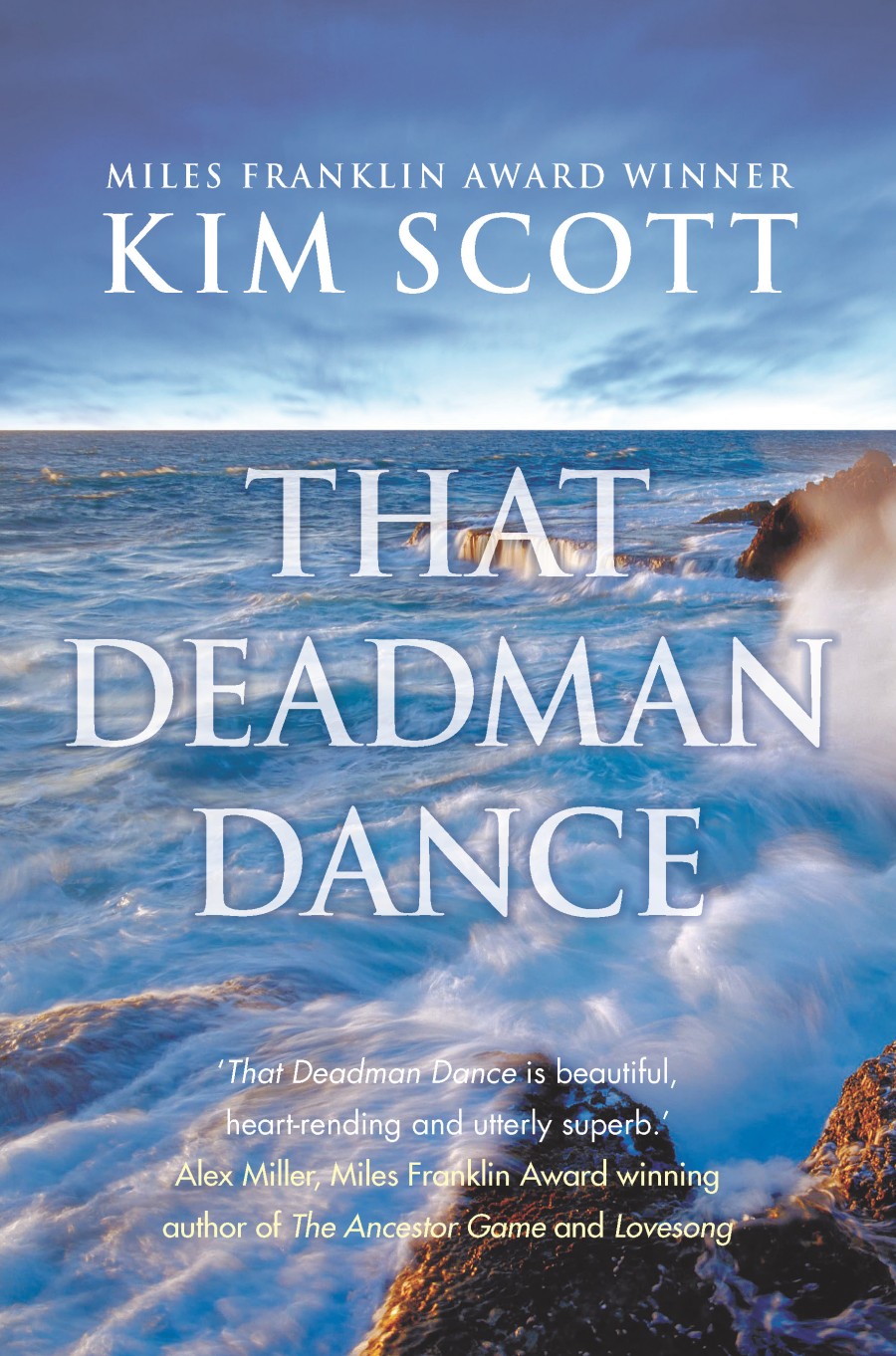
Kim Scott That Deadman Dance

Now, I admit that I don’t know Heynman or Floodline, but I reckon it would have taken a super-extraordinary book to beat Kim Scott. Heynman should take comfort from that. She could have lost to way lesser mortals! Judge Peter Taggart is a Queensland-based writer and theatre critic. Unlike McKay, he is very clear about which book is the winner and why. He appreciates much of what Heynman does but says that Floodline, a novel that explores the hypocrisy of Christina morality, recedes from memory while That deadman dance, with its powerful protagonist in Bobby, “lingers, which is why That Deadman Dance must take out this round”. Can’t argue with that. Scott’s wonderful book (my review) is not easy to forget, and will, I suspect, be a hard one to beat.

Round 1 Match 3: Jaya Savige’s Surface to air defeated Nevil Shute’s On the beach

I must say that, while I haven’t read Savige’s book and I loved Nevil Shute as a teen, I’m not surprised by this result. The mysterious judge, First Dog on the Moon, and I are in agreement. However, why First Dog chose Savige is not exactly clear – you can read the adjudication yourself at the link above – so I will just say that while I loved Shute’s dystopian novel when I was 15, I was disappointed when I read it a decade or so ago. Shute is a good story-teller – his books make great movies – but the characters were too stereotyped and the writing a little too prosaic to engage me beyond the basic story. Enough said. So, I must check out Surface to air which is, apparently, a collection of poetry.

(PS First Dog on the Moon is Walkley award-winning cartoonist Andrew Marlton)

Round 1 Match 4: Tim Winton’s Breath defeated Kate Grenville’s The secret river

Tim Winton, Breath

What a shame that these two books met in the first round – particularly since they are two of the four books I’ve read! Judge Tseen Khoo, a senior adviser in Research Development at RMIT University, had a hard job having to choose between these two great books, but I think, given the “sea” theme, that Tim Winton had to win. How could we not have Winton, our most famous chronicler of things oceanic, in the next round? Seriously, though, Khoo goes into some detail to explain her adjudication. Her decision, rightly or wrongly, comes down to the fact that she’s uncertain whether The secret river “changes conversations in Australia’s present about its past” – and she’d like it to. On the other hand, while she feels that Winton’s protagonist “never grows into measures of self-confidence and joy in life”, the book “left me haunted in an enduring way”. Grenville’s book, she said, felt like a book she’d read before, while Winton’s was unfamiliar and “not comfortable”. Much as I love both books, I think that’s a very good reason for choosing one work of art over another.

Recap

And so, we have 4 books – three novels and one book of poetry – going into Round 2:

  • Margo Lanagan’s Sea hearts
  • Kim Scott’s That deadman dance
  • Jaya Savige’s Surface to air
  • Tim Winton’s Breath

OK, so I’ve read two of these – Scott and Winton. Watch this space, to find out which two books will be in the finals …

Gabrielle Gouch, Once, only the swallows were free (Review)

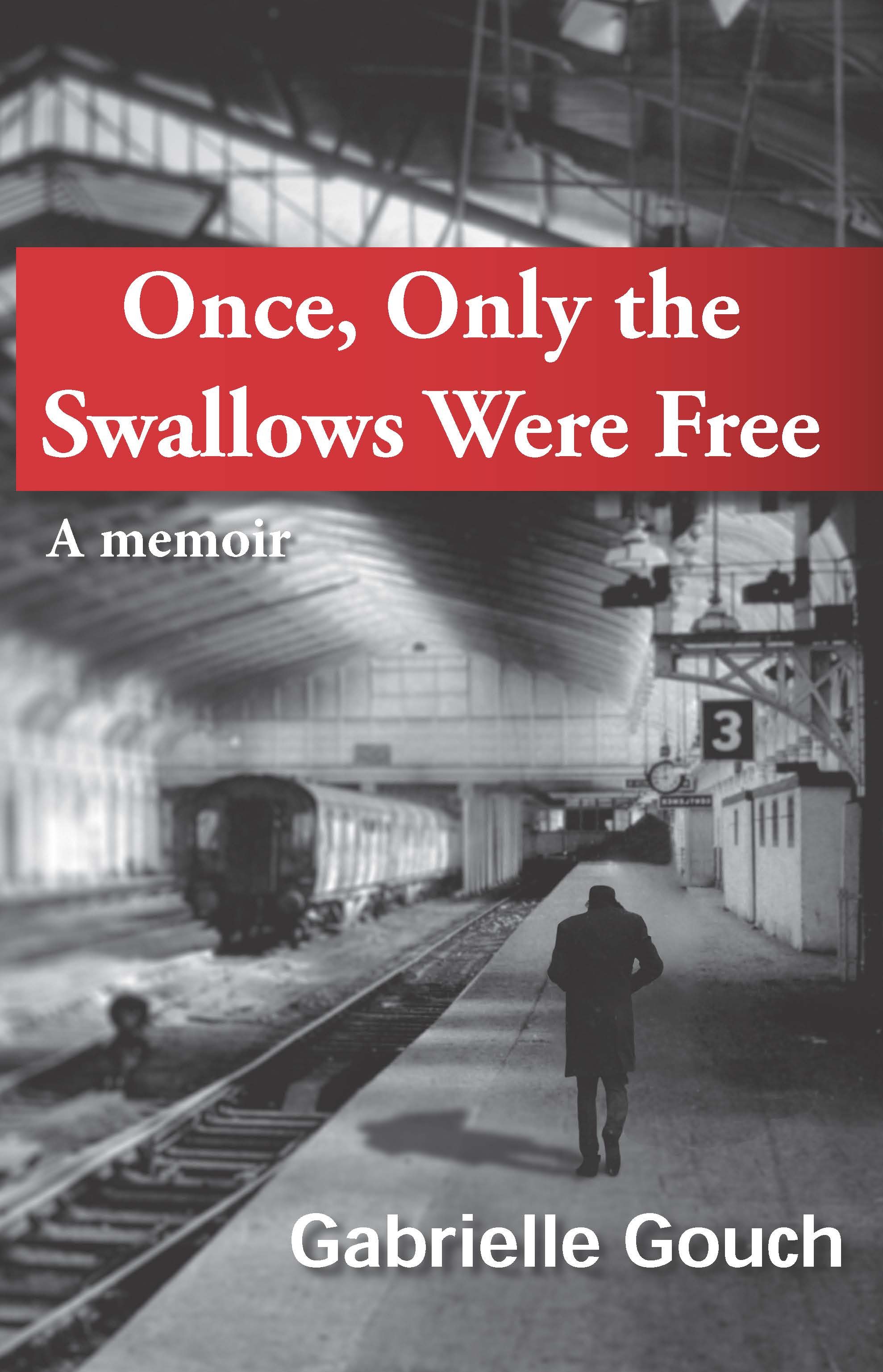
Gabrielle Gouch, Once, only swallows were free

Courtesy: Hybrid Publishers

Do you differentiate memoir from autobiography? I do. For me, a memoir, such as Gabrielle Gouch’s Once, only the swallows were free, deals with a specific aspect of a person’s life, such as a sportsman writing about his career when he retires from it or a person writing about her growing up, like, say, Alice Pung‘s Unpolished gem. An autobiography, on the other hand, I see as something more holistic, something written near the end of one’s life and summing up its entirety. What do you think?

Gabrielle Gouch was born in Transylvania, Romania to parents who’d both fled anti-Semitic Hungary. She moved elsewhere in Romania with her family before they emigrated to Israel, without her older half-brother, when she was around 20. A few years later, she emigrated on her own to Australia which has remained her home ever since. This is the basic chronology of her life, but Gouch is not really interested in telling us this story chronologically – and in fact, she’s not really interested in telling us the story of her life. What interests her is the brother, Tom, left behind. She wants to know about his life during and post communism in Romania. She also wants to know about the gaps in her knowledge of the family.

Gouch therefore doesn’t tell the story in a simple chronology. While she clearly signposts where you are as you read, I found it a little disconcerting to start with, until I felt familiar with the places and people she was writing about. This, however, could be due to other things going on in my life as I started this book. The memoir starts in 1990 with her first return to Transylvania after “the collapse of communism. The eternal and invincible communism”. A return that took place 25 years after she had left. As the book progresses, she visits Cluj several times, catching up with her brother, learning about her family. It’s a sad story – not surprisingly. Tom’s mother, the much beloved, vivacious Hella, died in childbirth. His – and eventually Gabrielle’s – father, Stefan, married the nanny, refugee Roza, hired in to look after the physically handicapped Tom. (As far as I can tell, his condition is hemiplegia, probably caused by the forceps birth). Roza and Stefan went on to have two children – Gabrielle and, somewhat later, Yossi – but country girl Roza was never accepted by Stefan’s well-to-do family.

The book proper starts in 1962 with the family expecting permission to migrate to Israel to arrive any minute. Of course, it doesn’t – and it is not until some 40 or so pages and three years later that they are finally able to leave. They leave without Tom, now well into his twenties, but exactly why this is so is not understood by Gouch. During the course of the book she finds out why – and she finds out what Tom’s life was like under the communist regime. It’s a very interesting story, and once you master the time shifts across the book’s seven parts, it’s a very readable one. The very short Part 2, for example, returns to the opening of the book, her return in 1990. Then Part 3 jumps to 2002 and another trip of hers “home”. From then on the focus is her time with Tom and the stories she gradually pieces together.

Gouch is a good writer. Her language is expressive, but not over-done. That is, she has some lovely turns of phrase that capture moments and people well. Here, for example, she describes her family’s reaction when her mother says something surprising:

We looked at her as if she had made her way into our home by the back door somehow, a woman we had never met before.

And I like this simple description of children:

Well, children are like shares, you never know how they will turn out.

There are two main threads in the book, one being life under communism, as experienced by Tom, and the other being the life of the emigrant, as experienced by her family. The book is enlightening for people interested in either of these topics, but I’m going to highlight the second, the emigrant’s life, because she explains it beautifully – from the tough life her parents experienced in Israel to her own experience of dislocation from culture. She writes, as she starts to reconnect with her brother:

Noone ever told me that you cannot turn physical distance into emotional one, you cannot forget your native country, you cannot give up your mother tongue. It deadens you inside.

She gives one of the best descriptions of the relationship of language to culture that I have read. She meets an old professor who had chosen to stay living under the repressive regime because, he said, “This is my native land, my language. I belong here.” She writes:

His words lingered. ‘My native land, my language.’ For most people, the sound of Hungarian is awkward; for me it is poetry and delight. When I say ‘flower’ in English I refer to a plant with petals and colours. But the word in Hungarian, virág, sounds to me melodious and joyful. Yes, you can learn to speak a language, you can even learn to think in a language but will you feel the same joy and sadness at the sound of those words? Feel the black desperation or be uplifted by hope? Will the word love evoke the same tenderness and ardour? I don’t think so.

Australian Women Writers ChallengeGouch also writes about “history”, about the impact on people of living through some of history’s trickiest times, as her family had. Her description of her father’s life – a loving father who had worked hard – is heart-rending:

A man who was a Jew but not Jewish enough, an Israeli but not quite, a Hungarian Jew among Romanians and a Jew among Hungarians. Finally he left this world with its divisive nationalisms, ideologies and religions which had marred most of his life. He was just another man on whom history had inflicted its painful and murderous pursuits: Nazism, the Second World War, the communist dictatorship, the Arab-Israeli conflict and Israeli religiosity. History had match-made him, history had controlled his life. It was over. He joined the infinite Universe.

I’ve possibly quoted too much, but Gouch’s words are powerful and worth sharing.

“Knowledge”, Gouch’s father once told her, “is your only possession”. Once, only the swallows were free is a story of discovery for Gouch, but for us, it provides a window into a particular place, time and experience that most of us know little about. The knowledge, the understanding, we gain from reading it is a precious thing.

Gabrielle Gouch
Once, only the swallows were free: A memoir
Melbourne: Hybrid Publishers, 2013
279pp.
ISBN: 9781921665998

(Review copy supplied by Hybrid Publishers)

Melissa Lucashenko, Sinking below sight (Review)

In this week’s Monday Musings about the Walkley Awards, I noted that Melissa Lucashenko had won the award for Long Feature Writing for her essay “Sinking below sight: Down and out in Brisbane and Logan” in the Griffith Review. I’ve now read the essay, and thought I’d share it with you. I’ve reviewed Lucashenko before, an essay and a short story. I really must get to one of her novels one day!

With her mixed European and indigenous Australian heritage, Lucashenko is well placed to tackle significant contemporary issues and see them from multiple perspectives. The last essay of hers that I reviewed, “How green is my valley”, dealt with stewardship of the land and the threat imposed by climate change. In “Sinking below sight” her subject is poverty. Lucashenko’s essays make engaging reading. Instead of dry reportage, she starts from the personal, and from that draws conclusions that make sense. And so, while “How green is my valley” drew from her experience on a farm in northern New South Wales, this essay draws from her return, after losing her farm through divorce, to the town of Logan, one of Australia’s ten poorest urban areas.

You’ve probably noticed that her subtitle alludes to Orwell’s autobiographical work Down and out in Paris and London which chronicles his experience of poverty. Similarly, Lucashenko writes that she’s been poor before, so “I had the skill set”. But, this essay is not about her. She starts by setting the scene, describing this “Black Belt” region as one in which

Welfare recipients and the working poor … don’t necessarily realise they are hard up. More accurately, many don’t realise just how poor they are, since everyone in their lives is battling.

She then moves on to the main topic of her essay, which is to find out “How do my Black Belt peers manage? How do single mums, in particular, get by on current levels of welfare? And what dreams are possible for the Brisbane underclass in 2013?” To answer this interviews three women currently living in poverty – Selma (27), Marie (38) and Charmaine (49) – and discusses their situations.

Selma, a Yugoslavian of Serbian and Croatian parents, has four children under ten and a partner who is in and out of jail. Having been a refugee and then involved with an abusive Aboriginal man, Selma has some clear views on her situation:

What I don’t like in society … is the judgments put on Indigenous and refugee and domestic violence people. I was in that situation for nine years. They say you make a choice, but I don’t ever remember choosing to be beaten up! From the age of seventeen ’til about two years ago, domestic violence was part of my everyday life.

She blames poverty for violence, saying that “poverty breeds hate”. Lucashenko suggests that the abuse she experienced “had roots also in the trauma and racism of the refugee experience.”

Marie is also a mother of four, with an “on-again, off-again partner”. She is a member of the “working poor” so not quite as poor as Selma. She grew up in a troubled home, had been sexually molested as a child, and was living independently by the time she was 14 years old. She, like Selma, had a history of “severe emotional and physical abuse from her previous partners, who were all, bar one, Anglo-Australian men”. Lucashenko writes:

Marie spoke to me of feeling enormous rage about the past abuses in her life, rage which sits constantly just beneath the surface.

The third woman is Charmaine, “blond, slim and still able to laugh despite a life that would crush most of us [and] the white Australian mother of four Aboriginal kids”. She too was raped and molested as a child, and ended up in a violent relationship in which she stayed too long.

Australian Women Writers Challenge

While recognising that her examples are more anecdotal than statistical, Lucashenko nonetheless draws some conclusions. They include:

  • Underclass expectations, which see people who grow up with nothing, expecting little
  • The importance of public housing in providing some “minimal prospect of safety”
  • Loneliness and isolation, which drive single mums back to “untenable situations”
  • Violence and mental illness in parents and partners, which entrench poverty for women
  • Childhood molestation and/or rape, which all three women had experienced
  • Women seeking relief in drugs, which of course can initiate new downward trajectories

Her three women, Lucashenko finds, have hopes for the future. Selma and Charmaine are studying, because, as Lucashenko writes

Realising that poverty is a creation of society and its choices, these two women also know that their lives might shift through higher education.

Pragmatic Marie has a saving plan. Their situations though are tenuous. To achieve their goals, they’ll need strength. Better still, though, would be if they got effective financial and other practical support.

Lucashenko opens the essay with the epigraph that “the opposite of poverty isn’t wealth. It’s justice”. Her essay may not be statistically significant from an academic perspective, but anyone who reads contemporary social commentary knows that what she writes rings true – and this, clearly, is why she won the Walkley.

Melissa Lucashenko
“Sinking below sight”
Published in the Griffith Review, Edition 41, 2013
Available: Online at the Griffith Review

Richard Rossiter (ed), Knitting and other stories (Review)

Richard Rossiter, Knitting

Courtesy: Margaret River Press

Short stories, I’ve decided, are the ideal reading matter for breakfast, so for the last couple of weeks I’ve been engrossed in Knitting and other stories, which contains a selection of stories from this year’s Margaret River Short Story Competition. The competition is new, having been offered for the first time last year. According to the Margaret River Press’s website, there were 260 entries. This book contains 24 of them, including of course the winner and runner-up, and four highly commendeds.

The collection takes its title from the winning story, Knitting, by Barry Divola. Divola is one of the only two names I recognise in the book, the other being Jacqueline Wright whose first novel, Red dirt talking, was published last year. Knitting is a rather apposite title because most of the stories are about characters whose lives are unravelling – or have unravelled – in some way. And not all manage, by the end of their stories, to knit themselves together again, which is realistic even if it makes us readers feel a little unravelled ourselves!

As I was reading the stories a few things became apparent. Most of them are by women (20 of the 24 in fact). Does this represent the gender ratio of stories entered? Not that it matters, but it’s interesting, partly because it also means that, with a few gender-crossing exceptions, most of the stories focus on women. I noticed some recurring themes, about which I’ll write more below. And, I became aware, through connections between theme, character and/or setting, that the order of the stories had been crafted. Rossiter’s introduction, which I read after finishing the book, clarified that he had indeed grouped stories together. I think it enhanced the reading. There is always a jolt when you move from story to story, particularly if you read them without a break. Grouping them not only lessens the jolt but somehow encourages the brain to think beyond the immediate story. Karen Lee Thompson who has also reviewed this book feels quite differently about “contrived” ordering.

Another thing I noticed was that the majority of the stories seemed to be told in first person. Fifteen of them in fact. One is told in second person, making eight in third person. Does this matter? Probably not. First person can provide a level of intimacy that you don’t quite get with the other voices and I enjoy that. But, when you read one after another, no matter how well written they are, all the I, I, I can feel a bit tedious, a bit self-involved. This is not a comment on the individual stories so much as on the impact of the whole. Fortunately there are some lovely third person stories in this collection to break up the I-ness! And Amanda Clarke, in “The girl on the train”, uses the second person effectively to convey the dissociation experienced by a woman grieving over her daughter’s death. Describing her grief as “a vicious sort of cling wrap”, she is both trapped in and standing apart from herself. The “you” voice captures this beautifully.

Now to that old problem of how best to review a collection. For this one, I think the best approach is through its themes, and I’ll start with the one that stood out for me – grief, grief for people who have died, or for broken relationships or lost opportunities. Kristen Levitzke’s “Solomon’s Baby” about a baby’s death is particularly wrenching, but there are stories about grandchildren and grandparents (Vahri’s “I shine, not burn” and Louise D’Arcy’s “Down on the farm”) and people grieving for lost time and opportunities (Jacqueline Winn’s “The bitter end”), to name just a few.  Other recurring themes are memory, growing up, ageing and, either explicitly or implicitly, time. Jacqueline Winn’s “The bitter end” starts:

Let’s not fool ourselves, time is not something to be negotiated. Time passes through us or we pass through time. No second thoughts, no second chances.

Family and family relationships are common subjects. In many stories, a parent is missing – either through death, or separation – creating a gap that can have lasting ramifications. One of my favourite stories in the collection is JS Scholz’s “Focus” about a young boy who’s on the run with his mother from his abusive father. Seen as a “hopeless” student who can’t “focus”, he uses his initiative to carry out a subversive action which shows his true character. In another favourite story, Kathy’s George’s cleverly named “A bend in the road”, the temporary absence of the father creates a tension between a mother and son. The daughter, though, sees the real issue:

“The family is a board game, a game with a missing piece … and nobody can play the game without the missing piece. Not properly anyhow.”

In some stories, it’s the chance meeting of strangers which throws light on the protagonists’ situations. Amanda Clarke’s second-person-story is one of these. In Kerry Lown Whalen’s “Notes in a scale” and Bindy Pritchard’s “The bees of Paris” the strangers are also neighbours.

While most stories are about character and family relationships, not all are. One such is John Dale’s “Expressway” which satirises the need to believe. It’s the story of a smudge on the wall of the Cahill Expressway which Francesca Lombardo believes is an image of the Virgin Mary. This sets in train a series of events including the removal of the section of the wall to Darling Harbour “which had better facilities and all day parking”. The government, talk shows, scientists, and social media are all targeted in this fun but pointed story about, at best, our desire for miracles and, at worst, our gullibility.

There is some lovely writing here, but I’ll just share two short examples. Dorothy Simmons describes the bush in her story, “Off the map”, about a young girl who is an orienteering champion:

All the little movements: lizard flicker, goanna slither, leaf rustle, sleek silvery trees posing beside slouching shaggy grey ones; cicada hum, magpie trill, whip bird …

The other is Paulette Gittins’ description in “Playing with Ramirez” of a gang of children coming down a Melbourne suburban street:

Down the street towards me a vaulting, whooping gang in stripes, red and black, blue and white, shrilling, colliding, hilarious; black-haired, scrawny, curly and nimble, they poured past.

As with any collection, some stories touched me more than others, but all have something to offer, something to say, about living and surviving in a world that for many, as Divola writes in the title story, “is too sharp [with] edges everywhere”. A most enjoyable read.

For other reviews of this collection which highlight some different stories, check out Karen Lee Thompson (in her review mentioned above) and Anne Skivington.

Richard Rossiter (Ed)
Knitting and other stories: Margaret River Short Story Competition 2013
Witchcliffe: Margaret River Press, 2013
319pp.
ISBN: 9780987218087

(Review copy supplied by Margaret River Press)

Delicious descriptions from Down under: Lebkowicz and Moorhouse on 1950s Canberra

At the beginning of this year I reviewed Frank Moorhouse‘s Cold light (my review) which commences with the arrival of his protagonist, Edith Campbell Berry, in Canberra in 1950. The Petrovs, the subject of Lesley Lebkowicz’s The Petrov poems (my review), arrived in Canberra in 1951.

Lebkowicz’s description of Canberra accords very much with Moorhouse’s. The second poem in her verse novel is “Canberra”. It is one of the unrhyming couplet poems in the book – and is also one of the poems that concludes on a single (and significant) line. I’d love to quote it all but I’m not sure about the copyright rules regarding individual poems in a verse novel – so I’ll assume I can quote a goodly percentage of the poem but not all of it*. The poem begins with a lovely description of  the quiet, the space, the birds, and uses that colour most associated with Patrick White, “dun-coloured”, to describe the grass. It then continues

… Their house is between

Kingston and Manuka where shops
for clothing and food squat close to the ground.

There’s a news agency, a shop for sewing materials,
a furniture store – but no cafés, no restaurants.

Civic has two-storey buildings with cloisters
where in winter the wind from Cooma sharpens the cold

into blades. She shivers. All around sheep huddle
and graze, but in Griffith they have a whole house

to themselves: a whole house and plenty of food.

Compare this with Moorehouse’s Cold light. Edith has been offered the honorary (!) job of town planner. She does a lot of reading, and appreciates Walter Burley Griffin‘s** passion and is awed Marion Mahony Griffin‘s gorgeous drawings:

She even had a small vision of her own – about the lucerne. Why not have a working farm in the heart of the city? With cows and and sheep and haystacks. Didn’t Marie Antoinette have her farm – the petit hameau?

She doesn’t voice this to her “boss”, Gibson – “she might not mention this idea at this moment” – which is just as well:

He said, “What we need are more verticals, more variation of skyline, blocks of flats, spires.”

She thought not. Gibson did not have the awe of the plans there in his office; maybe he was past that.

Gibson said, “Griffin didn’t want skyscrapers because he wanted low, large buildings so that light and air could play their parts. Now we have too bloody much of both. Pardon my French. We have too much light and too much air and too many trees and too little else.”

She smiled to put him at ease.

Sixty years later, we are still planning Canberra. We are still arguing about the verticals. How high or how low should we go? And about the green (or dun-coloured as the case may be) spaces. Should we fill some in? But perhaps all cities are like this? In Meanjin‘s The Canberra issue (my review), journalist-author Chris Hammer says, “The city is evolving as the nation it serves is evolving …”. And that, I think, is as it should be.

* The full version is, however, on line at Verity La, albeit not formatted the way it is in the book.
** To read more about the Griffins and Marion’s drawings in particular, see here and here (click on the illustration to see it in better detail.)