Delicious descriptions from Downunder: Isabella Bird on Nikkō in Japan

Woodwork on temple in Nikko, Japan

Carved birds and animals at Toshō-gū Shrine, Nikkō, Japan

This is one of those Delicious Descriptions that is from Downunder but is not of Downunder, if you know what I mean. It’s actually of Japan – as you observant readers will already know given the title of this post – and it comes from Isabella Bird‘s Unbeaten tracks in Japan to which I referred in my first Japan trip post in May.

One of Bird’s first stops after leaving Tokyo was Nikkō, now designated as a UNESCO World Heritage Site for its astonishing complex of shrines and temples. It was, it appears, no less astonishing in the late 19th century than it was for us when we visited it in 2006. Bird spends quite a few pages describing it, but I thought I’d share this one for now:

The shrines are the most wonderful work of their kind in Japan. In their stately setting of cryptomeria, few of which are less than 20 feet in girth at 3 feet from the ground, they take one prisoner by their beauty, in defiance of all rules of western art, and compel one to acknowledge the beauty of forms and combinations of colour hitherto unknown, and that lacquered wood is capable of lending itself to the expression of a very high idea in art. Gold has been used in profusion, and black, dull red, and white, with a breadth and lavishness quite unique. The bronze fret-work alone is a study, and the wood-carving needs weeks of earnest work for the mastery of its ideas and details. One screen or railing only has sixty panels, each 4 feet long, carved with marvellous boldness and depth in open work, representing peacocks, pheasants, storks, lotuses, peonies, bamboos, and foliage. The fidelity to form and colour in the birds, and the reproduction of the glory in motion, could not be excelled. (Letter VIII)

It is, as Bird says, simply marvellous, full of wonderful details that you can spend hours wandering around. However, during Bird’s stay:

there were two shocks of earthquake; all the golden wind-bells which fringe the roofs rang softly, and a number of priests ran into the temple and beat various kinds of drums for the space of half an hour.

Nikkō apparently means “sunny splendour”, and it sure is that – but how vulnerable it is.

Monday musings on Australian literature: Reading about Australian women writers

Books about Australian women writers

Some favourite books about Aussie women writers

In the 1980s my interest in Australian literature, which had been initially kindled by my parents and school, was renewed.  In the 1980s, too, women writers started to flourish again. Consequently, this second wave interest of mine was drawn particularly to these women.

I read their books of course (I’m thinking particularly of Elizabeth Jolley, Olga Masters, Beverley Farmer, Jessica Anderson, Thea Astley, Kate Grenville and Helen Garner), I attended talks where I could, and I read books about them and their predecessors. I loved the books about them! Not all of these books will still be available for purchase but they will be in libraries (in Oz anyhow) and so I thought this week I’d share some of my favourites, listed in their order of publication.

  • Drusilla Modjeska‘s Exiles at home: Australian women writers 1925-1945 (1981) is the one I don’t have, but I have borrowed it a few times from the library. She looks at the challenges confronting the women writing in the earlier part of the twentieth century. I have reviewed and/or mentioned a few of these women in past posts. They include: Miles Franklin,  Marjorie Barnard and Flora Eldershaw (who also wrote jointly under the name M. Barnard Eldershaw), Eleanor Dark, Jean Devanny, Dymphna Cusack and Katharine Susannah Prichard. Most of these women were politically engaged, with Prichard (for one) specifically identifying herself as Communist.
  • Jennifer Ellison’s Rooms of their own (1986) which of course takes its title from Virginia Woolf’s wonderful, pleading book on behalf of women creators. This book comprises interviews Ellison conducted with significant writers at the time. I still dip into it every now and then. She interviews: Blanche d’Alpuget, Jessica Anderson, Thea Astley, Jean Bedford, Sara Dowse, Beverley Farmer, Helen Garner, Kate Grenville, Elizabeth Jolley, Gabrielle Lord, Olga Masters, and Georgia Savage. Naturally, the gender issue is explored, but other issues relating to writing, publishing and the role of writers in society are also discussed.
  • Debra Adelaide‘s A bright and fiery troop: Australian women writers of the nineteenth century (1988). The great thing about this book is that it shows us the depth of women’s writing in Australia. It comprises essays by literary experts, most dealing with specific writers like Louisa Atkinson, Catherine Helen Spence and Ada Cambridge. It also includes an essay by Elizabeth Webby on nineteenth century women poets.
  • Debra Adelaide’s Australian women writers: a bibliographic guide (1988) was published, appropriately, by Pandora Press. It’s the driest of the books I’m listing as it is a bibliography – but it is lightly annotated with a brief description of each writer. In the mid 2000s, I used this book to help populate Wikipedia’s listing of Australian women writers. I thank Debra Adelaide for making that task so easy!
  • Gillian Whitlock’s Eight voices of the eighties: Stories, journalism and criticism by Australian women writers (1989). This one is, really, an anthology of selected writings by the writers included but there’s a good  introductory essay and a brief introduction to each of the writers. The writers are, well, pretty much the usual suspects: Kate Grenville, Elizabeth Jolley, Barbara Hanrahan, Jessica Anderson, Beverley Farmer, Thea Astley, and Helen Garner. In her introduction, Whitlock quotes Jolley as describing the 1980s as “a moment of glory” for the woman writer, a time when as Whitlock writes, “women writers and readers … entered the mainstream”. What a shame it is that in terms of writers, at least, things seem to have slipped backwards (yet again).

There are more books and bibliographies on the topic – many dealing with individual writers. Just do a Trove (National Library of Australia) search on “Women authors, Australian” or “Australian Literature – Women authors” or similar keywords and you’ll retrieve a goodly list. Meanwhile, the books keep coming. The most recent addition to my little collection is Susan Sheridan’s Nine lives which was published this year and covers post-war writing by women in AustraliaI haven’t read it all yet but you will probably see a review in the future.

Do you like to read about writers and writing, and if so do you have any favourites?

Tangea Tansley, A break in the chain: The early Kozminskys

Bookcover for Tansley's A break in the Chain

Book cover* (Courtesy: Affirm Press)

In the postscript to her novel A break in the chain, Tangea Tansley quotes Doris Lessing‘s statement that ‘fiction is better at “the truth” than a factual record’. This gets to the nub of my challenge with this book, which is a fictionalised account of three generations of the author’s family, particularly her great grandparents and grandparents. As I was reading it I was reminded of Kate Grenville‘s discussion in Searching for the secret river on how she commenced writing The secret river as nonfiction and ended up writing fiction. But more on that anon.

There’s a lot to like about this book, particularly if you are interested in Australian social history. It starts in Prussia in 1856 with a young man, Simon Kosmanske (later Kozminsky), playing violin to the cows on his father’s dairy farm. His father, Moses, does not think Simon is taking his work seriously enough, and so orders him to “Go to Australia and make an old man proud”. Australia, at the time, was of course at the height of the gold rush and was many a man’s destination. Simon, though, didn’t want to go, but go he did – and he eventually established Kozminsky, the fine jewellery and objet d’art store that still operates in Melbourne.

The novel chronicles in five parts the story of Simon, his marriage to Emma, and of his son Israel and his marriage. The first part which describes Simon’s trip to Australia and his first years in the colony as he tries to establish himself is fascinating. And then the story moves into the main drama which gives rise to the title. This drama centres on Judaism, its observance, and decisions made to marry within or outside of the faith. It is an intriguing story with some strong and interesting characters. However, as Tansley explains in her enlightening postscript, there are many gaps in knowledge about some of the key characters, particularly Emma. She writes:

For a family of journalists and writers, my family has left behind a sad lack of primary source material: no journals or diaries or letters and a dearth of documents of any kind. This meant that what was originally planned as a documented biographical work became instead a hybrid – a family memoir laced with fiction.

Those of you who know the Kate Grenville saga regarding The secret river will see why I was thinking of it as I read this book. I’m not sure that Tansley has pulled it off quite as well as Grenville. I wonder whether, in fact, she kept too close to the “facts” while aiming to write fiction. She writes, again in the postscript:

I resisted the temptation to write Emma into a fictional background, although Kozminsky family stories present a number of alternative lives for Emma.

Grenville, on the other hand, moved more thoroughly into fiction, changing the name of her protagonist from that of her ancestor, which freed her to explore more creatively just what might have happened in the lives of settlers like her ancestor. She did this because she found her factual account wasn’t working. Grenville says:

I was determined to write a book of non-fiction, but the only parts of this ‘assembly’ that were interesting were the ‘flights of fancy’ where I’d created the flesh to put on the bones of research. Where, in a word, I’d written fiction.

Grenville started off researching Solomon Wiseman because she “needed to know” what had happened in the early settlement, particularly between the settlers and the indigenous inhabitants. Tansley wrote her book to search out the “truth”, for past and future generations of her family but also “to fill what I see as a gap in the settler history of Victoria”. These goals she achieves pretty well, particularly the latter one, but I think she has used the story-telling mode of fiction to give us the “facts” rather than get to those larger “truths” that we can find in fiction. And this is probably because the story’s drama is hampered by her decision to not tackle the central mystery: what was Emma’s past that affected her so, and why, without giving anything away, did the family react as they did to Israel’s marriage? It is in this, I think, that the “truths” can be found. Without them, we have an interesting story, a good social history, but we don’t understand the real “truth” behind the “break in the chain”.

Overall, though, Tansley’s style is sure. She uses a chronological narrative structure, with a third person point of view in which the perspective shifts occasionally from character to character. These work well for the story she wants to tell. While there’s the occasional misstep in the writing (a forced image, or a too-obvious statement), she also writes some lovely descriptions particularly as the novel progresses and she warms to her story. Take this for example:

Bending to the ground he pulled at a shoot of grass only to find  that an entire yard of runner came loose with it. He flung it away. Damned rhizomes. They had a lot in common with extended families. Not much to be seen on the surface, but underneath you could be sure there was a vast network of tentacles working away in their subterranean hideout, linked for the term of their natural lives in dark and closeted conspiracy.

My final assessment? Well, it’s interesting for its social history. It’s also engaging for Tansley’s generosity towards her characters despite their flaws and the mistakes they make. And I enjoyed the opportunity it has given me to further tease out my response to the history-as-fiction question. I’ll conclude though on another question. Emma says to Israel that “the past is only good for the experience it provides”. Does this imply a duty to share the past (something Emma herself doesn’t do)?

Tangea Tansley
A break in the chain: The early Kozminskys
Mulgrave: Affirm Press, 2011
315pp.
ISBN: 9780980790467

Review copy supplied by Affirm Press

* The cover image is a detail from Frederick McCubbin‘s Study in blue and gold. The subject is Eileen Kozminsky, Tansley’s grandmother.

How do you handle Copyright on your blog?

Copyright notice by Open Source

Copyright (Courtesy: Joshua Gajownik, opensource.com, using CC-BY-SA-2.0)

Since the beginning of this blog I have been concerned about Copyright, and have worked through it in stages. I’m not a copyright expert and have no legal training, but I thought I’d share – in case it helps others – some of my thought processes over the last two years or so of my blog:

  1. I worried, in the beginning, about using other content on this blog, specifically images. I am careful about clearing the use of book cover images with publishers, and I check copyright statements for any other images I use on the blog. I attribute as best I can the creator of these images, and have found that creators (or copyright owners) are usually pretty easy to identify on sites such as Wikipedia and Flickr. But, there are many images that I have not used because I could not clarify their copyright situation.
  2. I then realised that I hadn’t made the situation clear about my own images and so, many months into the blog, I added a Text Widget for Copyright on Images. In this I stated my policy regarding my use of images from other sources, and I applied a rather loose Creative Commons licence statement for my own images.
  3. And then it occurred to me that I hadn’t properly clarified copyright on the rest of my content. Under Australian Copyright, anything I publish is automatically copyrighted to me, that is, I do not need to register for copyright in order for my content to be protected under copyright. However, as a (retired) librarian/archivist, I know how frustrating copyright can be  – in terms of knowing who owns copyright and how the copyrighted material can be used – and so today I have added a formal Creative Commons license to my blog (in the permanent sidebar) by using the Creative-Commons-Configurator and then adding the resultant html code to a WordPress Text Widget.

My Creative Commons Licence

Because I believe in collaboration, in sharing thoughts and ideas, my goal in choosing a licence was to make it easy for people to use my work without going through major hoops but to retain some rights for myself. The  licence I’ve chosen allows others to use my work (text and images in the case of this blog) under the following conditions:

  • Attribution. My work can be copied, distributed, displayed, adapted as long as it is attributed to Whispering Gums, with a link, where possible, to this blog.
  • NonCommercial. My work can be copied, distributed, displayed, adapted for non-commercial purposes only. Those who wish to use my work for commercial purposes must contact me for permission (wg1775[at]gmail[dot]com)
  • ShareAlike. Others may use my work in theirs, as long as they only distribute them under the same Creative Commons license that I’ve used for my work.

Note: None of these conditions overwrite rights protected under relevant copyright laws, such as fair use rights and moral rights. It is simply a licence by which I make clear how I, as a copyright owner, allow my work to be used.

Acknowledgement

I thank the Creative Commons people for the work they’ve done over the last 10 years in trying to both simplify and free up copyright for those of us who just want to create and share. May their work continue … as the world of creation, repurposing and distribution becomes more diverse and complex.

Monday Musings on Australian Literature: Writers’ retreats

Eleanor Dark, c. 1945

Eleanor Dark, c1945, by Max Dupain (Presumed Public Domain, from State Library of New South Wales, via Wikipedia)

The last Monday Musings in June was on Christina Stead‘s house and the current owners’ plans to modify it in a way that would spoil some of its heritage significance. The commentary on the post included discussion of how writers’ homes can be used. One rather apposite way is as writers’ retreats.

We have a few in Australia:

  • Eleanor Dark‘s Varuna in the Blue Mountains west of Sydney. Varuna was the home of Australian novelist Eleanor Dark and her husband Eric, and was given to the Eleanor Dark Foundation in 1989 by their son. Varuna’s website describes the retreat as “an environment totally dedicated to writing and offers writers ideal conditions in which to concentrate on their work. The success of Varuna absolutely depends on writers respecting the needs of their fellow guests – hence a few routines & conditions of stay.” This is clearly a serious place! The site also tells us that the retreat’s library has been catalogued onto LibraryThing. It might be an old house but it certainly seems up to date in using modern technology to support its services. Writers like Kate Holden, Toni Jordan and Cate Kennedy have all used the retreat – and recommend it.
  • Katharine Susannah Prichard Writers’ Centre in the hills around Perth, Western Australia. Established in 1985, it is located in Prichard’s home and is explicit about its twofold purpose: “Encouraging writing related activities in the Perth Hills whilst preserving the heritage value of the former home of leading Australian writer”.  The KSP website advertises that “the ambience of the Centre is excellent for creativity and inspiration. 20-60,000 words are frequently achieved by our Writers in Residence in a four week stay, in between enjoying the interaction with local writers”. I love the promise of productivity there!
  • Olvar Wood Writers Retreat, at Eudlo in the hinterland of Queensland’s Sunshine Coast. Having been established in 2008, it is the newest of the of the writers’ retreats and “sort of” meets the topic of this post. The Retreat was established by two Queensland writers, Nike Bourke and Inga Simpson, who bought a property with the purpose creating “an ethical, environmentally sustainable writers’ retreat”. It is their current home and a retreat: “Run by writers, for writers” is their catchphrase. For those who haven’t heard of them (like me, for example), Nike Bourke has a few books under her belt including The bone flute, her debut novel which won a Queensland Premier’s Literary Award in 2000, and Inga Simpson won a Scarlet Stiletto award for her short story, “Operation Bluewater”.

All three retreats offer more than retreat opportunities for writers and would-be writers. They run all sorts of seminars and workshops (such as writing in specific genres/styles such as memoir, crime, short stories, screenwriting); they offer prizes; they run events such as literary dinners and author talks; they offer fellowships; and they provide practical services such as critiquing and manuscript development. I wonder if they run courses for litbloggers? I’d be there in a flash.

I suppose writers’ retreats aren’t for everyone, but if you were of mind to go, how much more inspiring would it be to be in the home of a writer. I’d love to hear about other writers’ retreats you’ve come across, particularly if they are run from writers’ homes.

Red Dog (Movie and Book)

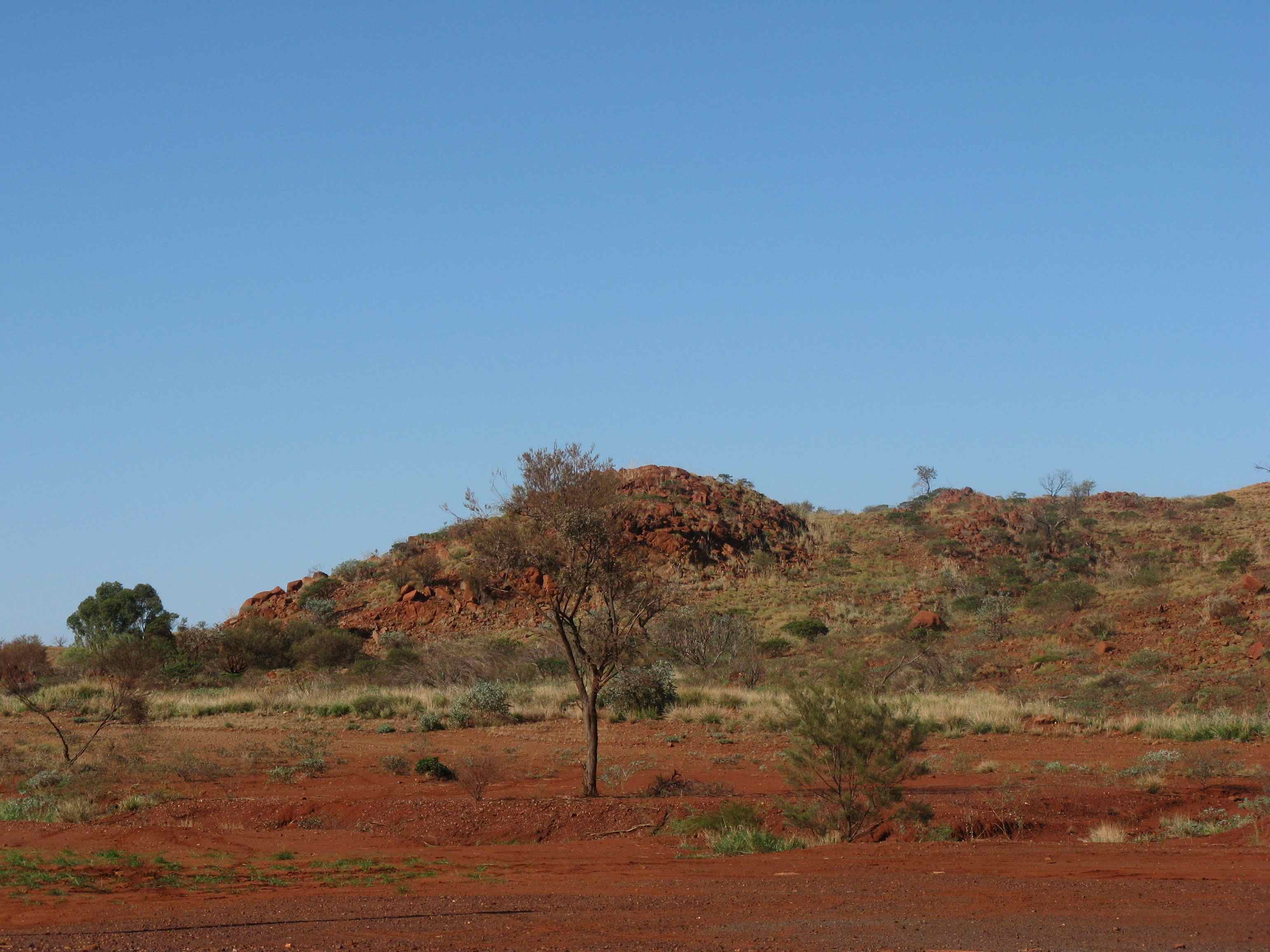
Pilbara landscape

Pilbara landscape

First, the disclaimer: I’m a dog person and am therefore a sucker for stories about dogs and their loyalty. I know, I know, it’s their nature, but that doesn’t stop me crying over doggie devotion stories. Red Dog is one of these! If dogs don’t move you, you may not want to see this film, but that would be a shame because while the dog – and it is based on a real dog – is the central idea, the film, and novel from which it draws, are about more than “just” a dog and his devotion to a master.

I first came across Red Dog – the (apparently famous) Pilbara Wanderer – several years ago through Louis de Bernières‘ novella (of sorts) which was first published in 2001. It’s a slim little tome and is based on stories de Bernières gathered about the dog, who lived from 1971 to 1979. De Bernières claims in his Author’s Note that the stories “are all based upon what really happened” to the dog but that he invented all of the characters, partly because he knew little about the people in Red Dog’s life and partly because he did not want to offend people by misrepresenting them. John though, he says, is “real”.

There is a simple plot in the book – it tells how Red Dog decides on John as his master and it then chronicles Red Dog’s various adventures in the mining communities of the Pilbara. The film follows de Bernières’ book pretty closely, though it takes a little artistic license, including adding a romance into the mix.

The story – and the film – is set in the Pilbara, the red earth country of Western Australia where mining is the main industry. It was – particularly back in the 1970s – a male dominated place and the workers at that time were mostly migrants:

It was lucky for him [Red Dog] that the town [Dampier] was so full of lonely men … They were either rootless or uprooted. They were from Poland, New Zealand, Italy, Ireland, Greece,  England, Yugoslavia and from other parts of Australia too. … Some were rough and some gentle, some were honest and some not. There were those who got rowdy and drunk, and picked fights, there were those who were quiet and sad,  and there were those who told jokes and could be happy anywhere at all. With no women to keep an eye on them, they easily turned into eccentrics.

And it is this* that the film, directed by Kriv Stenders, does so well … capturing men’s lives in a male dominated environment, against the backdrop of the starkly beautiful Pilbara. The cinematography is gorgeous, setting the region’s natural beauty against the ugliness (or beauty, depending on your point of view) of a mining environment. The music is what you’d expect, mostly 70s rock including, of course, Daddy Cool, but is appropriate rather than clichéd. And the dog is played by 6-year old Koko with aplomb!

The central story concerns John (Josh Lucas), Red Dog and Nancy (Rachael Taylor), but there are other smaller “stories” – the publican (Noah Taylor) and his wife, the Italian (Arthur Angel) who can’t stop talking about his beautiful home town, the brawny he-man (John Batchelor) who knits in secret, the miserly caravan park owners, to name just a few. Their stories are slightly exaggerated, and there is fairly frequent use of slightly low angle close-ups that give an almost, but not quite, cartoonish larger-than-life look to the scenes. These all work effectively to convey something rather authentic about character and place.

That said, occasionally the humour is too broad and the script a little clumsy – but these are minor. Overall, the film keeps moving at a pace that ensures it never gets bogged down in too much sentiment or romance or adventure or comedy. In other words, it’s not a perfect movie and yet it perfectly captures the resilient, egalitarian spirit of those people in that time. It’s a film I’d happily, if somewhat tearily, see again.

Louis de Bernières
Red dog
London: Vintage, 2002
119pp
ISBN: 9780099429043

*POSTSCRIPT: I quoted this passage from the book for a reason, and then got carried away on another point, but Kate’s comment below reminded me of what that reason was: it was of course to refer to Red Dog’s role in this male dominated environment. Not only does he symbolise the men’s independence and spirit of adventure that brought them to the Pilbara, but he also provides an outlet for their affection. Through this, he forges a community out of a bunch of individuals. As the publican says at the beginning of the film, it’s not so much what Red Dog did as who he was …

Alexis Wright, Carpentaria

Alexis Wright‘s Carpentaria won the Miles Franklin Award in 2007 and I read it back around then but it’s a book that keeps coming back to me so I thought it was time I shared why. This won’t be my usual review, but rather random comments on the ideas that float around my head.

First though, you do need a bit of an idea of what it’s about. It’s a wild novel and the plot is complex with its interwoven stories of the inhabitants of a fictional town called Desperance (great name!) in northwest Queensland. The local Indigenous people, the Pricklebush mob, are engaged in a number of disputes – amongst themselves (the Westend and Eastend groups) and with various non-Indigenous people and groups including local police, government officials, and the large multinational mining company operating on their sacred land. But it’s also about personal soul-searching as some of the main characters work to resolve their place in the world. There’s a large array of colourful characters, including Normal Phantom (the ruler of the family), Mozzie Fishman (religious zealot), Will Phantom (activist and Norm’s son, who undertakes a spiritual journey with Fishman), Elias Smith (mysterious outcast saviour), Bruiser (by-name-and-nature town mayor), to name just a few.

It is fundamentally, but not only, about black-white relations in a small town. It doesn’t polarise the issue the way books dealing with this topic often do. The whites are presented pretty negatively, but the Indigenous people are not painted as saints either. They are flawed, and have conflicts within their own community as well as with the white occupants of the town. I like the honesty of this. Some of the problems within the Indigenous population are due to the European invasion and the impact of dispossession, but some are clearly just because they are human with all the normal arguments, jealousies, power plays etc that are found in any family or community. Wright is most interested in conveying the complexity of black culture: its struggles to cope with the colonisation, and the conflict within black communities about how to respond. Consequently, the novel touches on many contemporary issues – land rights, deaths in custody, mining rights, boat people, petrol sniffing to name just a few. It could almost be seen as the contemporary corollary of Kim Scott‘s That deadman dance.

Towards the end of the novel comes this:

Old stories circulating around the Pricklebush were full of the utmost intrigues concerning the world. Legends of the sea were told in instalments every time you walked in the door of some old person’s house. Stories lasted months on end, and if you did not visit often, you would never know how the story ended.

It’s from Will who is sitting on top of the pub, waiting for the cyclone to do its damage. I like it because it rather describes the way the novel is told – circularly more than linearly, and certainly rather disconnectedly. I am always interested in structure, and structure is one of the main challenges of the book. I suspect the structure has something to do with the Aboriginal world view and way of seeing stories – and that understanding this structure better might help better understand the book. It’s both circular and multilayered.

The centre or heart of the novel comprises Elias’ burial at sea and Norm’s being tested. The notion of ‘trespass’ is introduced specifically here. It’s a critical notion in Christian religion. It also alludes to European civilisation trespassing on Indigenous land and culture. And, of course, Indigenous people have their own sense of trespass. In some (many?) ways, trespass is a core theme of the book:

Pausing momentarily, he [Norm] tried again to recite the prayer, before stopping to linger once more on the perplexing word trespass. Trespass had been a big word in his life. It protected black men’s Law and it protected white men. It breathed life for fighters; it sequestered people. The word was weightless, but had caused enough jealousies, fights, injuries, killings, the cost could never be weighed. It maintained untold wars over untold centuries – trespass.

What makes the book special is its language, which is often playful. I chuckled many times as I read it: the wordplay, and the comic set pieces in particular were well done. The set pieces include Angel Day’s retrieval of a Virgin Mary statue from the town dump, and Elias Smith’s emergence from the sea. Popular culture and language (such as clichés) are incorporated, both through allusions and simply as part of the rather colloquial text. Added to this, is the mix of biblical (parting of the waters/mist, big flood, feeding with fish) and traditional imagery and symbolism. I don’t completely understand the meaning of the traditional imagery/symbolism, but it’s there, and can be felt even if it can’t be fully articulated by us who are not part of the culture: water (sea, lagoons, rivers), fire, fish, birds (seagulls, pelicans and others), serpents, land, music, and so on. It’s interesting how many of these images work in both cultures. The novel teems with imagery, most of it worthy of further exploration.

And while I’m talking of language, the names are highly evocative: Desperance, Uptown and Pricklebush, Normal Phantom, Angel Day (Agnus Dei?), Truthful (the cop), Bruiser (the town mayor), Mozzie Fishman, Joseph Midnight, Will (a very wilful young man), and Hope.

There is also surrealism (or is it magical realism?) mixed with the real, which adds to the challenge and fun of reading this book: it is sometimes hard to tell what is ‘real’ and what is ‘dream’ or ‘myth’ or ‘imaginings’. Much of this aspect of the novel explores connections between Indigenous and Christian religions and cultures, which makes sense given the strong role missionaries played in the first century or more of contact.

This is one of those novels that begs comparison with others and yet it is so itself that any comparison does neither it nor the other book justice. However, I’m going to throw a couple of ideas out there anyhow: Tim Winton‘s Cloudstreet, and Gabriel Garcia Marquez’s One hundred years of solitude. All three deal with family on an epic scale and with a level of inventiveness that can make you high.

Without giving the conclusion away, I will say it ends on a positive image for Indigenous people, on the idea of “singing the country afresh”. There is no simple solution, and many unanswered questions are left hanging, but there is hope – which is just about how a book like this should end.

Alexis Wright
Carpentaria
Melbourne: Giramodo, 2006
519pp.
ISBN: 9781920882174

Monday musings on Australian literature: Some novels about the second world war

As I am still immersed in things paternal – and as my father served in the second world war – I thought that this week I’d take the easy way out again and list some of my favourite Australian novels about that war. Although I call myself a pacifist, I don’t shy away from war novels. The main reason is because in war we see humanity under duress and, through that, we see the best and worst of human behaviour. I love how the best war novels throw up the “truths” that I love to find in literature.

I’m going to list just 5 – though I’ve read more than that – in the order that I’ve read them. I’ve chosen these 5 not necessarily because I think they are the best (though I have enjoyed them all) but for the different perspectives they offer on the experience of war. (Note: the dates after the titles are not the dates I read them but when they were first published! Just so you know!)

Nevil Shute‘s A town like Alice (1950)

Nevil Shute was one of my favourite authors when I was a teen though when I read him now I see that he’s not as good a writer as my other teen passion, Jane Austen! Nonetheless, he was a good storyteller and many of his novels were adapted for film, including A town like Alice. It’s primarily a post-war romance, but the two characters, English rose Jean and rough diamond Aussie Joe meet when they are prisoners of war in Malaya, a story which is told in flashback. It’s a pretty stereotypical romance but the war, the English-Australian cross cultural story, and the Australian outback setting captured my teen heart.

Arnold Zable‘s Cafe Scheherezade (2001)

Café Scheherazade is set in, and based on, the real cafe of the same name. It was, from its establishment in 1958 to its demise in 2008, a significant meeting place for Jewish refugees who came to Melbourne post war. The novel tells the stories of the Cafe’s patrons – their lives in Europe, and how and why they came to Australia. It taught me something I hadn’t known before – that many Jewish refugees came to Australia via Shanghai. Zable’s prose is beautiful, and though the stories, as you can imagine, contain much tragedy, the final message comprises those universals of courage, endurance, love and even laughter.

Markus Zusak’s The book thief (2005)

Zusak’s The book thief is one of those rare books that pulls off telling a terrible story with humour. Its subject is an ordinary German family which fosters a young girl, and then hides, to their great risk, a young Jewish man. It’s a deadly serious book about bravery and cowardice, about kindness and cruelty – and yet it has, much of the time anyhow, a rather whimsical tone.

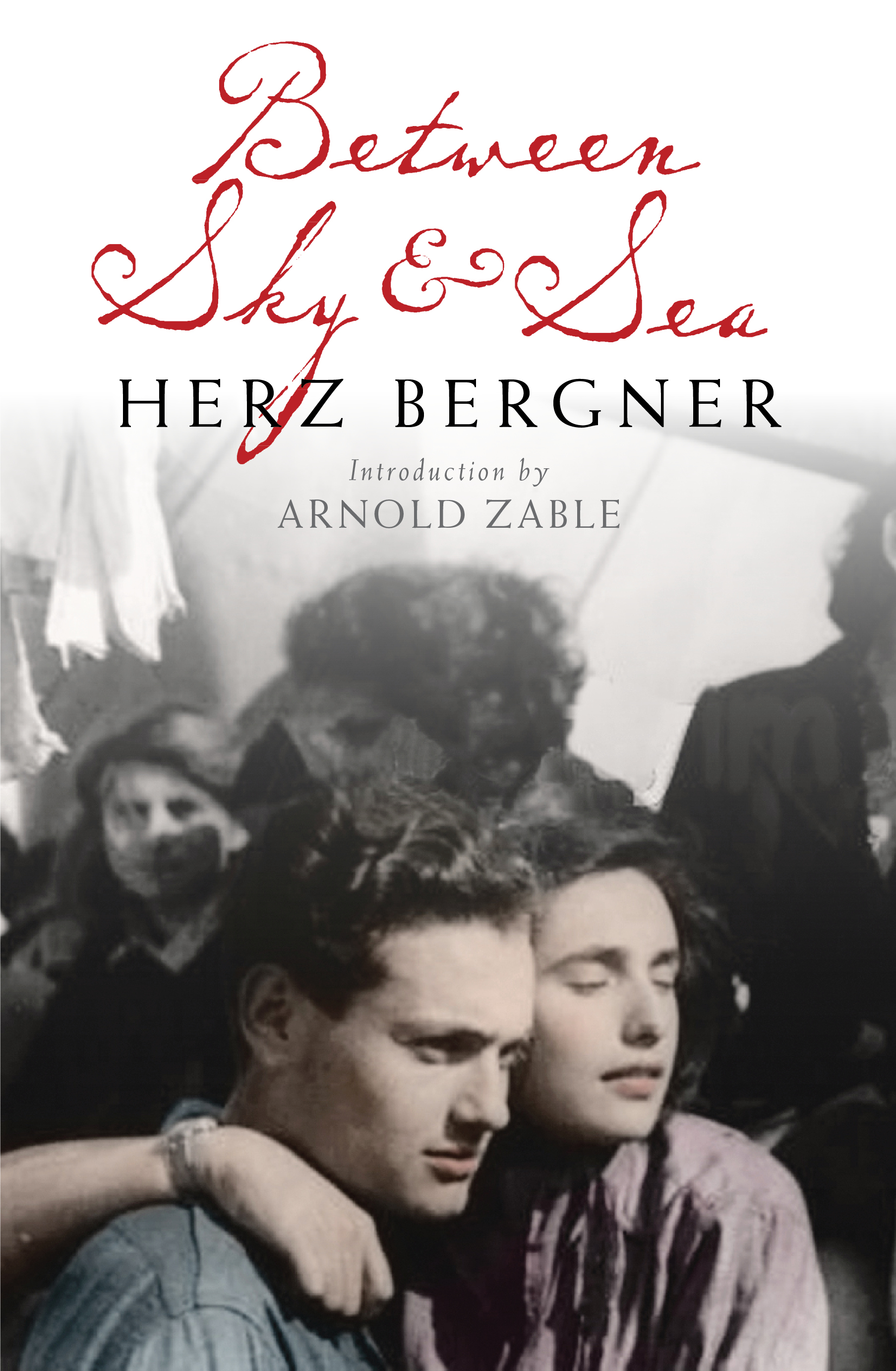
Hans Bergner’s Between sky and sea (1946)

Hans Bergner, Between sea and sky

Bergner tells the opposite story to that told by Zusak. His characters are Jewish refugees fleeing Nazi occupied Poland on a boat – but no-one will let them land, no-one will take them in, the way the Hubermanns took in Leisl and Max in The book thief. It explores the impact of this, as the reality becomes clear to the boat’s occupants. It’s a pretty devastating story.

Alan Gould‘s The lakewoman (2010)

I started with a romance and I’m ending with a romance, but that’s where the similarity between the two books ends. Shute’s book has a pretty traditional trajectory – boy meets girl, boy loses girl, boy gets girl, more or less – against the backdrop of the war and early post war period. Gould’s story is far more complex – more realistic about life and character, with a touch of the mystical thrown in. Gould argues that his is not really a war novel because it’s not about the war. To a large degree that’s true, but in a sense it’s true of many books set in war. War is the setting, but the themes are often something bigger (universals about human behaviour) and smaller (about how particular people behave under stress). One of the issues Gould explores is how the promise of a person’s life can be thrown, not only by the things that happen to them but by the decisions they make as a result. And in war, a lot of things can happen to a person!

I’ve limited myself to 5 so am sure to have missed some favourites of yours. I’d love to hear whether you read war novels, Australian or otherwise and, if so, what your favourites are. If you don’t read them, you can tell us that too!

How’s this for a description of reading?

I was going to make this post another Delicious Descriptions, but decided it needed a more direct heading. It’s another quote from Kim Scott‘s That deadman dance and has been used by several reviewers of the book. But I think it needs a post of its own:

When Bobby Wabalaginy told the story, perhaps more than his own lifetime later, nearly all of his listeners knew of books and the language in them. But not, as we do, that you can dive deep into a book and not know just how deep until you return gasping to the surface, and are surprised at yourself, your new and so very sensitive skin. As if you’re someone else altogether, some new self trying on new words.

… and new ideas, emotions, ways of being, eh?

What say you to this? Do you you have a favourite description of reading?


Delicious descriptions from Down Under: Kim Scott on indigenous connection with the land

A short Delicious Description today from Kim Scott‘s That deadman dance, but an important one because it attempts to convey to we non-indigenous people just how closely indigenous people relate to their environment. It comes from the same expedition as my previous Delicious Descriptions post:

Sometimes Wooral addressed the bush as if he were walking through a crowd of diverse personalities, his tone variously playful, scolding, reverential, affectionate.

It was most confusing. Did he see something else?