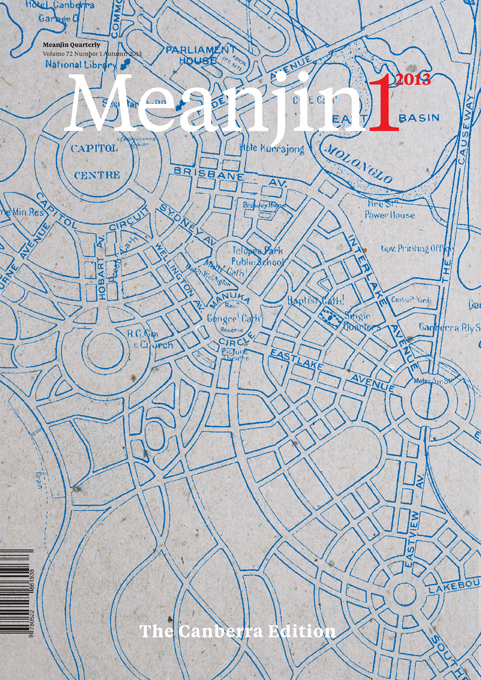
Courtesy: Meanjin
I indicated in my recent review of Meanjin‘s special Canberra issue that I would write another post or two on the issue. This is one of those posts. It may, in fact, be the only one, for who knows where the spirit will lead me next? Right now though, I want to devote a post to the second last piece in the volume, “Me and my country, Where to Now?”. It’s a conversation between writer Heather Taylor Johnson and Christos Tsiolkas whose novel The slap was one of the first I reviewed in this blog. While the novel was well received critically – won awards and was short/longlisted for others – it was not universally liked. The Wikipedia article on the novel quotes Commonwealth Writer’s Prize judge, Nicholas Hasluck, describing it as “a controversial and daring novel”. It was that …
Before I continue, I should say that this piece has a fairly tenuous link to Canberra – Tsiolkas lived here for a short time in the 1990s I understand – but its inclusion is justified, I think, for the relevance of the ideas it covers. I don’t plan to summarise the whole conversation, interesting though it is, but pick out a couple of points that got my attention – and they mostly relate to The slap.
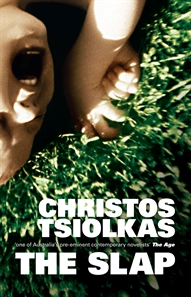
Courtesy: Allen & Unwin
Johnson commences by asking Tsiolkas about the mini-series adaptation of The slap. While recognising that the mini-series was not his work, but the work of those who had “translated and transformed” it for another medium, Tsiolkas talks of his overall intention:
I felt a certain responsibility with the screening of the series, a hope that whatever criticism people had of it, that it would be understood as an authentic voice of contemporary, multicultural urban Australia. I share the frustration of so many people of immigrant heritage in this country who have rarely seen their lives portrayed with any complexity or realism on the Australian screen. I also know that there would be people of that experience who either don’t read fiction or can’t read fiction in English and for whom the moving-image media are the only source for story and representation. I wanted people to be angry, frustrated, enraged by The slap, but I also wanted their arguments with it to be based on an appreciation that the representations were neither patronising nor sentimental. My own view is that the series succeeded in doing that.
Although focused on the miniseries, this statement is also, I think, a manifesto for the novel. It’s a warts-and-all story of people, most of whom happen to be immigrants or minorities in some way, getting on with their often flawed lives.
One of the themes that came through to me in the novel was that of violence. I felt Tsiolkas was saying that violence lies just beneath the surface of many human relationships. Later in the conversation he talks about the principles and philosophies, the “politics”, that drive him – feminism, racial civil rights, sexual liberation, post-colonial and communist. A complicated and, as he admits, sometimes contradictory bunch of ideas. He says:
I think that one of the drives I have in my writing is to express the complexity and violence of this tension. It means that though gender and sexuality are among the themes and ideas I explore in all my work, I can’t give myself over to a liberationist idea that the transformation of the individual can resolve these tensions and contradictions.
Hmm … this is pretty complex thinking methinks and I’m not sure I was able to articulate his ideas at this deeper philosophical level, but I sensed something going on and this helps explain it (to me, anyhow). He continues to say that he believes that “sexuality and the body constantly undermine our attempts at mastery and transformation”. This brought to mind the terrible recent rape cases in India and some angry discussions I’ve just read on Facebook about the current court case concerning the gang rape of the 16-year-old girl in the USA. We are not making much progress.
There is so much in this conversation that I’d love to talk about, such as his comment that much “Anglophone and European contemporary literature is moribund”. He argues that the most electric writing is coming from outside the Anglo-European centre. That must, I suppose, pose a challenge to him given his background. But, I’ll move on.
Johnson asks him about controversy, particularly in relation to The slap. Again his response is complex, but his main point is that “I want to pose questions that are unsettling or troubling”. One of the things that bothered me about the conversations surrounding The slap was that people focused on “the slap” itself – as in do you or don’t you hit a child, particularly one not your own – and not on the social, cultural and, yes, political issues inherent in the relationships involved. The fact that “the slap” plot is resolved way before the end of the novel tells us that this issue of hitting a child is not Tsiolkas’ main point. In fact, he says in this conversation with Johnson that “the language of moral absolutes … may be having a pernicious effect on much of contemporary writing”. And then he says:
I have given up reading blogs because so many people are dismissing work because they ‘don’t like the characters’ or because the resolution of a book is not neat, is not easy. We are reading for confirmation of ourselves rather than to challenge ourselves and I think that is a real danger.
He has more to say on issues that interest me – including Aboriginal dispossession and public education – but I think I’ll finish here, because I need to think …
in Meanjin 1, 2013, The Canberra Issue
University of Melbourne
pp. 178-188
ISBN: 9780522861938
(Review copy supplied by Meanjin)




 Whispering Gums