Diego Marani, The last of the Vostyachs (Review)

Italian writer Diego Marani‘s The last of the Vostyachs was originally published in 2002, but the English translation was not published until 10 years later in 2012. How lucky we are that it was, because this book is unlikely to have been written by an English-language writer. Its focus on the relationship between language, culture and place and on darker issues like ethnic nationalism comes from a different – and particularly European – sensibility. We speakers of the world’s dominant language can, I think, be a bit oblivious to the linguistic issues faced by speakers of other languages, particularly in Europe where multiple languages live cheek by jowl. The challenge of communication is an important issue for Marani who works in Brussels for the European Union. His roles have included interpreter, translator, and policy adviser on multilingualism. Marani knows as well as anyone that language is both a cultural and political issue – and this is what he explores in this, his second novel.

However, The last of the Vostyachs is no dry tome explicating the role and value of language. Instead it is a surprising and often funny novel that weaves myth and saga, melodrama and irony through the warp of a crime thriller. It incorporates a number of literary traditions and archetypes: the wild (innocent) man set loose in the city, the spurned wife, the spirit guide, the corrupt obsessive, and the remote cottage in the woods where dastardly things happen. On the night the crimes (murders, in fact) take place, nature runs amok. Zoo animals roam the city and the temperature drops to its coldest in fifty years.

The plot centres on Ivan, who is the last of the Vostyachs, an ancient Siberian shamanic tribe. He is the only one who can speak the language, though at the novel’s opening he had not spoken it (or anything else) for twenty years, not since, as a young boy in the gulag, he’d seen his father killed. When the gulag is suddenly freed, he returns to the Byrranga Mountains but all he finds are wolves. He believes them to be his people who, to flee the soldiers, had hidden deep in caves and turned into wolves. He cannot bring them back to human form but they shadow and protect him.

Every single language is necessary to keep the universe alive

Into this mix appears the plain, ethical, Russian linguist Olga who is excited to find a speaker of a language thought to have been extinct and who sees in this language an exciting connection between Europeans and the native Americans. Her old colleague, the womanising, unethical, Finnish linguist Jarmo Aurtova is not so pleased with this threat to his theory of Finnish as the “Latin of the Baltic”, as, in effect, the master language of Europe. Jarmo sounds scarily like Hitler in his desire to prove the supremacy of a pure Finnish language:

In ancient times we were the civilised ones and they were the barbarians. We were the masters, they were the slaves. Not for nothing is the word aryan so similar to the Finnic orja, which means slave.

and

But now ‘someone’ was trying to throw Finland into the dustbin of history, together with the other conquered peoples who have no future. Aurtova was not having that …

Jarmo cares not if a language or two disappears and dies in the service of his theory. He believes that the fewer the languages the more “we’re moving towards the truth, towards the pure language”, while for Olga “with each one that dies, a little truth dies with it”. Marani, the creator of the flexible inclusive language Europanto, is on Olga’s side, on the side of plurality. She says

The true meaning of things is hidden from us; it lies beyond the bounds of any one language, and everyone tries to arrive at it with their own imperfect words. But no language can do this on its own. Every single language is necessary to keep the universe alive.

Cherish ignorance

The last of the Vostyachs is a ripping yarn that takes us from the tundra to Helsinki, through city streets, down country roads, across ice and onto the sea, as the various characters pursue their passions. But it’s the irony that conveys its main messages – and much of this irony revolves around our arch-villain and misogynst, Jarmo. His guilt as a murderer is revealed through a clue that is gorgeously ironic. In his final speech to the linguistic congress he, an academic for heaven’s sake, exhorts people to “cherish ignorance”, to not learn other people’s languages but “force” them to learn yours. And, most ironic of all, not only is the Vostyach language not destroyed, but by the end of the book, without giving too much away, “it could truly be said to be alive and flourishing” – albeit in a rather odd place.

Partway through the novel, Olga says to Jarmo of Finns that “to communicate with the rest of the world you have to learn another one, you have to venture out among words which are not your own, which you have borrowed from others”. In The last of the Vostyachs, Marani has ventured out and written something wild and rather risky. In doing so, he has produced a novel that’s not only fun to read but also gives the mind much to think about.

Lisa at ANZLitLovers read and enjoyed this book earlier this year.

Diego Marani
The last of the Vostyachs
(Trans. by Judith Landry)
Melbourne: Text Publishing, 2012
176pp.
ISBN: 978192196885 (Kindle ed.)

Monday musings on Australian literature: Sisters in Crime

And now for something rather different here at Whispering Gums. Crime literature, as my regular readers know, is not my forte. In fact, I really only read crime if it comes my way for a specific reason – such as Peter Temple winning the Miles Franklin Award a few years ago. That doesn’t mean however that it’s not a relevant subject for Monday Musings. So today I bring you Sisters in Crime.

Sisters in Crime is an Australian organisation which aims “to celebrate women’s crime writing on the page and screen and bring a collective critical eye to the field.” Inspired by the American organisation of the same name, it was launched at the Feminist Book Festival in Melbourne in September 1991. It undertakes a range of activities supporting crime writing by women, including sponsoring two awards:

Because this is a reader’s blog rather than a writer’s one, I thought I’d focus on this awards aspect of their work – but for the record they offer a lot to writers, including workshops, networking opportunities, and promotion.

The Scarlett Stilettos

This year, 2013, was the twentieth anniversary of the Scarlett Stilettos, an award for short stories in the crime and mystery genre. The purpose of these awards is to “support and unearth new talent”. Over the years they have done just that with some of Australia’s top female crime writers having won the award, such as Cate Kennedy and Tara Moss. The Awards have an interesting “two-strikes-and-you’re-out” rule. That is, if you win twice you can’t enter again. I like this. It feels appropriately collaborative for an organisation that calls itself “Sisters”, and it shows they’re serious about the “unearth new talent” goal. Apparently, in its twenty years, four writers, including the inaugural winner, Cate Kennedy, have won twice.

Prizes are offered in multiple categories: First, Second and Third overall-prizes, Malice Domestic, Best Investigative, Cross Genre, The Body in the Library, Best New Talent, Great Film Idea, Funniest Crime, and a Youth Award.

In 2013 there were 175 entries, and an e-book of the 2013 winning stories, Scarlet Stiletto Short Stories: 2013 has been published. It’s available from Clan Destine Press (here), Amazon, Kobo and iTunes. At $4 it is surely a great deal if you love crime and mystery.

The Davitt Awards

These awards are a little younger, with this year being the 13th time they’ve been awarded. They are named for Ellen Davitt (1812-1879) who apparently wrote Australia’s first mystery novel, Force and fraud, in 1865. She was born in England, and married her husband, Arthur Davitt, there. According to the Australian Dictionary of Biography, they emigrated to Australia in 1854 “to take up a joint appointment with the National Board of Education, Davitt as principal of the Model and Normal Schools and his wife as superintendent of the female pupils and trainees”.

As with the Stilettos, several prizes are awarded: Best Novel (Adult), Best Novel (Children and Young Adult), Best True Crime Book, Best Debut Book, and Reader’s Choice (voted by members). In 2013 a new award was added, the Lifetime Achievement Award. Australian crime readers would not be surprised to learn that the inaugural winner of this award was Kerry Greenwood, author of the Phryne Fisher detective novels which have been recently adapted to a popular television series. I haven’t read the novels, but I love the 1920s inspired covers (of the current editions, anyhow) and have enjoyed the television series which beautifully reproduces the era in Melbourne.

Sixty-one books were entered for this year’s awards, which is apparently a record number. The winners are listed on the Sisters in Crime website so I won’t report on them all here. I was interested though to see that a Canberran whom I haven’t heard of, Pamela Burton, won the award for Best True Crime for her book The Waterlow killings: A portrait of a family tragedy. It’s about the murder of art curator Nick Waterlow and his daughter Chloe by their son and brother Anthony, a schizophrenia sufferer, and apparently explores the limits and failures of the mental health system. It’s the sort of crime book I could imagine reading!

There are other Australian awards for crime fiction – notably the Ned Kelly Awards. In fact, Kerry Greenwood won their Lifetime Achievement Award in 2003. I’m thinking I might do a bit of an occasional series on Australia’s literary awards for genre writing, if only to inform myself better on our literary landscape.

Richard Rossiter (ed), Knitting and other stories (Review)

Richard Rossiter, Knitting

Courtesy: Margaret River Press

Short stories, I’ve decided, are the ideal reading matter for breakfast, so for the last couple of weeks I’ve been engrossed in Knitting and other stories, which contains a selection of stories from this year’s Margaret River Short Story Competition. The competition is new, having been offered for the first time last year. According to the Margaret River Press’s website, there were 260 entries. This book contains 24 of them, including of course the winner and runner-up, and four highly commendeds.

The collection takes its title from the winning story, Knitting, by Barry Divola. Divola is one of the only two names I recognise in the book, the other being Jacqueline Wright whose first novel, Red dirt talking, was published last year. Knitting is a rather apposite title because most of the stories are about characters whose lives are unravelling – or have unravelled – in some way. And not all manage, by the end of their stories, to knit themselves together again, which is realistic even if it makes us readers feel a little unravelled ourselves!

As I was reading the stories a few things became apparent. Most of them are by women (20 of the 24 in fact). Does this represent the gender ratio of stories entered? Not that it matters, but it’s interesting, partly because it also means that, with a few gender-crossing exceptions, most of the stories focus on women. I noticed some recurring themes, about which I’ll write more below. And, I became aware, through connections between theme, character and/or setting, that the order of the stories had been crafted. Rossiter’s introduction, which I read after finishing the book, clarified that he had indeed grouped stories together. I think it enhanced the reading. There is always a jolt when you move from story to story, particularly if you read them without a break. Grouping them not only lessens the jolt but somehow encourages the brain to think beyond the immediate story. Karen Lee Thompson who has also reviewed this book feels quite differently about “contrived” ordering.

Another thing I noticed was that the majority of the stories seemed to be told in first person. Fifteen of them in fact. One is told in second person, making eight in third person. Does this matter? Probably not. First person can provide a level of intimacy that you don’t quite get with the other voices and I enjoy that. But, when you read one after another, no matter how well written they are, all the I, I, I can feel a bit tedious, a bit self-involved. This is not a comment on the individual stories so much as on the impact of the whole. Fortunately there are some lovely third person stories in this collection to break up the I-ness! And Amanda Clarke, in “The girl on the train”, uses the second person effectively to convey the dissociation experienced by a woman grieving over her daughter’s death. Describing her grief as “a vicious sort of cling wrap”, she is both trapped in and standing apart from herself. The “you” voice captures this beautifully.

Now to that old problem of how best to review a collection. For this one, I think the best approach is through its themes, and I’ll start with the one that stood out for me – grief, grief for people who have died, or for broken relationships or lost opportunities. Kristen Levitzke’s “Solomon’s Baby” about a baby’s death is particularly wrenching, but there are stories about grandchildren and grandparents (Vahri’s “I shine, not burn” and Louise D’Arcy’s “Down on the farm”) and people grieving for lost time and opportunities (Jacqueline Winn’s “The bitter end”), to name just a few.  Other recurring themes are memory, growing up, ageing and, either explicitly or implicitly, time. Jacqueline Winn’s “The bitter end” starts:

Let’s not fool ourselves, time is not something to be negotiated. Time passes through us or we pass through time. No second thoughts, no second chances.

Family and family relationships are common subjects. In many stories, a parent is missing – either through death, or separation – creating a gap that can have lasting ramifications. One of my favourite stories in the collection is JS Scholz’s “Focus” about a young boy who’s on the run with his mother from his abusive father. Seen as a “hopeless” student who can’t “focus”, he uses his initiative to carry out a subversive action which shows his true character. In another favourite story, Kathy’s George’s cleverly named “A bend in the road”, the temporary absence of the father creates a tension between a mother and son. The daughter, though, sees the real issue:

“The family is a board game, a game with a missing piece … and nobody can play the game without the missing piece. Not properly anyhow.”

In some stories, it’s the chance meeting of strangers which throws light on the protagonists’ situations. Amanda Clarke’s second-person-story is one of these. In Kerry Lown Whalen’s “Notes in a scale” and Bindy Pritchard’s “The bees of Paris” the strangers are also neighbours.

While most stories are about character and family relationships, not all are. One such is John Dale’s “Expressway” which satirises the need to believe. It’s the story of a smudge on the wall of the Cahill Expressway which Francesca Lombardo believes is an image of the Virgin Mary. This sets in train a series of events including the removal of the section of the wall to Darling Harbour “which had better facilities and all day parking”. The government, talk shows, scientists, and social media are all targeted in this fun but pointed story about, at best, our desire for miracles and, at worst, our gullibility.

There is some lovely writing here, but I’ll just share two short examples. Dorothy Simmons describes the bush in her story, “Off the map”, about a young girl who is an orienteering champion:

All the little movements: lizard flicker, goanna slither, leaf rustle, sleek silvery trees posing beside slouching shaggy grey ones; cicada hum, magpie trill, whip bird …

The other is Paulette Gittins’ description in “Playing with Ramirez” of a gang of children coming down a Melbourne suburban street:

Down the street towards me a vaulting, whooping gang in stripes, red and black, blue and white, shrilling, colliding, hilarious; black-haired, scrawny, curly and nimble, they poured past.

As with any collection, some stories touched me more than others, but all have something to offer, something to say, about living and surviving in a world that for many, as Divola writes in the title story, “is too sharp [with] edges everywhere”. A most enjoyable read.

For other reviews of this collection which highlight some different stories, check out Karen Lee Thompson (in her review mentioned above) and Anne Skivington.

Richard Rossiter (Ed)
Knitting and other stories: Margaret River Short Story Competition 2013
Witchcliffe: Margaret River Press, 2013
319pp.
ISBN: 9780987218087

(Review copy supplied by Margaret River Press)

Meanjin Tournament of Books: Goes to Sea in 2013

Surely it can’t be a year since the last Meanjin Tournament of Books? But yes, it is. My first post on the 2012 tournament – themed Short Stories – was last November. Wah!

This year’s theme is the sea. With their tongue surely planted firmly in cheek they announced the theme few months ago:

As the Meanjin Tournament of Books becomes increasingly influential in the Australian literary landscape, we’ve decided to raise the stakes even further by turning our critical gaze on that most tempestuous of subjects, the sea.

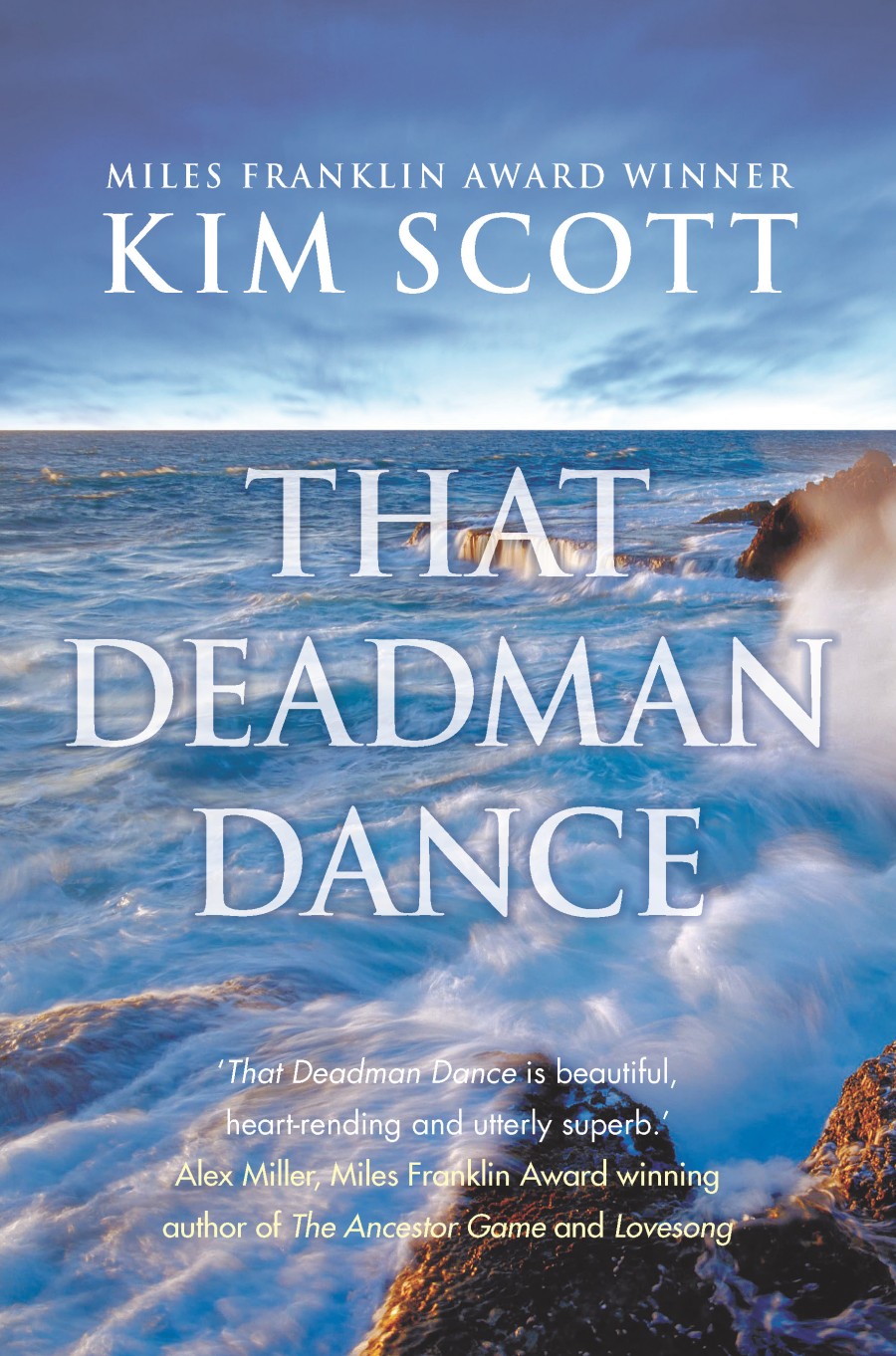
Kim Scott That Deadman Dance
(Courtesy Picador Australia)

“Increasingly influential on the Australian literary landscape”? Not that I’ve noticed! But I do enjoy following it. I love the sense of fun that accompanies an also serious attempt to shine a light on an eclectic selection of works related to a theme. For this year’s challenge, framed as “Who writes the best books about the sea and/or rivers?”, the works selected for the shortlist are:

An interesting selection (presented in Meanjin’s rather random looking order) of which I’ve read half (Winton, Grenville, Scott and Shute).

Ours is an island continent, so it’s not hard for us to find literature dealing with the sea – from the early days of the convicts (who arrived by sea and many of whom, depending on where they were, tried to escape incarceration by sea) to the present with our world-famous beach culture. The sea both isolates and protects us. It is rarely absent from our news, in one form or another – in politics through issues like asylum-seekers arriving by boat; regarding environmental issues like whaling; or in sports like surfing and the Sydney to Hobart Yacht Race. Ours is also a dry continent, so our need for water has always been a priority issue for us – from the first explorers who searched for inland lakes or seas to modern controversies about the management of our major rivers.

Consequently, pretty well any reading Australian looking at the shortlist is likely to have a favourite book missing from it. What about Marcus Clarke’s convict classic For the term of his natural life? Or Peter Carey’s Oscar and Lucinda (a story of immigrants which ends with an astonishing river scene)? Or Alexis Wright’s Carpentaria set in the Gulf Country? Or one of Richard Flanagan’s books? But, let’s not be churlish. Their selection is as good as any if you have to limit it to eight and you want to be a bit diverse – and, in the end, it’s all about having some fun and raising awareness.

Watch this space, as in previous years, for reports on the match as it progresses.

In the meantime, and despite my comment above, is there a sea-or-river-themed book you would love to have seen in the tournament? (Or, if you’re not Australian, a book on the theme from your literature that you’d recommend to the rest of us?). Here’s mine:

Picture the creative serpent, scoring deep into – scouring down through – the slippery underground of the mudflats, leaving in its wake the thunder of tunnels collapsing to form deep sunken valleys. The sea water following in the serpent’s wake, swarming in a frenzy of tidal waves, soon changed colour from ocean blue to the yellow of mud. The water filled the swirling tracks to form the mighty bending rivers spread across the vast plains of the Gulf country. The serpent travelled over the marine plains, over the salt flats, through the salt dunes, past the mangrove forests and crawled inland. Then it went back to the sea. And it came out at another spot along the coastline … (from the first chapter of Alexis Wright’s Carpentaria in which she describes the creation of country and the law that goes with it)

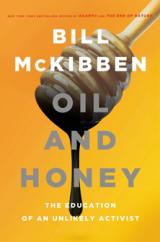
Bill McKibben, Oil and honey (Review)

Bill McKibben, Oil and Honey

Courtesy: Black Inc

It’s coincidental, but nicely appropriate, that the World Meteorological Organisation (WMO) published its Provisional Statement on the Status of the Climate in 2013 last week, just as I was finishing US environmental activist Bill McKibben‘s latest book, Oil and honey: The education of an unlikely activist. It’s likewise coincidental that, three days before WMO’s announcement, Stefanie (of So Many Books) published a post titled Gardening for Climate Change* containing her thoughts on her garden and how climate change might affect it.

WMO’s statement says, among other things, that “During the first nine months of 2013, most of the world’s land areas had above-average temperatures, most notably in Australia, northern North America …”. As you know, I live in Australia; Bill McKibben and Stefanie live in the northern part of the USA. We are seeing (feeling) the changes, and are concerned. What I’m going to say next is pretty obvious, but I’m going to say it anyhow because I always like to start with the basics in discussions like this. There are two critical issues in the climate change debate: Is the climate changing and, if it is, Is it human-caused? It’s hard to imagine, given all the data available, that there’s anyone out there who really believes the climate is not changing, though I believe there are still some who think it’s simply a case of “climate variability”. These people think that the climate will get back to normal (some year soon, they hope). The trickier issue, however, is the causal one. Most of the deniers are not so much denying that the climate is changing, but that we are causing it. This brings me to Bill McKibben.

McKibben does not, in Oil and honey, spend time trying to prove that humans are causing climate change. For him it’s a given. Rather, he shares how he changed from being an environmentalist, who researched and wrote books, to an environmental activist who campaigns (and writes books). It’s an interesting, clearly written book about one man and his path, but can also be read as a how-to for those who want to get active.

You may now, though, be wondering about the title. Oil and honey? I’m sure there’s an ironic allusion here to the biblical “land of milk and honey” (which we are not heading towards), but there is also a literal meaning to the title. The narrative shifts pretty seamlessly between his two main passions. One is to do with bees, honey and good farming practice. The other is oil, or the fossil fuel industry, and how to stop its impact on the climate. Oil and honey, climate and farming. It’s all related.

You may also be wondering, particularly if you’re not American, who Bill McKibben is. As the blurb on the back of my edition says, he has written over a dozen books including the New York Times bestselling Eaarth and The end of nature. He also founded the environmental organisation 350.org and “was among the first to warn of the dangers of global warming”. Despite all this, he did not until recently see himself as an activist. After graduating, he worked as a journalist for The New Yorker for five years, but quit in 1987 when its long-term editor was forced out of his job. Since then he has been a freelance writer.

Oil and honey is his latest book. I’d call it part-memoir part-manifesto, because it is both the personal story of his transition to full-blown activism and the story of his passion for saving the planet. The personal aspect of the book helps make it a good read. We get to understand his thinking, we feel his anxiety about becoming not only an activist but a leader of activists, and we learn that his activist philosophy is inspired by the non-violent resistance ideas of Gandhi and Martin Luther King Jr. We see his love for nature and for working close to the land on the bee-farm he bought for his friend Kirk Webster to run. This farm functions both as respite and as a place for him to see land stewardship working.

That’s the memoir aspect. In the manifesto aspect, he shares with us the development of his ideas and strategies. We learn of various campaigns he has been involved in since 2009, including Step It Up, Keystone XL,  Do the Math. And he explains how he and his co-activists have shifted from focusing on politics and politicians – through such activities as sit-ins at the White House and lobbying politicians – to directly tackling the fossil fuel industry. He came to realise, he says, that the situation was/is becoming so dire there’s no time “for slow graceful cultural evolution”. Consequently, the last part of the book deals with the goal of encouraging educational institutions to divest their investment portfolios of fossil fuel industries. They’ve targeted educational institutions because students represent a significant percentage of climate change activists. For these students the question is simple:

are you paying for our education by investments in an industry that guarantees we won’t have a planet to make use of that learning?

I’ve only touched the surface of what this book covers. Like many books of its type, chances are that it will only be read by the converted. That’s a bit of a shame, but it’s not useless says McKibben:

You might think it’s a waste to preach to the choir, but the truth is, you need to get the choir fired up, singing loudly, all out of the same hymnal. The choir is there, but most of the time it’s just humming in the background, or singing so many tunes that no distinct harmony emerges.

So, if you’re part of the choir, this book is still for you. And if you’re not, think about joining. It could be the most important thing you do.

Bill McKibben
Oil and honey: The education of an unlikely activist
Collingwood: Black Inc, 2013
255 pp.
ISBN: 9781863956178

(Review copy supplied by Black Inc)

* Stefanie has since posted a link to a British blog called Climate Change Garden.

Monday musings on Australian literature: MUBA 2013

Last year I reported on the inaugural MUBA – Most Under-rated Book Award. I hoped that it would continue, because it brings to our attention good books that somehow slide under the radar, mostly because their authors are less known and/or their publishers are small.

In 2012, I had read one of the four short-listed books, Irma Gold’s Two steps forward (my review), but it didn’t, unfortunately, win. This year again, I had read one of the four short-listed books, Merlinda BobisFish-hair woman (my review). But, before I announce the winner, here is the shortlist:

  • Merlinda Bobis’ Fish-hair woman (Spinifex Press)
  • Ginger Briggs’ Staunch  (Affirm Press, which published Irma Gold’s book)
  • Annabel Smith’s Whiskey Charlie Foxtrot (Fremantle Press)
  • Anna Solding’s The hum of concrete  (MidnightSun Publishing)

The judges for this year, according to its sponsor SPUNC, included book reviewer/writer Stephanie Campisi, bookseller/poet Ben Walter, and writer/bibliotherapist, Estelle Tang. SPUNC says of the shortlist that:

The shortlisted writers represent four of the original and worthy voices to be published by independent Australian publishers in the 2012 calendar year. These books show excellence in their genre and demonstrate quality of writing, editorial integrity, and production. They have been overlooked for other prizes and have not generated the sales they deserve for any number of reasons other than the great quality of the products.

And the winner is – ta da – Merlinda Bobis’ Fish-hair woman. As I said, I haven’t read the others though I do have Annabel Smith in my reading sights. However, I was highly impressed by Fish-hair woman, which is a challenging but rewarding read, and so am thrilled for her. It’s a timely win too as Merlinda Bobis is a Filippine-Australian. As Spinifex Press director Dr Renate Klein said in their Press Release on the award:

At this time when the Philippines is experiencing a humanitarian disaster on an epic scale, I’m pleased that a kernel of something positive has happened this week. Merlinda is a Philippine Australian writer who has shown how much she cares for the Philippines and its people, and I know this award means so much to her.

It is fantastic, but not surprising, that Fish-Hair woman captured the judges’ attention; it deserves a much wider audience, and this award will definitely assist in attracting more readers to the book.

So, huge congratulations to Bobis and Spinifex – and let’s hope it results in more sales.

Have you read any books in the last year or so that you believe are under-rated? Do let us know in the comments and give them a plug!

Griffyn Ensemble’s 2013 Elements of Canberra season

The Griffyns ended their 2013 season on a high … literally (in a performance of “Southern Sky”) and figuratively (with beautiful playing under somewhat challenging circumstances … but more on that anon).

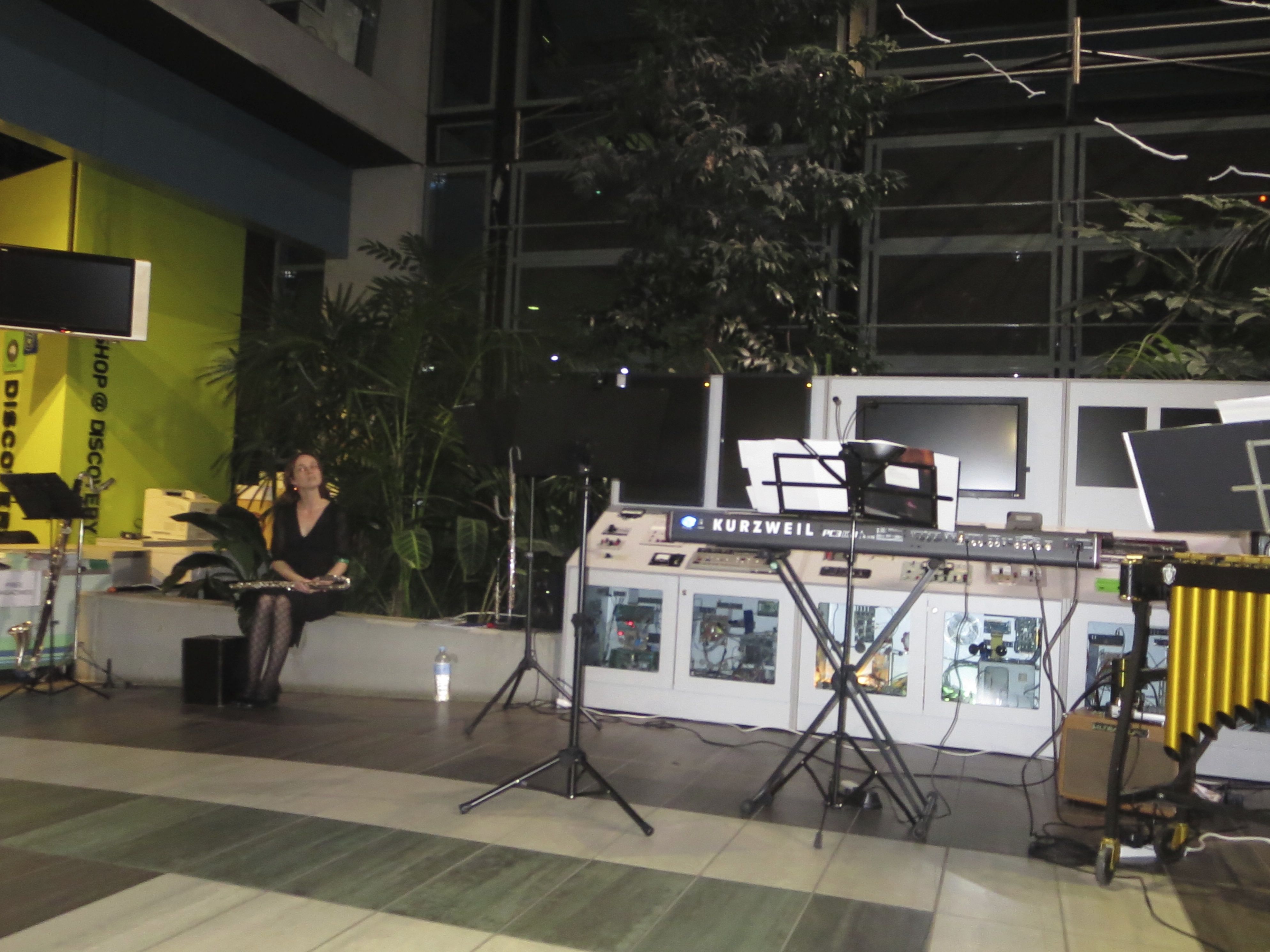
Griffyn Ensemble, CSIRO Discovery Centre

Downstairs, CSIRO Discovery Centre (A bit dark for my digital compact!)

You have to be hardy to be a Griffyn Ensemble follower. You never know where you will have to go to hear their next concert. In this Canberra Centenary year for their “Elements of Canberra” season, we went to the Belconnen Arts Centre ( “Water”) where the lovely Lake Gininderra forms a backdrop, the CSIRO Discovery Centre ( “Earth”), the TAMS Depot industrial hangar (“Air”) and the roofless shell of the ruined telescope on Mt Stromlo (“Stars”). These are not your usual concert venues with plush seats. In fact, a couple required some serious rugging up, but if the musicians are prepared to perform in these atmospheric venues, their loyal followers are clearly prepared to join them.

I haven’t written about the Griffyns this year since the first concert, mainly because we headed off overseas the day after the second concert and had only just returned, with all the concomitant catching up to do, before the third. (Indeed we sandwiched our trip to fit between these two concerts). I don’t plan to review them now. As I’ve said before, I’m not a musician. What I know, technically, about music you could fit on a clarinet reed. But, I do like music that moves, entertains, wows and challenges me – and this is what the Griffyns do for me. So, instead of writing a review, I’m just going to do a little recap of the other three concerts of the season.

It is not necessary to understand music; it is only necessary that one enjoy it (Leopold Stokowski)

The second concert was themed Earth, focusing on Trees and celebrating National Science Week. It took place in the CSIRO Discovery Centre’s atrium, where we were surrounded by trees, and displays and models from nature. It was mid-August and therefore winter in Canberra. Just as well we brought our winter woollies as the Griffyns took us on a musical and physical journey, upstairs and downstairs in this atmospheric, open-plan-glass-walled building. The concert was accompanied by a stylish booklet designed by local artist Annika Romeyn (whose illustrations were on display at the concert). That concert was some time ago now – or at least, I have done much since then including a 2-month overseas trip – so the memory has dimmed. It was, however, a typically eclectic Griffyn concert, as Annika Romeyn describes on her blog. It started with Finnish composer Kaija Saariaho‘s lovely, wistful piece “Fall” which, to me, had at times a rather Japanese sound. It featured the harp (Meriel Owen). And it ended with Michael Sollis’ composition, “City of Trees”, which was commissioned by Robyn Archer for our Centenary. In between were pieces like Martin Wesley-Smith‘s now well-known and fun “Caterpillar”; German-American composer Ursula Mamlock’s “Der Andreasgarten” featuring critters like dragonflies and hummingbirds; an arrangement of Cold Chisel’s “Flame Trees”; and, dear to my heart, Michael Sollis’ “Song of Trees”. It was composed for the opening of the National Arboretum and comprises an extensive list of tree names starting, of course, with gums. It was sung with aplomb by the Ensemble. You can read Clinton White’s review of this concert at CityNews.

Griffyn Ensemble, TAMS Depot, Kingston

Griffyns in the Tams Depot, Kingston

The next concert, Air, saw us sitting around cable drums in an old hangar on, fortunately, a very pleasant Spring day. We were neither too cold nor too hot. This concert, which coincided with the SPIN Festival, took us travelling by train, bike, plane and even into space. It started on a light note with Luigi Denza’s “Funiculi Funicula”, led by the always-expressive soprano Susan Ellis, and included another ensemble vocal piece led by Ellis, Freddie Mercury’s “Bicycle Race”. As with all their concerts, this one featured some seriously virtuosic playing, particularly from Kiri Sollis (flute) whose “The Great Train Race” (by Ian Clarke) was breathtaking and Matthew O’Keeffe who pushed his clarinet to surely its highest registers in “Someone is learning how to fly” (by Marie Samuelson). The final piece was Brian Eno’s mesmerising, eerie “Music for Airports” (first movement). It’s some 15 minutes or so long and rather repetitive but I could have listened forever. Dare I say I could imagine doing yoga to this, lifting my spirit while contorting my body!

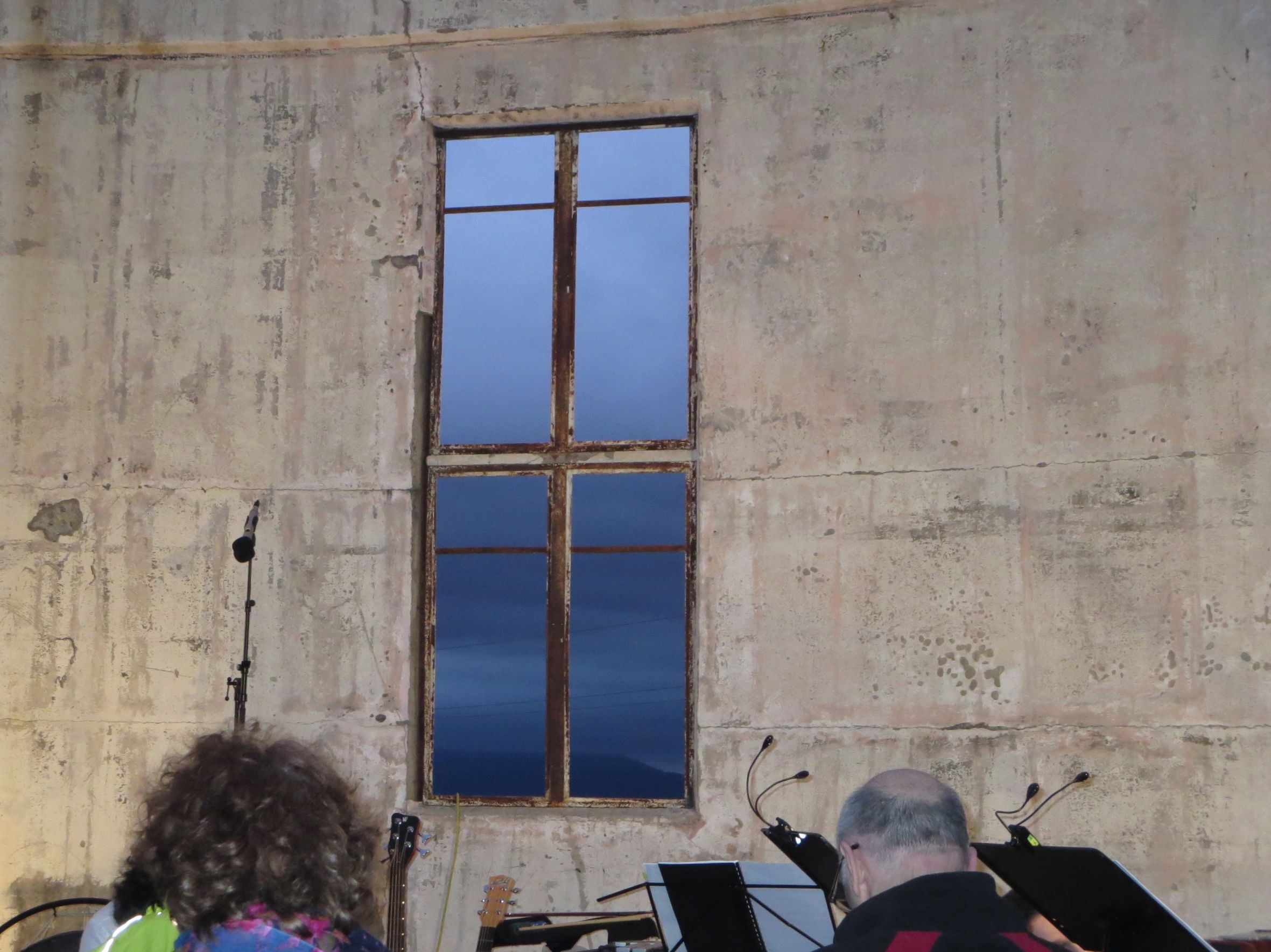
Mt Stromlo burnt out telescope

In the roofless, burnt out telescope on Mt Stromlo

The year ended on something a little different, because, unusually, the whole concert comprised one multi-movement piece called “Southern Sky” by Estonian Urmas Sisask who was inspired by his visit to Australia in the 1990s. You can read an excellent review of the concert on the Canberra Critics Circle blog. I really can’t add anything to what they’ve said. It was cold but, luckily for us (and the musicians), the rain that fell a few kilometres away on my house missed us. The piece, arranged by Michael Sollis, shows off all members of the Ensemble (as the above-mentioned review describes). It was magical, spoilt only by the fact that the cloudy sky meant that astronomer Fred Watson could not actually point out any of the constellations represented in the pieces. I did love seeing Wyana O’Keeffe back in her percussion spot. We’ve missed her this year while she’s been away on baby duties.

And so 2013 ended, a credit to Michael Sollis and his impressive all-round musicianship. What a team they are.

The Griffyns have announced their 2014 season, which is themed “Fairy Tales” and will see them again collaborating, as they like to do, with other creators around town. I can hardly wait.

If you are interested, you can hear examples of some of the music we’ve heard on the links below – but note that many of the pieces will be somewhat different to the versions we’ve heard, as ours were arranged by Michael Sollis for the Ensemble’s particular mix of instruments:

With apologies for this self-indulgent post but, you know, it’s my blog and I’ll write what I want to!

Delicious descriptions from Down under: Lebkowicz and Moorhouse on 1950s Canberra

At the beginning of this year I reviewed Frank Moorhouse‘s Cold light (my review) which commences with the arrival of his protagonist, Edith Campbell Berry, in Canberra in 1950. The Petrovs, the subject of Lesley Lebkowicz’s The Petrov poems (my review), arrived in Canberra in 1951.

Lebkowicz’s description of Canberra accords very much with Moorhouse’s. The second poem in her verse novel is “Canberra”. It is one of the unrhyming couplet poems in the book – and is also one of the poems that concludes on a single (and significant) line. I’d love to quote it all but I’m not sure about the copyright rules regarding individual poems in a verse novel – so I’ll assume I can quote a goodly percentage of the poem but not all of it*. The poem begins with a lovely description of  the quiet, the space, the birds, and uses that colour most associated with Patrick White, “dun-coloured”, to describe the grass. It then continues

… Their house is between

Kingston and Manuka where shops
for clothing and food squat close to the ground.

There’s a news agency, a shop for sewing materials,
a furniture store – but no cafés, no restaurants.

Civic has two-storey buildings with cloisters
where in winter the wind from Cooma sharpens the cold

into blades. She shivers. All around sheep huddle
and graze, but in Griffith they have a whole house

to themselves: a whole house and plenty of food.

Compare this with Moorehouse’s Cold light. Edith has been offered the honorary (!) job of town planner. She does a lot of reading, and appreciates Walter Burley Griffin‘s** passion and is awed Marion Mahony Griffin‘s gorgeous drawings:

She even had a small vision of her own – about the lucerne. Why not have a working farm in the heart of the city? With cows and and sheep and haystacks. Didn’t Marie Antoinette have her farm – the petit hameau?

She doesn’t voice this to her “boss”, Gibson – “she might not mention this idea at this moment” – which is just as well:

He said, “What we need are more verticals, more variation of skyline, blocks of flats, spires.”

She thought not. Gibson did not have the awe of the plans there in his office; maybe he was past that.

Gibson said, “Griffin didn’t want skyscrapers because he wanted low, large buildings so that light and air could play their parts. Now we have too bloody much of both. Pardon my French. We have too much light and too much air and too many trees and too little else.”

She smiled to put him at ease.

Sixty years later, we are still planning Canberra. We are still arguing about the verticals. How high or how low should we go? And about the green (or dun-coloured as the case may be) spaces. Should we fill some in? But perhaps all cities are like this? In Meanjin‘s The Canberra issue (my review), journalist-author Chris Hammer says, “The city is evolving as the nation it serves is evolving …”. And that, I think, is as it should be.

* The full version is, however, on line at Verity La, albeit not formatted the way it is in the book.
** To read more about the Griffins and Marion’s drawings in particular, see here and here (click on the illustration to see it in better detail.)

Lesley Lebkowicz, The Petrov poems (Review)

Canberra poet Lesley Lebkowicz has made a couple of brief appearances in my blog: first in my post on The invisible thread anthology, and then when she won this year’s ACT Poetry Award. I was consequently more than happy to accept for review her latest book, The Petrov poems.

English: Evdokia Petrova at Mascot Airport, Sy...

Evdokia being escorted by two Russian diplomatic couriers to a plane at Mascot Airport, Sydney (Presumed Public Domain, from NAA, via Wikipedia)

It’s intriguing that nearly 60 years after the events, we are still interested in the Petrovs. In fact, I have written about them before, in my review of Andrew Croome’s historical novel, Document Z. Most Australians will know who they are, but for those global readers here who don’t, the Petrovs were a Russian couple who worked at the Soviet Embassy in Canberra in the early 1950s. Vladimir (Volodya), Third Secretary, and his wife Evdokia (Dusya) were both Soviet intelligence officers (or, to put it baldly, spies). They defected in 1954. The defection was particularly interesting because Vladimir defected first, and Evdokia two weeks later at the airport in Darwin after some dramatic scenes at Sydney’s Mascot airport.

At first glance, The Petrov poems looks like a collection of poems but in fact it is a verse novel, albeit one comprising many short individually-titled poems. These poems are organised into four “chapters”: Part 1, Volodya defects; Part 2, Dusya defects; Part 3, The Petrovs at Palm Beach; and Part 4, The Petrovs in Melbourne.

I must admit that I wondered, initially, why Lebkowicz had decided to write about the Petrovs, given that they have already been picked over in novels, non-fiction, theatre, and television. But, as soon as I started reading it, I could see why. Lebkowicz gets into the heart of these two characters, bringing them back to ordinary human beings who were caught up in something that was both of and not of their own making. It is a rather pathetic story. There are no heroes here – and yet, as happens with these sorts of things, it captured the world’s attention for a short time.

Now, before I comment specifically on this book, I’d like to quote another Canberra poet Paul Hetherington from an interview with Nigel Featherstone in the online literary journal Verity La:

One of the ways I recognise the poetic is when I find works in which language is condensed, ramifying, polysemous and unparaphraseable. Part of what I wish to do when writing poems is to make works that speak in such ways – but to do so without resorting to any kind of trickery or artificial obscurity.

While I wouldn’t use words like “ramifying” and “polysemous”, and while we can paraphrase the ideas to a degree, this is pretty much what Lebkowicz achieves in The Petrov poems. In just 80 pages or so she manages to not only tell the story of their lives but get to the nub of their hearts and psyches – as much, anyhow, as anyone can do for another person. We learn that Volodya is not succeeding at spying:

He wants to succeed but stumbles. Failure
follows him like iron torn from a roof and
rattled along the wind.
(from “Glass I”)

We learn that he loves Dusya (“Dusya is his place in the world”), but that he loves booze, his dog and prostitutes more. He seems weak, but he’s a man struggling. With Stalin’s death and the arrest of his boss, he fears reprisals when he returns to Moscow. Here he is at the moment of defecting (which he does, after disagreements on the subject, without telling Dusya):

Once again he’s going to be wrenched from the soil.
He remembers his father – struck by lightning, buried up to his neck
by foolish men, and dying in the freezing night.
Then chaos and not enough food. Uprooting a full-grown plant
is no easy thing: so many roots
are wound through the earth. He mutters the Russian words
for sadness and home and ruffles his Alsatian’s fur.
(from “Loss”)

Dusya, on the other hand, is a stronger character, but she has suffered severe losses in her life, including her first love and her daughter:

This is something Dusya does not allow herself to think: how her
life might have been if Romàn had not been arrested. […]
If she had gone on taking happiness for granted. Living with
Romàn had been like walking along a winter street and arriving
in a field of warm poppies. If Romàn had not been broken in a
labour camp. If Irina had not died –
(from Romàn I)

While she understands Volodya’s fear, she fears even more what might happen to her family if she defects. At Darwin airport she doesn’t want to make a decision: “If only/this government man would abduct her”. But of course he can’t.

We then watch them as their relationship falters, first during ASIO’s interrogation, and then the years of living together in Melbourne, officially in disguise but known nonetheless. (“The whole street knows they are Petrovs -/too many photos, too much publicity”).

While I’m not a Petrov expert, I’ve read enough to feel that Lebokowicz’s interpretation is authentic. She explores what happens when the political interferes with the personal; she recognises the pull of culture and the despair that losing one’s home can engender; and she sees that corruption is not confined to communism:

so when ASIO falsifies (No! Not falsifies
amends, adjusts, even corrects) the documents
he brought from the Embassy – of course he assents
(from “Bones”)

Australian Women Writers ChallengeThese are wonderful, readable poems. They are poetic but, to quote Paul Hetherington’s goal, without “trickery” and “artificial obscurity”. The imagery is strong but clear. I particularly liked the way Lebkowicz varies and plays with form. None of it is rhymed, but there are sonnets, couplets, poems with multi-line stanzas but closing on a single dramatic line, and others. There are poems with short lines or terse rhythms, indicating action or stress, and poems with long lines conveying thoughts and reflections. There is also a shape-poem, “Torment”, in which the zigzag shape mirrors Dusya’s distress (“Her life is a staircase that switches directions”).

Like any good historical fiction – if a verse novel can be called that – you don’t need to know the history to understand the story told here. And like any good historical fiction writer, Lebkowicz has produced something that enables us to reconsider an historical event from another perspective and to understand the humanity below the surface of the facts. An excellent and moving read.

Lesley Lebkowicz
The Petrov poems
Sydney: Pitt Street Poetry, 2013
95pp.
ISBN: 9781922080141

(Review copy supplied by Zeitgeist Media Group)

Monday musings on Australian literature: Writers’ archives

Australian author and feminist Germaine Greer ...

Germaine Greer, 2006 Humber Mouth Festival (Photo: Walnut Whippet, CC-BY-2.0, via Wikipedia)

Having heard recently about the University of Melbourne‘s acquisition of Germaine Greer‘s archives and having written in last week’s Monday Musings about the biographer Hazel Rowley who spent hours researching such archives, I thought it would be worth writing a little about writers’ archives – their importance and challenges.

First off, I am, as many of you know, a (retired) librarian/archivist, so this topic is particularly dear to my heart. The personal papers or archives or manuscripts (terminology varies a bit) of significant creators are of course the lifeblood of researchers. Without them, writing biographies of people long gone is very difficult. Consequently, libraries often start negotiating for writers’ papers long before they die – to save that embarrassing, difficult vulture-like situation of contacting families after they’ve gone! Some donate outright, some sell (though money is tight so purchase is rare except for very significant papers), some are bequeathed, and some are donated through tax incentive schemes.

So, the first challenge is negotiating acquisition. I won’t detail the challenges regarding what is acquired, but this is another minefield. What does the library want? What is the creator prepared to offer? What indeed has the creator retained? Australians will know the story of the irascible Patrick White who wrote to the National Library in 1977 that:

I can’t let you have my papers because I don’t keep any. My manuscripts are destroyed as soon as the books are printed. I put very little into notebooks and I don’t keep friends’ letters as I urge them not to keep mine, and anything unfinished when I die is to be burnt.

However, wily that he was, this was not quite true, and some 16 years after his death, Barbara Mobbs, his literary agent and executor, pulled off what White biographer David Marr has called “perhaps the greatest surprise in this country’s literary history” by offering 33 boxes of White’s papers (including some manuscripts and correspondence) to the National Library of Australia. Very exciting for Australia’s literary culture – but somewhat of an ethical quandary, because White did direct in his will that his papers be burnt. Mobbs couldn’t do it, and argued that if White had really wanted this to happen he would have done it himself. She knew him very well so we have to assume she was right. Anyhow, she waited 16 years, three years after the death of Manoly Lascaris, White’s partner of 49 years, before she made the collection known.

Another challenge is that of embargoes. Many people, when donating their papers, put embargoes on some or all of the papers, usually to protect those named within, effectively preventing the use of those papers (or sections) for years, often decades. This is pretty frustrating for the librarians who want to make their collections available and for the researchers wanting to use them, but at least the collections are secure for the future.

And then there’s the challenge of organising the papers and making them available. This is an immense task, with some ethical challenges of their own. I don’t know of any major cultural collecting institution that doesn’t have large backlogs of papers needing to be sorted, arranged, indexed/catalogued and now, these days, digitised. The first reports I saw of the acquisition of Germaine Greer’s papers implied that they were bought for A$3million which made Greer sound a little money-grubbing but it turns out, as Greer clarified on ABC’s Q&A last week, that $3million is the cost of the archives. Katrina Dean, from the University of Melbourne, writes that this amount includes “transport, cataloguing, indexing and digitisation”. She says:

Despite the efforts of archivists and digital scholars, much of the archival legacy of the 20th century [and presumably preceding centuries] remains untranslated into computer-readable language and accessible only to those with traditional archival research skills and specialised reference services.

And of course, only accessible to people who can travel to the place where the papers are stored.

Some specific writers’ papers

David Marr wrote his Patrick White biography while White was alive. He did not see the papers that the library acquired until, well, they were acquired at which time he went through them in some detail. He says they contain no great revelations that would make him want to redo the biography, but:

Jumbled and haphazard though they are, the notebooks are filled with biographical gold: scraps of diary, poems, reflections, lists of characters (121 for The Vivisector), the first pages of at least six novels in early draft, reams of detailed research for Voss (“Sydney hospital was known as Sydney Infirmary till 1881”), timelines, fashion notes and fragments of conversations overheard in the street.

Just by way of example, I thought I’d mention a few writers’ archives, and the works they’ve supported:

  • Christina Stead’s papers at the National Library of Australia were used by Hazel Rowley in her biography of Stead. Interestingly, and as often happens, Rowley’s papers relating to her research for the Stead biography are also held by the Library.
  • Elizabeth Jolley’s papers at the Mitchell Library in the State Library of New South Wales were used by Susan Swingler in her memoir-of-sorts, House of fiction. Brian Dibble, who wrote a biography of Jolley, Doing life, did the same. There are apparently embargoes on these papers, but permission can be sought to access them.
  • Mary Durack’s papers (in the Durack Family Papers) at the State Library of Western Australia were used by Brenda Niall in her book, True north: The story of Mary and Elizabeth Durack. (See my review)
  • Miles Franklin’s papers at the Mitchell Library in the State Library of New South Wales were used by Jill Roe in her book,  Stella MIles Franklin: A biography.

A small sample but, as you can see, these papers are spread around Australia, which is a good thing, really, in terms of preserving literary heritage. Now all we need is for them to be digitised and readily available to all, eh?