The Griffyns end the year on, hmm, a macabre note

Only the Griffyn Ensemble could put together a concert that included Arvo Pärt and Bob Dylan, that started with eerie sounds from a tape and ended with mysterious knockings and bumpings from who knows where to the strains of Silent Night. Intrigued? Then read on …

This year the Griffyns’ theme has been Fairy Stories – loosely defined (and I do love loose definitions). We have wandered though strange maps, worried about what we believe, and thought about our place. In their final concert, “The shearer that could have been”, we were scared witless – well, not really, but they gave it their best shot. It all started with the setting – and a story …
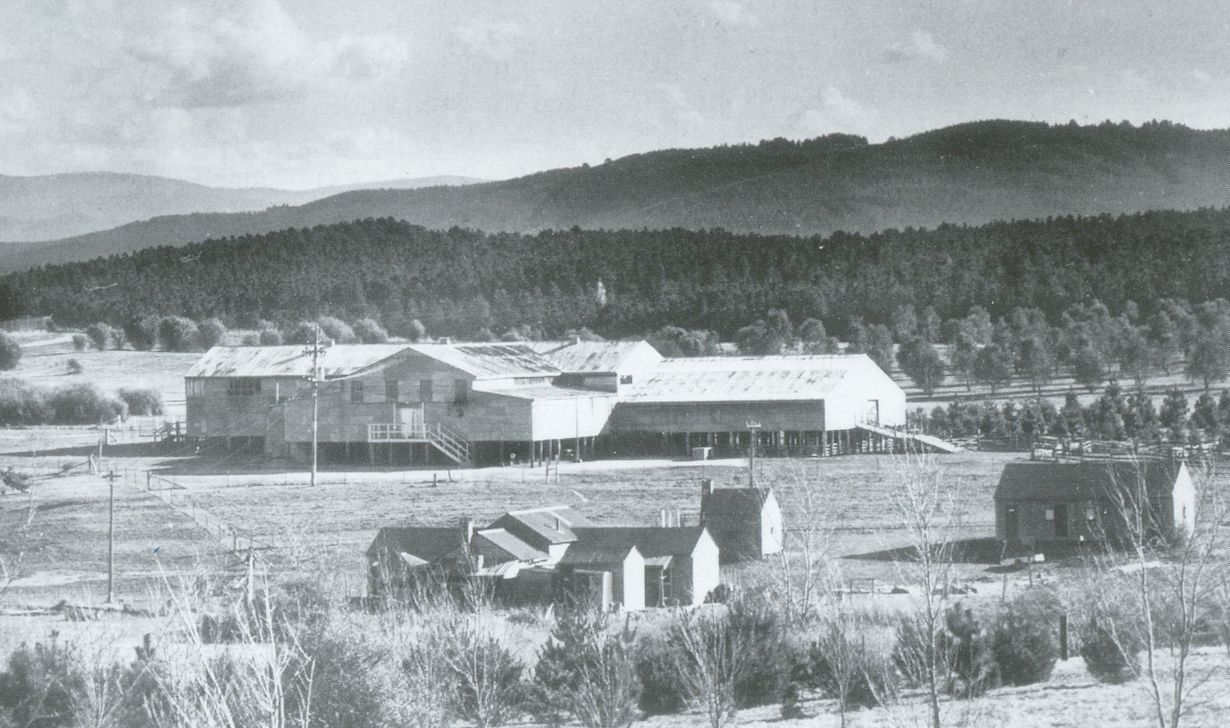
Yarralumla Woolshed, 1925

Yarralumla Woolshed, 1925 (Public Domain, via Wikipedia)

The Griffyn Ensemble like to mix up their venues – partly because they like to choose venues that add to their music, to the stories they want to tell – and so this last concert of the year was in yet another very new venue for them, the old Yarralumla Woolshed. Built in 1904, and still surviving in what is pretty close to the geographic centre of Canberra, the Woolshed has seen many uses over its lifetime – and one of these, in my twenties, was as Canberra’s most popular bush dance venue. It was this history, and its previous history as – of course – a woolshed, that the Griffyns drew on for their performance. And, as they have done all year, they had a collaborator, this time local author Katie Taylor.

Taylor created an appropriately spooky story, about shearers’ tales, mysterious disappearances, loss and hope, about beginnings and endings, and how endings are found in beginnings and vice versa. It was performed expressively by Kate Hosking who told the tale through and between the music performed by the ensemble. We were warned there’d be exaggerations because, as Taylor’s text told us,

exaggerations are what you want from a story-teller.

And so there were – at least we hope they were exaggerations, though you never know!

The eerie tone was set with Juan Pablo Nicoletti’s electroacoustic “Abismo al Abismo” played via tape. Its weird otherworldly impressions of wind and water were enhanced by the sound of Australia’s favourite cockatoos screeching over the woolshed. We were consequently well prepared for Susan Ellis’ unusual rendition of “Have yourself a merry little Christmas … it may be your last”!

From this, and with the story continuing, the ensemble moved on to play two of my favourite Erik Satie pieces (“Gymnopedie No. 3” and “Gnossienne No. 3”), followed by “Swamp Song”, composed by Griffyn violinist Chris Stone, and Shawn Jaegar’s “Pastor Hicks Farewell”. Then, in keeping with the venue, we were invited to take part in a bush dance called by Chris Stone and led by Michael Sollis, as the rest of the band played a “Bush Dance Macabre Suite”. Mr Gums and I aren’t unfamiliar with bush dance moves but “the stab”, “strangle your partner”, and “chop, chop like the guillotine”, were new moves to us! We think playing the spoons was a new move for flautist Kiri Sollis too, but, unlike our dancing, we felt she could easily take up a new bush band career. The suite ended with Susan Ellis singing Bob Dylan’s “Ballad of Hollis Brown” in character, as Ellis always does with aplomb.

We returned after a brief intermission to a dramatic change of pace – from jigs and ballads to Arvo Pärt’s minimalist “Fratres” played by Chris Stone (violin) and Laura Tanata (harp). I’m a bit of an Arvo Pärt fan, so enjoyed their thoughtful rendition. According to Wikipedia, this piece encapsulates Pärt’s “observation that ‘the instant and eternity are struggling within us'”. That fits rather nicely, I think, with the night’s theme of beginnings and endings, of moving forwards and backwards. This piece segued nicely to two very moody pieces: “so she moaned, and as she uttered her moans” composed by Michael Sollis, and featuring the double bass (Holly Downes), mandolin (Michael Sollis), violin (Chris Stone) and flute (Kiri Sollis), and  “Ghost” by Myrto Korkokiou and Apostolos Loufopoulos, with Kiri Sollis on alto flute accompanied by more electroacoustic music. These three pieces showed off the ensemble’s musicianship perfectly.

The concert concluded with Jeff Buckley’s “Dream brother” performed with some lovely singing by the whole ensemble:

Don’t be like the one who made me so old
Don’t be like the one who left behind his name
‘Cause they’re waiting for you like I waited for mine
And nobody ever came

Oh dear … And then, as Ellis moved onto “Stille nacht” (“Silent night”), the rest of the ensemble quietly left the stage, and it wasn’t long before we heard the ghosts of woolsheds past (or were they of our future?) a-knocking and tapping beneath us.

It was a beautifully coherent yet quirky concert that gave its audience a night to remember – and, just so we wouldn’t be left too spooked, they served us lamingtons at the end.

I look forward their Global Chronicles concert series in 2015.

You can hear other versions, online, of some of the music we heard:

Who’s watching our e-reading behaviour?

I was intrigued to read in The Guardian app this morning that Kobo has released a report on patterns in e-reading that they have gleaned from more than 21 million Kobo readers (the devices and, therefore, the readers!) across the world! The report says that retailers had been reluctant to share the data they had been gathering for themselves – but Kobo has apparently come clean. And how interesting it is. But first, the main issue implied by my subject line …

I’m not sure what to think about the fact that this data is being gathered. I find data about human behaviour fascinating but, as a librarian/archivist, I ascribe to the principle of reader/user privacy or confidentiality. Librarians don’t tell others what individual people are borrowing or researching, but they do gather data. Librarians running public libraries want, need in fact, to know what their users like. Do their readers prefer crime novels to classics, cookbooks to self-help, and so on? Librarians seek this information via such sources as borrowing statistics, surveys and just by chatting with their users. The public, presumably, thinks this is ok. After all, it is their/our money (our taxes) that is being used to buy the books – and we want that money spent sensibly.

Kobo, though, and all those other e-reader companies are in business. They also want to know what we like to read – because they want to make money. Fair enough. All retailers want to know what their customers want – at least, they should if they want to stay in business. The question is, in our electronic data driven world, what data is collected, how is it collected, and where is it kept? Is it anonymous, is it encoded, how is it used? There’s an interesting discussion about the collection of reader data at Scholarly Kitchen, particularly in relation to a recent discovery that Adobe Digital Editions was not only gathering information about users’ digital libraries and reading patterns, but sending it back to their servers in the clear (unencrypted). You can read more about this (with links to even more articles) at the Digital Reader. Adobe, of course, is not the only company gathering reader data. Amazon, says Scholarly Kitchen, “is notoriously silent about its activities, but it is well known that their use of big data gathering and analytics is profound”.

I’ll leave the discussion here … I have no solutions. In the end, we have two main options – opt out of the electronic world (if that’s at all possible) or trust providers (and do our best to be aware, careful consumers). Oh, and we can support the watchdogs who do their best to protect us and our information, and we can try to use trusted third parties (like, says Scholarly Kitchen, libraries and scholarly publishers).

I will end, instead, where I began – with Kobo’s recent report, and its finding that there is quite a discrepancy between what we buy and what we actually read. Hmm, let me put that more clearly: they found that the books at the top of the bestseller lists are not at the top of the “most completed” lists. Indeed, not one of the top 10 UK bestsellers (such as Gillian Flynn’s Gone girl which ranked 4) appears in the top 10 most completed. (You can see the two UK lists in The Guardian link I provided at the beginning of the post).

What does this say about bestsellers? Clearly promotion (and word of mouth) is extremely powerful – something we surely knew, but this data adds another whole angle to it. An interesting example is Northup’s Twelve years a slave which is ninth on the British bestseller list, due presumably to the  recent film adaptation, but which only 28.2% of British readers finished (or had, by the time the data was gathered). The book that topped the UK’s “most completed” list was

Casey Kelleher’s self-published thriller Rotten to the Core, which doesn’t even feature on the overall bestseller list – although Kelleher has gone on to win a book deal with Amazon’s UK publishing imprint Thomas & Mercer after selling nearly 150,000 copies of her three self-published novels.

Good news for Casey Kelleher.

Besides my intrinsic interest in what people buy versus what they read, my main question is how will Kobo (and other publishers) use this information? They probably don’t care greatly if people don’t read “bestsellers” – after all, they’ve got the money – but, getting their marketing machine behind smaller selling books that people are completing is another whole ball-game. Is this a scary thing or is there a wonderful potential here? For we general-cum-literary readers, it is scary, because the risk is they will start to skew their publishing activity (even more) towards the genres people most complete – which, in the UK, is romance – rather than taking a risk on something new. Sometimes, too much data can be a bad thing.

Thanks be to all those lovely small publishers who hang in there publishing different books. Once more, I “dips me lid” to them.


Monday musings on Australian literature: Prime Minister’s Literary Awards

I’ve written about the Prime Minister’s Literary Awards before – more than once in fact, as you will see if you click on my link. They were created in 2007 by our then new Labor Prime Minister, Kevin Rudd. What heady days they were. These were, at the time, Australia’s most lucrative literary awards, and were among the first of the major awards, when they instigated this in 2011, to provide a cash prize for shortlisted books. Awards were initially made in two categories – fiction and non-fiction – but gradually other categories have been added for poetry, children’s fiction, young adult fiction, and Australian history.

I do wonder though about the ongoing support. In 2010 the winners were announced on 8 November, then in 2011, it was 8 July, and in 2012 it was 23 July. Last year the winners were announced on 15 August, and this year they were announced tonight, 8 December. Why such inconsistency? Most major literary awards keep pretty much to a schedule, but this one is all over the place. Does this suggest a lack of commitment? I had started to think this year that they weren’t going to happen – until the shortlist was suddenly announced on 19 October.

I enjoy following these awards – and I’m primarily talking fiction here – partly because there is often something left field about them. Three winners – The zookeeper’s war by Steven Conte (2008), Eva Hornung’s Dog boy (2010) (my review) and Stephen Daisley’s Traitor* (2011) – didn’t win any other major award (as far as I’m aware). And the shortlists have included books that scarcely, if at all, popped up elsewhere, such as Sophie Laguna’s One foot wrong (2009) and Alan Gould’s The lakewoman (2010) (my review). Given that the arts is a subjective business, I like seeing different works being recognised. I can’t believe that there are only 6 or 7 books worth highlighting each year – and yet that’s what often seems to be implied when you look at the shortlists in any one year. (I suppose, though, if you are one of those 6 or 7 you hope that multiple listing will result in your winning at least once?)

Anyhow, it’s now time to announce this year’s winner of the fiction award – and it’s a joint award: Steven Carroll’s A world of other people and Richard Flanagan’s The narrow road to the deep north (my review).

And I can’t help giving a special mention to a couple of other winners:

  • Poetry award: Canberra’s gorgeous Melinda Smith with her collection Drag down to unlock or place an emergency call (published by the lovely little poetry press, Pitt Street Poetry). I haven’t read this, but I have heard Smith speak and mentioned her in my post on Capital Women Poets.
  • Non-fiction award: another joint award – Gabrielle Carey’s Moving among strangers (on my TBR) and Helen Trinca’s Madeleine: A life of Madeleine St John (my review).

The Australian history award was also made to two books. I have no idea what the authors think about all these joint awards, but as you can imagine, I like that the love was shared.

I do hope these awards continue, and hopefully on a more routine schedule.

Congratulations to all the authors, and their publishers, who won this year.

* I have been wondering about what has happened to Daisley, but I read just today in a catalogue from Text Publishing that he has a new book out in 2015, Coming rain, set in Western Australia in 1955, the year he was born! I’ll be looking out for it.

Helen Garner, This house of grief: The story of a murder trial (Review)

Helen Garner, This house of grief book cover

Courtesy: Text Publishing

Well you might ask why you would want to read a book about the trial of a man accused of murdering his three sons by driving his car into a dam and escaping the car himself? Indeed, Helen Garner was asked why she would want to attend such a trial – and write about it. But Helen Garner is made of strong stuff, having previously written The first stone about the sexual harassment of two girls at Melbourne University’s Ormond College and Joe Cinque’s consolation about the trial of a woman accused of murdering her boyfriend via a drug overdose. I’ve read and appreciated both these books, along with novels and short stories by Garner, and so was keen to read this, her latest.

For those of you who don’t know the story, here’s Wikipedia’s summary of what happened:

… as Farquharson was returning his children to their mother after a Father’s Day access visit, his white 1989 VN Commodore vehicle veered across the Princes Highway between Winchelsea and Geelong, crashed through a fence and came to rest in a farm dam where it filled with water and submerged. His three children, Jai (10), Tyler (7) and Bailey (2), were unable to free themselves and drowned. Farquharson managed to escape and alerted another driver who took him to nearby Winchelsea. Police divers recovered the boys’ bodies about 2 am the next day. They were still inside the vehicle and unrestrained by seatbelts.

Farquharson claimed that he did not intend to kill his children, that he had blacked out during a coughing fit (a condition known as cough syncope). However, he was tried and found guilty, tried again after winning an appeal and found guilty again, and was then refused leave to appeal to the High Court of Australia.

Garner sat through both trials, the first one lasting around 7 weeks, and the second one 11 weeks, and managed to condense it all into 300 pages of lucid prose. One of the reasons I was keen to read the book was to see what approach she’d take. In The first stone and Joe Cinque’s consolation, Garner’s opinion is pretty clear from the beginning – and I didn’t fully agree with her (for very different reasons in each of the books). However, in This house of grief, Garner is more measured. She doesn’t want to believe that Farquharson is guilty – “longed to be persuaded” otherwise – but is gradually swayed by the evidence to believe it must be so. She doesn’t engage emotionally with the participants in the intense way she did in Joe Cinque’s consolation, but she is emotional. How could you not be in such a case? There are two reasons I like Garner – her tight, evocative prose, and her fearless honesty. And so, in this book, she tracks her own response as she listens to the evidence – from her disbelief that a father could do such a thing, and her sentimental desire to believe Farquharson, to her horrified admission that any doubt about it is “no more substantial than a cigarette paper shivering in the wind”.

So, let’s get back to the original question. Why read such a story? There are a few reasons, but I’ll discuss my two main ones. The first is to gain insight into, and understanding of, human behaviour. Why do people do what they do? It’s so easy to judge people out-of-hand, but even horrific events have nuances, and I want to understand those. Not to excuse, because it’s impossible to excuse taking the lives of those in one’s care, but to be able to empathise in some way. Isn’t this what literature is about?

Garner achieves this by not demonising Farquharson. As she watches him in court, and listens to the evidence – professional, personal, expert – she presents a picture of a man who was “emotionally immature, bereft of intellectual equipment and concepts, lacking in sustaining friendships outside his family”. At the end of the first trial, the judge speaks kindly to Farquharson, and Garner writes:

Farquharson nodded to him, courteous and present. For the first time I saw him as he might have been in ordinary life, at work, at school. It touched me. Again I felt shocked, as if this response were somehow illegitimate.

(Interestingly, Garner did not accord such recognition to Anu Singh in Joe Cinque’s consolation. Yes, different case, very different people, but the principle still stands I think.) A little earlier in the trial, Garner quotes “a tough American prosecutor” who’d said to her:

‘If I were appearing for him, I’d try to make his family see that loving him doesn’t have to mean they believe he’s innocent’.

But, how tough that would be, eh?

My second reason is to understand the workings of courts and justice. I have never (yet anyhow) been called for jury duty. Oh my, oh my, after reading this, I’m even more desperate that I never am. Although it’s pretty obvious that the right verdict was achieved in this case, the process was not reassuring. Garner’s reporting of evidence and cross-examination reads very like those court dramas you see in film and television. There’s drama, police mistakes, twisting of the truth, character assassinations, conflicting expert opinions – and, in this case, a lot of complicated and sometimes obfuscatory technical evidence about cars and tire tracks and steering inputs, about arcs and gradients. And it goes on for weeks.

Garner keeps it interesting by focusing on the people and their reactions, reporting some dialogue, and summarising the critical (which, she makes clear, is not always the most relevant) points of evidence. Her descriptions of the defence and prosecution team are drawn with a novelist’s eye for character. Sometimes Morrissey, the defence barrister, is “as jumpy as a student undergoing an oral exam”, while at other times he’s “less flustered … more in control of the content and tone of his discourse”. His “waxen” appearance at the second trial is quite different from the beginning of the first when he’s presented as a hearty “spontaneous, likeable man” whose “stocks were high”.

She also pays a lot of attention to the jury. Of course we cannot know what they thought or discussed but Garner watches them, noting when their attention flags and when it picks up, when emotions get the better of them. She writes, for example, of one witness that “the jury liked him … he was one of the witnesses they instinctively trusted”. During her report on the second trial, she quotes American writer, Janet Malcolm who wrote that “jurors sit there presumably weighing evidence but in actuality they are studying character”.

Partway through the book, Garner comments that the question “Did he do it?” is the “least interesting question anyone could ask.” Later, between the first and second trial, she quotes a grandmother from another murky situation in which a father was suspected of killing his children via a house fire. The grandmother asks:

‘What’s worse? — living with suspicions and various possibilities and never knowing the truth, or living with the truth of something too horrible to contemplate.’

Books like Garner’s enable us – nay, force us – to contemplate such questions. They show us that trials are less about retribution, perhaps even less about justice, but more about the truth. What we are to do with the truths we so glean is another question – but that question, Garner suggests, is our “legitimate concern”, and I agree.

awwchallenge2014Helen Garner
This house of grief: The story of a murder trial
Melbourne: Text Publishing, 2014
300pp.
ISBN: 9781922079206

(Review copy courtesy Text Publishing)

Monday musings on Australian literature: The case for …

Back in February, the online journal, The Conversation, about which I’ve written before, started a occasional series they call The case for …. They described it simply as …

If you had to argue for the merits of one Australian book, one piece of writing, what would it be?

That’s very open-ended and I did think the intention might have been for contributors to argue for a book of controversial standing or, perhaps, one that has not received the recognition the casemaker thinks it deserves. But neither of these work for the first book, which was …

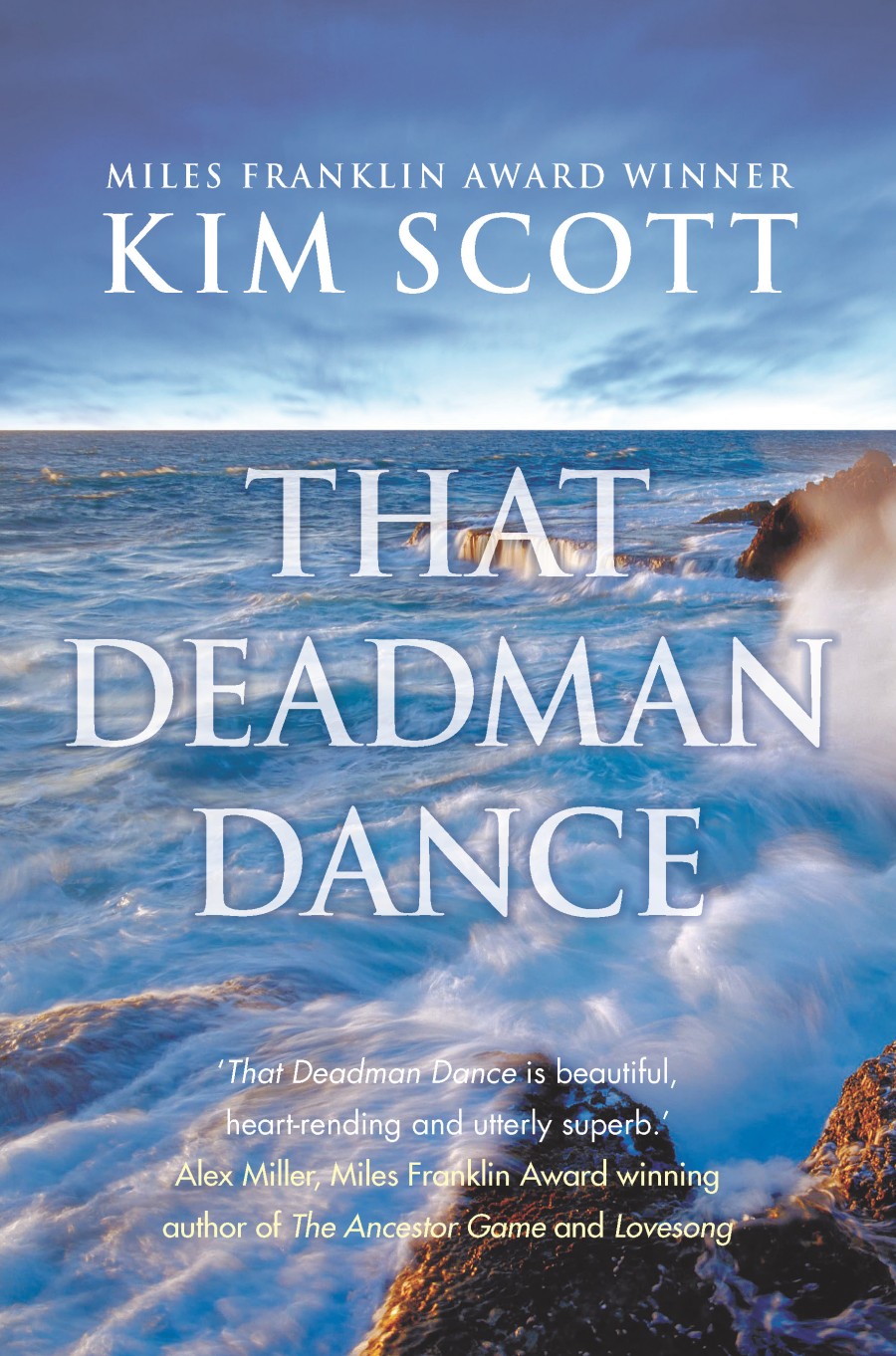
Kim Scott That Deadman Dance

(Courtesy Picador Australia)

Kim Scott’s That deadman dance, chosen by Tony Hughes-D’Aeth, Associate Professor, English and Cultural Studies, University of Western Australia. (See my review). It is not controversial, though some readers found it a little hard to read, and it won a swag of awards, as Hughes-D’Aeth tells us at the start of his case. However, he makes a case on the basis of its importance and relevance to the ongoing discussion in Australia about the facts and implications of first contact. And his case has to do with what he calls Scott’s “bold wager” that “he wanted to write a novel from the point of view of Aboriginal confidence” and that he was “inspired [to do so] by history”. Hughes-D’Aeth discusses his surprise at this idea of “confidence”, given that the history is one of “decimation” and “cultural annihilation”. You can read his “case” if you’d like.

I should clarify, before I continue, that The Conversation also says that the work can be “fiction or non-fiction, contemporary or historical”.

So far there have been eighteen cases put. Several are for books I know or have read (often before blogging), such as (links are to the “case”):

But some cases are for books, I don’t know at all (which probably just demonstrates my ignorance). These include:

Of the eighteen cases listed on the site, the one that stands out as a bit odd to me is Johnny Warren’s book, published in 2002. Warren was a legendary Australian footballer. Casemaker Lee McGowan (Senior Lecturer, Postgraduate Coursework Studies, Queensland University of Technology) admits that the book has its weaknesses, but argues that it’s important nonetheless. He says that “the book’s title refers to what Warren described as a ‘mentality’ that exists around football in its early days in Australia, a mentality he implied was borne of fear.” McGowan suggests this seems outdated now – though I’m not sure exactly what he’s saying is outdated. The words in the title? The mentality? The fear? He doesn’t explore this further, but moves on to say that the book’s main value is that it “remains the best, most insightful account of the Australian game’s contemporary development”. I guess I wouldn’t see the development of football as a critical issue warranting my attention, but to each their own I suppose.

I’m intrigued – though not surprised – to note that several of the books for which cases have been made are by indigenous writers or confront indigenous issues (including Kim Scott, Randolph Stow, Peter Temple, Paddy Roe, and Gail Jones’ Sorry). The cases, in other words, reflect the zeitgeist of our times. Suzie Gibson from Charles Sturt University, arguing for Stow’s To the islands (1958), for example, writes that in it

contemporary readers are confronted with the fruits of Australia’s racist policies concerning Aboriginal peoples.

She argues that, in addition to its literary merit, it is relevant to modern Australia

which tends to function in ignorance of the ongoing cultural disenfranchisement of Australia’s first peoples.

Literature, as we all know, comes in and out of fashion, sometimes for reasons that aren’t immediately obvious. I love this initiative by The Conversation – and hope further academics and researchers take up their offer to present cases.

Anyhow, I’m sharing this series for a couple of reasons. One is that it provides yet another list to look at when considering what to read next. And the other is, as you’ve probably guessed, to ask, What book* would you make a case for – and why? I will make a case for a book in a future Monday musings!

* Preferably from your own national literature.


Delicious descriptions: Eimear McBride is not all grim

Reactions to Eimear McBride’s A girl is a half-formed thing, which I reviewed recently, vary greatly. It is, overall, a bleak read and its style is idiosyncratic, which makes it a double whammy. So, for example, it has been called “brutal” (by Sunday Times Ireland) and a “joyous thing” (by Michael Cathcart, RN’s Books and Arts Daily). Both of these make sense to me – the story is “brutal” but the writing is “a joyous thing”, because it’s alive, it wakes you up, it compels you on.

In 2013, as you may have already heard, it was the inaugural winner of the Goldsmiths Prize, which was “established to celebrate the qualities of creative daring associated with the University and to reward fiction that breaks the mould or opens up new possibilities for the novel form. Accordingly, the annual prize of £10,000 will be awarded to a book that is deemed genuinely novel and which embodies the spirit of invention that characterises the genre at its best”.

Like most “brutal” works of art, though, A girl is a half-formed thing does have light or chuckle-inducing moments. I wanted to share one with you. Reviewers, I’ve noticed, have tended to choose a scene from the grandfather’s wake to illustrate this so I thought I’d choose something different, a description of Mammy being visited by her church friends early in the novel. Here goes:

Some most are women. In a blue moon a man. I like to eye. Sitting in the corner jugging as I can for all they say is interesting. Dress undressing no-neck cindy. Not stopping or I get look at little lugs there listening in. Oh taking it all in that one. Doesn’t miss a thing. Spelling I know but too iquick to understand r.u.n.o.f.f with the s.a.c.r.i.s.t.a.n and they are living in s.i.n down in such and such a place. There’s stink girl’s mother and her sister with women’s troubles so peculiar all pointed down and asked and how’s ahem? Ah she’ll not sit down for years. Apparently the smell of it is something wicked but god knows it’s not her fault. Their brother’s second wife — ach the first died leaving five behind. Tell me where’s the sense? They’re wild as wild. As bold as brats. The P.P’s housekeeper — God rest her late husband. A lovely man. She gave him a hard life but sure. Mrs one whose husband ran the AIB. Uppity up in herself — behind palms in the scullery they whisper adding a splash to warm the pot. Great red hat she wears to mass. So we have a look at her and where’s the humility in that? Ah each to their own, they say. Then your woman who bought a knitting machine. A hundred and twenty pounds now where did she … Her little boy. Downs. God love him. She does school jumpers so she can get him toys that are ed-u-cat-ional nod nod. That’s right for God helps those who help themselves. The politician’s wife they’d normally spite but God help us her heart is broke. He’s running about with this one and that one. She can’t look down on them. Her vows were sacred and he’ll not get her in mortal sin. Her heart may be pierced with a thousand spears but she’ll offer it as a penance that’s a bit proud don’t you think? And the one whose husband’s a desperate drunk. Like his father before him you know the type, vicious. That’d kill you in it by mistake. Her blue eyes. Her black eyes. Is he on the bottle? they say and pray for sometimes giving up and the forgiveness of his sins.

Go with it – and it’s perfect, a funny, biting rendition of women’s gossip. Stop to unpack the “sentences” – and you’re lost.

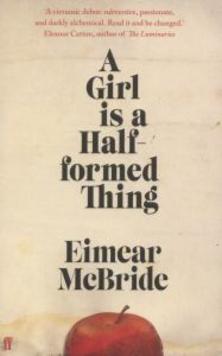
Eimear McBride, A girl is a half-formed thing (Review)

Eimear McBride, A girl is a half-formed thingI try very hard when writing reviews to avoid clichés and superlatives, like, say, “achingly beautiful” or “masterful”. But I think I’m going to use one for Eimear McBride’s multi-award-winning debut novel A girl is a half-formed thing when I describe it as “searing”. I can’t think of a more apposite word. Yet I fear it too has been over-used to the point of meaninglessness. So, let’s try something else …

Once again I’m coming late to the read, and once again this is partly because it was scheduled by my reading group. All I can say is, wow. I’m not sure I’d go so far as Eleanor Catton’s “read it and be changed” commendation on the front of my edition, but I do agree with her  “virtuosic” and “subversive”. It’s a gut-wrenching read.

The plot itself is simple enough. It’s the story of a family – a pious one-could-say-religiously-fanatical mother, a son who survived a serious brain tumour as a toddler, and the younger daughter. The tumour leaves the son somewhat brain-damaged and, of course, it returns. This tumour, the trauma of it, shapes their behaviour and defines their relationships. The story, which spans around 20 years, is told through the daughter and could, in one sense, be seen as coming-of-age. But. This. Tells. You. Nothing. Because …

This is not your typical first-person voice. Instead, we are in the head of the unnamed “girl”. We are there in her conscious unconsciousness (or, is it her semi-consciousness?) in which we hear what she’s experiencing in language that is – here’s another cliché – raw. By this I mean that the language is stripped of the mediation of a formalising narrator’s intellect. Instead it captures the immediate emotional truth of the girl’s experience as she grapples to make sense of her world. This is a book in which the style conveys the meaning as much as the words do.

How does McBride do this you are probably wondering (unless, of course, you’ve already read the book). Well, mostly by breaking, consistently, the rules of grammar and syntax. We are in the girl’s head, a place where, I believe McBride is saying, we rarely think in coherently formed sentences but in what I would call “impressions”. Take, for example, this description, on the first page, of the brother before his diagnosis:

I know. The thing wrong. It’s a. It is called. Nosebleeds, headaches. Where you can’t hold. Fall mugs and dinner plates she says clear up. Ah young he says give the child a break. Fall off swings. Can’t or. Grip well. Slipping in the muck. Bang your. Poor head wrapped up white and the blood come through. She feel the sick of that. Little boy head. Shush.

To orient you, “she” is Mammy, “he” is the father who disappears two pages later, and “you” are the little boy, the girl’s brother. Most of the novel is addressed to him (that is “you”). One of the challenges of reading this book, and it is a challenge to read, is its pronouns. Once you’ve got a handle on them, and once you realise that they are all from the perspective of the girl, you are half way there.

Anyhow, there is easier syntax than the above when life is relatively calm but, when our “girl” is distressed such as when the truth of her brother’s situation can no longer be avoided, it collapses almost completely:

I walk the street. City. Running through my mouth. Running in my teeth the. My eyes are. All the things. The said the done what there what’s all this? That stuff. I could do. My. I walk the street. Who’s him there having a look at me he. Look at my. Tits. Ssss. Fuck word. No don’t. Fuck that. No. Will. Not that. Not. That. But. If I want to then I can do.

This is not the most extreme example – I don’t want to spoil too much – but it should demonstrate what I mean by the language mirroring/enacting/even being her state of mind.

In addition to the idiosyncratic syntax, McBride draws on wide range of literary techniques to keep us focused on, grounded in the emotions of the here and now. The imagery is visceral, returning again and again to  “muck”, “dirt”, “blood”, and “puke”. She alters her rhythms to match the tone, not only through the syntax as evident in the examples above, but through allusions to and repetitions of prayers and hymns, lines from children’s games, literary works and sayings. She makes up new words (“I trup trup off behind her”), mangles existing words (“swoll” for “swollen”), and twists common expressions (“There’s a foul there’s a wind where’s the air”). McBride was inspired by Joyce she says, but her fresh, fearless, urgent language reminded me too at times of Gerard Manley Hopkins.

The novel is clearly set in Ireland and there are odd references to 1980s technology like Game Boys, but overall place and time are unspecified, and none of the characters are named. All this keeps the focus squarely on the emotional core of a family in pain, and the girl in particular. She is abused by her uncle at the age of thirteen and begins a strange love-hate, violent-tender, but sick, relationship with him. Sex becomes for her a weapon, a tool and a punishment. But the book is not about this, that is, it’s not yet another book about abuse. It is about the girl’s inability to handle her emotional pain, and her family’s inability to see her need, it’s about growing up unsupported. She is complicit in her own degradation because for her physical pain is better than the emotional. Like those who self-harm, she seeks out abuse again and again because

… what’s wrong here is me me me. Me the thing but I. Think I know. Is that the reason for what’s happened? Me? The thing. Wrong.

I know this all sounds unremittingly bleak and it largely is, but there are light touches – blackly comic scenes, surprising word plays, and chuckle-inducing descriptions (like her mother’s friends, “they polyester tight-packed womanhood aflower in pink and blue”).

A girl is a half-formed thing is hard to read style-wise and painful to read content-wise. But it is a book that, if you let it, reaches deep into your core and makes you understand the lives of others in a way that only the best literature can. I’m so very glad I read it.

John at Musings of a Literary Dilettante also liked it.

Eimear McBride
A girl is a half-formed thing
London: Faber and Faber, 2014
203pp.
ISBN: 9780571317165

Monday musings on Australian literature: The Voss Literary Prize

Did the title of this post grab your attention? It grabbed mine so dramatically when I came across it that I immediately abandoned my plans for today’s post – they can wait – to tell you about it.

The first thing to say about it is that it’s not what you think, if indeed like me you immediately thought of Patrick White’s Voss. I was impressed. We have prizes named for authors and sponsors but I hadn’t come across one named for a literary work. Have you? Well, as it turns out, I still haven’t because this award was named for its benefactor, Vivian Robert La Vaux Voss, who conceived it in 1955 – two years before Patrick White’s Voss was published. Hmmm … 1955 and I’ve only heard of it now? This is where the story becomes even more interesting.

I read about this award in one of my favourite on-line journals, The Conversation. The author, and one of the prize’s judges, Anthony Uhlmann, describes its genesis. Vivian Voss, according to Uhlmann, had a “an early career of brilliant promise”. He apparently won many prizes at the University of Sydney and the University of Rome but died in 1963, when he was just 33 years old. His grandfather, Frances Henry Vivian Voss, and mother, Harriette Martha Voss, were both medical practitioners and both appear in the Australian Dictionary of Biography (ADB) for their medical and community work. According to ADB, his grandfather “indulged his love of literature in his fine private library”. The family was wealthy, which must be why Vivian Voss was able to create the Voss Literary Prize in the will he wrote in 1955. In this will, he envisaged the prize being overseen “by five professors at his alma mater, the University of Sydney: the Professor of Latin, the Professor of English, the Professor of French, the Professor of Italian, the Professor of German”. They were to grant the prize to the best novel, “published or unpublished”, in the world! He clearly wasn’t thinking small!

Uhlmann says that the prize was offered to several major universities, all of whom turned it down. It was then offered to the Association for the Study of Australian Literature (ASAL), but they already had a literary award*. So, it was offered to the “newly formed Australian University Heads of English” (AUHE) who “gratefully accepted it”.  Uhlmann doesn’t explain over which time period all this occurred, but it sounds like this last offer was made fairly recently. And, in fact, an AUHE press release seems to explain the timing, stating that “a life tenant in Vivian’s Estate received estate income until his death in 2012”. Ah, so the money, it seems, was tied up, which is why the first award is only now being made. The prize in 2014, this same press release says, will be $6,500.

There is now a website for the award, which describes it as:

a new award dedicated to the memory of Vivian Robert Le Vaux Voss (1930-1963), an historian and lover of literature from Emu Park in Central Queensland who studied History and Latin at the University of Sydney and modern languages at the University of Rome.

As far as I can tell, the award seems to be now limited to Australian publications.

Now to the first awarding of the prize. Uhlmann names his co-judges: Brenda Walker (novelist whose Poe’s cat languishes in my TBR, University of Western Australia), Philip Butterss (whose An unsentimental bloke I recently reviewed, University of Adelaide), Brigitta Olubas (University of New South Wales), and Amanda Nettlebeck (University of Western Sydney). They shortlisted the following novels:

  • Hannah Kent’s Burial rites (my review)
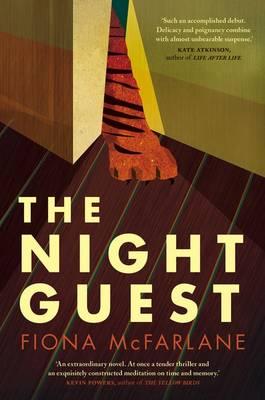
  • Fiona McFarlane’s The night guest (my review, added in 2015)
  • Christos Tsiolkas’ Barracuda (my review)
  • Tim Winton’s Eyrie
  • Alexis Wright’s The swan book

(You can see the longlist on their site).

McFarlaneNightGuestAnd the winner, announced on Wednesday November 19, 2014, at the annual meeting of the AUHE, is Fiona McFarlane’s The night guest. I have had this novel on my radar since I saw the first reviews start to come through for it at the Australian Women Writer’s Challenge. I now have it in my possession – and just need to find time to read it.

I have spent quite a bit of time, I know, on this award – but I thought it was an interesting story and hoped you would think so too. It will be an interesting one to follow – but, I know I will always do a double-take when I see its name!

* The ALS Gold Medal, which was awarded this year to Alexis Wright’s The swan book.

Art meets Literature at In the Flesh

I’m pushing it really with my heading, as for many the literary aspect of the National Portrait Gallery’s In the Flesh exhibition would be a passingly noticed sideline, but for me it added significantly to my enjoyment. It helped of course that I found the following in the first room:

It is not time or opportunity that is to determine intimacy; it is disposition alone. Seven years would be insufficient to make some people acquainted with each other, and seven days more than enough for others. (Jane Austen, Sense and sensibility)

I like it when exhibition curators draw parallels between different art forms or, perhaps more accurately in this case, use evidence from one art form (in this case literature) to comment or elucidate another (here, figurative art).

Exhibition curator Penelope Grist describes* the exhibition as being about “humanness – the experience of a mind enfleshed in a body”. She goes on to say that “relationships between the human mind, flesh and lifespan underpin the nature of portraiture”. But wait … are these portraits? Technically not, I think, not if we understand “portrait” to mean the depiction of a specific person. While individuals may have modelled for works in this exhibition, they are not, with an exception or two, identified. Given the subject matter of the works, I don’t see this as a problem. Categories are sometimes best left fluid.

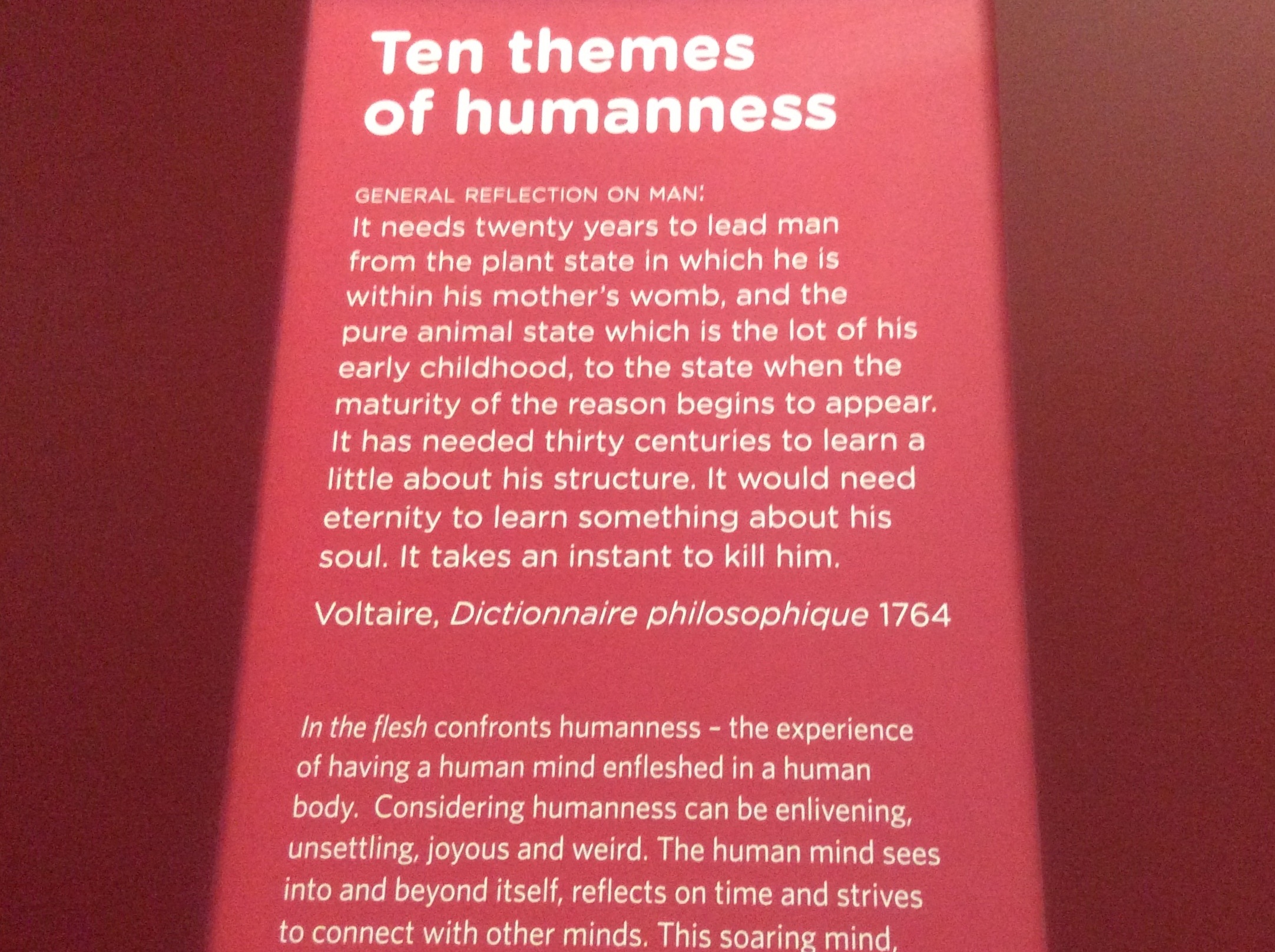
"In the Flesh" interpretative panel

From “In the Flesh”

This exhibition looks at the idea of “humanness” through ten themes – Intimacy, Empathy, Transience, Transition, Vulnerability, Alienation, Restlessness, Reflection, Mortality and Acceptance – which are, in themselves, interesting. I can imagine the fun the curators had in deciding these ten themes. They are an eclectic bunch, but they make sense. The works exhibited vary in form and come from ten contemporary figurative artists: Natasha Bieniek, Robin Eley, Yanni Floros, Juan Ford, Petrina Hicks, Sam Jinks, Ron Mueck, Jan Nelson, Michael Peck and Patricia Piccinini. I like art but keep up with it erratically, so was really only familiar with two of these: Ron Mueck and Patricia Piccinini.

So, where does the literature come in? Well, as you’ve probably guessed already, each of the themes is introduced with a quote. Jane Austen’s introduces the theme of Intimacy. In her article, Grist explains that:

The contemporary art of In the Flesh takes the weight of the thousands of years that human minds have expressed in art their struggle to comprehend the existence, transformation and demise of the human body. The ten quotations from Shakespeare to The Doors that accompany each theme reference this legacy.

I’m not sure why she limits her comment here to “the human body”, unless she doesn’t mean it literally, because the quotations themselves refer more widely to the condition of being human. And the rest of her article encompasses a broader concept of “humanness”.

I’m not going to discuss the ten themes in detail, and I’m not going to include a lot of images**. Instead, I’m going to briefly discuss my responses to two of the works to exemplify how one can enjoy this exhibition.

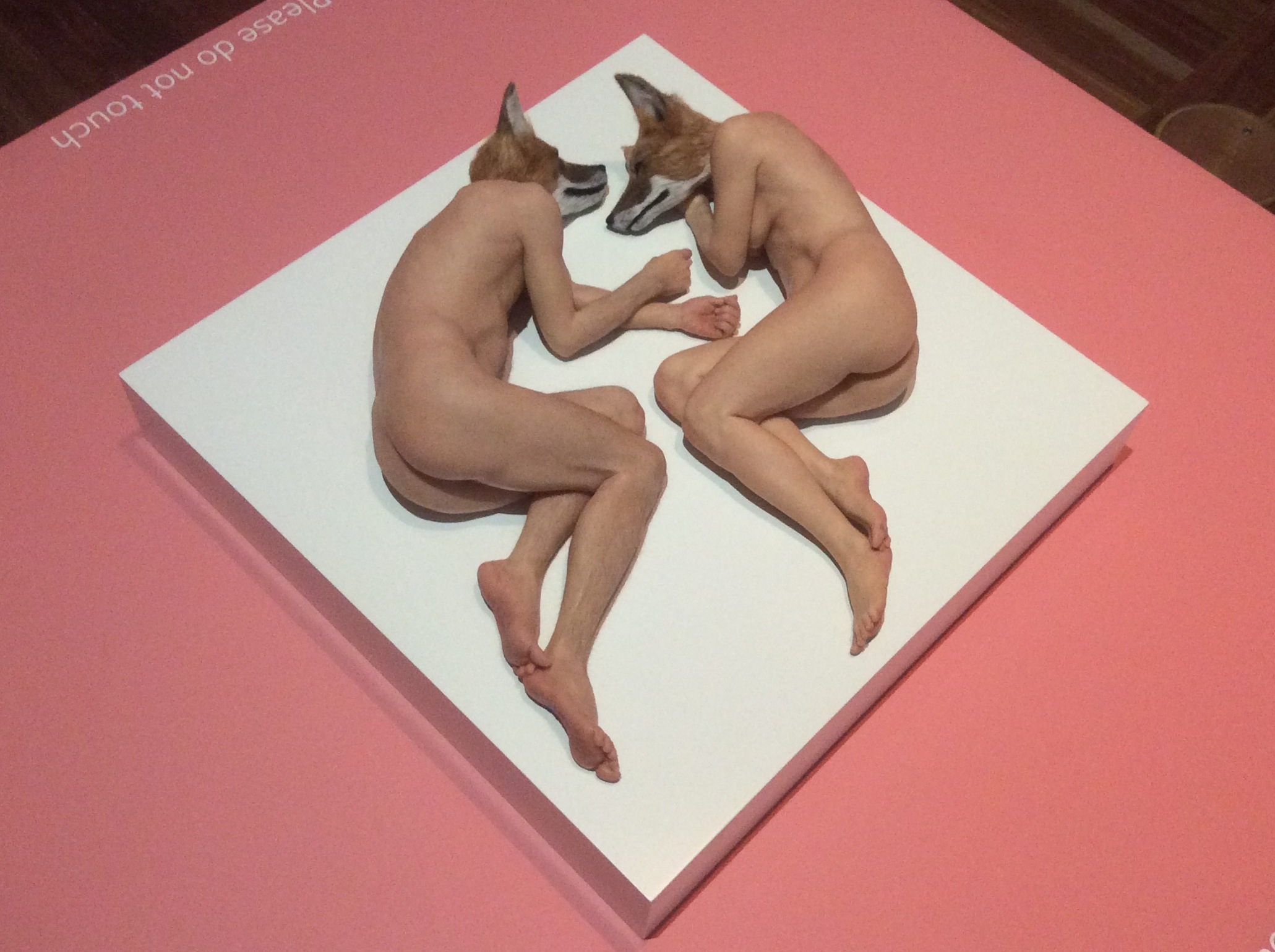
Sam Jinks, Unsettled Dogs

Sam Jinks, Unsettled Dogs

The first room is devoted to Intimacy, and it contains works by sculptor Sam Jinks, one being “Unsettled Dogs”. I was captivated by this. It’s tender, fragile. They look paradoxically trusting and vulnerable (another of the themes) as well as intimate. But it’s also disconcerting, because of the dog-heads. Grist explains this: “the dog-headed cynocephalus of ancient and medieval imagination reminding of the human capacity for destructive irrationality within intimate relationships”. I have always seen dogs as benign not destructive creatures, but the sculpture does indeed capture the tension contained in this classical concept. Perhaps it’s also because the dog heads are fox-like which we Aussies definitely equate with destruction.

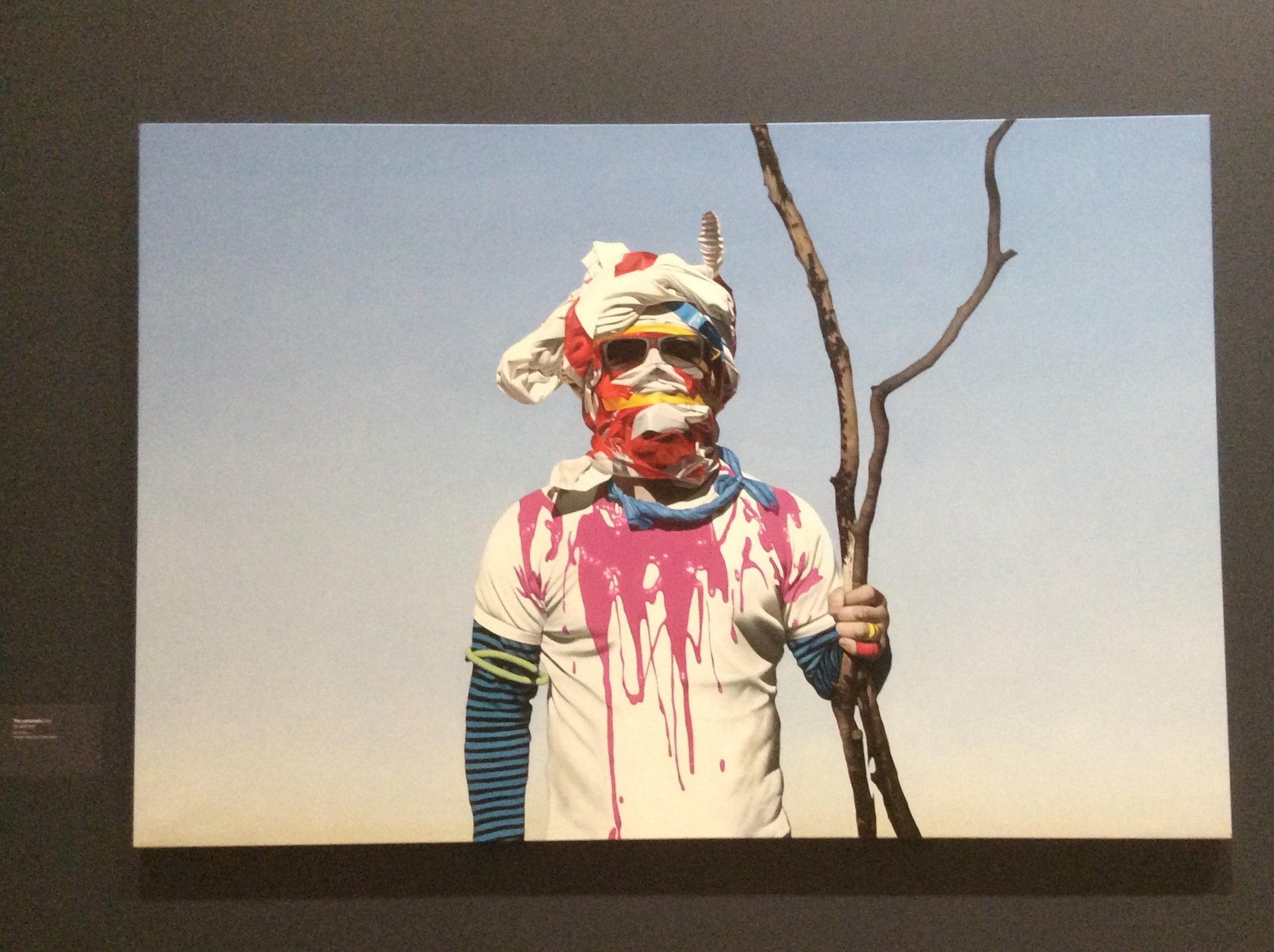
Juan Ford, The Reorientalist

Juan Ford, The Reorientalist

Another work in which a cultural context affected my “reading” is Juan Ford’s painting, “The Reorientalist” (2013). It is in the Reflection theme, and is a large, arresting, powerful piece. Grist talks about the “motif of the play-weapon” confronting “the notion of the natural self”. She says the works displayed in this section are not about glorifying war but questioning why we are interested in war as children, raising ideas of “innocence and experience”. The curator at the Dianne Tanzer Gallery says of this work:

Standing strong, grasping staff-like branches as if to communicate his allegiance to nature’s side of the war. Bound in industrial detritus, this figure wears a tribal outfit that might be conjured from a Mad Max film, like a lone-warrior of both painting and the wild – and a caricature of himself as the artist. The title itself suggests a challenge to the colonialist tendencies of the painting traditions he seeks to subvert, redirecting their Orientalist imperatives into the wilderness; an exorcism performed by an Absurdist shaman.

I can see the tension between children, play and weapons, and I appreciate Ford’s wanting to subvert colonialist traditions. However, in the current environment of concern about the radicalisation of young Australian men, this work had another layer for me. Am I over-thinking it? It certainly made me ponder how art can take on different meanings according to circumstance.

These are just two of the 63 works in the exhibition, most of which made me stop and think. If you are in Canberra over the next few months, I recommend you make time to visit this exhibition. Meanwhile, I will close on the literary reference used for the theme of Transience, partly because it’s by William Cowper who was one of Jane Austen’s favourite poets:

The lapse of time and rivers is the same,
Both speed their journey with a restless stream;
The silent pace, with which they steal away,
No wealth can bribe, nor prayers persuade to stay …
(William Cowper, “A comparison”)

The ultimate description of our “humanness”!

* “In the Flesh: an exhibition of humanness in ten themes” in NPG’s magazine Portrait #47 (Spring/Summer 2014). Currently for sale but will, I believe, be available online on the magazine’s site down the track. The article includes excellent images from the exhibition.
** I’m not totally sure of copyright issues, and I don’t want to detract from the exhibition itself, so I’ve just included a couple of my poor quality iPad images of works that the NPG has used on its website. You can click on the images to see them bigger, though not necessarily better! I am assuming that my use here is covered by fair dealing for criticism or review.

Ethel Turner, Tales from the “Parthenon” (Review)

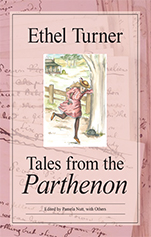
Ethel Turner, Tales from the Parthenon

Courtesy: Juvenilia Press

Hands up if you’re an Aussie and didn’t read Ethel Turner’s Seven little Australians in your childhood. Surely no hands have gone up? Seven little Australians, her first novel, was published in 1894 when she was 24, and was an instant hit, eventually becoming a classic. According to Wikipedia, it was, in 1994 (and may still be), “the only book by an Australian author to have been continuously in print for 100 years”. It seemed only right then that I should choose Ethel Turner‘s Tales from the “Parthenon” for my third foray into the bundle of juvenilia books I bought back in April from Juvenilia Press.

Like Juvenilia Press’ other publications that I’ve read to date, Tales from the “Parthenon” contains a wealth of supporting material besides the actual juvenilia, including an in-depth introduction, notes on the text, endnotes and footnotes, an appendix, and a list of references.

Ethel Turner (1870-1958) and Mary Grant Bruce (1878 – 1958), whose juvenilia was the first I wrote on, were contemporaries, and, according to the Introduction, “dominated the market for children’s fiction in Australia”. However, while Bruce focused on the bush, and the national character as exemplified by bush living, Turner, whose career started earlier, had, says the Introduction, “already moved away from that tradition and firmly established her fiction in suburban Sydney”. The Introduction also tells us a little about Turner’s early writing career, at school and then immediately post-school. At school she and her sister, Lilian, established a magazine Iris when the school’s newspaper, Gazette, which was edited by another Australian writer-in-training, Louise Mack, rejected Ethel’s contributions!

Turner left school in 1888, and in 1889 she and her sister established another magazine, the Parthenon, which ran from 1 January 1889 to 4 April 1892. An impressive effort methinks for two young women. As you will have now gathered from the title of this volume, it is from this magazine that Pamela Nutt and her team have chosen works to represent Turner’s youthful writing.

While the focus on urban/suburban life and settings is one point of interest in Turner’s writing, another is her awareness of gender issues (though she wouldn’t of course have used such language). This is made clear in the Parthenon’s first issue in which they identified their goals. They wrote that their great grandmothers had learnt to write and spell, and their grandmothers had added “French, the harp and pianoforte, and the use of globes”, but

now the desire for knowledge in rapidly growing: deeper and deeper, woman goes into the mazy labyrinth, untrodden before by any but men’s footsteps,—culling the flowers of knowledge,—yes, and enjoying them, and appreciating them even as much as men do.

Ethel Turner was active during the first wave of feminism in the late 19th to early 20th centuries. While this early wave didn’t reject women’s domestic role and function, it did argue for women’s rights and recognition of intellectual equality. Turner fits within this paradigm. The Introduction suggests that her novel Miss Bobbie, of which an earlier serialised version appeared in Parthenon, promotes “vigour and independence” in young women but situates this within a world still framed by “patriarchal expectations”.

The Introduction mentions a third way in which Turner contributes to Australia’s literary tradition: incorporating Australian elements into traditional English fantasy. The pieces in this volume have been well-chosen to reflect all these aspects of her writing. They are all children’s pieces – “Gladys and the fairies” (in 2 chapters), “A dreadful pickle” (in 3 chapters), both published in 1889, and chapter 3 of “Bobbie” from 1890. And all feature spirited if not naughty girls. Jane Gleeson-White, in her Australian classics: 50 great writers and their celebrated works, quotes Turner’s opening to Seven little Australians:

Before you fairly start this story, I should give you just a word of warning. If you think you are going to read of model children, with perhaps a naughtily inclined one to point a moral, you had better lay down the book immediately … Not one of the seven is really good, for the very excellent reason that Australian children never are.

Gleeson-White’s point is that Turner may have been called Australia’s Louisa May Alcott, but her children are very different. And these juvenilia pieces show her moving down that path. Gladys is “dreadfully spoilt” and behaves tyrannically. However, time in Shadowland and Fairyland, forces her to rethink her ways, though not before she collapses in a typical Victorian faint! It is here we find English fairies in a new environment. Turner’s fairy queen rides in a chariot comprising “part of an emu’s egg, wondrously carved” with elfs* following, “dressed in yellow and riding locusts”.

Midge, the protagonist of “A dreadful pickle”, is also spoilt, and, like Gladys, treats her governess badly. However, she has a kind heart along with her independent spirit, and “wants to help poor people like those in London”. The story takes a Dickensian turn when Midge finds herself out of her depth and alone with some of these poor people. There’s some fun wordplay in this story – and I was intrigued by the note on the word “pallor” telling us that Turner used the American spelling that was popular in Australia at the time. The things you learn!

Then there’s Bobbie. We only have one chapter of her story. Bobbie, like Gladys and Midge, is in a household of boys, but in her case she’s been left there by her father who is travelling in Europe with his new wife. From the little excerpt we have, she seems to be a more developed character than Gladys and Midge, that is, less the typical spoilt child, but she too gets in a pickle when her perverse behaviour brings on teasing from one of the boys, with disastrous results. The notes on this story point out that Turner and Mary Grant Bruce “created strong female characters who challenged the Victorian stereotype of the submissive female”.

So, once again, I’ve enjoyed reading a well-known writer’s juvenilia, not just for evidence of the writer to come, but also for the insight provided into Turner’s times and the role her work plays in the development of Australian literature. These may be stories for children, written by girls, but the value of material like this for students of literature shouldn’t be underestimated.

My previous Juvenilia Press posts are on Mary Grant Bruce and Eleanor Dark.

awwchallenge2014Ethel Turner
(ed. Pamela Nutt, with students from Year 11, the Presbyterian Ladies College Sydney)
Tales from the “Parthenon”
Sydney: Juvenilia Press, 2014
62pp.
ISBN: 9780733433740

* Turner’s plural form, not mine!