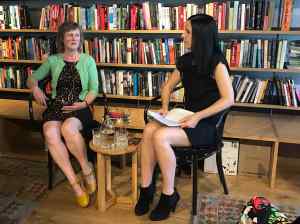
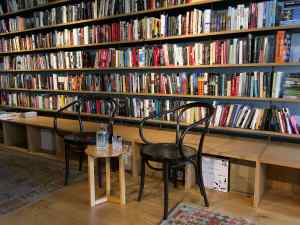
Introducing the first event of their Sunday afternoon program, Dan, co-owner of Muse, commented on a peculiarity of Canberra: when they offer sessions on politics or history, they are packed out, but when the focus is fiction, the events are more intimate. Fine by me! I love small, cosy events. But it’s interesting, eh? Anyhow, we then got down to the event, which involved local author and editor, whom you’ve met several times here before, Irma Gold, interviewing local poet, essayist, novelist, Robyn Cadwallader, about her debut novel The anchoress (my review).
It was excellent. Gold structured her questions beautifully, starting with some background questions, moving through well-targeted questions about the book itself – well-targeted for me anyhow because she focused on historical fiction and feminism – and then ending with Cadwallader’s future plans. There was something for everyone – though I suspect most of us were interested in it all.
Gold commenced by providing a quick bio, which included the facts that Cadwallader migrated to Australia with her family when young, and that her background is academic writing. Gold shared Cadwallader’s shock that, when she moved from academic writing to fictional, her struggles with the dreaded term structure followed her! That made me laugh because I love thinking about structure in fiction. Gold also told us that The anchoress had been published in the USA and UK as well as Australia, and has been (or is being) translated into French. She said Marie Claire described The anchoress as “the book the whole literary world can’t stop talking about”. Wow, eh?
The interview commenced then with a brief discussion of Cadwallader’s early interest in books and writing, but let’s get to …
The anchoress

The discussion started with Cadwallader doing a reading – and she chose the Prologue. That was great not only because it’s always (hmm, mostly) good to hear authors read from their own work, but also because it refreshed the book and some of its themes for me.
Gold said she’d never heard of anchoresses and asked Cadwallader what sparked Sarah’s particular story. Cadwallader responded that she’d come across anchoresses in her research for her PhD and, like Gold, was both horrified and fascinated by the concept. She said the inspiration for the story came from sitting in an anchorhold, unable to leave it, for an hour or so. It got her thinking about how it would feel to be in such a place forever. What would be the experience? She said her poetry is “about taking a moment and investigating it”. In this book, she took a small space and investigated it. Reinforcing her interest in focusing on the “experience”, she said she’d started writing the novel in 1st person but felt it wasn’t working, so tried 3rd but that didn’t work either. She then realised she had to be there to share the experience. She also made the point that she didn’t want Sarah to speak for all anchoresses.
Gold then honed in on the book’s genre, historical fiction, and asked Cadwallader how she went about separating her research from the writing. Cadwallader said she was lucky because she’d done so much research on the period before she started writing. She had to do a lot of thinking, however, and when she started writing she needed to do extra research on aspects she knew less well, such as village life and monasteries.
Next Gold moved onto how Cadwallader approached incorporating the history into the story. Cadwallader said she knew people would know little or nothing about anchoresses – how right she was! – but didn’t want to do exposition. She used the example of the section where Sarah stands in her cell (anchorhold) for first time. This was hard to write she said without “describing”. She tried to write it from Sarah’s experience in a way that would “show” modern readers, too, what it was like.
Some of the questions at the end concerned the historical fiction issue, so I’m sneaking them in here. Responding to what next, Cadwallader said that some people assumed she’d do a sequel! No, she said, as far as she’s concerned she’d wrapped up Sarah’s life and didn’t have anything more to say. Love it. This points, I think, to a difference between genre and literary-fiction. Genre tends to focus on plot, on the story of characters’ lives. Readers of genre love to get lost in – escape into – the characters’ lives and want to follow them, on and on. Readers of literary fiction – and they can be the same people, so I’m not suggesting a “snooty hierarchy” here – look for different things. They tend to be happy with ambiguous endings, and look forward to moving on to something different. I tend to be one of these readers. You could call me fickle.
Other questions picked up the relationship between fact/history and fiction, about the degree to which historical fiction should focus on the fact versus the fiction. Again, I loved Cadwallader’s considered response. She described historical fiction as an engagement between the present and the past. Writers, she said, need to balance what will communicate effectively with contemporary audiences and what’s accurate. She cited swearing as an example: a medieval oath, like “God’s teeth”, would not convey anger to a modern audience the way a modern swear word would.
Back to Gold now. Her next question concerned feminism. Yes! Was Cadwallader conscious of feminist issues from the start or did they emerge through the writing process. I loved Cadwallader’s answer. She said she was aware of feminist issues and theory from the start because her research had brought her face-to-face with medieval thinking about women, including the belief that women represent the body, and tempt men. However, she is concerned, she said, about historical fiction that wants to be positive about women. Such fiction needs to create strong, feisty women, but she wanted to explore what ordinary women experience.
So, her Sarah pretty soon finds her experience of her body starting “to bump against” the rule that tells her that her body is terrible. Cadwallader wanted to tell about ordinary women doing things that are not “spectacular”. She thinks some readers expected a “spectacular ending” but that would have plucked Sarah out of her context. Her approach to feminism was to describe these women’s experience, to honour them. She didn’t want to exploit them, but explore who Sarah was. She then talked about the village women. (They’re wonderful supporting characters in the book.) She didn’t want them to be “campaigners”, but wanted us to “see” them. It’s too easy for us to miss and not respect the ordinariness of women and what they do.
Gold ended with questions regarding how Cadwallader has handled her success and what her future writing plans were. Cadwallader talked about ongoing feelings of self-doubt and how easy it is to buy into criticism (rather, it seems, than praise). She described it – and being a writer, she used a metaphor – as being a headwind that you just have to keep walking into! And yes, she is writing another book. And yes, it’s mediaval-focused – to do with illuminators.
There was a brief Q&A, then it was over. We might have been an intimate group, but what a privilege to have been present at a conversation between an intelligent, warm interviewer and a thoughtful, open interviewee. Lucky us.





 Whispering Gums