Beryl Fletcher, Juno and Hannah (Review)

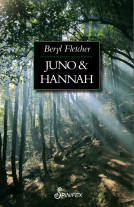
Beryl Fletcher, Juno and Hannah

Courtesy: Spinifex Press

I’ve been pretty remiss in my blog regarding New Zealand literature. I have read and enjoyed several New Zealand novelists, such as Keri Hulme, Janet Frame and Fiona Kidman, but the only New Zealand writer I’ve reviewed here to date has been Lloyd Jones. And so I was both intrigued and pleased when Spinifex Press sent me Juno and Hannah by New Zealand writer, Beryl Fletcher.

I’m embarrassed to say that I hadn’t heard of Fletcher, but she has some form! Her first novel, The Word Burners, won the 1992 Commonwealth Writers’ Prize Best First Book for the Asia/Pacific region. Juno and Hannah is her fifth novel. She has also written a memoir and some short stories. The fact that four of her five novels have been published by Spinifex Press would suggest a feminist agenda but, while Juno and Hannah certainly has an element of women being challenged by patriarchal authority, it is not a preachy or proselytising book, any more than are the other Spinifex Press books I’ve reviewed. Rather, like them, its focus is women’s experience of the world.

Hmm … that’s a long introduction. Time to get to this particular world. Juno and Hannah is set in 1920s New Zealand. The eponymous sisters are living in a religious commune, and are without parents. Despite the fact that Juno’s name appears first in the title, Hannah is the older. Two things happen in the opening pages of the book which cause Hannah to “run away” with Juno. The first is that she is punished with a month’s isolation for saving a strange man from drowning by breathing life into him – and thereby arousing fears of witchcraft, of communing with the spirits. It’s a clearly unjust punishment from (the significantly named) Abraham, who claims to adhere to “the sacred principles of Christian justice”. The second thing is her hearing that the community plans “to get rid of” 14-years-old Juno, probably to an orphanage in town. Juno, you see, requires special care as she is not quite normal – and the so-called Christian community “can’t carry a non-productive member”. This sets up what is essentially a Gothic adventure tale in which Hannah, with the help of a strange assortment of others, searches for a secure home for Juno and herself.

The novel (novella, really) is a page turner. There are good guys and bad guys (including eugenicists who have their sights on the “mentally defective” Juno), but sometimes we can’t always be sure who are the good guys. Hannah, a resilient and loyal young women but one who experienced abandonment at an early age, finds it hard to trust anyone, including those who offer help. In this mix are Hannah’s mother, her father and his mistress, the man she’d saved, and his sister. There are all sorts of Gothic archetypes here – cottages in the wood, horses pushed to their limits, storms, secrets, a sanatorium. While the story is told third person, we see much of it through Hannah’s inexperienced eyes, so when she is unsettled, so are we. And rightly so, because the world is an uncertain place.

Fletcher’s style is plain, direct, and yet also poetic. It comprises mostly short sentences, which keep the plot moving but which are interspersed every now and then with more Gothic descriptions. These are particularly effective because they are not overdone:

When the southerly blew itself out, fog crept up from the river and devoured all before it. Not one leaf moved, not one bird sang. One by one the trees melted away. The fog brought a terrible silence outside her prison that emulated the social death within.

And:

Something had changed. The hut was withdrawing into itself; the fire had gone out, empty tins had been dropped onto the clay floor. She touched the glass chimney of the paraffin lamp. It was cold.

I enjoyed reading this book, but am having trouble writing about it. I think this is because the themes are carried primarily through the plot. By this I mean, they are conveyed by who does what with whom, who appears and disappears, who chases whom, and who helps whom. I don’t really want to explain too much for fear of giving the story away. Briefly, though, the main themes are resilience and trust. As a young vulnerable woman responsible for an even more vulnerable sister, Hannah needs to be resilient to survive the world she finds herself in. She also needs to trust, but she must temper this with wariness because the world is not a safe place. Another theme is the responsibility to protect weaker members of our society, as Hannah does for Juno, but as was not done for her when she was “abandoned” in the religious community. In fact, “abandonment” is another theme. And finally is the theme of nurturing. Clearly, Hannah nurtures her sister, but the theme is also conveyed through the act of bread-baking, which occurs throughout the novel. Hannah is good at it, so is her mother Eleanor. Providing bread to others in need is one of the final, reassuring images of the novel.

Juno and Hannah is a compelling read. There were times when the plot seemed to be slipping from my grasp. Loose ends perhaps, or maybe just part of the uncertain world Fletcher was creating.  It was never enough, however, to stop my being invested in Hannah and her trials. There’s something about Fletcher’s direct narrative style evoking an almost other-worldly setting that drew me in. I didn’t want to put it down.

awwchallenge2014Beryl Fletcher
Juno and Hannah
North Melbourne: Spinifex Press, 2013
174pp.
ISBN:9781742198750

(Review copy supplied by Spinifex Press)

NOTE: I have included this review in the Australian Women Writers Challenge because Fletcher’s primary publisher is Spinifex Press (and because someone before me has also included her!). I hope Fletcher and any New Zealand readers here aren’t offended!
Kathy Marks, Channelling Mannalargenna (Review)

A few weeks ago I wrote a Monday Musings about the Walkley Awards, noting some of the winners that particularly interested me. They included two awards for essays in the Griffith Review, one by Melissa Lucashenko, whose essay “Sinking below sight” I subsequently reviewed, and the other by Kathy Marks whose essay, “Channelling Mannalargenna” is the subject of this post. Both essays deal with indigenous topics but while Lucashenko, who won the award for Long Feature, has Aboriginal heritage, Marks, whose award was for Indigenous Affairs, is English. This adds an intriguing layer to her piece which is about the troubled issue of identity in indigenous Tasmania. Marks has, however, been writing about the Asia-Pacific region since 1999.

Like most Australians of my generation, I grew up believing that genocide had resulted in the elimination of indigenous people from Tasmania. Truganini, we were told, was the last “full-blood” Tasmanian Aboriginal person. She died in 1876. In 1978, the documentary, The last Tasmanian, made by filmmaker Tom Haydon and archaeologist Rhys Jones, popularised this idea. It is, however, not quite as simple as we’d been led to believe – and Marks’ essay chronicles the identification legacy left by a history of being discounted. The Walkley judges described the essay as follows:

An elegantly written essay about a community still wrestling daily with the act of colonisation. Adding poignancy is the hovering myth of extinction, Kathy Marks deftly draws the reader into the everyday of establishing Tasmanian Aboriginal identity, teasing out the tensions, but without seeking catharsis.

It’s a brave essay, I think, something that Marks herself recognises when she said on her win that “I was thrilled to receive the award, not least because of the challenging and sensitive nature of the subject matter.” Being brave, though, is surely the hallmark of a good journalist. And so, Marks tackles the thorny issue regarding the definition of indigeneity in Tasmania.

As I read the essay, I was reminded of remarks made by Anita Heiss in Am I black enough for you? on conflict within the indigenous community regarding Aboriginality. Heiss discusses the different ways people come by their Aboriginality and says:

What age and experience  moving around the country has given me is a better understanding of the complexities around individual and collective Aboriginal identity. One shouldn’t be too quick to judge others, especially when some of us have been fortunate to know who we are all our lives, and others haven’t.

And herein lies the rub in Tasmania. Because of the particular history of indigenous Tasmanians, family lines and connections have been broken, and so the way Tasmanians discover their Aboriginal background is highly varied. In her essay, Marks talks to many of the groups and factions existing in contemporary Tasmania, and describes the bitter lines that have been drawn between some of them. Some of these lines are so strongly defended that one group, the Tasmanian Aboriginal Centre (TAC) in particular, has taken legal action against people who have claimed indigenous heritage. Officially, the definition of Aboriginality in Tasmania is the same as that established by the Federal government – the three-pronged factors of ancestry, self-identification and being accepted by the indigenous community. The TAC, however, demands a family tree as part of this. Marks quotes Michael Mansell who argues that to be accepted as indigenous Tasmanian, people need to:

show that…their families, from every generation back to tribal, have always maintained their connection with being Aboriginal. So that excludes people who undoubtedly have Aboriginal descent but who have been brought up as white people… If there’s been a break in the generations, where someone lost contact, the Aboriginal community’s view is…you can’t revive it.

Not all can provide this unbroken connection. For example, indigenous Tasmanian academic, Greg Lehman, told Marks that people were not keen to admit to indigenous forbears in the 194os and 1950s. And then there’s the devastation – dislocation –  that occurred one hundred years earlier through George Arthur’s infamous Black Line and then George Augustus Robinson’s corralling of indigenous people at the so-called “friendly mission” Wybalenna on Flinders Island in the 1830s.

awwchallenge2014Looking from the outside, I find this conflict all very sad. It’s hard enough when indigenous people suffer rejection and discrimination from the white majority culture, but when it also comes from inside the community it must be devastating. Patsy Cameron, an indigenous Tasmanian whose bona-fide is accepted, would like to see a more inclusive approach. Marks quotes Cameron:

‘Even someone who hasn’t been active in their culture or in the politics of the day,’ she says, ‘it doesn’t make them any less Aboriginal. Anyone who can show their lineage, and their extended family acknowledges them as part of that family, we should be embracing them. We should be embracing people who have been lost, rather than chasing them away and doing to them the exact thing that non-Aboriginal people have done to us in the past: denying us our rights, our identity.’

I’ve only touched the surface of Marks’ essay. It’s an excellent read that starts with a brief history of indigenous relations in Tasmania, including some distressing anecdotes regarding discrimination, before exploring in some depth the essay’s central issue regarding Aboriginal identity. Fortunately, the essay is freely available online via the link below. If you have any specific or general interest in the topic I commend it to you.

Kathy Marks
“Channelling Mannalargenna: Surviving, belonging, challenging, enduring”
Published in the Griffith Review, Edition 39, 2013
Available: Online at the Griffith Review

Catherine McNamara, Pelt and other stories (Review)

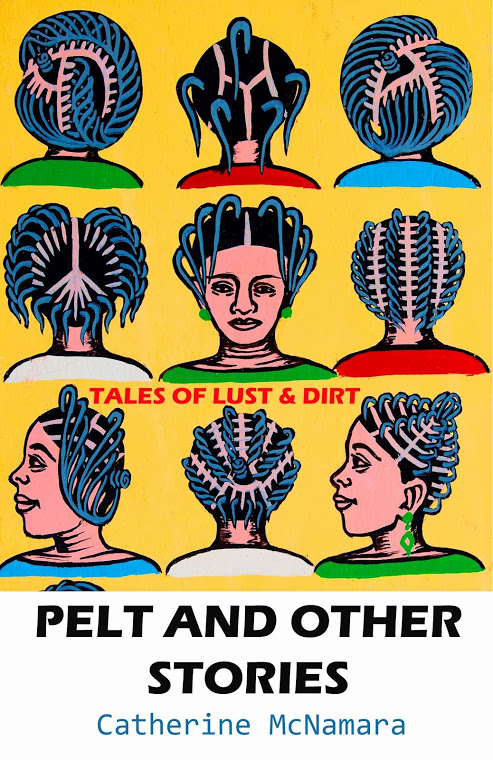
Catherine McNamara, PeltIt seems fitting that my first review of the year be for a book of short stories by one of this blog’s regular commenters, Catherine McNamara. I have reviewed McNamara before, her first published novel, The divorced lady’s companion to living in Italy. McNamara  describes that book as commercial fiction. It is, to describe it differently, chicklit for the mature woman – and is a fun read. However, Pelt and other stories is a different thing altogether. It represents, McNamara has said, where her real writing love is – literary short stories.

You will hear from Catherine herself soon in the form of an author interview on the blog, but by way of introduction now, she is an Aussie expat who left Australia as a student a couple of decades ago. She now lives in Italy but has lived in other parts of Europe and for several years Africa. All this is reflected in her stories which have Australian, European and African settings. As with many short story collections, several of the stories have been published elsewhere, on-line and in print. Her story “Coptic Bride” was published in Giramondo‘s now-defunct, but admired, literary magazine Heat.

The first thing to say about McNamara’s writing is that it is not spare. Her exuberant use of imagery reminds me at times of  the early writings of Thea Astley and another expat, Janette Turner Hospital, both writers who have reveled in colourful, figurative language, albeit to different purposes. Occasionally the imagery can feel a little overdone, but I love their freshness, love the risks McNamara takes. The next thing to say is that her subject matter tends to revolve around sex. The book is, after all, subtitled “tales of lust and dirt”. In McNamara’s work, sexual passion represents the best and worst of what life has to offer. And, given that there’s more drama in the worst or the problematic, it is this – in the form of violence, incest, jealousy and infidelity – that we mostly find in Pelt and other stories. Thirdly, McNamara mixes up her narrative voice. She uses first and third person, and she writes in a variety of voices, including, for example, a white gay male and a black female. This keeps you on your toes. You never know who the next characters will be, and where they’ll be from. I like that.

While Pelt and other stories is a collection, several stories are connected, which makes the order of the stories particularly interesting. I suspect ordering stories in a collection, which I discussed briefly in my review of Knitting and other stories, is one of the trials of preparing a short story collection (or anthology). Do you match or contrast tone or themes? Do you put related stories together? The truth is that it probably matters less to the reader than the writer/editor thinks, as readers will often pick and choose. However, with single-author collections, my practice is to read, from the beginning, in the order presented. And this is where the fun started with Pelt and other stories. There are, for example, sly connections in which a character – Nathalie for example – is an important subject in one story (“Nathalie”), but then appears as a passing reference elsewhere. Other stories have stronger connections. I was particularly intrigued by McNamara’s presentation of three of these – “Opaque”, “Where the wounded go” and “Volta”. They don’t appear consecutively, and when they do appear it is not chronological. I’m not sure what McNamara’s intention was in this, but for me it replicates the way we get to know people. We meet them at a point in time, getting to know their current lives, while gradually learning their back story. In a collection that ranges widely in character and location, the connections can be grounding.

What I particularly like about the stories is their honesty. McNamara doesn’t flinch from letting her characters express their (our) meanest, least generous thoughts. Love, McNamara shows, can make us selfish, desperate, and sometimes cruel. In the first story, “Pelt”, the animality of lust is palpable as a pregnant black mistress stands her ground, fighting for her rather weak, German lover against his barren wife. Many of her stories are about compromised relationships and the accommodations made, by one or both parties, to keep them going. “The Coptic Bride” is one of these, as is “Opaque” in which a woman’s love for her man is tested against her sense of morality, of what is right:

But if she called, it would perforate all that she held close to her. It would cost her her life.

Do you think she made that call?

awwchallenge2014These are unsettling stories about characters struggling to survive in a precarious world. Europe’s colonisation of Africa shadows the book. Many of the relationships are mixed, and in most stories there is power imbalance, and hints of exploitation. It’s there in “Pelt”. In “Janet and the Angry Trees” a sex-worker is taken to her Italian lover’s family home to look after his parents, and seems to accept the pittance of attention she gets from her still-married lover. It’s in the little piece “Innocent” about a taxi driver, his white employer and his pregnant teenage girlfriend, and in “Infection” in which a brother receives a western education while his sister “received no education, cursory love, much admonishment”. There’s a suggestion in some stories of stereotyping – you know, the lusty, sensual black woman and the unfaithful white man looking for “a bit” on the side – but the relationships are more complex than that. Overall, I’d say that the stories are more about humanity than about politics, while recognising that politics has contributed to the uncertainty of the world the characters inhabit.

A recurring motif in the book is the photographer. McNamara seems to view photographers with suspicion. At least they tend not to be the most admirable characters in the stories in which they appear. They represent the disconnect between appearance and reality, and perhaps also the idea of exploitation. In “Gorgeous Eyes”, the narrator views photographs by the visiting famous photographer, Nina Cooke, seeing the truth behind the idealised images of “Dinka men – erotic in beaded body corsets”. He reflects that those in the know see something else, “a crucible of sadness”, in these images and concludes:

If Nina Cooke’s gift ever needed an honest name it would be the invasive branding of humble detail. It appears she is at the vanguard of a vulgar world trait.

These stories are not comfortable reading. Some make more sense to me than others. But McNamara’s voice is strong, her writing lively and her characters real. Pelt and other stories will linger with me for some time.

Catherine McNamara
Pelt and other stories: Tales of lust and dirt
Beaworthy: Indigo Dreams Publishing, 2013
204pp.
ISBN: 9781909357099

(Review copy courtesy the author)

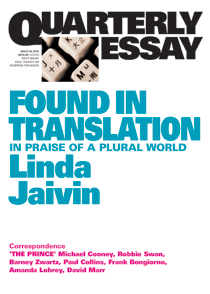
Linda Jaivin, Found in translation: In praise of a plural world (Review)

Linda Jaivin, Found in translation Book cover

Courtesy: Black Inc

Reading synchronicity strikes again! In the last couple of months, the issue of language, translation and culture has been crossing my path – in Diego Marani‘s The last of the Vostyachs, in Gabrielle Gouch’s Once, only the swallows were free, and on Lisa’s blog post about the AALITRA Symposium on Translation. I was consequently more than happy to accept a review copy of the latest Quarterly Essay, Linda Jaivin’s Found in translation.

Now, as some of you know, I have mixed feelings about reading books in translation. I want to read them because I want to read not just about but from other cultures. Not being fluent in all the languages of the world, the only way I can do this is to read works in translation, but when I read a translated work I am very conscious that there is a mediator between me and the work. This bothers me. Linda Jaivin, herself a translator, knows exactly what I mean:

… it is absurd to speak of issues of literary style, rhythm – or any aspect of a translated work aside from its structure, characters and plot – without acknowledging that the language of the text is at once a creation of the translator and an interpretation of the author …

And she gives good examples to support her statement. I was pleased to see her acknowledge this, because she knows of what she speaks! But, this little point is only a very small part of Jaivin’s wide-ranging, entertaining but also passionate essay. Jaivin, if you haven’t heard of her, is a multi-skilled woman: she subtitles Chinese film and television and translates Chinese text; she has worked as an interpreter; and she has written novels, stories, plays and essays.

As a reader and lover of words, I enjoyed Jaivin’s discussion of the technical and philosophical challenges faced by translators. She peppers her discussion with an eclectic but fascinating array of examples. And she quotes other translators, such as Edith Grossman who wrote that

a translation is not made with tracing paper. It is an act of critical interpretation … no two languages, with all their accretions of tradition and culture, ever dovetail perfectly.

Take swearing for example. How we swear is highly cultural. Swear words, Jaivin writes, “expose what is forbidden, what is permitted and what is held sacred” in a culture, and consequently “can  throw differences in worldviews into sharp relief”. However, you’ll have to read the essay, if you want to see her examples!

I was intrigued by her argument that translations of classics go out of date! So, this means that the Spanish will always read the same Don Quixote but English speakers are very likely to read a different translation depending on which one is currently in vogue.

“… a culture doesn’t grow just by talking to itself …”

But, the critical point of her essay is not the act of translation. As the title of her essay implies, Jaivin is passionate about pluralism, and more, about cosmopolitanism. By this, she means not just living side by side, not just accepting each other, but “sharing a common vision”.

Australian Women Writers ChallengeFor Jaivin, “translation” is not a narrow concept. Its implications extend far beyond the “simple” translation of words from one language to another, because attached to language are meanings and ideas. When ideas are translated – via words – from one culture to another those ideas change. Jaivin describes how concepts such as Confucianism and yes, even democracy, change when they cross cultures. This can lead, she says, to misunderstanding but it can also provide “room for the kind of creative interpretation that allows cultures and the conversations between them to grow and evolve”.

She argues that, because of Australia’s particular history and geography, and because Mandarin is the most commonly spoken language in Australia after English, “Australia is … in a unique position to translate the shift from the ‘American century’ to the ‘Asian one’ …”.

Building successful international relationships, she believes, requires genuine communication, which includes knowing, recognising and respecting other languages. It

does not require the weak to adopt the language of the strong – as reliance on English threatens to do, given its global and frequently imperial reach.

Jaivin argues that learning a foreign language should be a compulsory part of year 12 and university education, because “we need to have every possible line of communication open to us” if we are to successfully traverse the changes coming.  Not everyone agrees. What do you think?

Linda Jaivin
“Found in translation: In praise of a plural world”
in Quarterly Essay, No. 52
Collingwood: Black Inc, November 2013
103pp.
ISBN: 9781863956307

(Review copy supplied by Black Inc.)

Gabrielle Gouch, Once, only the swallows were free (Review)

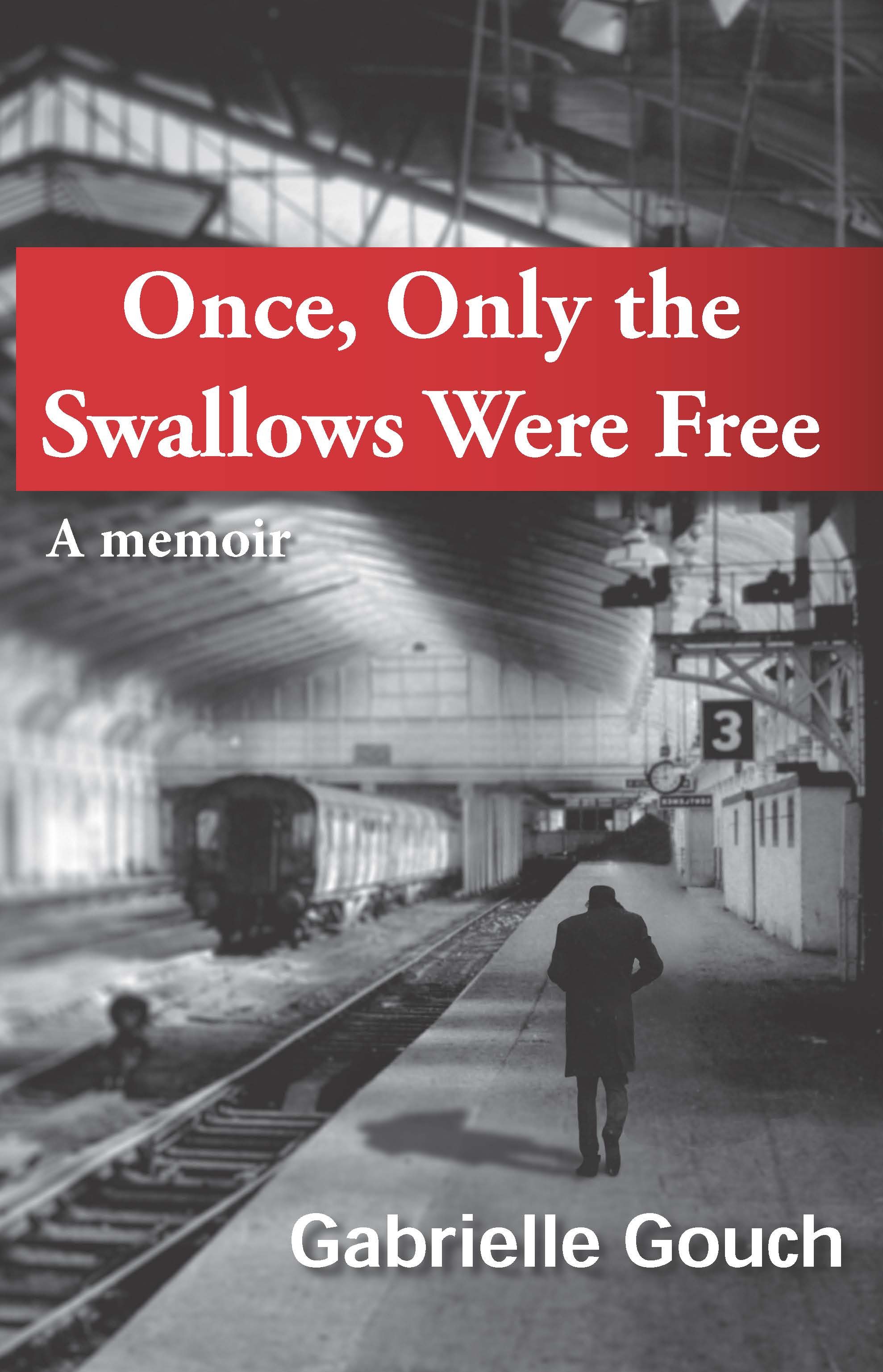
Gabrielle Gouch, Once, only swallows were free

Courtesy: Hybrid Publishers

Do you differentiate memoir from autobiography? I do. For me, a memoir, such as Gabrielle Gouch’s Once, only the swallows were free, deals with a specific aspect of a person’s life, such as a sportsman writing about his career when he retires from it or a person writing about her growing up, like, say, Alice Pung‘s Unpolished gem. An autobiography, on the other hand, I see as something more holistic, something written near the end of one’s life and summing up its entirety. What do you think?

Gabrielle Gouch was born in Transylvania, Romania to parents who’d both fled anti-Semitic Hungary. She moved elsewhere in Romania with her family before they emigrated to Israel, without her older half-brother, when she was around 20. A few years later, she emigrated on her own to Australia which has remained her home ever since. This is the basic chronology of her life, but Gouch is not really interested in telling us this story chronologically – and in fact, she’s not really interested in telling us the story of her life. What interests her is the brother, Tom, left behind. She wants to know about his life during and post communism in Romania. She also wants to know about the gaps in her knowledge of the family.

Gouch therefore doesn’t tell the story in a simple chronology. While she clearly signposts where you are as you read, I found it a little disconcerting to start with, until I felt familiar with the places and people she was writing about. This, however, could be due to other things going on in my life as I started this book. The memoir starts in 1990 with her first return to Transylvania after “the collapse of communism. The eternal and invincible communism”. A return that took place 25 years after she had left. As the book progresses, she visits Cluj several times, catching up with her brother, learning about her family. It’s a sad story – not surprisingly. Tom’s mother, the much beloved, vivacious Hella, died in childbirth. His – and eventually Gabrielle’s – father, Stefan, married the nanny, refugee Roza, hired in to look after the physically handicapped Tom. (As far as I can tell, his condition is hemiplegia, probably caused by the forceps birth). Roza and Stefan went on to have two children – Gabrielle and, somewhat later, Yossi – but country girl Roza was never accepted by Stefan’s well-to-do family.

The book proper starts in 1962 with the family expecting permission to migrate to Israel to arrive any minute. Of course, it doesn’t – and it is not until some 40 or so pages and three years later that they are finally able to leave. They leave without Tom, now well into his twenties, but exactly why this is so is not understood by Gouch. During the course of the book she finds out why – and she finds out what Tom’s life was like under the communist regime. It’s a very interesting story, and once you master the time shifts across the book’s seven parts, it’s a very readable one. The very short Part 2, for example, returns to the opening of the book, her return in 1990. Then Part 3 jumps to 2002 and another trip of hers “home”. From then on the focus is her time with Tom and the stories she gradually pieces together.

Gouch is a good writer. Her language is expressive, but not over-done. That is, she has some lovely turns of phrase that capture moments and people well. Here, for example, she describes her family’s reaction when her mother says something surprising:

We looked at her as if she had made her way into our home by the back door somehow, a woman we had never met before.

And I like this simple description of children:

Well, children are like shares, you never know how they will turn out.

There are two main threads in the book, one being life under communism, as experienced by Tom, and the other being the life of the emigrant, as experienced by her family. The book is enlightening for people interested in either of these topics, but I’m going to highlight the second, the emigrant’s life, because she explains it beautifully – from the tough life her parents experienced in Israel to her own experience of dislocation from culture. She writes, as she starts to reconnect with her brother:

Noone ever told me that you cannot turn physical distance into emotional one, you cannot forget your native country, you cannot give up your mother tongue. It deadens you inside.

She gives one of the best descriptions of the relationship of language to culture that I have read. She meets an old professor who had chosen to stay living under the repressive regime because, he said, “This is my native land, my language. I belong here.” She writes:

His words lingered. ‘My native land, my language.’ For most people, the sound of Hungarian is awkward; for me it is poetry and delight. When I say ‘flower’ in English I refer to a plant with petals and colours. But the word in Hungarian, virág, sounds to me melodious and joyful. Yes, you can learn to speak a language, you can even learn to think in a language but will you feel the same joy and sadness at the sound of those words? Feel the black desperation or be uplifted by hope? Will the word love evoke the same tenderness and ardour? I don’t think so.

Australian Women Writers ChallengeGouch also writes about “history”, about the impact on people of living through some of history’s trickiest times, as her family had. Her description of her father’s life – a loving father who had worked hard – is heart-rending:

A man who was a Jew but not Jewish enough, an Israeli but not quite, a Hungarian Jew among Romanians and a Jew among Hungarians. Finally he left this world with its divisive nationalisms, ideologies and religions which had marred most of his life. He was just another man on whom history had inflicted its painful and murderous pursuits: Nazism, the Second World War, the communist dictatorship, the Arab-Israeli conflict and Israeli religiosity. History had match-made him, history had controlled his life. It was over. He joined the infinite Universe.

I’ve possibly quoted too much, but Gouch’s words are powerful and worth sharing.

“Knowledge”, Gouch’s father once told her, “is your only possession”. Once, only the swallows were free is a story of discovery for Gouch, but for us, it provides a window into a particular place, time and experience that most of us know little about. The knowledge, the understanding, we gain from reading it is a precious thing.

Gabrielle Gouch
Once, only the swallows were free: A memoir
Melbourne: Hybrid Publishers, 2013
279pp.
ISBN: 9781921665998

(Review copy supplied by Hybrid Publishers)

Melissa Lucashenko, Sinking below sight (Review)

In this week’s Monday Musings about the Walkley Awards, I noted that Melissa Lucashenko had won the award for Long Feature Writing for her essay “Sinking below sight: Down and out in Brisbane and Logan” in the Griffith Review. I’ve now read the essay, and thought I’d share it with you. I’ve reviewed Lucashenko before, an essay and a short story. I really must get to one of her novels one day!

With her mixed European and indigenous Australian heritage, Lucashenko is well placed to tackle significant contemporary issues and see them from multiple perspectives. The last essay of hers that I reviewed, “How green is my valley”, dealt with stewardship of the land and the threat imposed by climate change. In “Sinking below sight” her subject is poverty. Lucashenko’s essays make engaging reading. Instead of dry reportage, she starts from the personal, and from that draws conclusions that make sense. And so, while “How green is my valley” drew from her experience on a farm in northern New South Wales, this essay draws from her return, after losing her farm through divorce, to the town of Logan, one of Australia’s ten poorest urban areas.

You’ve probably noticed that her subtitle alludes to Orwell’s autobiographical work Down and out in Paris and London which chronicles his experience of poverty. Similarly, Lucashenko writes that she’s been poor before, so “I had the skill set”. But, this essay is not about her. She starts by setting the scene, describing this “Black Belt” region as one in which

Welfare recipients and the working poor … don’t necessarily realise they are hard up. More accurately, many don’t realise just how poor they are, since everyone in their lives is battling.

She then moves on to the main topic of her essay, which is to find out “How do my Black Belt peers manage? How do single mums, in particular, get by on current levels of welfare? And what dreams are possible for the Brisbane underclass in 2013?” To answer this interviews three women currently living in poverty – Selma (27), Marie (38) and Charmaine (49) – and discusses their situations.

Selma, a Yugoslavian of Serbian and Croatian parents, has four children under ten and a partner who is in and out of jail. Having been a refugee and then involved with an abusive Aboriginal man, Selma has some clear views on her situation:

What I don’t like in society … is the judgments put on Indigenous and refugee and domestic violence people. I was in that situation for nine years. They say you make a choice, but I don’t ever remember choosing to be beaten up! From the age of seventeen ’til about two years ago, domestic violence was part of my everyday life.

She blames poverty for violence, saying that “poverty breeds hate”. Lucashenko suggests that the abuse she experienced “had roots also in the trauma and racism of the refugee experience.”

Marie is also a mother of four, with an “on-again, off-again partner”. She is a member of the “working poor” so not quite as poor as Selma. She grew up in a troubled home, had been sexually molested as a child, and was living independently by the time she was 14 years old. She, like Selma, had a history of “severe emotional and physical abuse from her previous partners, who were all, bar one, Anglo-Australian men”. Lucashenko writes:

Marie spoke to me of feeling enormous rage about the past abuses in her life, rage which sits constantly just beneath the surface.

The third woman is Charmaine, “blond, slim and still able to laugh despite a life that would crush most of us [and] the white Australian mother of four Aboriginal kids”. She too was raped and molested as a child, and ended up in a violent relationship in which she stayed too long.

Australian Women Writers Challenge

While recognising that her examples are more anecdotal than statistical, Lucashenko nonetheless draws some conclusions. They include:

  • Underclass expectations, which see people who grow up with nothing, expecting little
  • The importance of public housing in providing some “minimal prospect of safety”
  • Loneliness and isolation, which drive single mums back to “untenable situations”
  • Violence and mental illness in parents and partners, which entrench poverty for women
  • Childhood molestation and/or rape, which all three women had experienced
  • Women seeking relief in drugs, which of course can initiate new downward trajectories

Her three women, Lucashenko finds, have hopes for the future. Selma and Charmaine are studying, because, as Lucashenko writes

Realising that poverty is a creation of society and its choices, these two women also know that their lives might shift through higher education.

Pragmatic Marie has a saving plan. Their situations though are tenuous. To achieve their goals, they’ll need strength. Better still, though, would be if they got effective financial and other practical support.

Lucashenko opens the essay with the epigraph that “the opposite of poverty isn’t wealth. It’s justice”. Her essay may not be statistically significant from an academic perspective, but anyone who reads contemporary social commentary knows that what she writes rings true – and this, clearly, is why she won the Walkley.

Melissa Lucashenko
“Sinking below sight”
Published in the Griffith Review, Edition 41, 2013
Available: Online at the Griffith Review

Diego Marani, The last of the Vostyachs (Review)

Italian writer Diego Marani‘s The last of the Vostyachs was originally published in 2002, but the English translation was not published until 10 years later in 2012. How lucky we are that it was, because this book is unlikely to have been written by an English-language writer. Its focus on the relationship between language, culture and place and on darker issues like ethnic nationalism comes from a different – and particularly European – sensibility. We speakers of the world’s dominant language can, I think, be a bit oblivious to the linguistic issues faced by speakers of other languages, particularly in Europe where multiple languages live cheek by jowl. The challenge of communication is an important issue for Marani who works in Brussels for the European Union. His roles have included interpreter, translator, and policy adviser on multilingualism. Marani knows as well as anyone that language is both a cultural and political issue – and this is what he explores in this, his second novel.

However, The last of the Vostyachs is no dry tome explicating the role and value of language. Instead it is a surprising and often funny novel that weaves myth and saga, melodrama and irony through the warp of a crime thriller. It incorporates a number of literary traditions and archetypes: the wild (innocent) man set loose in the city, the spurned wife, the spirit guide, the corrupt obsessive, and the remote cottage in the woods where dastardly things happen. On the night the crimes (murders, in fact) take place, nature runs amok. Zoo animals roam the city and the temperature drops to its coldest in fifty years.

The plot centres on Ivan, who is the last of the Vostyachs, an ancient Siberian shamanic tribe. He is the only one who can speak the language, though at the novel’s opening he had not spoken it (or anything else) for twenty years, not since, as a young boy in the gulag, he’d seen his father killed. When the gulag is suddenly freed, he returns to the Byrranga Mountains but all he finds are wolves. He believes them to be his people who, to flee the soldiers, had hidden deep in caves and turned into wolves. He cannot bring them back to human form but they shadow and protect him.

Every single language is necessary to keep the universe alive

Into this mix appears the plain, ethical, Russian linguist Olga who is excited to find a speaker of a language thought to have been extinct and who sees in this language an exciting connection between Europeans and the native Americans. Her old colleague, the womanising, unethical, Finnish linguist Jarmo Aurtova is not so pleased with this threat to his theory of Finnish as the “Latin of the Baltic”, as, in effect, the master language of Europe. Jarmo sounds scarily like Hitler in his desire to prove the supremacy of a pure Finnish language:

In ancient times we were the civilised ones and they were the barbarians. We were the masters, they were the slaves. Not for nothing is the word aryan so similar to the Finnic orja, which means slave.

and

But now ‘someone’ was trying to throw Finland into the dustbin of history, together with the other conquered peoples who have no future. Aurtova was not having that …

Jarmo cares not if a language or two disappears and dies in the service of his theory. He believes that the fewer the languages the more “we’re moving towards the truth, towards the pure language”, while for Olga “with each one that dies, a little truth dies with it”. Marani, the creator of the flexible inclusive language Europanto, is on Olga’s side, on the side of plurality. She says

The true meaning of things is hidden from us; it lies beyond the bounds of any one language, and everyone tries to arrive at it with their own imperfect words. But no language can do this on its own. Every single language is necessary to keep the universe alive.

Cherish ignorance

The last of the Vostyachs is a ripping yarn that takes us from the tundra to Helsinki, through city streets, down country roads, across ice and onto the sea, as the various characters pursue their passions. But it’s the irony that conveys its main messages – and much of this irony revolves around our arch-villain and misogynst, Jarmo. His guilt as a murderer is revealed through a clue that is gorgeously ironic. In his final speech to the linguistic congress he, an academic for heaven’s sake, exhorts people to “cherish ignorance”, to not learn other people’s languages but “force” them to learn yours. And, most ironic of all, not only is the Vostyach language not destroyed, but by the end of the book, without giving too much away, “it could truly be said to be alive and flourishing” – albeit in a rather odd place.

Partway through the novel, Olga says to Jarmo of Finns that “to communicate with the rest of the world you have to learn another one, you have to venture out among words which are not your own, which you have borrowed from others”. In The last of the Vostyachs, Marani has ventured out and written something wild and rather risky. In doing so, he has produced a novel that’s not only fun to read but also gives the mind much to think about.

Lisa at ANZLitLovers read and enjoyed this book earlier this year.

Diego Marani
The last of the Vostyachs
(Trans. by Judith Landry)
Melbourne: Text Publishing, 2012
176pp.
ISBN: 978192196885 (Kindle ed.)

Lesley Lebkowicz, The Petrov poems (Review)

Canberra poet Lesley Lebkowicz has made a couple of brief appearances in my blog: first in my post on The invisible thread anthology, and then when she won this year’s ACT Poetry Award. I was consequently more than happy to accept for review her latest book, The Petrov poems.

English: Evdokia Petrova at Mascot Airport, Sy...

Evdokia being escorted by two Russian diplomatic couriers to a plane at Mascot Airport, Sydney (Presumed Public Domain, from NAA, via Wikipedia)

It’s intriguing that nearly 60 years after the events, we are still interested in the Petrovs. In fact, I have written about them before, in my review of Andrew Croome’s historical novel, Document Z. Most Australians will know who they are, but for those global readers here who don’t, the Petrovs were a Russian couple who worked at the Soviet Embassy in Canberra in the early 1950s. Vladimir (Volodya), Third Secretary, and his wife Evdokia (Dusya) were both Soviet intelligence officers (or, to put it baldly, spies). They defected in 1954. The defection was particularly interesting because Vladimir defected first, and Evdokia two weeks later at the airport in Darwin after some dramatic scenes at Sydney’s Mascot airport.

At first glance, The Petrov poems looks like a collection of poems but in fact it is a verse novel, albeit one comprising many short individually-titled poems. These poems are organised into four “chapters”: Part 1, Volodya defects; Part 2, Dusya defects; Part 3, The Petrovs at Palm Beach; and Part 4, The Petrovs in Melbourne.

I must admit that I wondered, initially, why Lebkowicz had decided to write about the Petrovs, given that they have already been picked over in novels, non-fiction, theatre, and television. But, as soon as I started reading it, I could see why. Lebkowicz gets into the heart of these two characters, bringing them back to ordinary human beings who were caught up in something that was both of and not of their own making. It is a rather pathetic story. There are no heroes here – and yet, as happens with these sorts of things, it captured the world’s attention for a short time.

Now, before I comment specifically on this book, I’d like to quote another Canberra poet Paul Hetherington from an interview with Nigel Featherstone in the online literary journal Verity La:

One of the ways I recognise the poetic is when I find works in which language is condensed, ramifying, polysemous and unparaphraseable. Part of what I wish to do when writing poems is to make works that speak in such ways – but to do so without resorting to any kind of trickery or artificial obscurity.

While I wouldn’t use words like “ramifying” and “polysemous”, and while we can paraphrase the ideas to a degree, this is pretty much what Lebkowicz achieves in The Petrov poems. In just 80 pages or so she manages to not only tell the story of their lives but get to the nub of their hearts and psyches – as much, anyhow, as anyone can do for another person. We learn that Volodya is not succeeding at spying:

He wants to succeed but stumbles. Failure
follows him like iron torn from a roof and
rattled along the wind.
(from “Glass I”)

We learn that he loves Dusya (“Dusya is his place in the world”), but that he loves booze, his dog and prostitutes more. He seems weak, but he’s a man struggling. With Stalin’s death and the arrest of his boss, he fears reprisals when he returns to Moscow. Here he is at the moment of defecting (which he does, after disagreements on the subject, without telling Dusya):

Once again he’s going to be wrenched from the soil.
He remembers his father – struck by lightning, buried up to his neck
by foolish men, and dying in the freezing night.
Then chaos and not enough food. Uprooting a full-grown plant
is no easy thing: so many roots
are wound through the earth. He mutters the Russian words
for sadness and home and ruffles his Alsatian’s fur.
(from “Loss”)

Dusya, on the other hand, is a stronger character, but she has suffered severe losses in her life, including her first love and her daughter:

This is something Dusya does not allow herself to think: how her
life might have been if Romàn had not been arrested. […]
If she had gone on taking happiness for granted. Living with
Romàn had been like walking along a winter street and arriving
in a field of warm poppies. If Romàn had not been broken in a
labour camp. If Irina had not died –
(from Romàn I)

While she understands Volodya’s fear, she fears even more what might happen to her family if she defects. At Darwin airport she doesn’t want to make a decision: “If only/this government man would abduct her”. But of course he can’t.

We then watch them as their relationship falters, first during ASIO’s interrogation, and then the years of living together in Melbourne, officially in disguise but known nonetheless. (“The whole street knows they are Petrovs -/too many photos, too much publicity”).

While I’m not a Petrov expert, I’ve read enough to feel that Lebokowicz’s interpretation is authentic. She explores what happens when the political interferes with the personal; she recognises the pull of culture and the despair that losing one’s home can engender; and she sees that corruption is not confined to communism:

so when ASIO falsifies (No! Not falsifies
amends, adjusts, even corrects) the documents
he brought from the Embassy – of course he assents
(from “Bones”)

Australian Women Writers ChallengeThese are wonderful, readable poems. They are poetic but, to quote Paul Hetherington’s goal, without “trickery” and “artificial obscurity”. The imagery is strong but clear. I particularly liked the way Lebkowicz varies and plays with form. None of it is rhymed, but there are sonnets, couplets, poems with multi-line stanzas but closing on a single dramatic line, and others. There are poems with short lines or terse rhythms, indicating action or stress, and poems with long lines conveying thoughts and reflections. There is also a shape-poem, “Torment”, in which the zigzag shape mirrors Dusya’s distress (“Her life is a staircase that switches directions”).

Like any good historical fiction – if a verse novel can be called that – you don’t need to know the history to understand the story told here. And like any good historical fiction writer, Lebkowicz has produced something that enables us to reconsider an historical event from another perspective and to understand the humanity below the surface of the facts. An excellent and moving read.

Lesley Lebkowicz
The Petrov poems
Sydney: Pitt Street Poetry, 2013
95pp.
ISBN: 9781922080141

(Review copy supplied by Zeitgeist Media Group)

Bianca Nogrady, The end: The human experience of death (Review)

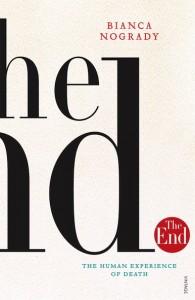
Bianca Nogrady, The end book coverHave you thought about your death? About how and where you want to die? These are the questions Australian science journalist Bianca Nogrady asks us to consider in her recent book, The end: the human experience of death. I’m not a morbid person, but when Nogrady contacted me to ask whether I’d consider reviewing her book, The end, it didn’t take me long to say yes. Like Nogrady I did witness, a couple of years ago, something I would call “a (pretty) good death”. That I felt it was so, intrigued me. I was therefore interested to read what Nogrady had to say.

And what she had to say was fascinating from beginning to end. In her introduction, she says:

This book could just as easily have been Everything you wanted to know about death but were afraid to ask. Death is fascinating, compelling, and it consists of much more than simply the end of a biological life-form. In seeking to understand death, we are seeking to understand life.

The rest of the book is structured logically according to the sorts of topics we are likely to ask about, starting with why we die, and then moving on to issues like defining death, where, when and how we die, spiritual and out-of-body experiences, and religion. Nogrady looks at these issues from all the likely points of view –  medical, sociological, psychological, philosophical, legal and ethical. She organises her information well, and the chapters (and subchapters) flow very naturally from each other.

So far, I have probably made it sound like a well-organised rather dry read – but that’s not how it is. Not only did Nogrady do a lot of secondary research (as the Notes at the end attest) but she also interviewed a lot of people. As a result, the formal information garnered from her research is supported by people’s stories, which also add colour and life to the facts. Many are of course sad – we are talking death after all – but this is not a sad book.

The most complicated section of the book is the second chapter on “Defining Death”. Nogrady takes us carefully through the different “definitions” – specifically, cardiac death and brain death (which, I learnt, can be further subdivided into “whole brain death” and “brain stem death”). She shows how the definition issue has been complicated by medical advances enabling us to keep the body alive and, of course, by the organ transplant process. Royal North Shore Hospital’s Intensive Care Specialist Dr Ray Raper suggests that death is:

a continuum; a graded box with one end as ‘being alive’ and the other end as ‘being dead’ … If you look at the domains of the transition between life and death, they’re spiritual, functional and structural and they’re biological, and the most important ones are the functional ones.

Death, in other words, is a process. If your fingernails are still growing when you are in the coffin, then, says Arizona State University Professor of Philosophy Joan McGregor, the questions needing answers relate to what are we preserving and why do we value it. I’ll leave this discussion here because there is no single solution – or not at present anyhow. This is murky ground indeed, but Nogrady manages to traverse it with clarity. I will probably have to read the book a few times though for the concepts to stick!

She also discusses euthanasia, teasing out misconceptions. She explains the differences between physician-assisted suicide, voluntary euthanasia and terminal sedation. She also explores the rise in palliative care as a profession, covering related issues like death doulas and volunteer workers in palliative care hospitals (or hospices). And of course she talks about near-death experiences, and those death-time phenomena that science can’t explain such as clocks stopping, machines behaving erratically, and deathbed visions.  The final chapter discusses faith and belief. Death is cultural, but, as she discovered, there is as much similarity as there are differences in end-of-life rituals.

It’s a funny thing to say, I suppose, but this is an enjoyable book. It’s neither superficial nor so detailed that you get bogged down. There is a lovely balance between expert opinions and anecdotes. I can imagine reading it again – or parts of it. It’s a shame, though, that there isn’t an index, which seems to be common in non-fiction books aimed at a general market. I guess it’s all about cost.

Australian Women Writers ChallengeIn her epilogue, Nogrady returns to her own experience, to how the death of her grandmother had caused her to want to better understand death. Writing the book, she says, made her think about “the value of planning, or at least thinking about how we want to die”. Death is, after all, a “one-way journey”. We do it alone, and it may well be, she argues, our best chance “find out who we are at the core”. One man who spent a long time thinking about his death, because he had a degenerative, terminal disease, was Australian public intellectual Donald Horne whose last book, written with his wife Myfanwy, was Dying: A memoir. He wrote:

My final drifting away, via a morphine dose, I would want to be among my memories, with Myfanwy whom I love holding my hand.

Think about your death, plan for it, is Nogrady’s final message to us. If you’re ready to take up her challenge, The end would be a good place to start.

Bianca Nogrady
The end: The human experience of death
North Sydney: Vintage Books, 2013
260pp
ISBN: 9781742752051

(Review copy supplied by the author)

Thoughts on Christina Stead’s writing in For love alone

I can’t resist writing another post on Christina Stead‘s For love alone, which I reviewed recently. Usually in my reviews I make some comments about the writing, but that review was getting so long that I decided to leave that discussion for another day.

I’m embarrassed to admit that For love alone is my first Stead. I’ve been wanting to get to her for the longest time, but somehow other books kept getting in the way. I’ll admit too that I was a bit nervous – as I’d heard over the years that she was difficult to read, or that her books were too miserable. Fortunately, I found neither of these to be the case with this novel. From the first chapter I was hooked. The book does have a little prologue which I enjoyed, but it was the first chapter that really got me in – and it got me in primarily because of its writing.

I love writing that plays with words and this is what I found in chapter one. Take for example this use of the word “bending” in an exchange between the heroine Teresa and her father (pp. 11-12):

“… I am in love again, with a young woman, a woman of thirty, a – ” His voice dropped. He came towards her, seized her arms and looked into her face without bending. “A wonderful, proud looking woman, pure in soul. “My whole life is wrapping itself around her, so I’m glad you brought it up for you will understand later on -”

She angrily shook her arms free. “Don’t touch me, I don’t like it.”

He sighed and turned his shoulder to her. “That is no way to treat men, men don’t like an unbending woman.”

“I am unbending.”

“You will be sorry for it.”

Then a few sentences down, her father says to her about flirtatious, coaxing behaviour in women:

“If, I say, you should ever be tempted to tricks like that, thinking to please some man, remember that they detest those tricks and see through them. They know they are traps, mean little chicane to bend them to women’s purpose.”

This is such a clever and telling exchange. It immediately tells us something about the father, the daughter and their relationship, about the likely themes of the novel (particularly given the title) and, though we don’t know it, it sets up future exchanges with Jonathan Crow who often talks of women trapping men.

A couple pages on is a another exchange in the family in which the idea of “honour” is played with and twisted. Stead, I sensed, was a writer I was going to like.

This, however, is not all that captured me in the first chapter. There were also several oxymorons (oxymora?) that added to the sense of slipperiness. Teresa’s room is described as “an inviting cell” and her brother, Lance, as “chaste and impure”. In the next chapter, a womanising dockhand is “agreeably sinister”.

It is language like this – ironic, satirical, biting – that keeps me reading, particularly in early stages of books where I’m not sure what is happening. I enjoy this sort of language because it challenges our preconceptions and can set a strong tone. (I do like a strong tone.) Mostly, though, such language tells me that the novel in question is likely to be multi-layered and that I’d better be ready to look beneath the surface.

Stead also writes beautiful, evocative descriptions. Christina Houen, commenting on my review of the book, referred to Stead’s description of Sydney. Stead herself grew up on Sydney Harbour. Here is the description Christina referred to. It occurs as Teresa is returning home after the wedding that opens the book:

It was high tide at nine-thirty that night in February and even after ten o’clock the black tide was glassy, too full for lapping in the gullies. Up on the cliffs, Teresa could see the ocean flooding the reefs outside, choking the headlands and swimming to the landing platforms of jetties in the bays. It was long after ten when Teresa got to the highest point of the seaward cliffs and turning there, dropped down to the pine-grown bay by narrow paths and tree-grown boulders, trailing her long skirt, holding her hat by a ribbon. From every moon-red shadow came the voices of men and women; and in every bush and in the clumps of pine, upon unseen wooden seats and behind rocks, in the grass and even on open ledges, men and women groaned and gave shuddering cries as if they were being beaten. She passed slowly, timidly, but fascinated by the strange battlefield, the bodies stretched out, contorted, with sounds of the dying under the fierce high moon. She did not know what the sounds were, but she knew children would be conceived this night, and some time later women would marry hurriedly, if they could, like one of her cousins who had slept the night with a man in one of these very grottoes; and perhaps one or two would jump into the sea. There were often bodies fished up around here, that had leapt when the heart still beat, from these high ledges into waters washed around these rocks by the moon. (Beginning of Ch. 5)

I won’t even try to unpack all this, but I’m sure you can see how intense and dense it is. It’s ambiguous about love and sex – and this ambiguity underlies the whole book, right through to – and beyond – its resolution.

Oh, and then there’s her facility with dialogue, her imagery, her literary and classical allusions – but again this post is starting to get long. Maybe another day!