Kate Grenville, One life: My mother’s story (Review)

Kate Grenville is one of Australia’s best known contemporary writers, and is one of that small band to have succeeded both critically and commercially. Most know her for The secret river, which was shortlisted for the Man Booker Prize among other awards. I enjoyed that, and the other novels of hers that I’ve read, with my favourite being The idea of perfection which won the, then, Orange Prize. I also loved her non-fiction work, Searching for The secret river, about researching for and writing The secret river. I was, consequently, keen to read her latest book, One life: My mother’s story, when I heard it was to be published this year.
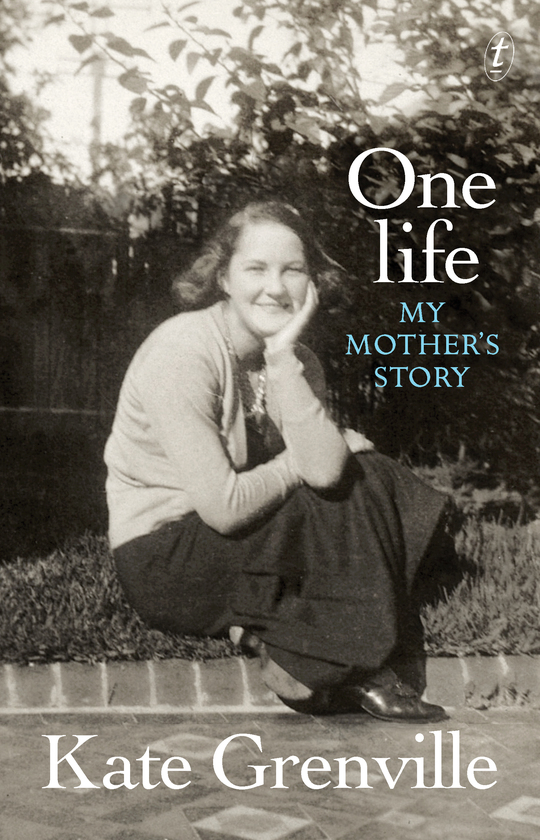
Kate Grenville, One lifeGrenville’s mother, Nance, was born in 1912, and died in 2002. Sorting through her mother’s papers later, Grenville discovered multiple notebooks containing her mother’s attempts to write her story. Nance apparently tried different ways of writing it – including, Grenville quotes, trying “to write it backwards”. However, her attempts always petered out, never going past her early forties “perhaps because by then she felt less need to look back and try to understand”. And so, Grenville’s book sticks to that, stopping (except for a short postscript) when Nance was 38 and pregnant with Kate. Wah! How disappointing not to be able to read about Kate’s childhood!

When I first heard of the book, I thought of Meg Stewart’s fascinating Autobiography of my mother, which I read a few decades ago. Stewart is the daughter of artist Margaret Coen and author Douglas Stewart (who, coincidentally, was born in 1913, one year after Nance). They are, however, very different books, not only because these two women led very different lives – one an artist married to a writer, and the other a pharmacist married to a lawyer – but because Stewart wrote her book in first person, as if she were indeed writing her mother’s autobiography, while Grenville opted for the more expected third person approach of a biography.

Given Grenville’s mother was not an artist or famous in any way, and given, as I’ve already said, she doesn’t write about her writer-daughter’s childhood, why is this book worth reading? Grenville, in her prologue, admits that her mother “wasn’t the sort of person biographies are written about” but argues that her story is worth telling because “not many voices like hers are heard. People of her social class – she was the daughter of a rural working class couple who became pub-keepers – hardly ever left any record of what they felt and thought and did.” The result, as Grenville – ever with an eye on history – says, is that “our picture of the past is skewed towards the top lot”. Grenville argues convincingly that the stories of people like her mother are well worth hearing, though I do think the argument has largely already been won. Many contemporary historians (and others, like museum curators) are, as we’ve seen in the books now being published and exhibitions being created, demonstrably interested in the lives of “ordinary people”.

The paradox, though, is that Grenville’s mother’s story is not at all an “ordinary” one. She was born to rather mis-matched parents, Dolly and Bert, whose marriage had been orchestrated, in 1910, by Dolly’s mother. Nance and her two brothers were “dragged” around the state as their parents worked on farms, in pubs, in the city, in country towns. Nance was sent away to a convent school, where she was very unhappy, wanting always to be part of a family. They experienced the Depression, and her parents lost their pub in Tamworth as a result. At the end of her teens, Nance wondered:

what would have happened if her parents had been unadventurous and contented with their lot. She’d have grown up in Gunnedah, left school at fourteen as they had, married a farmer and had six children … Yes, she wanted to meet someone, get married, have children. She wanted to be happy. But she knew now that she wanted something else as well.

What that “now” refers to is completing her first year of pharmacy studies in 1930. It is this, I think, that proves Nance, while never famous, to be no “ordinary” woman – but one who was “part of the world of the future, not the faded past”. So she becomes a pharmacist, and, after a few romantic adventures, some of which also prove her to be not quite “ordinary”, she meets Troskey-ite lawyer Ken Grenville Gee, the man she married and with whom she had three children.

It was not an easy marriage. Nance fell in love with Ken, but she gradually realised that he didn’t love her. He was a fair but remote man. He acknowledged women and respected Nance’s intelligence. He was happy for her to return to work – particularly when they needed the money! – though he, for all his forward thinking in some areas, never gave a thought to the necessary childcare arrangements or to the housework that still needed to be done. It might be a devoted daughter’s bias, but Grenville presents her mother as a loving woman, with a strong mind and a wonderful can-do attitude.

Running through the story of a woman is also the story of a time and place, of Australia in the first half of the twentieth century. Nance, from a working class background, comes to agree with middle-class-but-socialist Ken that ordinary people never have a chance. She realises that

what people called destiny was really the system everyone was part of. The ones on the top of the pile kept everyone thinking they could get ahead, when in fact ordinary people never had a chance.

War and the Depression taught her that. Nance also faces the challenges of being a woman in a patriarchal society. Not only was there the expectation that she would manage the domestic realm while working outside the home, but she was treated with unfairness and disdain when she applied for her pharmacist licence, despite having the required qualifications and paperwork.

I loved all this, but I did find it an odd book to read, and I think this is due to the voice, to the fact that while it’s not an autobiography it is far more intimate than the usual biography. Kate’s knowledge – or understanding – of her mother’s motivations and behaviour is so intense that I found the third person voice disconcerting at times, all the while enjoying the insights. Grenville’s prose is simple, straightforward, but not plain. Imagery is used with restraint, with the focus primarily on the story and Nance’s thoughts and feelings. Here’s an example, a description of Nance, always wanting family, returning home between her first and second year of pharmacy study:

Nance leaned on the windowsill of her old room, looking up at the washed-out green of the hill behind town. There was nothing for her here. Only that failing hotel, the cranky mother, the father muddled up with some other woman. If this had ever been any kind of home for her, it wasn’t one any longer.

One life is a fascinating, engaging book. Grenville’s insights into her parents’ marriage, and particularly her mother’s thinking, reflect the empathy you’d expect from a novelist. How much comes from Nance’s own words, and how much is extrapolation, is not clear, but the book is convincing – on both the psychological level and as a social history. It is well worth reading for both those reasons.

awwchallenge2015Kate Grenville
One life: My mother’s story
Melbourne: Text Publishing, 2015
260pp.
ISBN: 9781922182050

(Review copy courtesy Text Publishing)

Tony Birch and Ellen van Neerven in Review of Australian Fiction 10 (4)


Review of Australian FictionI have been wanting to write about the oddly titled Review of Australian Fiction for some time. I say oddly titled because, contrary to what it might sound like, this does not contain reviews but short fiction. Established in 2012, it is published, electronically (or digitally), every two weeks. Each issue contains two stories by Australian authors: one by an established author, and the other by an emerging author, chosen by the established author. Funnily, in the issue I’m reviewing here, it’s the emerging author, Ellen van Neerven, whom I’ve read before, not the established one, Tony Birch. But, I’m so glad that Lisa’s Indigenous Literature Week has given me the opportunity to a) finally read something by Birch, and b) finally read Review of Australian Fiction issue.

Tony Birch, “Spirit in the night”

Birch’s story is told first person by a young indigenous boy, the 11-year-old Noah Sexton. He’s dirty, smelly, poorly dressed, and no-one wants to know him – except the new girl, Heather, who invites him to sit next to her. She’s “the cleanest person I’d ever seen” with “no pox rashes, bites or scars like I had”. At lunchtime, Heather offers the hungry Noah a sandwich and engages him in conversation. She asks him why he sits alone, and he gives the classic reply:

‘I sit here because I’m a Sexton.’

She doesn’t know what that means of course. When he discovers that her father is the policeman “in charge of the station”, he assumes:

Our mob was well known to the police, and I knew straightaway that as soon as her father got the story on the family name, she wouldn’t be sitting under any tree offering me a vegemite sandwich.

But, it doesn’t quite work out the way he expected. When he explains to the friendly Heather that he’s from “the only abo family left in town”, she tells him that “abo” is “a dirty word” and that “people like you, we call them half-castes. It’s more proper”. Noah disagrees, telling her that “an abo’s an abo, no matter how black or white he is … Far as whitefella is interested, the shit smells just the same.” Heather shows discomfort at this language, but Noah doesn’t care. He’s “beginning to think she was only another do-gooder”. He tells her about how his people have been treated in town, but Heather tells him her father will be different, that “he’s always fair, to both sides”. Not surprisingly, Noah is (silently) sceptical. Nonetheless, this little bit of kindness from Heather brings out a new sense of self in Noah – he doesn’t wolf down the sandwich, pretending he has a few manners, and when he gets up to go into school after that first lunch he dusts his pants off “for maybe the first time in my life”.

And so Heather spends most lunchtimes with Noah, because she’s a Christian and it’s “a sin to turn away from those in need”. Noah doesn’t like being seen as a “charity case” but is so enamoured of Heather that he’ll “put up with anything”. Understandable, given his treatment at school before.

I won’t describe any more. This is a clever story about do-gooders. Birch has astutely chosen for his protagonist a young boy on the cusp of puberty. Noah, straddling that line between childhood and adulthood, has a sense of his agency, and yet not quite the experience, nor the resources, to insist on enacting it. It’s a story about confused emotions, and about smugness and self-satisfaction. It’s about the right to dignity, and, of course, about power.

Ellen van Neerven, “Sweetest thing”

awwchallenge2015Unique, original, fresh are words I avoid when writing reviews, not only because they feel cliched but because they can be contested by anyone whose reading experience is wider than mine. So, instead, I’ll just comment on Ellen van Neerven’s capacity to surprise. I found it in her Heat and light which I reviewed earlier this year, and in “Sweetest thing”.

“Sweetest thing” is a third-person story about Serene, the child of an indigenous mother and the town’s Dutch baker. She is addicted to having her breasts suckled. It all started in puberty (“that pertinent time of a woman’s life”) with her first experience of having a man suckle her breast occuring with a male tutor when she’s nearly fourteen. He lifts up her shirt:

Beautifully out of herself, she was open and messy and dislocated like a bouquet being readied for a vase, flowers, stems, spores spread everywhere.

Nothing else happens besides this suckling, but Serene feels “bliss” and “knew then that this was what she had been programmed to need”. Slowly, as Serene schemes and positions herself to have her need met, we learn about loss. We learn, for example, about the Kedron pub, which “had refused Serene’s grandparents entry” but which is now

a haunt for women of her mother’s ilk: divorced, discarded, with loose threads of long silent and secret relationships carried under their shirts.

Under their shirts. A reference to their breasts? We learn about the gradual withdrawal of her father as he starts to focus on his “real daughter”. Serene feels anger at “the silence in her life, at his hypocrisy”.

Born into this in-between world – not quite rejected as her grandparents were, but not fully accepted either – Serene believes she deserves “comfort, worship, devotion. Trust and understanding”, but fears “hollowness”.

And so, her life progresses through school and early womanhood into mature adulthood. She has friends, she experiences casual sex, she becomes a masseuse – but still there’s the need for suckling, to have “the most basic of her needs met”. Again, I’ll leave the story here. It’s longer than Birch’s and spans a few decades of Serene’s life, which includes a meaningful relationship and a successful career.

“Sweetest thing” is an edgy story. Serene’s unusual addiction works as a rather confronting metaphor for what all humans need – love and acceptance. What I like about Van Neerven, here and in Heat and light, is that her indigenous characters are not “types”. Their indigeneity is part of who they are, and is fundamental to the challenges they confront, but her characters are also “universal” – that is, they are needy, flawed characters who muddle along, just as the rest of us do, in the lives they find themselves in. It’s powerful stuff.

ANZ_ILW2015Read for ANZLitLovers’ Indigenous Literature Week.

Tony Birch, “Spirit in the night”
and
Ellen van Neerven, “Sweetest thing”
in: Review of Australian Fiction 10 (4), May 2014

Alice Robinson, Anchor point (Review)

Alice Robinson, Anchor PointI love it when the book I’m reading picks up ideas explored in my previous book. Alice Robinson’s debut novel Anchor point is, in reality, far removed from Mark Henshaw’s The snow kimono (my review), but the first line of Henshaw’s book – “There are times in your life when something happens after which you are never the same” – could have been Robinson’s first line. Her focus is more personal than Henshaw’s audacious broad sweep, but the point is still made with punch.

Another aspect of this novel that popped out for me is its rural focus. Rural romance is becoming popular here, but not much of our literary fiction focuses on the rural – on farm life, specifically, I mean. In this regard, it reminded me a little of Jessica White’s Entitlement (my review), though they are different books in terms of what drives them.

Have I intrigued you? I hope so, but it would probably help if I now told you a bit about it, rather than the books it reminded me of! The novel starts with a small family on a farm – ten-year-old Laura, five-year-old Vik, their artist-potter mother Kath, and farmer father Bruce. It’s clear there are tensions between the parents, and early in the novel Kath disappears. Interestingly, White’s novel also has a disappearance. Anyhow, young Laura, in a state of anger and shock, makes, as the book’s promos say, “an impulsive decision that will haunt her for decades”. Nonetheless, she fills the gap left – she mothers Vik, takes on the domestic duties, and helps her father on the farm. Robinson conveys beautifully the impact of on her – her pride in helping out, her exhaustion and loneliness, and her realisation of what she is missing. Her childhood, like that of a character in Henshaw’s The snow kimono, was “wrenched” from her. Late in the novel Laura reflects on “what she had lost, what she had cost herself”.

The novel is told third person, in a linear structure. It is divided into parts identified by dates: 1984, 1997, 2008 and 2018. Such a span could suggest saga, but this is a quieter work. It has its dramas, but the tone is not dramatic, which conveys a sense that this is life. Life, in other words, comes with highs and lows, and you just have to get on with it. So we follow the family as Vik grows up and leaves home for university, and as Laura eventually leaves too, at the suggestion of her father. There is always, though, the pull of the farm for Laura – and she does return.

Besides the family drama and the resulting narrative arc to do with Kath’s disappearance, the book is also concerned with farming and the land. Bruce and Laura struggle against drought, bushfires and land degradation to keep the farm going. Climate change hangs over this novel. By 2018 Laura has given up the struggle to regenerate the farm: “the climate had long stopped being something she understood”. This little jump into the future is surely a message from the author, and gives the book a foot in the cli-fi genre.

The other important land issue for farmers – indigenous people and their relationship with the land – is also a thread, introduced early on via Laura’s school friend, the indigenous boy Joseph. This issue is not laboured but bubbles along underneath, coming to the surface in 2018 when Joseph reappears as a man asking for occasional access to the farm for his people. Laura is taken aback:

The land belonged to her and Vik. She thought how mixed up they all were. There was what they believed and what they did, the stories they told. So many truths contained in skin, concentric rings. Laura imagined herself a log, sawn open. How many layers.

She remembers Joseph’s help in the past, and recollects the canoe tree on the property. “‘Course'”, she says, “You can use the place any time you like”.

Like White, for whom this issue is more central, Robinson offers no longterm resolution, but it’s positive to see non-indigenous authors addressing it. (As an aside, I can’t help but think Robinson’s naming one of the farms in the area, the Jolley farm, is a little tribute to Elizabeth Jolley.)

Robinson introduces another contemporary concern, Alzheimer’s. It works well as a plot device, but she does push it a little far. Not unbelievably so, but enough to weigh the novel down a little with issues. On the other hand, it could also work as a metaphor for the way we “forget” what we’ve done and are doing to indigenous people, and to the land.

I enjoyed Robinson’s prose. Here for example is a description of time passing:

The months broke across the year in alternating tasks: clearing, fencing, cutting wood.

And here is a description of the house, when Laura returns after a time away:

The house looked long abandoned, falling into the dry earth. Paint worn away by weather. Verandah sagging. Foundations shifted like rheumatic joints, as though it hurt the wooden skeleton to stay still.

The language, as you can see, is generally spare – sentences tend to be short, and not a lot of time is wasted in long descriptions, just as Laura herself has little time for anything but work.

Overall Anchor point is a tight, well conceived novel. The title, meaning “a safe place”, can be read in multiple ways. Laura does find some “safety” or redemption, but it’s not a simple or easy one for her, and the land itself is far from safe. In the end, it’s all about choices, and, as Laura learns, our choices can create ripples that last long after they’re made. Best, really, to make good choices first off. I’m not sure we’ve learnt that lesson yet.

Lisa at ANZLitLovers also enjoyed the novel.

awwchallenge2015Alice Robinson
Anchor point
South Melbourne: Affirm Press, 2015
263pp.
ISBN: 9781922213617

(Review copy courtesy Affirm Press)

Wendy Scarfe, Hunger town (Review)

Scarfe, Hunger Town, Wakefield PressA little over halfway through Wendy Scarfe’s novel, Hunger town, one character says to another that “kindness needs to be a political way of life”. It sounds a little naive I suppose, but in recent months the idea of kindness, in the political as much as the personal arena, has been playing on my mind. How different would Australia be (I’m being parochial here), if our leaders espoused kindness, tolerance and acceptance in their sound-bites, and if, heaven forbid, they placed a value on kindness in their policy-making?

Kindness is not exactly the main theme of this Great Depression era novel but politics certainly is. Set mostly in South Australia’s Port Adelaide River district from the mid 1920s to late 1934, Hunger town tells the story of the struggles of wharf labourers to survive as unemployment and hunger took hold. It explores the ensuing political unrest and the growing attraction of leftist political ideologies like communism and anarchism, alongside unionism, in such a volatile environment.

The novel is told first person in the voice of Judith Larsen, who, at the beginning of the novel, lives on a hulk with her Norwegian-born coal lumper father and homemaker-then-soup-kitchen-volunteer mother. Judith (Jude), intelligent, strong-willed and attuned to social justice issues from an early age, develops her drawing skill to become a cartoonist. Early in the novel she meets her well-to-do friend Winnie’s cousin, Harry, who is not so well-to-do, and a relationship develops. However, while their love story runs through the novel, it is not, as in most “genre” historical fiction, the main narrative arc. They marry, with little romantic build up, part-way through the novel. No, the main narrative focuses on the travails of the workers, and on Jude and Harry’s involvement in the politics of their times, Jude through her satirical cartoons, and Harry through the Communist Party.

The question that always comes to mind with historical fiction is why? Why choose to write about a particular time and place – besides, of course, intrinsic interest in certain times? Some readers love to escape to what they see as a more exciting, adventurous or romantic period. But for me, the book has to be more than “just” history. It has to throw light on “the human condition” and, preferably, encourage reflections on the present. What does the history tell us about who we are, how we got here, I want to know, and (yes, I admit it) can we learn any lessons from it?

Scarfe’s book achieves this for me. Not only does it offer a vivid portrayal of the richness and variety of life on the Port Adelaide wharves, but it encourages us to think about the relationship between the political and the personal, and about how governments do or don’t support some of its most vulnerable people, the working poor. It teases out the differences between theory, idealism and realism. It considers the role of violence. And, along the way, it raises issues like freedom of speech, and the role of the artist. All very topical, n’est-ce pas?

You have probably realised by now that this is a “big” book. Scarfe tells her story in 5 parts through a well-defined set of characters. Although relatively long, around 450 pages, the novel is tightly structured. Seemingly unimportant points made early in the novel reappear with significance later. An example is Harry’s “Judith, you are a card”. Once said, it appears as a refrain throughout, and plays a role in the conclusion. Characters are foils for each other – such as the warm idealistic Harry versus the unemotional, theoretical Communist Party organiser, Nathan; or the pretty, emotional, seemingly superficial Winnie versus the no-nonsense, practical, more socially aware Judith. We can also see Harry, who “really did envisage and believe in a socialist utopia” as a foil for Judith, whose cartoons are grounded “in a more savage awareness of what I saw as the gap between dream and reality”.

Scarfe’s writing is clear and direct, but peppered with lovely turns of phrase. The fog lifts, “not all at once but as if the sun took fistfuls and shook it apart”. Miss Marie, arriving at the women’s march

stepped down from her taxi and made her regal path through the crowd like dawn breaking through a mass of sooty clouds. She was a gasp of radiant colour …

There were times, though, when I wondered whether the first-person voice was the best choice for the novel. Judith is an interesting character, with a strong mind and a good heart. She’s also rather opinionated, occasionally taking sets against people with little (initial, anyhow) provocation. It’s probably just me, but I sometimes yearned for a wise third person omniscient narrator to rub off her edges! That said, Judith, who is described by her art teacher, mentor and friend, Miss Marie, as “an instinctive radical but an individual thinker” guides us engagingly through her world.

As the novel progresses and things worsen on the wharves with scab labour brought in to replace the striking workers, Harry heads off to Spain with Nathan, at the time of the Asturian Miners Strike, to see communism in action. Without giving too much away, this results in, a few months later, Judith and Miss Marie setting off in pursuit. Scarfe’s descriptions of France and particularly Spain in the early 1930s are vivid and believable, and tension builds as our two women, posing as the artists they really are, navigate borders and gun-toting guards to move deep into Franco’s territory. After witnessing a brutal event, Jude produces a cartoon, but Miss Marie demurs about sending it off. Jude, the artist, insists, despite the risks:

To not protest would leave a wound on my soul that might never heal.

The novel concludes with a resolution of sorts to the plot line, but leaves the main questions unanswered. This is as it should be, because these questions – how to balance the political with the personal, and what sort of politics will create a better, fairer society – have no simple answer.

I started by referring to the issue of kindness. I’m going to close on another issue that is close to my heart, that of moderation. Early in the novel, Judith meets librarian Joe Pulham who introduces her to the Aristotelian idea of living moderately. It’s an idea she returns to frequently though, as Miss Marie says, “moderation is not easy. It involves compromise, and to compromise, what do we give up?” Darned if I know, but it seems to me that negotiating that compromise is the best way forward?

Lisa Hill at ANZLitLovers also liked this book.

awwchallenge2015Wendy Scarfe
Hunger town
Mile End: Wakefield Press, 2014
454pp.
ISBN: 9781743053362

(Review copy courtesy Wakefield Press)

Helen Keller, I go adventuring (Review)

My reading has been so disjointed recently that I thought I’d look at recent Library of America (LOA) offerings for inspiration, and came across Helen Keller‘s “I go adventuring”, an excerpt from her Midstream: My later life. It appealed to me because I haven’t read anything by Keller since I was a teenager, and because this piece is about New York. I couldn’t resist.

Helen Keller sitting holding a magnolia flower, circa 1920 (Presumed Public Domain, from Los Angeles Times photographic archive, UCLA Library)

Helen Keller sitting holding a magnolia flower, circa 1920 (Presumed Public Domain, from Los Angeles Times photographic archive, UCLA Library)

Firstly, Keller. What an amazing woman. Like many, I suppose, I have always been in awe of her ability to make a meaningful life for herself without sight or hearing. LOA’s always useful introductory notes discuss Keller being asked, in relation to another excerpt, “what she could possibly have ‘seen’ from the top of the Empire State Building”. She replied that

I will concede that my guides saw a thousand things that escaped me from the top of the Empire Building, but I am not envious. For imagination creates distances that reach to the end of the world … Well, I see in the Empire Building something else—passionate skill, arduous and fearless idealism. The tallest building is a victory of imagination.

The notes continue to say that throughout her adulthood, Keller “faced scepticism over her abilities and criticism for her choices of language”. On one occasion, she responded that the deaf-blind person “seizes every word of sight and hearing, because his [using the male pronoun common to her times!] sensations compel it. Light and color, of which he has no tactual evidence, he studies fearlessly, believing that all humanly knowable truth is open to him”. American novelist and essayist, Cynthia Ozick, LOA tells us, accepts Keller’s point, saying, simply, “She was an artist. She imagined”.

Secondly, New York. Before I first visited New York in the early 1980s, I’d lived in Sydney, and had visited great European cities like London, Paris and Rome. None of these interested me greatly because I really don’t much like cities. (Yes, I liked the museums and galleries, the historic sites, but as places to “be” they didn’t really appeal). But New York. There was something about it – and I finally “got” cities. I still don’t like them a lot, but I credit New York with opening my eyes to “city-ness”, if that makes sense, to the buzz and rush and life of them.

However, I’ve indulged myself enough now, so let’s get to Keller’s piece. She starts by referring to her situation:

Cut off as I am, it is inevitable that I should sometimes feel like a shadow walking in a shadowy world. When this happens I ask to be taken to New York City. Always I return home weary but I have the comforting certainty that mankind is real flesh and that I myself am not a dream.

See, that’s New York for you! She then talks about the great bridges, starting with Brooklyn Bridge, which she says is “the oldest and most interesting of them … built by my friend, Colonel Roebling”. In my first visit to New York, one of the places I had to visit was Brooklyn Bridge – because of Ken Burns’ wonderful documentary of the same name. It’s an old film now, 1981, but is well worth viewing if you haven’t seen it and get the chance. Keller, though, says she mostly uses the Queensborough Bridge. She writes that not all poetry is found in poetry books, that

much of it is written in great enterprises of engineering and flying, that into mighty utility man has poured and is pouring his dreams, his emotions, his philosophy. This materializing of his genius is sometimes inchoate and monstrous, but even then sublime in its extravagance and courage. Who can deny that the Queensborough Bridge is the work of a creative artist?

While we continue to build astonishing structures, continue to push the edges of what we can achieve,  we are also, I think, more blasé about the achievements and more questioning about the value and implications. Keller’s admiration reminded me of the awe and wonder of the nineteenth and early twentieth centuries towards engineering feats, though she too, with the word “monstrous”, is perhaps sensing some other ways of seeing?

Keller’s piece is really short, so I’m not going to commentate it all. She describes circumnavigating New York in a boat and talks about about life on the water, and she ends with a vivid description of the power of the subways. I want to close though on another reference to herself. She writes:

New York has a special interest for me when it is wrapped in fog. Then it behaves very much like a blind person. I once crossed from from Jersey City to Manhattan in a dense fog. The ferry-boat felt its way cautiously through the river traffic. More timid than a blind man, its horn brayed incessantly. Fog-bound, surrounded by menacing, unseen craft and dangers, it halted every now and then as a blind man halts at a crowded thoroughfare crossing, tapping his cane, tense and anxious.

With that, she conveys so beautifully, for sighted people, some of her experience of the world.

Helen Keller
“I go adventuring”
First published: In Midstream: My later life, 1929.
Available: Online at the Library of America

Kavita Nandan, Home after dark (Review)

NandanHomeUSPWhen Kavita Nandan offered me her novel to review I was happy to accept because its setting – Fiji, Australia and India – intrigued me. I’ve read several novels set in India, and by Indian writers, but none set in Fiji or by Fijiindian writers. Moreover, as Nandan wrote in her email, and as the back cover blurb says, the novel is “set against the backdrop of the first Fijian coup of 1987”. I certainly hadn’t read any literature about that!

Nandan is, as you have probably gathered, a Fijiindian Australian. She was born in India, grew up in Fiji, and migrated to Australia in her teens after the 1987 coups. She currently lectures in Literature and Creative Writing at Charles Darwin University. This is her first novel, and like many first novels it is told first person and has strong autobiographical elements.

The novel starts with a story about the Colonel’s involvement in saving the main character Kamini’s life from choking, and then jumps 18 years to the coup when that same Colonel places Kamini’s father, a politician in the Fijian parliament, under house arrest along with other Fijiindian ministers. The stage is set then for a story about the fine balance between love/loyalty and betrayal. There’s humour, as well as pain, in Nandan’s description of the coup:

Most of us only had a vague idea of what a coup was and even after it happened, the word sounded foreign in our mouths as we ignorantly clucked out the “p” like chickens on my cousin Ravi’s farm.

Nandan conveys the unreality of the coup (or coups), but it was not a happy situation and, as Wikipedia says, it resulted in a strong wave of migration from Fijiindians. Nandan (and her character) were part of that wave.

The narrative tos-and-fros a little – taking us to her childhood village life in Fiji and her grandmother’s home in India – but it is mostly chronological. In chapter 3, having set the scene with the coup, Nandan jumps the story forward to when Kamini is 35 years old and returning to Suva, with a husband, to work at the University as a lecturer. It becomes quickly clear that her relationship with her husband, Gavin, is fraught. Gavin suffers from depression and hasn’t worked since their marriage three years previously. This, it appears, is not a marriage of mutual support and respect, and most of Kamini’s family do not understand why she had married Gavin in the first place.

It’s an interesting story, though I wondered at times why Nandan had decided to write it as a novel. This is a critical decision, and one I’ve seen several authors discuss and change their minds about. Kate Grenville, famously, started her novel The secret river as a non-fiction work about her ancestor, but felt she had too many gaps in knowledge about the things she wanted to explore, so turned to fiction to explore them. Anna Funder, on the other hand, intended Stasiland to be fiction but, having done her research, felt the best way to honour the stories was to make her book non-fiction. Nandan’s book is strongest in her descriptions of life in India and Fiji, and less so in the story of the relationship between Kamini and Gavin, which I suspect is the main fictional component of the novel. Kamini is negative about Gavin most of the book, while continuing to want to make the marriage work. It didn’t quite gel emotionally for me, so the links Nandan tries to draw between the personal and the political felt tenuous.

Nandan does, however, have some evocative turns of phrase, such as this of the relationship between her Indian grandmother, Nani, and her aunt:

She had always craved better connection with her youngest daughter, but what passed through the gap was mostly cold air.

Or this, about the pull of the past:

I had run my fingernail along those ancient walls of memory and now I was being disturbed by strange echoes.

And she understands the paradox of immigration. Here’s her description of her great-grandfather leaving India on a boat for Fiji:

He felt his back alert and alive. His legs held their ground on a swaying ship. His entire body was seeking a new life.

The act of leaving his parents, his sisters, his brothers, his old grandmother and voyaging to a faraway place changed my grandfather forever. Building upon the memories of the old, he created the foundations of a new home and a new language. His single intent had been a courageous one. He was not to know that the new shore would give not only life but a new kind of death to his children.

Early in the novel, Nandan writes:

My father created a universe of hope through books and reading. But he was careful to remind us that life was always more important than anything read in books.

In Home after dark, the most powerful sections are those that seem to be drawn most closely from life, that is, those detailing the effect of multiple migrations on an extended family. It is in this theme of dislocation and loss, rather than in the story of a relationship, that Nandan’s heart is clearest, her hand surest. I’d like to see her develop it more.

awwchallenge2015Kavita Nandan
Home after dark
Suva: USP Press, 2014
185pp.
ISBN: 9789820109216

(Review copy supplied by the author)

Jane Austen, Northanger Abbey (Review)

Although I’ve titled this a review, as I do when I write about a book, this post on my latest read, Jane Austen’s Northanger Abbey, is not really going to be a review. Like all her novels, it’s been intensively written about from multiple angles, and in fact there are many themes and ideas I’d love to write about, but for this post I am going to focus on one aspect that particularly struck me this time. This aspect is not exactly new to me, but it came together this read in a particular way – and it is this …

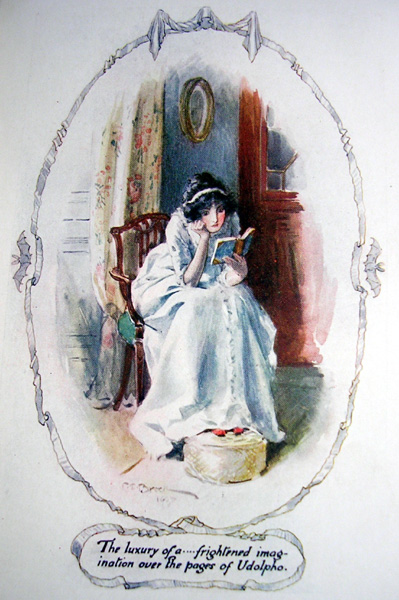
Northerner Abbey illus br Brock

From Chapter 9, illus. by CE Brock (Presumed Public Domain, from solitaryelegance.com)

Northanger Abbey is often seen as a spoof or satire of gothic novels. And it certainly does make fun of these novels, but it does so largely through satirising readers of these novels, particularly (young) suggestible readers. Northanger Abbey is also famous for its defence of the novel, on which I’ve posted before. However, the thing which stood out this read was how much Austen comments on the art or practice of writing novels. The novel opens with:

No one who had ever seen Catherine Morland in her infancy would have supposed her born to be an heroine.

Now this partly sets up the whole Gothic novel thread, the idea that heroines of Gothic novels are certain sorts of people, and that certain sorts of things happen to them, but on this read I was very conscious that there was more going on here between Austen and her reader (in this case, me). Before I explore this a little more, it’s probably worth outlining the novel’s publishing history. Initially called Susan, it was written around 1798–99, when Austen was 23-24 years old. She revised it in 1803, and it was sold to a bookseller, who never published it. In 1816, the year before Austen died, her brother Henry Austen bought it back. Austen revised it a little more, including changing the name of the heroine, and of the novel, to Catherine, but died before putting it out for publication again. In the end Henry organised for it to be published as Northanger Abbey, along with Persuasion, in 1817.

So, it was the first novel she finalised for publication (even though she had previously started on the books that later became Sense and sensibility and Pride and prejudice) but was the last published. The interesting thing about this essentially “first” novel is that the voice, or point-of-view, is a little different from the other five novels which are written more consistently in third-person omniscient voice. In Northanger Abbey however, the author-narrator frequently intrudes into the story to address the reader – sometimes, though not always, using first person – and in so doing tends to draw attention to the making of the fiction.

For example, she introduces the Thorpe family with a brief background, then writes:

This brief account of the family is intended to supersede the necessity of a long and minute detail from Mrs. Thorpe herself, of her past adventures and sufferings, which might otherwise be expected to occupy the three or four following chapters; in which the worthlessness of lords and attornies might be set forth, and conversations, which had passed twenty years before, be minutely repeated.

There is an element here of satirising Gothic novels which tended to be long and detailed and to deal with nobility, but it is also, as I see it, part of Austen’s novelist’s manifesto. She’s telling us that for the purposes of her story we don’t need long digressions into irrelevant, albeit possibly exciting, pasts.

Her frequent references to Catherine and whether or not she is a heroine sets up the reader for a traditional Gothic romance while at the same time teases us to think about what fiction might really be about. We know, from a letter to her niece, that this is, for her, “Three or four families in a country village”. So, on the one hand Austen tells us that Catherine has been “in training for a heroine” and “that if adventures will not befall a young lady in her own village, she must seek them abroad”, and then on the other hand, she returns us to reality with statements like:

she felt more obliged to the two young men for this simple praise [that she was “a pretty girl”] than a true-quality heroine would have been for fifteen sonnets in celebration of her charms.

Austen plays with us like this throughout, comparing the concerns and expectations of a Gothic novel heroine with those of a more “realistic” one.

Towards the end, the two threads – the Gothic and the natural or realistic – come together. Having discovered that all her wild imaginings of murder and mayhem at the Abbey were just that, wild imaginings, Catherine does have to confront a very real crisis when the General suddenly turfs her out of the Abbey, his home, with no explanation:

Yet how different now the source of her inquietude from what it had been then—how mournfully superior in reality and substance! Her anxiety had foundation in fact, her fears in probability; and with a mind so occupied in the contemplation of actual and natural evil, the solitude of her situation, the darkness of her chamber, the antiquity of the building, were felt and considered without the smallest emotion; and though the wind was high, and often produced strange and sudden noises throughout the house, she heard it all as she lay awake, hour after hour, without curiosity or terror.

This is one of the narrator’s third person pronouncements, but Austen, the author, intrudes in first person again at the end, with two statements that refer directly to the making of fiction. One alludes to the final resolution of the romance:

The anxiety, which in this state of their attachment must be the portion of Henry and Catherine, and of all who loved either, as to its final event, can hardly extend, I fear, to the bosom of my readers, who will see in the tell-tale compression of the pages before them, that we are all hastening together to perfect felicity.

The other refers to the introduction of a new character in the last chapter who helps bring about the above “perfect felicity”:

… I have only to add—aware that the rules of composition forbid the introduction of a character not connected with my fable—that this was the very gentleman whose negligent servant left behind him that collection of washing-bills, resulting from a long visit at Northanger, by which my heroine was involved in one of her most alarming adventures.

I love this aspect of Northanger Abbey – that is, I love Austen’s cheeky, inventive voice. She’s not scared to talk to us, to tell us what she’s doing and what she thinks. It’s a fresh, bright novel that beautifully bridges her juvenilia pieces with her more, let’s say, controlled works. We see here the lively intelligence of a young writer who is thinking, perhaps, about imagination and reality, and certainly about what she likes to read and what she wants to write.

This has been pretty brief, and may not have argued my point as coherently as I would have liked, but at least it documents for me the ideas that this reading brought to the fore. I hope it’s given you something to think about too.

Jane Austen
Northanger Abbey
Digireads.com, 2011
ISBN: 9781596251144 (ebook)

Emma Ashmere, The floating garden (Review)

Emma Ashmere, The floating gardenI had a little chuckle when, fairly early in Emma Ashmere’s novel, The floating garden, we discover that our main character, Ellis Gilbey, writes a gardening column under the name Scribbly Gum! Good name, I thought. If it hadn’t been for my school song inspiration, this would have been the name for me!

There’s another synchronicity for me, though, and it relates to the setting of this story. Last week I did a presentation on old Australian ads for an organisation I’m involved in. One of those ads was The charmed cup*. It was made in 1929, runs for around 8 minutes (can you believe it?), and is for Bushells tea. It also, coincidentally, contains footage of the Sydney Harbour Bridge mid-construction. It’s this construction which sets the scene for Ashmere’s story … so now, let’s get to it.

The floating garden is set in Sydney in 1926 when construction on the Sydney Harbour Bridge had started and houses in Milson’s Point on the north of the harbour were being  demolished with little or no compensation to the residents of those homes. One of those residents is middle-aged Ellis Gilbey, who has run a boarding house for over twenty years. At the novel’s opening the last of her boarders has left and she, with other residents in the street, is hoping against hope that some compensation will be offered. Meanwhile, in a well-to-do part of Sydney, south of the harbour, is 30-something Rennie Howarth, a young English artist who had “taken the outstretched arm of an Australian man she hardly knew and had sailed from everything cold, sad and stale”. Unfortunately that Australian man, Lloyd, who had brought her to a life of luxury, was also abusive.

Part 1 of the novel alternates the story of these two women, with more of the chapters devoted to Ellis. Whether these two women are connected, or are going to be connected, we don’t discover until Part 2 of this three-part novel. While we are wondering about this, Ashmere is busy drawing some parallels between the women – both have experienced brutal men in their lives, Ellis her father and then an employee in a house where she’d lived as a young woman, and of course Rennie her husband; both had toyed with theosophy; and both find themselves house hunting. Another parallel occurs within Ellis’s life when, destitute, she is taken in by an older woman, and then, when that doesn’t work out, destitute again, she is taken in by another older, but this time kinder, woman. These parallels are not laboured, but provide a subtle foundation to the story being told, and help hold it together.

Ashmere’s main focus is Ellis. In her story, we shift between past and present, while Rennie’s story is focused on her present. Ellis, we discover, had run away from her farm home, when she was a teen, after her mother died, and had found herself, rather by accident, in the home of theosophist, Minerva Stranks, aka Strankenstein, around the turn of the century. It was out of the frying pan and into the fire for Ellis, as Minerva is a cruel taskmaster and a charlatan, to boot. Ellis is sexually attracted to Minerva’s other protégé, the pretty Kitty Tate. Her belief that Kitty cares for her helps her survive her time in the house until … well, I won’t give this away, but by the novel’s opening, Ellis had been carrying guilt and regret for twenty-seven years.

We are not given the same depth of background for Rennie’s life before the present, but we learn that she’d had a couple of exhibitions in London before fleeing to Australia with Lloyd, and that she’d been a lively, fun woman before her marriage to a man who physically abused and emotionally manipulated her. In Australia her art changes from “polite English watercolours” to “bolder, flatter, earthier colours” that are all-round too confronting for Lloyd. She represents, as Ashmere explained in an interview on ABC’s Books and Arts Daily, the new modernist art movement, a movement which rejected tradition for something bolder. That’s certainly Rennie.

So, despite the parallels in their lives, Rennie works largely as a foil for Ellis, not only because of their class difference, but because she’s lively and risk-taking against Ellis’ more cautious approach to life, which is understandable given her greater age and particular experiences. If I have a frustration with the novel, it would be that Rennie’s story is not as developed as Ellis’s and that perhaps her main role is to be this foil or plot-device to move Ellis on rather than a character in her own right. This is more observation, though, than complaint, because overall the writing is evocative without being overdone, and the characters are engaging,

What I particularly enjoyed about the novel is that Ashmere does for the underprivileged of 1920s Sydney what Ruth Park did for the 1950s in Harp in the south. They are very different books in terms of their narratives and themes, but both exude warmth and sympathy for their motley crew of marginalised characters, and both are valuable for their social history. In The floating garden this includes evoking the about-to-be dispossessed Milson’s Point community, the charlatan fringe of theosophy, the colour of Paddy’s Markets, the energy of the artistic/bohemian community, and the opening up of land in the rural outskirts of Sydney, in Lane Cove.

The novel’s overall theme has to do with memories, guilt and grief, with the idea that you really can’t move on if you haven’t resolved your past. Late in the novel, as Ellis starts to understand the truth of what had happened all those years ago, Ashmere writes:

She’d grown used to her memories for all these years and now her grief – her guilt – had grown around them in the same way a tree’s trunk grew around a rock until both the rock and the tree risked mutual destruction if prised apart.

But sometimes, there can only be progress if they are prised apart – and prised apart they eventually are, of course.

The floating garden is a very enjoyable book. It deals with real issues honestly but gently, and it brings to life a past world in a way that enhances our understanding of the present.

awwchallenge2015Emma Ashmere
The floating garden
North Melbourne: Spinifex Press, 2015
243pp.
ISBN: 9781742199368

(Review copy supplied by Spinifex Press)

* Unfortunately, the ad is broken into three clips on this page. Clip 2 contains the Bridge footage.

Australian Women Writers 2015 Challenge completed

As most of you have heard now ad infinitum, I only do one challenge – the Australian Women Writer’s Challenge. As in previous years, I signed up for the top level, Franklin-fantastic, which required me to read 10 books and review at least 6. I have now exceeded this. Although I plan to continue to add to the challenge, as I’ve done in previous years, I do need to write a completion post so I’m doing it now. I have, so far, contributed 12 reviews to the challenge. RawsonWrongTurnTransitHere’s my list in alphabetical order, with the links on the titles being to my reviews:

Only one of these – Cusack’s – is for a classic and only one – Van Neerven’s – is by an indigenous author. I hope to broaden my reading for the challenge in the second half of the year but given the way the year is shaping up, it may not work out quite the way I’d like. My final post for this year’s challenge will tell the tale.

Do any of you do challenges? And if so, what do they add to your reading? I often see challenges that appeal to me, such as those ones to do with working through your TBR, or reading in an area I’d like to explore more, like Japanese literature, but I feel the completion stress would counteract the value so I resist.

Jane Austen, Emma Vol 3 (continuing thoughts)

I’ve now finished my re-read of Emma, and found that the theme of friendship, which I discussed in my Volumes 1 and 2 posts, did continue to play out in the last volume. In those previous posts, I suggested that Austen was presenting friendship as having both personal and social value, and I gave examples of different acts of friendship, some generous, others more questionable if not down-right self-serving.

Now, having finished the novel, I’d like to identify the different sorts of friendships which Austen presents to her readers:

  • neighbourly/kind friendship
  • “general” friendship
  • self-serving friendship
  • “true” friendship

Since I touched on some of these in previous posts, I will just expand a little more here. Neighbourly or kind friendship encompasses giving mostly practical support to others. In Emma this includes, for example, providing transport or food to poorer women in the neighbourhood. Many characters offer this sort of friendship, including, even, the unpopular Mrs Elton.

General friendship, on the other hand, is the sort of hail-fellow-well-met tolerance/acceptance of other people, with little regard to substance. Mr Weston is a perfect example of this. He’s “straight-forward, open-hearted”. He doesn’t discriminate against people on the basis of, say, class, but neither does he discern between sincerity and superficiality. And he’s inclined to gossip rather than hold his counsel. Here’s Emma on Mr Weston at the Crown where he is hosting a dance. He’d invited her to arrive early to pronounce on whether everything is in order, but she finds that he had similarly invited many other “friends”:

Emma perceived that her taste was not the only taste on which Mr. Weston depended, and felt, that to be the favourite and intimate of a man who had so many intimates and confidants, was not the very first distinction in the scale of vanity. She liked his open manners, but a little less of open-heartedness would have made him a higher character.—General benevolence, but not general friendship, made a man what he ought to be.—She could fancy such a man.

Such a man is, of course, Mr Knightley. Emma is, admittedly, a bit of a snob and likes to be recognised for her “place” in Highbury, but nonetheless, Mr Weston is presented to us as someone who “takes things as he finds them, and makes enjoyment of them somehow or other” rather than one who can be relied upon, for example, to make good judgement about character. He’s an appealing character, but not the ideal man.

Self-serving (or self-aggrandising) friendship is epitomised by the execrable Mrs Elton whose protestations of friendship, particularly towards Jane Fairfax, belie her real motivations, which are to look good and to spite Emma. She chooses her friendships on the basis of what they do for her.

And then there’s “true” friendship, the sort of friendship which is not swayed by superficial concerns, which is not scared to speak the truth, and which quietly works for the benefit of others without looking for praise or recognition. This is the sort of friendship offered by Mr Knightley, who tells Emma when he feels she’s behaved rudely or improperly, who consistently judges people correctly, and who is prepared to make sacrifices for the benefit of others.

There are readers who find the relationship between 21-year-old Emma and 38-year-old Mr Knightley a little paternalistic, if not creepy, but I’d argue these were different times with different expectations and mores. Emma is not a push-over and it’s clear that Austen sees their relationship as one built on love and “true” friendship. The last lines of the novel are:

The wedding was very much like other weddings, where the parties have no taste for finery or parade; and Mrs. Elton, from the particulars detailed by her husband, thought it all extremely shabby, and very inferior to her own. “Very little white satin, very few lace veils; a most pitiful business! Selina* would stare when she heard of it.” But, in spite of these deficiencies, the wishes, the hopes, the confidence, the predictions of the small band of true friends who witnessed the ceremony, were fully answered in the perfect happiness of the union.

Before I leave this topic of friendship, I want to mention a somewhat related topic – that of civil falsehoods. Austen introduces the term through Frank Churchill who, on being encouraged by Emma to go hear Jane Fairfax play the pianoforte, expresses an inability to pretend to like it if the instrument’s tone is poor. He says “I am the wretchedest being in the world at a civil falsehood”. The irony, of course, is that he is being false to Emma. Emma, though, blithely unaware, tells him that “I am persuaded that you can be as insincere, as your neighbours, when it is necessary”.

Emma, more than any of Austen’s novels, deals with a whole community. Austen teases out the idea that communities survive on the basis of “civil falsehoods”, that these falsehoods are at times “necessary”. On another occasion, when Mr Weston invites Mrs Elton to the Box Hill picnic, stating that “she is a good-natured woman”, a disappointed

Emma denied none of it aloud, and agreed to none of it in private.

Emma, in other words, does the polite thing and holds her tongue. But Austen knows there are costs, and that there is a place for “civil falsehoods” and a place for honesty. Falsehoods, even civil ones, Austen argues need to be handled with care. By the end of the novel, it’s clear that she, like Emma, would always prefer “openness” to concealment. I wonder if this is why she, known for her sharp tongue, felt Emma would be a heroine that only she would like!

Re-reading

Noticing this friendship theme is just one of the delights I’ve had in this re-reading of Emma. Each time I read it, I notice more – both in terms of Austen’s concerns and her technique.

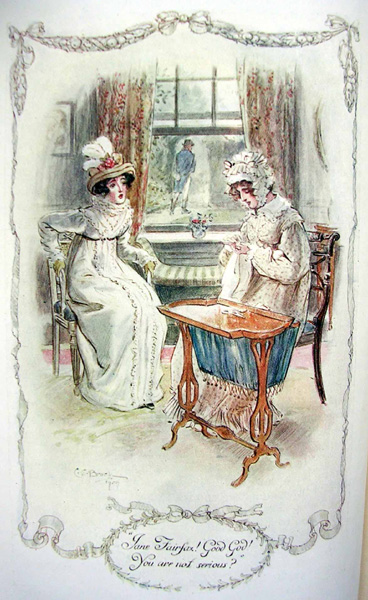
Illustration, Emma and Mrs Weston

“Jane Fairfax. Good God! You are not serious!” (Illus, by CE Brock)

One feature that interested me this read is the way she shows characters’ real love interests by whom they are watching (out for). It’s subtle and can be missed on early reads but it’s there. For example, while everyone thinks Frank Churchill is interested in Emma, Frank is watching out for Jane Fairfax. When Jane arrives at the Crown with her aunt, Miss Bates, it looks as though it’s Miss Bates whom Frank tends – “Miss Bates must not be forgotten” he says to his father as he rushes out to make sure they don’t get wet. But Miss Bates, in her chatter, lets drop his real interest:

My dear Jane, are you sure you did not wet your feet? It was but a drop or two, but I am so afraid: but Mr. Frank Churchill was so extremely—and there was a mat to step upon. I shall never forget his extreme politeness.

Similarly, when Emma and Harriet discuss a past occasion when they were with Mr Knightley and Mr Elton, Emma remembers where Mr Knightley had been standing, while Harriet only remembers Mr Elton:

“Stop; Mr. Knightley was standing just here, was not he? I have an idea he was standing just here.”

“Ah! I do not know. I cannot recollect. It is very odd, but I cannot recollect. Mr. Elton was sitting here, I remember, much about where I am now.”

Absolutely delicious. By the time this occurs, Harriet is over Mr Elton, and Emma is still unaware of her love for Mr Knightley, all of which adds to our delight in reading this scene.

Another technique which struck me was how often characters mis-read clues, how often they assume the wrong reason for an occurrence. Near the end, Mr Knightley holds Emma’s hand and is “on the point of carrying it to his lips—when, from some fancy or other, he suddenly let it go”. Emma doesn’t read this as love but as a sign of “perfect amity”. And when Frank, on his return to Highbury, visits Emma but doesn’t stay long, she assumes “it implied a dread of her returning power, and a discreet resolution of not trusting himself with her long”. However, the real truth, we realise on subsequent readings if not our first, is that he wants to visit Jane.

I could, in fact write three times this and more, on Emma, but I’d rather not. I’d much prefer it if these little tidbits encouraged you to read it (again!). At 200 years old, and despite its dated snobbery, this is a book that still has much to offer about human nature – and about skilful writing. I’m sure to read it again.

* Selina is Mrs Elton’s sister whom she sees as the arbiter of all things impressive.