Stella Prize 2018 Winner – and how the Stella is tracking (pun alert!)

I don’t always write announcement posts here – even when I write short and or longlist posts, because the news is usually so immediately known. What can I add? However, I’ve decided to post on last night’s Stella Prize announcement for a couple of reasons, one being the significance of the winner and the other being a statement released by Aviva Tuffield, the Prize’s Executive Director.

First, the winner. If you haven’t already heard, it’s Alexis Wright’s Tracker. This is the second time a non-fiction work has won since the award started in 2013. The first non-fiction winner was Clare Wright’s wonderful The forgotten rebels of Eureka (my review). For a full report of the announcement, check Stella’s page which contains Wright’s acceptance speech, the judge’s comments and an introduction to the book itself. I’ll just share a few highlights.

Alexis Wright, TrackerIn her speech, Wright commented on the diversity in this year’s shortlist:

The great celebration today is that we have many exciting, diverse voices in the world of Australian letters. We encompass the world right here in our literature. And even in this shortlist that has been judged as being some of the very best of women’s literature published in the past year, we demonstrate our remarkable diversity, internationalism, and maturity as people of many backgrounds, and here including Indonesia, Iran and Sri Lanka, as well as two Aboriginal writers. A literary dialogue that allows us to have greater knowledge and understanding of each other, and acceptance of difference, and respect for each other in our diversity, is what will make Australian literature truly marvelous, relevant, and far stronger than it has ever been.

Well said … I have so far read the book set in Indonesia (Riwoe’s The fish girl), and one of the two Aboriginal writers (Coleman’s Terra nullius). I plan to read more, because it’s an exciting list.

One of the things that interests me about this book, besides its being indigenous literature, is that Wright – not surprisingly once you know her work – plays with form, in this case what I’d call the biography-memoir (or vice versa) or what is formally being called “a collective memoir”. Wright said this in her speech, after explaining the significance of her subject, Tracker Tilmouth:

I thought very deeply about how to develop this book about him by using our own storytelling principle of consensus. I was not always sure that my approach would work as I continued on a long journey of six years from conception to finish, and gathering a mountain of material, but I was sure collaborative storytelling was the right way, and that it did work in the end is what matters. I am grateful for the storytelling skills of our culture and carried them into the book, which allowed, as Tracker himself wanted, everyone to speak for themselves, to tell their own part in the story.

I love this description, not only because it articulates what she was trying to do, but because she alludes specifically to “the storytelling skills of our culture” which is something I have mentioned in posts in the past, but a little hesitantly for fear of sounding like I was “exoticising” indigenous people. The thing is that when I read indigenous Australian stories, or hear indigenous Australians tell stories, I am frequently conscious of a very specific, and lively, storytelling culture.

In her statement announcing the winner (out of 170 submissions), judges’ chair, Fiona Stager said:

The winning book is unique in the history of Australian letters and it artfully fulfils all the Stella Prize’s criteria: it is excellent, engaging and original. We invite all readers to immerse themselves in a history, a landscape, a time and a story that is heartbreaking, poignant and humorous. […]

… the judges wish to acknowledge the craft of the author and pay tribute to the richness of the memories shared by the many people she interviewed. This book will enrich and change the understanding of readers. A man like Tracker Tilmouth could change our world. It takes a writer like Alexis Wright to change the world of Australian letters.

Stella Prize’s page on the book provides more information, including the judges report, an interview with Wright and a book extract.

In her speech, Stager also paid tribute to Aviva Tuffield. It was largely Tuffield’s statement about the Prize, released the day before the announcement, that committed me to this post. In it, Tuffield articulates what the Prize has achieved since its inception in 2012.  She reiterates why the Prize was established in the first place: “hard data had proved that women writers were underrepresented in three key areas:

  • as winners of the major literary prizes;
  • as authors of the books that received the most review and media coverage; and
  • as authors of the books on the school curriculum.”

She said those founding the prize appreciated that “much of this inequality arose from unconscious bias”, as evidenced by data showing that “‘blind’ orchestra auditions and CV assessments yield such different results to what happens when faces and names are attached.” However, whether conscious or unconscious, the impact is the same, and it’s serious because it “sends clear messages about whose voices, whose stories and whose experiences are most important.” Hence, the prize …

And, six years on, she says, the effects are clear (for the details, please check her statement at the link above):

  • women are now winning more prizes generally, and being increasingly shortlisted, across all major prizes.
  • more women writers are being added to school curricula. Victoria’s English curriculum now has gender parity in terms of authors listed, as opposed to being just over 30% of the list in 2014.
  • the ‘kinds’ of books that are now being considered of the ‘highest literary merit’ has shifted, with “novels focusing on contemporary family life or relationships – using those as microcosms for society at large – and often with female and even child protagonists” now being recognised.
  • general awareness of the breadth and quality of Australian women writers has increased. She says that “When Stella started many people told me that they didn’t realise there were so many good women writers in Australia – and especially writers of nonfiction (as Stella is for fiction and nonfiction books)”. She argues that Stella’s longlists and shortlists have raised awareness of the breadth of women’s writing, and that this awareness has spread beyond these lists to other writers who have said their work is being taken more seriously.
  • the ripple effect created when people see more women writers being recognised. “The landscape”, she writes, “changes: role models are provided, unconscious bias is dismantled, stereotype threats are banished.”

Now, some of this is more anecdotal than “proven” and not all of it is only due to the Stella, but the Stella Prize is, I’d say, making a significant contribution. And it will continue to do so because Stella’s job is not done. More is needed, she says, “in terms of diversity and extending Stella’s benefits to all women writers” and more also, as the #metoo movement has proved, “to shift the power structures of our patriarchal society” to ensure that women are heard. Finally, as we’ve seen before – and as is evidenced in other spheres like the gender pay gap – “things can slip back very quickly.”

So, I say thanks to Aviva Tuffield and the Stella Team. I am proud to count myself as a Stella Spark.

Claire G. Coleman, Terra nullius (#BookReview)

Claire G Coleman, Terra nulliusClaire G. Coleman’s debut novel, Terra nullius, was my reading group’s third book for this year. The first two – An unnecessary woman (my review) and The sympathizer (my review) were well liked – but not so Coleman’s book. In fact that I was the only one who liked it. So, instead of my usual review, I’ve decided to tease out some of the issues my group had with the book, and see where I end up. I didn’t take notes at the meeting, so I’m relying on my memory. I may not have got all the issues down, or down correctly, but I’ll give it my best shot. In doing so, I’ll also draw on GoodReads because its users tend to be general readers, like you finding reading groups.

First though, a brief introduction for those who don’t know the book. Terra nullius starts off reading like an historical fiction novel about the colonial settlement of Australia and the concurrent dispossession of our indigenous people. Coleman’s world of Settlers and Natives, of Troopers and Trackers, of Missions to which stolen children are taken for education, of a Department for the Protection of Natives, and so on, mimics colonial Western Australia in particular, but it’s not long before hints start to appear that all is not as we’ve assumed. Before halfway, all is revealed, and we realise we are not reading historical fiction, but speculative fiction set in some near future. It is, as a result, not about indigenous Australians versus white colonists, but about colonised people of all races versus settler-colonists (“grey fellas”) from somewhere else. This realisation is unsettling, and clever, because it forces non-indigenous readers to switch identification from the colonisers to the colonised.

Now to my reading group’s response. The over-riding criticism was that it was repetitive and tedious. This is the criticism I could most understand, because partway through the novel’s second half I felt the momentum flag a little, which I put down to the structure. It’s multi-stranded, with the stories of different people or groups running parallel for a significant portion of the book. The strands include Native Jacky who is on the run; Settler Sister Bagra who runs a Mission; Settler Sergeant Rohan who leads the posse which is hunting Jacky; Esperance and her camp of free, renegade Natives; and deserter-Settler Johnny Star who is taken in by some rebel Natives. Fortunately, just as I wondered whether the separate groups – the separate strands – were ever going to come together, two things happened. A new character, Father Grark, appeared, and the strands did start to coalesce. These, along with other factors including the writing itself, were enough to prevent the book’s becoming tedious for me.

However, my reading group friends weren’t alone in their criticism. One GoodReads reviewer described it as “gratingly repetitive” and another overall positive reviewer had “some minor quibbles”, of which the main one was that “some elements of the story were repetitive”.

Another criticism made by some of my group was that they weren’t interested in any of the characters. Some GoodReads reviewers concurred. One didn’t “connect with any of the characters” and another said that “the characters, the individuals, are basic, with no complex motivations, no desires”. This surprised me, because I was interested in several of the characters, and I looked forward to their next appearance. One was Esperance, the young woman living with that renegade camp of Natives. Another was Jacky, who is the first character we meet and who, for over half the novel, struggles on alone, trying to survive and keep one step ahead of his pursuers. There are, though, a lot of characters, and I can see the argument that many of them have “no complex motivations”. However, I’m not sure that deep characterisation is always essential for speculative, dystopian fiction, such as this book is. Anyhow, regardless of this point, I can’t accept the argument that none have desires. Esperance and Jacky, for example, certainly have desires. Survival is one, and for Jacky, returning to his home, his country, is a major driving force.

One of the positive GoodReads writers said, and it reflects my response, that “importantly, Coleman’s more ‘extreme’ characters – such as Sister Bagra, in charge of a Native ‘orphanage’ – are frighteningly familiar, and it [is] these elements of the story that will linger.” She is not, in other words, a particularly complex character, but given what I know of colonial history, she is believable. I’d argue that that’s sufficient.

Then there were arguments that the book was too heavy-handed, too obvious, not nuanced enough. Again, there were GoodReads reviewers who agreed, one saying the “messaging was much too overt” and another that it could have been more subtle. However, I’m not sure that I’ve read much dystopian fiction that is subtle. On GoodReads I found a perfect example of how differently we “read” books. One criticised the chapter epigraphs, which come from various fictional “sources”, saying that “the book could have been done much more subtly without the chapter-starters explicitly comparing the colonisation to the colonisation of Australia”, while another said that Coleman’s “use of ‘archival documents’ at the beginning of each chapter gave the book rich perspective.” Again, I concur with the latter, and some in my group agreed that this feature of Coleman’s book was effective and worth exploring further.

It seems that those who are well-versed in speculative fiction’s colonisation stories – in my reading group and on GoodReads – felt that Coleman’s book didn’t offer anything new. A member in my group felt that it was so clearly Western Australia’s story that Coleman may as well have made it Western Australia. I agree that the “facts” aligned closely with the Western Australian experience, but I didn’t see that spoiling its speculative layer. In a way, it increased its effectiveness because, using the GoodReads quote above, it felt “frighteningly familiar”. There is an argument to be had, I suppose, about how “familiar” speculative fiction can be before it’s no longer speculative, but for me it worked.

Other concerns were raised in my group, but there were positives too, particularly regarding the quality of Coleman’s descriptive writing. She knows the landscape well and captures the heat and light, not to mention the weirdness of Australian desert vegetation beautifully:

He [Sergeant Rohan] did not relish another night under the alien trees, the twisted limbs, the hanging bark, the wrong colour: their waxy grey-green leaves too hard, almost glassy.

There’s more to like about the writing than this, however. From the first page when we meet Jacky on the run, I loved Coleman’s voice. It’s direct but evocative, it’s serious but peppered with a light, cheeky touch that uses throwaway lines and afterthoughts to great effect:

Dinner was a disappointment: sure the meat was fresh but it was tough and tasted like all the other Native meats – quite unappetising, only to be relished by the desperate. Good thing they were desperate then.

So, I was impressed by this book. My heart engaged with the characters who were struggling to survive their nightmarish world, while my mind was intrigued by what Coleman was doing, by her layering of historical experience within an imaginative framework, by her grounding us in a familiar story, and then overturning it to force us to see it from a different perspective. I’m not sure I followed all her intellectual twists and turns but I certainly got the point about invasion – and about the cruelty people inflict on each other in its name.

He [Johnny Star] had learned, through his friends, that the bent, broken drugged and drunk state of those surviving near the Settlements was not the habitual state of Natives. The truth was, it was a sort of depression brought on by what they had lost, brought on by being dominated and controlled by another people. Who could not be depressed, being treated like animals in a land that had once been theirs alone.

Without giving away the details, the ending is generally what you’d expect from a dystopian scenario, but it’s not without hope, without defiance too. A great read … at least, I thought so!

Lisa (Anzlitlovers) loved the book, as did Bill (The Australian Legend).

Note: I haven’t cited the individual GoodReads reviewers, but they can be found at the site’s page for the book.

AWW Badge 2018Claire G. Coleman
Terra nullius
Sydney: Hachette Australia, 2017
294pp.
ISBN: 9780733638312

Mirandi Riwoe, The fish girl (#BookReview)

Mirandi Riwoe, The fish girlMirandi Riwoe was joint-winner of the 2017 Seizure Viva La Novella prize with her book, The fish girl – and it has now been shortlisted for this year’s Stella Prize. As you may already know, it was inspired by Somerset Maugham’s short story “The four Dutchmen”, which I reviewed a few days ago. Indeed, Maugham’s story provides the epigraphs to each of the novella’s three parts. Do you then need to have read Maugham’s story to appreciate Riwoe’s take? I’d say not – and would hate that assumption to put people off reading her book. Nonetheless, I’m glad I read Maugham’s work. How’s that for a foot in both camps?

To recap briefly, “The four Dutchmen” tells of four fat, jolly Dutchmen who work together on a boat plying the southeast Asian seas. Immensely loyal to each other, they plan to all retire when the first of them dies. The only blot on their togetherness is the captain’s penchant for Malay girls. However, the chief officer usually cleans up after him – paying off the girls, in other words, when the captain tires of them – until the day the captain decides to bring one of these girls along on a boat trip. Tragedy ensues.

Now, Maugham’s story is told first person by an observer-narrator, a traveller in the region, rather than one who’s involved in the events. The story has a matter-of-fact tone. Not so Riwoe’s story, which, although told first person, gets into the girl’s heart. Unlike Maugham, Riwoe gives her a name, Mina, and from the start, we realise that Mina’s fate is tied to men. Hers is a world controlled by men – regardless of whether that world is her village or the Dutch Resident’s house.

I should, perhaps, clarify some terminology at this point. Maugham uses the terms “Javanese” and “Malay girl” in his story. These days, we differentiate Javanese, who come from Java which is part of Indonesia, from Malaysians, who come from Malaysia, which neighbours Indonesia. However, in Maugham’s time, Malay was used for Austronesian people, which include today’s Malaysians and Indonesians, amongst others. Mina, Riwoe’s version of Maugham’s Malay girl, is from a Sunda village in this region.

Riwoe tells her story in three acts, each preceded by epigraphs from Maugham’s story. In the first part, Mina is offered by her father to a man who comes searching for “cheap labour for the Dutch Resident’s kitchen.” The barely pubescent Mina doesn’t want to go, has never left home before, but for her parents, her father in particular, there is hope that she will be able to send them things they “need, like more spice and tobacco.” Mina is scared, but we also get an intimation of resilience when we’re told of the “tremor of excitement finally mingling with the dread in her stomach.” Maybe it will work out alright we hope.

By the end of part 1, she has arrived at the Dutch Resident’s place where she works in the kitchen to the unsympathetic, unkind head cook Ibu Tana. She seems to be a favourite of the Dutch Resident who treats her kindly, and requests her to serve table in his house. Is he grooming her? Or is he decent? We fear the answer.

Part 2 introduces the four Dutchmen who dine with the Dutch Resident, and, in particular to the captain – the man described in the epigraph from Maugham as “losing his head over one brazen hussy or another”. That should warn us, though in this part he seems gentle. He wants her to teach him her language. In return he teaches her his, and gives her gifts. Hmm … our antennae are up. Meanwhile, Mina has fallen for Ajat, her village chief’s son who does some work for the Dutch Resident. Her sexuality is awakening, but Ajat treats her cruelly. Part 3 commences with her arrival on the boat with the captain, after which the story plays out pretty much as Maugham tells in his short story.

What Riwoe does in this story – her post-colonial response to Maugham’s – is to look at it from the angle of the colonised, and particularly colonised young women. What she shows is that young women are not only pawns in the hands of colonial powers but also in the hands of their own men (in this case her father who trades her for potential material gain, and the chief’s son who tricks her and uses her ill).

This may all sound same-same, as in “I’ve heard all this before”, and at a simple level that’s so. However, what makes The fish girl such a good read is the character Riwoe gives Mina. She’s young and naive, but she’s not a type. She has dreams and at least an attempt at having agency. Here she is, as she’s about to be taken to the boat by the Captain:

Kanjeng Ratu Kidal (Ocean Queen): By Gunawan Kartapranata (Own work) [CC BY-SA 3.0]


Mina leans against a tree, rolls her head gently against the prickly bark. She takes a deep breath. She will need to be very strong. She will need to be like one of the dhalang’s wayang puppets, as hard as lacquer, enduring.

Also, Riwoe adds a mythical element through Mina’s love of the sea, and her belief in the Ocean Queen. The sea is presented as a curative force – both physically (for her rash, presumably eczema) and spiritually.

She calls for the Ocean Queen. Only when she feels Nayai Loro’s strong, smooth pull, feels the soft arms suckle at her damaged thighs, does Mina scatter the flowers upon the sparkling water.

Finally, although this is short, Riwoe unfolds the story slowly, developing Mina’s character and allowing us to hope that Mina will endure. But that, of course, would be a fairy tale and, despite its heartening mystical conclusion for Mina, this is definitely not that. An engaging but powerful read.

AWW Badge 2018Mirandi Riwoe
The fish girl
Sydney: Xoum, 2017
97pp.
ISBN: 9781925589061

Monday musings on Australian literature: Mollie Skinner and DH Lawrence

I promised this post in yesterday’s review of Mollie Skinner’s short story, “The hand”, but have since been reminded that Bill (The Australian Legend) has already written about Skinner’s relationship with Lawrence. I’ve decided to continue with my plan, not only because it interests me, but because I hope to add to the discussion.

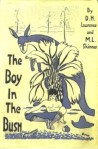
DH Lawrence, ML Skinner, The boy in the bush

First US edition, Thomas Seltzer, 1924

So, I suggest that you read Bill’s post (linked above), because I plan to avoid repeating what he’s said. However, you do need a little groundwork, and it is this. In 1922 Mollie Skinner was running a guest-house and nursing-home in Darlington, Western Australia, to which the newly arrived DH Lawrence, and his wife Frieda, had gone to stay. The end result of this meeting was the co-written novel, The boy in the bush. (You can read Bill’s review of this, too, on his blog.)

To avoid repeating Bill’s information which uses Paul Eggert’s introduction in the novel’s 1990 edition, I am drawing from – yes, you guessed it – my newspaper research in Trove, where I found some more contemporary commentary to complement Bill’s work. Contemporary commentary comes, of course, with the biases of the time, but is fascinating, both in spite of and because of that. Unfortunately, as is the way with newspapers, not all the articles have bylines.

ML Skinner, The fifth sparrowHaving said all this, the first article I’m using is not quite contemporary, having been written in 1973, and does have a byline, Maurice Dunlevy. He is writing because of a new Heinemann edition of the book, and seems to draw his information from Mollie Skinner’s autobiography, The fifth sparrow, which Bill’s Paul Eggert also uses, and from the Heinemann edition’s introduction by Professor Harry T Moore. (There is, it appears, no lack of critical analysis of this work!) Dunlevy notes the existence of previous writings on the pair, but also says that:

We can certainly be more sure of our facts than the reviewers were a half-century ago when they thought that Mollie Skinner was a man.

Presumably this was because she is cited on the book as ML not Mollie Skinner – though it’s pretty clear that she was well-known in her birth state of Western Australia. Interestingly, some editions of the book don’t have her name on the cover at all.

Anyhow, Dunlevy quotes Skinner’s description of Lawrence as:

a man-boy with the little red beard, scarlet lips, strange eyes flashing with amused lights, and an upright body held with dignity.

Dunlevy goes on the describe how the novel came about – Skinner’s showing Lawrence some of her work, his expressing approval of her writing and suggesting she write about a particular topic, and her eventually sending him her manuscript of the novel she called The house of Ellis.

He then reports that:

Lawrence thought the book had “good stuff” in it, but was “without unity or harmony”, “without form, like the world before Creation”. He offered to re-cast it and have it published under their joint names.

This recasting, apparently, included recasting the hero, Jack (who was based on Mollie’s brother) to be “not quite so absolutely blameless an angel”. This included his coming to believe he was entitled to two wives. Dunlevy reports that Mollie cried when she read of this change! He also writes that Lawrence recast what was essentially “a conventional, parochial romance of an English boy sent to Australia for a social gaffe” and who then turns hero, into

a much more complex and universal story, the story of an Englishman responding to the new freedoms, the new challenges, the new possibilities for living an unconventional life on a frontier not bogged down by traditions. It is also one of the few good examples of an “Australian” version of that situation so familiar in American literature: a boy’s initiation into manhood.

Nonetheless, Professor Moore does say:

The writing throughout is distinctly Lawrencean and the book should rank as a Lawrence novel, though Mollie Skinner’s extremely important contribution should be noted”.

But what of more contemporary commentary? As Bill noted, it did tend to be more parochial. Here’s one from a paragraph on Publications Received in Western Australia’s The Great Southern Herald (14 March 1925). The writer suggests that Skinner wrote all the lovely descriptive material, perfectly capturing “the scenery and scents of the bush” about Perth and Fremantle, but:

the narrative itself is a discredit to the Australians it attempts to depict. It is a story of sordidness and immorality with the characters speaking a mixture of Bowery and Cockney slang. The one thing, beyond all others, that the average Australian is remarkable for, is the purity of his diction, in this respect being far above the average Englishman, and it is an insult to characterise him as speaking the awful polygot which appears in “The Boy in the Bush.” The opening chapters of the book grip one with their descriptive power … [and] … stamp the writer as one who knows and loves the West. Of the rest of the story, the less said the better.

I do love the comment about the “average Australian” being “remarkable” for “the purity of his diction.” I’m not sure I’ve heard that said before. Anyhow, the writer concludes that Skinner “will shortly publish The Black Swan, written without collaboration, and which should offer better proof of her literary powers”!

Someone called Norbar, writing a little later in 1938, is a little more even-handed, writing:

STRANGELY different from other West Australian authors is Miss Mollie Skinner. Her work has an elusive character which is difficult to grasp. Its naivete, lack of discipline and neglect of construction have led many to dismiss it as worthless, yet the hypercritical D. H. Lawrence, one of the greatest figures in 20th century English literature, not only praised her first book but collaborated with her in a second and urged her to complete a third. Miss Skinner’s collaboration with Lawrence in “The Boy in the Bush,” however, besides dragging her into the type of controversy which would not normally have been associated with her work, has unduly overshadowed her own originality.

Norbar then says, confirming his criticism at the beginning of this paragraph, that it’s easy to find fault in her books but that “in none of them does she fall into the facile pattern of stock character and situation which fills the lending libraries.” After some further discussion of Skinner’s collaboration with Lawrence, and of some of her later works, s/he concludes with the following assessment, which is a good a place on which to conclude this discussion:

In Miss Skinner’s novels we find her considerable originality, spiritual perception and feeling use of words circumscribed at every turn by almost school-girl conceptions of situation and character, probably an unconscious legacy from a mid-Victorian middleclass sensibility which has lingered among the old families of Australia long after its wane in England. Whatever contempt men like Lawrence might feel for English intellectual aridness, Miss Skinner would have benefited from early introduction into a circle invigorated by the new realism inspired from Scandinavia and France, even if she had had to slough it off afterwards. But literary and spiritual currents had little effect on the respectable classes of Australia and Miss Skinner’s training and traditions were against her turning to the democratic crudity of the working class, the salvation of many Australian writers. She has, consequently, been left high and dry and her work bears the marks of her isolation.

An interesting insight into some thinking of the critics/reviewers of the day, n’est-ce pas? There are some things here worth teasing out another time.

M.L. (Mollie) Skinner, The hand (#Review)

ML Skinner, The fifth sparrow

ML Skinner, The fifth sparrow: An autobiography

Pam of Travellin’ Penguin blog read ML Skinner’s short story “The hand” for a challenge she was doing, and, when I expressed interest in it, very kindly sent me a copy. “The hand” is a mysterious little story – and by little, I mean, little in that it takes up less than 7 pages of the anthology, Australian short stories, that she found it in.

Now, the story is a bit tricky, and I think is best understood within the context of Skinner’s biography. She was born in Perth in 1876, but the family moved to England and Ireland in 1878. Mollie was a keen student and reader but had to abandon formal education in 1887 because of an ulcerated cornea, which resulted in her spending much of the next five years in a darkened room with bandaged eyes. After cauterisation partially restored her sight, she started to write poems and stories. Presumably this was around 1892 (ie 5 years after 1887?) when she was about 16 years old. Later she trained as a nurse, which gave her her main living. And then, the ADB biography (linked to above) says something interesting in terms of our reading of this story:  “she recognized within herself an intuitive power, or sixth sense.” A little later in the biography, we are also told that “Mollie believed that God’s hand on her shoulder guided her life. She dabbled in the occult”. She returned to Australia in 1900, though returned to England later to study. She also travelled to India, and served there and Burma during World War 1.

So to the story, which was first published in 1924. It is set in a “mining hospital back there in the west.” As there was “little doing” and the light too dim to read by, the Matron is encouraged to tell a story which she is “good at” doing. They – presumably the off-duty staff – ask her about her life in “those posts way back in the interior”. Was she ever frightened, they ask?

‘Of what?’
‘Well–the loneliness. And bad white men, and bad blacks. Of patients in delirium. Or some awful maternity case you couldn’t handle.’
‘I didn’t think about it. I did what I could. I was frightened once, though: and that, really, by a nurse screaming. A nurse shouldn’t scream.’

Interesting, the “bad white men, and bad blacks”, but I’ll just take that as another of those ways in which contemporary stories provide us insight into the times, and move on with the story. She then tells the story of the scream. She describes the small outback post, the sense of community they had, and the little L-shaped hospital which was open to the bush on one side, and the road and railroad on the other. There were two other nurses besides herself, one being Nurse Hammer “a regular town girl, very attractive, but unstable, untried.” On the night of the scream, our Matron story-teller was doing accounts while the two nurses were chatting with the patients. Our Matron’s mind kept wandering she says. She’s

very practical, really, and then liable to feel things in the air, things that other people don’t seem aware of. My father called it “unwarranted interference”; and told me to taboo it. But it gets hold of me sometimes: and this evening I was uneasy, aware of “something”. There seemed to be a sound.

But, she can’t identify anything, so continues to try to work. She hears Nurse Hammer go to bed, and then – the scream. The rest of the story concerns locating the scream – it was Nurse Hammer – and working out the cause of it – a hand has grabbed Hammer’s leg.

In the end, there’s a practical explanation for “the hand” but along the way there’s a sense of an awakening or at least, a growing up, for Nurse Hammer. Initially, the Matron is

conscious, not only of Hammer’s terrible fear, but of a deeper source, dark and secret within herself. I remembered how lovely she was. How men in the wards watched with furtive eyes as she walked past. I remembered the way she walked–how she avoided those eyes. I knew then that the girl had herself been tempted, that she was powerless, now, in this dark room, because in her own life she was passing through crisis.

The Matron finds herself praying that “whatever we found in this room would not be evil.”

Skinner builds up the suspense well, the darkness, the lantern going out, until eventually the cause of the scream is determined. Before it is fully explained though, Nurse Hammer has a little more to endure, but, says Matron,

I glanced at Hammer. The Nightingale light was flooding her face …

And the Matron goes on to use words that imply a biblical aspect to Hammer’s enlightenment – but if I say more, I’ll give away the story which I’m not sure I want to do (though unfortunately the story does not seem to be available online).

Interestingly, Skinner attracted the attention of DH Lawrence … but I think I might make this the subject of tomorrow’s Monday Musings! Meanwhile, I think the story is to be understood in the sense of a divine intervention intended to test and try Nurse Hammer, from which she emerges, in a sense, reborn and now a real nurse, like Florence Nightingale. (But, I could be wrong.)

AWW Badge 2018ML (Mollie) Skinner
“The hand” (1924)
in Australian short stories (1951)
ed. by Walter Murdoch and Henrietta-Drake Brockman
(pp. 148-154)

Sofie Laguna, The choke (#BookReview)

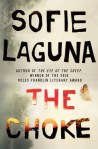
Sofie Laguna, The chokeThere are many reasons why I wanted to read Sofie Laguna’s latest book The choke. Firstly, I was inspired by a very engaging author conversation I attended late last year. Secondly, she won the Miles Franklin with her previous book The eye of the sheep (which I still haven’t read). Thirdly, its setting, the Murray River, is one of my favourite parts of Australia. For these and other reasons, I finally slotted it in this month, despite my growing backlog of review copies, and I’m glad I did. It’s an engrossing, moving read.

The novel is divided into two parts, the first set in 1971 when its first person protagonist Justine is 10 years old, and the second set three years later when she is thirteen years old and starting high school. It’s an effective structure. The first part sets up Justine and her physically and emotionally impoverished situation. She lives with her war-traumatised grandfather Pop on a struggling farm on the banks of the Murray. Her mother is long gone, and her father returns erratically. She has regular contact with her two older half-brothers who live nearby with her father’s first wife. Pop loves Justine, but he does not have the wisdom or emotional resources to guide – or even provide for – her as she needs. She is undernourished and poorly groomed. We are therefore unsurprised when Part 2 unfolds the way it does.

Now, I am a little cautious about first person narratives. It’s not that I don’t like them. In fact they can be highly engaging, but it did seem, for a while at least, that first person was becoming the voice du jour. However, Laguna’s choice here is inspired. She’s known for her ability to write young people and it’s well demonstrated here. Telling the story in Justine’s voice enables her to show Justine’s situation, without resorting to telling, which can so easily turn to moralising. Justine is the perfect naive narrator. She can only describe and explain the world as she knows it, so we readers must read between the lines to work out what is really going on. We work out, for example, that she is dyslexic by the way she describes her inability to read. We learn about the quality (often poor) of the relationships that surround her through her observations.

When I looked at [half-brother] Steve it was as if there was a ditch all around him too wide to jump. If you shone a torch into it, you’d never see the bottom. Steve couldn’t get across by himself; it was only Dad who could help him.

She might not understand the world – and it is this, along with her loneliness, which drives the crisis when it comes – but she’s attuned to the feelings between people.

One of the reasons this book so engaged me, in fact, is that it’s all about character. In the conversation we attended, Laguna said a couple of things about this. She said that it’s the characters and the tensions between and within them that drive the narrative and that character IS the plot.

“I got it wrong from the start”

So, who are these characters who drive the narrative? Justine is the main one, of course. She tells us that she was a breech birth – “I thought that was the right way to come out.” She understands by this that she “wrong from the start”, and she blames herself for her mother’s departure three years later. Her sense of being wrong – and feeling somehow responsible – is a recurring refrain in the novel. The other characters – her Pop, her sometimes-present father Ray, her mostly absent but significant aunt Rita, her friend Michael, her half-brothers, and the similarly dysfunctional neighbouring Worlleys – are all seen through her eyes. It is the tensions, stated and unstated, between them and their impact on her, that drive the narrative and the decisions she makes.

As well as a coming-of-age story, The choke is also a classic outsider story. Part one sets up Justine’s outsiderness, and chronicles, among other things, the friendship that develops between her and another outsider at school, Michael, who is taunted, bullied, because of his physical disability. Justine doesn’t have the words, but his disability appears to be cerebral palsy. The end of this friendship with Michael’s departure for the city ends Part One. This friendship plays multiple roles in the narrative. It helps develop Justine’s character. Her decision to stand up for Michael, having earlier wanted nothing to do with him, not only brings her a friend and marks her outsiderness from the cohort, but also shows her own sense of social justice. However, this friendship also exposes her low self-expectations and further reveals her neglect, because Michael’s family is a “normal” middle-class family. There’s a mum and dad, two kids, a proper house, regular meals and proper care. Justine is intitially embarrassed by the gap between their lives and hers, but when Michael eventually visits her home, she discovers he loves visiting it. He loves, for example, the chooks, Cockyboy and the Isa Browns.

By the time Part Two starts, her father Ray is in jail and Justine is starting high school. With Michael gone, she’s isolated at school and, while loved at home, continues to be neglected. The crisis is revenge-driven for something her father had done, but Justine, as the vulnerable female, is, of course, the target. It’s a gut-wrenching story of damage, neglect, abuse and, yes, also just simple misguidedness. Her Pop means well but is ill-equipped for the caring role thrust upon him. In the end, the story is also one of a failure of people and systems – including education – to identify Justine’s real situation.

And then there’s “the choke” of the title. I don’t always discuss a book’s title, particularly given that the author doesn’t always have last say on this, but for this book it’s highly relevant:

Down at The Choke the river pushed its way between the banks. The water knew the way it wanted to go. Past our hideouts, past our ring of stones, past the red gums leaning close enough to touch – it flowed forward all the way to the sea.

The “choke”, then, is a bottleneck in the river, a place, Justine says elsewhere, “where it would push through and keep going”. It is a physical place (based on the actual Barmah Choke) and a metaphorical one. Physically, it is a place of tranquility, of respite, for Justine. However, it also symbolises the things that threaten to “choke” her life, while at the same time hinting at hope, at the possibility of pushing through.

The choke is a book written by someone who knows exactly what she is doing. As I flipped through it to write this post, I noticed again and again the crumbs laid for us, the signs, in other words, that prepare the groundwork for what comes later. There is nothing wasted here. It is a grim story, but it is enlivened by its resilient young protagonist who finds the resources within herself to “push through” when life threatens to overwhelm. It may not have been shortlisted for the Stella Prize but I’m glad I decided to read it.

AWW Badge 2018Sofie Laguna
The choke
Sydney: Allen & Unwin, 2017
369pp.
ISBN: 9781760297244

Stella Prize 2018 Shortlist announced

Claire G Coleman, Terra nulliusAs you probably know, the Stella Prize is the award I particularly like to follow, though I don’t always post on the Longlist and the Shortlist as I am this year. The Longlist was announced on 8 February (my post), and the shortlist was announced, yesterday, International Women’s Day, as has, appropriately, become tradition.

Here is the shortlist:

  • The enlightenment of the Greengage tree, by Shokoofeh Azar (Wild Dingo Press)
  • Terra nullius, by Claire G Coleman (Hachette)
  • The life to come, by Michelle de Kretser (A&U)
  • An uncertain grace, by Krissy Kneen (Text)
  • The fish girl, by Mirandi Riwoe (Seizure)
  • Tracker, by Alexis Wright (Giramondo)

Interestingly, as has happened in the past, the proportion of non-fiction to fiction in the longlist has not carried through to the shortlist. Five of the twelve-strong longlist were non-fiction works, while just one of the six books in the shortlist is. And unfortunately, it’s not the one I’ve read! Seriously, though, I am glad to see Alexis Wright’s Tracker, which is about the Aboriginal leader, political thinker and entrepreneur Tracker Tilmouth, on the list. However, this pattern suggests that it is difficult to judge fiction against non-fiction and that the Stella Prize’s goal of offering one award irrespective of form or genre is perhaps harder to achieve that it sounds? In a sense I can understand it. If the award is about excellence in Australian writing, and if excellence includes some sense of innovation, then it is likely that such definition of “excellence” is more likely in fiction. (By the way, innovation to me can include experimenting/innovating in style, form, genre, structure, content, so it’s not impossible in non-fiction, just more constrained – perhaps?)

Anyhow, what do I think about the list? Well, firstly, I’m pleased so see that the list accommodates diversity. I’m also pleased to see that my pick, Terra nullius (which I’ll be reading soon) is on the list, and that The fish girl which I bought because of its long-listing is also on the list. I even mailed a copy to my American friend for her birthday this week. And, I’m not surprised to see The life to come and An uncertain grace on the list, given the quality of these writers and the buzz about their books. I’m disappointed, though, that the book I’m reading now, Sofie Laguna’s The choke, is not on the list – not because I believe it should be as I haven’t read enough of the books to make that assessment, but because it’s one I would have read when the winner is announced! Oh well … c’est la vie. Fortunately, I’m enjoying The choke so my reading time is certainly not wasted!

The winner receives $50,000, and each shortlisted author receives $3000, as well as a three-week writing retreat on the Victorian coast. It’s a lovely generous prize. The winner will be announced on 12 April.

Now, I’ll get back to my reading … but if you have any comments on the list, I’d love to hear them.

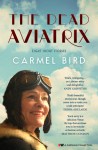
Carmel Bird, The dead aviatrix: Eight short stories (#BookReview)

Carmel Bird, Dead aviatrix

Carmel Bird, whose latest short story collection, The dead aviatrix: Eight short stories, I’m reviewing here, has to be the consummate writer. She can turn her hand to fiction and nonfiction, to short and long form writing, to formal and more informal voices, and to both serious and witty or satiric tones. She’s also an editor/anthologist in addition to being a writer. And now she’s experimenting with a digital platform. So, when she hesitantly offered me The dead aviatrix to read and review, there was only one answer, yes.

Her hesitation related to its e-book form. She feared that we Gums’ people aren’t much interested in ebooks, but, she wrote, “they are a growing part of the literary landscape”. Then, using a very Bird-like expression, she continued, “so maybe one day you will write a bit about them, and if and when you do, The Dead Aviatrix will be idling on the tarmac.” Well, how could I resist, even if I had wanted to, an aviatrix idling on the tarmac? And anyhow, as you know, I do read and write about e-books. Annabel Smith’s The ark (my review) is a good example, but I’ve reviewed several e-books here including Dorothy Johnston’s Eight pieces on prostitution (my review).

Like Dorothy Johnston’s book, which was a digital publishing initiative of the Australian Society of Authors, The dead aviatrix is the first Capsule Collection, a new platform by digital publisher Spineless Wonders. Subsequent titles in the series will, the book’s “About” says, include works “selected from The Carmel Bird Digital Literary Award”. You clearly can’t keep a good writer down. I love that this doyenne of the Australian literary scene is still exploring and experimenting.

However, it’s all well and good to explore and experiment with form, delivery platform, and so on, but in the end you need to produce the goods, and this Bird has done with her eight stories. I should say, before discussing them, that all have been published before – in publications like Southerly, Island Magazine, and Review of Australian Fiction.

So now, at last, the stories themselves. They are a wonderful lot. Bird regularly makes me laugh, and she does so again here. It’s not empty laughter though, because her targets are serious. It’s just that she frequently presents her ideas with a cheeky, often satirical approach.

The first story is “The dead aviatrix and the Stratemeyer Syndicate”. It’s written in the sort of style Bird used in Fair game, her memoir of Tasmania (my review). By this I mean it digresses or, as she says, becomes “productively sidetracked”. However, as “The dead aviatrix” is “a publishing story”, the opening digression about the prolific Edward Stratemeyer – creator of a childhood favourite of mine The Bobbsey Twins – is relevant in a way (of course!). Actually, it’s very relevant because she finds a quote about an aviatrix in a Stratemeyer book, and uses it to springboard her story. Oh, she’s a character! The tone of the story, like several in the book, is chatty. She talks directly to us, the reader, leading us along, often lulling us into a false sense of security. In this case, it’s a little satire on the publishing industry – on proofs going astray, on distracted publishing interns – but along the way it invokes or references all sorts of ideas, including the Australian aviatrix Nancy Bird Walton who “unlike the great and mysterious Amelia … did not disappear in the skies.” Sometimes it is hard to keep up with Bird (our Bird, I mean!) but I love trying. This story is, partly, about the art of writing stories.

The second story, “The Whirligigge of time brings its revenges”, draws from a Shakespeare quote, and is also a publishing story, this one more satirical about first and second novels, the notion of “literary” novels, awards, and not using agents. Again, it has a similar, chatty story-telling tone. Here’s an example:

The history of this novel (The Heat of Summer) is the real subject of my tale. That, and the wheel of fortune and the quirks of fate. The book takes its first inspiration from Camus’ famous L’Etranger, and its content is drawn from the aforementioned history of Joseph Tice Gellibrand, the disappearing Attorney-General of Van Diemen’s Land. Well, you can see that what Frankie was doing here was risky. It was what is often described as literary fiction.

There’s more delicious satire about publishers and their slush piles, but I’ll finish with a quote about promotion:

The media hype for The Heat of Summer is huge, what with the glamour of Frankie’s Paris life, and the deep fascination with gothic Australian bush stuff and so forth. Based around the tragic life of her ancestor. Smash hit. Frankie turned out to be a publicist’s dream, having, as well as the attributes I have alluded to, long legs, a face that could sell cosmetics and airline tickets, and an engaging lisp.

Delicious isn’t it?

And so the stories continue, addressing issues like missing children (“Cold case”), dying towns and New Age shops (“Cactus”), shallow suburbanites and their prejudices (“The matter of the mosque”), surrogacy (“Surrogate”), and species extinction (“Letter to Lola” and “The tale of the last unicorn”). All the stories could be lessons in writing – in tone, in varying form, in how to make words and language work for you, in being absurd without being absurd (if you know what I mean), in addressing serious matters with a light but pointed touch. I enjoyed every one.

While several stories are written in the chatty, satirical tone of the first two. Not all are. “Dear Lola” takes the form of a love letter from a Spix’s Macaw to his lost mate. It’s sad, and pointed, but the whole idea of a bird writing to its lover gives it a whimsical touch too. “The matter of the mosque”, on the other hand, is written in little scenes, comprising mostly dialogue between two mothers in which it’s clear that whether to use hairspray or mousse is more important than opening their minds to different ways of being. Bird’s control of language and narrative here, together with her use of repetition and recurring ideas or images, makes this a little gem.

Now, I know many of you aren’t short story readers, because you want to get lost in character. These stories won’t give you that. However, what a mind, what ideas, what fun and, ultimately, what heart, you miss by ignoring a book like this. It’s only available in e-format and costs a whopping $4.99! Why not give it a go?

AWW Badge 2018Carmel Bird
The dead aviatrix: Eight short stories
Spineless Wonders, 2017
50pp.
ISBN (e-version): 9781925052343

(Review copy courtesy the author, but available from Spineless Wonders)

Diana Blackwood, Chaconne (#BookReview)

Diana Blackwood, ChaconneDoes a book set in the early 1980s qualify as historical fiction? Does a book about a twenty-something woman’s romantic adventures, and search for direction, qualify as coming-of-age? The answer is probably yes to both. Certainly, it is within these parameters that it’s appropriate to discuss Diana Blackwood’s debut novel Chaconne.

Chaconne, as you can see, has a gorgeous cover. Rather than an image of a pretty young woman, promoting the idea of a “woman’s book”, it features a harpsichord – with an image of a Pershing (or similar) missile inside its open lid – sitting in a golden-lit rural landscape. This clues us into some important aspects of this novel, which are that music and war are involved. Of course, the title, Chaconne, also suggests a music theme. A chaconne, says Wikipedia, is “a type of musical composition popular in the baroque era when it was much used as a vehicle for variation on a repeated short harmonic progression, often involving a fairly short repetitive bass-line (ground bass) which offered a compositional outline for variation, decoration, figuration and melodic invention”. By this description, the “chaconne” works as a metaphor for Eleanor who is “sort of” progressing in her life, though with a deal of repetition, particularly in her way of choosing the wrong men and of  bumbling along, without goal, from job to job. And within this main storyline are several interesting people and events which intervene along the way to add variety and decoration to the whole!

The novel starts with 24-year-old Eleanor arriving in Paris in 1981 to meet her lover, the bourgeois communist Julien whom she’d met a couple of years earlier in Sydney while he was an exchange student in Australia. Eleanor, who has “a fuzzy sense of being shut out of her proper story as if she had failed youth, been found wanting by life itself”, seems to have little direction in her life, though we know from flashbacks that she’s interested in music. One of her complaints against her mother, Mavis, and there are many, is that she’d stopped Eleanor’s piano lessons, replacing them with something she deemed more important for Eleanor’s education, maths tutoring! Escaping to Paris, though, is a bit of out-of-the-frying-pan-into-the-fire, because Julien proves to be rather less than she thought. She finds herself spending much time alone in a tiny flat, relieved somewhat by her English teaching job at a lycée. Fortunately, her loneliness is assuaged a little by some lovely people, such as Rosa and the kind Monsieur Joubert who recognises her interest in music and starts, in a small way, her musical education.

As her relationship with Julien flounders, she meets Lawrence, an American who is flat-sitting for her next-door neighbour. It’s not long before she follows him to Germany, where he, a PhD student in deconstructive theory, is an English tutor on an American airforce base near a German village. The novel is set during the Cold War, when fear of nuclear destruction was high. Here Eleanor also obtains work teaching English. But, Lawrence – as we readers could have told her, just as we could have with Julien – doesn’t turn out to be the man she hoped.

Providing a background to Eleanor’s lacklustre romantic life is the unsettled political situation. Julien is engaged in communist politics, taking part in peace marches and the like, while Lawrence works on a military base where Eleanor keeps her Parisian life quiet and tries not to get too close to the base’s scary off-limit areas. Nonetheless she lives with “the unpalatable truth … that the nuclear umbrella was sheltering her by paying her rent.”

Not only does Lawrence draw her to this uncomfortable environment, but he is also not interested in music. What was she thinking in following him? Luckily, Eleanor finds a choir in the village, and her life gradually starts to change as she finally finds the thing that enlivens her.

And this is perhaps where the novel was a little problematical for me. While Eleanor’s journey to self-discovery was interesting, I never quite “felt” her sadness or her joy. I liked her, but I didn’t fully engage with her. This may be because she makes too many bad decisions that didn’t quite ring true for the intelligent young woman she clearly is. The coming-of-age felt a little late (particularly for the 1980s, which was before our 30-is-the-new-20 age?) But, this could just be sensible me speaking! Still, I would love to have seen more of her gutsy-but-also-life-challenged friend Ruth.

Nonetheless, there’s a lot to like about this book. I particularly enjoyed Blackwood’s obvious love of the English language. Eleanor and her Australian friend Ruth – not to mention her aforementioned mother – are grammar nazis (though that’s an unfortunate phrase given the post-war setting of this novel, a time when Germany was particularly uncertain about its past). The book delights in wordplay (including puns), alongside more serious discussions of grammar. Lawrence pegs Eleanor as “a proponent of prescriptive grammar” while she expects that “traditional grammar was another thing he would like to see tossed on the scrapheap”. The discussions Eleanor has about language are those we have here among the extended Gums’ family. We discuss language with each other, yell at the TV, argue about prescription versus description, ponder how and why language does or should or shouldn’t change. There are no answers but it’s fun exploring the issue.

Blackwood’s writing is also beautifully evocative, such as this description of Monsieur Joubert – “loneliness was close about him like a Parisian winter”. And this of the beginning of spring:

In the last few days spring has retreated. The quickening of the senses, the opening up to life and fate, had been dampened by chilling rain and the need to wear a jumper again.

This is exactly why I’m not a big fan of spring! It taunts with moments of warmth before plunging us all into cold again! Time and again Blackwood captured moments perfectly.

Chaconne, then, is an intelligent, well-written, well-structured book set in interesting times and places. I did like the cheeky metafictional reference to The catcher in the rye’s Holden Caulfield. Eleanor suggests that he needed “a firm but loving grandmother”. However, she also recognises that,

of course, the whole point of being a fictional character was to suffer misadventures and setbacks and humiliations without being bailed out by your grandmother, at least not until you’re sufficiently chastened.

Very true – and in the end our fictional character is – but no, I’ll not give it away.

Chaconne is book that should appeal to those who love Western Europe and baroque music, who remember the 1980s, and who like their romantic novels to be thoughtful and not neatly wrapped up. By the end, Eleanor has grown, but, as in life, we know she has yet more growing to do – and that’s the sort of ending I like.

Lisa (ANZLitLovers) loved this novel and includes two YouTube links to music referenced in the novel.

AWW Badge 2018Diana Blackwood
Chaconne
Melbourne: Hybrid Publishers, 2017
296pp.
ISBN: 9781925272611

(Review copy courtesy Hybrid Publishers)

Jane Austen, The Watsons (Unfinished) Redux

Book covers for Jane Austen's The Watsons

Book covers for Jane Austen’s The Watsons

Jane Austen fans, as you probably know, do a lot of re-reading. Given we only have six complete novels, plus her juvenilia and a couple of unfinished novels, we have little choice. Fortunately, it’s not a chore! And so, having completed rereading all her novels over the last few years for their respective 200th anniversaries, my local Jane Austen group decided to return to her two unfinished novels, starting this month with The Watsons. This was the third time we’ve done it in our relatively short existence. We did it in 2008 and again in 2011 (at which time I wrote my own reflections for this blog).

I do not plan here to write a “proper” review, so if you are interested in my thoughts, please check the link above. However, there are a couple of additional comments I’d like to make, starting with the question I posed in my 2011 post. The question relates to its unfinished nature. There are in fact two main questions regarding this: why did she stop writing it and why didn’t she pick it up again? And here I’ll quickly recap the novel’s background for those who don’t know it. The Watsons was written in Bath probably around 1803-1805, though there isn’t complete consensus about this. It’s commonly believed that she abandoned it after her father’s death in 1805 because of sadness and the resultant uncertainty in her living conditions. Whether this is true or not, it is true that she didn’t take up serious writing again until she settled in Chawton in 1809.

Now, it was at Chawton that she took up two earlier works, which became her first two published books, Sense and sensibility and Pride and prejudice. Why did she not then take up The Watsons and rework/finish it too? This is the more interesting question, I think, than why she stopped it in the first place. There are some theories around, though I haven’t investigated them thoroughly. However, her nephew James Austen-Leigh, who wrote the first “memoir” we have about her life, conjectures that Austen had become aware of “the evil of having placed her heroine too low, in such a position of poverty and obscurity” but I’m not sure I buy it.

My group discussed this idea, and we all felt that Austen had other “poor” heroines, of whom Fanny Price is the obvious example. But, the Dashwood girls were not well-to-do either. It’s true that Austen’s plan for The Watsons, as Cassandra reported, was for things to get worse for our heroine, but still …

No, my idea is different. The Watsons is broadly about four sisters and their marriage prospects – as is Pride and prejudice and Sense and sensibility. When we look at The Watsons, which Austen started after drafting those two books, we can see characters and storylines which remind us of these first two books. And so, I wonder whether, having published P&P and S&S, Austen felt she didn’t have enough new ideas to add to this storyline and wanted to try something different. Certainly, the next book, Mansfield Park, was something different. The marriage plot is still there, but it’s about a poor relation who is taken in by her wealthier ones. The interesting thing is that The Watsons commences with the return of 19-year-old Emma Watson to her family having spent 14 years with a wealthy uncle and aunt. Perhaps Austen decided to explore the story of the poor relation from a different angle, from the time of arrival at the new home?

Another thing about The Watsons is that as well as having characters who remind us of those first two novels, it also has characters reminiscent of some in later books, particularly in Emma. This suggests that while she didn’t finish The Watsons, her work on it wasn’t wasted – and she knew it.

We’ll never know of course. There’s so much we don’t know about our Jane, but it is fun trying to fill in the gaps.

A couple of apposite quotes

There’s more I could explore about this tiny fragment of around 17,500 words, but I’ll save those for the next re-read! Instead, I’ll conclude with two excerpts which grabbed my attention this time.

Gender and money

The first is a conversation between the heroine Emma and the wealthy aristocrat, Lord Osborne, who is interested in her, though his regard is not returned. In this conversation, he suggests that all women should ride horses:

‘I wonder every lady does not. – A woman never looks better than on horseback. –’
‘But every woman may not have the inclination, or the means.’
‘If they knew how much it became them, they would all have the inclination, and I fancy Miss Watson – when once they had the inclination, the means would soon follow.’
‘Your lordship thinks we always have our own way. – That is a point on which ladies and gentlemen have long disagreed. – But without pretending to decide it, I may say that there are some circumstances which even women cannot control. – Female economy will do a great deal my Lord, but it cannot turn a small income into a large one.’

Here we see Emma’s mettle. She stands up to Lord Osborne – to his assumptions about women and to his obliviousness that not all people have the means he has.

On reading to escape

And finally, The Watsons contains another of those wonderful quotes by Austen about books and reading. Here, right near the end of the fragment, Emma is thinking about the downturn in her fortunes through the death of her uncle:

The evils arising from the loss of her uncle were neither trifling, nor likely to lessen; and when thought had been freely indulged, in contrasting the past and the present, the employment of mind, the dissipation of unpleasant ideas which only reading could produce, made her thankfully turn to a book.

So, even in 1805, reading was seen as a way to occupy the mind and so escape, for a while, the troubles of life.

Jane Austen
“The Watsons”
in The Oxford illustrated Jane Austen. Vol VI, The minor works (ed. R.W. Chapman)
London: Oxford University Press, 1969
pp. 315-363