Tim Winton, The shepherd’s hut (#BookReview)

Book coverTim Winton and Christos Tsiolkas have to be Australia’s foremost contemporary writers about men and boys, Tsiolkas doing for urban/surburban males what Winton does for small town/rural ones. Winton’s latest novel, The shepherd’s hut, continues his exploration of males in extremis. It’s strong, gritty, page-turning, and yet reflective too, which is not easy to pull-off.

The shepherd’s hut is the story of a teenage boy who goes on the run after finding his violent father dead, crushed under the car in the garage. He thinks he’ll be blamed, and he’s not hanging around to find out. With the exception of Lee who lives in Magnet – she’s symbolically and literally his magnet – he’s friendless, so it’s to Magnet that he heads, on foot across the Western Australian desert. And thus the adventure begins, except that the novel starts at the end of that adventure – or the beginning of the next adventure – take your pick. Here are the last few sentences of the opening two pages:

For the first time in me life I know what I want and I have what it takes to get me there. If you never experienced that I feel sorry for you.

But it wasn’t always like this. I been through fire to get here. I seen things and done things and had shit done to me you couldn’t barely credit. So be happy for me. And for fucksake don’t get in my way.

What an impressive opening. The tone, and thus the character, is defiant. There’s the hint of trials that have been confronted. There’s the in-your-face vernacular language. And there’s the sense of something ending and something else beginning. Where is this book going to go, we wonder, so we turn the page – and we find ourselves in the past, at the beginning, we suspect, of whatever it is that he has just come through.

Soon enough, we learn that our boy is Jaxie Clackton, that his mother had died not too long ago from cancer, and that he is living with his violent father. Jaxie himself is, not surprisingly, prone to bullying and violence himself, but, really, all he wants is peace:

all a person wants is feeling safe. Peace, that’s all I’m after.

Can this angry boy, can anyone who has grown up surrounded by violence, really remake themselves? That is the question.

The shepherd’s hut is, essentially, a road story, albeit one done on foot. Jaxie heads out into the wheatbelt, steering clear of the highway. The exposed, pared-back landscape provides the perfect backdrop for Jaxie’s emotions as he struggles to survive in the wheatbelt-mining-desert country in which he finds himself. It’s not easy to hide out there where “you stick out like a rat on a birthday cake”, let alone find food and water, but Jaxie has to survive, physically, mentally and spiritually, if he is to achieve his goal. Winton’s descriptions of Jaxie’s journey – the landscape, what he needs to do to sustain himself – are graphic and visceral.

Eventually, Jaxie finds another human being out there, exiled Irish priest Fintan MacGillis. Jaxie is naturally suspicious – given all he’s heard about “pedos” and “kiddy-fiddlers” – but gradually a bond, sometimes uneasy but nonetheless strong and mutually beneficial, forms between these two outsiders. Jaxie’s energy and passion provide a foil for Fintan’s wiser more experienced understanding of the world. There is a sort of biblical feeling to all this – a forty-days-in-the-desert vibe – as these two serve out their “exiles”.

There is a lot we are not told. Exactly why Fintan is there is never fully explained (but it’s not for kiddy-fiddling), and whether anyone is really after Jaxie is never confirmed. This information is not important to the story being told, which is … well, what is it about?

“I know what I am now” (Jaxie)

On the surface, it is about violence – particularly about domestic violence and its impact on those so abused, like our Jaxie. But, this is Winton, and while his novels chronicle social conditions, exposing society’s failings, his main interest tends to something deeper – call it biblical, theological, or spiritual. So, to focus on Jaxie, our protagonist, I’d argue that his time in the desert – both alone and then with Fintan – do result in some spiritual  growth for him. One of the motifs running through the book concerns goats – why? Well, we could read Jaxie as a scapegoat. Literally, and perhaps even symbolically. We know he’s on the run because he believes he’ll be blamed for his father’s death, but is it going too far to also read him, damaged young man that he is, as a scapegoat for the violence enacted by society? We can certainly read the outcast, somewhat flawed priest Fintan, who, significantly, lives in the titular shepherd’s hut, as his spiritual guide. Indeed, Fintan describes the landscape in which they find themselves as “penitential”.

In the novel’s opening two pages, Jaxie, on his way out of the desert, describes himself as having “hoofed it like a dirty goat all these weeks and months”, but, he says, “I’m no kind of beast anymore”. It is both his time in the desert and the, dare I call it, ministrations of Fintan, which bring him to this new sense of self. Late in the novel, before the final drama that brings their time in the desert to its conclusion, Fintan says to Jaxie, “I suspect that God is what you do, not what or who you believe in”. When the crisis comes, Jaxie sees himself as an “instrument of God”, but my, it’s not a particularly pretty one!

In other words, none of this is as neat as we might like. Fintan is a complex shepherd, and Jaxie a problematic subject of his shepherding. There are no simple solutions, and there are no perfect beings, but there are people who are prepared to go through fire (or the desert, as the case may be) in order to come to a better understanding of themselves. “I know what I am now”, Jaxie says at the end, but whether he achieves the peace he believes is coming, whether he, with his “for fucksake don’t get in my way” attitude, is truly capable of achieving it, is the question we are left with. I’d like to think so.

Jaxie, then, is an original, compelling character whose edgy energy wins you over despite yourself. He challenges us to consider how violence plays out in contemporary society, and forces us to confront what this violence does to us. Through him, Winton asks whether redemption is possible and, more importantly, what that might look like. The shepherd’s hut is a book I could read many times and find something new to consider every time. That makes it a special read.

Tim Winton
The shepherd’s hut
Penguin Random House Australia, 2019 (orig. ed. 2018)
266pp.
ISBN: 9780143795490
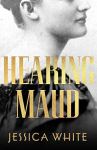
Jessica White, Hearing Maud (#BookReview)

Book coverHybrid memoir-biographies take many forms. For a start, some are weighted more to biography while others more to memoir. As I wrote in my post on Jessica White’s conversation with Inga Simpson, most of those I’ve read “have been mother-daughter stories, the biography being about the mother and the memoir, the daughter. White’s book is different. The biographical subject is Maud, the deaf daughter of the late nineteenth-early twentieth century writer Rosa Praed (1851-1935)”. However, Bill (The Australian Legend) responded in the comments that “I’m pretty sure Hearing Maud is another mother/ daughter memoir. On two levels”. In a sense he’s right.
I say “in a sense” because Maud is not White’s mother. However, two mother-daughter threads do run through the book, Maud and her author mother Rosa, and Jessica and her mother. But, unlike those more direct mother-daughter memoirs in which the daughter focuses on the mother’s story while also throwing some light on her own life, in White’s book the two mother-daughter stories work in some way as foils for each other, but, more significantly, the focus is on the two daughters’ lives. As with most memoirs – hybrid or otherwise – there is a larger intent behind Hearing Maud than simply telling the story of a life or lives. It involves exploring deafness.

As I reported in the conversation post, White talked about “coming out” as a deaf person. I wrote how “living in the country amongst a large extended family, she’d been, essentially, sheltered from fully experiencing her deafness”. This resulted in her growing up as “a hearing person” albeit a “bad” one! It wasn’t until she was in her 30s that she started to think about herself as deaf, and to understand its impact on her life, particularly in her longstanding sense of loneliness and isolation.

Before, however, you start suspecting that this is going to be another misery memoir, let me get to the book. It starts with a Prologue, in which White tells us how she lost most of her hearing around the age of four, due to meningitis (or, more accurately, the treatment for it.) She then says, and it is this idea that underpins her story:

My life came to be defined by what the ancient Greeks termed a pharmakon, that which is a poison and a cure.

She goes on to say that the way the pendulum swings, between these two, depends on the time and culture in which the deaf person lives. For Maud, deafness was “a bane”. It led to her being committed to an asylum at the age of 28 and being left there until she died 39 years later. For White, on the other hand, it led to her becoming a reader and then a writer, because these “assuaged my persistent loneliness and gave me a sense of purpose”. What White goes on to do in her book is provide a mini-history of attitudes to deafness and deaf people over the last century and a half, exploring the ways in which both personal (including family) circumstances and social attitudes and policies can deeply affect the course of a deaf person’s life. Of course, life is a lottery for all of us – we are all affected by time and place, family and culture – but for those with a disability, there are additional layers that further reduce their control over their outcomes. (Interestingly, probably because of when she was born, White doesn’t discuss the whole nomenclature issue. In the early 1980s, for example, it was not acceptable to call people “deaf”, they were “hearing impaired”.)

Now though, I want to talk a bit about the writing. Hearing Maud is White’s third book (I’ve reviewed her second, Entitlement), and it shows. It shows in the novelistic language that brings life to the story. It’s never overdone, but there are scattered images that beautifully convey her feelings, such as this comment after her first real conversation with another deaf person, when she was 32:

Once again I have the sense of something settling into place, like a bird alighting in a tree, its wings relaxing. When I say goodbye and walk back past the sandstone buildings to the bus stop by the lakes, my step is buoyant.

You can feel the emotional release, can’t you.

It also shows in the confident handling of the multiple storylines – hers, and Maud and her mother Rosa’s stories. The stories are told generally chronologically but are interwoven with each other, so we start with White’s childhood ending a little before this book is completed, and similarly we move through Maud’s life. However, there are some backwards movements when something in the life of one raises an issue in the life of another. It does require some concentration from the reader, but the segues are natural and clear. Describing her childhood, for example, White tells of the times she spent in the bush, and how “the solitude was a balm”, enabling her to daydream about the boy on whom she had a crush. This leads her directly to  Rosa Praed – “Whenever I read Rosa’s novels, I reconnect with this heady mix of romance and the bush” – and a discussion of Rosa’s focus on the bush in many of her novels. Similarly, a discussion of the importance of letter-writing to her – being an “unthreatening way … to make connections” – leads to an extended discussion of Maud’s letters, and from that to Maud’s education and the history of deaf education in Europe in the late nineteenth century. There’s a lot of information here, but it’s so well integrated into the narrative that you learn almost despite yourself!

Finally, White’s skill shows in her control of tone. This is not a dry non-fiction work, despite the amount of information it contains, but a story about real people. White’s tone balances the formal (grammatical sentences, endnotes, and so on) with the informal (first person voice, and expressions like “I imagine Maud walking to the museum”). She also conveys her passion for her subject, and sometimes her frustration and anger, but doesn’t let it flow over into diatribe. However, she’s very clear about her intention for the book, as she tells her sister:

‘I’m tired of being taken for granted. I want people to know how hard I’ve worked – and how hard most people with disabilities have to work – to get where I am. I want them to hear Maud’s voice [hearing Maud!] and to know that, although things are much better, deaf people are still expected to act like hearing people. I want them to see how difficult it still is, when it shouldn’t be…’

I hear you Jess, loud and clear!

Lisa (ANZ LitLovers) and Bill (The Australian Legend) have also reviewed this book.

AWW Challenge 2019 BadgeJessica White
Hearing Maud
Crawley: UWAP, 2019
271pp.
ISBN: 9781760800383

Sue Ingleton, Making trouble: Tongued with fire (#BookReview)

Book coverIn my recent post on Jessica White talking about her hybrid memoir-biography Hearing Maud, I commented that I’m intrigued by the ways in which biography is being rethought in contemporary literature. When I wrote that, I not only had White’s book in mind, but Sue Ingleton’s Making trouble. You can probably guess why from its sub-sub-title: “an imagined history of Harriet Elphinstone Dick and Alice C. Moon”.

“An imagined history”? And yet, it is classified on the accompanying media release as “Non-fiction (biography, history, crime)”. What does all this mean? Making trouble is about two English women, Harriet Elphinstone Dick (1852-1902) and Alice C. Moon (1855-1894), who, in 1875, left England for Australia. As the media release says, they were champion swimmers at a time when women did not swim in the sea; they refused to wear the corsets that women had been told were necessary to hold themselves up; and they were in love at a time when – well, you know the story. The problem, however, is that there is not enough documentary evidence for a traditional, formal biography. Ingleton writes in her Prologue that there were

no letters, no direct descendants both women being childless, no personal communications, only some newspaper stories, advertisements and sections of a thesis written in 1985.

In other words, their achievements are primarily documented in newspapers (“may the gods bless TROVE”, Ingleton writes): through ads for gymnasiums and physical education lessons, articles on talks and lectures, and death notices. Ingleton also had access to a master’s thesis by Lois Young titled Feminism and the physical sex sex education, physical education and dress reform in Victoria, 1880-1930).

To flesh out their lives, to give sense to these determined, influential women, Ingleton fills in the gaps using her imagination and her understanding of the history of the time. Describing herself as a “detective in time”, she had no choice, she writes, but to call this book “an imagined history” or, what is defined elsewhere, “speculative biography.” There is, in fact, a growing awareness, perhaps even acceptance, of this speculative approach to biography, but it’s tricky. At what point does such a work tip over into historical fiction?

Writing on the Australian Women’s History Network about her imaginative book The convict’s daughter, historian Keira Lindsey shares the contradictory responses she received to her requests for endorsement. One historian said she had “fearlessly carved a new path between history and fiction,” while another was “infuriated that she had gone “beyond the historian’s remit”. Clearly then, it partly depends on the reader. Some of us have more tolerance for straying from fact than others. But the writer’s approach and style also affects how readers respond.

Lindsey, for example, did not footnote, but she referenced the sources “with an index and bibliography”. She also provided “chapter notes at the end of the book for those wanting to know which portions of the book were fact and which were not”  and she explained her approach in an Afterword.

Ingleton took a different approach. She writes a Prologue and provides endnotes. I haven’t read The convict’s daughter so can’t comment on how Lindsey’s approach worked, but I did like Ingleton’s Prologue, albeit she argues that there are three components to her work – the Fact line, the Fiction line, and the Spirit world which, she says, can result in the revelation of “hidden facts” or “invisible truths”. This takes us into somewhat strange territory for a biography, speculative or otherwise, but in fact it doesn’t intrude too disconcertingly into the narrative proper.

“a barely documented history”  (Ingleton)

So, to tell the story of her two women, Ingleton interweaves more formal writing, which conveys the facts as she knows them, with a narrative style that is much closer to historical fiction. It generally works well, by which I mean you can usually tell which is fact, or draws on fact, and which is invented or imagined. While I’m happy to accept the use of imagination to fill in gaps, I did feel some of the imagined sections went a little too far into the historical romance fiction vein. I understand why, though. Ingleton is, among other things, an actor, director and stand-up comedian, and so is drawn to dramatic action. She also wanted to convey the love and romance between these two who dared to be different. How to do that in the absence of letters, was her challenge.

Now then, to the women, and why they’re worth reading about. Have you heard of them? Probably not, which is not unusual for women’s stories. Dick and Moon were, says Ingleton,

early pioneers* of physiotherapy, healthy diet, gymnastics and swimming for women and girls, biodynamic farming, journalism, breaking the barriers of women creating their own businesses and most importantly they were lesbians living together – the final bastion against the Patriarchy.

They also fearlessly advocated for sensible women’s attire, that didn’t cripple them physically and mentally. It’s an amazing story really. We follow them from England, to Australia, back to England when Moon’s father falls ill, and back to Australia. We see them build their gymnasium business in Melbourne, develop a teaching practice in schools, and establish a farm at Beaconsfield. Then we see Moon, devastatingly for Dick, cut loose and move to Sydney where she builds a career in journalism, only to die, before she’s 40, in seemingly mysterious circumstances, circumstances for which Ingleton believes she has an answer and builds a fair case.

All this is set against the backdrop of the burgeoning women’s movement in Australia – it was the time of the New Woman and the suffrage movement. Although Dick and Moon “were never deeply connected to the suffrage movement”, they did move in some of the circles mentioned by Clare Wright in her You daughters of freedom (my review), and “certainly were outspoken in the area of women’s rights over their own bodies and minds”.

Making trouble is an unusual book, but Harriet Elphinstone Dick and Alice C. Moon are two women who played a significant role in promoting women’s rights and proving, by their achievements, that women are as capable of living independently as men. They should be better known. Ingleton has done us a service in bringing them to our attention with such passion and flair.

* Not long after, another woman, Marie Bjelke Petersen (1874-1969) also pioneered physical culture for women, and was accused of dressing mannishly.

AWW Challenge 2019 BadgeSue Ingleton
Making trouble: Tongued with fire: An imagined history of Harriet Elphinstone Dick and Alice C. Moon
North Geelong: Spinifex, 2019
276pp.
ISBN: 9781925581713

(Review copy courtesy Spinifex Press)

David Brooks, The grass library (#BookReview)

Book coverOK, I’m going to show my hand here. I love animals – and hate animal cruelty – but I am not vegan. More to the point though, I am cautious about animal rights activists because they can sometimes act out the very violence and cruelty on humans that they condemn for non-human animals. I was, therefore, a little wary when I was offered for review David Brooks’ book, The grass library. However, Brooks, a poet/novelist/essayist/academic/one-time co-editor of Southerly, has enough cred that I decided to take a chance. I’m glad I did – just as I was glad to have read, three years ago, Bidda Jones and Julian Davies’ more targeted animal rights book Backlash: Australia’s conflict of values over live exports (my review).

The publisher’s letter accompanying my review copy quoted the Sydney Morning Herald’s description of Brooks as “one of Australia’s most skilled, unusual and versatile writers”. It is the combination of this writing skill, with the thoughts contained within, that makes The grass library such an engaging and provocative read.

Although there is no doubt about the author’s commitment to his cause, The grass library is not an in-your-face polemical book. Instead, it is a thoughtful work in which Brooks, now a committed vegan and animal rights advocate – advocate being, perhaps, a more appropriate word than activist – works through his practical, philosophical and ethical position. And he does so in a way that encourages us to think along, and to wonder about and question our own thoughts, practices and values.

The book is part-memoir, part-reflection. It starts with Brooks’ partner, simply called T in the book, pronouncing that she can’t eat meat anymore. “We’re turning vegetarian”, she says. A week later, that becomes vegan. And so, a big change occurs in their lives, one that takes oyster- and cheese-loving Brooks not too long, in fact, to get used to. Brooks writes, heralding the book’s real subject-matter:

But this book isn’t about veganism, or guilt. If I’d permitted myself a more eighteenth-century subtitle it might have been “An account of three years pf philosophical and un-philosophical transactions with animals in the Blue Mountains of New South Wales”, but ultimately and more simply it’s about discovery and wonder: wonder and wondering.

After a couple of false starts, Brooks and T find themselves, in 2012, living on a small farm in the Blue Mountains, with their recently adopted dog Charlie, and, soon after, two rescue sheep, Henry and Jonathan. Not long after that, a new-born lamb, Orpheus Pumpkin, joins them, and by the end of the book, ram Jason brings the number to four. These sheep and Charlie form the book’s backbone and become (or, should I say in the spirit of the book, are) characters in their own right. Other non-human animals appear too, some briefly, including cicadas, ducklings, a snake, and rats.

What I most enjoyed about this book is the calm, non-histrionic way in which Brooks introduces and ponders on a range of random-sounding but coherent-as-the-book-progresses ideas, such as “dusk anxiety” and “herd music”. “Dusk anxiety” is introduced early on through a twitching that Charlie was exhibiting at that time of day. It’s a sort of mood-change or discombobulation that some humans (and, Brooks believes, some non-human animals like Charlie) feel at that strange twilight, half-and-half time of day. Sounds valid to me. However, it also provides Brooks an opportunity to raise the issue of anthropomorphism. His argument is that anthropomorphism is not a bad thing, that in fact, it is central to empathy. The barbarity we engage in against animals is made possible, he argues, by denying this empathy, by believing “that we are so different from the creatures we live amongst that we cannot know or even hazard how they feel.” To read this book, then, you need to understand (if not accept) this fundamental world-view. Brooks may not know what the non-human animals he writes of feel, but he writes with the assumption that they do feel (and that we may know what they feel).

Another significant idea underpinning the book is that of the binary way we view animals. This idea is one of the most confronting or, at least, challenging in the book:

There are so many old, rusty binaries involved here. […]

We categorise animals, and behave towards them – accord or refuse them protection or sanctuary – depending on whether we see them as wild or tame, feral or domesticated, native or exotic, rare or common, endangered or of least concern, pet or pest, livestock or otherwise …

In most of these cases, he says, one side of the binary will be given a higher “value” (in human terms), with, often, a justification to kill the opposing side. For each animal concerned though it is his/her life!

It’s not for nothing, I think, that the next chapter talks about rats at their farm!

This discussion of binaries is part of a major thread in the book, which is language, and how it “trips” us up, how it “will restrict us, hold us back, if we don’t learn to use it with greater care and respect”. Language is all too often speciesist, he argues. Grammar – the use of “it” for a non-human animal, for example – is violent, for example, or, at least, has the potential for violence.

It’s a book, then, that makes the brain hurt – albeit in a gentle, encouraging way. However, there is beauty in the book too, such as the chapter on “herd music”. This chapter starts in his writing room, his “grass library”, and is inspired by the appearance outside his room of the two sheep when (and only when) he plays music. He ponders this. They are herd animals, but being just two rescue sheep, they have no herd and are thus deprived of, he posits, the music of the herd:

… if music it can be called (but how else to call it?): the sound of hooves shifting in the grass or tapping on stone, the occasional bleat of a lamb, response of its mother, grunt or growl or call of a ewe or a ram, the sound of snipping at grass-blades, coughs, throat-clearings, nudgings, strokings, as one sheep passes another, regurgitations, ruminant chewings, fartings, belches, sounds nearer and further off, all in all a constant, rolling concert, approximated—very distantly resembled, in a bizarre, post-something way— by the muted rhythmical under-music of whatever it is that I might be playing on the stereo system in my cabin, an aural equivalent of warmth, the ghost of companionship.

I share this because I loved this, but also because it provides some insight into the way Brooks thinks (or wonders.)

I can’t say I agree with all that Brooks writes. For example, as vegans, he and T didn’t want to feed their rescue lamb lactose-based lamb powder, so they seek non-animal products like almond milk (which doesn’t, for the record, work). But, but, I say, lambs grow on milk! And then, of course, there are those binaries. Philosophically I take his point, but practically? I need to think about this more.

The grass library, then, can be a confronting read because it challenges us to reconsider some fundamental perspectives and assumptions. However, it is not a difficult read, because not only is it generous, but it is also peppered with engaging stories about life in the mountains and the non-human animals with whom Brooks and T. live. I recommend it.

Lisa (ANZLitLovers) also enjoyed this book.

David Brooks
The grass library
[Blackheath]: Brandl & Schlesinger
221pp.
ISBN: 9780648202646

(Review copy courtesy Brandl & Schlesinger)

Lafcadio Hearn, Yuki-Onna (#Review)

I can’t believe how long it’s been since I’ve posted on a Library of America (LOA) Story of the Week. I usually “do” a few a year, but this is the first for 2019, even though I’ve identified several that I’ve wanted to do. However, when Lafcadio Hearn popped up last week – and with a Japanese story – I knew I really had to break the drought.

Image of Lafcadio Hearn's houseLafcadio Hearn (1850-1904) has appeared in this blog a couple of times before, the main time being in a Literary Road post from our 2011 trip to Japan when we visited Matsue. Hearn only lived there briefly but he met his Japanese wife there and it has a museum dedicated to him. Hearn is a fascinating man. Greek-born to a Greek mother and Irish father, he spent childhood years in Ireland before moving to the USA in 1869, where he then lived for two decades. Here he married a former slave who worked in his boardinghouse kitchen, and built his career as a journalist. In 1890 he went to Japan on a publisher’s commission. He married again, and lived out the rest of his life here, taking the name of Koizumi Yakumo. He became chair of English Language and Literature at the Tokyo Imperial University.

In their usual introduction, the Library of America quotes an article by another writer who appeared here only recently, Roger Pulvers. The article, in Japan Times, is titled “Lafcadio Hearn: ‘Japanese thru and tru'”. Pulvers provides a thoughtful, clear-eyed run-down of Hearn’s life, of his attitude to Japan, and particularly of his achievements as a writer. He says that Hearn:

was the shadow-maker, the illusionist who conjured up his own visions of Japan and gladly lost himself in them. He strove to leave Japan and return to the United States. Perhaps he realized that it was there that he had created his most accomplished work, attaining something he savored: notoriety. Again an ironical paradox emerges: He is remembered now in United States, if at all, not for his superb reportage on modern America but for his adoration of a long-gone Japan.

Pulvers says that Hearn loved “old” Japan –

He worshipped the static and wanted to see his beloved quaint Japan remain as sweet as it always was in his eye and the eyes of the world, bemoaning all progress: “What, what can come out of all this artificial fluidity!”

– but

loathed the modern Japanese male and what he stood for, and in this he recognized the futility of his task, a futility keenly felt toward the end of his years, where he heard “nothing but soldiers and the noise of bugles”.

Remember, when he died in 1904, Japan’s imperialism was at its height.

Hearn published roughly a book a year for the fourteen years he lived in Japan, but is best known for two of them, Kwaidan: Stories and studies of strange things (from which this post’s story comes) and Japan: An attempt at interpretation. Kwaidan comprises a number of ghost stories plus a non-fiction study of insects. Intriguing, eh?

Yuki-Onna, says the Library of America, means “snow woman”, and is “an ancient spirit who appears often in Japanese fiction, plays, and movies”. Hearn explains in the Introduction to Kwaidan that he’d heard this story from a farmer as a legend from his village. He says that he doesn’t know “whether it has ever been written in Japanese” but that “the extraordinary belief which it records used certainly to exist in most parts of Japan, and in many curious forms.” Wikipedia confirms in an article about this spirit that it dates back to the 14th to 16th centuries, and can be found in many Japanese prefectures including Aomori, Yamagata, Iwate, Fukushima, Niigata, Nagano, Wakayama, Ehime. If you know your Japan, you’ll know that these take us from northern Honshu down through the island and across to Shikoku.

The story is pretty simple, plot-wise, and given it’s just 4 pages long I’m not going to describe it here, except to say that it is about a vengeful snow spirit. Why she is vengeful is not made clear in Hearn’s story, but Wikipedia says that some legends believe she is the spirit of someone who perished in the snow. The legends vary over place and time, particularly in terms of how evil or aggressive she is.

I suggest you read it at the link below, as it will only take a few minutes. Meanwhile, I’m glad to have had this opportunity to remind myself of this intriguing 19th century character. Next, I’d love to read some of those American articles of his that Pulvers praises.

Lafcadio Hearn
“Yuki-Onna”
First published: Kwaidan: Stories and studies of strange things, 1904.
Available: Online at the Library of America

Ros Collins, Rosa: Memories with licence (#BookReview)

Book coverMemoirs are tricky things. There are readers who love them, readers who hate them, and readers like wishy-washy me who sit in the middle. I sit in the middle because, for a start, I don’t like to say “never” when it comes to reading. I sit in the middle because I couldn’t cope with a steady diet of memoirs, particularly those how-I-got-over-my-[whatever trauma or challenge it was], which is certainly not to say that I don’t admire those memoirists or don’t enjoy some of their fare. And, I sit in the middle because I don’t like formula, because I like books that try to tackle their subject or their form a little differently. So, the memoirs I mostly read are those which play with form or whose subject matter offers something different. Ros Collins’ memoir, Rosa: Memories with licence, does both of these.

First, the subject-matter. Rosa deals with, as the book description says, “Anglo-Australian Jews [who are] often overlooked in fiction and memoir.” Having known many Anglo-Australian Jews through my life, I was interested to read Collins’ discussion of her family’s life, as a contrast to those more directly Holocaust-influenced lives of European Jews we’ve all read about. It’s not easy being Jewish, I believe, regardless of personal or family history, so I was interested to read this story.

Then there’s the form. The subtitle, “memories with licence”, suggests that this is not going to be your usual memoir. For a start, it is told third person about a person called Rosa, which is the name given to the author Ros by “two elderly men from Southern Europe” whom she met on a recent Anzac Day Eve. She goes on to say, in her Introduction, that it is this “Rosa who wanders through the following stories, sometimes fictionally, sometimes autobiographically”, though I hazard to guess it is mostly autobiographical – just told one voice removed! Near the end of the introduction, she says that:

Rosa is much more personal [than her previous family history book, Solly’s girl] – and freely written – and I have taken liberties with the truth. Memoir with a little fiction, or fiction with a little history? It’s hard to say. Memories with licence.

The book has been classified on its back cover as Memoir. And that is how I have read it, as it reads true.

So, why tell it this way? Collins says she wishes “to entertain”. Her aim is not to delve into world history, cataclysmic events, or, even, dystopian futures. She wants, instead to shine a light on lives that may not be well known to many Australians, on Anglo-Australian Jewish lives. Taking a third person voice enables her to tell her story a little more objectively, to comment on what people, in particular Rosa, were, or may have been, thinking and feeling. Third person also enables her to get out of the main subject’s voice and head. It enables her to suggest what others might be thinking, such as Rabbi Szymanowicz:

Rabbi Szymanowicz stopped surreptitiously searching the room for younger people with whom he might more profitably connect, and looked at her. Seldom, if ever, had he met an elderly congregant quite like her; for an eighty-something-year-old Rosa did not come across as a sweetly gentle Miss Marple – more likely to be opinionated and argumentative.

This sort of statement could not be made in the same way in a traditional memoir. A traditional memoirist can not so directly get into the head of another character. A traditional memoirist can only suppose what another character might think (unless they are quoting documented facts from, say, letters). Taking this third person approach gives Collins more licence. She can, for example, “guess” about the relationship between her two grandmothers, two women who were not happy because they lost significant supports, when Rosa’s parents married.

All this could be disconcerting to some readers, but Collins has been honest from the start about what she is doing. Ultimately, the important thing is whether the book rings true and I believe it does. Rosa’s character – her humanity, her sense of her own flaws, her uncertainties, as well as her pride in her achievements – shines through.

Another way in which the book departs from traditional memoir is in its lack of linearity. While there is an overall movement from past to present, Rosa is not told chronologically. Instead, each chapter or “story” takes up a theme through which the story of English-born Rosa (Ros) and Australian-born Al (Ros’s husband Alan) is told. Chapter 4, “Jellied eels”, for example, explores food, Jewish culture, and Rosa’s navigation of it all. Collins explains how, as a child, Rosa had been told what she could and couldn’t eat, but not told why. Her mother expected her to “just accept the traditions” but of course this is not the way to hand down traditions, not, certainly, “to a difficult daughter – full of unnecessary questions”!

Collins also tackles, gently and without polemics, what Israel means (or, might mean) for Anglo-Australian Jews. For those of us who find Israel and the politics of the region highly problematic, it’s useful – though not necessarily convincing – to be reminded that in Israel, as Rosa quotes Golda Meir saying, “nobody has to get up in the morning and worry about what his neighbours think of him. Being a Jew is no problem here.”

Rosa, then, is a warm-hearted, open-minded “memoir” written by an Anglo-Australian Jewish woman for whom being Jewish, as for many I believe, is as much, if not more, about history and heritage as god and religion. In this book, Collins interrogates her family’s past, and her late husband’s story, in order to come to a better understanding of herself, and of what she would like to pass on to the next generation. This book is testament to that soul-searching, and makes good reading for anyone interested in the life-long business of forming identity, Jewish or otherwise.

AWW Challenge 2019 BadgeRos Collins
Rosa: Memories with licence
Ormond: Hybrid Publishers, 2019
ISBN: 9781925736113
186pp.

Dominic Smith, The electric hotel (#BookReview)

Book coverI admit to a brief feeling of déjà vu when I started Dominic Smith’s latest novel, The electric hotel, because it starts by telling us that its protagonist 85-year-old Claude Ballard has been living in the Knickerbocker Hotel in Los Angeles for over thirty years. Not another man living in a hotel like our gentleman in Moscow? Very quickly, though, I realised that this was a very different book. Towles was inspired by the idea of people living in hotels, while Smith was inspired by something completely different, the idea of lost films. The Library of Congress, he says, believes that over 75% of silent films have been lost forever. A figure familiar to retired film archivist me.

What’s the hotel got to do with all this? Well, apparently, the 1929-built Knickerbocker was, for much of its life, closely connected with the film industry. As Claude remembers in the novel, costume designer Irene Lentz committed suicide by jumping from the 11th floor, and silent film director DW Griffiths collapsed in the lobby. Moreover, at least one person, the character actor William Frawley, did live at the hotel for thirty years. However, Smith’s story, unlike Towles’, spends very little time in the hotel. Instead, it follows the life and career of fictional silent filmmaker Claude Ballard, focusing on his most famous film, The electric hotel, which sent him, and the production team, bankrupt, not because it was a failure but because the film inventor Thomas Edison threatened to sue for illegal use of his patented film stock. While Claude and his film are fictional, Edison was a shrewd businessman who did try to control the film industry. Smith’s research, then, looks good, and while I’m not an expert in the silent era or its technology, I felt pretty comfortable with the history – right down to the concerns about the vinegar smell in Claude’s room, although I don’t think the term “vinegar syndrome” was much used in the early 1960s.

For a (retired) film archivist like me, The electric hotel offers a step down memory lane. Indeed, the framing story is that film historian Martin, who is writing his dissertation on innovation in early American silent film, has become interested in Claude’s career. We are neatly given the shell of Claude’s career in the first chapter via his first meetings with Martin. This segues to Chapter 2 and the largest portion of the novel which takes us from the young Claude’s meeting the pioneering Lumière Brothers in the mid 1890s, through to the heyday of his career when he worked with American producer Hal Bender, French actor Sabine Montrose, and Australian stuntman Chip Spalding, and which peaked with the release of The electric hotel in 1908. They are artists, entrepreneurs, adventurers, and together they make something quite astonishing. Gradually, however, and for various reasons that I won’t spoil now, they go their separate ways. We follow them through to the end of World War 1, with a couple of forays back to the novel’s original time setting, 1962, where we also end up.

It’s an engrossing read. Smith creates vivid characters, and conveys well the excitement and energy of the early film industry pioneers – Claude’s early fin-de-siècle days in Paris, his travelling around the world with the Lumières’ cinématographe, the development of his career in New York with Hal and Chip, and the war years. It’s a complex story, with a fair share of twists and turns, about art and money, success and failure, and, yes, an artist (Claude) and his muse (Sabine).

What, though, is the book really about? Besides being inspired by the idea of lost films, I mean? Smith himself says, as quoted in the press release, that his ongoing interest is “the gaps and silences of history”.  What does he say about these gaps and silences? I’m not sure, really. I think that perhaps he’s not so interested in commenting on the gaps, as dabbling around in them and bringing them to our attention. This is what he does for silent film, anyhow, but in doing so he also explores the increasing realisation of the power of this new movie medium. Early on Claude tells Sabine that “it turns life into moving pictures”, and a little later, Sabine’s coach and devotee of naturalism, Pavel, says that Claude had “managed to trap real life”. It’s in the war, though, that film’s darker potential becomes obvious, as German soldier Bessler forces Claude to produce the perfect propaganda movie, The victor’s crown. Claude, however, manages to subvert it to his own ends, proving to Bessler’s detriment that, indeed, “the camera sees the truth”!

The book is also an ode to the drive, the obsession, to produce art – and to the price paid by those who have this drive. Claude, who never goes anywhere without his camera, keeps his most personal negatives undeveloped because “until that second they hit the chemical bath, every image is perfect in my mind”. I’m sure many creators understand this.

But the book also has a personal dimension. It’s about love and loss, about escaping, hiding, and stalling. Claude’s personal life is peppered with loss, from which he never really recovers. He tells Martin, “I had every intention of starting over. It was like an errand I meant to run for fifty years.” And, late in the novel he says:

… the past never stops banging at the doors of the present. We pack it into watered suitcases, lock it into rusting metal trunks beneath our beds, press it between yellowed pages of newsprint, but it hangs over us at night like a poisonous cloud, seeps into our shirt collars and bedclothes.

It’s good writing – expressive, but controlled, and never overdone.

The smug German Bessler tells Claude that “art is art wherever it blooms”. The electric hotel explores that in all its glorious messiness.

Dominic Smith
The electric hotel
Sydney: Allen & Unwin, 2019
349pp.
ISBN: 9781760528621

(Review copy courtesy Allen & Unwin)

Nhulunbuy Primary School, I saw we saw (#BookReview)

Book coverA week or so ago, I wrote a post to commemorate this year’s Indigenous Literacy Day. In that post I noted that the book I saw we saw was going to be launched at the Sydney Opera House that day. It was written and illustrated by students from Nhulunbuy Primary School, up on the Gove Peninsula, and a number of them were going to read and perform from the original Yolŋu Matha language version, Nha Nhunu Nhanjal?, at the launch. I ordered my own copy of the book that day.

The books – the original Yolŋu Matha version, launched at this year’s Garma Festival, and the English version – were published by the Indigenous Literacy Foundation, which describes itself as a “national book industry charity”. Their aim is to “reduce the disadvantage experienced by children in remote indigenous communities in Australia, by lifting literacy levels and instilling a lifelong love of reading”. These two books came out of their Community Literacy Project, and were produced through a series of workshops with illustrator Ann Haddon and teacher-librarian Ann James, with local Yolŋu elders helping develop the story.

So, the English-version book. It begins with a brief introduction telling us that the Yolŋu people of north-east Arnhem Land represent one of the largest indigenous groups in Australia. Their main language is Yolŋu Matha, which, it explains, has twelve sub-languages, each with its own name. It also tells us that, for most Yolngu children, English is their second (or even third or fourth) language. I saw we saw, the English language version of their book, is, by definition, written in English, but it uses words from the Dhaŋa sublanguage to name the actual “things” seen. This is a lovely, effective way of introducing indigenous language to non-indigenous people (as recommended at the Identity session of the Canberra Writers Festival). However, this approach also creates a bit of a challenge for the reader – what is being seen, and how do you pronounce it?

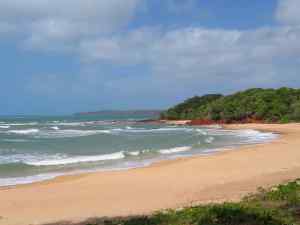
Beach, north-east Arnhem Land

Beach, north-east Arnhem Land

Well, there is quite a bit of help for us in this. First, the text and illustrations provide a lot of clues. “I see a waṯu grab a stick from a man” is accompanied by quite a busy drawing with birds, fish, turtle, jellyfish, and a person fishing, but there is also a picture of a dog with a stick in its mouth. So, waṯu is dog! Sometimes, however, it’s not so easy to get it exactly right, either because of the busy-ness of the picture or the (delightful) naiveté of the children’s drawings. You can usually guess, but can be uncertain, nonetheless. In these cases, the illustration on the last page of the story, which shows most of the creatures with their English names, provides most of the answers. Finally, there is also the online Yolŋu dictionary which, in fact, I used to obtain the necessary diacritics since, funnily enough, they are not available on my Apple keyboard!

That’s the “what is being seen” problem solved, but what about the pronunciation issue? How would you pronounce ŋurula (seagull)? Or mirinyiŋu (whale)? This one is easily solved. At the front of the book is a QR code. You hold your tablet or smart phone camera over that to be taken to a website where you can hear the story read by child-speakers of the language. The whole story only takes 3 minutes or so. Of course, being able to then say the words yourself will take some practice.

The story itself is simple, traditional picture-book style. The pages alternate between “I saw …” and “We saw …”, with each “I saw – We saw” pair forming a rhyming couplet:

I saw a maranydjalk leaping high
We saw a ŋurula soaring in the sky

It’s a delightful book. The rhymes are comfortable, not forced; the illustrations are appealing, particularly to young people; and story introduces readers to the rich natural environment of Arnhem Land region. It also conveys the pride the young authors and illustrators have in their country. It would be a wonderful book to use in primary school classrooms. It’s certainly one I look forward to reading to Grandson Gums when he’s a little older (and I’ve practised my Yolŋu Matha).

You can purchase this book directly from the Indigenous Literacy Foundation, for $24.99.

AWW Challenge 2019 BadgeNhulunbuy Primary School students, with Ann James and Ann Haddon
I saw we saw
Broadway: Indigenous Literacy Foundation, 2019
40pp.
ISBN: 9780648155492


Jocelyn Moorhouse, Unconditional love: A memoir of filmmaking and motherhood (#BookReview)

Book coverAlthough it is quite a traditional memoir, style-wise, Jocelyn Moorhouse’s Unconditional love: A memoir of filmmaking and motherhood is particularly interesting for a couple of reasons. Firstly, she’s an artist who had a happy childhood. Who knew that could happen? Secondly, while most memoirs focus on one aspect of the writer’s life – such as their career (sport, for example), their trauma (childhood abuse, perhaps), their activity (like travel) – Moorhouse intertwines two ostensibly distinct parts of her life, her filmmaking career and her life as a mother.
Jocelyn Moorhouse will be known to many filmgoers as the director of the critically successful Proof, How to make an American quilt, and The dressmaker. She is also the wife of PJ Hogan who directed Muriel’s wedding, My best friend’s wedding, and Peter Pan. This is one amazing couple. Not only have they each made critically successful films, but they are lifetime creative and life partners, working on and/or supporting each other’s movies, negotiating the logistics of parenthood, and so on. They have made it work for over 30 years, in a way that few do. That’s impressive.

It could all, then, have been pretty idyllic, but life rarely turns out that way, and for Moorhouse and Hogan it didn’t. The reason is that of Moorhouse and Hogan’s four children, the middle two are autistic. This resulted in an 18-year hiatus in her filmmaking career, although during that time she kept her hand in, mostly working in some way with PJ on his projects. The book, then, tells both stories, the development of her career from her early studies in media and drama at Rusden State College and then at the Australian Film and Television School, where she met Hogan, and her very particular and demanding life as the mother of two autistic children.

She shares the emotions of giving birth to two gorgeous children only to have them regress around two years of age, as is apparently typical with autism, into unhappy, and therefore difficult children. I say unhappy because it is clear that the children suddenly find the world confusing and frustrating. Their language and communication skills regress so they resort to screaming and crying, and other difficult behaviours. Moorhouse talks about the shock of diagnosis, the therapies they try, including the ones that work (for them), and the logistics of running a family whose life is peripatetic and dependent on the next film job coming along.

Moorhouse, the experienced storyteller (and in fact problem-solver), tells her story carefully. It’s not until halfway through the novel that she brings us to her growing uneasiness about her second daughter, Lily, and Lily’s diagnosis. It’s a tough chapter, because it was a shock to her. She realises that her discussion of causes, not to mention possible preventions and cures, could upset some readers:

I am aware that some of the readers of this book may be autistic themselves and could possibly find this chapter upsetting. Please understand that I wasn’t rejecting Lily because of her autism. If you keep reading, you will discover that I love her autism and her brother’s too. But twenty years ago I was afraid for Lily’s future …

It is tricky to write about issues like this, without offending unintentionally. It’s a long “journey”, to use current terminology, that she and her family go on. And it’s a hard one. Late in the book she says that it took her years to realise that a lot of the pain she was feeling stemmed from “an internal war between my instinct to cling to the dreams about life, and my need to accept the truth”. By the end, she and PJ learn to rebuild their dreams for Lily and Jack, and she learns to balance her need to work against the family’s needs.

This brings me to her career. I enjoyed reading about that, about her own films and the insight she gave me into a film director’s work in general. I worked with film – from an archival point of view – and met various film industry people over the years, but I still learnt much about just what a director does from this book, such as the amount of script work they (might) do, the work involved in casting, choosing location and designing sets, and so on. Each director has his/her own way of doing things, it’s clear, but I greatly enjoyed reading about Moorhouse’s experiences – the wins and losses, the need to be philosophical about those that got away or didn’t go to plan.

Style-wise, Unconditional love is a straightforward chronological memoir, told in plain language, making it an accessible read. A lovely, though not unusual thing she does, is to begin each chapter with a quote. They come from diverse sources, including filmmakers (like Ingmar Ingmar Bergman and Frederico Fellini), writers (like Virginia Woolf and Maya Angelou), people who treat or have autism (like Oliver Sacks and Temple Grandin), and artists (like Marc Chagall). The opening quote, for the introduction, comes from Margaret Atwood, saying that, “in the end, we’ll all become stories”, which seems perfect for both a memoir and a filmmaker.

This is a generous memoir, rather than a tell-all one. There’s little name-dropping, though of course names are dropped because that’s the business she and Hogan are in. There are references to relationship and financial challenges – you’d be surprised if there weren’t any – but these aren’t dwelt upon. She also seems careful to not intrude unnecessarily on her children’s rights to their own lives, particularly as they get older.

Unconditional love is a book that will appeal to readers interested in Australian filmmakers, to those interested in families with autistic members, but most to anyone interested in a story that shares the challenges of a life but focuses more on the solutions.

AWW Challenge 2019 BadgeJocelyn Moorhouse
Unconditional love: A memoir of filmmaking and motherhood
Melbourne: Text Publishing, 2019
296pp.
ISBN: 9781925773484

(Review copy courtesy Text Publishing)

Sir Walter Scott, Waverley, Vol. 1 (#BookReview)

I admit it, I’m defeated – not because I’m not enjoying it, but because it needs more attention than my distracted brain can give it right now. Consequently, I am posting on just the first volume of Sir Walter Scott’s first novel, Waverley. I read it for my Jane Austen meeting last weekend. We did Scott for two reasons: he was highly impressed by Austen’s writing, and Austen liked his!

Waverley was published in 1814, and Austen mentioned it in a letter to her niece Anna Austen that year (which was just three years before she died). She said, in her inimitable Austen way:

Walter Scott has no business to write novels, especially good ones. – It is not fair. – He has Fame & Profit enough as a Poet, and should not be taking the bread out of other people’s mouths. – I do not like him, & do not mean to like Waverley if I can help it – but fear I must… (28 September 1814)

And I must too, really, I must, notwithstanding my decision to not continue!

And Walter Scott is worth liking, because he liked Austen! Here are three references he made to Austen in his journal a decade after she died:

Also read again, and for the third time at least, Miss Austen’s very finely written novel of _Pride and Prejudice_. That young lady had a talent for describing the involvements and feelings and characters of ordinary life, which is to me the most wonderful I ever met with. The Big Bow-wow strain I can do myself like any now going; but the exquisite touch, which renders ordinary commonplace things and characters interesting, from the truth of the description and the sentiment, is denied to me. What a pity such a gifted creature died so early! Journal, 14/3/1826)

AND

The women do this better – Edgeworth, [Susan] Ferrier, Austen have all had their portraits of real society, far superior to anything man, vain man, has produced of the like nature. (28/3/826)

AND

Wrote five pages of the _Tales_. Walked from Huntly Burn, having gone in the carriage. Smoked my cigar with Lockhart after dinner, and then whiled away the evening over one of Miss Austen’s novels. There is a truth of painting in her writings which always delights me. They do not, it is true, get above the middle classes of society, but there she is inimitable. (Journal, 18/9/1827)

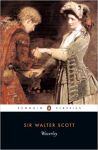
Waverley

Waverley book cover

Waverley is regarded as the first work of historical fiction. Its subtitle, “Or, Sixty years since”, tells us its historical setting, which is, specifically, the Jacobite uprising of 1745. The plot concerns Edward Waverley, an idealistic, impractical young man who joins the army, and is sent to the Scottish Highlands. He meets passionate Scottish patriots, Fergus and his sister Flora, who support Prince Charles Edward Stuart (aka Bonnie Prince Charlie), and is attracted to their cause. Not a wise move! Initially published anonymously, Waverley was a big success, marking, says Penguin’s blurb, “the start of his extraordinary literary success”.

So, why do I like it, and yet am not planning to finish it? I like it for its humour and Austen-like observations on human nature. I like the way the novel starts with Scott, as first person narrator, explaining why he chose his character Waverley’s name (“an uncontaminated name, bearing with its sound little of good or evil, excepting what the reader shall be hereafter pleased to affix to it”), and clarifying what sort of novel he was writing. He lists various possibilities – including Gothic, Romance, Sentimental – and then concludes:

By fixing then the date of my story Sixty Years before this present 1st November, 1805, I would have my readers understand that they will meet in the following pages neither a romance of chivalry, nor a tale of modern manners; that my hero will neither have iron on  his shoulders, as of yore, nor on the heels of his boots, as is the present fashion of Bond Street; and that my damsels will neither be clothed “in purple and in pall,” like the Lady Alice of an old ballad, nor reduced to the primitive nakedness of a modern fashionable at a route. From this my choice of an æra the understanding critic may farther presage, that the object of my tale is more a description of men than manners.

Examples of his Austen-like observations, include:

Where we are not at ease, we cannot be happy; and therefore it is not surprising, that Edward Waverley supposed that he disliked and was unfitted for society, merely because he had not yet acquired the habit of living in it with ease and comfort, and of reciprocally giving and receiving pleasure; (Ch. 4)

AND

There is no better antidote against entertaining too high an opinion of others, than having an excellent one of ourselves at the very same time. (Ch. 5)

There are many satirical or humorous comments made in this first volume, such this to the modern “soft” education methods:

I am aware I may be here reminded of the necessity of rendering instruction agreeable to youth, and of Tasso’s infusion of honey into the medicine prepared for a child;

Unfortunately, this method, he argues, did not serve our young hero well:

With a desire of amusement therefore, which better discipline might soon have converted into a thirst for knowledge, young Waverley drove through the sea of books, like a vessel without a pilot or a rudder.

Don’t you love that image, “like a vessel without a rudder”? Anyhow, he then elaborates on the ills of unstructured, uncritical reading.

Later, he describes Waverley’s arrival in the Highlands:

Three or four village girls, returning from the well or brook with pitchers and pails upon their heads, formed more pleasing objects, and with their thin short-gowns and single petticoats, bare arms, legs, and feet, uncovered heads and braided hair, somewhat resembled Italian forms of landscape. Nor could a lover of the picturesque have challenged either the elegance of their costume, or the symmetry of their shape, although, to say the truth, a mere Englishman, in search of the comfortable, a word peculiar to his native tongue, might have wished the clothes less scanty, the feet and legs somewhat protected from the weather, the head and complexion shrouded from the sun, or perhaps might even have thought the whole person and dress considerably improved by a plentiful application of spring water, with a quantum sufficit of soap. The whole scene was depressing, for it argued, at the first glance, at least a stagnation of industry, and perhaps of intellect.

This paragraph has so much in it: the cheeky reference to the mania for “the picturesque“, the “dig” at the English (and their preference for comfort, and, by implication, for “niceness”), and the social commentary regarding the poverty of the peasants.

Now, I know some people don’t like authors who talk to you. I understand it destroys their engagement – the fantasy that what they are reading is “real” – but I don’t feel that way. It could be argued, I think, that this style particularly suits historical fiction because it can remind us that this is someone telling us a story and that we need to think about what we are being told? Anyhow, I did start Volume 2, which opens:

Shall this be a short or a long chapter?—This is a question in which you, gentle reader, have no vote, however much you may be interested in the consequences; just as probably you may (like myself) have nothing to do with the imposing a new tax, excepting the trifling circumstance of being obliged to pay it.

Haha, eh?

However, the book is slow reading. There are so many long descriptions, and, in my Kindle version, the frequently appearing blue-links to footnotes kept distracting my eye, regardless of whether I decided to click on them or not! I just can’t love it enough, right now, to finish it.

So, I’ll leave you with Penguin’s praise that “with its vivid depiction of the wild Highland landscapes and patriotic clansmen, Waverley is a brilliant evocation of the old Scotland – a world Scott believed was swiftly disappearing in the face of a new, modern era.” Scott’s heart was in the right place. He treated his oppressed characters (peasants, for example) with respect, and he recognised that defeat was often accompanied by loss of culture. He is worth reading!

Sir Walter Scott
Waverley, Vol. 1
Penguin Classics, 2004 (Orig. pub. 1814)
388pp.
ASIN: B002RI9IQU
ISBN: 978-0140430714