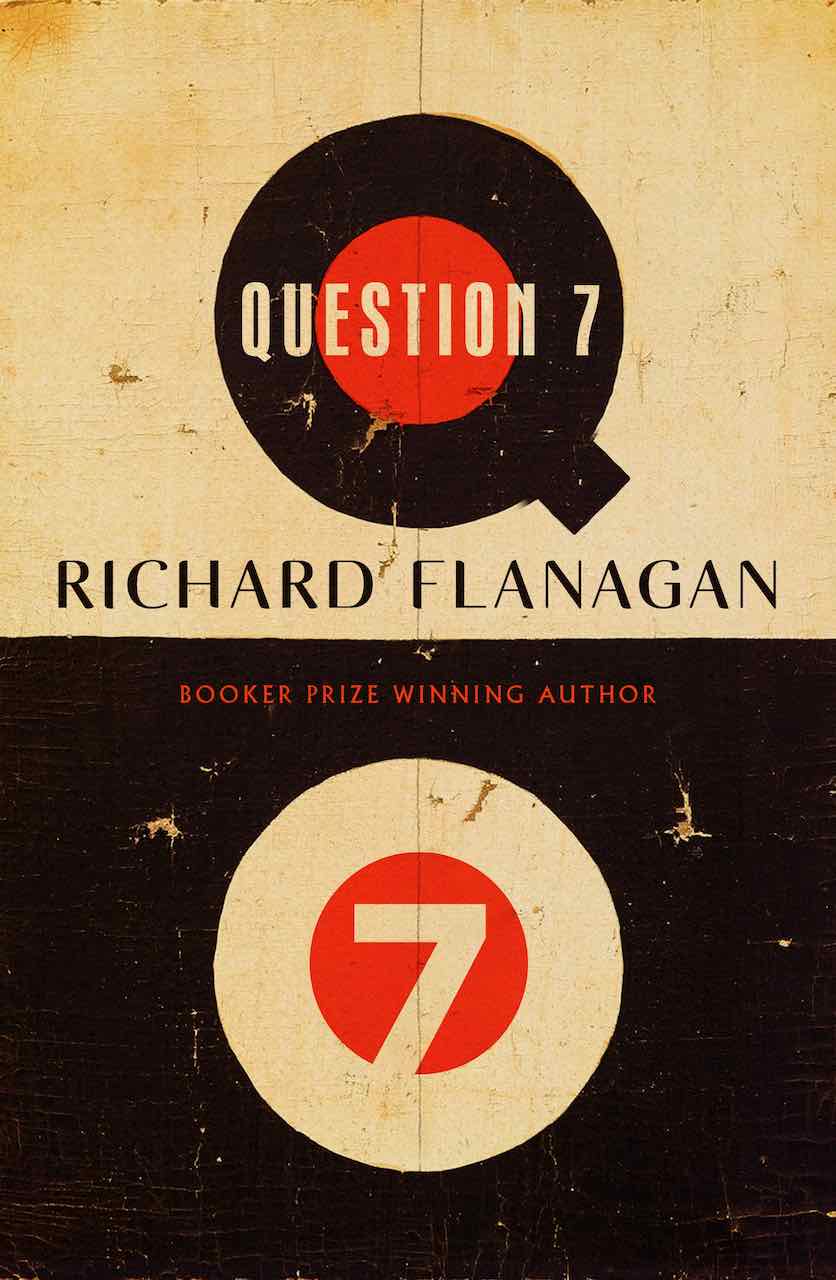
Question 7 is the fifth book by Richard Flanagan that my reading group has done, making him our most read author. That surprised me a little, but he has produced an impressive body of work that is hard to ignore – and, clearly, we haven’t.
We always start our meetings with sharing our first impressions. For this book they ranged from those who were somewhat bemused because of its disjointed nature to those who loved it, one calling it “extraordinary”. My first impression was that it’s a book full of paradoxes, and that these started with my experience of reading it. By this I meant that it was both easy and hard to read, easy because it was so engrossing and moving I was compelled on, but hard because the paradoxical nature of the ideas being explored kept pulling me up to ponder what he meant. What I didn’t add, because I feared overstaying my “first impressions” time, was that Question 7 felt like a humane book, a book about who we are and how we are, about what we do to each other and why.
“The words of a book are never the book, the soul of it is everything”
I can see how Question 7 can feel a bit disjointed – an effect of its stream of consciousness style – but there is a clear structure underpinning it, one provided by three interwoven threads. The first comprises the Hiroshima story, the role of Wells’ novel The world set free, in which he imagined “a new weapon of hitherto unimaginable power”, and the scientist Szilard. Flanagan uses novelistic techniques to link Wells, his lovers, Rebecca West and Little e (aka Elizabeth von Arnim), and Szilard, whose reading of Wells’ novel set him thinking about an atom bomb, and conceiving the idea of a “nuclear chain reaction”. The idea of a chain reaction becomes one of the novel’s connecting motifs or metaphors. One things leads to another, and, as Szilard was to find out to his horror, once started chain reactions are very hard to stop.
The second concerns the colonisation of Tasmania and, bringing in Wells again, his statement that his novel, The war of the worlds, was inspired by the cataclysmic effect of European colonisation on Aboriginal Tasmanians. Wells’ invading Martians become the novel’s second metaphor, Flanagan equating them with the colonising British. In a neat additional link, we learn that Szilard and some of his Hungarian Jewish scientist peers called themselves the Martians.
The third thread encompasses the story of Flanagan’s Tasmanian-based family, particularly his father’s life and his own. The way these threads, and their linking metaphors, coalesce to explore and expose life’s unanswerable questions makes for involving reading, as Brona and Lisa also found.
And yet, there’s more… There is another less visible connecting thread which provides the novel’s backbone and guide to meaning. It comes from Flanagan’s understanding of an essay by a young Yolnju woman, Siena Stubs, in which she discusses “a fourth tense” in Yolnju thinking. As I understand it, this encompasses the idea – in my words – that all time can coexist. For the Yolnju, for example, this means the ancestors were here, are here, will be here. Flanagan uses this concept as a refrain throughout his book, but in different contexts so that we can see its relevance. Thinking about his near-death experience on the Franklin, for example, he writes that “though it happened then it’s still happening now and won’t ever stop happening”. Or, to universalise it, “life is always happening and has happened and will happen” (p. 99).
A little later on, reflecting on the Hiroshima atrocity, he says:
what if vengeance and atonement both are simply the lie that time can be reversed, and thereby some equality, some equilibrium, some justice had? Is it simply truer to say Hiroshima happened, Hiroshima is still happening, and Hiroshima will always happen? (p. 140)
Further on again, he delves into the horrors of Tasmania’s colonial past and uses the refrain, “we were, we are, we will” to encompass not only the continuation of First Nations culture but the fallout from “the System” that the Martians had created. He concludes this section with another of his paradoxes:
And thereafter it was we who bore the inescapable, ineradicable shame that was not ours and which would always be ours. (p. 230)
Question 7, then, explores some of the toughest imponderables of our existence. It reminds us that once something happens, it doesn’t go away, but is part of the past, present and future, is part of the fabric of our being.
And so, we get to a related idea of memory, which also recurs throughout the novel. Writing about his childhood in Rosebery, Flanagan eschews checking some facts, saying,
This is an account of memory, not fact, and facts are not how we know ourselves, while memory – its tricks, its invasions, its silences, its inventions, its inevitable questions – is who we become as we shuffle around in a circle …. (p. 151)
There’s that circle – or non-linear time – again, because, in Flanagan’s mind “only fools have answers”. It is far better to keep questioning. This might be the appropriate place to share Flanagan’s two perfect epigraphs, as they provide a guide to how to read this book:
The author has not given his effort here the benefit of knowing whether it is history, autobiography, gazetteer, tragedy, romance, almanac, melodrama, or fantasy. It maybe myriad, it may not. The question is put, but where is the answer?
– Hobart Town Mercury reviewing Moby Dick 1851
and
No, this is not piano. This is dreaming.
– Duke Ellington.
It might also be the time to share book’s framing question, which comes from a short story by Chekhov, “Question posed by a mad mathematician”, in which he parodies a school test problem:
Wednesday, June 17, 1881, a train had to leave station A at 3am in order to reach station B at 11pm; just as the train was about to depart, however, an order came that the train had to reach station B by 7pm. Who loves longer, a man or a woman?
Ha! This unanswerable non-sequitur of a question, “who loves longer, a man or a woman”, is another of the novel’s framing motifs, alongside the (almost) throwaway line he uses at the end of particularly tragic or egregious situations, “that’s life”.
So, where does this all leave us, the reader? With a challenge, I think, to reckon with our personal histories and the wider histories we are part of – and to do so with a sceptical attitude to logic and rationality, because “the world from which we presume to derive meaning and purpose is not the true world. It is a surface world … beneath which an entirely different world surges.”
Near the end of the book, Flanagan shares some of the rather bizarre responses he received to his first novel, Death of a river guide, and writes,
After that I knew that the truth wasn’t the truth even when it was.
Here, then, another paradox, one that quietly snuck up on me but that embodies the book. Truths, of one sort or another, come thick and fast as you read, but always there are questions. We cannot, in other words, measure Hiroshima or the impact of colonialism. We cannot pretend
… there is some moral calculus to death. There is no equation of horrors … Who do we remember and who do we forget?
Ultimately, as Flanagan wrote part way through his book, the words are not the book, its soul is everything. In Question 7, we see into Flanagan’s soul and, inevitably, have a light shone on our own. Where to from here?
Richard Flanagan
Question 7
Knopf, 2023
280pp
ISBN: 9781761343452


 Whispering Gums