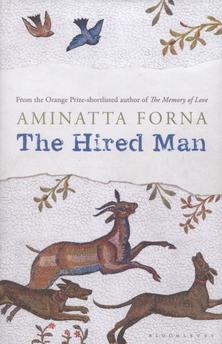
Aminatta Forna, The hired man (Review)

Aminatta Forna, The hired manEarly in Aminatta Forna’s The hired man, the narrator Duro is told by his old, ex-best friend Krešimir, “People have moved on, Duro. Maybe you should too”. At this point we are not sure exactly what they have moved on from but we guess it might have something to do with war – and as the story progresses we discover we are right.

The hired man is Forna’s third novel, but my first to read. All of them, together with her memoir The devil that danced on water, deal with the prelude and aftermath of war. In The hired man it’s the Croatian War of Independence which occurred in the early 1990s. Forna, though, never names the war, and while there is some description of war-time action, she doesn’t provide any real historic details about who, what or where.

The novel is set in the fictional town of Gost, and commences in 2007 with Duro, our first person narrator, telling us that “at the time of writing I am forty-six years old”. Later we realise he is writing for a future reader, after he dies. He writes

… I have to tell this story and I must tell it to somebody, so it may as well be you, come to sort through my belongings.

The trapdoor is opened …

So, what is the story he has to tell – and why is he suddenly compelled to tell it now? Well, towards the end of the novel he says this:

Laura arrived in Gost and opened a trapdoor. Beneath the trapdoor was an infinite tunnel and that tunnel led to the past.

You don’t know who Laura is, though, do you, so it’s time I introduced the plot. The novel spans Duro’s life from his childhood to his mid-forties. He tells of his family, and his boyhood friends, particularly the aforementioned Krešimir and his younger sister Anka, with whom Duro fell in love. He tells how his relationship with Krešimir crumbled as Krešimir’s true, cruel, nature became apparent, and why he left Gost for a few years, returning just before the war started. And he tells us about the “chaos” that ensued during the war, “when men turned to hunting each other”. I don’t want to give too much away here, but let’s just say that by the time the war starts his relationship with Anka had moved, necessarily, from that of lover to good friend.

We jump then sixteen years to 2007 – when Duro is living alone and friendless – though the novel is not told in this linear way. It’s told more organically as the changes resulting from the opening of the “trapdoor” stimulate memories and bring the past back to Duro. This trapdoor is opened because Krešimir sells the “blue” house, the home he’d shared with Anka and their parents, to Laura and her husband who plan to renovate it, sell it, and move on. Duro, we discover, is a handyman, and he becomes Laura’s “hired man” for this renovation, and in the process becomes the family’s friend.

There is an underlying theme here of the British moving into Europe, oblivious of history and inherent dangers:

The way the English saw it, the past was always better. But in this country our love of the past is a great deal less, unless it is a very distant past indeed, the kind nobody alive can remember, a past transformed into a song or a poem. We tolerate the present, but what we love is the future, which is about as far away from the past as it is possible to be.

These English do not understand, for example, that the “fields that used to be ploughed … are now full of wild flowers because nobody dares to walk in them in case they put their foot on a mine and are blown to pieces.”

“I imagine myself with the body of a bird, a raven. Outstretched wings and neck, rigid beak and shining eye, I swoop over the ravine and hover over the town.”

So, here is Duro, standing “guard over the past” like a predatory bird. And here is Laura, reminding him of Anka who, though we don’t know why, is no longer in Gost. And here is “the chill of unfinished business”. The stage is set … but here I’ll leave the plot.

What is beautiful about this novel is that, despite its depiction of brutality and betrayal, and despite a sense of menace, it is restrained – and it’s restrained because Forna’s focus is not violence and revenge, though there are elements of these in the novel. Her interest is how people live with each other after war, and particularly after Civil War when traitors, collaborators, opportunists and victims, depending  on your point of view of course, must all live together. The novel made me think of Olivera Simić’s Surviving peace which I reviewed last year. It’s a memoir, and Simić does not still live in her Serbian home, but she makes very clear that surviving a war, particularly ethnically-driven civil war, is just the beginning.

What is also beautiful about this novel is Forna’s writing – her use of imagery, symbolism, irony and parallels to convey her meaning. Birds and colours have multiple connotations, some positive, natural, others menacing. The “ravine” on the edge of town bears witness to beauty and horror. Hunting suggests violence and predation, but is also a source of sustenance and defence. The title, itself, “the hired man”, has both benign and malignant meaning …

As does the idea of masculinity, “with its undercurrent of aggression”. For Duro, it encompasses loyalty, protectiveness, and reliability alongside strength and control, while for men like Krešimir and Fabjan, the town bully, it means power and competitiveness, and is attended by a sense of menace.

Nothing, in other words, is simple in Forna’s world, and the language conveys this subtly but emphatically.

‘Well this is one of the most beautiful places I’ve ever been. You don’t notice it any more, but you don’t know how lucky you are.’

Laura, new to the town, is oblivious to the irony of her utterance, and so are we as the novel starts – but, we soon learn differently. It is not a pretty town but by the end some rapprochement, uneasy though it still may be, has been achieved. This is a moving but realistic book about just how difficult it is to survive peace.

Aminatta Forna
The hired man
London: Bloomsbury Publishing, 2013
ISBN (Kindle ed): 9781408818770

Biff Ward, In my mother’s hands (Review)

Biff Ward In my mother's hands

Courtesy Allen & Unwin

“Profoundly moving”, “a kind book”, and “harrowing” could be blurb words for Biff Ward’s memoir, In my mother’s hands, but they’re not. They are some of the words used by members of my reading group when we discussed the book this week with – lucky us – the author in attendance.

It’s quite coincidental that I happened to be reading this book right when Annabel Smith asked me to name my favourite memoir for her Friday Faves, which resulted in my follow-up post on memoirs this Monday. However, I’m glad it happened this way, because it’s given me an excuse to continue the discussion a little more. There’s so much to say about Ward’s book, but for this post I’m going to explore just two aspects: the reading experience, and its literary qualities.

On reading In my mother’s hands

So, let’s start with the story. Biff Ward is the daughter of one of Australia’s most influential historians of the mid-twentieth century, Russel Ward. At our meeting, she told us that people expected her to write his biography, but, she said, that was never her interest. Instead, she found herself writing about her mother. In doing this, though, she did in fact write about her father – but in a memoir, not a biography, because this book is about her experience of living in a family with an increasingly delusional, paranoid mother. What that experience was like – and how she eventually unravels the full story – makes compelling reading.

But, there’s more to reading this book than the story, strong as it is. There is how Ward tells it. She evokes the times beautifully – particularly the 1950s and 1960s – showing, in particular, the devastating result of the lack of understanding or awareness of mental illness. And she does this while inhabiting the child she was at the time, that is, she manages to tell those years from her child’s eye view, interspersing this voice with her experienced adult one. Take, for example, her description of when, as a teenager, she’s home when her mother is visited by “top girl” or “the queen bee of the university wives”. Ward believed this visit showed her mother was being talked about publicly, and she felt “shame and embarrassment” as “Top Girl bustled down the hall and out the front door”. That word “bustled” perfectly captures the idea of a “busybody”. Later, though, she sees it differently:

Now I can see that the network of women, connected through the university where their husbands worked, might have cared about my mother. Or might have wanted to care but were not sure how to go about it.

Also contributing to my reading enjoyment was how seamlessly Ward incorporated her research into the story to substantiate her feelings and ideas. She quotes from letters her father wrote to his parents and sister. (How wonderful that these were kept, says this librarian-archivist!) She talks of speaking to friends and family members later about their memories. She shares her research into official records. She refers to her father’s autobiography. And so on. None of this is tedious, but is woven naturally, logically, into the narrative.

Then there’s Ward’s honesty in confronting difficult truths, and her ability and willingness to reflect on her experiences and comprehend their meaning or implications. Here she is, for example, on her response to her father’s overwhelming (and surely unreasonable) request for her to look after her mother for a year:

I didn’t know that somewhere inside me was a plan. My motivation was buried way too deep for me to connect that first touch of an erect penis with the request Dad had made of me.

You can probably guess the outcome.

It would be easy to read this book with anger – to be angry particularly with Russel Ward for his failings – but that would, I think, miss the point. Ward is not angry – and indeed her father did a lot right too. Her tone is more one of sadness, than of anger. She appreciates the culture of the times and she knows that people are flawed. I loved this – the generosity with which she relates what was clearly a traumatic upbringing.

What makes a memoir literary?

This might sound like a snooty question, but literary non-fiction is a recognised genre, and memoirs are making literary award lists. So, what makes one memoir stand out over another in terms of literary qualities? Critic Barbara Lounsberry captures my perspective: “Verifiable subject matter and exhaustive research guarantee the nonfiction side of literary nonfiction; the narrative form and structure disclose the writer’s artistry; and finally, its polished language reveals that the goal all along has been literature.” (from Wikipedia)

So, narrative form, structure and “polished” language. While I wouldn’t call In my mother’s hands particularly innovative or challenging in terms of style and technique, I would call it skilled and polished. Ward’s use of her child’s voice interspersed with her more reflective adult one effectively draws the reader in. Her use of foreshadowing – such as “I missed seeing that I had been provided with a rehearsal of what was to come” and “It’s hard, looking back, to pick the precise moment when a turning point arrives, when your life is about to change” – picks up on a structural device common in fiction. (It also neatly demonstrates the memoirist’s ability to think back).

The jewel in the crown, though, is her language. Ward’s writing is generally direct and to the point, but she has a great eye for metaphor and produces some gorgeous images that can encompass multiple ideas. I loved this description of her mother’s increasing (often self-imposed) alienation within the family:

Even when there weren’t visitors, we hardly spoke to her. As her delusions grew, as she had almost no everyday conversation, we cut off from her, twig by twig. Our family tree grew its gnarled limbs around us and through us, in the imperceptible way trees do, so that we didn’t notice how weirdly shaped we all were.

This obviously distorts the traditional family tree motif but also, I think, subtly suggests the tree of (non) life?

And then there’s the title itself. In my mother’s hands references so many ideas – the fact that children are (rather defencelessly) in their parents’ hands; the idea that as a nurse her mother had had caring, nurturing hands; her mother’s grotesque habit of gouging and hurting her hands (invoking Lady Macbeth, and the mystery at the heart of the book); and her mother’s terrifying attempt to strangle Ward in her bed when she was 12 years old. Literal, symbolic, metaphoric. They’re all there in those four words.

The chapter titles are similarly evocative, usually brief and apt, such as Brittle, Knife, The Cobweb, Running. Language is, in fact, a significant issue in the book because in those awful days when mental illness was not understood, Ward, her father and younger brother had no language to explain to each other, let alone to outsiders, what they were experiencing. Sometimes Ward would lie, she said, because “when there are not adequate words, fiction will suffice”; other times they would use “shorthand” to obscure the reality.

I could write more about the language in this book, because I found it perfectly tuned to the story and to conveying the feelings within, but I’ll leave it here.

At the end of our meeting, I mentioned to Ward her longlisting for the Stella Prize. She smiled a little wryly, and said, in relation to missing out on the shortlist, that she felt in good company being “rejected with Helen Garner and Sonya Hartnett”! She sure is – and on the basis of this book, I’d say she well deserves being mentioned in the same breath as those writers.

awwchallenge2015Biff Ward
In my mother’s hands
Sydney: Allen & Unwin, 2014
268pp.
ISBN: 9781743319116

Jane Austen, Emma Vol 1 (Review, or perhaps just thoughts)

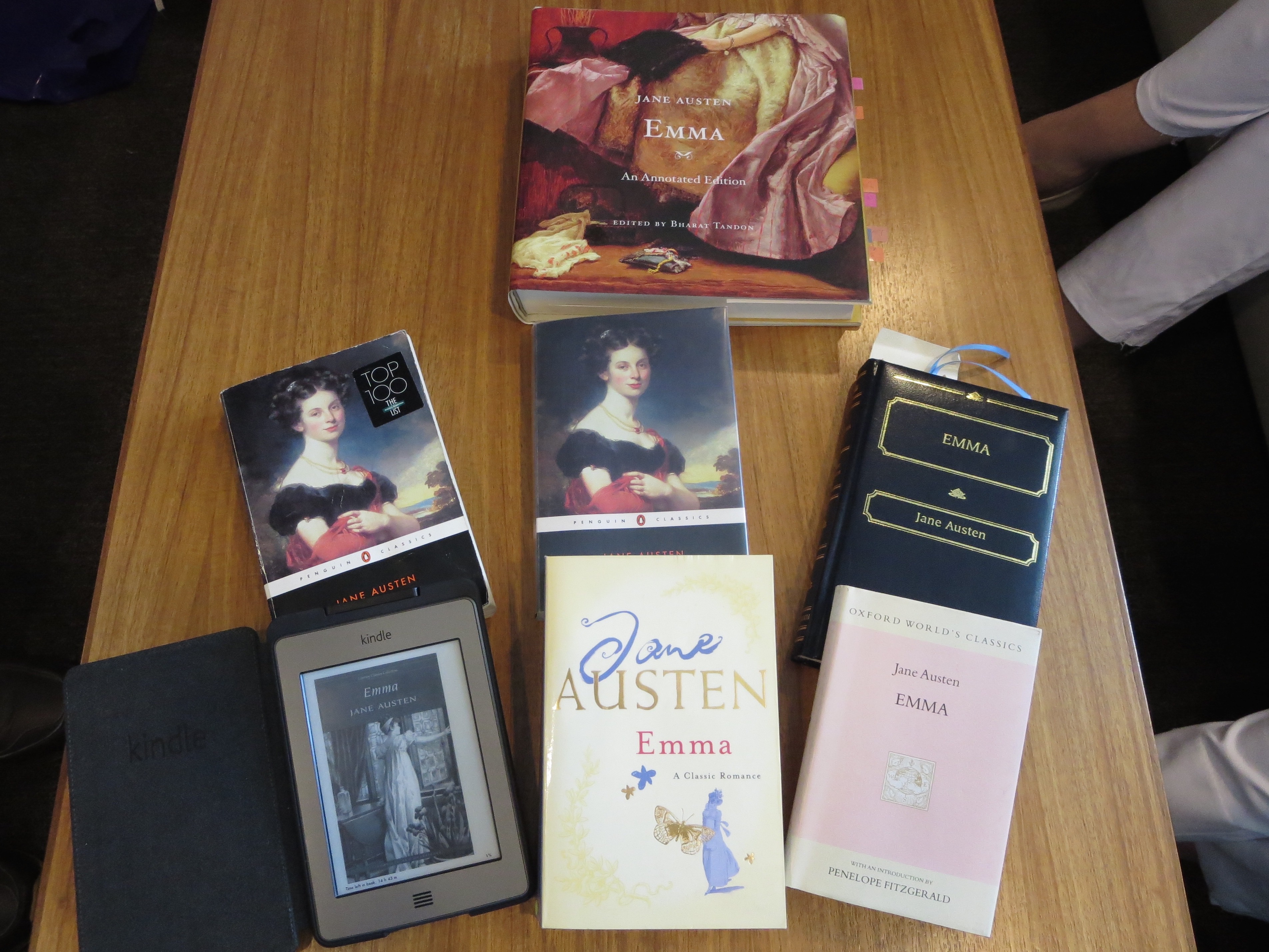
EmmaCovers

Every now and then my local Jane Austen group does a slow read of one of Austen’s novels. With 2015 being the 200th anniversary of the publication of Emma, we decided it was the logical choice for our next slow read. I love this activity because what happens when I re-read an Austen novel – particularly when I take part in a slow read – is that I “see” something new in the novel, something new to me that is, because it’s hard to think that anyone could come up with something totally new about Austen.

So, last time I re-read Emma, the thing that stood out for me was how beautifully plotted it is. There isn’t a word or action that doesn’t imply or lead to something telling, even if we don’t know it at the time. This read, with the plotting firmly in my brain, I’m finding that the aspect is flying a little under the radar. Instead, I’m noticing how often the word “friend” or notion of “friendship” is appearing. The novel, in fact, starts with Emma losing her ex-governess-then-companion Miss Taylor to marriage. They’ll remain friends but … so Emma, alone in a big house with her fussy, demanding, albeit gentle father, develops a friendship with Harriet, “the natural daughter of Somebody … [who] had no visible friends but what had been acquired at Highbury”.

This, though, is not the only friendship involving Emma to appear in Volume 1. Mr John Knightley, Emma’s brother-in-law, advises Emma “as a friend” that Mr Elton’s attentions are more than friendly, but Emma believes that she and Mr Elton “are very good friends, and nothing more”. Emma and her long-standing friend and neighbour, Mr Knightley, decide to “be friends again” after one of their quarrels. Meanwhile, we, like Mr Knightley, wonder whether Emma’s friendship is helpful to Harriet or not.

In the third paragraph of the novel, Austen suggests what she sees friendship to entail:

Sixteen years had Miss Taylor been in Mr. Woodhouse’s family, less as a governess than as a friend, very fond of both daughters, but particularly of Emma.  Between them it was more the intimacy of sisters.  Even before Miss Taylor had ceased to hold the nominal office of governess, the mildness of her temper had hardly allowed her to impose any restraint; and the shadow of authority being now long passed away, they had been living together as friend and friend, very mutually attached, and Emma doing just what she liked; esteeming Miss Taylor’s judgment, but directed chiefly by her own.

I’m talking about the words “and Emma doing just what she liked”. Miss Taylor/Mrs Weston, as Mr Knightley says to her later, had been a good companion to Emma but had also been better at submitting her will to Emma than in giving Emma the “complete education” he thinks she needed. Mr Knightley’s view of friendship encompasses providing honest, wise advice. He’s therefore severely angry with Emma when she encourages Harriet not to accept Robert Martin’s proposal:

 You have been no friend to Harriet Smith, Emma.

There are other friendships in the novel that don’t directly involve Emma, some with and between neighbours, and some within families. Her father, Mr Woodhouse, may be “no companion” for Emma, but we learn in Chapter 3 that he “liked very much to have his friends come and see him”. One of those visiting friends is Miss Bates who feels fortunate to be “surrounded with blessings in such an excellent mother and so many good neighbours and friends”. And one of these “good neighbours and friends” is Mr Knightley who supplies the low-income Bates’ women with apples and other produce from his estate. Emma’s friend Harriet, herself, has friends who invite her to visit, the Martin family who manage a farm on Mr Knightley’s estate. See what’s happening? An intricate set-up of all sorts of friendships. Austen must be on about something.

Emma more than any of Austen’s six novels paints a fairly in-depth picture of a diverse community. There are the Westons, Mrs and Miss Bates, and their niece Jane Fairfax, Mr Knightley and his estate, Mr Elton the minister and his wife, Mrs Goddard and other members of her school, the new-money Coles, and various other members of the community who appear briefly, including the poor and gypsies. This is a more complete “Country Village” than we find in the other novels, even though her focus here is still her favourite, that is, “3 or 4 families” (Letter to her niece, Anna, 9 September 1814). It’s not surprising, then, that with such a wide and diverse group that friendship would feature more significantly. I look forward to watching and thinking about how she develops this concept over the next two volumes. Watch this space …

Fiona McFarlane, The night guest (Review)

McFarlaneNightGuestPenguinThose of you who followed the literary award season in Australia last year will have seen Fiona McFarlane’s debut novel The night guest pop up several times. The more it popped up, the more I wanted to read it – but also the more I thought it would be good to read with my reading group. So, I bought it, and held onto it until this year, as we did, in fact, schedule it for our end of February meeting.

The first thing to say about this book is that it’s an easy, quick read, a page-turner in fact. But, it is not a simple read. It’s a read that keeps you guessing right to the end, even though you are pretty sure you know what is going on. It’s about Ruth. She’s in her mid-seventies, and recently widowed. She lives in the family’s old holiday house to which she and her husband had retired a few years previously. And, she’s “reached the stage where her sons worried about her”.

Then, along comes Frida, from the government she says, to be Ruth’s carer, because Ruth, as we’d suspected, has dementia, albeit in early stages. She is, she feels, “still self-governing”. Apparently, both of McFarlane’s grandmothers had dementia which helps explain why McFarlane has been able to present Ruth’s state of mind so convincingly. I say “helps explain” because there’s clearly a perceptive and skilled writer at work here too. It’s one thing to experience family members with dementia, but it’s quite another to be able to present it with such authority and authenticity.

How does McFarlane do this? The most important decision a writer has to make I think – and I’ve certainly heard many say this – is the voice. For this book, McFarlane chose third person subjective, that is, it is told third person but almost completely from Ruth’s perspective. A good decision, because we can feel Ruth’s uncertainty as she slides between confidence and uncertainty, between independence and neediness, between reality and a strange world that doesn’t always make sense. Because it’s from her point of view – and not an omniscient author’s – we are kept on our toes, not always sure, as Ruth is not, of where she is on any of those spectrums at any given time. Sometimes it’s patently obvious, but other times it’s not so clear.

Ruth has a few guests during the course of the book – including Frida (of course) and a man called Richard Porter. But there is another one, a tiger! The tiger appears in the opening sentence of the novel:

Ruth woke at four in the morning and her blurry brain said, ‘Tiger’.

She was of course dreaming, except that now she’s awake, she starts to hear noises, “something large … rubbing” against her furniture, and “the panting of a large animal”. These noises are too big to be coming from her cats. The tiger is ongoing “character” in the novel. More on this anon.

The second guest to arrive is the aforementioned Frida. She appears out of the blue one day – “You don’t know me from Adam” she says – to start caring for Frida. The question though is, is she “out of the blue” or is it that Ruth didn’t remember that someone was coming. Questions like this recur throughout the novel, keeping us in a sort of readerly vertigo. One minute we believe we know, and the next we are uncertain again. By the half-way point, though, I suspect most readers are pretty confident of what’s really going on, but even then there are uncertainties about how it will actually play out. All this makes the book an engrossing challenge.

Then there’s the third guest, Richard Porter, who was her first, and unrequited love, when she was a young woman living in Fiji with her missionary parents. Ruth invites him for a visit, hoping that “things could still happen to her”.

It’s hard to know how to write more about the book though because this is one of those stories in which the plot and the meaning are intertwined. However, I can say that it’s broadly about ageing, grief, love and loss. It’s also about trust, honesty and the responsibilities we have for each other.

The tiger

The tiger, as I’ve already indicated, appears on the first page. He’s a complex figure, alluding partly, I’m sure, to Blake’s “The Tyger”. But, and here perhaps I’m drawing a longer bow, he also reminded me of the tiger (aka Richard Parker, which is very close to Richard Porter, but that might be a bridge too far!) in Yann Martel’s Life of Pi. Both tigers reflect a duality: they are both fearsome (and perhaps representative of evil, though I like to avoid that word), but both can also be seen positively. Blake’s tiger was made by the God who also made the lamb, and so by extension can be seen to encompass both forces. Martel’s tiger needs to be kept at bay, but his very presence also gives Pi the strength and focus he needs to survive.

So, too, in The night guest does the tiger play a complex role. He appears when Ruth is at her most uncertain, most fearful, most disoriented, disappearing when she’s calm. In that sense he represents the negative. But, there’s something grand, and perhaps even reassuring about him. In his first appearance, Ruth thinks:

A tiger! Ruth, thrilled by this possibility, forget to be frightened and had to counsel herself back into fear.

A little later, when she is feeling comfortable, the tiger is “safely herbivorous”. But, he comes back, and Ruth is irritated “because there was no point to him now that she had Frida and Richard; the tiger had prepared the way for them and was no longer needed”. I’m tempted to suggest that Frida and Richard could represent the tiger’s duality, but the book isn’t simplistically conceived, so I don’t want to take that line of thinking too far.

Towards the end, when the tiger is fighting for his existence,

Ruth felt for a moment on the verge of understanding exactly what the tiger was saying when he roared. He wasn’t concerned for his safety, but for his dignity …

I’ll leave the tiger there, but I think you can see how McFarlane uses him in the novel.

There are other images and symbols which run through the book, some of them biblical, like lilies (“she was safe behind her lilies”), which makes sense given Ruth’s missionary upbringing. And, of course, Ruth’s name itself is biblical. None of this is heavy-handed though, or suggests a slavish adherence to symbolism. It just adds to the depth with which we can contemplate this book – at least, I think so.

In the end, this is a book about people – and how we treat each other. Several people, besides those I’ve mentioned here, are involved in Ruth’s life, such as her sons and a young mother who’d found her husband as he was dying. The book asks us to consider how far do we – should we – take our duty of care? How do we decide when we should intervene in another’s life and when we should not. I did enjoy this book.

Lisa at ANZLitLovers didn’t enjoy it as much as I did. I agree that it doesn’t really work as a psychological thriller, which is how some of the blurbs on my edition describe it. But, as I was reading it, I wondered whether that’s what McFarlane intended … or just how it’s been promoted?

awwchallenge2015Fiona McFarlane
The night guest
Melbourne: Penguin Books, 2014 (orig. ed 2013)
275pp.
ISBN: 9780143571339

Fyodor Dostoevsky, Crime and punishment (Review, hmm)

DostoevskyCrimePenguinPart way through my reading of Fyodor Dostoevsky’s Crime and punishment I wrote in my book – because, yes, I am a marginalia writer – “Who does Dostoevsky agree with?” It’s a somewhat naive question, I know, because the author doesn’t have to agree with anyone – and very often doesn’t. You just have to look at Humbert Humbert for example, or Patrick Süskind’s Jean-Baptiste Grenouille. But, in those novels, you can assume the authorial viewpoint. Crime and punishment, however, seems to me to be very different. What is Dostoevsky’s viewpoint? Does he have one?

SOME SPOILERS FOLLOW … THIS IS A CLASSIC, SO FAIR GAME I’D ARGUE.

This brings me to why I read classics. There are two main reasons: one being simply that I’m interested in our literary heritage, and the other is because they still have something to say. I guess this partly answers the question I posed a couple of posts ago doesn’t it? I read for insight into “the human condition”, to understand what makes us tick, and therefore, I suppose, to know myself and others better. Anyhow, back to Crime and punishment and my marginalia comment. The central question in the novel is, really, why did Raskolnikov do it? And his reasons are so ambiguous, so paradoxical, that he slots pretty comfortably into our post-modern world of uncertainty, self-consciousness and fluidity. Of course, he’s not modern (or post-modern). He’s a 19th century creation (and this is a mid-19th century novel with a happy ending). But he’s a creation who is hard to pin down, because he’s the creation of a writer from a society in flux, and of a writer who was perhaps himself in flux. Indeed, Raskolnikov’s name, so the translator of my edition tells me, derives from “raskol” meaning “a split or schism”.

So, Raskolnikov commits his crime. He murders not only the “old hag”, a pawnbroker with whom he’d had several problematic dealings, but her sweet, simple-minded sister Lizaveta, who surprised him in the act. Raskolnikov evinces little or no obvious guilt for his actions, though his physical illness and mental disarray post-murder are surely a psychosomatic response to what he’d done. His behaviour is quite schizoid, at one moment warm and generous, and then suddenly cold and calculating. No wonder those close to him can’t make him out. He’s a slippery beast.

And he’s a slippery beast because it seems – if I understand the various end-notes included in my edition – he’s a vehicle for Dostoevsky’s views on Russian society and intellectual life at the time. So, here I’m answering my opening question: Raskolnikov represents Dostoevsky in that he speaks to Dostoevsky’s concerns about some critical issues, but these concerns are multifarious so cannot be pinned down to one main idea. In some ways Crime and punishment could be seen as Dickensian, in its description of the grime and poverty of St Petersburg, but I don’t see Dostoevsky as a Russian Dickens. His main focus is not social justice, though the idea of “justice” features frequently in the novel, but more intellectual, political and psychological. Raskolnikov’s “motives” range from utilitarian ones (the world will be better off without the “hag”, “a useless, foul, noxious louse”) through philanthropic ones (her money could be used to help others) to megalomaniac and egotistic ones (“I wanted to become a Napoleon”, am I one of the “extraordinary” people “who dares to stoop and grab”, one who “moves the world and leads it towards a goal”?). These motives address many of the debates that were occurring in contemporary Russia, debates about socialism, Westernisation, moral responsibility versus environmental impact on human behaviour, and social Darwinism. Overlaying all this is Dostoevsky’s Christian belief. Sonya, the young girl who takes up prostitution to provide for her step-mother and siblings, is the person to whom Raskolnikov first confesses. While shocked, she listens and refuses to believe, or at least accept, his baser motives. Her solution is a Christian one, to “accept suffering and atone”.

In the end, at his trial, Raskolnikov gives practical reasons for the crime to do with his poverty and desire to use the victim’s money to help his career (except he didn’t touch the money), and admits he turned himself in because of “heartfelt remorse”. He receives a relatively light sentence (only eight years in Siberia) for various reasons, including his sickness before the crime, his generous character, and the fact he did not use the money.

Raskolnikov is one of literature’s great anti-heroes, alongside the likes of Shakespeare’s Macbeth and Camus’ Meursault, to whom he has been compared. I can see why – though he doesn’t have the clear motivation of Macbeth, nor the absence of motivation of Meursault. Like Meursault in particular, Raskolnikov is complex and engenders endless debates that are as affected by the reader’s beliefs, experiences and attitudes, and dare I say by the reader’s times, as they are by the text itself.

The novel’s ending suggests “renewal” and “rebirth”, but what exactly Dostoevsky meant by it all is not completely resolved, at least in my mind. There has been enough ambiguity and paradox throughout – for example, Raskolnikov argues that if he has to question whether he has “a right to power” then he doesn’t because one who does wouldn’t ask – and the trial is covered with such brevity to undermine complete confidence in the resolution. I like this sort of openness. It seems appropriate, therefore, to conclude with Raskolnikov’s loyal friend Razumikhin who says to Razkolnikov’s mother and sister:

Keep fibbing, and you’ll end up with the truth! I’m only human because I lie. No truth’s ever been discovered without fourteen fibs along the way … Name anything you like: science, development, thought, inventions, ideals, desires, liberalism, rationalism, experience, anything at all, anything, anything – and we are all, without exception, still stuck in the first years of preparatory school! We just love making do with other people’s thoughts.

Is Raskolnikov an original, a creative truth-teller, or just another confused human being prattling off ideas he’s heard from others? That is the question.

Fyodor Dostoevsky
Crime and punishment
(Trans. by Oliver Ready)
London: Penguin Books, 2014 (Orig. ed. 1866)
702pp
ISBN: 9780141192802

Delicious descriptions: Julian Davies on reading

A couple of weeks ago I reviewed Julian Davies’ Crow mellow. It’s an enjoyable and at times provocative read. I’d love to share many descriptions and scenes from it but, since this is a reader’s blog, I’ve decided to share some thoughts relevant to my focus made by the main character, poet Phil Day. Much of the discussion in the novel concerns the creation and criticism of art, but here Phil is considering its consumption, specifically in this case, reading:

Reading, writing. If writing was a perplexing activity, reading had to be somewhat puzzling. What could be more passive? He was more of a reader than most, an absorber of information on trust, on a whim and a wish. And what did he believe he was getting from the activity? Entertainment? Well, of a sort, but that was never enough. Betterment? He wasn’t so benighted a romantic as to believe anyone was improved by books. If it was information, wasn’t it a bloodless sort of knowledge? What else then? No, the most he hoped from reading were some silent conversations. If the authors were long dead, the interaction seemed more animated. This was a simple paradox simply to be enjoyed.

I was fascinated by this, because sometimes I wonder myself about whether this activity I so love is too passive. Should I be getting out there instead and doing something? There’s plenty to do – both around the house and outside it in the service of others. Of course, being a reader, I argue with myself that it’s not too passive, but on what grounds? Entertainment goes only so far – and anyhow, I’m not sure that I read specifically for entertainment, though reading is something I enjoy. And information is part of it, but less so – particularly if we are talking facts – from reading fiction. But betterment? This is a good one because there has been quite a bit of discussion recently about the value of reading.

In 2013 Huffington Post listed, with some supporting evidence, “7 Unconventional Reasons Why You Absolutely Should Be Reading Books” which include things like improved empathy and staving off Alzheimer’s. Last year, several newspapers reported on research published in Science which argued that “that social skills are improved by reading fiction – specifically high-end stuff*, the 19th-century Russians, the European modernists, the contemporary prestige names … [that] those who read extracts from literary novels, and then took tests measuring empathy, social perception, and emotional intelligence, did significantly better than other subjects who read serious nonfiction or genre fiction.” Science writer, Christian Jarrett, at the wired.com, though, does put some breaks on claims that reading changes our brains.

So, I’m sort of with Phil. I hope reading helps stave off dementia (which is “betterment” for me) and I’m romantic enough to hope that reading might improve our ability to empathise, but I don’t think “betterment” is the main reason I read. Conversation, however, is another thing – silent conversation with the author, sometimes conveyed via marginalia, and conversation with other readers about what I’ve read. These conversations challenge my intellect. But there are other reasons I read too. I read to escape into other worlds, both near to and far from my own, and I read for the emotional hit – to laugh, to cry, to feel all sorts of emotions (although I try to avoid fear!!) What all these add up to in the end is something very simple: I read because it gives me pleasure.

I’ve titled the post “Julian Davies on reading” but it’s his character Phil Day speaking. Is this what Davies thinks too? Possibly, though Crow mellow being the sort of satire it is, I think all we can assume is that Davies is throwing some ideas out there and that, since these ideas are coming from Phil, we should give them particular consideration.

And now, you know what I’m going to ask: Why do you read?

* The high-end literary word used by the Sydney Morning Herald writer!

Reading highlights from 2014

Unlike last year when I crammed all my highlights into one post, this year I’m returning to the two-post approach. This keeps the posts shorter, which better suits this lazy time of year (southern hemisphere speaking anyhow!) So, this post will focus on literary/reading highlights, and the other will share my blogging highlights (such as they are!)

Literary event highlights

I didn’t get to many literary events this year, partly because my year was fragmented with many small trips out of town (overseas and within Australia). Consequently, I only have two event highlights, and a special – well, you’ll see:

  • Les Murray, probably the current grand man of Aussie poetry, at Poetry at the Gods. What can I say about this except that getting a chance to see and hear one of Australia’s most significant living poets in an intimate venue was a treat, and something I’ll treasure.
  • Mansfield Park Symposium during the Jane Austen Festival of Australia. For some reason I didn’t write this most enjoyable event up on my blog. It involved four academics talking about Mansfield Park from different aspects: Janet Lee on letters and letter-writing, Heather Neilson on education, Gillian Dooley on music and its relationship to morality, and Christine Alexander on landscape gardening and the urge for “improvement” in the era. I’m hoping the 2015 festival includes another targeted symposium.
  • Meeting overseas readers. I began discussing books on the Internet eighteen years ago in January 1997 when I joined the “bookgrouplist”. Through this and other online book discussion groups, I’ve “met” a lot of wonderful readers, cyberly! Over time I have also managed to meet some face-to-face. In 2014 I added to my “met” list by seeing* Emmy, Merrilee and Murph in Toronto, Canada, Cheryl in Montreal, and Trudy (a re-meeting, in fact) in Redondo Beach, California. All lovely people. It’s special being able to put faces to the names, and, of course, meeting locals adds to the joy of travel. I thank them all for making the time to catch up.

* POSTSCRIPT: I’m mortified that I forgot to mention meeting cheeky Cheryl and her husband Tony in Montreal – and receiving three sample jars of Tony’s delicious homemade maple syrup. Never name names because you’ll aways forget one!

Aussie reading highlights

Once again, rather than trying to list my “top [X] books of the year”, I’m going to share some highlights:
  • Classics: I didn’t make great headway this year in my reading of Australian classics, but I did read the last two short stories in Barbara Baynton’s Bush studies collection, having started it in 2013. She’s a significant Aussie writer who offers an important counterbalance to the bush-writing of people like Henry Lawson and Banjo Paterson. I have another classic part-read on my Kindle. With any luck you’ll see a review of that appear some time soon …
  • Juvenilia: At the aforementioned Mansfield Park Symposium I met one of the speakers, Christine Alexander, who also happens to be Director and General Editor of the Juvenilia Press. They have published several volumes of Jane Austen’s juvenilia, but they also publish juvenilia from around the world, including Australia. I bought several, and to date have enjoyed Mary Grant Bruce, Eleanor Dark and Ethel Turner. Fascinating stuff if you are interested in writers and their writing lives.
  • Awards: Three of this year’s award winning books particularly impressed me: Evie Wyld’s somewhat controversial All the birds, singing (Miles Franklin Award), Richard Flanagan’s generous The narrow road to the deep north (Prime Minister’s Literary Award, among others), and Clare Wright’s The forgotten rebels of Eureka (Stella Prize).
  • Catherine McNamara, PeltShort stories: While I always read short stories, I read more anthologies and collections in 2014 than in 2013. The standout anthology was Australian love stories edited by Cate Kennedy. It left me with such a buzz, for the variety of stories and styles, and the depth of emotions presented. I also loved the latest Margaret River competition anthology, The trouble with flying and other stories, and The great unknown edited by Angela Meyer. And I enjoyed expat author Catherine McNamara’s Pelt and other stories for its unsettling subject matter, often involving exploitation and power imbalances in relationships, and for her richly expressive style.
  • TBR reading: I actually read 4 books from my TBR pile. Three were Australian – and all were well worth diving into the pile for: Jessica Anderson’s One of the wattle birds, Sara Dowse’s Schemetime, and Tara June Winch’s Swallow the air.
  • Non-fiction: I read 7 Australian non-fiction books this year, including four memoirs and a biography. I was particularly moved by Margaret Rose Stringer’s tribute to her husband in And then like my dreams, and Olivera Simić’s passion for non-violence in Surviving peace. And I loved Helen Garner’s latest foray into non-fiction, This house of grief. I admire the way Garner can wear her heart on her sleeves while writing with such perspicacity.
  • Small presses: Once again I read some excellent offerings from our small presses, including Nigel Featherstone’s The beach volcano (Blemish Books), Howard Goldenberg’s Carrots and Jaffas (Hybrid Publishers), and Margaret Merrilees The first week (Wakefield Press). They deserve a shout out.
These are just a few from what was another great year of Aussie reading.

Reading highlights from other parts of the globe

While the greatest percentage of my reading was Australian this year, I did read some excellent books from elsewhere. Highlights were:
  • Simone de Beauvoir’s Memoirs of a dutiful daughter. It reminded me that no matter how radical people are, they can never completely escape their childhood influences and the values of their times.
  • Adam Johnson’s Pulitzer prize winning The orphan master’s son. A surprisingly compelling, yet discomforting novel critiquing politics and power in North Korea.
  • Wallace Stegner’s Crossing to safety. My fourth TBR pile read. I love Stegner’s ability to get to the heart of relationships – with warmth and generosity.

Innovative/experimental/different works

Finally, here are a few books that impressed or excited me because of their voice. Some are pretty grim, but I like my reading fare to include books that shock and/or surprise and/or test my expectations …

  • Kirsten Krauth’s just_a_girl: a story that challenges us to think about young girls, their sexualisation and how they might safely traverse our on-line world.
  • Morris Lurie’s Hergesheimer in the present tense: a novel in thirty stories about an ageing writer coming to grips with love, life and writing.
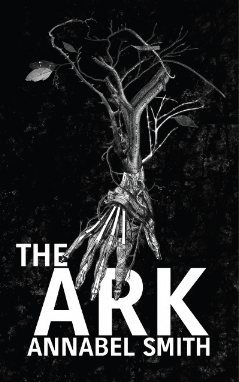
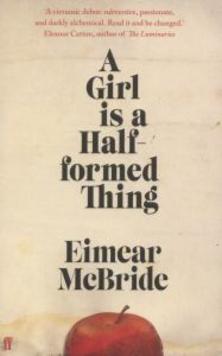
  • Annabel Smith. The arkEimear McBride’s A girl is a half-formed thing: a confronting story about family, disconnection and the urge to self-harm, told in an idiosyncratic voice that reaches your core.
  • Annabel Smith’s The ark: an inventive modern epistolary novel/app/e-book, dystopian speculative fiction set in a post-peak oil world.
  • Ouyang Yu’s Diary of a naked official: another challenging story, this one about sexualisation and self-indulgence in a materialistic world.

All in all, an exciting year of reading that included some challenging, confronting and controversial reads. I wouldn’t have it any other way.

What were your standout reads for the year?

Eimear McBride, A girl is a half-formed thing (Review)

Eimear McBride, A girl is a half-formed thingI try very hard when writing reviews to avoid clichés and superlatives, like, say, “achingly beautiful” or “masterful”. But I think I’m going to use one for Eimear McBride’s multi-award-winning debut novel A girl is a half-formed thing when I describe it as “searing”. I can’t think of a more apposite word. Yet I fear it too has been over-used to the point of meaninglessness. So, let’s try something else …

Once again I’m coming late to the read, and once again this is partly because it was scheduled by my reading group. All I can say is, wow. I’m not sure I’d go so far as Eleanor Catton’s “read it and be changed” commendation on the front of my edition, but I do agree with her  “virtuosic” and “subversive”. It’s a gut-wrenching read.

The plot itself is simple enough. It’s the story of a family – a pious one-could-say-religiously-fanatical mother, a son who survived a serious brain tumour as a toddler, and the younger daughter. The tumour leaves the son somewhat brain-damaged and, of course, it returns. This tumour, the trauma of it, shapes their behaviour and defines their relationships. The story, which spans around 20 years, is told through the daughter and could, in one sense, be seen as coming-of-age. But. This. Tells. You. Nothing. Because …

This is not your typical first-person voice. Instead, we are in the head of the unnamed “girl”. We are there in her conscious unconsciousness (or, is it her semi-consciousness?) in which we hear what she’s experiencing in language that is – here’s another cliché – raw. By this I mean that the language is stripped of the mediation of a formalising narrator’s intellect. Instead it captures the immediate emotional truth of the girl’s experience as she grapples to make sense of her world. This is a book in which the style conveys the meaning as much as the words do.

How does McBride do this you are probably wondering (unless, of course, you’ve already read the book). Well, mostly by breaking, consistently, the rules of grammar and syntax. We are in the girl’s head, a place where, I believe McBride is saying, we rarely think in coherently formed sentences but in what I would call “impressions”. Take, for example, this description, on the first page, of the brother before his diagnosis:

I know. The thing wrong. It’s a. It is called. Nosebleeds, headaches. Where you can’t hold. Fall mugs and dinner plates she says clear up. Ah young he says give the child a break. Fall off swings. Can’t or. Grip well. Slipping in the muck. Bang your. Poor head wrapped up white and the blood come through. She feel the sick of that. Little boy head. Shush.

To orient you, “she” is Mammy, “he” is the father who disappears two pages later, and “you” are the little boy, the girl’s brother. Most of the novel is addressed to him (that is “you”). One of the challenges of reading this book, and it is a challenge to read, is its pronouns. Once you’ve got a handle on them, and once you realise that they are all from the perspective of the girl, you are half way there.

Anyhow, there is easier syntax than the above when life is relatively calm but, when our “girl” is distressed such as when the truth of her brother’s situation can no longer be avoided, it collapses almost completely:

I walk the street. City. Running through my mouth. Running in my teeth the. My eyes are. All the things. The said the done what there what’s all this? That stuff. I could do. My. I walk the street. Who’s him there having a look at me he. Look at my. Tits. Ssss. Fuck word. No don’t. Fuck that. No. Will. Not that. Not. That. But. If I want to then I can do.

This is not the most extreme example – I don’t want to spoil too much – but it should demonstrate what I mean by the language mirroring/enacting/even being her state of mind.

In addition to the idiosyncratic syntax, McBride draws on wide range of literary techniques to keep us focused on, grounded in the emotions of the here and now. The imagery is visceral, returning again and again to  “muck”, “dirt”, “blood”, and “puke”. She alters her rhythms to match the tone, not only through the syntax as evident in the examples above, but through allusions to and repetitions of prayers and hymns, lines from children’s games, literary works and sayings. She makes up new words (“I trup trup off behind her”), mangles existing words (“swoll” for “swollen”), and twists common expressions (“There’s a foul there’s a wind where’s the air”). McBride was inspired by Joyce she says, but her fresh, fearless, urgent language reminded me too at times of Gerard Manley Hopkins.

The novel is clearly set in Ireland and there are odd references to 1980s technology like Game Boys, but overall place and time are unspecified, and none of the characters are named. All this keeps the focus squarely on the emotional core of a family in pain, and the girl in particular. She is abused by her uncle at the age of thirteen and begins a strange love-hate, violent-tender, but sick, relationship with him. Sex becomes for her a weapon, a tool and a punishment. But the book is not about this, that is, it’s not yet another book about abuse. It is about the girl’s inability to handle her emotional pain, and her family’s inability to see her need, it’s about growing up unsupported. She is complicit in her own degradation because for her physical pain is better than the emotional. Like those who self-harm, she seeks out abuse again and again because

… what’s wrong here is me me me. Me the thing but I. Think I know. Is that the reason for what’s happened? Me? The thing. Wrong.

I know this all sounds unremittingly bleak and it largely is, but there are light touches – blackly comic scenes, surprising word plays, and chuckle-inducing descriptions (like her mother’s friends, “they polyester tight-packed womanhood aflower in pink and blue”).

A girl is a half-formed thing is hard to read style-wise and painful to read content-wise. But it is a book that, if you let it, reaches deep into your core and makes you understand the lives of others in a way that only the best literature can. I’m so very glad I read it.

John at Musings of a Literary Dilettante also liked it.

Eimear McBride
A girl is a half-formed thing
London: Faber and Faber, 2014
203pp.
ISBN: 9780571317165

Clare Wright, The forgotten rebels of Eureka (Review)

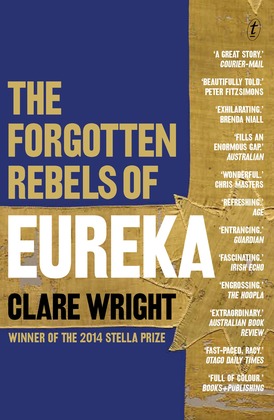
Book cover, The forgotten rebels of Eureka

Courtesy: Text Publishing

Wah! Once again I delayed reading a much heralded book until my reading group did it*, and so it is only now that I’ve read Clare Wright’s Stella Prize winning history, The forgotten rebels of Eureka. The trouble with coming late to a high-profile book is how to review it freshly. All I can do, really, is what I usually do, and that is write about an aspect or two that particularly interested me. Since other bloggers have already beautifully covered one of these, the history**, I’m going to focus on Wright’s writing and the approach she took to telling her story. I won’t be doing this from the angle of historical theory, as I’m not an historian, but in terms of her intention, and her tone, style, and structure.

If you’re not Australian, you may not have heard of the Eureka Stockade. It was a significant event in colonial Australia’s march to democracy and independence, involving the British army and police attacking a stockade created by miners whose grievances included the payment of a compulsory miner’s licence and the fact that this licence, which they saw as a form of taxation, did not give them the right to vote in the legislature. It has traditionally been framed in masculine terms, but Wright discovered, somewhat by accident while researching another project (as historians do!), a new angle – the role of women in the rebellion. There were, she found, over 5,000 women on the goldfields:

Women were there. They mined for gold and much else of economic value besides. They paid taxes. They fought for their rights. And they were killed in the crossfire of a nascent new order.

Consequently, in her book, Wright draws on extensive primary and secondary sources to explore and expose the lives of these women and the until-now-unheralded role that she believes they played in the goldfields, particularly in the lead up to and aftermath of that fateful day of 3 December 1854.

Wright opens the book with three epigraphs, one of which is particularly illuminating in terms of my subject. It’s by Australian historian Geoffrey Blainey and states that “every history of every country is a mirror of the author’s own interests and therefore selective rather than comprehensive”. Having been interested in historical writing since studying EH Carr’s What is history at university, I like the admission that histories are inherently subjective, regardless of how well researched they are. The historian makes decisions about what s/he will research, what the limits of that research will be, and how s/he will interpret that research. It’s common sense. How can it be otherwise? And so, in this history, Wright’s specific interest in the role of women means that all her research – even research into men’s activities – is viewed through that prism. There’s another implication, too, regarding selectivity: with her focus being specifically the women, we cannot read this book as a comprehensive history of the Eureka Stockade. It complements, or expands, or even jousts with other works.

None of this is meant negatively. I thoroughly enjoyed the read. My point is simply that it’s important, as it always is, to be aware of what we are reading – and I like the fact that Wright recognises this. So, what we have here is, to the best of my knowledge, a thorough but selective history. The text is extensively referenced, with 25 pages of meaningful endnotes and nearly 20 pages of bibliography, and there is a useful index. These are things I look for in a good nonfiction work. The book is logically structured, by theme and chronology, and its (creatively titled) chapters are divided into three main parts: Transitions, Transformations and Transgressions. You can sense a writer’s touch in the alliteration here.

And it’s the writer’s touch I want to turn to now, because Wright has achieved that difficult mix – a well-researched but readable history. It has been written, I’m sure, with an eye on a general, but educated audience. The language is often breezy and even jokey (perhaps a little too much) at times, and yet is replete with classical, Shakespearean, biblical and other literary allusions. She uses metaphor, such as “the cornered lizard bared its frills” to describe the hoisting of the famous Australian flag in the days before the attack. Her descriptions are evocative, and often visceral. You feel you are there in the crowded “tent city” that was Ballarat:

The arrival of the extra troops meant squashing more stinky little fish into an already overpacked tin … From the outside, it seemed like the tightrope was about to snap.

Her stories of the childbirth experiences of Sarah Skinner and Katherine Hancock are devastating to read.

Indeed, I would place this book in the narrative non-fiction tradition. It has a strong narrative drive, with a large cast of characters, some of whom stay with us, some of whom pass through. They include Ellen Young whose poems and letters in the Ballarat Times articulate the mining community’s distress and sense of injustice; hotel-keeper Catherine Bentley who, with her husband, earns the ire of the diggers by consorting with government officials; theatre-owner and actor Sarah Hanmer who donated more to the rebels’ cause than anyone else; and newspaper publisher Clara Seekamp who takes the helm when her husband is arrested for sedition. These women provide significant evidence for Wright’s thesis that women played more than a helpmeet role in the intellectual and political life of Ballarat.

In addition to “developing” these characters, Wright uses other narrative techniques, such as:

  • plot cliff-hangers (much like a screenwriter, which she also is, would do) and pointed aphorisms at the end of chapters
  • foreshadowing to suggest causation: “Even female licence holders expected a modicum of representation for their taxation—as dramatic events would later demonstrate”
  • repetition of ideas and motifs to propel her themes. Take, for example, the Southern Cross. It functions as “a hitching post for existential certainty when all else was in mortal flux” during immigrants’ sea journey from the northern hemisphere to the south (Ch. 3, “Crossing the line”) and is later picked up as a symbol for the rebels’ flag “as the one thing that united each and every resident of Ballarat” (Ch. 11, “Crossing the line (Reprise)”).

As an historian, Wright is confident and fearless, expressing clear opinions, either as direct statements, or indirectly through her choice of language. She calls the Bentleys’ murder trial, for example, a “morality play”. She asks questions; she offers close analysis of her sources, such as noting that the use of the word “demand”, rather than “request” or “humbly pray”, conveys the diggers’ frustration with authority; and she makes considered deductions by testing textual evidence against her understanding of the times and the work of other historians. She discusses discrepancies in reportage, such as the different witness reports of the fire at the Bentleys’ hotel. But she also, as other bloggers and my own reading group have commented, draws a long bow when she suggests the full moon and menstrual synchrony may have been a factor in so many men leaving the stockade on the night of the attack. She provides some evidence for this synchrony as a phenomenon, and offers other reasons for the desertion, but it feels a little out of left field.

At times her nod to the popular and her push for dramatic effect jars, but Wright’s argument that women played an active role at the diggings and in the stockade is convincing. I’m not surprised she won the Stella Prize, because this is engaging reading that is underpinned by extensive scholarship and clear thinking. It’s exciting to see a work that doesn’t just explore the role of women in history but that puts them right in the action.

awwchallenge2014Clare Wright
The forgotten rebels of Eureka
Melbourne: Text Publishing, 2013
539pp.
ISBN: 9781922182548

* I bet you can hardly wait until next month now!
** Do check out historian bloggers, the Resident Judge and Stumbling Through the Past, and litblogger Lisa of ANZLitLovers.

Jane Austen, Lady Susan (Review)

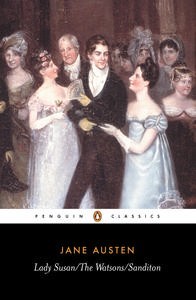
AustenLadySusanPenguinIt is a truth universally acknowledged – I know this is a tired old joke but I seem programmed to do it – that Jane Austen fans will collect multiple editions of her works. There are many reasons for this behaviour, but one of them is our interest in different introductions. And so, although I already had a copy of Lady Susan, in the Minor works volume of R.W. Chapman’s The Oxford Illustrated Jane Austen, I bought the Penguin edition for my Kindle because it had an introduction by Margaret Drabble. And I have a second confession to make: this is a rereading, but my reason for rereading has little to do with the reasons I gave in my recent post on Flanagan. The reason is simple – my local Jane Austen group decided to schedule it for our October meeting. I was happy with that. As far as I’m concerned all bets are off my usual “rules” when it comes to Jane Austen.

If you’re not an Austen fan, you may not have heard of Lady Susan. It is a complete novella that sits between her Juvenilia and her adult novels. It was written, we believe, in 1793/4 when Austen would have been 18-19 years old, but was not published until 1871, well after her death, when her nephew James Edward Austen-Leigh included it in his memoir of her.  It is epistolary in form, something she tried again with Elinor and Marianne. While this latter one she rewrote in her well-known third person omniscient voice, retitling it Sense and sensibility, for some reason she didn’t go back to Lady Susan. One reason might have been its subject matter.

 “the most accomplished coquette in England” (Reginald of Lady Susan)

Lady Susan is a beautiful, 35-year-old widow of four months, who is already on the prowl for a new, wealthy husband. The novel opens with her needing to leave Langford, where she’d been staying with the Manwarings, because she was having an affair with the married man of the house, and had seduced his sister’s suitor, Sir James Martin. She goes to stay with her brother-in-law Charles Vernon and his wife Catherine, whom she’d done her best to dissuade him from marrying. She’s not long there before Reginald, Catherine’s brother, arrives to check her out because, from what he’s heard,

Lady Susan possesses a degree of captivating deceit which must be pleasing to witness and detect.

Of course, the inevitable happens and the artful Lady Susan captivates him. Meanwhile, Lady Susan wants her 16-year-old daughter, Frederica, to marry Sir James, the man she’d seduced away from Miss Manwaring – but sweet, sensible Frederica wants none of this weak “rattle” of a man.

You’ve probably worked out by now that this is not Austen’s usual fare. Lady Susan belongs to the 18th century tradition of wickedness, lasciviousness and adultery, forced marriages, and moralistic resolutions. The novel’s characters tend to be types rather than complex beings, and it is racily written, with a broad brush rather than a fine pen. And yet …

“Lady Susan is not wholly a villain” (Margaret Drabble)

This is also where Austen’s mature touch starts to appear. For all Lady Susan’s self-centred “bewitching” machinations, she is also, as Drabble says, “witty, energetic, intelligent and charming”. Drabble and other critics argue that Lady Susan’s spirit can be seen in characters like Elizabeth Bennet, Emma Woodhouse and, particularly, Mary Crawford who, like Lady Susan, comes from London where she moved in “fast” circles. How could a teenaged country parson’s daughter imagine into being such a duplicitous character? Austen was, we know, a great reader and read the gothic novels of her day. She also knew the behaviour of Mrs Craven, the mother of her neighbour Mrs Lloyd. According to Drabble, Mrs Craven “had treated her daughters shockingly, locking them up, beating them and starving them, until they ran away from home …” just as Lady Susan’s daughter ran away from school. And, as her letters demonstrate, Austen was capable of bite.

We don’t know why Austen didn’t pursue this book, besides making a good copy of it in 1805, or why she didn’t try again to write about a beautiful 35-year-old widow.

Hints of what’s to come

All this is well and good, and I loved the read, but my main reason for reading these early Austens is their insight into the writer to come – her wit and irony, and her commentary on human nature. Lady Susan, having been written on the cusp of her maturity, is particularly interesting in this context. The melodrama, for example, is toned down, compared with the books Austen would have been reading. Frederica isn’t locked up as she might have been in Walpole’s Castle of Otranto (my review), there are no rapes as we see in Richardson’s Clarissa. Austen is moving, in other words, towards the naturalism of her favourite topic, “3 or 4 families in a Country Village”.

I love Austen’s irony, and there’s plenty in evidence here. A good example is when Reginald, completely convinced by Lady Susan, writes to his father of how she has been misrepresented, saying that this

may also convince us how little the general report of any one ought to be credited … I blame myself severely for having so easily believed the scandalous tales invented.

The joke is on him because, of course, he should believe these “scandalous tales”. One of the complexities of the novel is this issue of gossip – who should believe what and whom? As Austen readers know, gossip plays a significant role in her characterisation and plots.

Other ideas and themes that we see in later novels also appear in Lady Susan. Bad mothering is one. Another, more specific, is this delightful comment on accomplishments, reminding us of the discussion between Mr Darcy, Miss Bingley and Elizabeth at Netherfield. Lady Susan writes to her equally scheming friend Alicia Johnson:

Not that I am an advocate for the prevailing fashion of acquiring a perfect knowledge in all the languages arts and sciences; it is throwing time away; to be mistress of French, Italian, German, music, singing, drawing etc., will gain a woman some applause, but will not add one lover to her list.

And then there’s that main reason I love Austen – her terse, pithy commentary on human behaviour. There’s much in Lady Susan, including

but where there is a disposition to dislike a motive will never be wanting

and

Silly woman, to expect constancy from so charming a man!

Have I convinced you to give it a go? I do hope so.

Jane Austen
“Lady Susan”
in Lady Susan, The Watsons, Sanditon
London: Penguin Books, 2003
Kindle Edition EISBN: 9780141907901

Available in e-text.