A month ago I posted some musings arising from the first part of my current slow read of Northanger Abbey with my Jane Austen group. In this post I’ll share some reflections on the rest of the novel, Chapters 20 to 31, which is the part that encompasses our “heroine” Catherine’s arrival in and departure from the Abbey.
On the art of fiction
In my previous post, I discussed how Northanger Abbey spoofs or parodies Gothic novels. Northanger Abbey also contains Austen’s famous defence of the novel. These contribute to one of the pleasures of this novel, which is the joy Austen seems to be having in being an author. She intrudes regularly with her own voice, not only commenting on the characters but on fiction itself. It’s the new novelist having fun, flexing her muscles, and making an argument for more “realistic” fiction over the Gothic novel that was popular in her time.
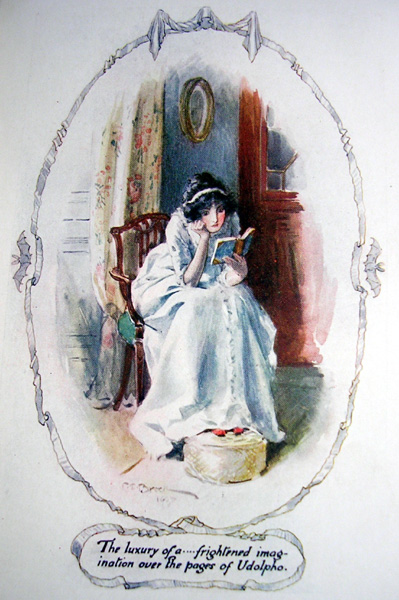
So, for example, here is Catherine, at the Abbey, deciding that the General had been up to no good regarding his late wife:
His cruelty to such a charming woman made him odious to her. She had often read of such characters, characters which Mr. Allen had been used to call unnatural and overdrawn; but here was proof positive of the contrary.
Mr Allen is the sensible neighbour who, with his wife, had taken Catherine to Bath. One of the things Austen does in this novel, and particularly in the second half, is satirise readers of Gothic novels, readers who let their imaginations run away with them. Catherine, our narrator tells us, is too “well-read” to let the General’s “grandeur of air” and “dignified step” dissuade her from her belief about his dastardliness. And so, when at last she is proved wrong (though the General does prove villainous in other ways), Henry admonishes her:
What have you been judging from? Remember the country and the age in which we live. Remember that we are English, that we are Christians. Consult your own understanding, your own sense of the probable, your own observation of what is passing around you. Does our education prepare us for such atrocities? Do our laws connive at them? Could they be perpetrated without being known, in a country like this, where social and literary intercourse is on such a footing, where every man is surrounded by a neighbourhood of voluntary spies, and where roads and newspapers lay everything open?
There is so much to tease out here besides Austen’s satirising the Gothic sensibility … but let’s save them for another re-read, and move on.
Soon after, Catherine considers Henry’s admonition, and thinks:
the whole might be traced to the influence of that sort of reading which she had there indulged. Charming as were all Mrs. Radcliffe’s works, and charming even as were the works of all her imitators, it was not in them perhaps that human nature, at least in the Midland counties of England, was to be looked for.
So, it is human nature that most interests Austen – not the one-dimensional “angel” and “fiend” characters of the Gothic novelists.
Late in the novel, as our hero and heroine are coming together, Austen writes:
Henry was now sincerely attached to her, though he felt and delighted in all the excellencies of her character and truly loved her society, I must confess that his affection originated in nothing better than gratitude, or, in other words, that a persuasion of her partiality for him had been the only cause of giving her a serious thought. It is a new circumstance in romance, I acknowledge, and dreadfully derogatory of an heroine’s dignity; but if it be as new in common life, the credit of a wild imagination will at least be all my own.
Here, I’d say, there are two main things going on. One is the cheeky novelist teasing us with her “new circumstance in romance” undermining the conventional idea of romantic love between heroes and heroines in novels. The other is the more serious Austen making a rather subversive observation about the realities of love and human relationships, because she was a pragmatist at heart. She believed in love, but she also understood the implications of the marriage market.
If all this sounds a little confused, that’s probably because it is. Austen plays around in this novel with ideas about fiction versus reality, Gothic (European) sensibility versus more ordered (English) values, and reading versus readers. To do so, she slips in and out of different modes of narrative, daring us to keep up with her. No wonder it’s the book that has proven the hardest to adapt to film.
More word teasing from Henry
In my last post, I shared Henry’s little tirade about the word “nice”. I can’t resist sharing another little tirade from later in the novel:
“No, and I am very much surprised. Isabella promised so faithfully to write directly.”
“Promised so faithfully! A faithful promise! That puzzles me. I have heard of a faithful performance. But a faithful promise—the fidelity of promising! It is a power little worth knowing, however, since it can deceive and pain you…
Love it …
And here endeth my reflections on my most recent re-read of Northanger Abbey. What a delight it has been, yet again. It may not have the romance of Pride and prejudice or the complexity of Emma, but it has the lively, fresh mind of an author who wants to engage with her readers about the very thing she is doing, writing a novel. I find that irresistible.
Picture credit: From Chapter 9, illus. by CE Brock (Presumed Public Domain, from solitaryelegance.com)













 Whispering Gums