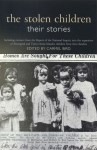
Carmel Bird (ed), The stolen children: Their stories (#BookReview)

Carmel Bird, The stolen childrenCommenting on my post on Telling indigenous Australian stories, Australian author Carmel Bird mentioned her 1998 book The stolen children, describing it as her contribution “to the spreading of indigenous stories through the wider Australian culture”. It contains stories told to, and contained in the report of, the National Enquiry into the Separation of Aboriginal and Torres Strait Islander Children from their Families (Bringing them home)*. She offered to send me a copy, and of course I accepted (despite having read much about the Report at the time.)

Bird said in her comment that the book is “still regularly used in schools”. This is excellent to hear because it contains a history that needs to be told – forever, alongside all those other histories taught to Australian students. It needs to be as well (if not better) known by our students as the story of The Gold Rush or Our Explorers. We need to know it, we need, as a nation, to know our dark side, our failures, as well as our big adventures and achievements.

What makes this book particularly useful is Carmel Bird’s curation of it – and I would call what she’s done “curation” because of the complexity and variety of the writings she has gathered and organised. Bird has structured the book carefully to tell a story, with introductory front matter (including a preface from Ronald Wilson the National Committee’s prime commissioner); the Stories themselves; Perspectives from people at the time, including Hansard excerpts from politicians at the tabling of the Report; the Report’s Recommendations; and end matter comprising an Afterword from historian Henry Reynolds and a poem titled “Sorry” by Millicent whose story appears in the Stories section. Bird’s curation also  includes providing introductions to each of the stories to draw out important issues or points about that person’s situation, and adding other explanatory notes where appropriate.

This careful curation ensures that the book contains all the content and context it needs to stand alone as a resource for anyone interested in the Stolen Generations.

“It made no sense”

In her story, Donna says “It made no sense”. She’s describing her train trip away from her mother in the company of a white woman, a train trip she’d been initially excited about, thinking it was to be a family trip. However, with her mother staying behind on the platform and her brothers disappearing one by one as the journey went on, it just made no sense to her.

None of the stories make sense. And they are all heart-rending. Some children were given up willingly by their mothers, who believed it would result in better opportunities, and some, most, were stolen, often suddenly, with no explanation. Some were newborn, some pre-school or primary school-age, while others were 12 years old or more. Some found themselves in loving foster homes, but many found themselves in institutions and/or abusive situations. All, though, and this is the important thing, suffered extreme loss. They lost family and they lost language and culture. Fiona, for example, who will not criticise the missionaries who cared for her, says, on reconnecting with her family thirty-two years later:

I couldn’t communicate with my family because I had no way of communicating with them any longer. Once that language was taken away, we lost a part of that very soul. It meant our culture was gone, our family was gone, everything that was dear to us was gone.

Fiona also makes the point, as do several others, about the treatment of the mothers:

We talk about it from the point of view of our trauma but – our mother – to understand what she went through, I don’t think anyone can understand that.

The mothers, she said, “weren’t treated as people having feelings”.

The stories continue, telling of pain, pain and more pain. Murray says “we didn’t deserve life sentences, a sentence I still serve today”, and John talks of being a prisoner from when he was born. “Even today,” he writes, “they have our file number so we’re still prisoners you know. And we’ll always be prisoners while our files are in archives”. This is something that I, as a librarian/archivist, had not considered.

But, there’s more that makes no sense, and that’s the government of the time’s refusal to apologise, to satisfy, in fact, Recommendations 3 and 5a of the Report. This issue is covered in the Perspectives section, with extracts from speeches made by the then Prime Minister John Howard and the Minister for Aboriginal Torres Straight Islander Affairs Senator Herron who argue against making an apology, and from the Opposition Leader Kim Beazley and Labor Senator Rosemary Crowley, who made their own apologies. Crowley also says:

If ever there were a report to break the hearts of people, it is this one.

The Perspectives section also includes other commentary on the Report and the apology. There’s a letter to the editor from the son of a policeman who cried about his role in taking children away from “loving mothers and fathers”, and one from La Trobe Professor of History Marilyn Lake contesting the historical rationale for the practice of forcible removal. She argues that there had never been “consensus [about] the policy of child removal”. There’s also a long two-part article published in newspapers that year, from public intellectual Robert Manne. He picks apart the argument against making an apology, noting in particular Howard’s refusal to accept that present generations should be accountable or responsible for the actions of earlier ones. Manne differentiates between our role as individuals and as members of a nation:

we are all deeply implicated in the history of our nation. It is not as individuals but as members of the nation, the “imagined” community, that the present generation has indeed inherited a responsibility for this country’s past.

In the event, of course, an apology was made, finally, in February 2008, by Labor Prime Minister Kevin Rudd. This, however, does not mitigate the value of Bird’s book. It has value, first, as documenting our history and the voices of those involved – indigenous people, politicians and commentators. And second, it contains thoughts and ideas that we still need to know and think about, not only for historical reasons, but because in the twenty years since the Report we have not made enough progress along the reconciliation path. It is shameful.

I loved Carmel Bird’s introduction. It’s both passionate and considered, and clearly lays out why she wanted to do this book. I’ll conclude with her words:

I think that perhaps imagination is one of the most important and powerful factors in the necessary process of reconciliation. If white Australian can begin to imagine what life has been like for many indigenous Australians over the last two-hundred years, they will have begun to understand and will be compelled to act. If we read these stories how can we not be shocked and moved …

“There can,” she says, “be no disbelief; these are true stories.” This is why the stolen generations should be a compulsory part of Australian history curricula (Recommendation 8a). It’s also why, to progress reconciliation, we should keep reading and listening to indigenous Australians. Only they know what they need.
aww2017 badgeCarmel Bird (ed)
The stolen children: Their stories
North Sydney: Random House, 1998
188pp.
ISBN: 9780091836894

(Review copy courtesy Carmel Bird)

* For non-Australians who may not know this Enquiry, its first term of reference was to “trace the past laws, practices and policies which resulted in the separation of Aboriginal and Torres Strait Islander children from their families by compulsion, duress or undue influence, and the effects of those laws, practices and policies”. You can read the full Report online.
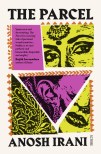
Anosh Irani, The parcel (#BookReview)

Anos Irani, The scribeOne of the main reasons I read is to enter worlds unknown to me – physical worlds and more interior or personal ones. Anosh Irani’s novel The parcel meets this criterion perfectly. It is set in the Kamathipura red-light district of Bombay/Mumbai, and its main character is a eunuch, or hijra, named Madhu. Brought up as a boy, but never comfortable with that gender, teased and ostracised for his feminine walk, he joins the hijra world at 14 years of age. When we first meet her, though, she’s forty.

The novel opens with a first-person prologue from Madhu, who describes herself as “neither here nor there … neither man nor woman”. It’s clear that she’s at a crossroads in her life, just as Kamathipura is, with the developers moving in and AIDS wreaking havoc. The novel then moves to third person subjective, but still with Madhu who remains our guide until the first person epilogue. It’s a clever structure: it ensures that we are immediately engaged, but then facilitates a narrative that shifts easily between present and past, as Madhu goes through her days while reconsidering her life.

From the beginning, we see that Madhu is deeply unhappy. She is and always has been “a shivering, jittery soul trapped in the wrong body”. She starts her day smoking a beedi, which she flicks away:

She smiled as the beedi disappeared into a gutter. Even dead cigarettes wanted to get away from her as soon as possible.

As the first chapter progresses, we feel Madhu’s pain. She’s forty, no longer in her prime, relegated from being her brothel’s most sought-after prostitute to a mangti hijara, a beggar peddling blessings. She’s grateful to gurumai, the now-failing hijra brothel madam, for taking her in, but she mourns her family who had never given her the love and acceptance she craved. More and more her thoughts turn to them and to her decision to leave when she was fourteen.

“an act of compassion”

It’s important that Madhu be established for us as a figure of pathos, as a character we care about, because by the end of the first chapter we meet “the parcel”, a young 10-year-old virgin girl from Nepal sold by her aunt into sex-slavery. Madhu’s job is to prepare her for her “opening” by the man who has paid for her. It’s a horrific and shocking start to a novel which explores the murky morality of human beings – and we are now attached to Madhu. What are we to think?

Madhu and the parcel are not the only characters, of course. Irani creates a community of people surrounding them – the prostitutes, the brothel madams, the hijra leaders, and Madhu’s ex-lover and dearest friend Gajja. While there is warmth, trust, and loyalty between many of the characters, overall it is a devastating picture of marginalised people who struggle to survive in a world where survival, no matter how or in what form, is all there is.

This is a character-driven novel. We are acutely aware not only of Madhu’s inner conflict, but of her fundamental decency, and her desire to reduce the pain of those around her. This is why she had taken on parcel work many years previously. She’d seen the cruelty with which they were treated and wanted to prepare them – she has no notion of helping them escape – so that the trauma will be minimised, so they will live, so they will not go mad. For her, it’s “an act of compassion” – but, oh my, what this “compassion” involves is unbearable to read. It’s the ultimate perversion of the I’m-doing-this-for-your-own-good scenario, except we are not talking about a little slap, or a time-out. We are talking cruelty – being caged in a dark place, starved, and emotional deprived, in order to to remove hope and teach submission. This is better, Madhu believes, than the pimps’ method of preparing “the parcels for whoredom by plundering them beyond belief, turning them into vegetables.”

The parcel is, however, also a plot-driven novel. As Madhu divulges more of her past – and increasingly questions her decisions and behaviour as well as those of her parents – we wonder what decision she will make about her future, because a decision is surely coming. We also wonder what will happen to “the parcel”. Will Madhu save her? And we wonder about Kamathipura, as internal politics within the hijra hierarchy, and with and between brothel madams, are revealed. It’s not only Madhu who’s in transition, but the community as a whole.

And, it’s an ideas-driven novel. In a way it could be seen as Irani’s love-letter to the hijras. He says in his acknowledgements at the end that he grew up opposite Kamathipura. It inspires and haunts him he said, and he is grateful for the “transgendered people, sex-workers and residents … who opened up their hearts and minds to him over the years”. For Irani, writing this book, I’d say, is “an act of compassion”, and he weaves through it the history of and legends involving this “reviled and revered” group of people, the hijras.

But, there are other ideas too, including the moral complexities inherent in Indian society (and in fact society in general). Prostitution, Madhu sees, keeps “the privileged and selfish safe” by satisfying men’s needs:

As long as the people outside Kamathipura were not harmed, what happened inside the cages was justified. It prevented rape. But in order to prevent rape, parcels were being torn from their homes and raped every minute.

This double-standard is forced home later in the novel when there’s an uproar over the rape of a bride. Madhu is bothered by

how much coverage this incident was getting: a bride had been violated on that most sacred of nights. But what about ordinary women on ordinary nights?  Or indecent women, perhaps, like sex workers? Or hijras? What happened when less-than-ordinary souls got violated? Why not create a furore then? Why let their pain slide away like rainwater into a gutter?

“Like rainwater into a gutter” is one of the many striking images used by Irani. The writing is direct, accessible, and full of images that startle with their clarity, such as Madhu seeing that, for the parcel, “hope was leaving in the way the sun left the evening”, or observing that, for the aging hijra leaders, “as their bones turned brittle, money and power were the only forms of calcium that worked”.

Madhu is a finely wrought, complete character. With maturity, she comes to question her simplistic understanding of her parents’ and indeed gurumai’s actions. Her life becomes increasingly empty and lonely, and yet still “she believed that sometimes life gave you a lesser version of a dream, and it was up to you to take it.” You could, perhaps, say that this is what she does at the end, an end that’s inevitable and, in its own way, redemptive.

In a recent interview, Australian author Richard Flanagan said that novels ask questions. In The parcel that question concerns compassion. I can’t think of a better question for our times.

Lisa (ANZLitLovers) has written an excellent review of this book.

Anosh Irani
The parcel
Melbourne: Scribe, 2017
284pp.
ISBN: 9781925322262

(Review copy courtesy Scribe Publications)

Ellen van Neerven (ed.), Writing black (#BookReview)

Writing black: New indigenous writing from Australia is one of the productions supported by the Queensland Writers Centre’s if:book that I wrote about in a recent Monday Musings. It’s an interactive e-book created using Apple’s iBooks platform, and can be downloaded free-of-charge via the if:book page or directly from iBooks.

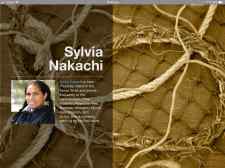
Title page for Ch. 16, Sylvia Nakachi

Ch. 16, Sylvia Nakachi (Using fair dealing provisions for purposes of review)

Writing black was edited (and commissioned) by Ellen van Neerven (whose book Heat and light and story “Sweetest thing”, I’ve reviewed here). It contains works by 20 writers, in a variety of forms, including prose by writers like Bruce Pascoe, Tony Birch, and Marie Munkara; poetry by Tara June Winch, Lionel Fogarty, Kerry Reed-Gilbert and Steven Oliver (most of which are presented in both text and video); and twitter-fiction by Siv Parker. For each writer, there is a “title” page which provides a brief biography, and the works are illustrated with gorgeous sepia-toned photography by Jo-Anne Driessens.

In her editor’s introduction, van Neerven states that, by the time of publication, there had not been a “digital-only anthology of Australian indigenous writing”. This book addresses that gap, but with a very particular goal. It was, she writes, “moulded by possibility”, by the fact that “the multimedia and enhancements a digital publication allows lifts the imagination”. Certainly, we see some of these possibilities in this production.

Her point, though, that particularly interested me was this:

Expectations of what we write about are changing, no longer the narrow restriction of life stories and poetry. Indeed, Indigenous writers do not need to write about Indigenous issues at all, if they choose not to. With more Indigenous books and authors comes a new generation of readers — open-minded to what Indigenous writers can write about, and across new forms and experiences.

Great point – just as it’s important that we see indigenous people on television and in movies, for example, without their indigeneity needing to be referenced or be part of the story. Anyhow, we see this broadening of content in Writing black – in Jane Harrison’s “Born, still”, for example – although, not surprisingly and completely understandably, given where we are on the reconciliation journey, many of pieces do have political intent.

This brings me to one of the appealing aspect of this production, which is its variety, not only in form as I’ve already mentioned, but in tone and content. The pieces span moods from the intensity of Tara June Winch (“Moon”) to the cheeky humour of Marie Munkara (“Trixie”), from the anger of Kerry Reed-Gilbert (“Talking up to the white woman”) and the frustration of Steven Oliver (“You can’t be black”) to the melancholy of Bruce Pascoe’s (“A letter to Barry”). Many of the pieces speak to loss of country and identity, and the emotional impact of these. What makes them particularly powerful is that they come from all over, from the tropical north to country Victoria to various urban settings.

Another appealing thing, which stems from its being an e-Book, is that we can hear poets perform their own work, as well as read the text ourselves. One of these is the new-to-me Steven Oliver. He has four poems in the collection – “Real”, “You can’t be black”, “Diversified identity” and “I’m a black fella” – with video of him reading each of them. He (or his poetic persona) is an urban dweller who regularly confronts questions concerning his indigenous identity. In “Real” he describes a discussion with another who refuses to accept he’s “black”, who produces those crass arguments like he’s “more of a brown” and “not really a full”, but who suddenly turns when our poet responds that his English name suggests he’s not “from here”. Oliver writes:

Listen here Abo, you know-it-all coon
It seemed that my friend has spoken too soon
Just moments ago I was not the real thing
Yet now by his words my heritage clings

This is a long-ish poem, but is accessible. Its use of rhyming couplets provides a light touch that keeps the reader engaged while the actual words drive home a serious point about Aboriginal identity. I hope it’s taught in schools.

Another poem of his, “You can’t be black”, also addresses assumptions others make about what being Aboriginal is:

You can’t be black
When the media shows Aborigines they live on communities
And struggle with petrol, poverty and disease
So you can’t be black
If you’re black you wouldn’t have nice clothes on your back.

Oliver’s poems are made to be performed, as are those of the next poet Kerry Reed-Gilbert.

She also comes out fighting, with five poems. She writes of being in a bar, waiting for the racist slurs (“A conversation and a beer”), or of being exploited by people who only want to know her to further their own aims (“Talking up to the white woman”). She speaks in the voice of a white racist in “Because my mum said so” to show how racism is learnt through families. This is a particular concern of mine. I’ve seen schools trying their hardest to teach tolerance and respect – but that role-modelling at home is mighty powerful stuff.

Another well-established poet who has been politically active for decades is Lionel Fogarty. His two poems in this collection focus more on caring for country, on sharing the land, on passing knowledge on.

The prose pieces are, overall, more diverse. There’s Tristan Savage’s cheeky short film script, “Gubbament man” about Freddy the indigenous “discrimination prevention officer”. Siv Parker’s twitter-fiction piece “Maisie May” was originally released as tweets over several hours on, note, 26th January, in 2014. It tells of a trip to country for the funeral of Aunty Maisie May who “could tell you about country and our ways that we lost over the years.” Marie Munkara is here too with her particular brand of humour to tell about “Trixie” who takes revenge on her ex. There’s also Tony Birch whose “Deep rock” clearly draws from (or fed into) his novel Ghost River (my review). And there’s David Curtis whose “What kind dreaming” tells of three young indigenous men, two already becoming familiar with the life and law of their country and the other a greenhorn from the city, who go bush. Our greenhorn soon learns a few things from the other two, who respect “them old people”.

In an interview in Sydney Review of Books, Ellen van Neerven comments briefly on why she wanted to do this “digital collection”:

For me it’s as much about audience and access. There is a really hungry international audience for Indigenous writing but also lots of roadblocks in getting the books out there. Being able to access work online is definitely an advantage and we’ve had a lot of feedback and contact from people overseas who have been able to find out about Indigenous writing and read content from 20 different authors that way.

And that’s exactly it. This oh-so-rich collection introduces readers to many of Australia’s current significant indigenous writers, not to mention the range of issues that interest them. And it’s free to download. That we should be so lucky! A big thanks to if:book and the Queensland Writers Centre for supporting such innovative and sophisticated projects as this one.

aww2017 badgeEllen van Neerven (ed.)
Writing black: New indigenous writing from Australia
State Library of Queensland, 2014
133pp.
ISBN: 9780975803059

Catherine McKinnon, Storyland (#BookReview)

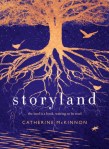
Catherine McKinnon, StorylandIt is still somewhat controversial for non-indigenous Australian authors to include indigenous characters and concerns in their fiction, as Catherine McKinnon does in Storyland. But there are good arguments for their doing so. One is that not including indigenous characters continues the dispossession that started with white settlement. Another is that such fiction brings indigenous characters and stories to people who may not read indigenous authors, which is surely a good thing?

However, such writing requires sensitivity, or empathy, on the part of non-indigenous writers. Indigenous author, Jeanine Leane says that this can only be achieved by social and cultural immersion (which can include informed reading of indigenous writing). McKinnon addresses this in a couple of ways. In her author’s note, she refers to discussing “stories and ownership” with local Illawarra region poet and elder, Aunty Barbara Nicholson, which resulted, for example, in her telling a brutal story from the convict perpetrator’s point of view rather than from the indigenous victim’s. She also acknowledges Nicholson “for reading, local knowledge and generous advice both early on in the process and nearing completion”. But now let’s get to the reason for all this …

Storyland is set in the Illawarra region south of Sydney, and tells the story of the Australian continent, post-white settlement, from 1796 to 2717. It has a nine-part narrative arc that takes us through five characters and six time periods: Will Martin 1796, Hawker 1822, Lola 1900, Bel 1998, and Nada 2033 and 2717. These form the first five parts of the novel. The final four parts return through Bel, Lola, Hawker, finishing with Will Martin, each picking up its character’s story where it had been left first time around. Got it? Two of these characters – Will and Hawker – are based on historical figures, while the rest are fictional.

… a tricksy plot

Will’s employer, the explorer George Bass, says early on that “the land is a book, waiting to be read”, and this, essentially, is what the book’s about. Will is a 15-year-old who sailed with Flinders and Bass in 1796 on their search for a river south of Sydney. On their trip they meet “Indians” whom they fear might be cannibals. We leave them at a nervous moment in their encounter to move to 1822 where we meet the convict Hawker. He’s a hard man, who believes you need “a mind like flint and a gristly intent”. He has his eye on a young indigenous woman, but also on improving his future. From him, we jump again, this time to 1900 and young hardworking dairy-farmer Lola who lives with her half-sister and brother Mary and Abe, both of whom have indigenous blood. There is racism afoot, with a neighbouring farmer suspicious of Abe’s friendship with his teenage daughter Jewell. We leave this story, with Jewell having gone missing, to meet Bel in 1998.

Bel, the youngest of our protagonists at 10 years old, spends her summer rafting with two neighbourhood boys on a lagoon that features in each of the stories. They befriend a couple, Ned and his indigenous girlfriend Kristie. Bel is a naive narrator, but adult readers quickly see the violence at the centre of this relationship. Meanwhile, down the road lives the slightly younger Nada, who is the pinnacle of our chronological arc, featuring in 2033 and 2717. In 2033, climate change has created havoc in the land, and a dystopia is playing out …

Country and connection

I hope this doesn’t sound too confusing – or fragmented – because in fact Storyland is a very accessible book. Superficially, it seems disjointed, but McKinnon connects the stories through links that gradually register as the narrative progresses. For example, the transitions between each story all feature birds, such as this one from Hawker to Lola:

The women are disappearing into the forest. And then they are gone. Lost in the dark trees. An owl

Lola
1900

calling boo-book, boo-book.

(My html skills aren’t up to replicating the layout I’m afraid.) Other links include the aforementioned lagoon, a creek, a cave which most characters reference, a big old fig tree and an ancient stone-axe. None of these are forced, or feel out of place. Instead these places and objects naturally connect the stories, despite their very different narratives, to provide a continuity that transcends the people to focus on the land itself – because, ultimately, this is a story about the land and our ongoing relationship with it.

McKinnon, the author bio says, has been a theatre director and playwright, as well as a prose writer. This is evident in the voices (all first person) and dialogue which beautifully capture the rhythms, vocabulary and grammar of the different characters and their times. Will Martin talks of “Indians”, Hawker talks of “forest”, while turn-of-the-century farmer Lola uses structures like “Jewell and me carry buckets of skimmed milk” and “When he were done”. Ten-year-old Bel is language-proficient, with a good vocabulary, but she sees things through a ten-year-old’s eyes, such as this on the abused Kristie, who “has her big black sunglasses on” and “looks funny, her lips look bigger or something”.  (In a delightful in-joke, her father Jonathan is writing his PhD on unreliable narrators).

The real star of the novel, though, is the land. McKinnon traces its trajectory from an almost pristine state at the dawn of colonisation through being farmed by Hawker and Lola to climate-change-caused destruction in 2033 followed much later by a mysterious post-apocalyptic world. She similarly traces our relationship with indigenous people from early caution, uncertainty and tentative goodwill, through 19th century brutality and ongoing dispossession, to the continuing racism and exploitation of the twentieth century.

The question to ask here is why did McKinnon structure the story the way she did, starting and ending with 1796? Here is Will at the end, exploring a beach on his own:

The white sand curves around the land; the dunes in the late night are dark mountains and valleys; the forest behind is thick and green to the sky. This is a wild place. Too wild for civilisation. It is a place for adventure.

And “the water is fresh” to drink! Is McKinnon, by ending with this more idyllic picture of the land, suggesting that there’s still hope? This is how it was, this is what could happen. Does it have to? Can we yet turn it around? Well, yes, perhaps. As Uncle Ray says to Bel, “it’s our job to look after all this land around here. If we don’t, bad things can happen.”

“To dare is to do”, George Bass tells Will, and this is what McKinnon has done in Storyland. She has combined historical, contemporary and speculative fiction to tell us a story about our land – and our relationship with it and with the people who know it best. This land, these mountains, creeks, lagoons and trees, were here first, Uncle Ray says, and this makes us “part of their history, not the other way around.” The message is clear.

Storyland is a beautiful book physically – in cover, design and construction – as well as being a moving and relevant read. I dare you to read it today.

Bloggers Lisa (ANZlitLovers) and Bill (The Australian Legend) liked this book too.

aww2017 badgeCatherine McKinnon
Storyland
Sydney: Fourth Estate, 2017
382pp.
ISBN: 9781460752326

(Review copy courtesy HarperCollins Publishers)

Jane Austen’s Persuasion, Vol. 2

Jane Austen, Persuasion

I recently posted my thoughts on Volume 1 of Persuasion, which I read for my Jane Austen group’s slow reading of the novel. This post, obviously, is on the second (and last) volume. As before, I’ll be focusing on reflections from this read rather than writing a traditional review. And, again, just in case you need a refresher on the plot or characters, please check Wikipedia.

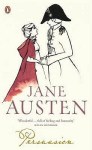
Persuasion

… and Self-interest

Last meeting, my Jane Austen group discussed Lady Russell’s advice to Anne. Some found it wanting while others felt she was justified in recommending that 19-year-old Anne reject Captain Wentworth’s proposal. In Volume 2, we get to question Lady Russell’s judgement again, when she sees Mr Elliot as a good suitor for Anne.

So, we have a conundrum. She’s Anne’s friend and supporter, but she’s also a member of the aristocracy, which is not presented positively in the book, and her judgement is suspect. What are we to make of her?

At the end of the novel, Lady Russell is treated well. Is this because her advice, poor though it is (in hindsight, particularly), doesn’t stem from self-interest? Here is Austen wrapping up Lady Russell at the end:

There is a quickness of perception in some, a nicety in the discernment of character, a natural penetration, in short, which no experience in others can equal, and Lady Russell had been less gifted in this part of understanding than her young friend. But she was a very good woman, and if her second object was to be sensible and well-judging, her first was to see Anne happy.

If we agree that Lady Russell is redeemed because her focus was Anne’s happiness, not self-interest, where does this leave Mrs Smith? She was prepared not to share with Anne her knowledge of Mr Elliot’s character, her reason being:

After listening to this full description of Mr. Elliot, Anne could not but express some surprise at Mrs. Smith’s having spoken of him so favourably in the beginning of their conversation. “She had seemed to recommend and praise him!” “My dear,” was Mrs. Smith’s reply, “there was nothing else to be done. I considered your marrying him as certain, though he might not yet have made the offer, and I could no more speak the truth of him, than if he had been your husband. My heart bled for you, as I talked of happiness.

But, given her hopes for Anne interceding on her behalf with Mr Elliot, is there not some self-interest in her decision not to influence Anne? Mrs Smith’s situation was dire in a way that Lady Russell’s was not, but … Anyhow, she too is treated well in the novel’s wrapping up.

What this says to me is that while Austen gently satirises groups (such as the aristocracy) or ideas (such as persuasion/influence/advice-giving), she is not black-and-white about it. She understands humanity – and would like us to, too!

… or, being persuadable

Last post I commented on Anne’s wondering whether Captain Wentworth, after Louisa’s accident at Lyme, might have realised “that a persuadable temper might sometimes be as much in favour of happiness, as a very resolute character.” Well, in the resolution, we discover that he did!

There, he had learnt to distinguish between the steadiness of principle and the obstinacy of self-will, between the darings of heedlessness and the resolution of a collected mind.

Meanwhile, Anne tells him that, despite the pain it caused, her 19-year-old self was right to listen to Lady Russell:

I must believe that I was right, much as I suffered from it, that I was perfectly right in being guided by the friend whom you will love better than you do now. To me, she was in the place of a parent. Do not mistake me, however. I am not saying that she did not err in her advice. It was, perhaps, one of those cases in which advice is good or bad only as the event decides.

This last sentence reminds me of that “good spirit” narrator in The museum of modern love (my review) who said in the opening paragraph, “It’s a human condition to admire hindsight. I always thought foresight was so much more useful”. If only Anne knew, eh, what the event would decide?

Anne Elliot, Fanny Price and Elinor

Jane Austen fans love to consider her characters, to discuss who is the worst villain or the best hero, or whether character X is like character Y, and so on. So, when my Jane Austen group discussed this volume, one member hesitatingly suggested that Anne Elliot could be seen as a mature Fanny Price (Mansfield Park). Yes, I said, I had the same thought! Not so some other members of the group, but here’s the thing. Both Anne and Fanny resist pressure or encouragement to marry people they don’t love, both have strong moral codes, both nearly lose their “love” to rivals, both are relied upon by their families to provide nurturing and support. There are differences. Anne, with her “higher” social position, has more power and agency than Fanny, the poor cousin, but a couple of could see a distinct similarity.

Another member responded that she saw a likeness to Elinor (Sense and sensibility). There is some argument for that too. Elinor is also a steady, moral character who is relied on by her family, and she too nearly loses her “love” to another. And, like Anne and Fanny, Elinor does not need to learn lessons the way Marianne (Sense and sensibility), Elizabeth (Pride and prejudice), Emma (Emma), and Catherine (Northanger Abbey) do. But she doesn’t have to contend with pressure from others the way Anne and Fanny do, which is why I’d see a closer connection between Anne and Fanny.

The Navy

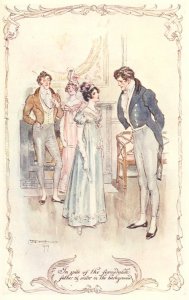
Anne and Captain Wentworth, Ch 20
Anne and Captain Wentworth in front of her “formidable” family (CE Brock, Public Domain)

I said in my Volume 1 post that I’d talk about the Navy in this post, but I’ve ended up talking about other things. However, it’s worth mentioning that in Persuasion, Jane Austen, who had two Naval brothers, presents the Navy positively, as family-oriented men whose values draw more from having good relationships with their families and their “brother” officers  than from status/position. Here is Anne watching Admiral and Mrs Croft in Bath:

They brought with them their country habit of being almost always together. He was ordered to walk to keep off the gout, and Mrs. Croft seemed to go shares with him in everything, and to walk for her life to do him good. Anne saw them wherever she went. …  Knowing their feelings as she did, it was a most attractive picture of happiness to her. She always watched them as long as she could, delighted to fancy she understood what they might be talking of, as they walked along in happy independence, or equally delighted to see the Admiral’s hearty shake of the hand when he encountered an old friend, and observe their eagerness of conversation when occasionally forming into a little knot of the navy, Mrs. Croft looking as intelligent and keen as any of the officers around her.

This continues her feelings from late Volume 1 when the visiting party in Lyme had spent time with Captain Wentworth and his naval friends. She saw their hospitality, their lack of “the usual style of give-and-take invitations, and dinners of formality and display” that typified her circle. “These would have been all my friends,” she thinks, and the idea lowers her spirits. It’s surely no coincidence that in this novel Austen presents some of the worst of the aristocracy with its focus on appearance and position against the best of the Navy with, as Louisa notices, “their friendliness, their brotherliness, their openness, their uprightness”.

And then there’s the last line of the novel:

She gloried in being a sailor’s wife, but she must pay the tax of quick alarm for belonging to that profession which is, if possible, more distinguished in its domestic virtues than in its national importance.

What does this mean, besides the point that being married into the Navy means you will always have the worry of war? Many have discussed the meaning of “more distinguished in its domestic virtues than in its national importance”, with some believing that it is Austen suggesting a new world in which the professional classes, the middle class, represented here by the Navy, is gaining ascendance in English life.

What do you think?

Heather Rose, The museum of modern love (#BookReview)

Heather Rose, The museum of modern loveAs I neared the end of Heather Rose’s Stella Prize-winning novel The museum of modern love, I slowed down. I wanted, of course, to know how it was going to resolve, but I wanted to savour it too. It doesn’t seem right to rush the end of thoughtful books like this.

But, I have to admit that I was initially hesitant about reading the book, as I am about any book inspired by a person or work I don’t know. I fear missing something important. However, I did want to read it and my reading group scheduled it. The die was cast. Then, as I was about to start reading, Brother Gums sent me a link to the documentary Marina Abramović: The artist is present about her and the performance piece which inspired this novel. I was set! As it turned out, I think Rose’s writing is evocative enough that it wasn’t necessary to have seen the film, but it did add a layer to the experience.

So, what is The museum of modern love about – besides love, that is? Its centre is performance artist Marina Abramović’s 75-day piece, The Artist is Present, which she performed at MoMA in the spring of 2010, to accompany a large retrospective exhibition of her work. The piece involved her sitting, still, quiet, at a table all day, 6 days a week (MoMA is closed Tuesdays), with gallery attendees invited to take turns to sit opposite her and share a gaze. It was an astonishing success, with, by the end, people camping out overnight to get the chance to sit. Many attended for days just to watch, creating, as Rose describes it, quite a community of spectators. In the end, over 850,000 people attended, with 1,545 people sitting (including Rose). (All are recorded at flickr.)

Anyhow, from this premise, Rose weaves an engaging, thoughtful story about art and love. It has two main narrative strands, telling the real Marina Abramović’s story and that of an attendee, the fictional musician Arky Levin, whose life is stalling, partly due to a restraining order made by his now-unresponsive terminally-ill wife that he not visit her. Interspersed with these, enriching the exploration of the themes, are smaller stories of other attendees, and family and/or friends of the protagonists. It’s narrated by a mysterious third person voice, who starts the novel with

He was not my first musician, Arky Levin. Nor my least successful. Mostly by his age potential is squandered or realised. But this is not a story of potential. It is a story of convergence.

This is a very particular omniscient narrator, some sort of artist’s muse who self-describes late in the novel as a “good spirit, whim … House elf to the artists of paint, music, body, voice, form, word”, one whose job is sometimes just “to wake things up”. This could be cutesy or forced, but it isn’t because Rose doesn’t overdo it. Mostly the story progresses without the intrusion of this narrator, so that when s/he appears we pay attention.

The moral conundrum at the novel’s heart is – is art enough or is love more important? It’s explored primarily through Levin, whose friends suggest he should appeal Lydia’s court order.

I know you’re going to say that she wanted you to do this; she wanted you to make music. But is that enough?

Music, it sounded feeble suddenly in the face of the yawning gap between life before Christmas and life these past four months. (p. 158)

So what does Levin do? Continue to live his increasingly lonely life making music, or follow his heart?

Levin’s story is off-set against other stories, notably that of Jane Miller, a friendly, recently widowed art teacher visiting New York from Georgia. She is lonely, like Levin, missing her husband “achingly, gapingly, excruciatingly. Her body hadn’t regulated itself to solitude.” She becomes one of the mesmerised watchers, but she also connects with others in the crowd, including Levin and Brittika, a PhD student from the Netherlands who is writing her thesis on Marina. Jane forms a natural link between the two themes of love and art.

What, then, is art?

The first time Jane attends the performance, she overhears people in the crowd questioning what the show is about, asking what is art, in fact. There are, of course, the naysayers, the ones who say that “art is irrelevant. If everything goes to crap, it won’t be art that saves us”. But Jane thinks differently, and turns to the man next to her who is, you guessed it, Levin, and says

I think art saves people all the time … I know art has saved me on several occasions.

As the novel progresses, various claims are made for art. Our muse, speaking particularly for artists, believes that “pain is the stone that art sharpens itself on time after time” and that “artists run their fingers over the fabric of eternity”. Marina’s art teacher says to her 16-year-old self that  “Art will wake you up. Art will break your heart”, which causes Marina to consider that “Art … could be something unimaginable”. At one point Marina is reported as saying “I am only interested in art that can change the ideology of society”.

Jane, the viewer, though, has her own epiphany:

And maybe this was art, she thought, having spent years trying to define it and pin it to the line like a shirt on a windy day. There you are, art! You capture moments at the heart of life.

But, I think it is art critic Healayas who makes the clearest, simplest point when she says during a discussion about Marina’s performance:

She simply invites us to participate … It may be therapeutic and spiritual, but it is also social and political. It is multi-layered. It is why we love art, why we study art, why we invest ourselves in art.

… and what has love got to do with it?

Everything, if art, as all this suggests, is about humanity.

Let’s look specifically at Levin. It would be easy to criticise him, as his friends and daughter gently do, for being passive. But, we do get the sense that Lydia encouraged his passivity in their life together, that she liked to be in control, not in a control-freak way but in that way that super-competent people can do. Moreover, Lydia made her order out of love for him, to let him continue creating his art, rather than look after her which she didn’t believe was in him. So, what’s Levin to do? How does he reconcile his love against hers?

The resolution when it comes is triggered by art, by Marina’s performance. And this, as Jane believes art can do, probably saves him. I say probably because Rose, clever writer that she is, leaves the ending uncertain. As she and Levin realise,

the best ideas come from a place with a sign on the door saying I don’t know.

This is an inspired and inspiring book that leaves you pondering. I’ve only touched the surface.

Lisa (ANZLitLovers) also liked the novel.

aww2017 badgeHeather Rose
The museum of modern love
Sydney: Allen & Unwin, 2016
284pp.
ISBN: 9781760291860

Stephen Orr, Datsunland (#BookReview)

Stephen Orr, DatsunlandTwo things I loved about Stephen Orr’s novel The hands (my review) were its evocation of men, boys and their relationships, and its rural setting. And this is also why I liked Datsunland, his recent short story collection comprising thirteen short stories and a novellaIt’s a no-holds-barred exploration of the lives of boys and men. It is not a pretty book, but it feels real, even where it pushes extremes.

Lisa (ANZLitLovers) interviewed Orr in one of her early Meet an Australian Author Series of posts. Answering her question about who inspired him to write, he said

I became convinced the human psyche was the only thing really worth worrying about, so I’ve been working at it ever since.

This is true of these stories in which men confront their dreams and hopes, their strivings to achieve these, and their frequent failures. Take, for example, the first story, “Dr Singh’s despair”, which is about an Indian doctor from the Punjab who obtains a visa to work in rural Australia. We are desperate for doctors in rural/outback areas and he seeks a better life for his family. Unfortunately, his welcome – to Coober Pedy, which would be a challenge for anyone – is less than ideal. Indeed, we could call it non-existent. Not surprisingly, Dr Singh does not last and returns home, “disappointed … [but] at least happy”. This is the first story in the collection … worth considering, that ordering of the stories!

The stories in this collection are loosely linked. Most are set in rural or suburban South Australia; all focus on men (though women do appear); and many reference, sometimes so briefly you could miss it, a particular school, the Christian Brothers’ Lindisfarne College. The characters never cross into each other’s stories, however. It’s more that the school represents a certain conservative or inward-looking value or attitude – which makes this a good time to introduce the second story, though I promise to not describe every story in the collection! Titled “The shot-put”, it is set on a farm in 1919, just after World War 1, and concerns a couple whose son, a school shot-put champion, is being publicly listed on a Cowards’ List and has therefore been removed from his school’s – the aforementioned college – Honour Board. It’s another story of hopes (and in this case promise) unfulfilled – and more, of lack of compassion.

Lack of compassion is, in fact, one of the underlying themes of the collection. Had Dr Singh in the first story, for example, been shown some compassion, he may have stayed. In the fourth story, “A descriptive list of the birds native to Shearwater, Australia” a new wife begins to realise that what she’d hoped might be compassion in her husband was something entirely different, and in the fifth story there’s something creepy in Brother Vellacott’s caring for Miss Mary. It all, though, comes to a head halfway through the collection, in “Akdal Ghost”, the seventh story. It’s about a preacher, Pastor Fletcher, who should be compassionate, right? He hires a commercial video producer to make a video showing people what will happen if they don’t “find God”. It features the Akdal Ghost, which I had to look up in Wikipedia, and is absolutely shocking, though, as in several of the stories, Orr does not play it fully out. Much more effective to leave it to the reader’s imagination!

Religon is another motif that runs through the collection, and is behind some of the most violent stories. Besides “Akdal Ghost”, there’s “Confirmation” in which a massacre in 1976 Ireland is set against the hopefulness of a son’s confirmation, and “The Syphilis Museum” about a man preparing for the end of the world. One gets the impression that Orr is not a fan of religion.

And, so the stories continue. Some are more poignant, such as “The Barmera Drive-in” about a 45-year-old man who buys an old, long defunct, drive-in, thinking (hoping) he can reclaim his childhood and in so doing make the (or his) world a better place, and “The Shack” about an aging father who needs to decide what to do about his “retarded” son.

Most of the stories focus on adults, but a few feature children, including the 9-year-old boy lost in the hull of ship under construction (“The One-eyed Merchant”) and the 6-year-old boy trapped with a neglectful mother and an abusive step-father (“The Adult World Opera”). The final, titular story, “Datsunland’, which appeared in last year’s Griffith Review IV novella edition, also features a child, though in this case a teenager.

At 100 pages, “Datsunland” concludes the collection beautifully, continuing the melancholic tone but containing just that little bit of hope to leave us not completely discouraged as we turn the last page. It concerns teen-aged Charlie Price, his widowed father Damien, who sells second-hand cars at Datsunland, and his Lindisfarne College guitar teacher, William Dutton. The story opens with William Dutton, a struggling musician who finds teaching, particularly at that “poor cousin of elite schools” Lindisfarne, stultifying. He hates the narrow focus on assessment and performance, on trivialities, such as the proper wearing of socks, on rules that squash motivation and creativity.

Meanwhile, Damien knows his son is bright, has potential, but becomes increasingly concerned about the relationship developing between Charlie and William. The story leads us on, keeping us, along with Damien, unsettled, exploring the awful challenge faced by teachers in today’s fearful environment. What are the boundaries between teacher and student, and where are they crossed? How can a teacher nurture, safely?

Now, more often than not, reviewers describe short story collections as uneven, which is probably not totally unreasonable, because how can every story have equal punch for every reader. So, I’m not going to go there. I don’t think it particularly helps and, anyhow, I’ve seen reviews of collections where different reviewers identify very different stories as the best or the weakest. It’s so subjective, particularly given short stories can range from quiet slices of life to plot-driven-tales-with-twists. If you are a plot-twist lover, can you equally love the quieter story? I’ll simply conclude by saying that in Datsunland, we, like William Dutton, find ourselves “caught in the middle of multiple truths” – and what uncomfortable truths they mostly are. It’s a provocative read, but a good one.

Lisa (ANZLitLovers) reviewed the novella and the collection. The collection has also been reviewed by French blogger Emma (bookaroundthecorner) and Carmel Bird (The Newtown Review of Books) whose insightful analysis of the language and style is well worth reading.

Stephen Orr
Datsunland
Mile End: Wakefield Press, 2017
295pp.
ISBN: 9781743054758

(Review copy courtesy Wakefield Press)

Jane Austen’s Persuasion, Vol. 1

Jane Austen, Persuasion

My Jane Austen group is reading Persuasion – eleven years since we last did it – because 2017 is the 200th anniversary of its publication. Of course I’ve read it several times, so, as you’ll know from my other Austen re-reads, my aim here is to focus on reflections from this read rather than to write a traditional review.

You’ll probably also know that my group often does slow reads of her novels, a volume at a time. Persuasion was published in two volumes, so last month we read Volume One. It finishes at Chapter 12, just after Louisa Musgrove has her fall at Lyme. This post is about this volume.

But first, I want to say something my relationship with Persuasion. I first read it in 1972 when the second TV miniseries was screened in Australia. I was reading it in tandem with the screening, and the night the last episode screened I sat up late to finish the last chapters. I’ll never forget my emotional response to it. I can’t remember whether the miniseries was a good one, but I sure thought the book was. Why?

Persuasion doesn’t have the sparkle of Pride and prejudice, nor the  young spoofy humour of Northanger Abbey, nor even the heroine we love to laugh at in Emma, but it is quiet, emotional and deeply felt. Its heroine Anne, at 27 years old, is Austen’s oldest. She’s caring, intelligent, but put upon by her unappreciative family – and yet we don’t feel she’s a pushover. The novel’s romance, when it comes, feels right and well-earned. No-one ever says that Austen should not have married Anne to her man the way some do about some of her other heroines such as Marianne in Sense and sensibility, and Fanny in Mansfield Park. No, when it comes to Persuasion, Austen fans are generally in agreement: it’s a lovely book in which the hero and heroine belong together. But, it’s about so much more too …

I’m not going to provide a summary, so if you need to refresh yourselves on the plot and characters please check Wikipedia.

A specific setting

I’m not sure why it is, but on this my nth (i.e. too many to count) reading of Persuasion, I suddenly noticed that it was the only book, really, that gives us a very specific date and that is set pretty much exactly contemporaneous with when Austen was writing it. It starts in “this present time, (the summer of 1814)” and ends in the first quarter of 1815. This period pretty much covers the hiatus in the Napoleonic Wars when Napoleon was exiled to Elba – and is why Naval Officers are out and about, on land and available for appearing in Persuasion! Sir Walter’s friend and advisor, Mr Shepherd tells him:

This peace will be turning all our rich Navy Officers ashore. They will all be wanting a home.

It is the appearance of the Navy and Austen’s contrasting the substance of naval officers with the superficiality of the aristocracy that gives Persuasion its particular interest – beyond its lovely story, I mean. It is very much a book about social change. (I should say, here, that Austen was partial to the Navy, having two successful Naval brothers)

Two themes

Anyhow, this idea and that relating to persuasion are developed in Volume 1 through various themes, two of which I’ll discuss here.

Appearance and Social status

That social status is a major concern is heralded on the book’s first page when we are told about Sir Walter’s favourite book: “he was a man who, for his own amusement, never took up any book but the Baronetage”. The narrator tells us soon after that:

Vanity was the beginning and the end of Sir Walter Elliot’s character; vanity of person and of situation.

However, he has not been sensible with his money, and needs to rent out his home Kellynch-hall, hence my earlier quote. But, Sir Walter doesn’t like the Navy, and his reasons convey two of the novel’s themes – the focus on status and the cult of appearance. His response to the idea of renting his home to a Naval officer is:

Yes; it is in two points offensive to me; I have two strong grounds of objection to it. First, as being the means of bringing persons of obscure birth into undue distinction, and raising men to honours which their fathers and grandfathers never dreamt of; and secondly, as it cuts up a man’s youth and vigour most horribly; a sailor grows old sooner than any other man …

This is of course ironic, because the naval officer, Admiral Croft, to whom he eventually agrees to rent the place is a thoroughly decent man (who removes Sir Walter’s myriad “looking glasses” when he takes residence). Croft also, Anne “fears”, looks after the Kellynch estate and its people far better than her family did. However, for Sir Walter, the only thing that matters is status.

As the novel progresses, the difference between the Navy and the aristocracy is further developed, but more on that anon.

Anne’s sister Mary is highly aware of her status as a Baronet’s daughter, and the “precedence” due to her. That she stands on this demonstrates her superficiality and lack of decent human feeling. She complains when she goes to her in-laws’ home that her mother-in-law does not always give her precedence. One of her sisters-in-law complains to Anne:

I wish any body could give Mary a hint that it would be a great deal better if she were not so very tenacious; especially, if she would not be always putting herself forward to take place of mamma. Nobody doubts her right to have precedence of mamma, but it would be more becoming in her not to be always insisting on it.

Later, after Louisa’s fall at Lyme, when it is suggested that calm, capable Anne remain behind to care for Louisa, Mary objects:

When the plan was made known to Mary, however, there was an end of all peace in it. She was so wretched, and so vehement, complained so much of injustice in being expected to go away, instead of Anne;—Anne, who was nothing to Louisa, while she was her sister …

Here again is Mary’s misplaced sense of “precedence”. It is also a lovely example of Austen’s plotting, because only a few chapters earlier Mary had refused to stay home from a family party to look after her own injured little boy, preferring Anne do it. Austen had set us up nicely to see the superficiality of Mary’s desire to care for her sister-in-law. The more you read Austen, as I’ve said before, the more you see how fine her plotting is.

Strength of character versus Persuasion (or the influence of others)

Another ongoing issue in the novel concerns strength of character. Captain Wentworth reflects on Anne’s lack thereof in refusing their engagement when she was 19:

He had not forgiven Anne Elliot. She had used him ill; deserted and disappointed him; and worse, she had shewn a feebleness of character in doing so, which his own decided, confident temper could not endure. She had given him up to oblige others. It had been the effect of over-persuasion. It had been weakness and timidity.

A little later, he praises Louisa Musgrove’s strength of mind, but we, the reader, realise her pronouncements are theoretical. She had not been put to the test. She says:

What!—would I be turned back from doing a thing that I had determined to do, and that I knew to be right, by the airs and interference of such a person?—or, of any person I may say. No,—I have no idea of being so easily persuaded. When I have made up my mind, I have made it.

Meanwhile, Louisa shares gossip about Anne, suggesting that Lady Russell, who had discouraged Anne from marrying Captain Wentworth, had also discouraged her from marrying Charles Musgrove (which of course reinforces for Wentworth the idea of Anne’s weakness of character).

… and papa and mamma always think it was her great friend Lady Russell’s doing, that she did not.—They think Charles might not be learned and bookish enough to please Lady Russell, and that therefore, she persuaded Anne to refuse him.

In this case, though, the decision was all the then 22-year-old Anne’s – but Wentworth only hears the gossip.

Henrietta adds to the chorus about Lady Russell’s persuasive power:

I wish Lady Russell lived at Uppercross, and were intimate with Dr. Shirley. I have always heard of Lady Russell, as a woman of the greatest influence with every body! I always look upon her as able to persuade a person to any thing!

You can see Austen building up the plot here, leading us to see Wentworth as unlikely to be interested in Anne again.

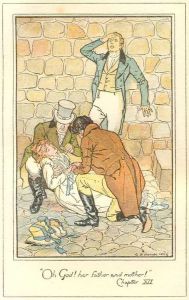
Persuasion, Lyme fall, CE Brock
Oh God! her father and mother (CE Brock, 1893?)

Anne, though, sees that firmness of character can go too far, that Louisa’s wilfulness against the advice of others had resulted in her potentially life-threatening fall. She wonders

whether it ever occurred to him now, to question the justness of his own previous opinion as to the universal felicity and advantage of firmness of character; and whether it might not strike him, that, like all other qualities of the mind, it should have its proportions and limits. She thought it could scarcely escape him to feel, that a persuadable temper might sometimes be as much in favour of happiness, as a very resolute character.

Will he see it her way? We’ll have to read Volume 2 to find out!

There’s a lot more I could say, but I think I’ve said enough. Next post I plan to take up the Navy issue a bit more …

Phil Day, A chink in a daisy-chain (#BookReview)

Phil Day, a chink in a daisy chain

You’ve “met” Phil Day, author of A chink in a daisy-chain, here before. He illustrated co-publisher Julian Davies’ Crow mellow (my review) and Hartmann Wallis’ Who said what, exactly, which I reviewed very recently. This time, though, Day is author as well as illustrator.

It’s a fun, mind-bending book – with the fun starting on the cover page in which the illustration, as befits a story inspired by Alice I suppose, is upside down. On the back cover is a simple statement: “If there is a perfect book, Alice is it”. This is the question – oops, statement, really – to which Day returns regularly throughout his short book. But, before I talk more about that, I’ll share publisher Julian Davies’ description of the book in his covering letter:

The book is a creative essay, cum personal reflection, on the relationship between Lewis Carroll’s Alice books, personal identity and argumentative opinion. It is the first in a three-book series Phil plans to write on the embattled nature of individual intellectual and creative autonomy.

So, now, are you any the wiser? Perhaps not? And I’m not sure that I can enlighten you, but I’ll try.

The essay could also – perhaps – be described as a memoir, except that I would be hard-pressed to say hand-on-heart which of what Day tells us really happened, if any of it did? Or perhaps all of it did, just not quite the way Day tells it!

The essay starts with Day and his wife sitting on the minimal furniture left in the lounge-room of the Shillams (look at that name upside down and see what you get!) who are moving to Grafton (as you do!) They had been invited for farewell dinner and drinks and, over a mocktail called Clancy of the Overflow and Gin-and-Tonics served in teacups from the piano-doubling-as-a-bar, Day makes his pronouncement concerning Alice. “Can’t see why, Mr S said” – and we’re off, following Day’s weird and wonderful mind just as Alice followed weird and wonderful creatures down the rabbit-hole.

What makes Alice so good, poses Day’s foil, Mr S? Well, besides the fact that Day didn’t say it was “good” but that it was “perfect”, he doesn’t want to get into discussions of “the meaning of good”. And then Mr S asks him to “look at the man”, but, quite rightly, Day isn’t interested in the man either:

I didn’t want to look at the man. I don’t care about the man. I wasn’t drawn to the man, it was the book itself that made me say–If there is a perfect book, Alice is it.

You are probably following this ok right now – the ideas and the language – and it does make sense. It continues to make sense as Day embarks on a critique of teaching, of

the state government syllabus–a deformed thing that devalued the one-off self-directed realisations that a student might naturally become conscious of through their own curiosity. But because the state government syllabus was created by teachers it had no chance of being anything more than an approved state government syllabus, and because of the approved state government syllabus, I instructed my students not to be curious …

And of course curiosity is why Alice is so special. Not that Day says this specifically, but we know this is what he means.

From here, though, the connections and word associations become increasingly bizarre or absurd, just like in Alice. They are not the sorts of associations that make sense in the telling. You have to read it yourself. You have to follow Hobbes the cat, and the peppered oysters, the trees and the warrens, not to mention red-painted bedrooms and nursery rhymes, to find your own meaning … Beyond that my lips are sealed.

I wonder what Phil Day will come up with next in his personal odyssey into curiosity and creativity. Whatever it is, it will be original, probably absurd, definitely cheeky, and very likely a cri-de-coeur for the freedom to think unbound by rules and approved state government syllabi.

Lisa at ANZLitLovers also enjoyed the book.

Phil Day (author and illustrator)
A chink in a daisy-chain
Braidwood: Finlay Lloyd, 2017
61pp.
ISBN: 9780994516527

(Review copy courtesy Finlay Lloyd)

Min Jin Lee, Pachinko (#BookReview)

Min Jin Lee, PachinkoIf you are looking for a big, engrossing read that takes you into a little-known world, then I offer you Korean-American author Min Jin Lee’s Pachinko. It tells a story about the Korean diaspora in Japan over a period of 80 years, and was my reading group’s pick for August. There wasn’t a bored person in the room.

Interestingly though, several in the group had no idea what Pachinko was, so in case that’s the same for you, let’s get that out of the way first. It’s a sort of pinball-arcade game that is hugely popular in Japan. It’s a gambling game – a bit like our poker or slot machines – except that gambling is illegal in Japan so there is a complicated system of winning “prizes” which can be sold at a separate business for money! Pachinko parlours, which are highly visible in the entertainment districts of big cities, are dominated by Koreans – that is, their management and/or ownership is – which is where the title for Min Jin Lee’s book comes in.

Lee starts her novel in a small fishing village, Yeongdo in Busan, on the South Korean peninsula. It’s 1910, and a match is being made between Hoonie the cleft-palated, club-footed only son of a fisherman and his wife, and Yangjin, the 15-year-old daughter of a struggling family. A recipe for disaster you might expect, given the way historical sagas often go, except that Hoonie is a decent, loving man and Yangjin a hardworking, appreciative and loving young woman. They produce one daughter, Sunja, and it is her story – together with that of her family and friends – which forms the basis of Lee’s novel, until it closes in 1989.

The date 1910 was specifically chosen for the start of her novel because this is the year Japan annexed Korea, changing Koreans’ lives forever. With Koreans effectively belonging to Japan, many made the physical move there, believing their economic chances would be better, but most ended up in ghettos, living in poverty, and with minimal rights. Being Korean was, essentially, a passport to a second-class life, but they survived and this book chronicles their lives and spirit.

The first thing to say about Pachinko is that it’s a ripping read, covering four generations juggling life in a hostile land. We quickly become engaged in the lives of Sunja and her husband Isak as they move to Japan to live with his brother, Yoseb, and sister-in-law Kyunghee. Two children come, Isak is arrested (for preaching Christianity), and Sunja and Kyunghee join other Korean women selling kimchi and candy in an open market to help the family survive. Lee tells her story in straightforward, matter-of-fact language, with very few descriptive flourishes, which keeps the narrative moving without holding the reader up with extensive scene-setting. This description of Sunja’s second son, Mozasu, is a perfect example of Lee’s clear no-nonsense writing:

Mozasu had grown noticeably more attractive. He had his father’s purposeful gaze and welcoming smile. He liked to laugh, and this was one of the reasons why Goro liked the boy so much. Mozasu was enthusiastic, not prone to moodiness.

The rhythm is almost staccato at times, but never stilted. On occasion though, Lee will break out with something that is more evocative, and it can leave you breathless, such as this description of yakuza Hansu’s money-collector, Kim:

Hansu preferred Kim to do the collection because Kim was effective and unfailingly polite; he was the clean wrapper for a filthy deed.

The other interesting thing about Lee’s writing is that most of the big emotional events – marriages, births, and particularly deaths of which there are some awfully tragic ones – happen off-camera, and are reported to us in the same tone as the rest of the story. This is not the sort of storytelling you usually find in big family sagas, which love to squeeze out every emotional drop they can. I’d say this is because Lee’s goal is not to engage her readers in those sorts of emotions but to demonstrate the resilience and gutsiness of the people …

…. Because Koreans in Japan have had to be gutsy to survive in the face of being ostracised as aliens, of being treated as illiterate and filthy people, of being prevented from accessing higher level jobs. We, like the Koreans, are never allowed to forget their lack of status and, as a result, their reduced choices and opportunities.

It’s not surprising then that one of the themes is parents wanting education for their children, seeing that as a passport for a better future. Sunja’s son Noa wants to go to university, and later Noa’s brother Mozasu, himself not keen on schooling, sees education as a path out, preferably to America, for his son, Solomon. It’s not easy though. Korean children are bullied and ostracised at school, and are not encouraged to go to university. Only the dedicated make it through. The rest – like Mozasu – have to find work, which Mozasu does, luckily, albeit in a Pachinko Parlour. This, to his brother Noa’s disgust, becomes his career, but he becomes a wealthy man. Wealthy perhaps, but still Korean! He says to his friend Haruki:

In Seoul, people like me get called Japanese bastards, and in Japan, I’m just another dirty Korean no matter how much money I make or how nice I am.

And this brings me to my next theme, that of home. Lee provides three epigraphs in the novel, one for each of its parts, and the first one comes from Dickens: “Home is a name, a word, it is a strong one; stronger than magician ever spoke, or spirit answered to, in strongest conjuration”. It’s clear throughout the novel that our Koreans in Japan are homeless – reviled in Japan, they also no longer belong in Korea, particularly the succeeding generations that were born in Japan. As our omniscient narrator says at one point:

There was always talk of Koreans going back home, but in a way, all of them had lost the home in their minds for good.

And so, in this book, characters need to find their own sense of “home” which is, in most cases, family. It is in this context – and I think I can say this without spoiling anything – that we might understand Solomon’s decision at the end and Noa’s tragedy.

The third theme is perhaps the most obvious one, as it relates to the title, which clearly has metaphorical as well as literal readings. I’ll let Mozasu explain it:

Mozasu believed that life was like this game where the player could adjust the dials yet also expect the uncertainty of factors he couldn’t control. He understood why his customers wanted to play something that looked fixed but which also left room for randomness and hope.

However, here’s the thing. This is such a big, baggy monster that every reader is going to come up with different themes, different emphases. Lee herself, in an interview included with my edition, talks about her themes as “forgiveness, loss, desire, aspiration, failure, duty, and faith”. And, of course, all those are there too!

So, to sum up, Pachinko is a wonderful read about an engaging cast of characters. It provides a broad historical sweep of a region many of us could know more about, and it exposes the situation faced for a century or more by alien Koreans in Japan. It is also a book about human beings, one that never quite plays to type, that doesn’t opt for the easy marks. Instead, it is suffused with a clear-eyed humanity which encompasses the best and worst in people, and lets the reader make his or her own assessment. As I said, a thoroughly engrossing read.

Min Jin Lee
Pachinko
Head of Zeus, 2017
ISBN: 9781786691347 (e-Book)