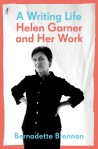
Bernadette Brennan, A writing life: Helen Garner and her work (#BookReview)

Bernadette Brennan, A writing life Helen Garner and her workEnough of the filler posts for a while! It’s time for a review, and it’s a special one because it’s for a book about one of my favourite writers, Helen Garner. The book is Bernadette Brennan’s A writing life: Helen Garner and her work. Described as a “literary portrait” rather than as a biography, it carefully and thoroughly explores her work from multiple angles, the effect of which was to confirm my overall understanding of her work while also resolving some of the gaps or misconceptions in my reading of her.

This brings me straight to the book’s fundamental assumption that knowing a writer’s life is (or can be) relevant to understanding his or her work. Brennan writes in her Introduction that she did not want to write a biography, which was just as well, as Garner did not want her to either. However, Brennan “knew” that the intersection of Garner’s “life and art made discussion of the biographical essential to understanding her work.” There are those who argue that the text is the thing – and the only thing. However, others of us believe that our reading of a text can be enhanced by other factors, that, as editor and critic Adam Kirsch has said, it is valid “to use the life to clarify the factors that shape the work — to show how life and work were both shaped by the same set of problems and drives.” What I realised while reading this book is that this can be as true for non-fiction as for fiction.

“honest, authentic” (Brennan)

I have written about Helen Garner several times on this blog, and many of those times I’ve explained that I love her writing, even though I don’t always agree with her. I love her honesty I say. Well, so do others apparently. In her Introduction, Brennan writes that:

Garner is one of the best-known and, some would say, best-loved writers in Australia. That admiration is inspired by a sense that she is honest, authentic …

And then, working chronologically, she starts the book proper with Garner’s first novel, Monkey grip. Concluding this chapter, Brennan quotes the judges who awarded Garner the National Book Council Book of the Year Award in 1978. They described her as “utterly honest in facing the dilemmas of freedom, and particularly of social and sexual freedom for women”. That was just the beginning. Garner, as we now know, continued to confront difficult issues and, as a result, to face censure, again and again, throughout her career. Brennan, to use current jargon, unpicks all this, book by book, using the texts themselves, the responses of critics, Garner’s unpublished letters and diaries, the clippings she collected, and spoken and written conversations with Garner herself and with several who know (or knew) her. It’s comprehensive.

You may be wondering at this point whether you need to have read Garner’s books to gain value from this book. Not necessarily, I’d say. I have read eight of the listed fourteen books, and found the chapters on those I haven’t read engaging despite not knowing them. However, those on the books I have read were particularly engrossing, and frequently illuminating.
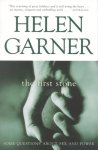
Helen Garner, The first stoneTake The first stone, for example. Subtitled “Some questions about sex and power” it explores a 1992 sexual harassment scandal at a Melbourne University college. The book was highly controversial at the time and Garner copped some ferocious criticism, particularly from feminists, for the stance she took. I was one who disagreed, strongly, with her. But, here is where my point regarding the value of knowing the author’s biography comes in. In a 50-page chapter, Brennan analyses the book in depth, exploring the circumstances of the case, Garner’s writing process, and the role played by the facts of her life in the approach she took. It was enlightening. I came away still not exactly agreeing with her, but understanding Garner’s position more. Brennan describes, among other things, Garner’s uncertainty regarding the young women, and how her own history and vulnerabilities affected her response.

Brennan starts this chapter with the statement that the “truth” surrounding the events “may never be fully known”, and follows this with the “facts” that are known. Of course, I loved this differentiation. Another significant point Brennan makes in the chapter concerns Garner’s positioning of herself in the story. The idea came from friend and publisher Hilary McPhee who, writes Brennan

suggested she insert herself as a character in into the narrative and write a book that charted the effects of each person’s statement on her own point of view. That strategy allowed her to explore the issues with which she was grappling, despite the absence of the complainant’s perspective, yet it late infuriated some commentators.

This approach would have come naturally to her, I’d say, given that all her writing has a strong autobiographical component, as she herself admits. This intrusion of her “self” has become a feature of her non-fiction writing and is part of a style of narrative non-fiction that she helped pioneer and that we now see used by younger Australian writers like Anna Krien and Chloe Hooper.

Brennan’s research into the writing of The first stone is meticulous, and is carefully documented in the end notes. Her subsequent analysis and the conclusions she draws are well-considered and make sense. She applies this technique to every chapter – to her discussions of Garner’s fiction like Monkey grip and Cosmo cosmolino, as well as to her other non-fiction works like Joe Cinque’s consolation and This house of grief. The book ends with last year’s essay collection, Everywhere I look.

“For me, particularly, it’s one book. The book of what I make of the world and my life as I have lived it.” (Garner)

Superficially, Garner’s work is diverse. She has written in almost every form you could imagine, including song lyrics, libretti, and plays as well as novels, short stories, essays and longform non-fiction. But the subject matter is much tighter – it tends to be domestic and relationship-based, but with a particular focus, because it grapples, says Brennan, with the problem of balancing “the desire for personal freedom with ethical responsibility”. Garner’s concerns are ethical and moral. She explores these values in the daily lives of ordinary people, in both her fiction and non-fiction, whether it’s a mother deserting her family (in The children’s Bach) or a father driving his car full of children into a lake (This house of grief), and she doesn’t separate herself from the issues. She shows her own failings, her own ugliness, with a breathtaking vulnerability, and brings, Brennan shows, much distress upon herself. She doesn’t, in other words, write what she writes lightly.

So, what picture does Brennan paint of Garner, the writer? It’s a complex one. It’s of a writer who has strong emotions, a fierce intellect and a commitment to seeking out the “truth”. It’s of a writer who can be hard on others, including those she knows, but who is equally hard on herself. It’s of a writer who isn’t scared to cross boundaries of form and defy expectations in order to tell the best story she can. Brennan’s approach to her topic is analytical, rather than critical. That is, she interrogates Garner’s work and mines her life for the aspects that will help us understand the work, but she doesn’t, herself, critique the work – which is probably to be expected, given the book’s title.

There is so much more that could be said about the book, so many angles from which it could be discussed, but I’ll close here by saying that this is, obviously, a book for those who want to understand Garner’s work more. But, it is also a book which makes clear the significant contribution Garner has made to Australian literature. And, in doing that, it is itself a significant book.
aww2017 badgeBernadette Brennan
A writing life: Helen Garner and her work
Melbourne: Text Publishing, 2017
334pp.
ISBN: 9781925498035
Amy Witting, Afterplay (#Review)

Amy Witting’s first novel wasn’t published until 1977, when she was 59 years old, which is why she appeared in my late bloomers post a few years ago. She went on to publish five more novels after that – two of which I read and enjoyed long before blogging – and she was an accomplished short story writer and poet.

An interesting piece of Witting trivia is that in the 1960s she taught at the same high school in Sydney as Thea Astley, who was a few years younger. Astley encouraged her to submit a short story to the New Yorker, which duly published it. Wikipedia tells us that Australian poet Kenneth Slessor once said “tell that women I’ll publish any word she writes”. And critic Peter Craven argues that her form of realism wasn’t really accepted by the reading public until Helen Garner appeared on the scene.

Amy Witting, Selected stories

“Afterplay” is not in this collection!

All this is to say that although Witting has never had the level of recognition enjoyed by writers like Astley, Jolley and Garner, she was well-regarded in literary circles, and is being brought to our notice again through Text Classics. This year they added three of her books – The visit (her first), A change in the lighting (which my reading group did back in the 1990s), and Selected stories – to their list. Discussing the publication of her stories, they said they could not include them all as they wanted to keep the book to a manageable size. However, as a little tempter, they decided to publish one of her stories, “Afterplay”, online, describing it as “a bite-sized taste of Witting’s short-form genius”. This has given me a wonderful opportunity to include her on my blog – and with a story you can read too. Win-win, as they say!

“Afterplay” provides an excellent introduction to Witting’s writing for a number of reasons. It’s a good example of the realism which Peter Craven sees as her métier; it exemplifies her spare, direct style; and its subject matter reflects her main writing interest, relationship-focused stories in domestic settings. It is also, at less than 1,500 words, a short short-story, and, according to Text, demonstrates “Witting’s masterly economy”.

“Afterplay” focuses on “two young women”, Judith and Geraldine, and their response to Geraldine’s break-up with Ken ten days previously. The problem is that her way of breaking up was to walk out leaving a note on the kitchen table, and he, not expecting this to happen, wants to talk to her. Judith thinks Geraldine should, but Geraldine is resisting all his attempts to contact her, telling Judith that she “can’t stand confrontation. Never could.”

The thing about this story, which is told third person, is the way Witting subtly shifts perspective between the two women, and only gives us Ken’s perspective through Judith reporting a phone conversation as it takes place. There is also a little back story about Geraldine’s previous relationship which seems to have ended with, or just before, the man’s death (by suicide is the implication). The effect of all this is to keep the reader a little uncertain, a little off-balance. We are not given the full picture from any of the perspectives, so our antennae keep pointing in different directions as we try to work out where our sympathies should lie. In the end, I think, my sympathy went mostly to the poor friend caught in the middle!

There’s some cheeky humour here – including little innuendoes about sex as a sport. Ken was “proficient at all sports, never missed a goal”, and of course the title “afterplay” brings to mind “foreplay” (which was not, apparently, Ken’s forte, albeit he’s “a sweet-tempered man”.) However, there is one awkward part where Geraldine tells Judith some things about the break-up that she surely already knows. You could argue, perhaps, that at times like these people do tell and retell their experiences, but it did feel a little clumsy.

Regardless, “Afterplay” is a beautifully crafted little (in size, not in value) story. But, don’t take my word for it. At only 1500 words and available on-line, how about you read it too – and let me know what you think.

aww2017 badgeAmy Witting
“Afterplay”
First published (I think): Quadrant 39 (5), May 1995
Available online at Text Publishing.

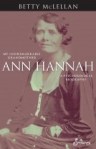
Betty McLellan, Ann Hannah, my (un)remarkable grandmother: A psychological biography (#BookReview)

BettyMcLellanAnnHannahBetty McLellan’s Ann Hannah, my (un)remarkable grandmother: A psychological biography disconcerted me at first. I’d never heard of a psychological biography (which, I presume, is the same as psychobiography) so I was intrigued by McLellan’s discussion in the Introduction of her decision to use this approach. I did feel, for a chapter or two that she was drawing a long bow, but I persevered and it was worth the effort.

McLellan commences her Introduction by telling us a little about who Ann Hannah Stickley was and why she decided to write the book. As you’ll have gathered from the title, Ann Hannah was her grandmother. Born in 1881, and emigrating to Australia with four children when she was 40, Ann Hannah was, writes McLellan, “an unremarkable woman who lived an unremarkable life and died an unremarkable death” (albeit at the, I’d say, remarkable age of 97!) However, McLellan came to realise, long after Ann Hannah had died, that this grandmother, who was already living with her family when she was born and who was still there when she left home at nineteen, was worth investigating. She sensed that her grandmother had had a “remarkable resilience” and wanted to know how she’d done it. But how was she to explore this, given her grandmother had been dead for nearly 40 years?

The problem was that she knew relatively little about this quiet, practical, hardworking woman, and that there was no one left who might have known more. So what, she questioned, “would be the best literary device to use to record her story, explore my own reactions to it and analyse it in terms of its relevance for other women?” A straight biography would not work, for the reasons already given. Consequently, she turned to this new-to-me genre of psychological biography which “seeks to discover a subject through analysis of their political pronouncements, decisions, writing, behaviour or art”. Ann Hannah, being a private, “ordinary”, person had none of those, but she did have a number of sayings – didn’t all our grandmothers? It is through these that McLellan decided to analyse Ann Hannah, “with a view to uncovering the deeper meaning behind her words” and in so doing to not only understand her grandmother more, but, among other things, “to present her as a representative of many women born in her time and circumstance”. It’s a big ask …

McLellan, a psychotherapist and feminist activist who has written other books, does this by taking each saying, explaining its meaning and how her grandmother had used it, and then exploring its wider implications or connotations. What exactly she explores is largely driven by the saying. The saying in Chapter 2, for example, is “I’m a Londoner”, and so McLellan explores – through historical and sociopolitical lenses – what life was like in the parts of London where Ann Hannah had lived until her migration to Australia in 1921.  She was uneducated, and part of “the working poor”. But, this was also the time of the women’s suffrage movement, which McLellan describes in some detail. Ann Hannah, she says, had never indicated she was aware of the “political machinations” going on around her, so in one sense we could question McLellan’s inclusion of the history here. However, McLellan concludes the chapter by saying her grandmother had lived her life as a “strong, determined woman”. It could be argued that this was in part made possible by the sociopolitical environments she found herself in.

By contrast, Chapter 4’s saying is “‘e was a wickid man” [ “wickid” being spelt that way to capture Ann Hannah’s pronunciation]. It deals with Ann Hannah’s second husband’s violence and sexual abuse of his step-daughter, as well as of Ann Hannah, herself, and one of their daughters. Here, not surprisingly, McLellan looks more at psychiatry, psychology and the law, than history and politics. She describes the lack of recourse women had during the time Ann Hannah lived, and concludes that her grandmother’s only choice, really, was to “accept her lot” and get on with it, which is exactly what she did. (Not surprisingly, Ann Hannah said it was “the ‘appiest day of my life when ‘e died”!)

These are just two of the six chapters exploring Ann Hannah’s sayings. Two others deal with the experience of migration and of the loss of a child, both of which particularly engaged my interest.

Overall, the approach makes for a somewhat disjointed book, skipping as it does around different fields of human knowledge and experience. Nonetheless, it all works reasonably well because there are unifying threads to which McLellan returns, one being Ann Hannah herself, and the other McLellan’s feminist perspective. I say “reasonably” well because there were times when, due I’m sure to lack of information, Ann Hannah seemed to slip though my fingers. I wanted, I suppose, a more traditional biography! Given that McLellan explained why she couldn’t produce that, it’s unreasonable of me to criticise the book for what it’s not, so I won’t. I’ll just say that it’s what I would have liked!

The real question is, then, does McLellan’s decision to write a psychological biography of her grandmother work? Does it provide, in other words, some useful insights into women’s lived experience, as McLellan intended? I think it does – and does so in a way that not only illuminates the past, but also contributes to our understanding of the present and why things are the way they are today. A different but interesting read.

aww2017 badgeBetty McLellan
Ann Hannah, my (un)remarkable grandmother: A psychological biography
Mission Beach: Spinifex Press, 2017
150pp.
ISBN: 9781925581287

(Review copy courtesy Spinifex Press)

Helen Garner, Why she broke: The woman, her children and the lake (#Review)

Three years ago I reviewed Helen Garner’s This house of grief about Robert Farquharson who drove his car into a dam in Victoria, resulting in the deaths of his three sons. It’s a grim grim story, so you might wonder why I am now writing about her essay “Why she broke: The woman, her children and the lake” about Akon Guode who, in 2015, drove her car into a lake in Victoria resulting in the deaths of three of the four children inside.

There are two reasons, the main one being that this essay was, last week, awarded the Walkley Award (about which I’ve written before) for Feature Writing Long (over 4000 words). I hadn’t read the article when it was published in June this year, and probably wouldn’t have read it now, except for this award. What, I wondered, when I heard the news, made this essay, on a topic so seemingly similar to her recent book, worthy of the Walkley Award? The other reason is that although there are similarities – both parents drove their cars into water resulting in the deaths of children – there is a big difference. One parent was a father, and the other a mother. I wanted to know what, if anything, Garner would make of that in her analysis.

I’ll start two-thirds through the essay, where Garner quotes Guode’s defence counsel using a statement made to the Victorian Law Commission in 2004:

While men kill to control or punish their children or partner, women kill children because they cannot cope with the extreme difficulties that they encounter in trying to care for their children.

Given the current political climate – Harvey Weinstein, Don Bourke, et al – this statement must surely be read as part of that bigger picture concerning women’s powerlessness.

In the first part of the essay, Garner describes Guode’s life. She was a Sudanese refugee to Australia who had been married as a teenager but had then lost her husband in the civil war there. In that culture women cannot remarry, but remain a possession of their husband’s family. Guode’s third child was fathered by a brother-in-law. Eventually, after more trauma in Africa, she was sponsored to come to Australia by another of her late husband’s brothers, Manyang. Her life here became difficult in a different way, with her bearing four children to this already married man. At the time of the incident she had seven children.

Garner details the difficulties of Guode’s life, including the traumatic birth of her seventh child, and her struggle to care for her family while also sending money back to family in Africa. To her, this was an obligation, but at the committal hearing, Garner writes, a local community leader said that “It is not an obligation. I would call it a moral duty”! Not surprisingly Garner’s reaction to this is that “under the circumstances this seems like a very fine distinction”! This sort of word play – “obligation” versus “moral duty” – can make such a mockery of the law (or of its practitioners), can’t it?

There was of course discussion during the hearing of Guode’s mental state, with the judge suggesting that “something dramatic” must have triggered her action. The psychiatrist, however, argued that “it can just be the ebb and flow of human suffering, and the person reaching the threshold at which they can … no longer go on.”

But Garner also proposes a possible “trigger event” that went back 16 months to the last traumatic birth. Postnatal haemorrhaging was so bad she was close to needing a hysterectomy. Guode initially refused treatment. Garner writes that she was

prepared to risk bleeding to death on a hospital gurney rather than consent to the surgical removal of the sole symbol of her worth, the site of her only dignity and power: her womb?

Surely, a woman whose life had lost all meaning apart from her motherhood would kill her children only in a fit of madness.

Garner also discusses the technicalities of infanticide versus murder in Victorian law, and Guode’s counsel’s argument that all three deaths should be viewed through “the prism of infanticide”, which would result in a lesser sentence, even though only one of the children met the age criterion. Her eventual sentence makes clear that he didn’t win his argument.

What makes this essay so good, besides the analysis, is Garner’s writing. Here she is on a jury trial versus a plea hearing (which this was):

If a full-bore jury trial is a symphony, a plea hearing is a string quartet. Its purpose seems to be to clear a space in which the quality of mercy might at least be contemplated. There is something moving in its quiet thoughtfulness, the intensity of its focus, the murmuring voices of judge and counsel, the absence of melodrama or posturing. It’s the law in action, working to fit the dry, clean planes of reason to the jagged edges of human wildness and suffering.

That last sentence! Breathtaking. It reminds me once again what an excellent essayist Garner is, and it’s not just for her style. She has the ability to take us on a journey, leading us logically, and empathically, to consider values and ethics, without ever being didactic.

In this essay, it’s her concluding comments and final question regarding mercy which gets to the nub of it. It concerns the idea of “mother”, which she calls “this great thundering archetype with the power to stop the intellect in its tracks”. Read Garner’s essay, and/or this report in The Age, and see what you think. I don’t envy Justice Lasry’s job, but I know, based on what I’ve read, where my intellect goes.

aww2017 badgeHelen Garner
“Why she broke: The woman, her children and the lake”
The Monthly, June 2017
Available online

Caroline Moorehead, Dancing to the precipice (#BookReview)

Unusually, my reading group read two biographies about non-Austrian women this year, Jane Fletcher Geniesse’s book on Freya Stark (my review) in January and now, this month, Caroline Moorehead’s book Dancing to the precipice: Lucie de la Tour du Pin and the French Revolution on the French aristocrat Henriette-Lucy, Marquise de La Tour-du-Pin-Gouvernet. Interestingly, Moorehead has also written a biography of Freya Stark. Moreover, while Caroline Moorehead is an English writer, it turns out that her father was the Australian war correspondent and historian Alan Moorehead. How tangled is all this!

But now the book itself. Dancing to the precipice chronicles the life of French-born aristocrat Lucie, from her birth in 1770 to her death in 1853, a period which, you’ll realise, covers some of Europe’s and, in particular, France’s most tumultuous times. Lucie de la Tour du Pin, as Moorehead calls her, saw most of it up close and personal, but somehow managed to survive. The evocative title conveys a sense of how tenuous that survival could be. It comes from Lucie’s own words written just before the storming of the Bastille. She wrote:

Amid all these pleasures we were laughing and dancing our way to the precipice.

Lucie, Moorehead tells us, went on to say that while this blindness was pardonable among the young, it was “inexplicable in men of the world, in Ministers and above all, in the King”. She wasn’t wrong – and the rest of the book tells us how often throughout their lives they nearly went over the precipice.

Dancing to the precipice is a thorough work, thorough in its description of Lucie’s life, and thorough in the research carried out by Moorehead. The biography is footnoted (though not intrusively) and contains an extensive list of sources at the end. It is also well-indexed. All of these are important – to me, anyhow! The reason the book is able to be so thorough – without Moorehead ever needing to resort to gap-filling – is because her life is so well documented, by herself primarily.

Lucie, in fact, has been described as the Pepys of her generation because of the memoir she started writing when she was 49. Titled Journal d’une femme de 50 ans, it was published posthumously and covers her life through the Ancien Régime, the French Revolution, to the time of Napoleon, until March 1815 when he returned from exile on Elba. In her Afterword, Moorehead explains that in addition to this memoir, which apparently has never been out of print, she had access to an extensive collection of letters written by Lucie to a god-daughter and many others, and the papers and correspondence of her husband. A wealth of resources that I suspect many biographers would die for.

Except, it’s perhaps this wealth that has caused my one little criticism of what is, really, an excellent biography. My criticism, as you’ve probably guessed, concerns the amount of detail in the book. There were times when I wondered whether I really needed to know as much as she gave, for example, about the wedding of a half-sister or the love-life of her friend. In terms of social history, perhaps yes, but there were times I wanted a tighter focus, and to not be inundated with quite so much information about so many people. That said, Dancing to the precipice is a fascinating story about an astonishing period of history and an engaging and resilient woman.

There were many aspects of the book I enjoyed, starting with refreshing my old high school and university history studies in the French Revolution. As Moorehead revealed each new phase in that tortuous process by which France moved from the ancien regime to the final republic, I remembered. I loved the description of Lucie and her husband’s time as émigrés in Albany, NY, in America, and the resourceful way they fit into the life there, despite their aristocratic training. I also loved the descriptions of fashion and food in Paris, and of the salons, and the role played by women in encouraging intellectual discussion and debate. Every time the émigrés felt it was safe to return to Paris, the salons started up again (until, eventually, they didnt!) Moorehead draws a stark comparison between the engagement of women in public debate in France versus that of their English counterparts:

Englishwomen remained, to the surprise and annoyance of their French guests, firmly in their segregated and inferior places, expected to withdraw after dinner to allow the men to talk literature and politics. In England, a visitor smugly remarked, women were ‘the momentary toy of passion’, while in France they were companions ‘in the hours of reason and conversation’. As Jane Austen put it, ‘Imbecility in females is a great enhancement of their personal charms’, something that Lucie, brought up to talk intelligently, would find extraordinary. (Loc 4713)

What most retained my interest in the book, though, was Lucie herself. Always the aristocrat but also believing in the need for change, her resilience and resourcefulness in the face of blow after blow was inspiring. Besides the escapes from France and the returns, only to have to escape again, there was the loss of her children. Only one from her ten pregnancies outlived her, something Moorehead argues was extreme, even accounting for the times. Lucie was also unusual for a more positive feat, that of having a successful, loving marriage for 50 years. She and Frédéric were, it appears, true partners.

So, there was more to enjoy about the biography than to criticise, and I’m very glad I read it. I’ll conclude with a quote from the book describing Frédéric’s last days, and his statements about the importance of studying history:

He now spent much of his time in his room, reading and writing to [grandson] Hadelin, long letters mulling over his own life and urging the young man to study, to think on serious matters, to develop a taste for reflection. He should turn, he wrote, towards ‘the vast questions of humanity: there you will find true riches’. […]  It was in history, he told Hadelin, that he should seek to find ways of understanding the world, and to learn how to make his mark on it; for it was to history that ‘one must look to discover motives and judgements, the source of ideas, the proof of theories too often imaginary and vague’. Reflection, he added, was ‘the intellectual crutch on which the traveller must lean on his road to knowledge’.

It’s astonishing that this couple who, Moorehead writes, stood out “for the reckless ease with which they challenged political decisions they considered to be lacking in morality or common sense”, regardless of who was in power, survived into their old ages. It says, I suspect, something about both the respect with which they were held and their ability to judge when it was time to skedaddle. A most interesting read.

Caroline Moorehead
Dancing to the precipice: Lucie de la Tour du Pin and the French Revolution
London: Vintage, 2010
ISBN: 9781409088929 (ePub)

Stephanie Buckle, Habits of silence (#BookReview)

Stephanie Buckle, Habits of silenceI have been champing at the bit to read local author Stephanie Buckle’s debut short story collection, Habits of silence, ever since I attended its launch in August by John Clanchy at the Canberra Writers Festival. The readings that both Clanchy and Buckle herself gave from the book grabbed my attention and convinced me that this would be a book I’d like. However, it had to wait its turn in my review copy pile. Finally its number came up – and I devoured it. I will never understand why some readers don’t like short stories. At least, I understand their reasons in my head, but I don’t in my readerly heart! (If that makes sense.)

John Clanchy, in launching this beautifully designed book, spoke about its title which is not, as commonly occurs, the title of one of the stories inside. When this happens, it’s logical to consider what the title means, and for Clanchy it reflects the book’s interest in communication, and particularly in the part played by silence. Silence, he said, can be positive or negative, and both of these are explored in Buckle’s stories. This is not to say that all the stories are specifically about, or even feature silence in a major way. But even in those that don’t, there’s usually some missed communication or miscommunication that might just as well be silence.

And now I come to that part that’s always a challenge with reviewing short story collections, which is whether to quickly survey all the stories or focus on a couple or try to do a bit of both. I usually opt for the last of these, and will probably do so again here. One day I’ll come up with an exciting new way to discuss short story collections, but I haven’t found it yet!

So, the survey part. There are fourteen stories, some of which have been published before, with a couple having won awards. There are both first-person and third-person stories – providing lovely variety – and the protagonists range in age, situation, and gender. It feels like a collection that could only be written by someone with a good few decades of life experience under her belt (but perhaps that’s denying what imagination can do). I’m certainly not saying that Buckle has experienced all she writes about, but the stories do feel imbued with a deep sense of knowingness.

One of the stories that is specifically about silence is titled, well, “the silence”. It’s about two brothers, Jim and his older brother George Clayton (love this cheeky last name), who live in a country town and have run the family furniture business for years, without speaking to each other. Each works alternate days and George communicates with Jim by letter, because, it seems

Silence is safe. Silence commits to nothing. Far easier to be silent than to speak.

Except, this silence is burning Jim up – that, and his brother’s complete inflexibility about changing anything in their increasingly anachronistic shop to bring it up to date. I liked this story, the beautiful realisation of the characters, and its tentative but by no means certain resolution.

Another story in which silence is central is “fifty years”. This is one of the stories read from at the launch, and it tantalised me. It concerns a woman who has been rendered mute by a stroke. She’s in hospital, attended by her husband of fifty years and her daughter, from whose point of view the story is told. Here’s part of the excerpt read at the launch. It comes after the husband has been prattling on with platitudes:

And that’s when I see it, the first time. It’s the expression you make when you think no one’s looking. The one you make to yourself, with your back turned. It’s the one that makes all the others look like masks, as if all the cups of tea, and all the ironed shirts, are just pretending. She turns from me and regards him quite steadily, but as if she sees him down the wrong end of a telescope, or as if he’s a fly buzzing still against the window, that she briefly thinks she might stir herself to deal with, but can’t be bothered. Are you still here? it says.

If that doesn’t make you want to read this book, then I’d say you’re a lost cause! Buckle’s insights into human relationships make you sit up and pay attention – and her honed spare writing is well-suited to her theme.

The second story in the collection, “sex and money”, is also about a lonely wife who feels unappreciated. Like the husband in “fifty years”, Frank appears to know little about the wife he lives with, and is more likely to help a neighbour than do something she’s asked. And yet, in his head, he loves – at least he desires – his wife. Rose meanwhile finds her own way of obtaining pleasure. It’s all to do with money, but not what you might be thinking. Buckle’s playing with ideas of lust, desire and money here is cheeky – and telling.

But not all marriages, not all relationships in the book, are poor. The woman in “the man on the path” has been grieving her beloved husband’s death for four years. She has come to the Lakes, a favourite holiday place of theirs, for a break, but feels out of place amongst all the happy holidaying couples. Then, out walking, she meets a man on the path, but a “failure of courage”, an inability to communicate appropriately, sees an opportunity to make a connection pass. She perseveres with her walking, however, and, well, you never know, there could be a second chance …

There’s nothing like mental illness to focus us on essential truths about humanity. Lillian, in the opening story “lillian and meredith”, is developing dementia – her “words scatter in all directions” – but, like many of the book’s characters, she’s lonely so when new patient Meredith appears she sees her opportunity. Meredith is welcoming, but when money goes missing, it all falls apart and poor Lillian is handled with less than kindness by the staff. This is just one of several stories which feature mental illness, with three of them – “us and them”, “frederick”, and “no change” – set in the same place, Cedar Grove Psychiatric Facility. There is no cross-over in characters, but there’s something nicely grounding in returning to a familiar place, even if when we get there we are confronted by questions about duty of care and our frequent failure, for whatever reasons, systemic or personal, to provide it.

Buckle’s stories, then, explore all sorts of relationships – between couples, siblings, parents and children, friends, teachers and students, and even staff and patients – showing that none are immune from communication challenges, from silences that hide true feelings to words which do the same, from convictions that relationships are true to realisations that they aren’t, from attempts to connect to refusals to do so. Although some stories impacted me more than others, I was engaged by them all, reminding me once again why I love short stories. It’s their little nuggety insights into human nature – and Buckle’s Habits of silence provides just that.

aww2017 badgeStephanie Buckle
Habits of silence
Braidwood: Finlay Lloyd, 2017
202pp.
ISBN: 9780994516534

(Review copy courtesy Finlay Lloyd)


Viet Thanh Nguyen, The sympathizer (#BookReview)

Viet Thanh Nguyen, The sympathizerA cover blurb on my edition of Viet Thanh Nguyen’s Pulitzer Prize winning novel, The Sympathizer, captures the novel perfectly when it calls it “intelligent, relentlessly paced, and savagely funny” (Wall Street Journal). I loved reading it. It’s quite coincidental that I read this straight after Hoa Pham’s Lady of the realm (my review) but they make an interesting pairing because both deal with the Vietnam (or American) War and its aftermath, both are written in first person from a Vietnamese character’s point of view, and both question what happens when revolutions win. But, their approaches couldn’t be more different.

The sympathizer starts with an in-your-face statement by a never-named narrator: “I am a spy, a sleeper, a spook, a man of two faces.” It is April 1975 and the war has ended with the capture of Saigon by the North Vietnamese Army, but in the second paragraph we discover something else about our narrator. He is not talking to us but to a “Commandant”. So, where is he, and why is he talking to a Commandant? We don’t fully find out until near the end, although we soon discover that he is being held captive and is writing his “confession”. The story he tells, the story we read, is his confession. And what he confesses to is his life as a North Vietnamese mole in the close employ of a South Vietnamese General.

In this role, he leaves Saigon in the chaotic evacuation and ends up in Southern California, still working (now unpaid) for the General, while at the same time sending covert reports back to his “aunt” in Paris. In other words, in the USA, he maintains his life as a man of “two faces”, a man who is “able to see any issues from both sides”. He can do this, not only because of his role as a mole, but also because he is a bastard, the son of a Vietnamese woman and a French priest who had seduced her and had never acknowledged his son. With feet in both camps – the Orient and the Occident – he is well-placed to comment on their respective cultures and actions while, at the same time, symbolising their conflicts, confusions and misunderstandings. Near the end he says:

I was always ever divided, although it was only partially my fault. While I chose to live two lives and be a man of two minds, it was hard not to, given how people had always called me a bastard. Our country itself was cursed, bastardised, partitioned into north and south, and if it could be said of us that we chose division and death in our uncivil war, that was also only partially true. We had not chosen to be debased by the French, to be divided by them into an unholy trinity of north, centre and south, to be turned over to the great powers of capitalism and communism for further bisection …

What makes this book such a great read – besides its heart and themes – is its writing. Nguyen migrated to the USA with his parents when he was 4 years old. In the notes at the back of my edition, he describes growing up in a Vietnamese enclave in California, and how he’d decided that he couldn’t live life well with two languages, so decided to “master one and ignore the other. But in mastering that language and its culture, I learned too well how Americans viewed Vietnamese”. This seems to the main driver for this book – to tell a story about the Vietnam War from a Vietnamese perspective – but his aim is wider than that too. It is to comment on war, on its futility, and on the way American culture seems to thrive on it.

The first chapter introduces us to the central feature of Nguyen’s writing, satire, and my, it shows how well he mastered his adopted language. If the pace is relentless, as the Wall Street Journal says, so is the satire. Its targets are broad, and non-discriminatory, though, admittedly, American life and culture bear the major brunt. In Chapter 3, he discusses prostitution:

I am merely noting that the creation of native prostitutes to service foreign privates is an inevitable outcome of a war of occupation, one of those nasty little side effects of defending freedom that all the wives, sisters, girlfriends, mothers, pastors, and politicians in Smallville, USA, pretend to ignore behind waxed and buffed wall of teeth as they welcome their soldiers home, ready to treat any unmentionable afflictions with the penicillin of American goodness.

The language is sly and wry, as our narrator of the divided-soul teases us – provokes us – again and again with dualities and paradoxes. Literally, he is a communist sympathiser, but his true sympathies are broader. “Although it’s not correct, politically speaking”, he says, he feels “sympathy” for the South Vietnamese poor who were attacked by their own soldiers. “No one asks poor people if they want war”, he writes.

And so the book continues. There are comic set-pieces such as his role as a Vietnamese expert on the making of a film that reads very much like Apocalypse Now. The experience teaches him that not controlling the way you are represented results in “a kind of death”. There are also awful scenes of torture and violence, including those where he is ordered by the General, even in the USA, to eliminate apparent opponents. He says of the General’s plans:

The General’s men, by preparing themselves to invade our communist homeland, were in fact turning themselves into new Americans. After all, nothing was more American than wielding a gun and committing oneself to die for freedom and independence, unless it was wielding that gun to take away someone else’s freedom and independence.

This idea of “freedom and independence” is the complex conundrum that underpins the fundamental irony of the book, from its opening chapters when Ho Chi Minh is quoted as saying “Nothing is more important than independence and freedom”. What these mean, what people do in their name, and why so often they are taken away by the very people who called for them, are scrutinised by Nguyen via his narrator.

The sympathizer is, in many ways, a bitter novel, because it sees clearly into the human heart, and its messy, divided nature, its “moth-eaten moral covers” – but the bitterness is offset by a sense of resilience and a belief that it need not be like this. A big thanks to my Californian friend Carolyn for sending me this.

Lisa (ANZLitLovers) was also impressed by this novel.

Viet Thanh Nguyen,
The sympathizer
New York: Grove Press, 2015
382pp.
ISBN: 9780802124944

Hoa Pham, Lady of the realm (#BookReview)

Hoa Pham, Lady of the realm

Hoa Pham was one of the participants at the recent Boundless Festival (my post), so it’s rather apposite that her latest work, Lady of the realm, popped up as my next review copy. The very brief author bio on the Festival site describes the novel as “about a Buddhist clairvoyant in Vietnam”. Well, it is, but it’s about far more than that too.

Vietnamese-Australian Hoa Pham was born in Hobart after her Vietnamese parents went there to study in the 1970s. She has written several novels, children’s books, plays and short stories, but her novella, Lady of the Realm, is the first that I’ve read. It’s a slim book, a novella in fact, told first person in a chronological sequence that covers nearly five decades from 1962 to 2009. If you know your south-east Asian history, you’ll realise that this time-span starts during the Vietnam or American War (depending on your perspective.)

It’s quite a challenge to cover such a long and tumultuous period in less than 90 pages, but Pham achieves it by keeping her focus tight – to the experience of the Buddhist monk Liên. Before we meet her formally though, there is a short prologue, which is also in her voice, albeit unknown to us at that point. She prepares us for the vignette-style in which she tells her story:

Looking back over the years, it seems that time stretches and contracts, depending on my experience of each moment. Some moments are etched in my memory, like the sunlight patterning the water in the river, ethereal moments captured only by my mind. Other longer stretches of time are a blur ….

This makes perfect sense to me in terms of how we remember our lives, and hence works for telling a story that covers a long life in a turbulent place. However, if you are someone who likes to get lost in a character and the ongoing drama of life, this book may not work for you.

So, Liên. She is introduced in 1962 as a young girl who has a prescient dream that the Viet Minh will come and destroy her fishing village. This marks her as the one to succeed her grandmother Bà as keeper of the shrine and mouthpiece for the Lady of the Realm (as she calls the Buddhist goddess of mercy, Quan Ám). Unfortunately, the village head ignores the warning, and the village is attacked with most in the village killed. Liên, however, escapes, and lives to chronicle the aftermath.

The book then takes us through moments in Liên’s, and therefore Vietnam’s, life in 1968, 1980, 1991 and 2007, before finishing in 2009 when Liên is now an old woman living in a Buddhist monastery. She has experienced much violence and oppression – through the war and the “fall of Saigon”, through the Communist regime which she “naively believed” would bring peace but which brought “re-education” and more death, and through later “reforms” which were supposed to open up Vietnam but saw her beloved Prajna Monastery destroyed. Liên survives it all, sustained by hope:

Ever hidden away the Lady could still bring hope, I thought. I had found the Lady in many guises, but the strongest seemed to be the Lady I had inside. (1980)

This hope is sorely tested, however, and in the last section she says:

Sanctuaries are an illusion, only suffering is real. I know that this is not what Buddha taught, and my experience has made my own sayings out of his teachings. I believe that any safety I find is temporary, any refuge is not permanent. But my teacher would say, all things are impermanent and change. I hope that our situation will change. Some days I cannot bear another moment of being under siege. (2009)

The tone, here, is typical of the book as a whole – calm, somewhat resigned, and sometimes hopeful.

Now, how to describe the writing? There’s the tone, and there’s Pham’s simple, direct language (which is also evidenced in the above excerpt). There’s also her preponderant use of short paragraphs. And there’s the episodic form, with each episode/year heralded by an epigraph, the last four by Buddhist monk and peace activist, Thích Nhất Hạnh. Together, these create a sort of prose-poem, and with that, dare I venture, a higher (or perhaps just universal) plane of truth!

In other words, Pham has contrived to tell a personal, human story through her character Liên, while also conveying a philosophical attitude to life based on endurance, compassion and most of all hope. A moving, inspiring read.

Lisa (ANZLitLovers) captures the book beautifully in her review.

aww2017 badge

Hoa Pham
Lady of the realm
Mission Beach: Spinifex Press, 2017
98pp.
ISBN: 9781925581133

(Review copy courtesy Spinifex Press)

Stan Grant, Talking to my country (#BookReview)

Stan Grant, Talking to my countryHistory is, in a way, the main subject of my reading group’s October book, Stan Grant’s Talking to my country. I’m consequently somewhat nervous about writing this post, because discussions of history in Australia are apt to generate more emotion than rational discussion. I will, though, discuss it – through my interested lay historian’s eyes.

However, before we get to that, I’d like to briefly discuss the book’s form. Firstly, it’s a hybrid book, that is, it combines forms and/or genres. In the non-fiction arena, this often involves combining elements of memoir with something else, like biography, as in Gabrielle Carey’s Moving among strangers (my review). In Grant’s case, he combines memoir with something more polemical – an interrogation of Australian history, and how the stories we tell about our past inform who we are and how we relate to each other.

Secondly, and probably because it’s not a straight memoir – Grant wrote his memoir, The tears of strangers, in 2002 – the book is structured more thematically than chronologically, though a loose chronology underlies it. For example, his discussion of the lives of his grandparents and parents doesn’t happen until Part 3, and then in Part 4 he discusses the government’s policies for handling “the ‘Aboriginal problem'”, particularly that of assimilation (or, more accurately, “absorption”.) This structure enables him to focus the narrative on his theme, so let’s now get to that.

The book opens with an introductory chapter titled, simply, My country: Australia. In it, Grant sets out why he wrote the book, which is to convey to non-indigenous Australians just what life is like for indigenous people, to explain that although history is largely ignored it still “plagues” indigenous people, and to tell us that the impetus for him to finally write the book was the booing of indigenous football player Adam Goodes in 2015. And here, in very simple terms, Grant states his thesis:

This wasn’t about sport; this was about our shared history and our failure to recognise it.

He goes on to explain that while some tried to deny or excuse it, his people knew where that booing came from. From my point of view, it’s pretty clear too.

“the gulf of our history”

Now, I’m not going to summarise all his arguments – or the stories of his and other indigenous people’s experiences – but I do want to share some of his comments about history. As Grant is clearly aware – and what Australian isn’t – history is politicised, sometimes consciously, sometimes unconsciously. My generation, the baby-boomers, grew up learning that Captain Cook discovered Australia and that Governor Phillip established the first settlement. If Aboriginal people were mentioned, it tended to be in passing. They were merely a side-bar to the main story. We may have learnt about the missions (and the “great” work they were doing) and we may have learnt in later years of schooling that many indigenous people lived in poverty, but we weren’t told about the massacres and violence that occurred, and nor was it ever suggested that we* had invaded an already occupied land. However, as we now know, these things we weren’t told are incontrovertible facts, supported by evidence.

Some, unfortunately, still ignore these facts and some try to interpret them differently, while the rest of us accept them but feel helpless about how to proceed. And this leads directly to Grant’s underpinning point, which is that we – black and white Australians – meet across “the contested space of our shared past”. Elsewhere he states it a little less strongly as “the gulf of our history”. I love the clarity of these phrases. They explain perfectly why discourse in Australia regarding indigenous Australians can be so contentious and so often futile. Grant’s point is that we can’t progress as a unified nation until this space is no longer contested, until the gulf is closed or bridged.

Grant puts forward a strong case based on experience, anecdote and hard facts (such as the terrible, the embarrassing, statistics regarding indigenous Australians’ health outcomes, incarceration rates, etc) to encourage all Australians, “my country” as the title says, to understand why, for example, when we sing the national anthem – “Australians all, let us rejoice” – indigenous people don’t feel much like joining in. What do they have to rejoice about? Where is their “wealth for toil”.

Suffice it to say that I found this a powerful book. While in one sense, it didn’t teach me anything new, in another it conceptualised the current state of play for me in a different way, a way that has given me new language with which to frame my own thoughts.

By now, if you haven’t read the book, you’ll be thinking that it’s a completely negative rant. But this is not so. It’s certainly “in your face” but Grant’s tone is, despite his admitting to anger, more generous. His aim is to encourage us white Australians to walk for a while in the shoes of our indigenous compatriots and thus understand for ourselves what our history, to date, has created. He believes that good relationships do exist, that there is generosity and goodwill but that, as the Adam Goodes episode made clear, bigotry and racism still divide us.

Late in the book Grant discusses the obvious fact that this land is now home to us all, that many of us have been here for generations and “can be from nowhere else”. Rather than rejecting “our” claims to love this place, he writes that this should make it easier for us to understand indigenous people’s profound connection to country. He writes:

I would like to think that with a sense of place comes a sense of history; an acceptance that what has happened here has happened to us all and that to turn from it or hide from it diminishes us.

And so, rather than telling indigenous people that “the past is past” and “to get over it”, it would be far better, far more honest, far more helpful, for us non-indigenous people to say, “Yes, we accept what we did and understand its consequences. Now, how should we proceed?” Is this really too hard?

Stan Grant
Talking to my country
Sydney: HarperCollinsPublishers, 2016
230pp.
ISBN: 9781460751978

* And by “we”, I mean, as Robert Manne explains it, not “we” as individuals, but as the nation.

Gabrielle Carey, Moving among strangers (#BookReview)

Gabrielle Carey, Moving among strangersEmma’s guest Monday Musings post last week on Randolph Stow provided the impetus for me to finally retrieve Gabrielle Carey’s Moving among strangers: Randolph Stow and my family from my TBR pile. I’ve been wanting to read it for the longest time, but … well, those of you with big TBRs will understand.

Moving among strangers, whose title comes from a line in Stow’s novel The girl green as elderflower, is an unusual book. It’s partly a biography of Stow, and partly a memoir of Carey and her family, but Carey wouldn’t call it either. She says in her prologue:

… this book is not a biography. Neither is it a work of literary analysis or scholarly enquiry. It is more like a ‘mostly private letter’, to use Stow’s phrase, written out of curiosity, and tenderness towards a man whom I have come to think of as an almost-relative, a dear friend of my mother’s, and the ideal literary mentor.

It all started when, as her mother was dying in 2009, Carey wrote to Stow in England letting him know of her mother’s condition. It was his response, which came four days after her mother’s death, which set Carey off. She’d known there’d been a connection, of course, but she didn’t know much about it. Stow wrote that Joan’s letters from London, when he was a schoolboy and undergraduate, “were like a window on the world”. Why, Carey wondered, did her mother correspond “with a young man, an adolescent, thirteen years her junior, who wasn’t even a relation?” This question is never properly answered in the book, not because there’s something salacious to discover (in case you were wondering), but because some connections made in life don’t have explanations beyond the fact that they occur. If that makes sense.

So, as the book progresses, Carey follows a Stow trail, “like a groupie”. She interrogates his novels and other writings, and reactions to them. She reads the letters Stow wrote to members of her and his family. And she visits the places in England where Stow had lived and meets some of the people who knew him there. One of the main strands in her story concerns Stow’s unease with Australia – with his feeling rejected by Australia and/or his rejecting Australia. There is no answer to this question either, but Carey’s exploration of the issue is enlightening (particularly given all those other Australian intellectuals who left in the 1960s – some well known like Germaine Greer and Clive James, others less so like Jill Ker Conway and Ray Mathew. Each story is different but there is probably a thread that links them too?)

There are many angles, in fact, from which I could write on this engaging but slippery book. There’s Carey’s sharing of her own history – the loss of her mother, her tricky relationship with her sister, the death by suicide of her father, and so on. There’s the form of the work and how it fits into what seems to be a new breed of biography-memoirs that is popping up. And of course, there’s Stow, himself. He comes across as an elusive character, and that’s probably because he was. When she, having made connection with him, enthusiastically tries to engage him, by correspondence, in a literary discussion about his and her mutual interest in James Joyce, he shuts her down, albeit politely, explaining that he was “old and ailing” which, in fact, he was. He died the next year.

This doesn’t deter her – for which we should be grateful because although the book is not, as she forewarns us, a biography, we do, nonetheless gain insight into Stow. She paints a picture, in the end, of a man at odds with the country in which he was born though exactly why is hard to say. Did he reject Australia – with its “depressing tolerance, even worship, of the second-rate” (his words) – or did Australia reject him with its inability to understand his work. Australian critics, apparently, panned his novel Tourmaline, for example, rejecting its combination of “fable and poetry” with “realism”. A later critic, Carey says, notes that Tourmaline represented a change, a move away from “bush realism … towards something more experimental”. However, at the time, as is so often the case with innovative creators, this was not recognised and Stow’s “too truthful, too confrontational of conventional attitudes” novel was not appreciated in his own country. Stow felt the rejection.

But, Carey is wary of coming to conclusions, as she constantly reminds us. At one point, when she has questions and no answers, she tells us that given there’s no one alive to tell her “the real story”, she “can only imagine”, but a page or two later, she says

But I could be wrong. Being wrong, I realised, is how I’ve spent most of my life: misinterpreting, misunderstanding, misjudging, miscommunication. Words slip and slide, as T.S Eliot said, or as Stow put it, ‘words can’t cope’.

A strange thing for a writer to say, perhaps? And yet, perhaps not. Perhaps, it’s something only a writer could say?

You are probably getting the gist now of this unusual book – and hopefully, realising what a delightful, engrossing and stimulating read it is. It is not a long book, and is therefore not comprehensive. If you want, for example, to read about the Stow book I know best, his first Miles Franklin winner, To the islands, you won’t find it here. What you will find though is an intelligent analysis of Stow the man and of his work. You will also gain, or, at least I did, some insights into literary Australia of the mid to late twentieth century – not a list of luminaries, or even a history, but a sense of the life and times, and of how one particular writer did (or didn’t) navigate it.

Near the end, Carey returns to a theme she introduced earlier in the book, that of twinning or duality of perspectives. She concludes that, in the Essex pub where she met people who had known Stow in the latter years of his life, she found “twin versions” of him, one “content in his lifestyle, in his aloneness, who was self-sufficient and independent” and one “who was uncomfortable in his own skin, internally and perpetually in conflict over his sexuality, his nationality and his identity.”

If you are interested in Stow, in Australian literary history more broadly, and/or in Carey herself, this is a book for you.

aww2017 badgeGabrielle Carey
Moving among strangers: Randolph Stow and my family
St Lucia: UQP, 2013
232pp.
ISBN: 9780702249921