Lafcadio Hearn, Yuki-Onna (#Review)

I can’t believe how long it’s been since I’ve posted on a Library of America (LOA) Story of the Week. I usually “do” a few a year, but this is the first for 2019, even though I’ve identified several that I’ve wanted to do. However, when Lafcadio Hearn popped up last week – and with a Japanese story – I knew I really had to break the drought.

Image of Lafcadio Hearn's houseLafcadio Hearn (1850-1904) has appeared in this blog a couple of times before, the main time being in a Literary Road post from our 2011 trip to Japan when we visited Matsue. Hearn only lived there briefly but he met his Japanese wife there and it has a museum dedicated to him. Hearn is a fascinating man. Greek-born to a Greek mother and Irish father, he spent childhood years in Ireland before moving to the USA in 1869, where he then lived for two decades. Here he married a former slave who worked in his boardinghouse kitchen, and built his career as a journalist. In 1890 he went to Japan on a publisher’s commission. He married again, and lived out the rest of his life here, taking the name of Koizumi Yakumo. He became chair of English Language and Literature at the Tokyo Imperial University.

In their usual introduction, the Library of America quotes an article by another writer who appeared here only recently, Roger Pulvers. The article, in Japan Times, is titled “Lafcadio Hearn: ‘Japanese thru and tru'”. Pulvers provides a thoughtful, clear-eyed run-down of Hearn’s life, of his attitude to Japan, and particularly of his achievements as a writer. He says that Hearn:

was the shadow-maker, the illusionist who conjured up his own visions of Japan and gladly lost himself in them. He strove to leave Japan and return to the United States. Perhaps he realized that it was there that he had created his most accomplished work, attaining something he savored: notoriety. Again an ironical paradox emerges: He is remembered now in United States, if at all, not for his superb reportage on modern America but for his adoration of a long-gone Japan.

Pulvers says that Hearn loved “old” Japan –

He worshipped the static and wanted to see his beloved quaint Japan remain as sweet as it always was in his eye and the eyes of the world, bemoaning all progress: “What, what can come out of all this artificial fluidity!”

– but

loathed the modern Japanese male and what he stood for, and in this he recognized the futility of his task, a futility keenly felt toward the end of his years, where he heard “nothing but soldiers and the noise of bugles”.

Remember, when he died in 1904, Japan’s imperialism was at its height.

Hearn published roughly a book a year for the fourteen years he lived in Japan, but is best known for two of them, Kwaidan: Stories and studies of strange things (from which this post’s story comes) and Japan: An attempt at interpretation. Kwaidan comprises a number of ghost stories plus a non-fiction study of insects. Intriguing, eh?

Yuki-Onna, says the Library of America, means “snow woman”, and is “an ancient spirit who appears often in Japanese fiction, plays, and movies”. Hearn explains in the Introduction to Kwaidan that he’d heard this story from a farmer as a legend from his village. He says that he doesn’t know “whether it has ever been written in Japanese” but that “the extraordinary belief which it records used certainly to exist in most parts of Japan, and in many curious forms.” Wikipedia confirms in an article about this spirit that it dates back to the 14th to 16th centuries, and can be found in many Japanese prefectures including Aomori, Yamagata, Iwate, Fukushima, Niigata, Nagano, Wakayama, Ehime. If you know your Japan, you’ll know that these take us from northern Honshu down through the island and across to Shikoku.

The story is pretty simple, plot-wise, and given it’s just 4 pages long I’m not going to describe it here, except to say that it is about a vengeful snow spirit. Why she is vengeful is not made clear in Hearn’s story, but Wikipedia says that some legends believe she is the spirit of someone who perished in the snow. The legends vary over place and time, particularly in terms of how evil or aggressive she is.

I suggest you read it at the link below, as it will only take a few minutes. Meanwhile, I’m glad to have had this opportunity to remind myself of this intriguing 19th century character. Next, I’d love to read some of those American articles of his that Pulvers praises.

Lafcadio Hearn
“Yuki-Onna”
First published: Kwaidan: Stories and studies of strange things, 1904.
Available: Online at the Library of America
Monday musings on Australian literature: 1930s, moving beyond “gumleaf and goanna”

Time for another post inspired by Trove, this one, as often happens actually, discovered while researching something else. What I discovered was the discussion that went on in the 1930s about Australian fiction’s coming of age – and the fact that much of this was down to the women writers of the time (about which I have written before).

This post will focus on what critics and reviewers were saying about the Australian novel and its creators, and I’ll start with an intriguing competition that was run by Sydney’s The Sun in 1934. The competition was, apparently, for “a short comment on the progress of Australian fiction since the war”. What a fascinating competition idea? The competition report sums up the entries as follows:

Nobody expressed regret at the passing of the “gumleaf and goanna” phase — that tiresome exploitation of externals, of the obviously distinctive things in the Australian scene. Contestants commented on the decline of blood-and-thunder melodrama, and on the entry into Australian prose of high imagination and feeling for style (notably in the works of Henry Handel Richardson). Several commented on the success of women writers (H. H. Richardson, Kathleen Pritchard [sic], G. B. Lancaster, Helen Simpson, and others), and the use of themes of universal interest, even if the setting be Australian.

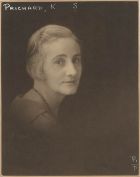
Katharine Susannah Prichard

Katharine Susannah Prichard (1927/8) (State Library of New South Wales [Public domain], via Wikimedia Commons)

This idea that Australian prose was moving away from a focus on melodrama and simple plots to exploring deeper issues and concerns runs through all the articles I read from the decade. As The Sun’s writer says, the setting, for most, was still Australian, but the core issues were becoming more universal. (Also running through the articles, unfortunately, was an ongoing issue with getting Katharine Susannah Prichard’s name right – something I’m sure biographer Nathan Hobby knows all about, and then some!)

Anyhow, the winner of the competition, a Miss Constance Wallace of Roseville, wrote that:

The Australian novel at last has broken from the convention of gum-trees and wide open spaces. It is losing its colonial, narrow atmosphere for a more vital and a broader national—and International—outlook. It has achieved a deeper humanity and a more virile quality. No longer is it mere landscape painting; the canvas begins to glow with the warmer tones of human emotions.

She names, among others, Henry Handel Richardson, Helen Simpson, G.B. Lancaster (pseudonym for Edith Joan Lyttleton), M Barnard Eldershaw, and a man or two, including Ion Idriess.

Meanwhile, back in 1931, The Canberra Times reported on two talks given to the Canberra Society of Arts and Literature by eminent men of letters of the time, Kenneth Binns and Harold White. Binns discussed M Barnard Eldershaw’s Green memory. He described the plot as “strong, dramatic and dignified” and as proceeding “with that quality of inevitableness which is characteristic of all great dramatic writing”. He liked the characterisation, describing the interest being in “the pull of character against character, instinct against instinct” in the two main characters, but he also commended the authors’ ability to delineate their minor characters. In terms of style, he described the pair as “masters of vivid, picturesque yet dignified writing”, likening them to Robert Louis Stevenson, “in their use of picturesque and arresting words and metaphors, and also in their command of highly pregnant short sentences”. Binns believed that Marjorie Barnard and Flora Eldershaw had “produced a book which not only delights but which also adds dignity and significance to Australian letters”.

Book coverWhite talked about Henry Handel Richardson’s The fortunes of Richard Mahony (1930), starting by contesting some of the criticisms from Australian critics. He described the trilogy as having “a structural harmony found only in very great novels” and he dispensed with “the question of whether the author had produced a typicallv Australian book or not” by saying it was “a universal work, and that should be enough”. (So there!) White, like Binns, then went on to talk about the work in detail – plot, characterisation, style, and so on, concluding, our reporter says, that
with this one book, Australian fiction took its rank with European conception of the novel as a form of art through which the real experiences of life are recorded sincerely and honestly. At the same time the author had recreated a period in our social history and added two living creations to the world’s great characters in fiction.

In 1934, a writer in The Age reviewed a later work by Henry Handel Richardson, The end of a childhood, which s/he described as “a collection of odds and ends”. Some of this the reviewer felt would “add little to the author’s reputation”. However, the work includes some sketches of girlhood, in which, says the writer, “slight as they are, Mrs. Robertson [sic!!!] displays a penetrative knowledge of the mentality of young girls”. The book concludes with four stories, which, our writer finally praises, reveals the “psychological subtlety which has proved a valuable asset in her portrayal of characters on a larger canvas”.

Moving on, in 1937, an article in Adelaide’s The Advertiser discussed Katherine [sic] Susannah Pritchard’s [sic] (honestly!) novel Intimate strangers, which the writer argues represents a development in Australian fiction because it “gives one the impression that Mrs. Pritchard [sic] is feeling her way towards what one may call the sociological novel”. The writer has some reservations about the book, but also praises it because Prichard

has grasped so well … the essentially challenging nature of marriage — the surrender that it calls for but which cannot wholly be given; the individual aspirations that, in its infinite demands, it so often submerges; the regrets it cannot completely banish; and the whole complex and unfathomable business of two distinct personalities being required to find a common denominator.

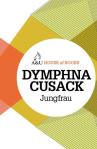
Dymphna Cusack, JungfrauAnother writer praised during the decade is Dymphna Cusack. In another 1937 article in Adelaide’s The Advertiser, the reviewer praises Cusack’s Jungfrau (my review). The reviewer starts with:
“IT is not wholly fanciful to suggest that within a decade or so most novels of ideas will be written by women,” a distinguished English literary critic wrote recently. “Modern intelligent men,” he added, “express themselves and their thoughts more easily in autobiographies, biographies, essays, and books of travel than in the form of fiction. And the future of the English novel is already largely in the hands of women.”

Our reviewer goes on to suggest that we should test this idea against the Australian novel, and starts by referencing Henry Handel Richardson. However, “are there”, s/he asks, “any young Australian women writers to succeed her in making the future of the Australian novel a brilliant one?” Well, yes, is the answer, and one of these is Dymphna Cusack as evidenced by her debut novel Jungfrau. I loved the writer’s reference to the cover, when s/he describes it as “a novel that — despite its title and its publishers’ absurd pictorial jacket— is arrestingly Australian in every way as well as being a fine piece of fiction”.

S/he goes on to praise Jungfrau, for its portrayal of Sydney, giving

a valuable picture of our city life that should do much to dispel persistently recurring illusions abroad concerning Australians’ homes, culture, manners, and way of speech.

Not only is Jungfrau “interesting and convincing”, s/he writes, it is also

extremely well-written, the prose having an effortless continuity and forcefulness which make it delightful to read, as, one feels, it must have been delightful to write.

The writer praises Cusack’s “lesser characters”, saying she “has endowed the very least of them with life; they are all so easy to believe in, and so easy to like or laugh at or despise.” And finally, s/he concludes that “altogether, the young writer is very much to be congratulated on her first book; on her irony, insight, and deft handling of human nature”.

So, Henry Handel Richardson, Katharine Susannah Prichard, Marjorie Barnard and Flora Eldershaw, and Dymphna Cusack … all praised, with clear argument, for progressing Australian fiction through the quality of their writing and their characterisation, and by tackling bigger and more universal ideas.

Have you read these authors, and, if so, what would you say?

Special Book and Event Giveaway for Jessica White’s Hearing Maud

Book cover

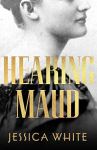
Regular readers here will know that I very rarely do give-aways. However, when Jessica White, who is on the Australian Women Writers Challenge team with me and whose novel Entitlement I’ve reviewed, asked whether I’d be happy to do a giveaway for her latest book, Hearing Maud, and her conversation with Inga Simpson at Muse, how could I refuse? Of course, I couldn’t, and didn’t want to.

So, here’s the deal:

On Saturday 2nd November, from 4.30 – 5.30pm at the wonderful Muse Books and Cafe, Jessica will be in conversation with writer Inga Simpson about her hybrid memoir on deafness, Hearing Maud, which details Jessica’s experiences of deafness after losing most of her hearing at age four. It charts how, as she grew up, she was estranged from people and turned to reading and writing for solace, eventually establishing a career as a writer. Central to her narrative is the story of Maud Praed, the deaf daughter of 19th century Queensland expatriate novelist Rosa Praed. In researching Maud’s story, Jessica reached back into the history of the deaf and realised how, although her and Maud’s stories are a century apart, they both still struggled with the expectations that they be like hearing people.

Jessica is offering not one but TWO giveaways:

  • a copy of the book and a free ticket to this event; or,
  • a copy of the book

Please leave your name in the comments, noting which of these two draws you wish to go into, by midnight AEDST Tuesday 29th October.

The draw, using a random number generator, will be made on Wednesday 30th October:

  • The winner of the book and event will just need to turn up at the event as his/her name will be recorded at the door.
  • The winner of the book will need to email his/her address as requested in the announcement email.

Jessica and I look forward to hearing from you!

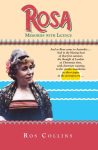
Ros Collins, Rosa: Memories with licence (#BookReview)

Book coverMemoirs are tricky things. There are readers who love them, readers who hate them, and readers like wishy-washy me who sit in the middle. I sit in the middle because, for a start, I don’t like to say “never” when it comes to reading. I sit in the middle because I couldn’t cope with a steady diet of memoirs, particularly those how-I-got-over-my-[whatever trauma or challenge it was], which is certainly not to say that I don’t admire those memoirists or don’t enjoy some of their fare. And, I sit in the middle because I don’t like formula, because I like books that try to tackle their subject or their form a little differently. So, the memoirs I mostly read are those which play with form or whose subject matter offers something different. Ros Collins’ memoir, Rosa: Memories with licence, does both of these.
First, the subject-matter. Rosa deals with, as the book description says, “Anglo-Australian Jews [who are] often overlooked in fiction and memoir.” Having known many Anglo-Australian Jews through my life, I was interested to read Collins’ discussion of her family’s life, as a contrast to those more directly Holocaust-influenced lives of European Jews we’ve all read about. It’s not easy being Jewish, I believe, regardless of personal or family history, so I was interested to read this story.

Then there’s the form. The subtitle, “memories with licence”, suggests that this is not going to be your usual memoir. For a start, it is told third person about a person called Rosa, which is the name given to the author Ros by “two elderly men from Southern Europe” whom she met on a recent Anzac Day Eve. She goes on to say, in her Introduction, that it is this “Rosa who wanders through the following stories, sometimes fictionally, sometimes autobiographically”, though I hazard to guess it is mostly autobiographical – just told one voice removed! Near the end of the introduction, she says that:

Rosa is much more personal [than her previous family history book, Solly’s girl] – and freely written – and I have taken liberties with the truth. Memoir with a little fiction, or fiction with a little history? It’s hard to say. Memories with licence.

The book has been classified on its back cover as Memoir. And that is how I have read it, as it reads true.

So, why tell it this way? Collins says she wishes “to entertain”. Her aim is not to delve into world history, cataclysmic events, or, even, dystopian futures. She wants, instead to shine a light on lives that may not be well known to many Australians, on Anglo-Australian Jewish lives. Taking a third person voice enables her to tell her story a little more objectively, to comment on what people, in particular Rosa, were, or may have been, thinking and feeling. Third person also enables her to get out of the main subject’s voice and head. It enables her to suggest what others might be thinking, such as Rabbi Szymanowicz:

Rabbi Szymanowicz stopped surreptitiously searching the room for younger people with whom he might more profitably connect, and looked at her. Seldom, if ever, had he met an elderly congregant quite like her; for an eighty-something-year-old Rosa did not come across as a sweetly gentle Miss Marple – more likely to be opinionated and argumentative.

This sort of statement could not be made in the same way in a traditional memoir. A traditional memoirist can not so directly get into the head of another character. A traditional memoirist can only suppose what another character might think (unless they are quoting documented facts from, say, letters). Taking this third person approach gives Collins more licence. She can, for example, “guess” about the relationship between her two grandmothers, two women who were not happy because they lost significant supports, when Rosa’s parents married.

All this could be disconcerting to some readers, but Collins has been honest from the start about what she is doing. Ultimately, the important thing is whether the book rings true and I believe it does. Rosa’s character – her humanity, her sense of her own flaws, her uncertainties, as well as her pride in her achievements – shines through.

Another way in which the book departs from traditional memoir is in its lack of linearity. While there is an overall movement from past to present, Rosa is not told chronologically. Instead, each chapter or “story” takes up a theme through which the story of English-born Rosa (Ros) and Australian-born Al (Ros’s husband Alan) is told. Chapter 4, “Jellied eels”, for example, explores food, Jewish culture, and Rosa’s navigation of it all. Collins explains how, as a child, Rosa had been told what she could and couldn’t eat, but not told why. Her mother expected her to “just accept the traditions” but of course this is not the way to hand down traditions, not, certainly, “to a difficult daughter – full of unnecessary questions”!

Collins also tackles, gently and without polemics, what Israel means (or, might mean) for Anglo-Australian Jews. For those of us who find Israel and the politics of the region highly problematic, it’s useful – though not necessarily convincing – to be reminded that in Israel, as Rosa quotes Golda Meir saying, “nobody has to get up in the morning and worry about what his neighbours think of him. Being a Jew is no problem here.”

Rosa, then, is a warm-hearted, open-minded “memoir” written by an Anglo-Australian Jewish woman for whom being Jewish, as for many I believe, is as much, if not more, about history and heritage as god and religion. In this book, Collins interrogates her family’s past, and her late husband’s story, in order to come to a better understanding of herself, and of what she would like to pass on to the next generation. This book is testament to that soul-searching, and makes good reading for anyone interested in the life-long business of forming identity, Jewish or otherwise.

AWW Challenge 2019 BadgeRos Collins
Rosa: Memories with licence
Ormond: Hybrid Publishers, 2019
ISBN: 9781925736113
186pp.

ABR’s Top Twenty Aussie novels of the 21st Century

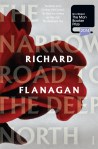
Ten years after publishing its first ABR readers fan poll, the Australian Book Review asked its readers again to nominate their best Australian novels, but to keep it to those published this century. In its intro to the resultant list, ABR says that Richard Flanagan’s novel The narrow road to the deep north emerged as the clear winner. It also noted that Tim Winton’s Breath came fourth as it did in the original FAN Poll for the best Australian novel of all time. (That poll was won by Tim Winton’s Cloudstreet). Two other books appeared in the top ten (I think they mean) of the two lists: Alexis Wright’s Carpentaria and Christos Tsiolkas’ The Slap.

In my report of that first poll, I wondered whether Breath’s high ranking was “largely due to its still being fresh in people’s minds”. Clearly it’s more than that, which is fine with me because it’s a book that has remained vivid for me.

You can see the whole list, plus reviews and interviews for the Top Ten, on ABR’s page.

The top twenty

  1. Richard Flanagan’s The narrow road to the deep north (2013) (my review)
  2. Trent Dalton’s Boy swallows universe (2108) (my review)
  3. Alexis Wright’s Carpentaria (2006) (my review)
  4. Tim Winton’s Breath (2008) (my review of sorts)
  5. Markus Zusak’s The book thief (2005) (my review)
  6. Peter Carey’s True history of the Kelly Gang (2000) (read before blogging)
  7. Heather Rose’s The museum of modern love (2016) (my review)
  8. Charlotte Woods’ The natural way of things (my review)
  9. Christos Tsiolkas’ The slap (2008) (my review)
  10. Hannah Kent’s  Burial rites (2013) (my review)
  11. Craig Silvey’s Jasper Jones (2009) (my review)
  12. Michelle de Kretser’s Questions of travel (2012) (my review)
  13. Jane Harper’s The dry (2016)
  14. Kate Grenville’s The secret river (2005) (read before blogging)
  15. David Malouf’s Ransom (2009) (my review)
  16. Peter Temple’s Truth (2008) (my review)
  17. Steve Toltz’s A fraction of the whole (2008) (my review)
  18. Gillian Mears’ Foal’s bread (2011) (my review)
  19. Kim Scott’s That deadman dance (2010) (my review)
  20. Shirley Hazzard’s The great fire (2003) (read before blogging)

Comments? Not many. After all I’m on the road in Japan and my time is short. I am astonished though, to discover that I’ve read nineteen of the top twenty, and most of those I’d regard as worthy of faring well in such a list. Some of course are very recent, and may not appear in ten years time, given the century is so young. Nine of the twenty are by women, which is a fair representation, and two are by indigenous writers. There’s also some immigrant literature here, that is, fiction dealing with issues relating to our multicultural society. There are coming of age stories, some crime, a dystopian novel, and quite a bit of historical fiction. There are books grappling with our uncomfortable history, and there are quieter more contemplative books. In other words, a broad range.

Although there are notable omissions – Murnane springs to mind, for example, but there are many many others – I’m not going to get into what I think should or shouldn’t be here. Sorry!

Thanks to Colin Steele who organises ANU/The Canberra Times Meet the Author events that I try to attend.

And now, over to you. I have a train to catch.

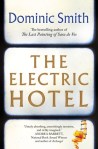
Dominic Smith, The electric hotel (#BookReview)

Book coverI admit to a brief feeling of déjà vu when I started Dominic Smith’s latest novel, The electric hotel, because it starts by telling us that its protagonist 85-year-old Claude Ballard has been living in the Knickerbocker Hotel in Los Angeles for over thirty years. Not another man living in a hotel like our gentleman in Moscow? Very quickly, though, I realised that this was a very different book. Towles was inspired by the idea of people living in hotels, while Smith was inspired by something completely different, the idea of lost films. The Library of Congress, he says, believes that over 75% of silent films have been lost forever. A figure familiar to retired film archivist me.
What’s the hotel got to do with all this? Well, apparently, the 1929-built Knickerbocker was, for much of its life, closely connected with the film industry. As Claude remembers in the novel, costume designer Irene Lentz committed suicide by jumping from the 11th floor, and silent film director DW Griffiths collapsed in the lobby. Moreover, at least one person, the character actor William Frawley, did live at the hotel for thirty years. However, Smith’s story, unlike Towles’, spends very little time in the hotel. Instead, it follows the life and career of fictional silent filmmaker Claude Ballard, focusing on his most famous film, The electric hotel, which sent him, and the production team, bankrupt, not because it was a failure but because the film inventor Thomas Edison threatened to sue for illegal use of his patented film stock. While Claude and his film are fictional, Edison was a shrewd businessman who did try to control the film industry. Smith’s research, then, looks good, and while I’m not an expert in the silent era or its technology, I felt pretty comfortable with the history – right down to the concerns about the vinegar smell in Claude’s room, although I don’t think the term “vinegar syndrome” was much used in the early 1960s.

For a (retired) film archivist like me, The electric hotel offers a step down memory lane. Indeed, the framing story is that film historian Martin, who is writing his dissertation on innovation in early American silent film, has become interested in Claude’s career. We are neatly given the shell of Claude’s career in the first chapter via his first meetings with Martin. This segues to Chapter 2 and the largest portion of the novel which takes us from the young Claude’s meeting the pioneering Lumière Brothers in the mid 1890s, through to the heyday of his career when he worked with American producer Hal Bender, French actor Sabine Montrose, and Australian stuntman Chip Spalding, and which peaked with the release of The electric hotel in 1908. They are artists, entrepreneurs, adventurers, and together they make something quite astonishing. Gradually, however, and for various reasons that I won’t spoil now, they go their separate ways. We follow them through to the end of World War 1, with a couple of forays back to the novel’s original time setting, 1962, where we also end up.

It’s an engrossing read. Smith creates vivid characters, and conveys well the excitement and energy of the early film industry pioneers – Claude’s early fin-de-siècle days in Paris, his travelling around the world with the Lumières’ cinématographe, the development of his career in New York with Hal and Chip, and the war years. It’s a complex story, with a fair share of twists and turns, about art and money, success and failure, and, yes, an artist (Claude) and his muse (Sabine).

What, though, is the book really about? Besides being inspired by the idea of lost films, I mean? Smith himself says, as quoted in the press release, that his ongoing interest is “the gaps and silences of history”.  What does he say about these gaps and silences? I’m not sure, really. I think that perhaps he’s not so interested in commenting on the gaps, as dabbling around in them and bringing them to our attention. This is what he does for silent film, anyhow, but in doing so he also explores the increasing realisation of the power of this new movie medium. Early on Claude tells Sabine that “it turns life into moving pictures”, and a little later, Sabine’s coach and devotee of naturalism, Pavel, says that Claude had “managed to trap real life”. It’s in the war, though, that film’s darker potential becomes obvious, as German soldier Bessler forces Claude to produce the perfect propaganda movie, The victor’s crown. Claude, however, manages to subvert it to his own ends, proving to Bessler’s detriment that, indeed, “the camera sees the truth”!

The book is also an ode to the drive, the obsession, to produce art – and to the price paid by those who have this drive. Claude, who never goes anywhere without his camera, keeps his most personal negatives undeveloped because “until that second they hit the chemical bath, every image is perfect in my mind”. I’m sure many creators understand this.

But the book also has a personal dimension. It’s about love and loss, about escaping, hiding, and stalling. Claude’s personal life is peppered with loss, from which he never really recovers. He tells Martin, “I had every intention of starting over. It was like an errand I meant to run for fifty years.” And, late in the novel he says:

… the past never stops banging at the doors of the present. We pack it into watered suitcases, lock it into rusting metal trunks beneath our beds, press it between yellowed pages of newsprint, but it hangs over us at night like a poisonous cloud, seeps into our shirt collars and bedclothes.

It’s good writing – expressive, but controlled, and never overdone.

The smug German Bessler tells Claude that “art is art wherever it blooms”. The electric hotel explores that in all its glorious messiness.

Dominic Smith
The electric hotel
Sydney: Allen & Unwin, 2019
349pp.
ISBN: 9781760528621

(Review copy courtesy Allen & Unwin)

Nhulunbuy Primary School, I saw we saw (#BookReview)

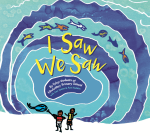
Book coverA week or so ago, I wrote a post to commemorate this year’s Indigenous Literacy Day. In that post I noted that the book I saw we saw was going to be launched at the Sydney Opera House that day. It was written and illustrated by students from Nhulunbuy Primary School, up on the Gove Peninsula, and a number of them were going to read and perform from the original Yolŋu Matha language version, Nha Nhunu Nhanjal?, at the launch. I ordered my own copy of the book that day.

The books – the original Yolŋu Matha version, launched at this year’s Garma Festival, and the English version – were published by the Indigenous Literacy Foundation, which describes itself as a “national book industry charity”. Their aim is to “reduce the disadvantage experienced by children in remote indigenous communities in Australia, by lifting literacy levels and instilling a lifelong love of reading”. These two books came out of their Community Literacy Project, and were produced through a series of workshops with illustrator Ann Haddon and teacher-librarian Ann James, with local Yolŋu elders helping develop the story.

So, the English-version book. It begins with a brief introduction telling us that the Yolŋu people of north-east Arnhem Land represent one of the largest indigenous groups in Australia. Their main language is Yolŋu Matha, which, it explains, has twelve sub-languages, each with its own name. It also tells us that, for most Yolngu children, English is their second (or even third or fourth) language. I saw we saw, the English language version of their book, is, by definition, written in English, but it uses words from the Dhaŋa sublanguage to name the actual “things” seen. This is a lovely, effective way of introducing indigenous language to non-indigenous people (as recommended at the Identity session of the Canberra Writers Festival). However, this approach also creates a bit of a challenge for the reader – what is being seen, and how do you pronounce it?

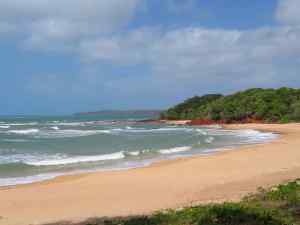
Beach, north-east Arnhem Land

Beach, north-east Arnhem Land

Well, there is quite a bit of help for us in this. First, the text and illustrations provide a lot of clues. “I see a waṯu grab a stick from a man” is accompanied by quite a busy drawing with birds, fish, turtle, jellyfish, and a person fishing, but there is also a picture of a dog with a stick in its mouth. So, waṯu is dog! Sometimes, however, it’s not so easy to get it exactly right, either because of the busy-ness of the picture or the (delightful) naiveté of the children’s drawings. You can usually guess, but can be uncertain, nonetheless. In these cases, the illustration on the last page of the story, which shows most of the creatures with their English names, provides most of the answers. Finally, there is also the online Yolŋu dictionary which, in fact, I used to obtain the necessary diacritics since, funnily enough, they are not available on my Apple keyboard!

That’s the “what is being seen” problem solved, but what about the pronunciation issue? How would you pronounce ŋurula (seagull)? Or mirinyiŋu (whale)? This one is easily solved. At the front of the book is a QR code. You hold your tablet or smart phone camera over that to be taken to a website where you can hear the story read by child-speakers of the language. The whole story only takes 3 minutes or so. Of course, being able to then say the words yourself will take some practice.

The story itself is simple, traditional picture-book style. The pages alternate between “I saw …” and “We saw …”, with each “I saw – We saw” pair forming a rhyming couplet:

I saw a maranydjalk leaping high
We saw a ŋurula soaring in the sky

It’s a delightful book. The rhymes are comfortable, not forced; the illustrations are appealing, particularly to young people; and story introduces readers to the rich natural environment of Arnhem Land region. It also conveys the pride the young authors and illustrators have in their country. It would be a wonderful book to use in primary school classrooms. It’s certainly one I look forward to reading to Grandson Gums when he’s a little older (and I’ve practised my Yolŋu Matha).

You can purchase this book directly from the Indigenous Literacy Foundation, for $24.99.

AWW Challenge 2019 BadgeNhulunbuy Primary School students, with Ann James and Ann Haddon
I saw we saw
Broadway: Indigenous Literacy Foundation, 2019
40pp.
ISBN: 9780648155492


Jocelyn Moorhouse, Unconditional love: A memoir of filmmaking and motherhood (#BookReview)

Book coverAlthough it is quite a traditional memoir, style-wise, Jocelyn Moorhouse’s Unconditional love: A memoir of filmmaking and motherhood is particularly interesting for a couple of reasons. Firstly, she’s an artist who had a happy childhood. Who knew that could happen? Secondly, while most memoirs focus on one aspect of the writer’s life – such as their career (sport, for example), their trauma (childhood abuse, perhaps), their activity (like travel) – Moorhouse intertwines two ostensibly distinct parts of her life, her filmmaking career and her life as a mother.
Jocelyn Moorhouse will be known to many filmgoers as the director of the critically successful Proof, How to make an American quilt, and The dressmaker. She is also the wife of PJ Hogan who directed Muriel’s wedding, My best friend’s wedding, and Peter Pan. This is one amazing couple. Not only have they each made critically successful films, but they are lifetime creative and life partners, working on and/or supporting each other’s movies, negotiating the logistics of parenthood, and so on. They have made it work for over 30 years, in a way that few do. That’s impressive.

It could all, then, have been pretty idyllic, but life rarely turns out that way, and for Moorhouse and Hogan it didn’t. The reason is that of Moorhouse and Hogan’s four children, the middle two are autistic. This resulted in an 18-year hiatus in her filmmaking career, although during that time she kept her hand in, mostly working in some way with PJ on his projects. The book, then, tells both stories, the development of her career from her early studies in media and drama at Rusden State College and then at the Australian Film and Television School, where she met Hogan, and her very particular and demanding life as the mother of two autistic children.

She shares the emotions of giving birth to two gorgeous children only to have them regress around two years of age, as is apparently typical with autism, into unhappy, and therefore difficult children. I say unhappy because it is clear that the children suddenly find the world confusing and frustrating. Their language and communication skills regress so they resort to screaming and crying, and other difficult behaviours. Moorhouse talks about the shock of diagnosis, the therapies they try, including the ones that work (for them), and the logistics of running a family whose life is peripatetic and dependent on the next film job coming along.

Moorhouse, the experienced storyteller (and in fact problem-solver), tells her story carefully. It’s not until halfway through the novel that she brings us to her growing uneasiness about her second daughter, Lily, and Lily’s diagnosis. It’s a tough chapter, because it was a shock to her. She realises that her discussion of causes, not to mention possible preventions and cures, could upset some readers:

I am aware that some of the readers of this book may be autistic themselves and could possibly find this chapter upsetting. Please understand that I wasn’t rejecting Lily because of her autism. If you keep reading, you will discover that I love her autism and her brother’s too. But twenty years ago I was afraid for Lily’s future …

It is tricky to write about issues like this, without offending unintentionally. It’s a long “journey”, to use current terminology, that she and her family go on. And it’s a hard one. Late in the book she says that it took her years to realise that a lot of the pain she was feeling stemmed from “an internal war between my instinct to cling to the dreams about life, and my need to accept the truth”. By the end, she and PJ learn to rebuild their dreams for Lily and Jack, and she learns to balance her need to work against the family’s needs.

This brings me to her career. I enjoyed reading about that, about her own films and the insight she gave me into a film director’s work in general. I worked with film – from an archival point of view – and met various film industry people over the years, but I still learnt much about just what a director does from this book, such as the amount of script work they (might) do, the work involved in casting, choosing location and designing sets, and so on. Each director has his/her own way of doing things, it’s clear, but I greatly enjoyed reading about Moorhouse’s experiences – the wins and losses, the need to be philosophical about those that got away or didn’t go to plan.

Style-wise, Unconditional love is a straightforward chronological memoir, told in plain language, making it an accessible read. A lovely, though not unusual thing she does, is to begin each chapter with a quote. They come from diverse sources, including filmmakers (like Ingmar Ingmar Bergman and Frederico Fellini), writers (like Virginia Woolf and Maya Angelou), people who treat or have autism (like Oliver Sacks and Temple Grandin), and artists (like Marc Chagall). The opening quote, for the introduction, comes from Margaret Atwood, saying that, “in the end, we’ll all become stories”, which seems perfect for both a memoir and a filmmaker.

This is a generous memoir, rather than a tell-all one. There’s little name-dropping, though of course names are dropped because that’s the business she and Hogan are in. There are references to relationship and financial challenges – you’d be surprised if there weren’t any – but these aren’t dwelt upon. She also seems careful to not intrude unnecessarily on her children’s rights to their own lives, particularly as they get older.

Unconditional love is a book that will appeal to readers interested in Australian filmmakers, to those interested in families with autistic members, but most to anyone interested in a story that shares the challenges of a life but focuses more on the solutions.

AWW Challenge 2019 BadgeJocelyn Moorhouse
Unconditional love: A memoir of filmmaking and motherhood
Melbourne: Text Publishing, 2019
296pp.
ISBN: 9781925773484

(Review copy courtesy Text Publishing)

Sir Walter Scott, Waverley, Vol. 1 (#BookReview)

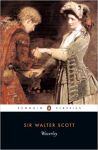
I admit it, I’m defeated – not because I’m not enjoying it, but because it needs more attention than my distracted brain can give it right now. Consequently, I am posting on just the first volume of Sir Walter Scott’s first novel, Waverley. I read it for my Jane Austen meeting last weekend. We did Scott for two reasons: he was highly impressed by Austen’s writing, and Austen liked his!

Waverley was published in 1814, and Austen mentioned it in a letter to her niece Anna Austen that year (which was just three years before she died). She said, in her inimitable Austen way:

Walter Scott has no business to write novels, especially good ones. – It is not fair. – He has Fame & Profit enough as a Poet, and should not be taking the bread out of other people’s mouths. – I do not like him, & do not mean to like Waverley if I can help it – but fear I must… (28 September 1814)

And I must too, really, I must, notwithstanding my decision to not continue!

And Walter Scott is worth liking, because he liked Austen! Here are three references he made to Austen in his journal a decade after she died:

Also read again, and for the third time at least, Miss Austen’s very finely written novel of _Pride and Prejudice_. That young lady had a talent for describing the involvements and feelings and characters of ordinary life, which is to me the most wonderful I ever met with. The Big Bow-wow strain I can do myself like any now going; but the exquisite touch, which renders ordinary commonplace things and characters interesting, from the truth of the description and the sentiment, is denied to me. What a pity such a gifted creature died so early! Journal, 14/3/1826)

AND

The women do this better – Edgeworth, [Susan] Ferrier, Austen have all had their portraits of real society, far superior to anything man, vain man, has produced of the like nature. (28/3/826)

AND

Wrote five pages of the _Tales_. Walked from Huntly Burn, having gone in the carriage. Smoked my cigar with Lockhart after dinner, and then whiled away the evening over one of Miss Austen’s novels. There is a truth of painting in her writings which always delights me. They do not, it is true, get above the middle classes of society, but there she is inimitable. (Journal, 18/9/1827)

Waverley

Waverley book cover

Waverley is regarded as the first work of historical fiction. Its subtitle, “Or, Sixty years since”, tells us its historical setting, which is, specifically, the Jacobite uprising of 1745. The plot concerns Edward Waverley, an idealistic, impractical young man who joins the army, and is sent to the Scottish Highlands. He meets passionate Scottish patriots, Fergus and his sister Flora, who support Prince Charles Edward Stuart (aka Bonnie Prince Charlie), and is attracted to their cause. Not a wise move! Initially published anonymously, Waverley was a big success, marking, says Penguin’s blurb, “the start of his extraordinary literary success”.

So, why do I like it, and yet am not planning to finish it? I like it for its humour and Austen-like observations on human nature. I like the way the novel starts with Scott, as first person narrator, explaining why he chose his character Waverley’s name (“an uncontaminated name, bearing with its sound little of good or evil, excepting what the reader shall be hereafter pleased to affix to it”), and clarifying what sort of novel he was writing. He lists various possibilities – including Gothic, Romance, Sentimental – and then concludes:

By fixing then the date of my story Sixty Years before this present 1st November, 1805, I would have my readers understand that they will meet in the following pages neither a romance of chivalry, nor a tale of modern manners; that my hero will neither have iron on  his shoulders, as of yore, nor on the heels of his boots, as is the present fashion of Bond Street; and that my damsels will neither be clothed “in purple and in pall,” like the Lady Alice of an old ballad, nor reduced to the primitive nakedness of a modern fashionable at a route. From this my choice of an æra the understanding critic may farther presage, that the object of my tale is more a description of men than manners.

Examples of his Austen-like observations, include:

Where we are not at ease, we cannot be happy; and therefore it is not surprising, that Edward Waverley supposed that he disliked and was unfitted for society, merely because he had not yet acquired the habit of living in it with ease and comfort, and of reciprocally giving and receiving pleasure; (Ch. 4)

AND

There is no better antidote against entertaining too high an opinion of others, than having an excellent one of ourselves at the very same time. (Ch. 5)

There are many satirical or humorous comments made in this first volume, such this to the modern “soft” education methods:

I am aware I may be here reminded of the necessity of rendering instruction agreeable to youth, and of Tasso’s infusion of honey into the medicine prepared for a child;

Unfortunately, this method, he argues, did not serve our young hero well:

With a desire of amusement therefore, which better discipline might soon have converted into a thirst for knowledge, young Waverley drove through the sea of books, like a vessel without a pilot or a rudder.

Don’t you love that image, “like a vessel without a rudder”? Anyhow, he then elaborates on the ills of unstructured, uncritical reading.

Later, he describes Waverley’s arrival in the Highlands:

Three or four village girls, returning from the well or brook with pitchers and pails upon their heads, formed more pleasing objects, and with their thin short-gowns and single petticoats, bare arms, legs, and feet, uncovered heads and braided hair, somewhat resembled Italian forms of landscape. Nor could a lover of the picturesque have challenged either the elegance of their costume, or the symmetry of their shape, although, to say the truth, a mere Englishman, in search of the comfortable, a word peculiar to his native tongue, might have wished the clothes less scanty, the feet and legs somewhat protected from the weather, the head and complexion shrouded from the sun, or perhaps might even have thought the whole person and dress considerably improved by a plentiful application of spring water, with a quantum sufficit of soap. The whole scene was depressing, for it argued, at the first glance, at least a stagnation of industry, and perhaps of intellect.

This paragraph has so much in it: the cheeky reference to the mania for “the picturesque“, the “dig” at the English (and their preference for comfort, and, by implication, for “niceness”), and the social commentary regarding the poverty of the peasants.

Now, I know some people don’t like authors who talk to you. I understand it destroys their engagement – the fantasy that what they are reading is “real” – but I don’t feel that way. It could be argued, I think, that this style particularly suits historical fiction because it can remind us that this is someone telling us a story and that we need to think about what we are being told? Anyhow, I did start Volume 2, which opens:

Shall this be a short or a long chapter?—This is a question in which you, gentle reader, have no vote, however much you may be interested in the consequences; just as probably you may (like myself) have nothing to do with the imposing a new tax, excepting the trifling circumstance of being obliged to pay it.

Haha, eh?

However, the book is slow reading. There are so many long descriptions, and, in my Kindle version, the frequently appearing blue-links to footnotes kept distracting my eye, regardless of whether I decided to click on them or not! I just can’t love it enough, right now, to finish it.

So, I’ll leave you with Penguin’s praise that “with its vivid depiction of the wild Highland landscapes and patriotic clansmen, Waverley is a brilliant evocation of the old Scotland – a world Scott believed was swiftly disappearing in the face of a new, modern era.” Scott’s heart was in the right place. He treated his oppressed characters (peasants, for example) with respect, and he recognised that defeat was often accompanied by loss of culture. He is worth reading!

Sir Walter Scott
Waverley, Vol. 1
Penguin Classics, 2004 (Orig. pub. 1814)
388pp.
ASIN: B002RI9IQU
ISBN: 978-0140430714

Grace L. Chao and Amanda Ambinder Shapiro, Bookclub social: A reader’s guide to online book clubs (#BookReview)

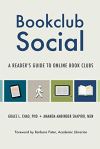
BookcoverBack in 2016, I completed a survey about online bookclubs, and answered some supplementary questions about “my” sort of club. I also took part in a follow-up telephone interview with the two American researchers involved, Grace Chao and Amanda Shapiro. Now, three years later, they have completed their research and self-published it in their book, Bookclub social: A reader’s guide to online book clubs. Of course I bought it, because although it’s some time since I’ve been active in online book clubs (or, OBCs), I am interested in reading communities of all sorts.

Chao and Shapiro explain their research process in the opening chapter. They describe their work as an ethnography, and so used “anthropological methodology”. This involved the survey (for which they received 840 responses, a 22% response rate), followed-up by in-depth interviews with around 100 participants, and participant observation of a number of clubs in operation. They divide the clubs into seven genres:

  • Classics (which includes Literary)
  • Erotica
  • General Reader
  • Horror
  • Mystery/Thriller
  • Romance
  • Sci-fi

You won’t be surprised to hear that I slotted into the Classics group.

Anyhow, in this chapter they explain their aim as being to look at “how the nature of community is being redefined and shaped in the digital age”. I wouldn’t say, necessarily, that what they found was surprising – at least not in terms of my own experience of such clubs – but the book makes some cogent points about how international online communities can work, what they can offer, and some of the challenges they face too.

Of course, Chao and Shapiro found that, overall, female readers dominate most of the clubs, which is similar to face-to-face clubs, although in certain genres, like sci-fi, men are involved in greater numbers than in others. They found that people join these clubs to converse about books, “to deepen and enhance their reading experience”, and often, to seek both intellectual and social outlets. Face-to-face clubs can do these too, but OBCs can offer more.

For example, and this is something that I particularly liked, in a traditional face-to-face book club, there is limited time for discussion, usually just an hour or so. As Chao and Shapiro put it, these groups require “a faster thought process where there is less time to analyze or to react”. In an OBC, you can read a comment by another reader, mull it over, and write a response in an hour, a day, or whenever (within the rules or practices of the club.) I learnt so much during my 10 years or so of active involvement in these clubs.

However, it’s not only the extended time-frame which enables deeper or more expansive discussion. The global nature of these clubs allows for a more “diverse cultural exchange of perspectives and opinions”. This diversity can be generational, gender, racial, ethnic, socioeconomic, political and/or religious based.

For some readers, Chao and Shapiro found, OBCs represented the only outlet available to them for book discussion. These are readers who live in countries/places/situations where “a shared reading culture is not prioritized” (or, even, approved of), or who read genres (like Erotica) for which it is not always easy to find local reading communities, or who, for some reason (such as being housebound), are unable to access activities like face-to-face reading groups.

A propos the first group, Chao and Shapiro write that “for members from more restrictive cultures and communities, a virtual shared reading community could be their first foray into a community which allows personal expression and choice”. They include some moving stories about such readers, mostly women, who are desperate to be part of a reading community. A member of a Romance bookclub told Chao and Shapiro about a member from Pakistan, who was being pressured to marry “an elderly gentleman”:

Shortly thereafter, she told us that her family was not allowing her to post in the group anymore and even restricting her access to the internet. In her last post, she wrote: ‘Think of me.’ I didn’t know what to do. We never realized the risk she was taking by being a member of our book club. Through our book discussions, she was exposed to different cultures, religions, politics, morals, and values; she was able to speak her mind freely, things we take for granted in Western society. It’s like the club was deemed a bad influence…

Stories like this are saddening, but not surprising.

They note, in fact, that the social aspects of these clubs disprove the popular misconception that OBC members are “anti-social because they prefer online to face-to-face interactions”. Socialisation does take place, they say, with “intricate networks of friendships” being created across “national borders, time zones, and cultural barriers”. Here I’ll share a quote from the book that I’m sure another survey participant wrote about me:

I met another gal from Australia when she and her hubby were visiting here. We went to a great museum in Los Angeles.

Mr Gums and I did indeed meet two OBC friends of mine, and we had a lovely day at the J. Paul Getty Museum in Los Angeles. My OBC experience has had a significant and ongoing influence on my life, even though I am no longer active.

The book is logically structured, with the main body comprising chapters focusing on specific questions, such as Who’s in charge? (on the role of moderators) and Who’s anchoring the club? (on the role of core members). Other chapters explore social connection in OBCs, how they create virtual safe havens, their role in exposing members to new ideas, and the way they are able to create a sense of belonging among members. Chao and Shapiro support these discussions with evidence from their field research and from relevant academic writings by anthropologists, sociologists, information scientists, and others. The chapters are carefully footnoted and there is an extensive list of references at the end.

I’m not sure whether what they found can be extrapolated to other online communities and the book ends with advice about OBCs rather than making such extrapolations, but they do make some cogent points about the way OBC’s support and promote diversity and inclusivity, and they identify the main factors that make these sorts of communities work (or not). For these reasons, Bookclub social is a worthwhile read, as well as, for me at least, an enjoyable one.

Grace L. Chao and Amanda Ambinder Shapiro
Bookclub social: A reader’s guide to online book clubs
BookBaby, 2019
ISBN (ebook): 9781543947526