Amanda Duthie (ed.), Kin: An extraordinary filmmaking family (#BookReview)

Book coverKin: An extraordinary filmmaking family is the second tribute book I’ve reviewed in Wakefield Press’s Don Dunstan Award series. The first, Margaret & David: 5 stars, was also edited by Amanda Duthie. Like that book, Kin contains short reflections and essays on the contribution made to Australia’s film industry and culture by Freda Glynn, her children Erica Glynn and Warwick Thornton, and her grandchildren Dylan River and Tanith Glynn-Maloney. The book also includes brief biographies of the five individuals involved, and a family tree, all of which help orient the reader.

In my review of Margaret and David, I focused on one aspect of the pieces that interested me, which was the commentary on what I called “the practice of criticism”. That made sense, because Margaret and David are critics. Freda Glynn and family are a very different awardees. They are indigenous Australians from central Australia, and they have championed and practiced Aboriginal screen story-telling for over three decades, their influence reaching way beyond Australia. Freda Glynn helped establish CAAMA (the Central Australian Aboriginal Media Association) and Imparja Television. Erica Glynn and Warwick Thornton are internationally renowned filmmakers (and more), with third generation Dylan River and Tanith Glynn-Maloney following in their filmmaking footsteps.

The pieces are written by a wide variety of indigenous and non-indigenous arts people from around the world, such as actor Deborah Mailman, authors Bruce Pascoe (whose Dark emu I’ve reviewed here) and Larissa Behrendt, critics Margaret and David (of course!), arts administrator Kim Williams, and American academic Faye Ginsburg, to name just some of the over 20 contributors.

Most of the pieces comprise personal reflections and heartfelt tributes to the various individuals in the family, but for those wanting a good overview of how it all started, Philip Batty’s longer piece, “Freda Glynn and the evolution of CAAMA: A personal reflection”, is well worth reading. Too few Australians know about our indigenous pioneers – who they are, let alone what they’ve done and the challenges they’ve faced doing it. Having worked, as most of you know by now, in the film archive/library industry most of my career, I became aware of CAAMA early in its existence, but I didn’t know half the story told by Batty – the personal and the political! He tells of CAAMA applying for money in 1988 from the Australian Bicentennial Authority:

Some city-based Aboriginal groups protested again CAAMA accepting the bicentennial ‘blood money’ and, on several occasions, Freda fronted up to these groups to argue that all government funding to Aboriginal organisations could be described as ‘blood money’. Indeed, at a particularly hostile meeting, I remember thinking back to the first time I met Freda when she was confronted by the all-white Citizens for Civilised Living [can you believe such a name!!]. On this occasion it was an all-Aboriginal crowd she confronted with the same bravery.

It’s important to note here that, as Stan Grant and so many others have stated, indigenous people are not united in their responses to how their cause should be progressed – any more than non-indigenous people are about their lives. I’m frequently astonished by how we white Australians seem to expect all other groups to be united in a way that we are not. It denies people the individual agency in their lives that we demand for ourselves.

Anyhow, rant over. I’m not going to spend a lot of time on this book. I’m unusually behind in my reviews, and this book is, in one sense, of specialist interest, though in another I’d argue that it would offer something to all Australians interested in our cultural history. It does have a political thread – of course – but that thread is unified by a single foundational idea, the idea that sits at the bottom of all that this impressive family does. I’ll let Bruce Pascoe tell you:

The real history of the country was eliminated from our curriculum, our society, our politics, our morality. If the best-educated people in the land, the mild professors and urbane historians, can fabricate a history of such blinding connivance then another tactic has to be employed if the oppressed are to receive any form of justice. And that tactic is on old one: story.

What Freda Glynn and her family have done – as this book shows – is to set up infrastructures (the CAAMA group supports music, film, television, radio, for example) that facilitate that story being told, to provide training for indigenous people in creating and producing their stories, and of course, to make stories themselves. Warwick Thornton’s films Samson and Delilah and Sweet country are just two examples of a swathe of productions members of this family have made and/or facilitated.

All I can say is may the Glynn family continue to make stories that tell us as it is! Meanwhile, I commend this book to you as an excellent introduction to all that can be done when people put their hearts and souls into something they believe in.
AWW Challenge 2019 BadgeAmanda Duthie (ed.)
Kin: An extraordinary filmmaking family
Mile End: Wakefield Press, 2018
176pp.
ISBN: 9781743056028

(Review copy courtesy Wakefield Press)

Janet Lee, The killing of Louisa (#BookReview)

Book coverI started reading Janet Lee’s historical fiction The killing of Louisa straight after reading Amor Towles’ A gentleman in Moscow (my review), which is also a work of historical fiction. They couldn’t be more different. Not only is one about a real historical figure in late 19th century Australia, while the other is about a fictional one in 20th century Bolshevik Russia, but one is told first person present tense, while the other is third person past tense.

Now, when first person present tense started appearing on the contemporary literary scene as the style-du-jour, I rather liked it. I liked its freshness, and the sense it gave of speaking directly to me. But then it started to wear a bit thin. This is not to say that I don’t like it – ever – just that it can be overused and not necessarily add to the experience. I loved the measured, sometimes wry, third person voice in Towles’ novel. It suited a book that seemed to be critiquing both human nature and an historical period. Did the first person voice suit Lee’s novel?

Well, let’s see. The novel is about Louisa Collins who, in 1889, was the last woman to be hanged in New South Wales. Her story is a horrifying one: she was tried four times for murder, with the fourth trial convicting her after the three previous ones failed to come to a decision. There’s more to it though, in that the first two were for the murder, by poison, of her second husband. When the juries could not agree, she was charged with the murder, also by poison, of her first husband. When that too failed, they returned to the first husband, and finally a guilty verdict was achieved, largely using the testimony of Louisa’s 11-year-old daughter May who admitted to seeing a box of “Rough on Rats” in the kitchen. The novel tells this story from Louisa’s point of view.

Formally, the story takes place over six weeks, from 26 November 1888, when she is in gaol waiting for her fourth trail, to 8 January 1889, when she is executed. However, of course, we want to know the full story of Louisa’s life and how she got to be where she was. Lee does this by having her tell her story to the prison chaplain, Canon Rich, while she awaits her execution.

It’s a moving story – of course. Born to a poor family in a country town, Louisa, when still a young teen, is found a job in the home of a lawyer by, it seems, the mother of a wealthy young man who fears her son is becoming too close to the girl. Louisa’s employer is good to her, and she’s happy, but at the age of 18, she is married her off to a man around 15 years her senior whom she barely knows. Charles is a butcher with his own business, and they both work hard, but, more through bad luck than bad management, the family, which seemed to be making a go of it, ends up living in Sydney, and poor. They take in boarders to supplement their income. It’s a world, of course, where women had no rights and little power, though Louisa does stand up for herself within her marriage, exerting a right to wrest some enjoyment out of her life. Things, however, become complicated when the flashy, confident Michael appears on the scene.

All, or most of, this Louisa tells Rich, with a fair degree of self-knowledge about her own failings but also with some insights into human nature (such as how recollections can change!) and how the world works. On her mistress spending years in mourning for a dead baby, Louisa says to Rich:

But the Missus had become like this because she was allowed to dwell upon her sadness for so long. Sometimes folk who suffer a tragedy can pick themselves up and dust themselves off and keep going on through life, and it is often the poorer ones who do this because they don’t have the luxury to stop and mourn […]

Mourning and feeling feeble is a luxury, and it is my observation that only the rich have that luxury, sir.

Louisa is not speaking from theory here; she has learnt the truth through her own experiences of loss.

However, hers a tricky story to tell, because, ultimately, we don’t know whether she was guilty or not, and Lee is not about producing a work of romantic fiction. So, she needs to tread a fine line. Using the primary resources available to her which comprise some letters, court and parliamentary records, and newspaper reports, she tells Louisa’s story.

And Louisa’s story is worth telling for several reasons. First, there’s that reason why many of us enjoy historical fiction, which is to learn, to feel, the social history of a period. Louisa’s first person voice conveys perfectly the lives of poor working women of the time – the hard work, the dust and grime, the worry, the powerlessness. She also conveys her increasing awareness of the need for representation for women in parliament. Knowing where we’ve come from and why we should do all we can not to go back there is a good reason for reading books like this.

But, unfortunately, the book also reminds us of how far we still have to go. One of the features of Louisa’s case is that old story of women being tried by society and the media for not behaving with the propriety expected of them. Louisa likes to have a good time, so she would dance and drink when an opportunity arose, and she argues for her right to do so. Worse though, she appears “cold” after the deaths of her husbands. She doesn’t wear mourning and she doesn’t cry and wring her hands. Heard that before? (Australians will immediately recall the Lindy Chamberlain case.) Louisa’s awareness of this issue is supported in the text by well-placed excerpts from primary sources, such as the snide remark in Parliament, comprising all men of course, about her “method of procuring divorce by means of arsenic”. The problem is that, still, even after Lindy Chamberlain, things haven’t changed, or not changed enough … we still have trial-by-media and women are still excoriated for not behaving in a so-called “womanly” way.

Janet Lee’s is not the first book about Louisa Collins. In 2014, journalist Caroline Overington published her history, Last woman hanged, after researching the case for some years. I haven’t read that, but I understand that she too presents an “open” story, that is, one that leaves it to the reader to consider the rights and wrongs of the case. And that, I think, is the right way to handle this story. What is wrong, though, is capital punishment! It is wrong for so many reasons, but one of the greatest of these is the risk of executing innocent people.

But now back to my original question regarding voice. As I started The killing of Louisa, I felt I wanted a third person omniscient voice telling this story. I wanted a considered voice giving me the pros and cons of the case. However, as I read on, I became engaged by Louisa’s voice, particularly by the tone Lee achieves which, while containing an element of sorrow and self-pity, is neither pathetic nor whiny. By adding excerpts from the sources, Lee provides some of that overview I wanted.

The killing of Louisa, then, is not only an engrossing story about a shameful case from the past, but one that intelligently grapples with the challenges of presenting such a case through historical fiction.

AWW Challenge 2019 BadgeJanet Lee
The killing of Louisa
St Lucia: UQP, 2018
268pp.
ISBN: 9780702260223

(Review copy courtesy UQP)

Amor Towles, A gentleman in Moscow (#BookReview)

Cover for Amor Towles A gentleman in MoscowAmerican writer Amor Towles’ third novel, the best-selling A gentleman in Moscow, generated a surprisingly lively discussion at my reading group last week, because beneath its engaging, accessible exterior are some puzzles. These puzzles relate primarily to Towles’ intentions. What were they? Why did an American investment banker write an historical fiction novel about a Count in Bolshevik Russia?

But, I’m rushing ahead, so I’ll slow down and do the right and proper thing, which is to start  with a plot outline. The novel opens in Moscow in 1922, when our protagonist Count Rostov – once a hero of “the prerevolutionary cause” but now a “Former Person” – is sentenced to indefinite house arrest in the grand hotel, the Metropol, in which he has been living for four years. Not only that, but he is to live in the old servant’s quarters rather than in his luxurious suite. Fortunately, our count is nothing if not resourceful, and he quickly decides that “if a man does not master his circumstances then he is bound to be mastered by them”. The next 450 pages or so chronicle the next three decades or so of the Count’s life under this house arrest, detailing life in the hotel and the relationships he forges over that time. It is, unexpectedly, a thoroughly enjoyable read, but why, exactly? What is it all about?

While most of my reading group loved the book, albeit a couple of us had this niggling “why” question, one member found it “intellectually dishonest”. She could not accept the Count as being in any way representative of Russian aristocrats of the time, and she felt that the novel glossed too easily over the real horrors of the period. Why did she feel so strongly about this, while the rest of us, mostly well-versed in Russian history, did not feel the same way? Well, I don’t know exactly, but I think it might have something to do with form and tone.

I’m going to explore this a little rather than focus on the content, partly because it intrigues me and partly because I presume that quite a few of you will have read the book and know its content. So, here goes. The novel is historical fiction, but what sort? It’s not your bodice-ripping romance nor the swash-buckling adventure that exemplify this genre. But, neither is it the sort of social realism that is the most common alternative to the romance or adventure approach. What, then, is it? Well, as I was reading it, I had visions of Austen. Sorry, but it’s true! It’s not Austen, of course, but it has a comedy-of-manners ring to it, complete with Austen-like commentary, not to mention her satiric and ironic touches.

This means that although, as its own blurb says, it takes place during “some of the most tumultuous decades in Russian history”, the focus is elsewhere. It’s on the Count and the small community surrounding him; it’s on how does one, in fact, adapt to living under such circumstances. Some of you will know Jane Austen’s famous comment in a letter to her niece about her subject matter:

You are now collecting your People delightfully, getting them exactly into such a spot as is the delight of my life – 3 or 4 families in a Country Village is the very thing to work on.

It’s not a stretch to see the story of the Count’s life in the Metropol through this prism. Indeed, the above-mentioned blurb continues to say that the Count, stripped of his luxuries, “is forced to question what makes us who we are”. This journey was the book’s main story for me. We do learn about Stalin’s regime, through characters who come to the hotel and interact with the Count, but the Count’s personal story is the main game.

So, what does he learn? Early on, he vows “to master his circumstances through practicalities”, and this he does by tailoring his life and expectations. His initial change from hotel guest to prisoner sees him still living pretty much the high life, free to relax and dine, but by the end of the novel he is working as the Head Waiter in the main restaurant, for which, in fact, his aristocratic training in etiquette had well qualified him. He had said that “his model for mastering his circumstances” would not be Dantés planning revenge, nor Napoleon imagining his triumphal return, but “a different sort of captive altogether: an Anglican washed ashore. Like Robinson Crusoe”. Crusoe, in other words, adapted, confronting the challenges as they arose.

As with most of Austen’s protagonists, the Count’s “learnings” are not overly dramatic. He’s already a generally decent, sensible sort of person, but late in the novel, he tells his lover, Anna, in a discussion comparing American “conveniences”, like dishwashers, with Russian privations,

“I’ll tell you what is convenient … To sleep until noon and have someone bring you your breakfast on a tray. To cancel an appointment at the very last minute. To keep a carriage waiting at the door of one party, so that on a moment’s notice it can whisk you away to another. To sidestep marriage in your youth and put off having children altogether. These are the greatest of conveniences, Anushka—and at one time, I had them all. But in the end, it has been the inconveniences that have mattered to me most.”

These inconveniences revolve around the deep relationships he develops through his imprisonment and the demands that such relationships entail. They result in a man who is described by his interlocutor at the beginning as being “without purpose” turning into someone very purposeful.

What’s also Austen-ish is the commentary, the astute observations made about human nature, such as:

By their very nature, human beings are so capricious, so complex, so delightfully contradictory, that they deserve not only our consideration, but our reconsideration—and our unwavering determination to withhold our opinion until we have engaged with them in every possible setting at every possible hour …

If there’s one thing Austen recognises it’s the capriciousness of humans. Another Austen-like statement is this one: “It is a fact of human life that one must eventually choose a philosophy”.

But, still, why write such a story? Towles, himself, has said that he wanted to write about someone forced to live in a grand hotel, and that he had “no central theme”. Rather, he wanted to create a work that would be “satisfyingly cohesive” but “prompt varied responses from reader to reader, and from reading to reading.”

Consequently, while my reading of the book encompasses seeing it as critiquing the corruption, hypocrisies and loss of freedoms that characterised the Bolshevik regime, my overall response is a broader one, which is that, unlike the Count’s friend Mishka and the little-girl-turned-mother Nina, we would do better to develop and rely on our personal set of values, to work on our relationships and the attendant responsibilities not to mention on our own adaptability to circumstances, as the Count does, than commit to any single “ism”.

Lisa (ANZLitLovers) thoroughly enjoyed this book too.

Amor Towles
A gentleman in Moscow
London: Viking, 2016
502pp.
ISBN: 9781448135509 (Kindle ed.)

Vicki Laveau-Harvie, The erratics (#BookReview)

Book coverTruth is that, while I like to read at least some of the Stella Prize shortlist, I didn’t have Vicki Laveau-Harvie’s memoir, The erratics, on my high priority list, though the more I heard about it, the more intrigued I became. However, it was winning the prize that tipped it over into my must-read category. What a challenging read it is.

The erratics is the story of how Laveau-Harvie and her sister responded to their estranged aging parents’ needs as infirmity caught up with them. Canadian-born Laveau-Harvie had, decades earlier, escaped the family home in rural Alberta moving, eventually, to Australia. Her younger sister had also escaped, though not so far. She lived in Vancouver. It all came to a head when their 94-year-old mother’s hipbone “crumbles and breaks” putting her in hospital. Laveau-Harvie and her sister regroup to help – their father, in particular, who, they discover, had been being systematically starved by their mother. The story of this dysfunctional family, and the sisters’ actions to save their father and ensure their mother is deemed incompetent, never able to return home, is arresting.

Equally arresting is Laveau-Harvie’s writing. It’s not surprising that she won the Stella (not to mention the Finch Memoir Prize and being shortlisted in the NSW Premier’s Literary Awards), because the writing grabs your attention with an impressive sureness of tone and language. It’s particularly impressive because it is, apparently, 70-something Laveau-Harvie’s first book.

The back-cover blurb of my edition concludes with: “a ferocious, sharp, darkly funny and wholly compelling memoir of families, the pain they can inflict and the legacy they leave, The erratics has the tightly coiled, compressed energy of an explosive device  – it will take your breath away”. It does all of that.

First, it’s an astonishing story of a mother who seems incapable of the love we expect from a parent. I’ll share the quote that you’ll have read before if you’ve read about this book:

One of the few coherent messages my mother repeated to me and my sister as we grew up, a message she sometimes delivered with deceptive gentleness and a touch of sadness that we weren’t more worthy prey, was this one, and I quote: I’ll get you and you won’t even know I’m doing it.

If you are a parent who feels guilty about mistakes you made in your parenting, you can rest easy after reading this (unless of course you are like Laveau-Harvie’s mother!) Most of us, I’m sure, made our mistakes inadvertently, not with the intent behind this woman’s behaviour. The problem in Laveau-Harvie’s family was compounded by the fact that their father, while not brutal like their mother, was weak, believing (or, at least accepting) everything his wife said about their daughters.

So, the story, itself, is compelling – in the strange behaviour of these two parents, and in the willingness of the daughters, despite being rejected by their mother, including being given no formal role in managing her affairs, to step in and do the hard stuff out of love for their father and, I guess, a sense of responsibility. But, in addition to the story, what makes this memoir particularly compelling is, as I’ve already said, the writing itself.

It’s a tight, spare read at just over 200 pages. It has stunning descriptions, but I’ll exemplify it with the metaphor contained in the title itself, a metaphor that draws from a geologic formation called the Foothills Erratics Terrain in the town nearest her parents’ home:

Countless years ago, the Okotoks Erratic fell in on itself and became unsafe to climb upon. It dominates the landscape, roped off and isolated, the danger it presents to anyone trespassing palpable and documented on the signs posted around it.

Unfortunately, Laveau-Harvie’s mother came with no such sign.

There is a deft handling of chronology, with the occasional bit of foreshadowing. And then there is the tone, which is achieved by a crisp story-telling style that is direct, colloquial, witty even, and that focuses on the facts with little explication, all the while conveying the challenges faced by the two sisters in negotiating their relationships with each other, their father and their mother. One of Laveau-Harvie’s techniques is to undercut a description or plan with a short, emphatic sentence like “That was the plan” or “I can’t fix this” or “I don’t do this”.

It’s an invidious situation, and you can’t help but feel their pain. She writes at one stage of not remembering certain events:

I do know this: where there is nothing, there must be pain; that’s why there is nothing. Be glad if you forget.

There’s another of those short concluding sentences – “Be glad if you forget”. It’s powerful.

The strongest part of the narrative concerns the relationship with her sister who, still living in Canada, is the person on-site, and who has always been less able distance herself from the pain. There’s a telling sentence about their choices of mementoes from the house:

I salvage a few other things … things from my childhood … my sister takes only things acquired by my mother after we had left home, heavy crystal goblets, silver serving plates, full dinner sets of translucent china. I want only the connection to the past, she wants never to feel it again.

So, this sister, the one who wants to distance the past takes on, at a cost to her health, more than Laveau-Harvie believes sensible: “I can see sinkholes of simmering resentment about to develop between us.” Laveau-Harvie explores the challenges of siblings negotiating the care of aging parents with the clear-eyed honesty she applies to the whole story, albeit, at times, I wondered how the sister felt about her depiction. Presumably, it’s ground they’ve well-covered between each other.

The book, then, is compelling and many readers, like Kim (Reading Matters), have found it a “compulsive read”. I did too. But, there was also something about the tone that disquieted me, as it did Kate (booksaremyfavouriteand best). This surprised me because I wasn’t expecting to feel this way. I love fearless honesty. It’s one of the reasons (besides her writing) that I like Helen Garner so much. She is not afraid to say the hard, unpalatable things. And yet, I found it difficult at times here. I think it’s because I felt some of this “honesty” was attended by an unkindness, by a willingness to laugh at another’s expense (though, admittedly, she also frequently laughs at her own).

An example is her description of the array of carers she and her sister put in place for their father. It’s funny, and has an element of truth, recognisable by anyone who has experienced the situation. But I bridle at name-calling, so “the gold-digger” and “the housekeeping slut” did not make me laugh. (I particularly hate women calling other women “slut”, even a “housekeeping” one – but that may just be me!) And then there’s the description of the breakage of some fine china freighted to Australia:

I imagine customs officers dropping the box because it has a label that says ‘Fragile’, satisfied at the sound of something delicate breaking.

Ultimately, however, although I couldn’t help reacting, occasionally, with the disquietude that I did – I realise I can’t judge. How can I, when the family life she experienced is beyond my ken? And, the ending is inspired. She draws on myths about the Okotoks to lay her mother – that “bitterly unhappy and vindictive old woman” – to a potentially more peaceful rest.

The erratics, then, is an impressive debut. It’s compelling and, significantly, it prompts us to think about the importance of love, responsibility and respect within all families.

AWW Challenge 2019 BadgeVicki Laveau-Harvie
The erratics
Sydney: Fourth Estate, 2019 (Orig. pub. 2018)
217pp.
ISBN: 9781460758250

José Jorge Letria, If I were a book (#BookReview)

Book coverIf I were a book is one of those “gift” books you give to readers – and it was in that spirit that it was given to me for my birthday a couple of years ago. It’s a delight of a book, and is somewhat quirkier than these sorts of book-lovers’ gift books often are, which is why I’ve decided, finally, to share it with you. Or, have you seen or read it already?

My edition is a little hardback of 60 plus pages produced in San Francisco in 2014. The original, however, was published in Portugal in 2011, the author being Portuguese. The illustrator, André Letria, happens to be his son. Now I hadn’t heard of José Jorge Letria before, but he was born in the Lisbon District of Cascais, in 1951, and is apparently, says Google’s translation from a Portuguese biography, “a journalist, poet, playwright, fiction writer and author of a vast work for children and young people.” This biography also tells us that he has won many many national and international literary awards, including the Unesco International Prize (France), the Barcelona Classical Poetry Prize, the Plural Prize (Mexico), the Prize of the Paulista Association of Art Critics (São Paulo), and the Gulbenkian Prize. He has won prizes for “the environment in children’s literature” and the Manuel de Arriaga Prize for his contribution to the defense and dissemination of animal rights. He has been on many Portuguese, European and international literary boards, and his books have been translated into “over a dozen” languages. Yet, I hadn’t heard of him, until, that is, I was given this delightful ….

… love-letter to the book and reading. I fell in love with its passion and idealism. The book comprises two-page spreads, each one containing an image and the phrase “If I were a book” followed by a response. So, the first image shows a person looking at a book on a park bench, with the phrase “If I were a book, I’d ask someone in the street to take me home.” (What a nice sign that would make for a street library!) The next shows this same person opening a larger-than-life book, inside which there are stairs descending into unknown depths, with the phrase “If I were a book, I’d share my deepest thoughts with my readers”. And so it continues…

What makes this book so delightful is the personalising of the book (as in “if I were a book”), the ideas expressed in these personalised phrases, and the illustrations. I’m not sure what is allowed by copyright, but I’ve chosen three images to share with you, so you can see what I mean:


This slideshow requires JavaScript.

I’ve chosen these three because the one suggests the way I like to read – slowly, savouring the words and ideas – and because the other two contain aspirations that I’d love books to achieve. You can see how in some images the book is supersized, while in others its size is more “normal”. The images are simple but beautifully whimsical, the colour palette is minimalistic, and the text’s font feels a little worn and loved.

And here, I think I’ll leave it, because what more, really, can I say?

José Jorge Letria
If I were a book
Illustrated by André Letria
Translated by Isabel Terry
San Francisco: Chronicle Books, 2014 (orig. pub. 2011)
[64pp.]
ISBN: 9781452121444

Julian Davies, Call me (#BookReview)

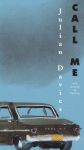
Book coverI wasn’t sure what I was in for when I started reading Call me, the latest offering from that tricksy duo, novelist Julian Davies and illustrator Phil Day. But, it soon became clear that what was before me was a coming-of-age story. What, I wondered, was Davies doing writing such a novel? Then I remembered that this was the author who gave us, most recently, Crow mellow (my review), so I decided to relax and go with the flow. Sensible me, because this is a sophisticated take on the genre, geared to an adult audience.

The story starts in the first person voice of a young woman called Caddie, who is in bed with a young man called Pip. They are both in their last year of school, and the story spans the last couple of months of that year, through their eyes. However, the tricksiness starts here, because Caddie’s voice is first person, while Pip’s is third person subjective. Why? An author doesn’t make these decisions lightly, so I usually want to know why. It’s particularly interesting here because this is a male author choosing to write his female character in first person, and the male in third person. I’ll come back to this because right now you are probably wanting to know more about the actual story than these technicalities!

“This is Australia” (Pip’s friend, Stu)

So, the story. Caddie and Pip have been in a relationship for around a year at the start of the novel, but it’s geographically challenged because Caddie lives in the city (in Canberra, in fact) while Pip lives in the country, an hour or so’s drive away. Davies knows whereof he speaks because he too lives about an hour’s drive from Canberra. Caddie’s parents see themselves, according to Pip, as “high middle class”. They both run businesses, her father’s being an investment business called Capital Capital, and her mother’s an art gallery called Sense and Sensibility (because, as she apparently told Pip, “she was lapping up Jane Austen while her friends were still  playing with their dolls”). They keep “upgrading” their homes, and they fight a lot. Pip’s parents, on the other hand, describe themselves as “feral middle class”. Sydney escapees, they live in the not-quite-finished house they built themselves; they take a loving but laissez-faire approach to parenting; and they get on well. All this introduces the city-versus-country theme that recurs in Davies’ works, including Crow Mellow and his Meanjin piece about building his own home (my review). It’s pretty clear where Davies’ preference lies!

The majority of the novel takes place over 15 days, and chronicles, in lovely nuanced detail, the tensions that develop in Pip and Caddie’s relationship due to Pip’s decision to leave school only weeks before the end. Their thoughts and feelings are told alternately in chronologically named chapters, like “Day One” and “Day Eight (Still Later)”. Although Caddie is critical of her parents, in the way that teenagers often are, she’s following the traditional path of working hard at school and planning to go to university. She is totally into mobile phones and social media. Pip is a more independent thinker. He’s not interested in social media, and only has a phone because Caddie gave it to him. And yet, in a neat paradox, Caddie records her thoughts in a diary, while Pip records his into his phone! This is pure Davies, by which I mean nothing is simple or straightforward.

So, we have the city-versus-country theme, plus a subtle questioning of modern technology, including our reliance on it and its potential for misuse. A third theme relates to education. Pip’s decision to leave school stems from his refusal to live by external expectations that don’t feel authentic to him. He hates the “petty rules” and, as Caddie explains it, “the kind of society we live in that the education system feeds”. He has no alternative plans but feels incapable of “passively endorsing” a system he doesn’t believe in.

“What kind of person am I?” (Caddie)

Accompanying these more sociological themes are personal, psychic ones. Both Caddie and Pip are deeply concerned with their identity, specifically with what it is to be “a person”. Caddie, living in her “sheltered” house and uncomfortably aware of the material benefits provided by her parents, wonders not only “what kind of person” she is, but, more broadly, “what does it mean to be a person.” This question of personhood is frequently burdensome to her. Pip, however, has a different take, recognising that “he is only one person”. One of the challenges they face is negotiating their own and each other’s personhoods. Late in the novel, when their relationship is floundering, Pip wonders “did the new, distant Caddie undermine and diminish his sense of her as the person he thought he knew?” Meanwhile, Caddie “wonders who Pip is that he can hold this view.”

Call me, then, is essentially a book of ideas that questions, in a lightly satirical way, aspects of modern Australian society, but it’s not boringly didactic, partly because the ideas are explored though some engaging characters. These include two we met in Crow Mellow, making this book a sort of “companion piece”. The characters are the wise Phil Day, a teacher who, cheekily, happens to share a name with the book’s illustrator, and the ridiculously named cynic, Dick Scrogum (aka Scrotes). Scrogum’s opinionated banter and Day’s quiet conversations encourage Pip to dig a little deeper into the reasons for his decision.

These characters, however, are only part of why the book doesn’t become mired in earnestness. Another reason is that, surprisingly, as the book progresses, it becomes apparent that there’s more to it than just Caddie and Pip’s relationship; there is in fact quite a plot developing. Who are the mysterious callers on Pip’s phone and what do they want? Should we be worried about them? And what about the gun that Pip has? It is pretty much de rigueur that once a gun is mentioned in a narrative it’s going to be used, but will it? Is this book not what it looks, but, really, some sort of crime-mystery-thriller? You’ll need to read it to find out.

And now, I’ll return to that question I posed at the beginning about voice. Both first person and third person subjective voices offer easy engagement with characters but can only offer limited perspectives. Telling the story through two such voices widens the perspective, by letting us see Caddie and Pip through each other’s eyes as well as their own. In other words, we get a little touch of omniscience alongside close engagement. But, why is one voice first person and the other third? I’m not sure really, but maybe it’s something to do with the fact that Pip is the main protagonist, and that Caddie, as the “I”, represents both herself and the reader (who is, perhaps, likely to be more like her – female, sincere, somewhat conservative, but also open-minded and keen to explore). By being more directly in her head, we are encouraged to question, as she does, certain assumptions and values. I suspect too that there may be something autobiographical about this novel. Is Pip like Davies’ younger self? And does putting Pip at one step remove provide him with a little space to interrogate the boy he was? Certainly Caddie seems to question who Pip is more than vice versa. I’m probably wrong about this, but at least I’ve given it a shot!

As I say all too often, there is so much to say about this book. I haven’t even touched on the gorgeous landscape descriptions of a region I love. Nor on the clever segues, nor Phil Day’s whimsical illustrations, nor the humour, nor, indeed, what a beautiful book is it to look at, hold and read. However, I’ve written enough for now.

Call me, then, is not only an engrossing story about the psychic growing-up of its protagonists, but one that also offers provocative commentary on both humanity in general and modern society in particular. Them’s big boots, but Davies pulls it off, resulting in a book that’s both intelligent and fun to read.

Julian Davies
Call me
Illustrated by Phil Day
Braidwood: Finlay Lloyd Publishers, 2018
363pp
ISBN: 9780994516541

(Review copy courtesy Finlay Lloyd Publishers)

Karen Viggers, The orchardist’s daughter (#BookReview)

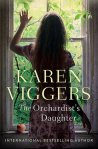
Karen Viggers, The orchardist's daughterThe orchardist’s daughter is local author Karen Viggers’ fourth novel, but the first that I’ve read. She has, however, appeared on my blog before, being the person who conversed with Sofie Laguna about her novel, The choke. It was one of the most entertaining conversations I’ve ever attended.

Now, if you haven’t read or heard of Karen Viggers before, there are some facts worth knowing about her. Firstly, she’s a vet with special training in native wildlife health – and this background informs most if not all of her novels, I believe. It certainly informs The orchardist’s daughter. Another significant fact is that she’s a best-selling author in France! How wonderful that a novelist who writes strongly Australia-centric books does so well in France! Her previous novel, The lightkeeper’s wife, was, in fact, awarded the Les Petits Mots de Libraires literary prize.

So, an interesting author, and The orchardist’s daughter is an interesting, enjoyable book. It is set in a small logging town in Tasmania, and has quite a formal structure, starting with a Prologue, followed by four parts – Seeds, Germination, Growth, Understorey – and ending with an Epilogue. It is told third person through the perspective of three characters – Miki, the titular orchardist’s daughter who is 17 years old for most of the novel; Leon, a Park Ranger, who is 25 years old at the novel’s start; and Max, a 10-year-old boy who is Leon’s neighbour. Miki and Leon are relative newcomers to the town, Miki arriving with her older brother Kurt to run the town’s takeaway shop after they lose their home, farm and parents in a fire, and Leon moving from his Ranger job on Bruny Island to the mainland. All three are outsiders and serve to illuminate the tensions existing in the town.

Around these characters is a community comprising mainly logging families, Max’s being one of them. However, there are others who round out the town a little, including policeman Fergus and his sons, Geraldine who runs the information centre, and vet Kate. The narrative develops around a couple of situations. One is a mystery surrounding Miki’s brother Kurt. What does he do by himself in the forest when he insists that Miki wait in the ute, and what does he do during his weekly solo trips to Hobart (during which he locks Miki inside their shop/home)? The other concerns logging, and the dangerous unrest that develops when a temporary ban is placed on logging around a certain ancient tree. Jobs are at risk, the loggers believe, and the butt of their anger is of course Parkie Leon. From these two situations, Viggers builds tension slowly but inexorably, with the Kurt-and-Miki story becoming the prime focus, of course, given the book’s title.

So, there is a strong plot to the novel, but this plot, while driving us on to read, is there to serve some issues that Viggers wants to explore. These concern logging and the environment, bullying and domestic violence, not to mention more personal ones like freedom. These are big issues, and not only is Viggers clearly passionate about them, but her writing about them feels authentic. The characters may be a little less complex than, say, those in Lucashenko’s Too much lip, but they are believable. Logger and vicious bully Mooney is offset against Robbo, who is equally single-minded about logging but seeks more peaceful, law-abiding means of protest. Similarly, Max’s father Shane, another logger who is violent, is offset against colleague Tobey who has a tender, caring relationship with his wife. All of this is observed by Miki from her shop-counter – and she makes her own little attempts to lighten the lives of the bullied and the ostracised, by sneaking treats into their take-away bags. Through this little subversive action, we sense Miki’s inner strength and resourcefulness, something she takes to another level when she works out ways of escaping her “prison” while Kurt is away.

Freedom is one of the novel’s underlying drivers. Miki’s imprisonment is literal, but imprisonment takes many forms – the wives who are abused but feel incapable of escaping, and young Max who is bullied to behave in ways antithetical to his nature. Some of these are resolved, but Viggers recognises that there’s no magic wand for domestic abuse. The first step is moving from passive awareness (or acceptance, even) to taking action, and this starts to happen in the novel.

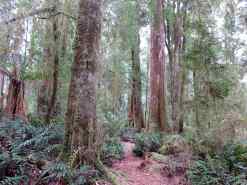
In the Tarkine, NW Tasmania

The book really stands out, however, in its writing about nature. A Booktopia interview with Viggers tells us that she grew up in the Dandenongs and has been to Antarctica. She has also spent time in Tasmania (and immersed herself in Tasmanian-set books, including two I’ve read, Anna Krien’s Into the woods, and Louis Nowra’s Into that forest). All of this has given her a sure feel for the wilderness, so much so that it’s difficult to choose an excerpt to share, but here’s one:

Miki loved the trees and the birds, but what she loved most couldn’t be seen. The way she felt in the forest. The scent of the bush after the rain. The sound of bark crackling. Branches squeaking. The feeling of patience and agelessness, growth and renewal. The aura of trees. The sense of connectedness. Of everything having its place. She could stay here all day, breathing with the tree, drawing its life into her lungs.

These forest descriptions move into Tasmanian Gothic realms during the climactic chase. The experience is both “terrifying and surreal” for our character who crawls and runs through, burrows and squats in the forest, “slipping from the thicket and weaving though the trees, ducking under tree ferns, past the tipped-up end of a fallen tree whose buttressed roots made a wall he could hide behind.” It’s muddy and dangerous with sword grass that scratches you and bark mounds that can trip you up. Viggers knows this landscape – and how to make it terrifying.

In the end, The orchardist’s daughter is about community and compromise, and about the courage to break free. It straddles the boundary between commercial and literary fiction. It is accessible, it has a strong plot and easy-to-engage-with characters, and it is hopeful (not that literary fiction can’t be!!) But, it is also gritty in subject matter and doesn’t offer neat solutions to the important environmental and social issues it raises. I like that in my reading!

Theresa (Theresa Smith writes) also loved the novel.

AWW Challenge 2019 BadgeKaren Viggers
The orchardist’s daughter
Crows Nest: Allen & Unwin, 2019
389pp.
ISBN: 9781760630584

Review copy courtesy the author, Karen Viggers.

Melissa Lucashenko, Too much lip (#BookReview)

Melissa Lucashenko, Too Much LipMelissa Lucashenko’s title for her latest novel Too much lip conveys a lot about what she is trying to do here. Superficially, the title refers to protagonist Kerry’s refusal (or inability) “to swallow her opinions”, but there are layers to the title which reflect the layers in the novel. Kerry is female and indigenous, and she is lippy, which gets her into trouble, sometimes rightly because she’s not always sensible and measured in her responses, but sometimes there’s a political layer. Sometimes she has something relevant to say but because she’s a woman, or because she’s indigenous, or because, “truesgod”, she’s a woman and indigenous, her “lippiness” is ignored or put down. I’d venture to say – and I don’t think this is a long bow – that this political layer extends to imply that all indigenous people can be seen by white Australians as having “too much lip”. It is this clever, wicked multilayering in Too much lip that makes it such an engrossing and confronting book to read.

Essentially, Too much lip is a contemporary story about an indigenous family living in the small fictional country town of Durrongo in Bundjalung country, in northeast New South Wales. The family struggles to keep it together – and, as the book progresses, we come to see why. And it’s no surprise: colonial dispossession, the massacres, the stolen children policies, not to mention the ongoing racism, result in poverty and dysfunction, in unemployment, drug-taking, violence and withdrawal from wider society. Lucashenko does not shy from exposing violence and conflict within the novel’s indigenous community but she also makes clear that the cause can be found in long-standing, intergenerational traumas experienced by the community – as individuals and as a group.

Now this might all sound very earnest, but it’s not. This is a ripping read with a strong plot about vibrant, beautifully differentiated characters. After a somewhat mysterious opening chapter whose import is not clear until well into the novel, we meet protagonist Kerry, the 34-year-old daughter of Pretty Mary. She’s coming home, riding into town on her stolen Harley, no less. It’s to be a quick trip. She wants to say goodbye to her dying grandfather and then get out of there. It’s clear there’s not much love lost between Kerry and her remaining family in town. However, she is at a bit of a personal crossroads. She’s fleeing a botched armed robbery which resulted in the imprisonment of her partner Allie, who has broken their relationship. Kerry is grieving this. When she and her family catch wind of plans to develop Granny Ava’s island, a sacred place for their people, she decides to stay a bit longer and fight the fight.

So, this becomes, also, a story about land and connection to country versus greedy developers and corrupt politicians who, in this small town, combine in the form of one man, Mayor Jim Buckley. There’s enough thrills and action in the novel, not to mention a romance, to keep lovers of exciting plots engaged, but there’s also enough about characters and their relationships, to keep us more character-oriented readers interested.

This is a confronting novel for non-indigenous Australian readers – but it’s a confrontation we need. It shows (not, didactically tells) what colonial settler societies have done to indigenous inhabitants and how this reverberates through the generations. My back cover blurb calls the novel “gritty and darkly hilarious” – and that’s a perfect description of its tone. Lucashenko privileges us to sit in on an indigenous family’s life. We get to see the world from their perspective, their pain, their frustrations, but also the jokes they make about white people’s ignorance.

Kerry had managed, on the surface anyhow, to rise above the racism she experienced at high school, but

her indifference – part pretence, part real – meant the insults quickly found their targets elsewhere, in the small handful of other Goories who usually decided to fight back, and who were quickly expelled for expecting a bit of common decency in their lives.

Disgusting, isn’t it? Examples of racism abound in the book, but there are also times where Lucashenko’s Goories critique white culture. One of these occurs when policemen, Jim Buckley’s henchmen, turn up at Pretty Mary’s home. The family retaliates by suggesting, at one point in the confrontation, that white people need a refresher on their old ways, and more:

‘How to invade other people’s countries and murder em, and call it civilisation …’ Ken couldn’t remember when he’d enjoyed himself this much.

‘Child stealing 101,’ Black Superman nodded enthusiastically. ‘Interventions for fun and profit.’

‘Globalised capitalism for the one per cent,’ Zippo called out.

Eventually they force the police to retreat, and feel a great sense of victory. They rework the story, savour and analyse it, embellish it, agreeing that “Glenrowan had nothing on Durrongo”. Haha! It’s a wonderfully written scene that makes us whitefellas squirm.

It’s not all hilarious though. The dysfunction is serious. There’s heavy drinking and violence. Brother Ken is irrational, violent, and neglectful of his adolescent son Donny, who is struggling to find his way. Kerry sees this, but is struggling with her own demons, including living in a gendered world where her word counts for little. Even her mother, Pretty Mary, is more likely to turn to Ken than to her daughter. It’s tough. There is hope though, and it comes mainly in the form of two characters – Ken and Kerry’s younger, successful city-dwelling brother, Black Superman, and Uncle Richard.

Uncle Richard, in particular, embodies both strength and wisdom. He’s not a push-over, but he exerts leadership when it’s needed. He says to the incendiary Ken:

‘Yeah, okay. We need to fight. But first I think you’d better come to Men’s Camp this weekend. Get yer head clear, neph. Manage your anger so you use it, not it using you.’

It takes some talking, but he eventually prevails. A little later, Uncle Richard brokers a reconciliation amongst the family, encouraging past hurts to be put into context rather than poison their futures:

‘History’s made us all hard … We had to grow hard just to survive, had to get  as hard as that ol’ rock sitting there. But the hardness that saved us, it’s gonna kill us if it goes on much longer. People ain’t rocks …’

Pervading all this is a strong sense of indigenous culture. Connection to the land is palpable, as is its power to revive the family. Birds, particularly crows, play a subtle role. There’s the “king plate” with a power “too dangerous” to leave lying around. There are references to totems, including tongue-in-cheek jokes that suggest indigenous people are serious but not humourless about their culture. And then there’s the Doctor, a shark which swims around Granny Ava’s island, waiting for a blood debt to be paid.

There are some books you read that you just really want to write about. Too much lip is one such book. I so looked forward to writing this post, but I was challenged at the same time. How to do justice to Melissa Lucashenko’s achievement? By wrapping a rich contribution to truth-telling inside an entertaining story guaranteed to keep you turning the page, she has pulled off something impressive. I really hope I’ve been up to the task. Perhaps you’d better read the book – if you haven’t already – to judge for yourself!

Lisa at ANZLitLovers was also impressed by the book.

AWW Challenge 2019 BadgeMelissa Lucashenko
Too much lip
St Lucia: UQP, 2018
318pp.
ISBN: 9780702259968

(Review copy courtesy UQP)

Us Mob Writing, Too deadly (#BookReview)

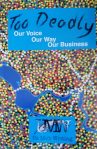
Us Mob Writing, Too DeadlyToo deadly is an anthology of writings by the Canberra-based writing group Us Mob Writing. Comprising Australian First Nations writers, this group was formed in the late 1990s and is, apparently, one of our capital’s longest running writers’ groups. I saw advertising for the book’s launch back in late 2017, but was unable to attend. I was consequently thrilled to be offered a copy to review some months later. Finally, it worked its way to the top of the pile and I have read it. Things happen slowly here at the Gums!

The book comprises works by 11 women writers. It is introduced by Jeanine Leane whose novel Purple threads I reviewed a few years ago. She describes the content as including “prose and narrative poetry; flash fiction, fiction and creative non-fiction; and life writing.

It was interesting to read this just after reading Anita Heiss’s anthology, Growing up Aboriginal in Australia (my review). Heiss’s book, obviously, is all life-writing, while this anthology is more varied in form and subject matter, but, as in Heiss’s book, many of the works are overtly political, not surprisingly, but all writers speak of connection to culture, in some way.

Now, how to do this? I don’t usually discuss every writer in an anthology because doing so, without writing a tome, risks being superficial, but I’m going to try here and see if I can find a fair balance. You be the judge.

Wulli Wulli writer Lisa Fuller: eight pieces, mostly poetry. They deal with her writing practice, her sources of inspiration, and her sense of self. My heart went out to her struggles to accept that she is “good enough” in poems like “Who me?” and “Never enough” (“I will kill myself through/ should-i-n-g and my 20/20 judging”), but I also loved her sense of humour and word plays. “Waking” made me laugh, with the “only clock in the place/ disguised as a phone” as did her wry references to her “Master pieces” in “Electronic inclusions”, which describes her preference for “paper and pen” over keyboard. She also writes of nature and the inspiration it provides, including:

the mist envelops
its cool embrace
blocking everything
making the everyday
more mysterious
(“Surrounds”)

Juru-Kija poet Michelle Bedford: six poems, most of which directly address culture – her connection with it, and/or loss of it. In “Kindred Spirit-so many stories untold”, the refrain at the end of each verse is “so many stories untold”, while “Straight up and back with a certain native pride” tells of a hunting party and how engaging in cultural practice brings contentment and pride. Coming from the beautiful Kimberleys, she has some poems evoking her love of that landscape: “Colour me fine” is a love-letter to the Kimberley that I could relate to. Other poems are more overtly political. “Standing alone with others” and “I promise you … she is worthy” reminded me somewhat of Oodgeroo Noonuccal’s work.

Wiradjuri poet Yullara Reed: one poem, “Catch me if you can”. Told in the voice of a bird, her allegorical poem confronts its reader with the realities of indigenous life, particularly regarding the stolen generations, as the bird watches out for catchers. There’s a cheeky freshness to this poem which makes its message so much starker.

Erubian writer Chella Goodwin, from the Torres Strait: two poems and one prose piece. “Morning dreaming” is a gorgeous poem about yearning for a simpler life. Her irregular use of rhyme here is particularly effective. Many of us can relate to these lines, “microsoft word/ part of the city herd”, and to

divorcing the city
with its traffic and hustle
for straight roads to the horizon
where the kookaburras hustle

Bundjalung writer Samia Goudie: six pieces, mostly poems. They mourn a loss of culture, but also express defiance (particularly “White lie”) and sorrow (“Dirt child”). Her prose piece, “Coming home”, is a short story about a stolen generation daughter meeting her mother for the first time. The insensitivity of the church official, where the meeting is effected, is breathtaking. He wants a photo for, he says:

“… the church newsletter, the story, our story; it is such a great story. The congregation will love it.”

Whose story?

Yuin writer Brenda Gifford: one memoir piece about her life on the road, for ten years, with the mixed indigenous and non-indegnous band, Mixed Relations. Much of the story would be familiar to any band, I guess, except that this one has the added issue of race to deal with. She talks of confronting racism in Moree, and of the opposite in Brewarrina, where the local mob showed them the fish traps (now made famous by Bruce Pascoe in Dark emu.) She also writes of touring North America, and sharing experiences with First Nations Americans (not to mention trying their wonderful fried cornbread!)

Wiradjuri author Kerry Reed-Gilbert (grandmother of Yullara above) has ten pieces, and is the best-known, most published of the group. Reed-Gilbert also appears in Growing up Aboriginal in Australia, with a strong small town story. Some of her poems talk of dark history, such as blood loss and massacres in “The place in the paddock”, while others ask for Australians to work together, as in “Reflections” and “I know you”. Many of her pieces, as do those of others, talk of the wisdom of older people (uncles, grandfathers, grandmothers) and, further back, of the Old or Ancient Ones from whom the laws come.

Ngemba/Barkindji writer Barrina South: four pieces. Her poem “Ghost Gum” describes the ageing and regeneration of a tree, but surely also works as a metaphor for indigenous history – the losses (“pooled blood appears on the surface caused by previous contusions”) and the hope for the future (“She reaches up and gently sways/ Dancing in time with the stars…”) “Baaka” is more overtly political, but also uses nature, the river in this case, to oppose long connection with culture (and the “old people”) against loss (and “they [who] fence rivers”).

Wiradjuri poet Marissa McDowell: three pieces. “By the campfire” is a lovely hymn to indigenous creation spirit Biamie, “the maker of all things”, while “Me” is a plea to be respected “before all is lost/at what human cost”.

Kamilaroi writer Joyce Graham: eight pieces, starting with three haiku which lead into more powerful, pull-no-punches poems. “Proud Uncle” references, I believe, the story of the two indigenous men Jimmy Clements and John Noble who walked miles to attend the opening of Canberra’s provisional parliament house in 1927. It confronts us with our lack of interest (“ignored by white/ present not caring/ not curious/ Dismissive/ ignorant of your importance”). It’s a story most Canberrans didn’t know until recently. Certainly I didn’t – “ignorant”! “Life’s landscape” uses strong language, too, to make its point, describing “the white dust storm” and its aftermath.

Torres Strait Islander writer Samantha Faulkner: twelve pieces, including five prose pieces. Faulkner’s pieces, like many others, explore the history of indigenous experience in Australia. “The Old Man” also reflects on the Jimmy Clements and John Noble story, describing the two men as “compelled to be there”. “Tribute to Mabo” is another straightforward narrative poem about an indigenous hero. “One Day at Walpa (Walpa Gorge, Kata Tjuta/the Olgas” made me laugh at its depiction of tourists visiting this beautiful peaceful, place. And “It’s a small town world” succinctly conveys opposing images of small towns – narrow on one hand, and big-hearted on the other. Faulkner’s is, generally, a lighter touch than some in the book, but no less effective for that.

There are, then, recurring themes in the anthology, as you’d expect – to do with loss and disconnection caused by colonisation and white laws – but while some are angry (and understandably so), many are generous and hopeful, looking to a better future. Motifs recur too. There’s the wisdom of older people and of the Old Ones, and, of course, nature, particularly trees and birds, appears in many pieces.

Too deadly is a challenging book to read with its varied styles and tones, but it is well worth the effort because this very variety provides a breadth of insight that is not easily come by. I’ll close with some lines from McDowell’s “Me”, because, in many ways, it conveys the heart of the book (but apologies for not getting the lines’ layout right):

Images are plastered all over our screens
Scaring the weaker
And empowering the meaner
Open your door and open your mind
move a bit closer
I could be your friend
not an enemy
Who’s portrayed as the end.

AWW Challenge 2019 BadgeUs Mob Writing
(Eds. Kerry Reed-Gilbert, Samantha Faulkner, Barrina South)
Too deadly: Our voice, our way, our business
Us Mob Writing, 2017
172pp.
ISBN: 9780992559823

(Review copy courtesy Sarah St Vincent Welch and Us Mob Writing)

Anita Heiss (ed.), Growing up Aboriginal in Australia (#BookReview)

Anita Heiss, Growing up Aboriginal in Australia

As many others have said, including my reading group, Anita Heiss’s anthology, Growing up Aboriginal in Australia, should be required reading for all Australians. At the very least, it should be in every Australian secondary and tertiary educational institution. Why? Because it contributes to the truth-telling that is critical to real reconciliation between Indigenous and non-Indigenous Australians. Truth-telling comes in many forms. There are formal processes, as through truth-telling commissions, but there are also the informal processes that we can all engage in while we wait for the government to fiddle-diddle around deciding whether it can front up and do the right thing.

Essentially, truth-telling means all Australians acknowledging and accepting “the shared and often difficult truths of our past, so that we can move forward together”. These truths include the original colonial invasion of the country, the massacres, the Stolen Generations, and the ongoing racism that results in continued inequities and significant gaps in almost every health, educational and occupational measure you can think of. Informal truth-telling encompasses all the things we do to inform ourselves and each other of these truths. Heiss’ anthology, Growing up Aboriginal in Australia, which contains 50 stories by indigenous Australians on their experience of growing up indigenous in this so-called lucky country of ours, contributes to this informal truth-telling. Taken as a whole, the book provides a salutary lesson, for all Australians who care to listen, on the experience of being indigenous in Australia. Taken individually, each story has the potential to break your heart. If you think I’m laying it on a bit thick, then you haven’t read the book!

“a stranger in my own land”

The above line from William Russell’s story, “A story from my life”, brought me up short because it replicates a line I read in Atkinson’s book The last wild west (my review). Atkinson describes his Indigenous friend and co-worker Sno as being “an alien in his own homeland”. There is strength in this replication between books, just as there is strength in the repetition of experiences within Heiss’s book, and the strength is this, that every repetition reinforces the truth of the historical (and continuing) injustice faced by Indigenous Australians. The stronger, the more inescapable the truth becomes, the harder it must surely be to ignore.

So, what are the repeated experiences in Growing up Aboriginal in Australia? Well, there are recurring references to the Stolen Generations, to being questioned about identity (“are you really Aboriginal?”, “you look too white to be Aboriginal”), to feeling disconnected from culture, to being called racist names, to being humiliated in myriad ways too numerous to list, and to being physically attacked. These are the experiences that we’ve all heard of, but Heiss’ contributors enable us to feel them. And that’s important. I’ll share just a few quotes from a few stories:

Thankyou for your acknowledging every 26 January with such grace and humility. Thankyou for your encouragement – and advice to me – to let the past be in the past, to simply ‘get over it’ on the day my people’s land was invaded and dispossessed. (Dom Bemrose’s biting “Dear Australia”)

My father cut to the chase. ‘Olly, you can’t go telling people we’re Aboriginal … It isn’t safe’. (Katie Bryan, “Easter, 1969”)

I would paint and draw and sculpt about being Aboriginal. I would see people twitch uncomfortably and sometimes even let their ignorant thoughts out: ‘But you don’t look it’, ‘From how far back’, ‘Do you get lots of handouts?’ (Shannon Foster, “White bread dreaming”)

In Year 2 I was lined up with Aboriginal classmates to be checked for nits and, as I stood there with fingers being raked through my hair, I felt angry and embarrassed as my non-Indigenous classmates watched. I realised that … for some reason it was only supposed to be us Aboriginal kids that had nits. (Jared Thomas, “Daredevil days”)

None of us kids are allowed to go anywhere outside after dark by ourselves. We can’t ever go to the toilet at night: we gotta go in twos, and Mummy stands at the door and watches. She has a big bundi* ready in case there’s trouble … Terror is outside the door, and we can’t do anything about it. (Kerry Reed-Gilbert, “The little town on the railway track”)

It was hard selecting these quotes – not because they were hard to find but because there were so many options that it was hard to decide which ones. That’s the shame of it. And these stories come from all ages – from teenagers to those in their 70s or 80s –  and from all parts of Australia, from, as Heiss writes in her Introduction, “coastal and desert regions, cities and remote communities.” They come from “Nukuna to Noongar, Wiradjuri to Western Arrernte, Ku Ku Kalinji to Kunibídji, Gunditjamara to Gumbayanggirr and many places in between.”

The contributors include many well-known people – writers like Tony Birch and Tara June Winch, sportspeople like Patrick Johnson and Adam Goodes, performers like Deborah Cheetham and Miranda Tapsell –  but there are also lesser-known but no less significant people, many of whom are actively working for their people and communities.

Despite the devastating picture being painted, the book is not all grim. There are also positive repetitions in the book. They include deep connection to country, the importance and support of family, and particularly, the strength of mums. There’s humour in some stories: you can’t help but laugh, while you are also grimacing, at Miranda Tapsell’s story of her friends expecting her to turn up to a party as Scary Spice, but opting for Baby Spice instead (Miranda Tapsell, “Nobody puts Baby Spice in a corner”).

“two divided worlds”

One of the early stories is particularly sad because its 29-year-old author, Alice Eather, took her life before the book was published. In her person, in her story, in her life, she represents the challenge Indigenous people face in Australia today. Her story “Yúya Karrabúrra” starts with a poem. At the end of the poem she writes:

This poem is about identity, and it was a really hard thing to write in the beginning because identity is such a big issue. It’s a large thing to cover. The poem is about the struggle of being in between black and white.

Now Alice, like many in the book, had an Indigenous parent and a non-Indigenous one, but the struggle she names here is faced by every person in the book, regardless of their family backgrounds, because every one of them must contend with white society and culture, and it’s clearly darned hard.

I’m going to close on this idea of identity, because identity is the well-spring from which everything else comes. The stories are organised alphabetically by author, which I’m sure was an active decision made to not direct the conversation. Coincidentally, though, the last story – Tamika Worrell’s “The Aboriginal equation” – provides the perfect conclusion. It constitutes a strong, unambiguous statement of identity. She says:

I will not sit quietly while my identity is questioned. It doesn’t matter how many times you say you didn’t mean to be offensive, that doesn’t dictate whether or not I’m offended.

Then concludes with a hope that she

will live to see a future that is less ignorant, less racist and at least somewhat decolonised. Until then, I’ll continue to be an angry Koori woman, educating those who don’t understand and those who choose not to.

She’s not asking for the moon here is she? The least we can do is choose to understand – and we can start by reading books like this.

Lisa (ANZLitLovers) has also posted on this book, and there are several reviews for the Australian Women Writers Challenge.

* “bundi” is a Wiradjuri hitting stick I believe.

AWW Challenge 2019 Badge

Anita Heiss (ed.)
Growing up Aboriginal in Australia
Carlton: Black Inc, 2018
311pp.
ISBN: 9781863959810