Stephen Orr, Sincerely, Ethel Malley (#bookreview)

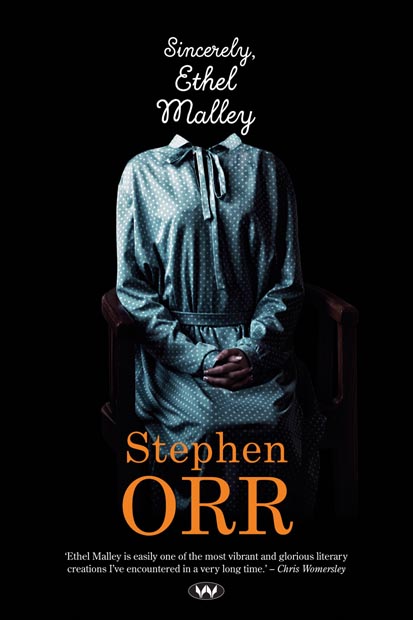
Like Lisa, I’m a Stephen Orr fan, but for some reason it took me forever to finish his latest book, Sincerely, Ethel Malley, partly I think because while its characters are engaging, it’s a novel that deserves concentration which I seem to have in shorter supply this year. This is not meant to discourage readers, because it’s a fascinating, and wryly humorous read that explores a range of issues, to do with art and society, against a backdrop of war-time 1940s Australia.

As those who know the story will have guessed, Orr’s novel takes as its starting point the infamous Ern Malley literary hoax. To summarise Wikipedia, this hoax was perpetrated by two conservative writers, James McAuley and Harold Stewart, who created modernist-style poetry in the name of a fictitious poet, Ern Malley. They wrote the poems using random words from various reference books and rhyming dictionaries, and, in 1943 sent them, in the name of Ern’s sister Ethel, to Max Harris, editor of Angry Penguins, the journal of a modernist art and literary movement. This movement included some of the leading lights of the Heide art group, which was the inspiration for Emilly Bitto’s novel, The strays (my review). They were modern, confident, and prepared to tackle head on conservative Australia. It wasn’t long before the hoax was exposed, but that wasn’t the end of it, because Max Harris was then tried for publishing the poems, on the grounds of obscene content.

I have written about literary hoaxes earlier in this blog, and made some points about what hoaxes tell us. Among these are that they raise some fundamental issues for readers and critics about the nature of literature, about what we mean by authenticity and how we define quality. Is a work, for example, somehow less “authentic” and of less literary quality because the author isn’t who we believe s/he is? In other words, is the work the thing? These are some of the issues Orr explores in Sincerely, Ethel Malley.

The novel’s intent is also suggested by the four epigraphs, the first of which – with its own in-joke – is “ascribed” to Aeschylus. It suggests that Prometheus is the source of “every art possessed by man”, so, perhaps, why worry about anything but the art? Then there’s Frederick R. Ewing’s suggestion that the problem occurs from a misunderstanding over where “the truth left off and imagination began” – which, in a way, is the idea underpinning this book. The third comes from Max Harris arguing, essentially, against “playing god”. And finally, there’s Donald Crowhurst’s “it is the mercy”. I’ve never heard of Crowhurst but, according to Wikipedia, he was an amateur sailor who disappeared during a race. Wikipedia says that this statement, which he left behind “is obscure, [but] most commentators have accepted that it signifies his relief that, at last, he is leaving an unbearable situation”.

All this will tell you that Stephen Orr has big ideas in his sights. Fortunately for us, they are wrapped up in the engaging character of Ethel. She carries the novel. It starts in 1981, with her death, and then flashes back to 1943, which begins the main body of the novel and tells the story of Ern and his poems from Ethel’s (first-person) point-of-view. The novel’s last chapter returns to 1981, with Max hearing about Ethel’s death. Ethel (and Ern) are Sydney-based – which is where McAuley and Stewart were based – but most of the action takes place in Adelaide, where Max Harris was based.

In the 1970s, Adelaide was a beacon of progressive thought in Australia, but back in the 1940s it was a very different place. Orr is South Australian and captures the ambience of the place and time beautifully, as our Sydney-suburban housewife, Ethel, makes her way between the iconoclastic Max, the lively bookseller Mary Martin, and Adelaide’s conservative establishment.

I thoroughly enjoyed the explorations – many of them done with wit if not downright cheek – about truth and authenticity, about poetry not being meant to be understood but to be “interpreted”, and about the art versus the artist. It’s subversive in self-consciously confronting some of the things we say and think about art and literature. It tackles conservatism, our resistance to innovation – “Originality. If your writing’s worthwhile, most people will hate it”, Max tells Ethel. Early in the novel is a discussion within Harris’ theatre group about what play they will perform, one by Shaw or one by Cocteau. Most of the players argue that people won’t come to Cocteau, because they “want a story”. For boundary-pushing Max, “that’s their problem”. He wants to do something “modern” (hence, also, his interest in Ern). This dilemma is not confined to 1940s Adelaide, but is one arts communities grapple with constantly. What will audiences tolerate?

Orr’s skill is in presenting his “big” issues through “authentic”, engaging characters and strong narratives which draw us into their reality. Orr’s characters are always warm and authentic (even when fictionalising an already made-up person like Ethel) and his dialogue is so natural. The story of Ethel as she struggles to prove that Ern is real, and his poetry not obscene, is entertaining – particularly when people start questioning her existence too. It can get mind-bending some times, and quite rollicking other times, as Ethel flips between present and past, but it works.

All of this is in the service of issues Orr thinks are worth thinking about, but it’s the thinking and the questions that are, in the end, more important than the answers, with Ethel, of course, being our guide. Early on, she’s never heard of Sid Nolan, but by the end she can hold her own with the best of them as she struggles to defend herself, Ern and his art against those who question. It’s both heartfelt and funny.

There is a lot to this book, but fundamentally, I see it as being about conservatism. In addition to the whole modernist poetry debate, Orr makes pointed comments along the way about the press and academia, not to mention Australians themselves. Ethel tells Sid Nolan, she’s learnt that “Australians hate anyone who claims to be creative”. In Sincerely, Ethel Malley, Orr is teasing us, goading us even, into being open to new ways of seeing, just as Max Harris wanted to do in the 1940s – and he has done so with his usual skill combined with a good dose of fun.

Lisa (ANZLitLovers) loved this book and covered its essence very well.

Stephen Orr
Sincerely, Ethel Malley
Mile End: Wakefield Press, 2021
441pp.
ISBN: 9781743058084

Review copy courtesy Wakefield Press.

Damon Galgut, The promise (#BookReview)

Damon Galgut’s Booker Prize winning novel, The promise, is one of those novels that grabbed me intellectually and emotionally from its opening pages. The plot, itself, is straighforward. It concerns a White South African family’s promise to give a house on their property to their Black maid, whom their grandfather had acquired “along with the land”. The narrative tracks just how hard it is for the family to honour this promise. What makes the novel a Booker-Prize winner is the quality of the writing and how Galgut uses his story to create a potted history of South African life and politics in the post-Apartheid decades.

The novel is set between 1986 and 2018, and centres on the family, and their farm outside Pretoria. The family comprises Ma, Pa, and their three children, Astrid, Anton and Amor. In the opening pages, the youngest family member, Amor, overhears her dying Jewish mother extract the aforementioned promise from her Afrikaner father to give the house to Salome. Amor wants this promise honoured but achieving it turns out to be much harder than she expected.

The promise was my reading group’s May read and, somewhat unusually for us, it was universally enjoyed. Our ex-South African member used words like sharp, clever, funny, vicious, and said that Galgut nails the South Africa she knew and had experienced.

“something out of true at its centre”

There is so much to say about this book, that it’s hard to know where to start, but the writing is an excellent place, because it truly carries the novel. Particularly effective is the slippery voice (or point-of-view) which shifts perspective and person, sometimes mid-sentence. The effect, among other things, is to implicate us readers in the narrative. It prevents us distancing ourselves from the choices, decisions and behaviours we see. Here, for example, we shift from third to first in a paragraph:

For there is nothing unusual or remarkable about the Swart family  … We sound no different from the other voices, we sound the same and we tell the same stories, in an accent squashed underfoot, all the consonants decapitated and the vowels stove in. Something rusted and rain-stained and dented in the soul, and it comes through in the voice.

And here is a mid-sentence shift from third to second person:

But in truth he’s bored by this man, by his ordinary life and his ordinary wife, just as he’s bored by almost everything these days, all significance leaked away by now, and it doesn’t feel wrong to wait till he’s gone, then get up and wander out into the night, as if you’ve been drinking on your own. You probably have.

Alongside the voice is Galgut’s wordplay, his recognition of the power of words to clarify or obfuscate. Take the irony of the white family’s name, Swart, which means black. But it doesn’t stop there because it is also an archaic word for “baneful, malignant”. Take also the narrator’s frequent self-corrections that always nail home a point, like:

“So Salome has gone back to her own house instead, beg your pardon, to the Lombard place.” (Which reminds us that the promise has not been enacted.)

“He no longer calls himself dominee, he’s a pastoor these days, peddling a softer line in salvation to his customers, ahem, that is to say, his flock, so that everyone benefits.” (Which tells us something about this man of the church’s real motivations.)

Then there’s the idea of promise itself. What a loaded word that is. While this is the story of a family, The promise is ultimately a political novel, so Galgut deftly plays with the idea of “promise” in more ways than one. The novel opens and closes with false promises, related to the historical realities of 1986 and 2018, as well as to the family’s inaction. It also teases us with the idea that the end of Apartheid would bring the promise of a new South Africa, but it shows that ideal foundering. The failure of the country to live up to its promise is paralleled in the character of Anton who, at the beginning of the novel, is “full of promise”, as he describes himself in his unfinished autobiographical novel, but who, by the end, admits that he has not lived up to it:

He’s still stunned by the simple realisation that’s just struck. It’s true, I’ve wasted my life. Fifty years old, half a century, and he’s never going to do any of the things he was once certain he would do … Not ever going to do much of anything.

(Note the slip from third to first to third person, here!) There are many failed promises in the novel, including a minister’s failure to keep a confession.

Other motifs threading through the novel include the four funerals in four different religions/belief systems that shape the narrative’s four parts, and the fact that the Swart’s family business is a (failing) Reptile Park. How telling is that! Just think of all the allusions.

The characters are another compelling aspect of the novel. As an epigraph-lover, I can’t resist sharing Galgut’s from Frederico Fellini:

This morning I met a woman with a golden nose. She was riding in a Cadillac with a monkey in her arms. Her driver stopped and she asked me, ‘Are you Fellini?’ With this metallic voice she continued, ‘Why is it that in your movies, there is not even one normal person?’

What a hoot, and what a great epigraph choice. It immediately challenges us to consider what is “normal”, if such exists, and puts us on the alert about notions of normality. Galgut’s characters – even the minor ones like Lexington the driver (who “brings the Triumph to the front steps”), the homeless man (“as he keeps obsessively singing the first line to Blowin’ in the wind, let’s call him Bob”), and the various funeral workers – are carefully differentiated, and add depth to the picture being painted of a family and country in crisis. The irony is, I think, that each is disconcertingly normal – in their own way!

Early in the novel, the narrator describes the recently departed Ma’s spirit lingering around the house:

She looks real, which is to say, ordinary. How would you know she is a ghost? Many of the living are vague and adrift too, it’s not a failing unique to the departed.

“Vague and adrift” perfectly describes Astrid, Anton and Amor, none of whom have it together. The “quiet and attentive” Amor, however, is at least empathetic, and therefore the most sympathetic. She constantly shows heart, but, having little power in the family, her solution is to disappear at every opportunity, and live a spartan life, working as a nurse among the most needy. Could she have done more sooner?, is the question worth asking.

So, what is the takeaway from this novel? My reading group was unanimous in feeling that the novel is underpinned by the idea that when one group has an unhealthy position of power over another, both are diminished, if not destroyed. It is to Galgut’s credit, however, that he explores this without didacticism. We are never told what to think. Instead, he presents his characters’ thoughts, actions and decisions, and leaves us to consider what it all means.

We are also given this:

No truthful answers without cold questions. And no knowledge without truth.

The wonder of this book is that such a strong and serious story can be so exciting to read.

Lisa also loved it.

Damon Galgut
The promise
Vintage, 2021
295pp.
ISBN: 9781473584464 (Kindle ed.)

Book Launch of My heart is a little wild thing by Nigel Featherstone

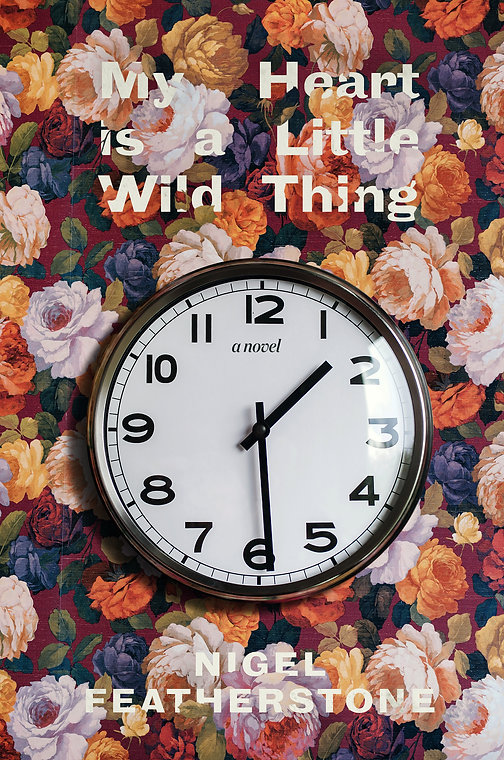
A respite this week from Monday Musings because I did want to bring you the Canberra launch of Nigel Featherstone’s My heart is a little wild thing, which happened on Saturday. Normally, I would have published the post on the weekend, but I was otherwise engaged, and so have decided to usurp Monday Musings to post it now. The launch, which took the form of an interview with Featherstone by Anna Vidot, was to take place at Harry Hartog Bookseller’s ANU campus location. However, interest was so high that it was moved to a small lecture theatre next door. Such is the support for local author and arts activist Nigel Featherstone.

The participants

Nigel Featherstone is no stranger to this blog, as checking out the link on his name will demonstrate. I have reviewed his 2019 novel (Bodies of men), the three novellas that preceded that, and a song-cycle. I have worked with him as litblogging mentor for the ACT Writers Centre’s New Territory program. And I have reported on myriad events that he has organised and/or been part of, most recently F*CK COVID: An Online Literary Affair organised during you know what.

Anna Vidot is a presenter on ABC Local radio – since 2019 – before which she had been ABC Rural’s national political reporter. I enjoyed her questioning. She had clearly engaged with the work.

The conversation

Anna commenced by saying that this was one of those books she clasped to her chest on finishing … and then launched into the discussion.

On where the book came from

Nigel said that after completing his manuscript, he came across his writer’s journal from July 2007 which had the words “two people, farm, quoll”. This core had been with him since then but it hadn’t come together until he spent a week on the Monaro after the 2019/2020 fires. He had tried various ideas and locations, but this is when the novel clicked. (My post on the Monaro, which includes a mention of Nigel.)

As for the quoll, the Tiger Quoll has been extinct in the region for some time but conservation efforts are bringing it back. It is a quoll which leads his lonely protagonist Patrick to a meaningful relationship.

On how the Monaro bled into him

Nigel had gone to a remote little heritage-listed barn in Bobundra, in the Monaro/Ngarigo Country. While there, he realised, when he was more interested in a Stephen Fry book than in writing his novel, that it wasn’t working. So he walked, and walked, until his character Patrick came to him. He then wrote the main draft by hand in 14 days. It took 12 drafts, way less than the 40+ for his last novel!

On how much of Patrick is in him

It is a work of the imagination, Featherstone reiterated. He described it as being a “ghost writer” writing Patrick’s memoir, the story of a dutiful son who has denied his own self.

On “what if” or “sliding door” elements, particularly when you borrow from yourself

While the book is not about Nigel, things in his life did inspire it. When his mother died a few years ago, he immediately thought, he said, “who was she?” He wanted to write about a mother-son relationship. What would his life have looked like if he had “obeyed his mother”, who didn’t want him to be a writer or to love men, and who never came to one of his events? Patrick, to some degree, is that person. (At the end of the interview, Nigel told us that when he and his brother were clearing out their mother’s house, they found a scrapbook in which she’d kept all the articles he’d written, and all the articles/reviews/advertisements about him. It told him, “If you think I wasn’t paying attention, I was.” What a gift, he said!

On his understanding of being a good child

Nigel quoted novelist George Saunders who said that “our characters are better versions of ourselves”. Patrick was loyal and faithful to his mother. This is a three-way love story: man and his mother; a man with another man; and a man with a place. Nigel said that he also wanted the novel to be a loving portrait of a mother.

Continuing the discussion on family, Nigel noted that Patrick also watches his siblings’ relationships with their parents, which in turn affects his relationship with his siblings.

On how he found Lewis, the love interest

Nigel responded by mentioning an essay, “The opposite of glamour“, by  Delia Falconer, which discusses climate change, the extinction crisis and the loss of nature – and the deep impact this is having on our beings. He came up with the idea of Patrick seeing a man, Lewis, planting trees. But, he said, you can’t write, “Oh you’re planting trees, let’s shag”, though a poet could! He talked about the Tiger Quoll, again, encouragement from novelist John Clanchy, and finding the link with his character Patrick. He talked about the “revegetation” motif, with its layer reflectin the revegetation in Patrick’s heart.

He also laughed about The Saturday Paper review which described some of sex scenes as “a bit smutty”, but the reviewer had gone on to say that they were “perfectly appropriate for a man finding his sexuality”.

On finding Patrick’s voice

Voice, said Nigel, is a mystery. In fact, everything about writing is a mystery. He wanted the voice to be concise, simple, and had tried third person but it wasn’t working. He talked of being inspired by Tsiolkas’ fearlessness (and mentioned his essay in Reading like an Australian writer, on which I posted recently.) He also quoted Irvine Welsh’s advice that “it’s your page you can do whatever the f*** you want to”. And, he mentioned a residency he, Robyn Cadwallader and Julie Keys had had with Charlotte Wood. Discussing his opening sentence –

The day after I tried to kill my mother, I tossed some clothes, a pair of hiking boots, a baseball cap and a few toiletries into my backpack, and left at dawn.

– with Wood, she asked him, “has it got heat in it?” because “heat” should be an indicator.

On tackling being fearless

He said there was an element of being “shit-scared”, and that there was a balance between “caring and letting go”. He quoted Tim Minchin’s statement that any piece of art is about “How much time you had” combined with “how much energy you gave to it”.

He shared here that he’d given an early version to his agent, who called it “rubbish”. “Her business model,” he said, “is to follow people around with an axe.” Clearly though, she knows what she’s doing – and, she knows what Nigel can take!

On the role of music in the work (and Nigel’s life)

Music is one of the three loves of his life he said – which, anyone who knows Nigel’s work or reads his blog, would know. So, he realised Lewis would be a composer, and that it would create opportunities for him. Then he told us that he had just heard from London-based composer, Ben P Moore, who had written a suite of music inspired by the novel. Nigel was chuffed. Moore, he said, had never been to the Monaro, but had captured it beautifully.

On the book’s exploration of happiness

Anna suggested that the book grapples with “what do we decide is enough in our lives” and/or “what is enough for happiness”. Nigel agreed that his novel was partly driven by considering “happiness”. He had once heard Patrick White say that “happiness is a red herring. It’s not the point”, but Nigel disagreed. He said he’s always been interested in happiness, though it’s a fleeting thing.

This led to a little more on Lewis’ role. Nigel described Lewis as part-animal and the tiger quoll as part-human. Lewis gives Patrick permission to be himself.

Q & A

There was an engaged Q&A. Here are some highlights:

Do you find the words or do the words find you?: Both, said Nigel. He does love a dictionary, and a thesaurus. Writers are not just vessels, but do a lot of work to produce what they do.

It is the the absence or presence of joy/contentment that stimulates good writing?: (I might have lost the connecting thread here!) Nigel feels that readers are satisfied when characters get what they need more than what they want, but what do they yearn for? Nigel shared that he yearns to be an artist. A someone in the audience called out, he is. Patrick needs to get a life, said Nigel, he needs to live deeply, wildly (which reminded me a little of Nigel’s novella, The beach volcano.)

Did the two violent events in the book happen as a surprise or were they planned?: Nigel answered that the writing was very much a stream of consciousness process. He mentioned poet Melinda Smith’s idea of duende, of having two muses, an angel and a devil/goblin one. The “goblin muse” encourages you to say things people say you shouldn’t say, of going to “the dangerous place”. So, with his opening line, he realised the response was to “let’s follow that”. I saw a theme here – Smith’s dangerous place, Tsiolkas’ fearlessness, and Wood’s heat.

Do you depend on honest criticism to produce a work like this?: Nigel had already shared his agent’s response to an earlier draft, but he shared here David Malouf’s advice that there are no wrong steps, that if you go down one path, you needed to go there, and then it’s “now we are going here”. Tim Minchin, he said, talks of “spine tingles” (for Nigel it’s the “tummy buzz”) that tell you you are on to something.

How do outside stresses affect the ability to create art?: Paul Verlaine spoke about love, said Nigel, but for him it’s also about the hope to live in an environment that isn’t dying. The novel is about people, the environment and animals wanting to live again.

It was an intense and fully engaged launch – and I hope I got the gist. I can’t wait to read the novel now.

Book Launch of My heart is a little wild thing by Nigel Featherstone
Cultural Centre Kambri (organised by Harry Hartog Bookseller ANU)
Saturday 28 May 2022, 12noon-1pm

Ryan O’Neill, An Australian short story (#Review)

If you haven’t heard of this story by Ryan O’Neill, you are in for a surprise. It was first published in The Lifted Brow, an online literary magazine, in 2012. Its title tells you nothing, but, before I tell you more, I should introduce Ryan O’Neill for those who haven’t heard of him.

I had heard of O’Neill, but I hadn’t read him, which was one reason I chose this story to read. He came to my notice when his tricksy novel, Their brilliant careers: The fantastic lives of sixteen extraordinary Australian writers, appeared on the scene in 2016. It was shortlisted for the 2017 Miles Franklin and NSW Premier’s Literary Awards, and won the Prime Minister’s Literary Award that same year. As publisher Black Inc writes on its website, it’s “a hilarious novel in the guise of sixteen biographies of (invented) Australian writers”. You can see what I mean about tricksy.

Well, hold that thought, because his earlier-written short story, “An Australian short story” is tricksy in a different way. Instead of inventing sixteen Australian authors, this story is entirely composed of lines from short stories and poems by Australian writers, written between 1850 to 2011. The source works are an eclectic bunch, and include writers as diverse as Henry Lawson and Angelo Loukakis, as Rosa Praed and Thea Astley, and so on. You get the gist.

There are 149 of them, every one footnoted so you know exactly where they have come from. Some are as short as one word, such as “Goodbye” (from JMS Foster’s “I do love to be beside the seaside”), “–What?” (from Kate Grenville’s “Having a wonderful time”) and “Yes”, at least twice (from H. Drake-Brockman’s “The price” and Morris Lurie’s “Running nicely”, for example). You gotta laugh!

Others, though, are longer, like “And she lay beside him, separated by knowledge which he did not share, of something sinister; of wounding, of unhappiness, and of pain” (from “Winter Nelis” by Elizabeth Jolley).

There is a plot, and it concerns a couple, an unnamed husband and wife living in “a plain weatherboard house” (which comes from Peter Carey’s “American dreams”) whose “solidity was late-nineteenth century, as the town’s was” (from Hal Porter’s “Gretel”). So, we are in a country town, not a city. And then, a few sentences on, we discover that our couple are on “a farm, if such it could be called”. He, 42-years-old, is a writer, and is uncertain about whether he is “happy with her”, as in fact is she likewise re him.

The story reads seamlessly, albeit with a strange other-worldly feeling, but this comes not so much from the method of construction as from the fact that the people and places aren’t named. It’s also quite a melancholic piece, which speaks, I think, to the Australian short story tradition that it draws from and pays homage to. It is clearly Australian, O’Neill has called his story “Australian” and makes it very clear with references early on to parrots, gums and she-oaks. But, it is not a traditional farm story, because our husband is a writer, so this Australian story is about a writer, one struggling with his novel and frustrated at a perceived lack of support from “her”, while she feels she’s given him enough. It’s inspired and adds a wonderful layer to what O’Neill is doing here.

Now, I was intrigued about this story, so I went searching, and found a piece by O’Neill on writing this story. He explains how he, a Scottish-born Australian, came to write the story. He discusses his extensive reading of Australian short stories, and his thoughts about the strong realist tradition that runs through them. He sees (saw then) experimentation not being a strong feature of Australian short story writing, but does identify pockets of such occurring. It’s a great article for anyone interested in Australian short stories.

I was particularly interested in his statement at the end of the piece about his intention:

I had originally intended for this piece to be a satire. “An Australian short story” was titled “The Australian short story” for a long time, to suggest the idea that this piece, with its bush setting, and sentimental love story, was somehow representative of a certain uniformity in Australia short fiction. But as I finished the story I was surprised and pleased to see it had developed into more of a celebration than a satire.

I like this because as I was thinking about the story, I wanted to call it a satire or spoof, but it felt too subtle for that. “Celebration”, plus, we could say, commentary on, is a good way to view his story.

Coinciding with the publication of Their brilliant careers, its publisher Black Inc posted on its website, O’Neill’s Five tips for writing a short story. Tip no. 2 is that he believes

it is impossible to write a decent short story unless you have read a lot of great short stories. Try to read as many short stories as you can, and not only from contemporary writers. Read Poe, Maupassant, James, Chekhov, Carver, Mansfield, Borges, Woolf, Kipling, Barth, Salter, O’Connor (Frank and Flannery), Salinger, Yates, Jolley and Greene. These men and women are the greatest teachers a short story writer can have. You’ll learn all you need to know about structure, characterisation, setting, plot and everything else, and you’ll also have a great time. With any luck, something of their stories will stay with you when you write your own.

You certainly couldn’t argue that he doesn’t practise what he preaches, could you!

Ryan O’Neill
“An Australian short story”
in The best of The Lifted Brow. Volume 2 (ed. Alexander Bennetts)
Brow Books, 2017
ISBN: 9780994606877

Monday musings on Australian literature: The Red Witch

Last week, I attended the online launch of Nathan Hobby’s biography, The red witch: A biography of Katharine Susannah Prichard. It was beautifully emceed by Lisa Hill, of ANZLitLovers, and involved three speakers, Karen Throssell, award-winning poet and the only grandchild of Prichard; Nathan Hollier, the publisher; and, of course, the author himself, Nathan Hobby.

A brief intro

Katharine Susannah Prichard
KSP, 1927/8 (Courtesy: State Library of NSW, via Wikimedia Commons)

Katharine Susannah Prichard (1883-1969) has to be among Australia’s most interesting and significant writers. I first read her in my teens when, keen on civil rights and concerned about racial discrimination, I read her novel Coonardoo. I loved it, though I’m sure my response was naive and typical of those earnest times. However, I never forgot Prichard.

She wrote thirteen novels, a memoir, plays, reportage, poetry and short stories. She won the Australian section of Hodder & Stoughton’s All-Empire novel competition with The Pioneers (1915) (my review), and in 1929, Coonardoo shared the Bulletin’s Novel prize with M. Barnard Eldershaw’s A house is built. She was also a founding member of the Communist Party of Australia, which brought her notoriety that dogged her through life.

So much is known about her, and yet so little, because, although we have her son’s Ric’s 1975 biography, Wild weeds and wind flowers, there has not been a comprehensive biography – until now.

The launch

Before I share the highlights of the launch, I’ll reiterate a comment I made on my post on contemporary responses to Coonardoo, because it speaks to the challenges faced by KSP researchers. I wrote:

I was horrified by the frequency with which Prichard’s name was spelt incorrectly. This must have driven Hobby mad in his research. She is frequently written as KathErine, not KathArine, and occasionally Catherine, and even Kathleen. Really? Then, there’s her last name, which was often reported as PriTchard not Prichard. It must have driven HER mad too, at the time. Sometimes, too, her married name, Mrs Hugo Throssell, is used.

It is truly astonishing how often her name was – and still is – got wrong.

So now, the launch …

After the usual introductory comments and acknowledgement of country, Lisa introduced the three speakers, and then were were off, starting with Karen Throssell who had the honours of formally launching the book.

Karen referred to the title, suggesting the word “witch” connotes independent women who defy convention, which accurately captures her grandmother. (An aside, I remember when Nathan asked us bloggers to vote on the titles he was considering for his planned biography, long before he had a publisher. None of them was The red witch, but what an inspired title it is.)

Anyhow, Karen went on to read her poem “My fairy godmother” about her doting gran, the “wild Bohemian”, KSP. She mentioned the challenge over the years of protecting her family’s reputation, referencing her recently published book about her father, The crime of not knowing your crime: Ric Throssell against ASIO.

Karen then turned to Nathan’s biography. She initially feared he was focused on some of the personal secrets in Prichard’s life, but was pleased that his biography does, in fact, focus on KSP’s intellectual and political ideas more than her “private peccadillos”. What she likes most about the biography is Nathan’s detailing the “journey of the individual books” including KSP’s travel to the places in which her books were set. She also likes his coverage of the various books’ reception, particularly of Coonardoo, which she described as an “act of literary empathy”.

She declared the book launched and the floor (or screen) was handed over to Melbourne University Press’s publisher, Nathan Hollier. He spoke briefly, noting that early reviews had praised Nathan’s “capacity to write and tell a story … with felicity … without overt authorial intrusion”. Books, he said, are not ephemeral, and he believes this one will stand test of time as a resource for literature, culture, history, and Australians generally.

Then it was Nathan Hobby’s turn. After introductory acknowledgements, he got onto talking about the process and challenges of writing the biography. Given the reputational issues that have dogged KSP’s family, he said he had been apprehensive because he was aware of the pain that had been caused to the family by scholars and others.

He was grateful that the publisher let him go to 150,000 words. (As we bloggers who followed the project on Nathan’s blog for several years know, this was still a challenge, because he was initially keen on a three-volume biography. But, I suspect it’s a good decision, and maybe Nathan can now write a bunch of articles using all those treasures he had to cut!)

He talked about the value of the Internet for modern research, praising, in particular, Trove. It was especially useful for him as a Western Australian, and even more when the pandemic and travel restrictions hit. It would be utopia, he said, to have all of Australia’s archives digitised. Yes!

Nathan talked a little about the art of writing biography, and referred to some other biographers, but I didn’t catch the names. He talked about the challenge of resolving contradictions in your subject, and quoted one writer – if I’ve got this right – as describing biography as the “art of human betrayal in words”. In terms of writing his own, he said he had to juggle the constant tension between the chronological and the thematic. He also talked about the style of biography which involves the “biographer on a quest”. He suggested this works well when there is not much material, such as Brian Matthews’ Louisa, on Louisa Lawson, but this was not a problem he faced with KSP! He said that his aim was to show “a lived life”.

Oh, and he thanked all his supporters for their encouragement and camaraderie.

Q & A

There were several questions, but I’m just sharing some:

  • On deciding what to cut and what to keep in the editing: his criteria were how the material related to the bigger picture, its literary and political significance, and whether it explained who she was and/or her work
  • His favourite KSP work: perhaps Coonardoo, but he also has a soft spot for the Wild oats of Han. KSP saw The roaring nineties as her most important work.
  • On what KSP would make of Russia today: Russia is not really a Communist nation today; he can’t see she’d like Russia or Putin.
  • Most exciting moment: many Eureka moments, often little things like finding a grocery receipt from their honeymoon in Hugo Throssell’s papers.
  • Most challenging moment: different types of challenges, such as technical ones in accessing material, and writing ones like determining a structure.
  • Difference in public reception of KSP and Jean Devanny (from academic Carole Ferrier): Devanny would probably answer in terms of class. Ferrier commented on the rivalry between the two: Devanny felt KSP had been “taken up” by the Community Party. KSP’s image was “respectable” whilst Devanny’s was “disreputable”. Ferrier said the women encompass some of the issues faced by women as revolutionaries.

A big thanks to all for a smoothly-run and engaging launch. Now to read the book …

Further reading

Shelley Burr, Wake (#BookReview)

Regular readers here will know a few things about me. One is that I don’t regularly read crime, and another is that for three years, before the pandemic struck, I was the litblogging mentor for an ACT Writers Centre program. One of the last two participants in that program was Shelley Burr, author of the just-published crime novel Wake.

In my post on that 2019 program, I introduced Shelley as follows:

Shelley Burr is working on a novel, and took part in the ACT Writers Centre’s well-regarded Hard Copy program last year … She is particularly interested in what she calls “drought noir”, which term sounds perfect for some of the crime coming out of Australia at present. Shelley has had her writing place well in the Stockholm Writers Festival First Pages program.

That novel she was writing was Wake. It won the CWA Debut Dagger in 2019. It was also shortlisted for the 2019 Kill Your Darlings Unpublished Manuscript Award, which gave her a Varuna fellowship, and the 2020 Bath Novel Awards, which is an international award for emerging writers. Judge for the Bath award, literary agent Jenny Savill, wrote of Wake:

With forensic attention to detail, the reader is effortlessly drawn into the small town, rural Australian setting and a community in mourning. Immersive and riveting.

Savill was right on all fronts. Burr’s attention to detail is forensic, and readers (even non-crime readers like me) are “effortlessly drawn in”. I was thoroughly engaged from the opening pages, and this is because, besides being a crime novel, it’s a novel about character, and what happens to people when terrible things happen to them. How do people respond, and why do different people respond differently? It confronts readers to think about our own responses. How would we respond if it happened to us? And, how would, or do, we respond when it happens to others?

Wake is about a cold-case that took place on a remote farm some twenty years before the novel opens. Nine-year-old Evelyn (Evie) McCreery disappeared from her bed one night, never to be seen again. This means the novel alludes to a longstanding Australian writing tradition, that concerning the lost child. However, this motif has layers of cultural complexity that are not central to this novel, so I’m just mentioning it and moving on.

Now, the plot … as the book’s promotion says, “no forced entry, no fingerprints, no footprints, no tyre tracks”. Evie’s twin sister, Mina, has grown up in the wake (pun intended!) of that disappearance. She has never fully recovered and is quietly trying to solve the mystery on her own. The novel opens with the clearly fragile Mina doing her shopping under the kindly eye of a local shopkeeper. A stranger, who turns out to be private investigator Lane Holland, approaches her, but she is not interested. The novel progresses from this point with the twists and turns typical of the genre until its inevitable – though not completely expected – resolution.

Wake is carefully plotted, with, for example, hints concerning Lane Holland and why he has chased this particular case being gradually shared. Wake is also well-paced, starting slowly, and gradually building intrigue until near the end when the pace hots up. Suddenly, the chapters become shorter, causing the alternating perspectives, which characterise the narrative, to become more urgent.

As I mentioned above, the characters are a major strength of the novel. Mina and Lane are sensitively developed. Both are driven by past trauma, and can be tough and prickly, but both also exhibit moments of vulnerability and tenderness which help us care about them. There are a few other characters, the main ones being Mina’s more together friend Alanna whose sister had also disappeared around the same time as Mina’s, and Lane’s much younger sister Lynnie. Though minor, they too have flesh.

The narrative is chronological, with occasional flashbacks filling in some gaps. Other gaps are cleverly filled in by entries on a social media forum, MyMurder, which open some of the chapters. They add a thoughtful layer to the story, by conveying how such mysterious cases catch the public attention and how obsession with them can play out. They show how crime aficionados, conspiracy theorists, and others, can spear wildly away from the truth and potentially, if not actually, cause mental harm to those most touched by the crime.

So, yes, I was impressed. The writing and plotting is so sure, and Burr’s exploration of the crime is considered, sympathetic, and grounded in reality. There is drama – of course – but it properly serves the story and the complexity of the emotions, reactions and consequences that Burr is exploring. This made for engrossing reading for a non-crime reader like me, but Wake is also, if the awards tell us anything, great crime reading. It’s a page turner, with depth.

Now, I’d better at least mention the setting, given I’ve referenced Burr’s interest in “drought noir”. Wake is set in rural central New South Wales. Burr, herself, grew up in regional New South Wales, and her grandparents had a farm in regional Victoria, so her writing of place and country life felt authentic. The setting adds tension because Mina and her father Liam’s property is remote, remote enough that they have installed alarms on the gates to announce the arrival of visitors. You can’t be too careful when you live so far away from help.

However, the property also neatly reflect the challenges being faced by Australian farmers in climate-change-affected times. It was a working farm, but the disappearance of Evie consumed the family’s energy so much that viable farming fell by the wayside. In a nice political touch that speaks to our times, Burr has Mina and her father moving into working it as a conservation project.

Wake earned Shelley a two-book deal with Hachette, and is about to be published in the USA. Having now read it, I’m not surprised. I recommend it.

Shelley Burr
Wake
Hachette Australia: Gadigal Country/Sydney, 2022
360pp.
ISBN: 9780733647826

(Uncorrected proof courtesy Hachette Australia)

Nigel Featherstone on Christos Tsiolkas’ fearlessness

This week, Nigel Featherstone’s latest novel, My heart is a little wild thing, was published, and I plan to attend the launch later this month. In the meantime, it seemed apposite to discuss his essay on Christos Tsiolkas in Reading like an Australian writer. Those of you who have read Nigel’s blog will know that he’s a Tsiolkas fan, so it’s not surprising that he was commissioned to write on him for this anthology. As it happens, I’m a Tsiolkas fan too, so this was one of the essays I was keen to read.

Fearlessness

This essay, though, is a little different to the previous essays I’ve discussed from this anthology, because it’s more about Tsiolkas’ oeuvre than one work.

Early on, Featherstone references Orwell’s essay, “Why I write”, noting that “political purpose” is one of those reasons. Tsiolkas is “one of Australia’s most politically attuned writers of his generation”. It’s relevant to explain here, as Featherstone does, that Tsiolkas is the son of Greek migrants, is gay, and identifies as a socialist and atheist. Given this (and, I would add, given the grittiness of many of his novels), it is “truly remarkable”, says Featherstone, that in our contemporary conservative Australia, Tsiolkas has had significant critical and commercial success.

Featherstone starts at the beginning – with Tsiolkas’ first novel, Loaded (adapted to film as Head on), which was published in 1995. Now, Featherstone is a writer too, of course, so he is particularly interested in exploring Tsiolkas’ craft. To do this, he shares specific excerpts/quotes* which reveal, among other things, why he titled his essay “Fearless”. Tsiolkas is audacious, from the opening paragraph of his first novel.

I mentioned above that Tsiolkas is “gritty”, which is my description of in-your-face writing like Tsiolkas’. Featherstone doesn’t use that word, but it’s what he means when he says that the writing “could come across as crass”. It doesn’t, though, he says, because it feels confident, which is why readers stay with it.

How he makes it feel confident is the thing, isn’t it? It may partly be in the way, as Featherstone puts it, Tsiolkas “pushes his prose towards poetry”, by which he means “the language is doing more than one thing at once. Featherstone also refers to the epigraph for Loaded. I love that, because I do think the epigraph can contain serious clues to a work. Epigraphs are not there for fun (or, if they are, the fun is also part of the meaning!)

Featherstone looks at what emerging writers can learn about writing with audacity (or fearlessness): it requires, he says, writing not just from the brain, but the body (chest, gut and crotch) and it requires caring deeply about the characters (no matter how flawed).

Featherstone also identifies Tsiolkas’ main concerns – “class in Australia, and the power and privilege of whiteness” – and he describes one of Tsiolkas’ “many strengths” as “his ability to explore political concerns through the depiction of the everyday”. This is certainly how I think of The slap and Barracuda . I wrote in my Barracuda post:

“This dissection of worlds, of  “class”, and of anglo-Australia versus immigrant Australia, is an ongoing concern for Tsiolkas. We came across it in his previous novel, The slap (my review), and we see it again here. Tsiolkas is not the only writer exploring this territory, but he’s one of the gutsiest because he’s not afraid to present the ugliness nor does he ignore the greys, the murky areas where “truth” is sometimes hard to find (though he doesn’t use the word “truth”).”

So, I liked that when talking about the short story “Tourists” from Merciless Gods, Featherstone says:

In this relatively simple tale the author reveals the racism that exists at the core of Australia’s masculinity and the violence that courses through the nation’s vernacular.

In fact, I don’t just like this, I love it, because, for me, “the violence that courses through the nation’s vernacular” is the main idea behind The slap. As Featherstone writes, “Tsiolkas is a social critic as much as he is a writer of literary fiction”. True, and it’s not particularly surprising. Some of my favourite literary fiction also encompasses social criticism. (Think Charlotte Wood’s The natural way of things or Melissa Lucashenko’s Too much lip.)

The last work Featherstone looks at is Damascus (my review) and again he starts with the first paragraph, and teases out its power – the precision with which Tsiolkas can convey multiple layers of fear. He see fear as being one of the novel’s themes. The opening of this novel is truly terrifying, but another point Featherstone makes is Tsiolkas’ ability to “contrast the heavy with the light”. (Some readers, I know, struggle to find the light in Tsiolkas’ work, but I’m with Featherstone. It is there.)

Nigel Featherstone perfectly meets the brief of this anthology, which was to share how a writer reads. His essay contains very specific lessons that can be taken from Tsiolkas’ writing. However, in doing this, he also conveys the two prongs that make writing sing for me – fearlessness in style, structure and/or content, and generosity in attitude to tough characters and/or ideas. Tsiolkas epitomises both, and so, I think, does Featherstone.

* Do read the essay to see all the great excerpts.

Nigel Featherstone
“Fearless: On Christos Tsiolkas”
in Belinda Castles (ed), Reading like an Australian writer
Sydney: NewSouth, 2021
pp. 125-136
ISBN: 9781742236704

Mark McKenna, Return to Uluru (#BookReview)

Mark McKenna’s engrossing history, Return to Uluru, takes as its starting point the arrival in Central Australia, in 1931, of 29-year-old police officer, Bill McKinnon. Of course, Uluru’s true history reaches back into the almost-incomprehensible mists of geological time, and its human history back to the arrival of Indigenous Australians tens of thousands of years ago. But, a historian has to start somewhere, and McKenna’s choice of McKinnon’s arrival speaks to the particular story he wants to tell.

Uluru

Before I get to that, though, I would like to share my own little story. Mr Gums and I have visited Uluru three times (so far), in 2000, 2009, and 2015. Each visit, we walked around “the rock” rather than climb it, because that was the expressed preference of its traditional owners, the Anangu. In 2019, the climb was finally closed. Interestingly, each of our circumnavigations was a bit longer than the previous one, stretching from around 9kms the first time to around 11kms the last. This is because the Anangu have gradually moved the route away from particularly sacred sections of Uluru. It’s been a very slow process for the Anangu to claw back ownership of their own country and it is to this, really, that McKenna’s book ultimately speaks.

But, that’s not immediately obvious at the book’s opening. It’s divided onto four parts, with Part one, “Looking for the centre”, introducing the reader to Central Australia. It teases out the role of “the centre” in Australian life and culture, pitting its Indigenous history and significance against the early settlers/explorers’ “awe, terror and incomprehension” at what they found. McKenna writes that for the settler “to find the centre was to confront the metaphysical dilemma of being a white man in an Aboriginal country”:

What they saw as empty was layered with story … Where European explorers saw arid desolation, Aboriginal people knew a larder teeming with sources of animal protein and fat and a wide variety of plants that provided nutrition, medicine, tools and shelter.

McKenna then shifts from traditional history-writing to the personal, placing himself in the story by sharing his own experience of the Centre but continuing to reveal its history as well. This approach enables McKenna to reflect philosophically, as well as historically, on what he was doing. He conveys how confronting, and how paradoxical, the Centre can be. “It laid everything bare at the same time as it pushed all language and emotion within.” But, most significantly, he writes how actually visiting the centre “unsettled the history” that he had intended to write. So, let’s get to that.

Part two, “Lawman”, returns to a more traditional history – or biography, now – style. It tells the story of Bill McKinnon, who he was, how he ended up in the Centre, and what he did there. The focus, though, is a particular expedition in 1934 whose goal was to capture some Aboriginal men accused of killing, under Tribal Law, another Aboriginal man. One of these men, Yokununna, was shot and killed by McKinnon. This incident was to be just part of McKenna’s history but, as he wrote in Part one, it became the centre of the book when he recognised that the “biography of one moment in one man’s life encompassed the entire history of the centre and went straight to the heart of the nation’s long struggle to come to terms with its past”.

“Lawman” is the longest part of the book. Bill McKinnon was a complex man. He unquestioningly bought into the settler project and saw “discipline” as the key to maintaining control, a discipline that, of course, frequently involved brutality. But he wanted “to be both the centre’s law enforcer and its storyteller”. He was keenly interested in the centre’s history, and, writes McKinnon, had “moments of contemplation … when he became faintly aware of the depth and complexity of Aboriginal culture”. He was also a meticulous recordkeeper, and retained his records because “his desire to be present in history was insatiable”.

Part three, “Uluru”, the second longest part, returns, obviously, to focus on Uluru. Here, McKinnon comes back in the frame. He delves more deeply into the settler-era history of Uluru, interweaving it with Indigenous culture and stories. He traces the dispossession of the Anangu, as the settlers moved in, and their gradual return in the second half of the twentieth century. He identifies McKinnon’s shooting of Yokununna at the rock’s Mutitjulu Waterhole as “the foundational moment in a long history of injustice”. It is here that McKenna shows his historian’s eye for the symbolic that makes a point:

Uluru’s creation story and the frontier murder which defined the killing times for the Anangu more than any other event in the twentieth century took place at the same sacred site.

It is also in this part that we see the historian’s drive for the clue that nails the truth, and the challenge that can result. It occurs when he visits McKinnon’s daughter, and is given access to McKinnon’s archives. Remember what a recordkeeper he was? What McKenna finds transforms the story he was telling.

In the final part, “Desert Oak No. 1”, McKenna remains in the frame, as he shares more of his research journey. The focus is Yokununna (“Desert Oak No. 1”) and we start at the South Australian Museum where Yokununna’s skull had been identified. Till this point, I felt McKenna had managed well the tricky business of being a non-Indigenous historian writing an Indigenous-focused history, but I did feel he made a false step when describing the centre as a “region where darkness stalked the landscape”. The word “darkness” seems unfortunate in the context. This, however, is a small miss in a work that recovers a significant story and carefully places it within the context of the return of Uluru to the Anangu in 1983, and the 2017 Uluru Statement from the Heart. Returnng Uluru to its rightful owners is a win for all Australians because Uluru is the spiritual heart of our nation, and it’s critical that our heart be in the right place – if you know what I mean!

Return to Uluru is a beautiful book in every way. It is gorgeously produced. Those of us in my reading group who read the physical version loved the paper and the extensive images. We felt sorry for the Kindle readers who missed this experience. But more importantly, Return to Uluru is sophisticated, conceptually, in the structured way McKenna elicits the symbolism from the facts to make very clear not only what happened but why it matters.

For an historian’s perspective, check out Janine’s review.

Mark McKenna
Return to Uluru
Carlton, Vic: Black Inc, 2019
256pp.
ISBN: 9781760642556

Stella Prize 2022 Winner announced

The 2022 Stella Prize winner was announced tonight and it’s not a surprise, as several of us in the blogosphere rather thought that

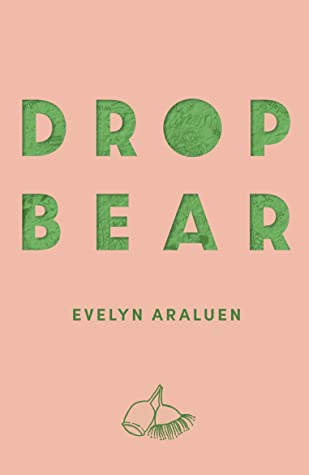
Evelyn Araluen’s Dropbear

would be the winner. Indeed, I was so confident I took it with me to Melbourne this month, fully intending to read it. But, there was not much reading time, and it took most of my time there to finally finish 2020’s winner, Jess Hill’s See what you made me do (my review). I only read a couple of pages of Dropbear before I realised that I’d better read my reading group book for this week’s meeting. (It’s the next review you’ll see!) So, Dropbear is still languishing on the TBR, but you may remember from my shortlist announcement that Brona has reviewed it. Jonathan Shaw at Me fail? I fly has also reviewed it.

The book is a combination of prose and poetry, and the judges described it as:

a breathtaking collection of poetry and short prose which arrests key icons of mainstream Australian culture and turns them inside out, with malice aforethought. Araluen’s brilliance sizzles when she goes on the attack against the kitsch and the cuddly: against Australia’s fantasy of its own racial and environmental innocence.

The panel chair, Melissa Lucashenko, said that it will take you “on a wild ride” that is “simultaneously comical and dangerous”. All this confirms my desire to read it, because I enjoy writers who play with traditions, conventions and myths to encourage us to look again at who we are and what we do.

The quotes above, plus one by Stella’s Executive Director, Jaclyn Booton, can be found on the Stella website (linked below). There is also a quote from Evelyn Araluen’s acceptance. She commented that she’d been following the Stella for the length of her writing aspirations, and had hoped one day to write a novel that would win it. She never dreamed Dropbear would be that winner. She also said:

I’m deeply interested in the lives, histories, and dreams of women and gender diverse writers in Australian publishing, and it’s an honour to be recognised by a prize designed to champion those stories. There aren’t words to explain how thrilled I am to win.

Just to remind you, the judges were author Melissa Lucashenko, as chair, with her co-judges being writer, poet, essayist Declan Fry; author-across-all-forms Cate Kennedy; memoirist and activist Sisonke Msimang; and essayist and screenwriter Oliver Reeson

There’s more on the anouncement on the Stella website.

Any comments?

Jess Hill, See what you made me do (#BookReview)

Jess Hill See What You Made Me Do

I took me a long time to read Jess Hill’s 2020 Stella award-winning See what you make me do, partly because I bought the e-book version which I read in fits and starts and partly because of its content. As the Aussies among you will know, Hill’s book is an intense, thorough discussion of domestic abuse. It’s not an easy topic but it is a critical one because if statistics tell us anything it’s that the situation in Australia is not improving.

There’s no way I can share the wealth of information or fully convey the impressive depth of research Hill has done. However, I’ll do my best to give a sense of what this book does, and how Hill does it. She starts on definition, explaining that wherever possible, she replaced the term “domestic violence” with “domestic abuse” because “in some of the worse abusive relationships, physical violence is rare, minor or barely present”. “Domestic abuse” is the term now used by UK police because it undercuts the assumption that abuse is only serious if it’s physical.

Those of you versed in trauma will appreciate a fundamental challenge Hill faced, which, as she describes it, is that “power imbalance built into the journalist–source relationship: the journalist usually has ultimate power over what gets published”. For survivors of abuse, who have suffered at the hands of power, this could effectively mean abusing them all over again. So, Hill “wanted to flip that and give the power back to them. If this process was not a positive experience for them, there was no point in doing it”. So, she gave “them the chance, wherever possible, to review their story, suggest revisions or ask for things to be deleted – especially if there were safety concerns”.

In her Introduction she lays out the road map:

In the chapters that follow, we will travel through an extraordinary landscape, from the confounding psychology of perpetrators and victims to the Kafkaesque absurdity of the family law system.

And so, in eleven chapters, Hill traverses domestic abuse from multiple angles, grounding it in case studies – usually with names changed – which force us to put a face on the accompanying theories and statistics.

Hill starts by establishing coercive control as a fundamental aspect of domestic abuse. Our understanding of its techniques, she writes, come from the Cold War and US Air Force social scientist Albert Biderman’s recognition of how the tools of coercive control had been used on American POWs in North Korean camps. From here she analyses how the same techniques are used by intimate partners – almost always male, though there is a chapter on women who abuse – to create a threatening atmosphere that will convince the victim of the perpetrator’s omnipotence, the futility of resistance, and the necessity of compliance. The aim is total dominion (which is exactly what Wemyss’ wanted over Lucy in the prescient Vera). Hill describes the techniques in detail, and it’s chilling.

The best word for this book is forensic, because Hill burrows deep. She confronts us with our uncertainties – why did she stay, for example – and makes us see just how deep the degradation goes. She explains how a concussed women can look drunk and so be missed by the police as the victim. She shows how a traumatised woman can come across as irrational and erratic in court versus her cool, calm, well-presented abuser. She interrogates the role of patriarchy, and how it damages men, as well as women. Feminists, as many of us know, were the first to recognise this.

She looks at disabled women. She looks at children and the way they are used and treated by abusers in power plays. Indeed, her chapter on children and the courts is horrifying. She details the gradual weakening of the Gough-Whitlam-established family court system through successive, mostly conservative, governments. She shows how some of this weakening has been underpinned by a particularly egregious theory called Parent Alienation Syndrome. She reveals the perfect storm created for children caught up in a family court softened by law and bolstered by such spurious theory.

And, she devotes a chapter to First Nations women, who are at significantly greater risk of abuse than their non-Indigenous peers. The stories just keep on piling up as you read, stories that you can barely countenance, except that anyone with any semblance of awareness will know they are true.

It’s tough going but it’s valuable reading, because for all I thought I knew, there were details I didn’t know or appreciate. Hill asks some pertinent questions, like:

In the years I’ve spent writing this book, I’ve found that it’s the questions we don’t ask that are the most confounding: Why does he stay? Why do these men, who seem to have so much hatred for their partners, not only stay, but do everything they can to stop their partner from leaving? Why do they even do it in the first place? It’s not enough to say that perpetrators abuse because they want power and control. Why do they want that?

Or, as “Survivor Queensland” put it, ‘I want people to stop asking “Why does she stay?” and start asking “Why does he do that?”‘

Some of the answers lie in “traditional notions of masculinity – particularly male entitlement” which are at “the core of men’s violence against women”. But Hill identifies more questions, such as “what are the different reasons men have for needing to dominate their partners?” and what is going on in their minds that makes them “sabotage the lives of their partners and children – to the point where they destroy even their own lives?” These are “critical parts of the puzzle” that are “missing from our public conversations about domestic abuse”. 

Hill titles her final chapter “Fixing it”. She notes Australia’s excellent record in tackling public health problems. “From thwarting the tobacco industry to criminalising drink-driving, Australian governments have shown they are willing to burn political capital to save lives”, she says, and have achieved results. She then shares some of the actions currently being taken – but, of course, this was just before the pandemic so I suspect some of them have fallen by the roadside.

In 2017, she writes, a KPMG report concluded that although “significant progress” had been made against the “National Outcomes”, not only was there no evidence of reduction in “domestic violence”, in fact, the evidence suggested that “the incidence and severity of domestic and family violence” was increasing. However, lest we close the book feeling completely hopeless, Hill concludes with examples of two recent programs that have worked. We just need government will and support to back more such targeted programs. It can be done.

Janine (Resident Judge) also reviewed it.

Jess Hill
See what you made me do: Power, control and domestic abuse
Carlton, Vic.: Black Inc, 2019
416pp.
ISBN: 9781743820865 (eBook)