Omar Musa’s Killernova book launch, with Irma Gold

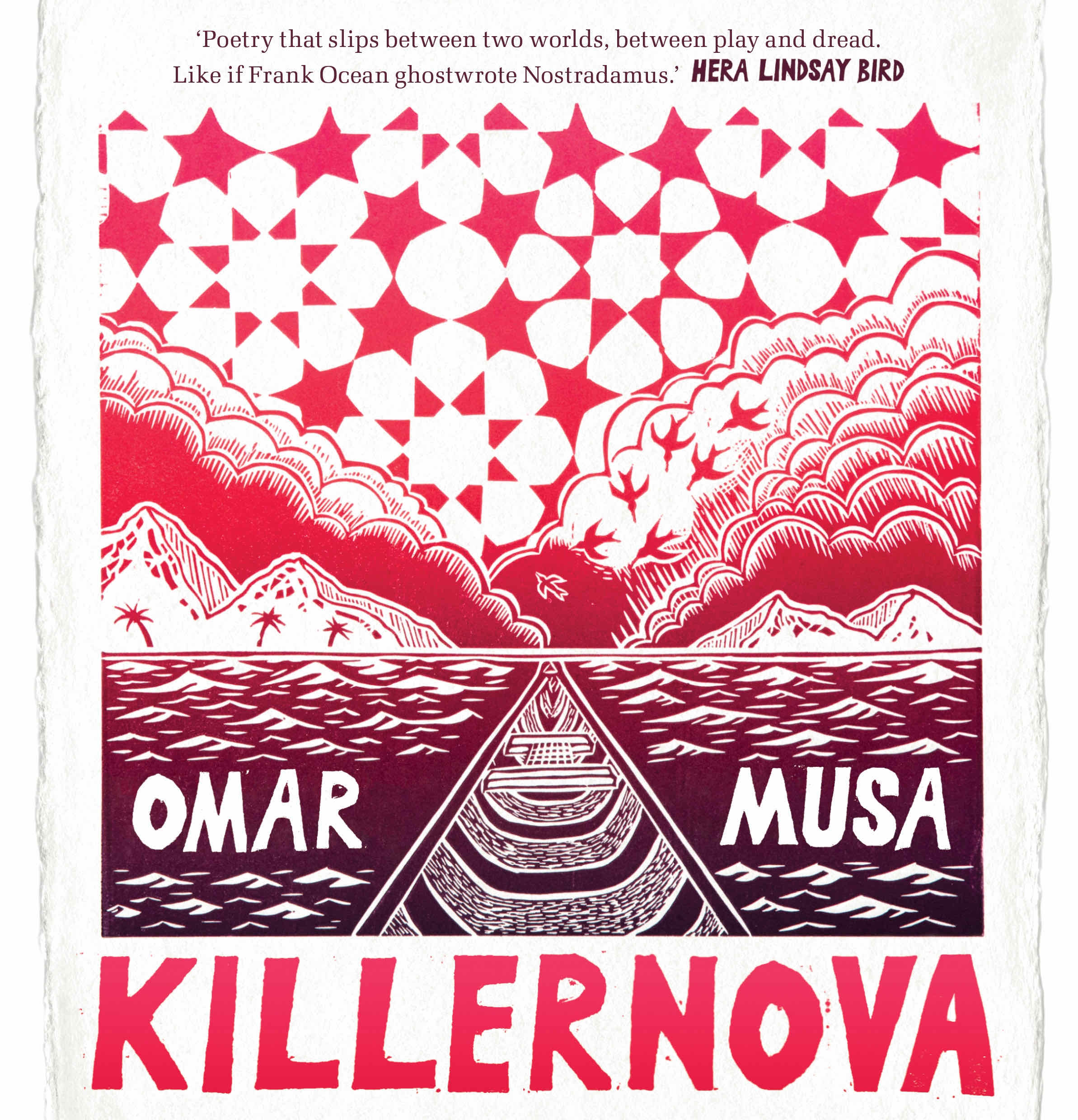
Local performance poet-novelist-artist Omar Musa’s latest book, Killernova, had two launches in Canberra this weekend, one with Polly Hemming and the other with Irma Gold. Being Gold fans, Mr Gums and I booked her session, and it was both engaging and illuminating, but I have it on good authority that Polly Hemming’s session, though different, was also well worth attending.

Omar Musa has three poetry collections, a Miles Franklin Award longlisted novel (Here come the dogs), and a play to his name. He has also released solo hip hop records. And now, he has turned his hand to woodcuts and woodcut printing. He is, you’d have to say, multi-talented – and it comes, I think, not only from a curiosity about the world, but a desire to find his place, to engage with it, and to explore ways of expressing the things that he feels strongly about.

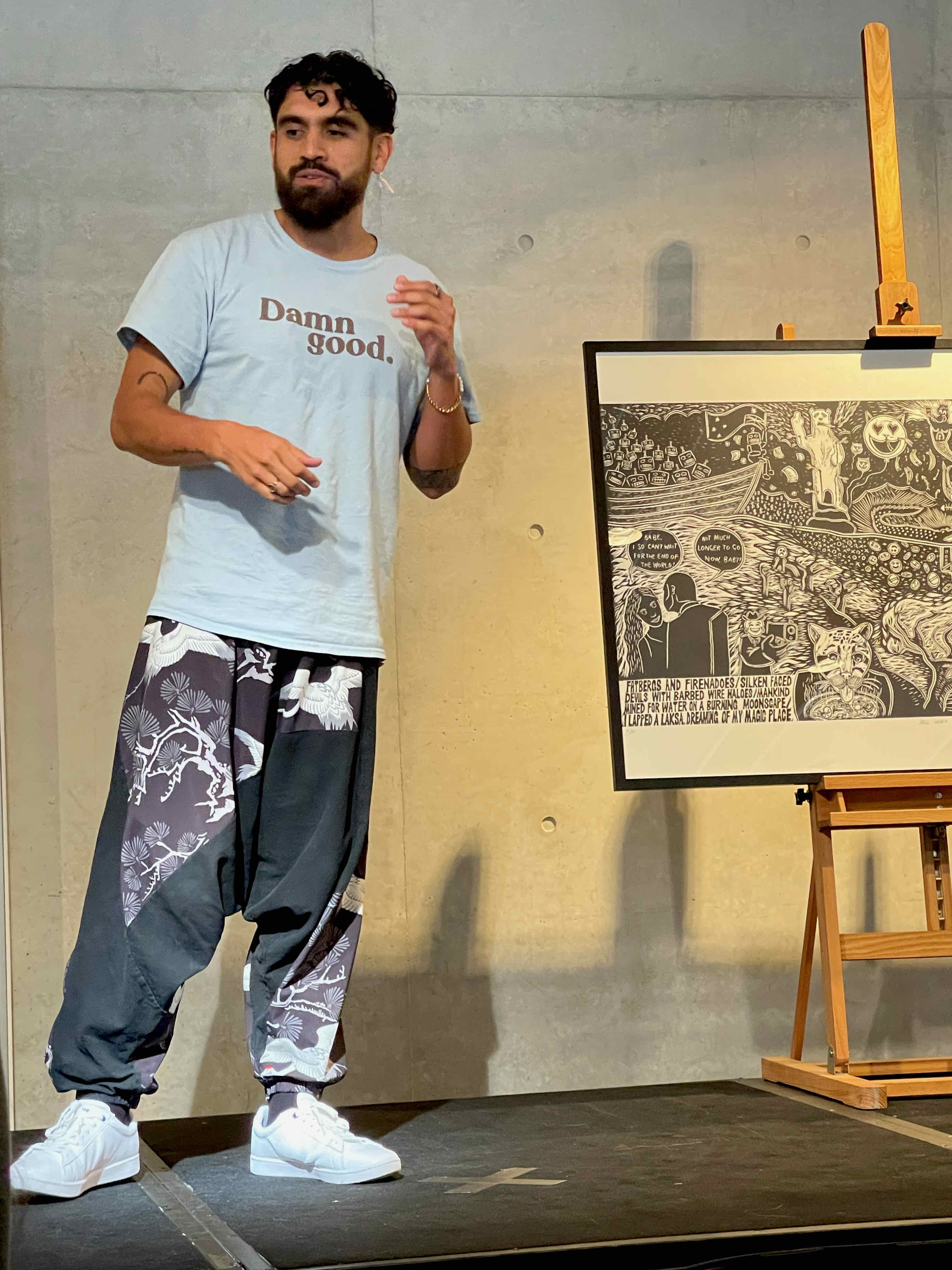
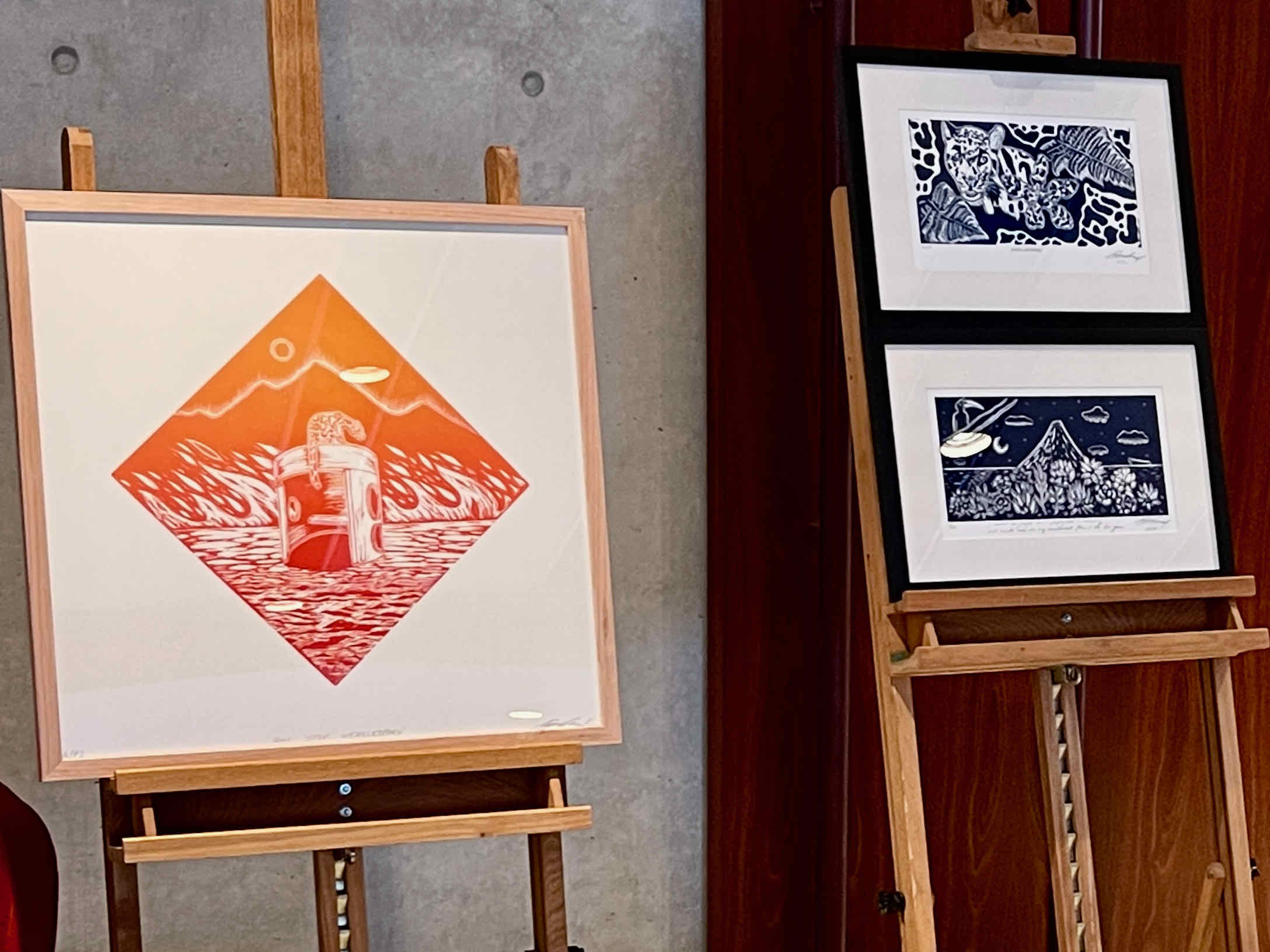
Not surprisingly, then, this was not your usual “in conversation” launch. It started with Musa performing some of his poetry, and a song. There’s nothing better, really, than hearing a poet read or perform their own writing, and Musa is a polished performer. So there was that. Then there was a display of his woodcuts, most of which appear in his book, and home-made sambal for sale, along with the book, not to mention the conversation with Irma Gold.

The performance

It was such a treat to have Musa perform some poems. I’ve heard him before, and love his heart and his ability to convey it so expressively through words and voice. His poetry is personal but also political, carefully crafted yet fresh too. Here’s what he performed:

l am a homeland: Musa, who has Malaysian and Australian heritage, started with this poem that explores home and belonging, when you don’t have one place, and got some audience participation going, asking us to breathe in its meditation-inspired refrain, “inhale”, “exhale”:

Inhale – I am singular
Exhale – I appear in many places

UnAustralia: Musa explained that he is often criticised as being UnAustralian because he (dares to) criticise Australia. This poem is his answer to that, and perfectly examplifies his satirical way with words:

Come watch the parade!
In UnAustralia
Land of the fair-skinned.
Fairy Bread.
Fair Go.

Rose gold lover: this one was a song – part ballad, part rap, and beautiful for that. (You can hear it performed with Sarah Corry on LYRNOW)

Hello brother: Musa dedicated this poem to Haji-Daoud Nabi, who, with the words “Hello, brother”, warmly welcomed to Christchurch’s Al Noor mosque, the shooter who went on to kill him and 50 other people.

Flannel flowers: Musa introduced us to a rare pink flannel flower that grows in the Blue Mountains. It flowers only when “specific conditions … are met … fire and smoke, followed by rainfall”, making it bitter-sweet – and an opportunity to contemplate both the environment and our mortality.

The conversation

So, I’ve introduced Musa, and Irma Gold needs no introduction, as she has appeared many times on this blog, including for her debut novel, The breaking (my review). Click on my tag for her to see how active she is. Irma is also a professional editor, and co-produces the podcast Secrets from the Green Room.

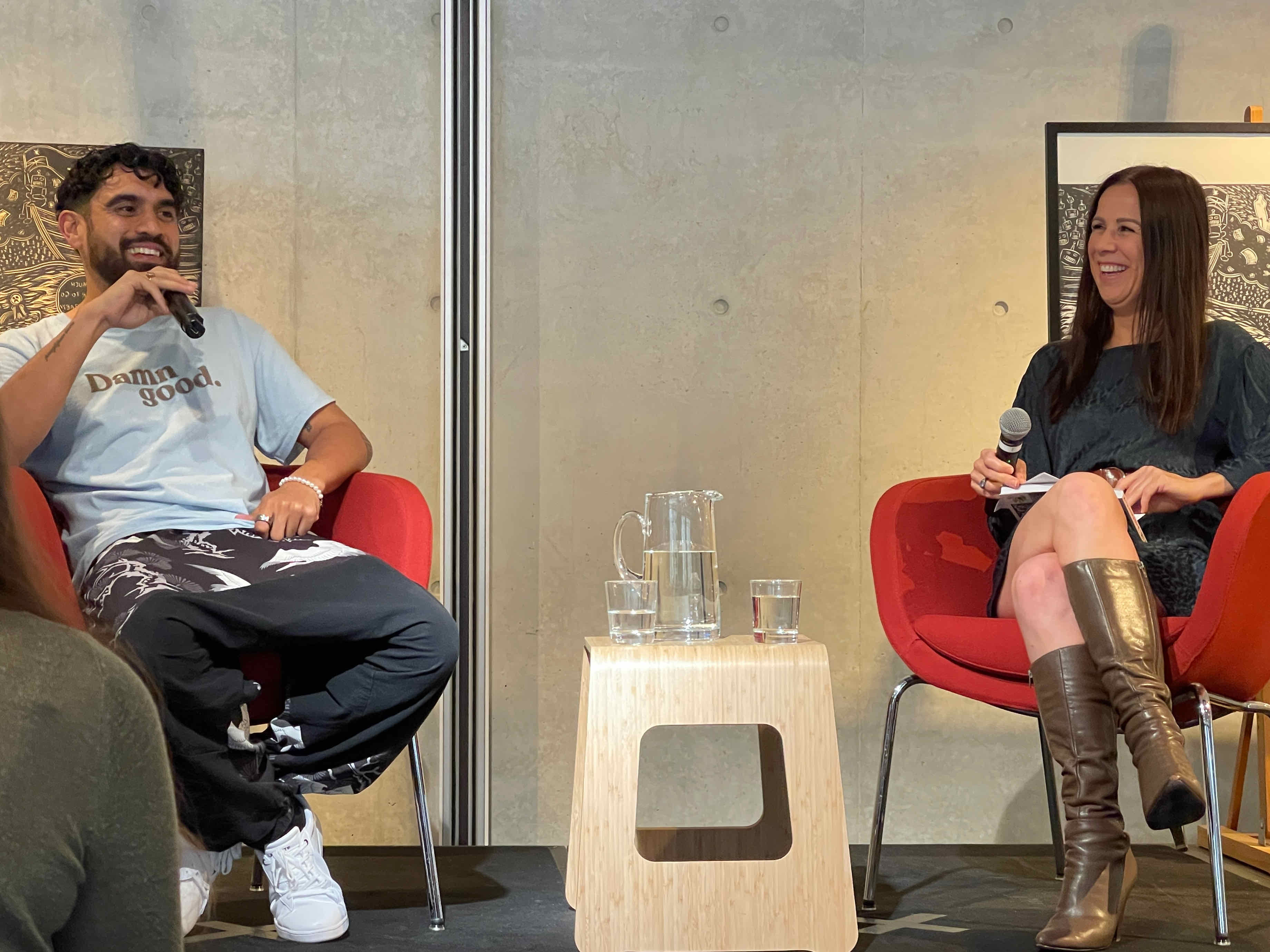
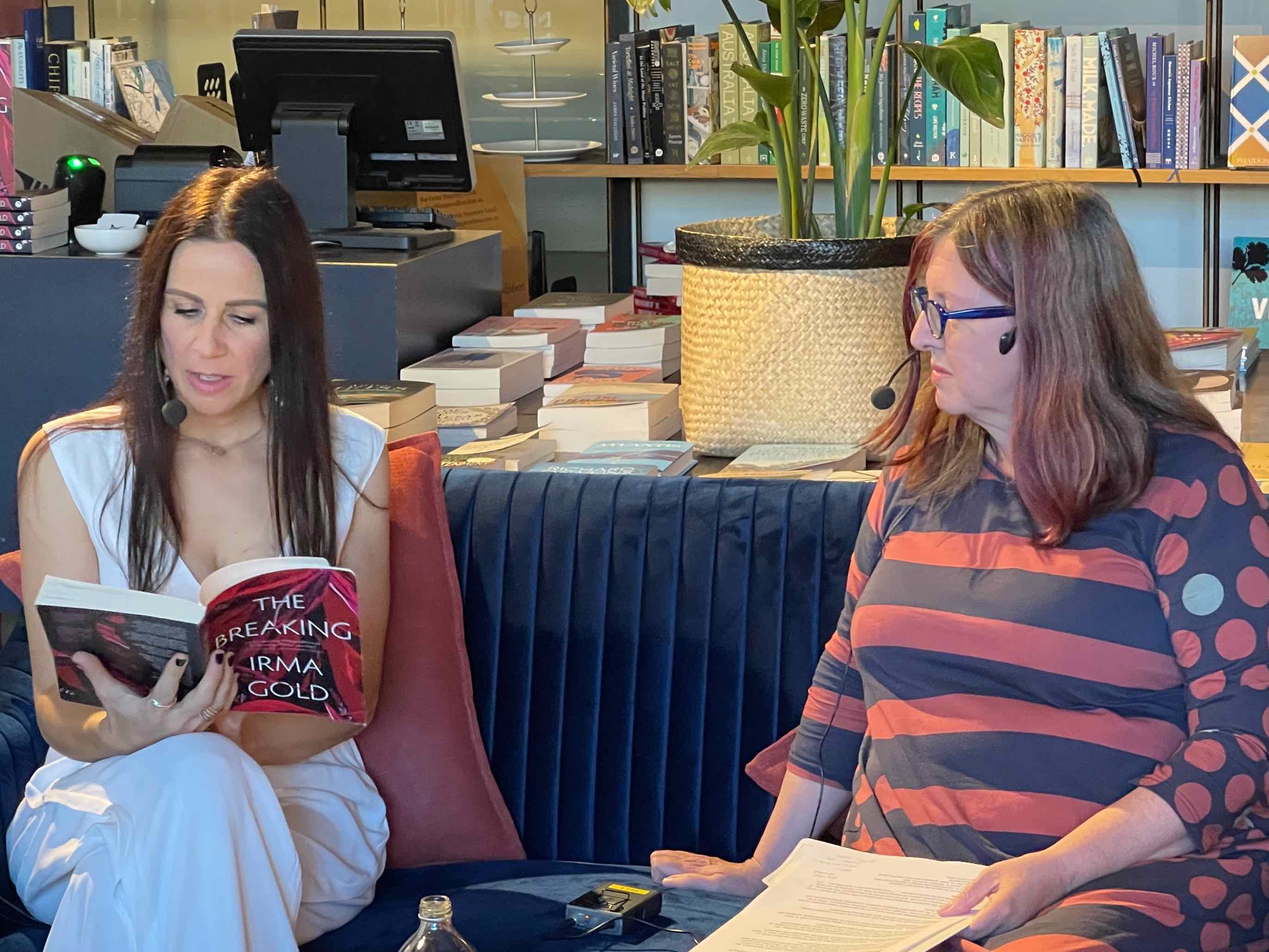
Musa and Gold, National Portrait Gallery, 27 November 2021.

Gold commenced by introducing Musa as a multi-talented artist, poet, rapper. She also praised, as an editor, the book being launched, Killernova. It’s a collection of diverse poems and woodcuts, and yet flows seamlessly, she said.

It was a thoroughly enjoyable conversation that, with Gold’s warm and thoughtful questioning, covered a lot of relevant ground.

The woodcuts

Given woodcuts feature strongly in the book, and are a “new” art for Musa, Irma started with how he got into woodcutting. He explained how he’d been in a dark place – had started to hate what he was supposed to love, writing and performing – so was visiting his father in Borneo, when he came across Aerick LostControl running a woodcut workshop, and joined in.

He spoke of the leopard which appears – often playfully – in his woodcuts (including one on top of Canberra’s iconic bustop.) So much of his writing, he said, focused on the ugliness of humanity, on racism, depression, so he wanted to do something beautiful. His first woodcut depicted the local small leopard (Sunda clouded leopard, I think). Although he felt it was “childish”, his teacher saw talent – what a surprise! – and a new form of expression for Musa was born.

Gold also asked him about the practice of “stamping the spirit into the works”. This is, Musa said, the traditional Southeast Asian way of printing woodcuts, and is still used, I think he said, by Indonesian protest poster-makers.

Musa then talked about taking the craft of writing so seriously it can lead to paralysis. Language is so imprecise you can just keep going, tweaking, tweaking the words. In woodcutting, if you make a mistake, you have to move on, as what is done is done. To make art, you have to take risk. He’d been taking himself too seriously, he felt, so wanted (needed, too, I felt he was saying) to be playful.

At the end of the conversation, but I’m popping it in here, Gold asked about how woodcarving deepened his connection with heritage. Musa said that he “would like to say it felt like homecoming but it felt more like tourism”. Some of this tension is conveyed, he said, in the first poem he performed, “I am a homeland”. It explores how we can inhabit different identities. A box limits you, he said. He prefers fluid identities.

The writing process

Gold asked whether, given he’s a performance poet, he reads aloud when he is writing? Musa said he writes in a “trancelike state” then “sculpts” his work. “Write in passion, edit in cold blood” is his practice. He also shared the philosophy of his favourite poet, Elizabeth Bishop – write with “spontaneity, accuracy, mystery”.

On whether he ever edited a poem further after performing, I think he said yes! (Given I sometimes post-edit my blog posts – because I can – I say, why not?)

Art and creativity

Gold referred to the poem, “Poetry”, because she related to its ideas. In it, he plays with the traditional recommendation to “write what you know”, shifting it, first, to “write what you know about what you don’t know”, then rephrasing it to “write what you don’t know about what you know”, before finally getting to the crux – and I like this – “write a question”.

The best art, he said, makes us ask questions about the world around us, but he likes to start with a question about self, with something that tests one’s preconceptions. Art, he believes, does not have to provide answers, just ask questions. Yes.

Gold then asked him about the role of alcohol and drugs in creativity, something Musa has spoken about. Killernova, he responded, is partly about undercutting mythologies in the art scene. One is the singular genius writer or artist. It’s b***s***, he said. All artists are products of their environment, so, this book includes collaborative poems. Another concerns the “addict musician, drunk poet” which he had bought into, but this book was “written when clean”.

The environment

Gold noted that concern with desecration of the environment runs through book, and asked Musa about the role he saw for art. Art, Musa believes, both holds a mirror up to world as it is and as it can be.

There is a Utopia in Killernova, Leopard Beach. Are Utopias dangerous, childish ideas that distract us OR could they project the world as it could be? he asked. Good question. He described a successful turtle sanctuary in Borneo, which was the result of someone’s dream. Through art, we can reimagine the world, and make us feel less alone.

Can art change people’s minds?

Musa responded that Werner Herzog said no, but he thinks it can, through asking questions. However, this needs to go hand-in-hand with collective action.

The end

Musa gave us one more performance to end with. It was a collaborative poem (“after” Inua Elliams) about pandemic, F***/Batman. Loved it, with its wordplay on masks (“we could finally drop our masks”) and references to toilet paper, Zoom, jigsaws; its exploration of the positives, negatives, and potential contained in the pandemic; and the idea that we “grew madder yet clearer headed”. What will we do with this, though, is the question. A provocative end to a great launch.

Omar Musa’s Killernova book launch with Irma Gold
National Portrait Gallery
Saturday 27 November 2021, 3-4pm

Stella … 10 years

While the Stella Prize isn’t quite 10 years old, next year will see the awarding of the 10th prize. With that landmark in its sights, the Stella people decided to tweak the prize criteria, and have added single-author poetry collections to the forms eligible for the prize. An excellent move. Around the same time, they announced their 2022 judging panel – Melissa Lucashenko (chair), Declan Fry, Cate Kennedy, Sisonke Msimang, and Oliver Reeson – creating another nicely diverse panel.

Now and then: Ten years of Stella

To celebrate entering its 10th year, Stella held a zoom session involving three past winning and shortlisted authors, Carrie Tiffany (Mateship with birds), Emily Bitto (The strays), and Claire G. Coleman (Terra Nullius). (Links are to my reviews) The session was convened by Christine Gordon who introduced herself as a Stella founding member, and the Programming and Events coordinator for Melbourne’s Readings Bookshop.

I wasn’t sure what to expect, but it was short and tightly focused on the value of the Stella. There was no Q&A, but I it was a good opportunity to hear from three writers whom I’ve read and reviewed here.

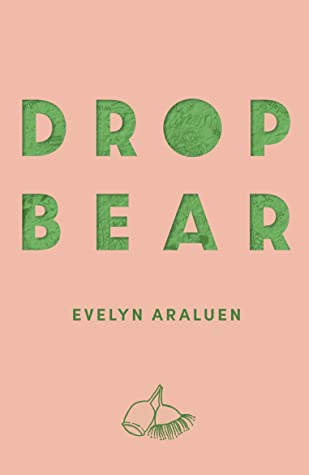
To honour the Prize’s inclusion of poetry collections next year, Christine started by reading from Evelyn Araluen’s poem “Acknowledgement of country” (from Dropbear). It’s a powerful, in-your-face poem that further inspired me to read this collection. (Brona has reviewed it, but doesn’t mention this particular poem.)

What did you know about the prize at the point your book was listed/won?

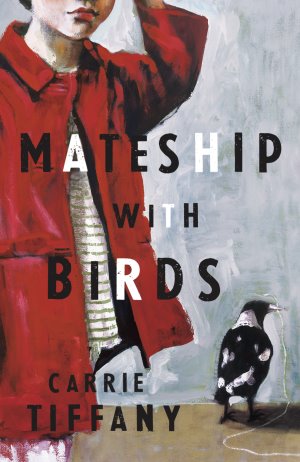
Mateship with Birds (Courtesy: Pan MacMillan)

Emily, who won the prize in its third year, remembers being excited by the idea behind the prize. Being a debut author, she didn’t know much about the literary landscape that inspired it, but she was amazed by the inequities that the Stella Count had revealed for women writers, across prizes, publishing, and reviewing. She was thrilled to win, but straight after, she found its value being questioned by men who wondered how worthwhile it was to win a prize only open to women! As the panel concurred, these critics didn’t understand the idea of an unequal playing field and its impact.

Carrie, Stella’s inaugural winner, said that she had not been overly aware of discrimination. She’d had good experience with her first novel – Everyman’s rules for scientific living – of the Orange Prize (now the Women’s Prize for Fiction), which was taken very seriously. But, she did experience backlash immediately after winning the Stella, with patronising articles in The Age and The Australian, for example. The latter described her book as a “bush romance”. Had someone like Carey or Winton written the book, she said, it would have been described in terms of exploring “nature and desire”. She said that her approach now would be to talk about history and women’s lack of opportunity and education, about how women have much catching up to do. Stella, she said, has more than broken the glass ceiling, it has “smashed the wall out of the building”.

Claire said that, like Carrie, she’d come to writing late, and had had no connection with the writing community. Being longlisted and then shortlisted for her debut novel was a profound endorsement.

What did winning mean for you?

Emily BItto, The strays, book cover

Christine noted that winning the Stella has a clear impact on sales. Emily agreed saying her book had been out for a year before winning the award, and sold as much in the first two weeks after winning as it had in that whole first year. Claire said after her shortlisting, her book achieved a spike in sales. Christine then mentioned the ongoing work Stella does to keep books in the public eye, over the long haul.

Choose a favourite poem

Christine asked each participant to share a favourite poem:

  • Claire read “White excellence” (Ellen van Neerven’s Throat, which Brona has also reviewed)
  • Carrie commented first that, while poetry collections are new to the prize, verse novels like Lisa Jacobsen’s shortlisted The sunlit zone had been eligible from the beginning. She read a poem dedicated to poet Anne Carson (Maria Takolander’s Trigger warning). She loved its focus on words and the concreteness of language.
  • Emily read “This landscape before me” by, she admitted, her friend, Sarah Holland-Batt. (Available at Poetry Foundation.

Why do you write/Earliest memories of writing

Emily talked about writing newspapers for her mother – from headlines right through to the sports news! As for why she writes, she described herself as an “angsty person” concerned about finding what we can do that’s meaningful. Books give her meaning, and she decided she wanted to contribute to that. Writing feels a worthwhile thing to do. (Amen to that, eh?) She added that winning the Stella was a wonderful endorsement.

Claire G Coleman, Terra nullius

Claire said, simply, that she was impelled to write Terra nullius: it was there and had to be written. In the process, though, she found that writing was something she could do, and that it is, in fact, the only job she’s suited for! She felt that being listed for this and other prizes helped create interest in her, which probably then helped her get her next books published. The prize changed her life in the sense that it told her that she could write.

Carrie, like Emily, sees reading as life-sustaining. She also likes that she can conceal herself in her writing, she can use the novel “to express me”. She believes in the role fiction can play in encouraging empathy: through novels we can “learn what it is to be someone else”. As to whether the prize was life-changing, she said that she was obliged, as a winner, to give lectures at universities. This was challenging as she’d never done it before! She also felt that her success with her first two novels meant people were more open to her later, more difficult book.

At this point, Christine closed the session, reminding us that Stella’s aim is to get women’s writing on everyone’s agenda, and asking us all to “Be a Stella Ambassador”. But of course!

I wouldn’t say I learnt anything earth-shatteringly new. However, through the experience of these quite different writers, I obtained a first-hand sense of what Stella can mean for writers. I also enjoyed getting to know these three a little more – and I loved all four poems that were shared. There’s something about hearing a poem read.

F*ck Covid: An Online Literary Affair (2)

This is the second of my two posts on the F*CK COVID online-only event. My first post introduced it and covered the fiction session. This post will report on the non-fiction session. I’ll start by noting that while the first session involved established authors, this one, I think it’s fair to say, involved emerging writers, who were also both from diverse cultural backgrounds.

Past-present: adventures in non-fiction with Shu-Ling Chua and Sneha Lees

While Gold’s and Brandi’s books were both novels, the two books covered here represent different forms, Shu-ling Chua’s Echoes being a collection of essays, and Sneha Lees’ Good Indian daughter (published under the name Ruhi Lee) being a memoir.

On their inspirations

Shu-Ling was inspired by the surprising discovery that a pop song in Crazy Rich Asians, “I want your love”, had been loved by her grandmother. This led her to researching the soundtrack, and exploring “lineages and inheritances” from various perspectives, including cultural, literary, fashion. This core theme held true, she said, through the three essays, which focus on domestic life, fashion, music, and water. Nigel suggested the word “intricate” described her book, but Shu-Ling prefers “intertextual” because she layers different cultural sources. She talked about the pressure she felt to be original (but I’ll leave that to the Q&A where it came up again!)

Sneha‘s book started with her wanting to understand why she was disappointed to discover, when pregnant, that she was having a girl. She came to realise that it was not about the baby but about how she felt as a woman in the world, and that this went back to psychological and physical abuse she’d experienced growing up. Her challenges in writing her story were: how to maintain a relationship with her family on whose watch this abuse had happened; and how to retain her culture. She talked about the high suicide rate for Indian woman, and her wanting to break the silence.

On wounds, scars and critiquing culture

Nigel said there was a heart of forgiveness in her memoir. Sneha laughed and said that Hard Copy program’s Nadine Davidoff had advised to write from the scar not the wound, but she’d often written from the wound. She admitted, however, that she had developed empathy for her parents, as their own stories had been tough, and this had given her a kernel of forgiveness. (This reminded me of Alice Pung coming to understand her parents.) Sneha’s book is about self and inter-generational understanding.

Shu-Ling talked of writing about wounds and scars – regarding sexual trauma – in her earlier writing, and the need to write about these things in ethically, responsibly. You need to consider, she said, the ethical, social, cultural, historical backgrounds. 

Sneha, sort of expanding this, spoke of needing to be mindful when writing about Indian culture in Australia. She was writing, she said, for white editors, publishers, readers, and didn’t want to make it easy for white people to see her critiques of her culture as evidence of their culture’s superiority. She loves her culture, but she also wanted to critique it. She’s interested in what it means to be Indian, what it means to be Australian.

Nigel wanted to explore this more, particularly how to critique dominant Australian culture?

Shu-Ling spoke about being part of a bigger group of writers trying to broaden Australians’ understanding of migrant culture, away from the expected traditional voyage and first generation stories. They need to be able to write about things important to them. Activism can take different forms and newer writers are carving out their own space.

Nigel asked whether the current bland simplification in Federal politics regarding migrants – like the “stop the boats” mantra – makes it hard to write about. Sneha commented on how distressing the short-term understanding behind these policies is. How can a white person proudly say “send back the boats” when they themselves came by boat and ruined the country. This thinking devalues what migrants and refugees bring: it ”feels like shit but you just write through it”.

On writing openly, honestly, respectfully about family …

… when they are still alive!  

Sneha talked to her parents about publishing her story, being anxious about airing “dirty laundry” and not wanting to attack the family. As a result, she agreed to publish under a pseudonym, Ruhi Lee (she’s now out!), but she also quoted Ann LaMott’s

If people wanted you to write warmly about them, they should have behaved better.

For Shu-Ling it was different. Her book is mainly about her mother’s side and her mother was part of the process. There were, however, uncomfortable conversations, such as about premarital sex. She agreed with Sneha that it’s not easy to write about family, but said that Echoes is a bit removed. She used music, for example, to create a bridge with her mother (and grandmother).

On the role of place in their writing

Shu-Ling said that, while she wrote the book in Melbourne, it is very much about Canberra because She’s exploring nostalgia. Also, she sees Canberra as “her” city, because neither her mother nor grandmother lived there.

Sneha didn’t feel that where she was writing, Melbourne, had impacted her book, but admitted that, before she wrote it, she had seen India through rose-coloured glasses.

The readings

As in the first session, both authors read. Sneha chose a section about having to talk to her parents about her sex education homework. Her father was horrified by the “the debauched syllabus”. Being taught this was “so veritably un-Indian”. Shu-Ling read from the last essay in her book, “To fish for the moon”, in which she talked, among other things, about what “opting out of motherhood” means. Is this a beginning or ending or both?

Nigel asked Shu-Ling about the tenderness he perceived in her writing. She said she writes as if she is speaking to a friend. She also said that her favourite writers write tenderly.

For Sneha, the question was obvious – her humour. Sneha said that humour writing is her first love, and that books and memoirs by comedians were major influences. She grew up with a diet of humour in her family. Readers need humour, she said.

Q&A

  • On the pressure to be original. Expanding this, Shu-Ling explained that she loved, for example, Alice Pung’s work, but had felt she must be different from her and others, like Benjamin Law and Maxine Beneba Clarke. She wanted to move away from the capitalistic focus on the individual, so used the conversation idea. She sees herself as renovating rather than building a new building. What a great metaphor!
  • On feeling equipped to write about BIG issues. Sneha spoke about addressing the political in a personal way. The advice from Hard Copy was to “just tell your story”, and to “give the reader more credit”, letting them come to it. This lets her stick to what she knows. Shu-Ling spoke similarly on focusing on the personal, and also about not wanting to speak over others.
  • On relationship with editors. Sneha said she had a great editor, and really enjoyed what was a collaborative process. She felt she could push back, but she also respected their suggestions and probings. Shu-Ling didn’t feel comfortable with her first editor, but the second one was collaborative.
  • On whether their families have read their stories. Sneha was sad that she felt she couldn’t celebrate publication with her family, besides her sister, while Shu-Ling said her mother had read her final draft for inaccuracies.
  • On turning memories into memoirs, managing the gaps and creating a narrative. Shu-Ling starts with a moodboard, and writes her first draft using stream of consciousness, winding her way through her question to a conclusion. She then develops her narrative during polishing. Because her subject matter is recent, she has few memory gaps. Anyhow, she says, memoir is not about the past, but about your relationship with the past. Sneha, on the other hand, says regarding narrative that she is a big structure person, so puts that down first. Her memoir was structured along her pregnancy timeline; for her new novel she has mapped out her chapters. However regarding memory, she said her story was complicated by gaslighting so she had to cross-check with sister, husband, and friends. Nigel commented that he loved her memoir’s chapter titles, like “Thanks for the panic attack. Here’s a heart attack in return”.
  • On surprising post-publication emotions. Shu-Ling was initially “down” that her book hadn’t charged the world, but appreciated the positive responses. Sneha didn’t expect ”to feel like shit”, but this was partly due to her the lockdown causing her launch to be cancelled, and to the COVID crisis being so bad in India. She was surprised by how much women “felt” her book.

Tips for writing through the pandemic

Sneha said to go back to what you love, like rereading old favourites. She was reassured about the value of her work by Ethan Hawke’s TED talk’s statement that

art’s not a luxury—it’s actually sustenance. We need it.

Shu-Ling agreed with rereading old favourites, being for her, essays. She also talked about the importance of community, and that the pandemic means she can attend interstate and overseas writing events which revitalise her creative energy. (Hear, hear!)

Overall themes

Interestingly, two ideas recurred in both sessions: one related to trusting readers, and the other to the value of the editing process.

A big thanks to the ACT Writers Centre, Nigel Featherstone and the four panelists for organising and taking part in an event that felt so honest and reaffirming. Art is indeed sustenance.

F*ck Covid: An Online Literary Affair (1)

An initiative of the ACT Writers Centre and its Creative Producer Nigel Featherstone, F*CK COVID, was an online-only event. It comprised two panel discussions, featuring “four of Australia’s most exciting literary voices”, one focused on fiction, and the other non-fiction. I will report on these in separate posts.

Both sessions included the authors reading from their books for a few minutes, which, as always, was a treasure.

Hard truths; Risky fiction, with Irma Gold and Mark Brandi

After introducing the authors and their latest books, Irma Gold (The breaking, my review) and Mark Brandi (The others), Featherstone launched into his gently probing questions, which resulted in some great insights, for readers and writers. We started with Gold and Brandi describing their books, but you can find that info elsewhere if you haven’t read the books! You can also read more about Irma on her novel in my report of a conversation in May.

On their inspirations

Interestingly, both authors’ novels started as short stories.

Book cover

Gold’s started as a story that is now, essentially, her first chapter. It was not initially about elephants and animal cruelty. She feels that if she’d started with that idea the novel would have been more issues-driven that the character-driven story it is. The two characters appeared to her fully-formed she said. She also said that her stories are usually dark, but she wanted to write something more joyful.

Brandi’s novel started as a short story (published in Meanjin in 2016). Unlike Gold’s non-autobiographical novel, Brandi’s story was based on a childhood experience that gave him his first insight into the complexity and contradictions of the adult world. However, he said that as he has talked about the novel post-publication, he has realised that the story was more inspired by his father’s life with his father’s father. It’s about nature versus nurture, and how events affect us later in life.

On challenges they faced writing difficult sections

For Irma, this was writing the animal cruelty scenes. One scene in particular was “very hard” to write. She wanted to not make the book so harrowing that people would not want to read it. Her aim was to give enough for people to understand the situation. Even so, one agent and some publishers found her story “too risky” and did not want to take it on. Gold said what she loves about writing is “seeing the world through other perspectives”, which is just what we readers like too, eh?

For Mark, the whole thing was challenging! He also likes “seeing world though other eyes”. The discussion focused mainly on writing difficult material through a child’s eyes. Brandi spoke about trusting readers. He believes that the reader’s imagination can do a better job than the author, so he creates the prompt to allow readers “to go to the dark place if they are brave enough to”. People, he said, can tolerate cruelty to humans more than to animals. (Why is that?) He also said he’s happy to read “dark stuff”, that it doesn’t give him a negative world view (which I relate to).

Nigel complimented Australia’s publishing landscape, believing we have publishers prepared to take risks.

On style

Nigel asked Mark about his “pared back” style, in which there’s barely a sentence that is exposition or description. Mark responded that this is what he likes to read. He likes to be trusted, respected as a reader. He wants his readers to bring themselves to the work, and to “paint the picture themselves”. Reading, he said, is a “dance between reader and writer”.

This led to a discussion about dialogue. Brandi tries to use dialogue sparingly. It must have meaning. Nigel quoted Francine Prose (Reading like a writer) who wrote that “good dialogue is when character’s thoughts are louder on the page”. Irma concurred, saying that every line of dialogue has to have a reason for being there.

On themes and perspectives

Nigel suggested that Irma’s overall theme was Hannah’s yearning to do the right thing and to find love. Irma replied that she wasn’t consciously thinking of these, but she has later realised that Hannah came from her observation of 20-something tourists she’d seen in Thailand. Their freedom looked “so delicious and wonderful” but she’d realised that, at her age, she had the benefit of knowing who she was, and where she was going. Uncertain Hannah came from this recognition! It’s interesting to explore a character like Hannah, particularly when you throw in someone like Deven who tests and challenges. Nigel commented that in good novels, the DNA is in the opening, and that The Breaking opens with a sense of tension, darkness, and humour.

For Mark, Nigel returned to the issue of writing from the perspective of an 11-year-old (Jacob). Mark confessed that the inner child is “close to the surface for him”! Then, turning serious, he identified the two main issues: a child’s limited understanding of the world, particularly when that world is closely mediated through his father; a child’s language and narrow “vocabulary palette”. He used Jacob’s imagination to convey things a boy’s language couldn’t.

Here a William Faulkner quote was paraphrased, as it seemed to apply to both Irma and Mark. The original is:

“It begins with a character, usually, and once he stands up on his feet and begins to move, all I can do is trot along behind him with a paper and pencil trying to keep up long enough to put down what he says and does.”

On bringing together character, plot and story

Nigel asked about their writing process, regarding how and when they bring all the elements together.

Irma said that for her character and place go together. She also talked about how her work as an editor has given her an insight, particularly, into pacing. She said that her first draft is very much character-based, with plot and pacing honed during editing.

Mark’s response somewhat echoed Irma’s in that he’s very dependent on his editor and publisher for help with plotting. Again, his style of reading aligned with mine, when he said that he doesn’t pay much attention to plot in his own reading, and that he “will stay with good characters through whatever harebrained plot the author throws up“. I loved this, because I don’t care about plot holes. I care about characters and ideas.

Anyhow, he said that he leaves a couple of months after his draft, and will often see plot deficiencies when he returns to it, but there are always more when the book gets to publisher.

Q&A

  • On their writing sessions: Both writers said you need a routine, and described their own. Mark drafts 2-3 hours every day because “voice and character are crucial” and he needs to stay with them. Irma said her process/routine varies for each project depending on what’s happening in her life (as she works full-time and has three children). With The breaking, she could only allocate two three-hour sessions a week, but her subconscious worked away in between, making those sessions productive.
  • On writing violence, and how to dial it back when the subject matter is violent. Irma suggested that people tolerate more violence against humans so it may not be a big problem, while Mark says that you give the reader enough details, then trust them to imagine. The question is, he said: What are the violent scenes in service of? Are they to convey what it’s like day to day, to support characterisation, or? Answering these will help avoid gratuitous violence.
  • On titles, which comes first, the story or the title: For both it was clearly the story, but Mark said that The others came to him very early while The rip started as something else. Irma said The breaking came to her after the book had gone to the publisher.

Tips for writing through the pandemic

Mark said routine and ritual and hard work – and giving it your whole being and heart.

Irma admitted that, until now, we Canberrans hadn’t been greatly affected, but she agreed that routine is important. Now she is in lockdown, and has more time, she plans to grab that! Find your time and your routine, was her advice.

Live events are the best, but online ones like this can be just as good in terms of both content and warmth. Watch for session two’s report …

Monday musings on Australian literature: Poetry Month 2021

I have posted on World Poetry Day, which occurs in March, several times in recent years. And I have written about Australian poetry various times, including about the Red Room Company (or, Red Room Poetry). Their vision is very simple: “to make poetry in meaningful ways”. They have initiated and supported various projects over the years, and have now come up with a new one, Poetry Month. It seems the perfect topic for another Monday Musings on poetry in Australia.

Many of you are probably aware that the US has various months dedicated to literary/humanities/justice issues, like Black History Month in February. One of these is their National Poetry Month which has been going now since 1996. I’ve often thought it would be good for Australia to emulate some of these. We do have NAIDOC Week, of course, but that could be a month, eh? Anyhow, now Red Room has initiated a Poetry Month which is exciting:

Our goal is to increase access, awareness, value and visibility of poetry in all its forms and for all audiences. The inaugural Poetry Month will be held during August 2021 with the aim of an ongoing annual celebration.

What are they doing?

A lot, in fact. They say that they have

an electrifying lineup of poetic collaborations, daily poems and writing prompts, online workshops, poetic residencies and live to live-streamed showcases, designed to engage everyone – from veteran poetry lovers to the (for now!) uninitiated.

There is a calendar. They have 8 poetry ambassadors, who are an eclectic and appropriately diverse bunch: Yasmin Abdel-Magied, Tenzin Choegyal, Peter FitzSimons, Dr Karl Kruszelnicki, Stephen Oliver, Grace Tame, Megan Wilding.

My love of reading and writing poetry is guided by a lifelong attraction to the seemingly simple and unadorned.

~ Tony Birch

Specific events are …

  • 30in30 daily poetry commissions: every day there are/will be “new original text/video poems, poet reflections and writing prompts from some of the country’s leading poets, authors, spoken word artists and playwrights”. They can be accessed on the site, and on social media (with the hashtag #30in30). Today, for example, there’s a 2-minute video from First Nations author, Tony Birch, on what poetry means to him. He talks of poems that can have new meanings each time you read them. 30in30 will include commissions from their larger Fair Trade project which involved First Nations poets from around the world.
  • Line Break: a weekly online show, on Tuesdays through August, 7pm AEST, on Facebook and YouTube, providing previews from feature poets, publishers, spoken word artists, and musicians, and more.
  • Poets in Residence: a program, supported by City of Sydney (how great is that). The poets were to be located at Green Square Library “for a period of writing, reading and performing poetry on site, engaging the general public in various ways and showcasing COS library collections”. Unfortunately, Sydney’s current lockdown has forced the postponement of this.
  • Showcases: a “raft” of live and online events across the country, including the inaugural Poetry Month Gala supported by The Wheeler Centre. Click on the Showcases link to see events from, indeed, around the country, including in South Australia and Western Australia.
  • Workshops: weekly online workshops, on Wednesday nights 7-9pm, via Zoom, catering “for all poets at all levels … anywhere in Australia”, with the topics being “stripping poetry back, breath and beatboxing, the intersection of poetry and comedy, and a special older emerging voices workshop”. They suggest a donation of $10. The workshop leaders are Sarah Temporal, Hope One, Vidya Rajan and Tony Birch.

What an exciting-sounding and diverse program.

Here is a taster … Australian of the Year, Grace Tame, with her strong 30in30 contribution, “Hard pressed”.

A little value add from me …

If you are looking for contemporary Australian poetry, you could start with two independent publishers:

Ali Cobby Eckermann, Inside my mother
  • Giramondo, which published Jonathan Shaw’s chapbook that I reviewed recently). They have also published Ali Cobby Eckermann, Jennifer Maiden, Gerald Murnane, Gig Ryan, Fiona Wright, and so many more known and unknown to me.
  • Pitt Street Poetry, which published Lesley Lebkowicz’s The Petrov poems (my review) and Melinda Smith’s Drag down to unlock or place an emergency call, which won the 2014 Prime Minister’s Literary Award for poetry. They have also published Eileen Chong, John Foulcher, Peter Goldsworthy, Geoff Page, and Chris Wallace-Crabbe, to name some of the better known (to me) from their stable.

There is also the Australian Poetry Library, about which I’ve written before. It now contains, the website says, “tens of thousands of poems from hundreds of Australian poets”. You can read poems free online, but if you want to download and print poems, there is “a small fee, part of which is returned to the poets via CAL, the Copyright Agency Limited”. This resource is particularly geared to teaching poetry, but is available to anyone.

Lesley Lebkowicz, The Petrov Poems

If you are looking for Australian bloggers who write about poetry, try Jonathan Shaw at Me fail? I fly. This link will take you to his poetry tagged posts, of which there is now a substantial number. Also, blogger Brona (This Reading Life) is planning to support the month, so if you don’t already subscribe to her blog, do check her out if you are interested in poetry and/or in what Red Room is trying to do for Australian poetry.

Finally, you can also find poetry reviews in the Australian Women Writers database.

And now my question: do you have a favourite poem to share with us? (And do you, like Tony Birch, go back to it again and again, and find something different each time?)

Irma Gold in conversation with Sarah St Vincent Welch

Like many bookshops, Muse Canberra offers a wonderful program of book events. Unfortunately, I get to very few, but I did get to this weekend’s conversation between local poet (among other things) Sarah St Vincent Welch and Irma Gold about Gold’s debut novel The breaking (my review).

Irma Gold, reading from her novel The breaking, with Sarah St Vincent Welch, Muse, 23/5/2021

The participants

Irma Gold has appeared a few times on this blog, including for her collection of short stories, Two steps forward (my review), her children’s picture book, Megumi and the bear (my review), the Canberra centenary anthology she edited, The invisible thread (my review), and now, of course, The breaking. Irma is also a professional editor, and co-produces the podcast Secrets from the Green Room.

Sarah St Vincent Welch has also appeared in this blog, though more subtly. Besides having a piece included in The invisible thread, Sarah, a lovely past work colleague of mine, was the person behind my taking part in a public reading of Behrooz Boochani’s No friend but the mountains in March 2019. Sarah is a published poet and organises various arts events in Canberra, including a weekly poetry event, That Poetry Thing That Is On At Smiths Every Monday.

The conversation

Irma and Sarah know each other well – not just because they are both actively involved in Canberra’s literary scene but because they had been in the same short fiction writing group. This, I’m sure, helped make the conversation seem so effortless, but only partly, because Sarah’s natural warmth and Irma’s relaxed, thoughtful engagement with the questions made the conversation a delight. It covered a lot of ground, so I am going to use headings for the main questions Sarah asked. It started with a brief reading from the book.

Character or issue-led?

Book cover

Nothing like getting straight into the nitty-gritty, and that’s what Sarah did with her opening question. Character-led, said Irma, not the elephant cruelty issue. Indeed, she said, she didn’t know at the start that the book was going to be about elephants. It started with the two characters, Deven and Hannah, who arrived fully formed on the page. But, here’s the thing – it also started as a short story, which, with interest from her writers’ group, became two linked short stories. At this point, John Clanchy (whose writing I love) suggested that she was writing a novel. Irma said she’s glad it was the characters who drove the book, because if it had been the elephants, it would have been more polemical. (That was one of my potential questions gone!)

Can a novel effect change?

Another great to-the-point question. Irma, who admitted she loves fiction best anyhow, said she believes fiction can investigate complex issues in a way that non-fiction can’t. Readers can be put in the shoes of characters to “see” the issues. Through characters, fiction can explore complex issues, like the elephant situation, without offering answers.

Irma hopes that what her book (and fiction like it) can do is lead people to make different decisions, which, in this case, means not buying into the elephant tourism – not riding elephants, not attending elephant shows, etc. She feels that her novel is timely, because the current hiatus in travel gives us the opportunity to consider our travel decisions, and how we engage with another culture. This includes the practice of westerners volunteering (as she herself did). Are we helping or interfering? She mentioned the Instagram selfie culture, in which tourists take selfies with elephants, not seeing what’s going on behind them to keep that elephant in check.

Irma talked a little about the cruelty practised on elephants, but I won’t repeat that here. It is in the book, and is not pleasant reading, but is necessary knowledge, particularly for tourists to Asia. She also talked about how her love of elephants started in childhood.

Surpises as a debut novelist?

The best surprise has been the positive feedback, she said, as she’d steeled herself for criticism. She was particularly thrilled with an email from a long term Thai resident who thanked her for getting Thailand right, for avoiding cliches.

This led to a discussion about the work involved in writing the novel, because while she’d been to Thailand and worked in elephant rescue, she hasn’t lived there. She worked hard to get Thai life and culture right. She talked about working in the elephant sanctuaries where the two main groups of volunteers were young people in their 20s who have no strong sense of where their lives are going, and those in their 50s and 6Os.

On writing short stories versus novels

As a lover of both forms, I appreciated Irma’s practical responses. First, she said, you can hold all of a short story in head at one time. This is harder with a novel, so you need concentrated time, which she organised for herself. Then, she said, pacing is different in a novel, and, of course, a novel involves longer-term character development.

Place of her novel in the literary landscape

Another question up my alley! Irma said more novels are engaging with this sort of thing. She commented that one reader had asked her if her book was like We are all completely beside ourselves. She was surprised because it’s a very different book, but it was in fact an inspiration for her novel.

More books, she added, are engaging with animal rights. There’s a growing awareness she said, but she hopes, too, that the book is an enjoyable read.

Joy

Sarah ended by saying that as well as being about elephants, the novel is about madcap behaviour and the joy of love and life. Irma agreed, saying that everyone wants to talk about elephants, but she wanted to write about joy. She loved writing Deven she said.

Q & A

There was quite an engaged Q&A, but I will keep it brief:

  • On the aspect of the book most difficult to confront in herself: Irma likes to write from what she knows to doesn’t know, believing there is no black and white, but the most difficult thing was watching the “breaking”/phajaan videos.
  • On writing about “delicate” things: Irma understood the questioner’s not wanting to give plot points away, so let’s just say that she talked about how fiction, by definition, will involve writing about things that are not your lived experience, and that you have to consult.
  • On whether there is more Hannah or Deven in her: Irma is drawn to confident, intense people like Deven, so she has probably come out of that. However, she feels these characters came from nowhere, or, from the girls she saw at the sanctuary
  • On what we can do given the complexity of the problem: Irma said that the elephant industry only exists because of tourists, so the main answer is awareness! She hopes that not only will readers of her book become aware, but will talk to others. Tourists, though, need to make choices consciously and carefully because places will pretend to be what they are not. The Save Elephant Foundation is a good place to start.
  • On the editing process: There was quite a bit of talk about this. Irma, as an editor herself enjoyed the process – for the help it gave her book, and what it taught her about her own work as an editor. (I loved her comment about authors having “go to” words – bloggers do too – and the need to get those out!) Irma concluded by acknowledging John Clanchy for the immense help he gave her.

Irma Gold in conversation with Sarah St Vincent Welch
Muse (Food Wine Books)
Sunday 23 May 2021, 3-4pm

Sydney Writers Festival 2021, Live and Local (Session 2)

My second Sydney Writers Festival’s Live and Local event for 2021 was an hour after the first one. This left me time to fill in. It was disappointing that the National Library’s Bookplate Cafe was closed by then, which I think has happened in previous years. It would have been nice to sit down with a cuppa, or a cool drink. However, there was the bookshop, so I did business there instead!

Richard Flanagan and Laura Tingle: Conversation, Saturday 1 May, 4pm

If I hoped that this second session would not be as demanding on my ability to simultaneously take notes and absorb the discussion as the first, I was to be disappointed. This session featured multi-award-winning writer Richard Flanagan and the also award-winning journalist Laura Tingle, and I think I took even more notes. In fact, once again, Karen Viggers, who was also taking notes, nudged me a few times to say “get that down”! What a hoot!

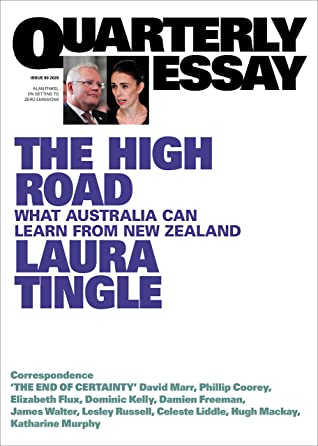
Flanagan is always entertaining, which doesn’t mask the thinking and humanity in what he says. Tingle proved, not surprisingly, to be up to the task of interviewing – conversing with – this man. The topics ranged far, but stemmed mostly from Flanagan’s latest two books, his non-fiction exposé, Toxic: The rotting underbelly of the Tasmania salmon industry, and his latest novel, The living sea of waking dreams. Flanagan also referenced Tingle’s writing, particularly her latest Quarterly Essay (#80), The high road: What Australia can learn from New Zealand. Flanagan has appeared several times on my blog.

Tingle started the traditional way by introducing Flanagan through his oeuvre. She noted its breadth of subject matter, then turned to Toxic. Read it, she said, if you want to be depressed, and horrified, and, oh yes, informed. It spoiled her breakfast, she said, wryly.

Flanagan, ever the humorist, suggested he is creating a new genre, Tasmanian non-fiction horror! Then, in one of his several compliments to Tingle, he said that in the last year Australian journalism has become stronger, better, and that this has been largely due to our women journalists, particularly Laura Tingle.

Flanagan then read, as requested, from Toxic – a particularly unappealing description of the physical matter involved in the industry – before answering Tingle’s obvious question regarding how Tasmania has responded to it.

Apparently, Toxic is “the fastest-selling book ever” in Tasmania, going to three print runs in its first week. Flanagan and his publisher had kept the project secret until the day it was placed in bookshops, without pre-publicity, with just his name and title. It has had immense support in Tasmania, but the government and salmon industry have been silent.

His plan had been to write a short article, but he just kept discovering patterns of intimidation and violence. Ultimately, he said, companies run rogue when there are no rules, and there is no proper governance in the salmon industry. There’s a lot we don’t know about the food industry, he added. He wrote the book for the public. He wants it to help people make decisions in supermarket aisles. (And, perhaps, Tingle for her breakfast!!). Responding to Tingle’s question about its impact on the state election that day, Flanagan said that exit polls were showing a stronger result for the Greens.

Tingle asked about Tasmania’s history of “f*****g up its water supplies”, about the confluence of business and bureaucracy in this. Flanagan talked of Tasmania’s particular history – the near genocide and the convictism which encompassed slavery. Many pathologies persist when you see mass trauma, he said. Most Tasmanians are the issue of the first quarter of its history. He commented on the abuse of power, and the use of silence and fear to retain power. He also quoted Chekhov:

Write about this man who, drop by dropsqueezes the slave’s blood out of himself until he wakes one day to find the blood of a real human being–not a slave’s–coursing through his veins.

Flanagan added “word by word” after “drop by drop”! (As Jim noted in his comment on my previous post, the subtitles frequently got tricky words and names wrong. I didn’t note them down, but I do remember Chekhov becoming “check cover”)

Tingle then turned to his books in general, suggesting that there are about people shaped by greater tides, people who have no control over their destinies. She was eloquent, and drew out a typical, somewhat self-deprecating Flanagan response that this “sounds plausible”.

Every writer, he said, belongs to both their birthplace and the universe of letters. Like many writers, he seeks the universal in the particular, and his particular is “this strange island”. All his books come out of the wonder of his original world in the western Tasmanian rainforests. He suggested that the history of novels is not made in the great centres. Joyce wrote in that tucked-way place of Dublin, Marquez in his fictional place, Macondo, and so on.

Tingle returned to her question, reframing it somewhat, to reference power. His characters she said are not authors of their own fate. Power doesn’t have to be at the centre of literature, he replied. Yet, in his latest book, The living sea of waking dreams, the characters are trying to control the mother. Her life is about people trying to control others.

Flanagan then made a point that made me sit up. He said there’s a potent and poisonous myth that everything is about power. He talked about how identity politics is a zero-sum game. The truth is, he said, that most things are not political. He quoted that grim poet, Larkin, who said that ”what survives of us is love”. Flanagan’s characters are about love, he said. This is the nub of what life is about. Seeing life through power is a “false compass”. This bears more thinking, though there is truth in what he says about love.

Tingle turned to time, to the linear time in European thinking versus Indigenous circular time. Does fiction free us of linear time, she asked? Flanagan talked of identifying two ideas underpinning European art: everyone is alone, and time is linear. BUT, he’d come to realise that no one is alone, that you only exist in others, and that time is circular. Stories go back and forth, in and out. Yolngu people, he said, have a tense that combines past-present-future. This is more what he grew up with.

There was more talk about Tasmania, but the next point I want to share is his idea – one Indigenous people understand – that “Bush is freedom, City is oppression”. We need our political leadership to open up to Indigenous heritage and ways of thinking.

Tingle then threw in a statement made by past conservative New Zealand PM, Jim Bolger, who, when asked “why the Waitangi Tribunal”, responded “because the country’s honour was at stake”! Imagine this from a contemporary Australian politician?

Flanagan’s response was that not thinking Bolger’s way led to “the slow corrosion of us as a just and democratic society”. He said that the “battle to be a good people and a good society matters”, but we are losing this as we continue to allow such things as Aboriginal deaths in custody. He said that the battle for the soul of nation is the battle for a nation worth living in. (Karen whispered to me, “so eloquent”!)

Then he referred to one of my all-time favourite books, Camus’ The plague (my review). The plague is always there. It’s deeply disturbing, he said, how out of their comfort zone many of our politicians are.

We then moved to Australian literature. Flanagan noted that there’s been a great surge in Indigenous and women’s writing, though he’s “annoyed” that women from the past are not getting the credit they should. Women – such as publishers Beatrice Davis and Hilary McPhee – have shaped a different literature here compared with American and Europe. He barely tipped the surface, though, of the depth of women’s contribution to Australian literature from its beginning.

Moving right along, Tingle asked Flanagan whether he was moving more into non-fiction. Not a bit of it, was, essentially, the reply. But, he did say that non-fiction gets you out of the door which is good for novelists. In the end, it’s story that’s important and fiction has a “profound spiritual aesthetic and intellectual tradition”.

The conversation then moved the challenges confronting writing stories (fiction and non-fiction), today: libel laws, not to mention the “wall of noise” and “multiple strands”, which Tingle said make it hard to pull stories together.

For Flanagan, there’s one simple story – rapidly growing inequality. He spoke of how the richest and most powerful have connections with politics, and act in ways that cloak the state’s withdrawal from where it should be, like education, health, environment. They manufacture identity wars in ways that shroud real needs.

He said his latest book looks at how words can create a wall between people rather than a bridge, and then talked about politicians lying in the morning, then again in the afternoon. This is the tactic of totalitarians. It creates a situation in which truth has no value, leaving you with opinion. When that’s all you have, “society moves into darkness”.

After all this, and a little more on politics and writing, the session ended with Flanagan reading a lovely piece from Toxic about an octopus. Flanagan said that despite it all, he’s not despairing: there’s hope in beauty and wonder.

It was hard to cut much out of this!

Sydney Writers Festival 2021, Live and Local (Session 1)

This is the third year I’ve attended Sydney Writers Festival’s Live and Local live-streamed events at the National Library of Australia.

More often than not, I attend these events alone, but I was lucky to find that one of our wonderful local authors, Karen Viggers, was also attending alone, so I had company in my note-taking and we did manage a little debrief after each session too. We had both booked two sessions – the same two. Karen has appeared a few times on my blog.

Sarah Krasnostein and Maria Tumarkin: Conversation, Saturday 1 May, 2pm

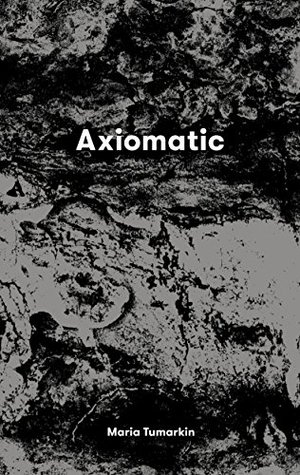
Maria Tumarkin, Axiomatic

This session was to be Sarah Krasnostein with Helen Garner. However, on Friday, an email announced that Garner was unable to attend and would be replaced by Maria Tumarkin. I was a little disappointed, of course, but I was very happy with Maria Tumarkin as replacement. I’ve read and reviewed her impressive book, Axiomatic, which won the Melbourne Prize for Literature’s Best Writing Award and was shortlisted for several other awards.

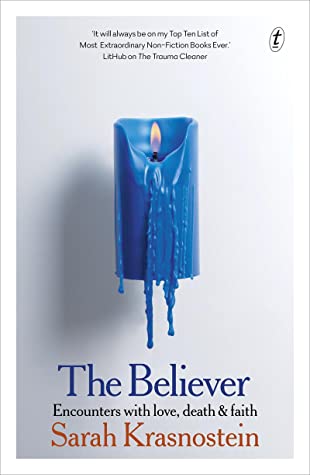
Writers festival conversations are interesting beasts. They are, formally, interviews, with one person’s role being to talk to the other about their latest work, in this case, Sarah Krasnostein and her book, The believer. But, what often happens, and what happened here, is that although it was clear that the focus was Krasnostein’s book, the session did feel more like a conversation with Tumarkin actively engaged in sharing ideas. Some of her questions were almost as long as Krasnostein’s answers. Indeed, at one point she admitted that she was taking a long time to ask her question and that “Helen would never do this”! She got a friendly laugh.

Here is how the Festival program described the session:

Sarah spent time in Australia and the US talking to six extraordinary people who held fast to a belief even though it rubbed against the grain of conventional wisdom. Her research culminated in The Believer: Encounters with Love, Death & Faith, a deeply humane and deftly drawn enquiry into the power of belief.

The program continued:

Sarah is joined by Maria Tumarkin to explore what we believe in and why – from ghosts and UFOs to God and the devil, dying with autonomy and beyond.

This is not, in fact, how it came out but, I’m not sorry, because what we got was something far more interesting. No, let me rephrase that. I don’t know how interesting the suggested topics might have been but I loved what they did talk about – because they spoke to matters that interest me.

With a nod to Helen Garner, Tumarkin started by quoting Garner who has apparently said that her first lines “come as music from some other place”. She wondered if that’s how Krasnostein’s books start.

“Not anything like that!” said Krasnostein, and she talked about her research and writing processes which topics interest me. She basically, as Tumarkin reframed it, “squirrels material without having a particular idea” about where it’s going. With The believer, Krasnostein “stumbled across the Mennonites” and went from there. She holds her material close, she said, “until it tells you what it is”. (A bit like Michelangelo finding the sculpture that’s already in the block of marble?)

Tumarkin asked what inspires Krasnostein. She replied that it’s the wonder of what she finds in a day, and telling story of that. In other words, she’s driven by curiosity, and finding the story under the surface.

Tumarkin then asked how Krasnostein fixes or anchors her stories. How she finds their core, I guess she meant. Krasnostein said it’s not about what she likes but what is “interesting”, about finding different versions of the world. She didn’t know exactly what she wanted to know about belief when she started.

However, she knew she didn’t want to write magazine pieces or a book of essays. She wanted to “articulate the commonality”, to know the stories we tell about our “interior vulnerabilities”. She talked about her book comprising a “house of unlike things”. Tumarkin liked this – because it mirrors her own way of thinking – and asked her to explain further. Krasnostein paraphrased German sociologist-philosopher-critic, Theodor Adorno, saying “that harmony in art is not achieved by forcing components into resolution but making space for dissonance”. [I hope I got that down right, Karen!]

Then she said something that interested me. She wanted to come up with a structure that would demonstrate (mirror? reflect?) what she wanted to express philosophically. I love writing in which the structure informs or reflects or enhances the meaning.

This clearly also interests Tumarkin, who feels that much Australian non-fiction is formulaic in argument and structure. This is paradoxical, perverse, she said, because books are where “very different things can live together”, where you can practise dissonance and find unlike things.

This led to voice. Krasnostein said she prefers first person but you have to balance being in there too little against too much. She argues that third person is the most narcissistic because it means acting like God. All non-fiction is subjective, involves selection; a first person voice recognises this. Regarding how and where you put yourself in, she said that sometimes it’s for ethical reasons (to provide context, say), sometimes practical (such as reporting conversations), and sometime technical (such as to move the narrative along). However, while Krasnostein prefers first person, she is “never comfortable” about putting herself in!

Krasnostein mentioned Tumarkin’s writing about memoir vs confession (such as here), saying she doesn’t like memoir so much. She thinks it’s hard to see out of one’s own life.

Tumarkin asked about her approach to developing relationships during her research, suggesting that you can’t really see or know another person’s world, but you can connect on, say, an axis of fear or wonder. (I’m reminded of EM Forster’s Howard’s End theme, “Only connect”)

Krasnostein talked about doing the research to find the “right” people. Then it’s case-by-case, and depends on each person’s physical and emotional availability. For her, duration is a dimension of the story, as people change over time. Consequently, some relationships take 2-3 years to develop. In factual writing, it’s not about friendship. She said that Janet Malcom (whom I know Garner also admires) writes about this. Her ultimate contract is with the reader.

Tumarkin teased this out, suggesting there are other ethical responsilbilities besides to the reader, including to the subject matter. She commented that people are unreliable narrators of their own lives, and asked how Krasnostein balances responsibility to the person (the subject) and the reader (who needs the truth). You know the person in front of you is an unreliable narrator but you cannot undercut them.

Krasnostein said it’s partly about context. If you unpack the context – if you show the situation the person is in, and you honour their truth – you can respect everyone’s humanity and meet your ethical obligations. (This made sense to me. I would probably use the word “respect” too: you respect their story, their truth, which writers can do, at least partly, with tone.) She referred to Dorothea Lange, and the Frances Bacon quote on her darkroom door:

The contemplation of things as they are, without error or confusion, without substitution or imposture, is in itself a nobler thing than a whole harvest of invention. 

Krasnostein said she is interested in “bearing witness”, in seeing different views of same world rather than in making judgements.

The conversation continued, with Tumarkin asking Krasnostein about whether her legal training helps her work. Krasnostein identified the positives as being the story (context, character, evidence) and the training in writing directly, boldly. It taught her to “be frank on the page”. Somehow, this led to a discussion about resolutions – about how “resolution” is for fiction and the law, but not for non-fiction. Resolution is unsatisfying, they agreed.

Interestingly, Krasnostein described herself as a “pointillist”, as someone who only sees detail, which, she said, was “good for a writer, terrifying for a person”! However, I’d say that to write what she does, she is also able to see the forest.

There was a little more, but I’ll close by sharing Tumarkin’s essay on “wildness” that Krasnostein referenced, because it shows their mutual interest in “not following formula”. Tumarkin writes that

the essay moves by sway and swagger, not always but often enough. What it never does is march toward a preordained horizon. You can never give an essay its marching orders.

I love the way these women think, so it was a real pleasure to see them both in action.

Monday musings on Australian literature: FAW Activities (1)

FAW, or, the Fellowship of Australian Writers, was established in Sydney in 1928. Its exact origins are uncertain but the Oxford Companion of Australian Literature believes that the poet Dame Mary Gilmore was encouraged by another poet Roderic Quinn, to hold a meeting of writers. Poet, critic and professor of literature John Le Gay Brereton became the president. I have written before about the triumvirate – Marjorie Barnard, Flora Eldershaw and Frank Dalby Davison – who were actively involved in the Fellowship in its early days. Indeed, in 1937, Davison was elected President, and Eldershaw, one of the vice-presidents.

My aim today is not to discuss the origins, but I will just share this from an early 1929 newspaper report about the Association’s early days:

it is evident, that before very long the organisation, in a numerical sense, will be remarkably representative, and in a position to increase in a practical way the popularity of Australian literature. At the present time local unattached writers, with very few exceptions, have an extremely hard row to hoe, but it is hoped that the efforts of the Fellowship, will materially alter this position and open up new avenues of hope and actual success.

Now to today’s topic which is to have a look at what events and talks FAW ran for its members over its first decade, from 1928 to 1937. I found the information in Trove, of course, mostly from announcements of coming meetings rather than reports of meetings held, so the detail is minimal.

Most of the “events” in these early years were part of their regular meetings, rather than being offered as separate events (like today’s festivals, workshops, and so on). And most were speakers, but there were also discussions, readings and performances. Below is a small selection of those I found, with the year-links being to the appropriate newspaper article.

Talks and papers

The talks and papers varied, with the most common topics being the lives of writers or other figures in the arts, the practice of writing, and the state of the Australian literary scene. I’ve listed my selection alphabetically by speaker.

  • Fred Broomfield, a journalist, on “Henry Lawson and his critics” (1930): according to the ADB “Tradition has it that Broomfield accepted Henry Lawson’s first Bulletin contribution”.
  • Jack Adrian Clapin, a solicitor, on literature and copyright laws (1929)
  • Winifred Hamilton on “Critics and Gloom” (1929)
  • Professor Le Gay Brereton on “Some Australian books” (1931)
  • Dr. G. Mackaness, President of FAW, on the progress made in the quality and quantity of Australian art and literature (I wonder what he said?) (1932)
  • Dorothy Mannix and John Longden, of Cinesound Studio, and Eric Bedford, of United Artists, on “Writing for the Talkies” (1935)
  • Sydney Elliott Napier, writer and poet, on “Books, Libraries, and Places I Have Visited.” (1930)
  • Rev. Father Eris O’Brien, “an authority on early Australian literature”, on “The Work of Dr. Ullathorne” (1930)
  • Very Rev. Dr. M. J. O’Reilly on “John O’Brien” (author of Round the Boree Log“): A report on this meeting said that “Dr. O’Reilly said that O’Brien’s poetry was not great. It provided recreation, however, and also preserved the image of the old type of Irish settler”. Is this a case of being damned with faint praise? (1931)
  • Peardon Pearce Packham on the life of past Bulletin editor, JF Archibald (1929)
  • Roderic Quinn on his associations and friendships with various Australian writers and editors (1929)
  • Steele Rudd on “How I wrote On our selection” (1929)
  • Sir Keith Smith, who, with his brother Ross, was the first to fly from England to Australia, on “The Pen and the ‘Plane” (sounds intriguing, eh?) (1931)
  • Percy Reginald Stephenson, writer, publisher and political activist, on “The Future of Literature in Australia” (1932)
  • E. M. Tildesley, honorary secretary of the British Drama League, on “The British Drama League and the Australian Dramatist” (1937)

There was an interesting report of a 1933 meeting. It’s not clear whether the meeting comprised a discussion or three papers, but it notes that:

  • Cecil Mann, journalist and short story writer, said, regarding what editors wanted that “there were no standards; it was all a matter of appropriateness. Each paper had an inner spiritual character, and every freelance writer must make an acquaintance with this if he hoped to have his articles accented”.
  • Percy Reginald Stephenson said that ‘there was no recipe for a “best seller.”‘ He said that only one book in a hundred was a good seller, and only five or six out of 15,000 published became best sellers. “To be successful, he said, books must be deliberately constructed, filled with inspiration, and polished and repolished before they were published. The public was not interested in anything not original, and the publisher was not running a correspondence course in authorship. The author must sub-edit his work, knock out about one-third of his words, “ring the bell” every five chapters, and round off a great character.” (Your heard it here!)
  • Eric Baume, journalist, novelist and radio personality, suggested there things were currently good for the freelance writers, that was “a greater call for Australian stories”, and that “Australian short stories were just as vital as those from elsewhere”.

Performances, readings, etc

Other sorts of meetings included discussions and debates. At an early 1929 meeting “an enthusiastic discussion took place on ways and means of winning the Australian public over to a practical interest in Australian literature”, and in 1936 the Fellowship debated the Sydney University Union on “That literature should be romantic rather than realistic.”‘ I would love to have been there!

There were also play readings (such as in 1930, the reading of Harry Tighe’s four-act play, Open Spaces), short story readings, poetry recitations, and even, sometimes, musical performances.

In 1931, FAW was behind a benefit concert for “distressed Australian authors”. Supporting Australian authors, particularly those who were struggling at the end of their lives, was an important FAW objective (at least from my past FAW research).

And now a question for you: Do you think literature “should be romantic rather than realistic”?

Yarra Valley Writers Festival 2020 (Online): New Release Sundays: Ramona Koval

Four weeks ago I posted on another session from the Yarra Valley Writers Festival’s New Release Sundays, the one with Robert Dessaix talking about his book about growing older, The time of our lives. In that post, I mentioned that Dessaix had presented a couple of radio programs on ABC RN, including Books and writing. Well, coincidentally, this weekend’s program features Ramona Koval who presented, for five years, a successor to that program, The Book Show (which I also loved.) Her new release is the intriguingly titled A letter to Layla: Travels to our deep past and near future.

Layla is her granddaughter, and the book, as the session’s promo says, explores the following questions: How might the origins of our species inform the way we think about our planet? At a point of unparalleled crisis, can human ingenuity save us from ourselves? Sounds like a huge task to cover in 300 pages. Unfortunately, I had a little technical problem resulting in my getting two soundtracks, one with a 10 second delay, so I missed much of the first 15 minutes!

The conversation

Convenor – and journalist – Fiona Gruber started by asking the obvious question, who is Layla, which of course I’ve answered above. As far as I could gather via the garbled soundtrack I was listening to (until I got it sorted), this grand-daughter, together with her own realisation of, for example, climate change, got science-trained Koval thinking about what’s going to happen in the world. She noted her interactions with Layla – which I believe thread through the book – saying that “interaction” was elemental to the things she wanted to think and talk about.

Unfortunately, at this point, I was trying to work out what was going on with my system, so I missed much of the early conversation, which dealt with primates. By the time I had it sorted, we were nearly done with them – but I did get a few things!

Such as, that Koval likes to start at the beginning, but in this case she couldn’t start with unicellular organisms, hence the primates, hominids and hominins!

She talked about going to Georgia to see the homo erectus skulls at Dmanisi. She went there rather than Africa, the accepted “the cradle of civilisation”, because Africa is less safe, she said, and no-one would pay a ransom for her! Hmm … Anyhow, she told a very entertaining story about her Georgian tour, which I won’t repeat here, except to share that at the end of a long day, she was surprised that the scientist, whose name I didn’t capture, wanted to talk about the soul rather than the famous skulls!

She commented at this point that everyone she met gave her something different about being human than she’d expected. Anyhow, Gruber asked about the soul and what evidence there is for its existence. In art, she asked? Or ritual?

“we just measure”

Koval said she’s not religious, nor an ideologue, being more interested in where evidence takes her. She talked about being taken 700 metres deep into France’s Niaux cave. This would have been dangerous, she said, in the days without modern torches etc, so why? Her scientist didn’t want to answer. “We just measure”, he said, because they can’t know why. However, when asked, modern hunter-gatherers suggest that when people do things like this it’s because they wanted to go into “another world”.

This led to quite a discussion about scientists. Gruber suggested that this French scientist’s comment suggested a lack of imagination in scientists. She noted that there is consensus that cave paintings are spiritual, but that Koval found little consensus among her scientists. Koval responded that she didn’t see scientists as unimaginative – meaning, I think, that they have different imaginations. She also doesn’t think a lack of consensus is a problem. These disagreements, she suggested, are just “steps on the way to understanding”. One of my strong takeaways from this session was that Koval is curious and open-minded.

Koval talked about disagreements between scientists, citing one anthropologist Bernard Wood has had with other researchers, particularly in terms of process. The details are not my point here, though. After some discussion about this, Koval shared that Wood had told her that if he had his time over he wouldn’t do science at all because it’s all changing too quickly, and it’s hard to keep up. (This made me laugh because Mr Gums sometimes said the same about his career in electronic communications!) The interesting thing is what he said he would study – how humans make decisions. Koval liked this, saying this is the critical thing.

Gruber then raised race which led to the next most interesting point for me: University of New England’s Iain Davidson’s point that the original colonisation of what is now Australia is the first evidence of modern human thought. Such ability was probably evident before, but this act – the planning, etc, it involved – is the “first” evidence of such thought.

How interesting! I guess those of you who read in this area knew this, but I didn’t. Koval noted that these ideas are fraught with conversations about race and eugenics – but it is important to confront all ideas and continue being curious.

At this point, with around 10 minutes to go, Gruber turned to the second – and future-focused – part of the book. I won’t spend much time here, but Koval talked about cryogenicists and their perspective that nature is not our friend, that ageing is a disease to be cured. Some of these people are disdainful of our humanness, she said. However, many people are working on life-extension.

There was also some talk about computers, robots, AI, and whether they can ever replace us – and about computers and consciousness, and the idea of “singularity“. I’ll leave this here, except to report that Koval said that we are still in charge of things. No-one has, yet, made a computer capable of doing the complexity of what humans can do. Cooperation, for example, is fundamental to human endeavour and achievement, which is something computers can’t do (now anyhow, I suppose, is the caveat.)

Concluding discussion

Towards the end, Gruber asked more about the book itself. Did Koval aways plan it to be in the two parts. Koval replied that she was interested in all the ways people are thinking. She did her research, and the book, including the Layla parts, essentially self-assembled.

On whether the book changed her, an initially stumped Koval said that it made her admire humans’ need to understand, and desire to connect. It also made her think her next book should be about just ONE thing!

Gruber concluded by describing the book as one full of rabbit holes, good questions, and encounters with interesting people. I get the sense, from the review excerpts on Text Publishing’s website, that we only touched the edges of this wide-ranging book. I can’t imagine how you could achieve more in an hour’s conversation. I certainly found it an engaging conversation.

I thank the Yarra Valley Writers Festival for offering this session free of charge. This was the Festival’s first year, I believe. I’m impressed with what they have achieved and offered. I wish them well – for their sakes and mine – in 2021 and beyond.

From Yarra Valley Writers Festival 2020 (Online): New Release Sundays
29 November 2020, 4:00 – 5:00 PM
Livestreamed