Week 4 of our Shadow Man Asian Literary Prize 2011 longlist reviewing project and we’re moving along with …
Jamil Ahmad’s The wandering falcon (Pakistan) by Stu of Winston’s Dad. He, like Lisa who has already reviewed it, liked it for what he felt to be its authentic portrayal of the tribespeople of an area that now encompasses parts of Afghanistan, Pakistan and Iran.
Tahmina Anam’s The good Muslim (Bangladeshi) by Lisa of ANZLitLovers. She liked it a lot. Her description of the way it explores the domestic (personal) and the bigger picture (political) – and the fact that it’s a Bangladeshi novel – have tempted me!
Rahul Bhattacharya’s The sly company of people who care (India) by Fay of Read, Ramble who calls it “a captivating first novel”. It’s about a cricket journalist who goes to Guyana for a year … that in itself intrigues me!
Anuradha Roy’s The folded earth (India) by Matt of A Novel Approach. He’s impressed, with reservations.
Tarun J Tejpal’s The valley of masks(India) by Lisa of ANZLitLovers. She says “It’s not for the faint-hearted, but it is an outstanding book.”
I hope you are finding this an easy way to keep up with the team reviews … and that what I’m doing here is not redundant. The last thing I want to do is post for posting’s sake. (And, I know you won’t believe a word I say, but my first Man Asian review will appear next week!)
Week 3 of our Shadow Man Asian Literary Prize 2011 longlist reviewing project brings you …
Mahmoud Dowlatabadi’s The colonel(Iran) from Lisa of ANZLItLovers. This sounds quite different in style and structure, but worth reading, particularly since it’s from a country whose literature is little known to me.
Yan Lianke’s Dream of Ding Village(China) from Matt of A Novel Approach, and Yan Lianke’s Dream of Ding Village (China) from Fay of Read, Ramble. Matt and Fay have inspired me with their reviews to put this on my high priority list.
PS: My promised review didn’t eventuate this week as I’ve been in Sydney for the weekend. But I’ve nearly finished my first book, so my review is not long coming!
Banana Yoshimoto‘s The lake(from Japan), which is high in my priority list as I’ve read Yoshimoto before and I’m particularly interested in Japanese literature.
My recent post on the semifinals of Meanjin‘s Tournament of Books engendered some comments on the value or validity of the tournament itself – so I thought, having dedicated myself to reporting on the tournament, I should comment on what I think about it as an event.
I’ll start by saying that I don’t take literary competitions overly seriously. Literature (like any creative pursuit) just cannot be fit into a neat set of criteria against which to judge it. We could (should we so desire) judge the longest book, or the book with the most characters, or, well you get the drift, but judging the “best” book that, for example, depicts “Australian life in any of its phases” (the Miles Franklin) or that represents “literary excellence” (Prime Minister’s Literary Awards) is patently not a cut and dried thing. But, awards have value, the two main ones being that they:
raise awareness and bring not just the winners but also short and longlisted books to wider attention, and that is never a bad thing;
often involve MONEY for the winner, and that, too, is never a bad thing!
And so to Meanjin. Here is the Wheeler Centre’s announcement launching the tournament:
The inaugural Meanjin Tournament is a literary stoush like no other. The venerable literary journal pits classics against each other to determine one true candidate for the Great Australian Novel.
The Meanjin Tournament of Books is not your typical literary prize. It’s a sports tournament for people who don’t like sports, a literary smackdown that pits book against book in a bloody battle for ultimate victory. Join us as we launch the Tournament for 2011, announce the shortlisted 15 books, and ask you the audience to vote for a 16th contender. This year the shortlist is limited to novels by Australian women, of any era. The Meanjin Tournament of Books is certain to be the year’s bloodiest, most ruthless literary event.
“Literary smackdown”, “bloody battle”. That rather sets the tone, don’t you think?
Shared Reading (Courtesy: Amy via Clker.Com)
This is not to say that the tournament doesn’t have intellectual or cultural value – as well as a promotional one. Lisa Dempster, Emerging Writers’ Festival director, said in a guest post on Kill Your Darlings that she was going to readalong with the tournament, and wrote on the value of shared reading. This made me think of “water cooler” television programs. You know, those programs that people like to watch in real-time so they can talk about it at work the next day, something that media fragmentation is undermining big time. But, for Dempster, it’s a bit more than this. She says:
I don’t just enjoy talking about books I have read; I also love the idea of having a shared reading experience, discovering new books, and being one of a community of people reading the same books at the same time …
She’s keen on ideas like One city, One book which encourages everyone in a city to read and discuss one book. I like the idea too … as long as it’s a book I’d like to (or, should I saw, be happy to) read!
But, back to the Tournament itself. Here is what they at Meanjin say it is about:
The Tournament is a literary prize… kind of. Finding a winner is less important in the Meanjin Tournament of Books than the arguing and debating of the competition. It’s about reading books you’ve always meant to read but never quite got around to, and about re-reading dog-eared favourites…
And that, I think, encapsulates perfectly the way I see this and other literary competitions. What do you think?
Lisa of ANZLitLovers has hit the ground running with two reviews this week – and she says that already she is going to find it hard to choose between the two. That augurs well (or badly, depending on your point of view!) for our judging, doesn’t it?
Locator Map of South Korea (Courtesy: Seb az86556, using CC-BY-3.0, via Wikipedia)
Two of the Man Asian Literary Prize team have cheated! They read and reviewed Please Look After Mother by Kyung-Sook Shin before our team was formed, and are showing me up big-time. I bear no grudge though and happily point you to their reviews. We are, as they say, on our way!
Shin Kyung-sook was born in South Korea in 1963. She has written several novels though few have been translated into English – and has won major literary awards in her country.
It’s exciting, in fact, that our first reviews represent a country – South Korea – that many of us (speaking for myself at least) are not well read in. This diversity – with books from such places as Iran, South Korea, and Bangladesh as well as from the bigger countries like China, India and Japan – has to be one of the best things about the Man Asian Literary Prize.
PS Apologies for the unusual rapid fire of posts this week. I promise I won’t keep filling up your inboxes/readers/feeds like this – I couldn’t keep it up anyhow!
This week, to whet your appetite (unbeknownst to you!), I focused my Monday Musings on Asian Australian writers … What, do you say, was I whetting your appetite for? Well, for a plan to review the longlist for this year’s Man Asian Literary Prize, which is an annual literary award given to the best novel* by an Asian writer published in the previous calendar year. The plan involves a team – conceived by Lisa and Matt (see below) – of bloggers who will review, between them, all the longlisted titles.
Each blogger will post her/his own review/s and will also post links to reviews on team members’ blogs.
After the announcement of the shortlist next January and before the winner is announced in March, we will, if possible, select a shadow winner. Watch this space (well, not THIS ACTUAL SPOT) for updates.
Thanks to Kevin from Canada whose Shadow Giller Prize Jury inspired our plan. And again, thanks to Lisa for getting our ball rolling and to Matt for creating our logo. We hope our readers enjoy this coordinated approach to providing reviews …
* The novel can be either written in English or translated to English.
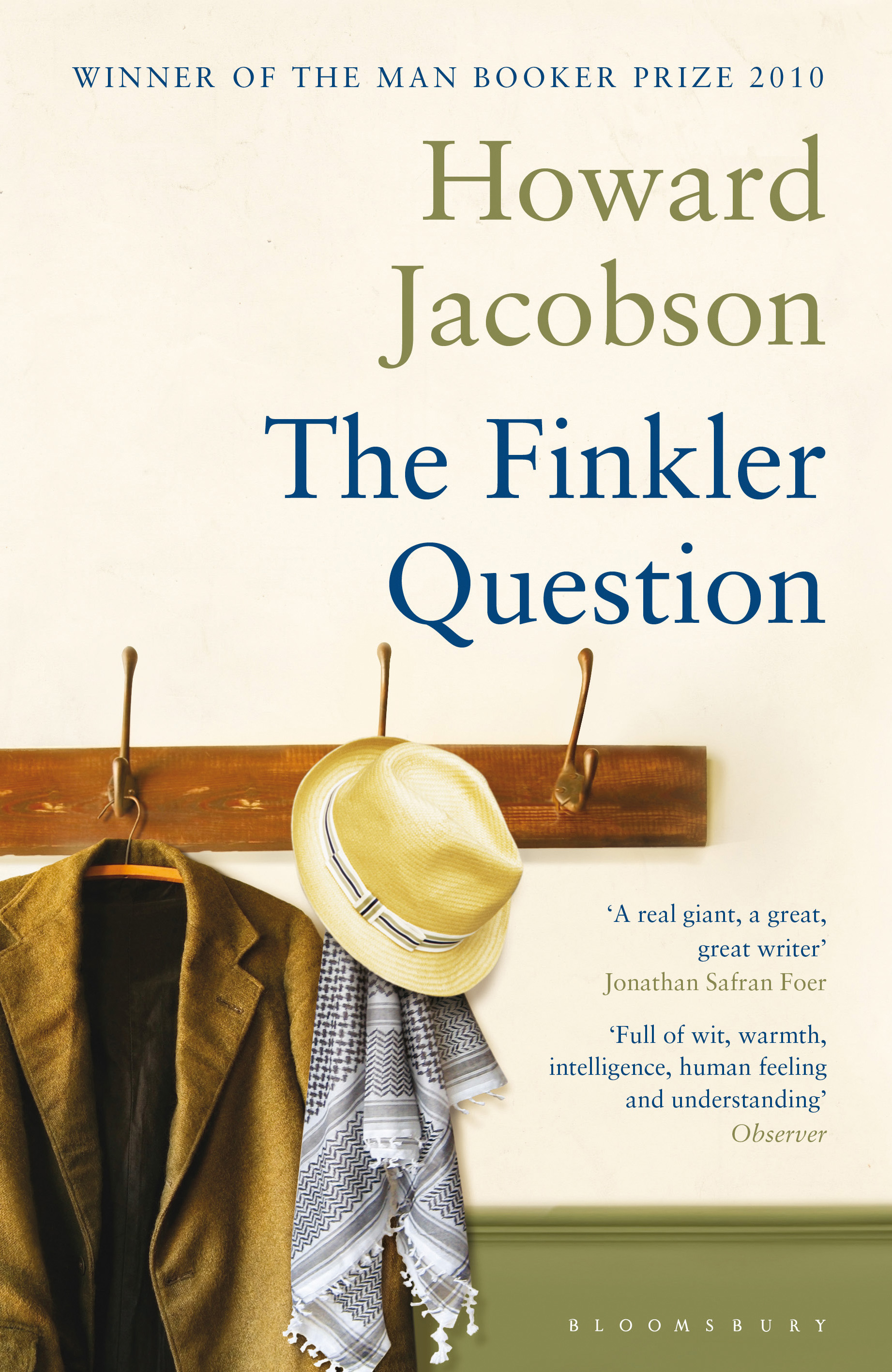
Howard Jacobson’s The Finkler question (Courtesy: Bloomsbury Publishing)
Whispering Gums, as you would expect, writes erudite marginalia and so you’d be in for a treat if you ever obtained my copy of Howard Jacobson‘s 2010 Booker award winning novel, The Finkler question. The margins are peppered with my reactions, like, you know, “Ha!” and “Oh dear”. Riveting stuff … and yet, what comments would you make in this book? Ah yes, “stereotyping” is another one, because that, really, is the springboard from which this rather funny book is written.
Do I need to summarise the plot? I feel that I’m about the last blogger to read this book, but just in case I’m not, here goes … It concerns three longstanding friends: Julian Treslove and Sam Finkler who have been friends since schooldays, and Libor Sevcik who was their teacher at school. At the beginning of the book, Finkler and Libor, both Jews, have been recently widowed. Treslove, the non-Jew, is the “honorary third” widower because he is single (yet again). The novel’s premise is that Treslove would like to be a Jew …
Why, you might ask, would Treslove want to be a Jew (or, a Finkler, as he privately calls them – and hence the title)? It is not an accident that Treslove’s occupation when the novel opens is to be a paid double (or “lookalike”) of famous people at parties, conferences, corporate events:
Treslove didn’t look like anybody famous in particular, but looked like many famous people in general, and so was in demand if not by virtue of verisimilitude, at least by virtue of versatility.
And that’s pretty much how his Jewishness goes too. He might look and play the part but, deep down, can a non-Jew ever really be Jewish? Treslove is about to find out.
Jacobson has a way with words. It was this, together with the endless discussion, using every Jewish stereotype going, of what makes a Finkler (a Jew, remember!) a Finkler, that kept me going through a book that I wasn’t really sure was going anywhere. I laughed at Treslove’s incomprehension of Finkler (the character, this time):
“Do you know anyone called Juno?” Treslove asked.
“J’you know Juno?” Finkler replied, making inexplicable J noises between his teeth.
Treslove didn’t get it.
“J’you know Juno? Is that what you’re asking me?”
Treslove still didn’t get it. So Finkler wrote it down. D’Jew know Jewno?
Treslove shrugged. “Is that supposed to be funny?”
Oh dear! “Julian Treslove knew he’d never be clever in a Finklerish way” but, despite this, he continues with his goal to be Jewish. Meanwhile, Finkler, grieving for his wife and a marriage he still doesn’t understand, tries to dissociate himself from Jews (particularly Zionists) through membership of the ASHamed Jews. And Libor, grieving heavily for his true love, tries to dissuade Treslove from his ambition.
The book chronicles a year or so in the life of these three as each confronts his particular challenge. Treslove falls in love with Libor’s (Jewish) great-niece, Hephzibah, furthering, he hopes, his path to Jewishness; Finkler starts to fall out with the ASHamed Jews though not with their anti-Zionist principles; and Libor starts to fall out of life itself. All of this is told with both warmth and humour. The humour is always there, and yet is never pushed so far that the humanity of the characters is lost. You feel for them, despite their flaws and foibles. You want Julian, the hopeless father and failed lover, to make a go of it this time. You want Finkler to make peace with his Jewishness. And you want old Libor to get over his grief and join the world again. But through all this, you wonder, why? Why is Jacobson writing this story?
I have a few ideas. One may simply be to capture the diversity of Jewishness. Through all the stereotypes that made me laugh (Jews are musical, brokenhearted, rich, clever, comic, and so on), Jacobson shows that Jews, like any other group, are not all the same, cannot all be put in the one basket. Another reason, though it’s depressing to think it’s needed, may be to defend Jews in an anti-Semitic world, to show their humanity. You care for these characters whose troubles with identity, love and loss are universal. And another may be to explore Zionism, safely. Can Zionism be defended? Has it changed into something more ugly, something that undermines its original conception?
In the end I did like this book because, while I was contemplating the “why”, I was engaged by the characters and their stories. The novel commences with Treslove, the would-be Jew, but it concludes with Finkler, the troubled Jew. Here he is, towards the end:
He was a thinker who didn’t know what he thought, except that he had loved and failed and now missed his wife, and that he hadn’t escaped what was oppressive about Judaism by joining a Jewish group that gathered to talk feverishly about the oppressiveness of being Jewish. Talking feverishly about being Jewish was being Jewish.
Ha! You said it, Mr Jacobson, I’m tempted to say. But that would be too smart-alecky of me because the book is, in fact, as much about humanity as it is about being Jewish.
Howard Jacobson The Finkler question
London: Bloomsbury, 2011
370pp.
ISBN: 9781408818466
Alexis Wright‘s Carpentaria won the Miles Franklin Award in 2007 and I read it back around then but it’s a book that keeps coming back to me so I thought it was time I shared why. This won’t be my usual review, but rather random comments on the ideas that float around my head.
First though, you do need a bit of an idea of what it’s about. It’s a wild novel and the plot is complex with its interwoven stories of the inhabitants of a fictional town called Desperance (great name!) in northwest Queensland. The local Indigenous people, the Pricklebush mob, are engaged in a number of disputes – amongst themselves (the Westend and Eastend groups) and with various non-Indigenous people and groups including local police, government officials, and the large multinational mining company operating on their sacred land. But it’s also about personal soul-searching as some of the main characters work to resolve their place in the world. There’s a large array of colourful characters, including Normal Phantom (the ruler of the family), Mozzie Fishman (religious zealot), Will Phantom (activist and Norm’s son, who undertakes a spiritual journey with Fishman), Elias Smith (mysterious outcast saviour), Bruiser (by-name-and-nature town mayor), to name just a few.
It is fundamentally, but not only, about black-white relations in a small town. It doesn’t polarise the issue the way books dealing with this topic often do. The whites are presented pretty negatively, but the Indigenous people are not painted as saints either. They are flawed, and have conflicts within their own community as well as with the white occupants of the town. I like the honesty of this. Some of the problems within the Indigenous population are due to the European invasion and the impact of dispossession, but some are clearly just because they are human with all the normal arguments, jealousies, power plays etc that are found in any family or community. Wright is most interested in conveying the complexity of black culture: its struggles to cope with the colonisation, and the conflict within black communities about how to respond. Consequently, the novel touches on many contemporary issues – land rights, deaths in custody, mining rights, boat people, petrol sniffing to name just a few. It could almost be seen as the contemporary corollary of Kim Scott‘s That deadman dance.
Towards the end of the novel comes this:
Old stories circulating around the Pricklebush were full of the utmost intrigues concerning the world. Legends of the sea were told in instalments every time you walked in the door of some old person’s house. Stories lasted months on end, and if you did not visit often, you would never know how the story ended.
It’s from Will who is sitting on top of the pub, waiting for the cyclone to do its damage. I like it because it rather describes the way the novel is told – circularly more than linearly, and certainly rather disconnectedly. I am always interested in structure, and structure is one of the main challenges of the book. I suspect the structure has something to do with the Aboriginal world view and way of seeing stories – and that understanding this structure better might help better understand the book. It’s both circular and multilayered.
The centre or heart of the novel comprises Elias’ burial at sea and Norm’s being tested. The notion of ‘trespass’ is introduced specifically here. It’s a critical notion in Christian religion. It also alludes to European civilisation trespassing on Indigenous land and culture. And, of course, Indigenous people have their own sense of trespass. In some (many?) ways, trespass is a core theme of the book:
Pausing momentarily, he [Norm] tried again to recite the prayer, before stopping to linger once more on the perplexing word trespass. Trespass had been a big word in his life. It protected black men’s Law and it protected white men. It breathed life for fighters; it sequestered people. The word was weightless, but had caused enough jealousies, fights, injuries, killings, the cost could never be weighed. It maintained untold wars over untold centuries – trespass.
What makes the book special is its language, which is often playful. I chuckled many times as I read it: the wordplay, and the comic set pieces in particular were well done. The set pieces include Angel Day’s retrieval of a Virgin Mary statue from the town dump, and Elias Smith’s emergence from the sea. Popular culture and language (such as clichés) are incorporated, both through allusions and simply as part of the rather colloquial text. Added to this, is the mix of biblical (parting of the waters/mist, big flood, feeding with fish) and traditional imagery and symbolism. I don’t completely understand the meaning of the traditional imagery/symbolism, but it’s there, and can be felt even if it can’t be fully articulated by us who are not part of the culture: water (sea, lagoons, rivers), fire, fish, birds (seagulls, pelicans and others), serpents, land, music, and so on. It’s interesting how many of these images work in both cultures. The novel teems with imagery, most of it worthy of further exploration.
And while I’m talking of language, the names are highly evocative: Desperance, Uptown and Pricklebush, Normal Phantom, Angel Day (Agnus Dei?), Truthful (the cop), Bruiser (the town mayor), Mozzie Fishman, Joseph Midnight, Will (a very wilful young man), and Hope.
There is also surrealism (or is it magical realism?) mixed with the real, which adds to the challenge and fun of reading this book: it is sometimes hard to tell what is ‘real’ and what is ‘dream’ or ‘myth’ or ‘imaginings’. Much of this aspect of the novel explores connections between Indigenous and Christian religions and cultures, which makes sense given the strong role missionaries played in the first century or more of contact.
This is one of those novels that begs comparison with others and yet it is so itself that any comparison does neither it nor the other book justice. However, I’m going to throw a couple of ideas out there anyhow: Tim Winton‘s Cloudstreet, and Gabriel Garcia Marquez’s One hundred years of solitude. All three deal with family on an epic scale and with a level of inventiveness that can make you high.
Without giving the conclusion away, I will say it ends on a positive image for Indigenous people, on the idea of “singing the country afresh”. There is no simple solution, and many unanswered questions are left hanging, but there is hope – which is just about how a book like this should end.
About a third of the way into Kim Scott‘s novel That deadman dance is this:
We thought making friends was the best thing, and never knew that when we took your flour and sugar and tea and blankets that we’d lose everything of ours. We learned your words and songs and stories, and never knew you didn’t want to hear ours.
And, it just about says it all. In fact, I could almost finish the post here … but I won’t.
That deadman dance is the first Indigenous Australian novel I’ve read about the first contact between indigenous people and the British settlers. I’ve read non-Indigenous Australian authors on early contact, such as Kate Grenville‘s The secret river, and I’ve read Indigenous authors on other aspects of indigenous experience such as Alexis Wright‘s Carpentaria and Marie Munkara’s Every secret thing. Kim Scott adds another perspective … and does it oh so cleverly.
The plot is pretty straightforward. There are the Noongar, the original inhabitants of southwest Western Australia, and into their home/land/country arrive the British. First, the sensitive and respectful Dr Cross, and then a motley group including the entrepreneurial Chaine and his family, the ex-Sergeant Killam, the soon-to-be-free convict Skelly, the escaped sailor Jak Tar, and Governor Spender and his family. The novel tracks the first years of this little colony, from 1826 to 1844.
That sounds straightforward doesn’t it? And it is, but it’s the telling that is clever. The point of view shifts fluidly from person to person, though there is one main voice, and that is the young Noongar boy (later man), Bobby Wabalanginy. The chronology also shifts somewhat. The novel starts with a prologue (in Bobby’s voice) and then progresses through four parts: Part 1, 1833-1836; Part 2, 1826-1830; Part 3, 1836-1838; and Part 4, 1841-44. And within this not quite straight chronology are some foreshadowings which mix up the chronology just that little bit more. The foreshadowings remind us that this is an historical novel: the ending is not going to be fairytale and the Indigenous people will end up the losers. But they don’t spoil the story because the characters are strong and, while you know (essentially) what will happen, you want to know how the story pans out and why it pans out that way.
What I found really clever – and beautiful – about the book is the language and how Scott plays with words and images to tell a story about land, place and home, and what it means for the various characters. His language clues us immediately into the cross-cultural theme underpinning the book. Take, for example, the words “roze a wail” on the first page:
“Boby Wablngn” wrote “roze a wail”. But there was no whale. Bobby was remembering … “Rite wail”. Bobby already knew what it was to be up close beside a right whale …
Whoa, I thought, there’s a lot going on here and I think I’m going to enjoy it. Although Bobby’s is not the only perspective we hear in the book, he is our guide. He is lively and intelligent, and crosses the two cultures with relative ease: just right for readers venturing into unfamiliar territory. He’s a great mimic, and creates dances and songs. The Dead Man Dance is the prime example. It’s inspired by the first white people (the “horizon people”) and evokes their regimented drills with rifles and their stiff-legged marching. There’s an irony to this dance of course: its name foretells while the dance itself conveys the willingness of the Noongar to incorporate (and enjoy) new ideas into their culture.
In fact there’s a lot of irony in the novel. Here is ex-Sergeant Killam:
Mr Killam was learning what it was to have someone move in on what you thought was your very own home. He thought that was the last straw. The very last.
And who was taking his land? Not the Noongar of course, but the Governor … and so power, as usual, wins.
The novel reiterates throughout the willingness – a willingness supported, I understand, by historical texts – of the Noongar to cooperate and adapt to new things in their land:
Bobby’s family knew one story of this place, and as deep as it is, it can accept such variations.
But, in the time-old story of colonisation, it was not to be. Even the respectful Dr Cross had his blinkers – “I’ve taken this land, Cross said. My land”. And so as the colony grew, women were taken, men were shot, kangaroos killed, waters fouled, whales whaled out, and so on. You know the story. When the Noongar took something in return such as flour, sheep, sugar, they were chased away, imprisoned, and worse.
I’d love to share some of the gorgeous descriptions in the book but I’ve probably written enough for now. You will, though, see some Delicious Descriptions in coming weeks from this book. I’ll finish with one final example of how Scott shows – without telling – cultural difference. It comes from a scene during an expedition led by Chaine to find land. They come across evidence of a campsite:
You could see where people camped – there was an old fire, diggings, even a faint path. Bobby was glad they’d left; he didn’t want to come across them without signalling their own presence first, but Chaine said, No, if we meet them we’ll deal with them, but no need to attract attention yet.
Need I say more*?
The book has garnered several awards and some excellent reviews, including those from my favourite Aussie bloggers: Lisa (ANZLitLovers), the Resident Judge, the Literary Dilettante, and Matt (A Novel Approach). Our reviews differ in approach – we are students, teachers, historians, and librarian/archivists – but we all agree that this is a book that’s a must to read.
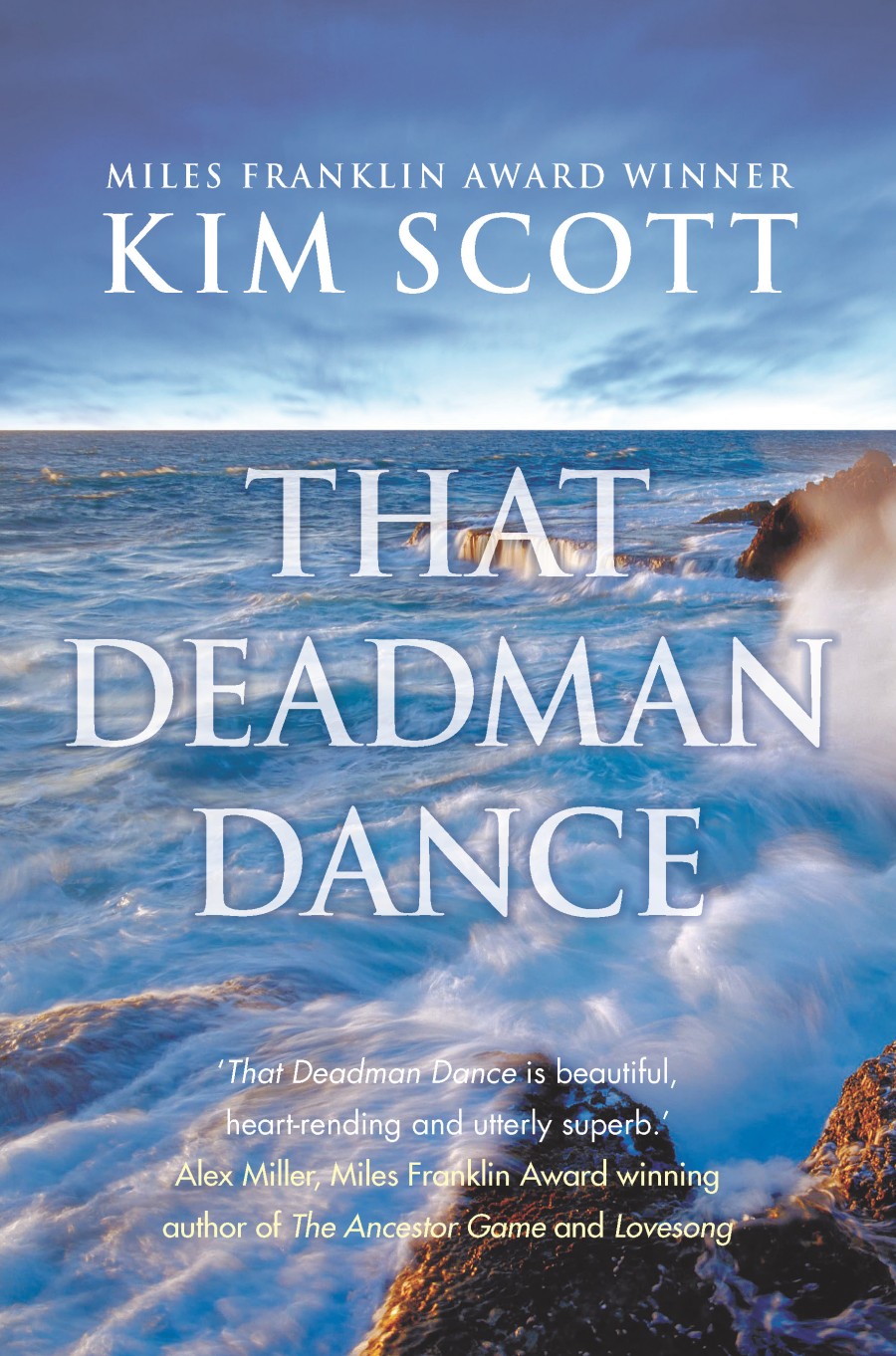
Kim Scott That deadman dance Sydney: Picador, 2010 400pp. ISBN: 9780330404235
* I should add, in case I have misled, that for all the truths this novel conveys about colonisation, it is not without vision and hope. It’s all in the way you read it.


 Whispering Gums