Jasmine Seymour and Leanne Mulgo Watson, Cooee mittigar: A story on Darug songlines (#BookReview)

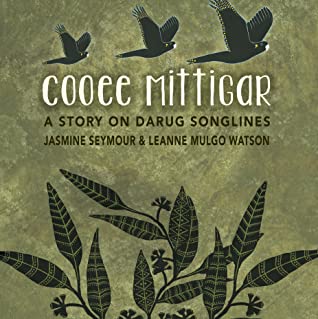
Recently, on a bit of a whim, I bought two books from the Indigenous Australian publishing company, Magabala Books. They were the younger readers-young adult novel, Black Cockatoo (my review), which had been shortlisted for a few awards, and this picture book, Cooee mittigar, which had just won the 2020 Prime Minister’s Literary Award for Children’s Fiction. It is described on the Awards website as “introducing children and adults-alike to Darug ‘Nura’ (Country) and language”. So, a book for children and adults. I’m in …

The book tells the story of the seasons*, as understood or experienced by Sydney’s Darug people, through the eyes of the black swan, Mulgo. It is a perfect example of the generosity of Indigenous Australians. Despite being dispossessed of their country, despite being repeatedly discounted as having anything important to contribute, despite being overlooked or specifically excepted by policy-makers, they come back again and again, willing to share their knowledge – and, particularly, their language – when there’s a real risk that it too might be taken from them. They seem to understand, when so many don’t, that it’s only by sharing and communicating with each other our values and belief systems that we can mature as a nation.

And so, we have this beautiful hardback, written and illustrated by two Darug women, Jasmine Seymour and Leanne Mulgo Watson. Like many recent books I’ve read by Indigenous Australian writers, it incorporates Indigenous – Darug here, of course – language into the story. The technique they use is, in two-page spreads, to tell the story using English and Darug words, immmediately followed (on the same spread) by a glossary for the Darug words used. So, for example, we have:

In the time of yuruka and burara
Elders tell us not to hunt the buru.

yuruku – hot
burara – dry
buru – kangaroo

The glossary words are presented in slightly smaller but still clear text. The illustrations for the page, as you’d expect in a picture book, help convey the meaning. This spread, for example, is dominated by hot-dry looking yellows and tans, with two kangaroos lazing in the grass.

But now, let’s go back to the beginning. The book starts with a welcome: “Warami mittigar. Welcome friend. … Cooee mittigar. Come here friend.” We are then introduced to our guide, the afore-mentioned black swan, Mulgo, who tells us that she will teach us “about Darug life” – and off we go, starting, logically, with an introduction to Biami (dreaming ancestor spirit) and the idea of Darug dreaming and the songlines which tell the story of “Nura” or country. From here, we move through the seasons, starting when the “the darrabura [day] grows long and the weather warms up”. Each step of the way, we are told what to look for, what might be happening, what we can do, with respect to country and the natural environment, such as:

During dagara, gulgadya will bloom –
ready to be turned into spears.

dagara – frost
gulgadya – grasstree

The story ends with the gentle request to “tread softly on our lands”.

The language flows simply – though, as a non-indigenous reader, I’m sure it would take me a few readings to feel comfortable enough with the words to make it sound good aloud. Leanne Mulgo Watson’s illustrations draw mostly from greens, blues and yellows, but with touches of other hues. They are gorgeously evocative of the text, making them a delight for all readers, but they also provide good opportunities for actively engaging younger readers (and listeners).

At the end of the book is a complete glossary of the Darug words used throughout, with a simple pronunciation guide, which is a feature I’ve missed in other books. So, for example, there’s “warami – wara me – hello”. There is also a one-page description of Darug Country, and another page providing brief bios of Seymour and Watson.

Cooee mittigar concludes with a statement of its creators’ intentions, which are “to share Darug language and culture and show that the Darug people are still strong on Country”. They also “hope that Cooee mittigar will contribute to the continuation of stories and culture”. I’d be surprised if they haven’t achieved this, but I hope that in publishing this post I will have made my contribution to supporting their goals.

Challenge logo

Jasmine Seymour and Leanne Mulgo Watson (illus.)
Cooee mittigar: A story on Darug songlines
Broome: Magabala Books, 2019
48pp.
ISBN: 9781925936865

* As many Australians know, Indigenous Australians do not see the year through “our” four-season calendar, but through different seasons depending on the country.

Monday musings on Australian literature: Selected early high country history

As some of you know, I am currently having a little summer break in Australia’s high country, based in Thredbo in Kosciuszko National Park. This is an annual trek for Mr Gums and me, and I have written about it occasionally before. I thought I’d do so again for this week’s Monday Musings, from an historical angle. It’s just a soupçon, because I’m too busy holidaying to do more!

Bundian Way

The Bundian Way is, says its website, “an ancient pathway for Aboriginal people from Yuin, Ngarigo, Jaitmathang, Bidawal Country that provided safe passage between the coast and the high country”. 

The project to document and develop it as a community resource is an ambitious one that, say the organisers, is not about native title, but about acknowledging “Aboriginal cultural heritage values in the historic landscape” and that “these are symbolised by the old pathways”. Surveying the Way commenced in 2010, and was conducted, says Wikipedia, by the Eden Aboriginal Land Council and naturalist John Blay (who has subsequently written On track: Searching out the Bundian Way, 2015). They identified the 265-kilometre route (though the length varies a bit according to the source) using, for example, historical records like 19th century survey reports and journals. The website notes early interactions with Europeans, and the role played by journals:

The old Aboriginal people showed the European ‘explorers’ the pathways (e.g. Ryrie 1840 journals and maps; Robinson 1844-5) and permitted use of the country in the earliest days by highland Scots shepherds, and the horsemen and cattlemen who followed (Watson 1984).

I came across the Bundian Way in an article in the December 2020 issue of the free The Snowpost magazine. It describes the Way as “a shared history pathway” “that was the easiest path from the Monaro to the coastal plains”. It includes places associated with Aboriginal whaling and springtime ceremonies in Twofold Bay on the south coast, and Aboriginal bogong moth hunting and ceremonies in the high country in summer. The article notes that there is still evidence along the route of “old land management … in its Aboriginal landscapes”, which presumably was also used in the survey.

The Snowpost (possibly using Wikipedia) also notes the role played by the controversial Chief Protector of Aborigines GA Robinson in all this. Wikipedia cites John Blay as saying that Robinson recorded the story of Al.mil.gong who walked from Omeo to present his new corroboree to his kin at Bilgalera on Twofold Bay on 14 August 1844. The important thing is not who provides the information, but that we have the information, eh? The Snowpost also records that geologist WB Clarke, who explored around here in 1852, recorded Indigenous people’s description of the Bundian Pass. Unfortunately, his writings and Robinson’s don’t appear to be available on Project Gutenberg Australia.

Finally, the Snowy-Monaro Regional Council makes the point that:

This walking track is older than the silk roads and was used the Aboriginal people for trading, ceremonies, family gatherings and caring for country for thousands of years.

Georg von Neumayer

Also active in Australia around the middle of the nineteenth century, like Robinson and Clarke, was the German polar explorer and scientist Georg Neumayer or Georg Balthasar von Neumayer. Tim Flannery writes in his book, The explorers, that “the exploration of the Australian Alps seems inextricably linked with Germans and Poles: Lhotsky, Strzelecki, Neumayer and von Guérard”. Neumayer, who was interested in “terrestrial magnetism, hydrography and meteorology”, conducted a magnetic survey of “the colony of Victoria”. In doing so, he visited the summit of Mt Kosciuszko in November-December, 1862, with his assistant Edward Brinkmann and the artist Eugène von Guérard. Flannery writes that Neumayer’s account of this trip “provides a terrifying example of Australia’s fickle alpine weather”. Flannery also says that the Von Guérard painted “one of his most memorable works [of Mt Kosciuszko] from the view he obtained on that dramatic November day”. You can see a version on the Art Gallery of New South Wales website.

Flannery quotes Neumayer as saying that

The vegetation near the camping place [which overlooked the Manroo Plains and Thredbo River] reminds one very much of that of the Alps except that the strange look of the dwarf gum trees introduces rather a new feature.

I suspect it’s true that alpine regions can look very similar – except for vegetation! Neumayer also notes that

M. de Guérard, meanwhile, had seated himself on the summit, which affords a beautiful view of the mountainous country of New South Wales and Victoria, as well as the plains of the Murray River, and was taking a sketch of the scenery when, just as I was completing my observations, he called out that it appeared to him a heavy storm was approaching from the New South Wales side.

What follows is a rather terrifying description of coping with this storm, during which Edward Brinkmann (who was looking after some of Neumayer’s instruments) got lost. This was around 18 November 1962, I think. Despite looking hard for him, they could not find him.

Neumayer writes on 3 December 1862

The day very hot, and a haze, caused by bushfires, over the whole sky, so that nothing of the fine mountain scenery was visible.

Such is the alpine environment – blizzard one day, bushfire the next. Anyhow, Neumayer and von Guérard

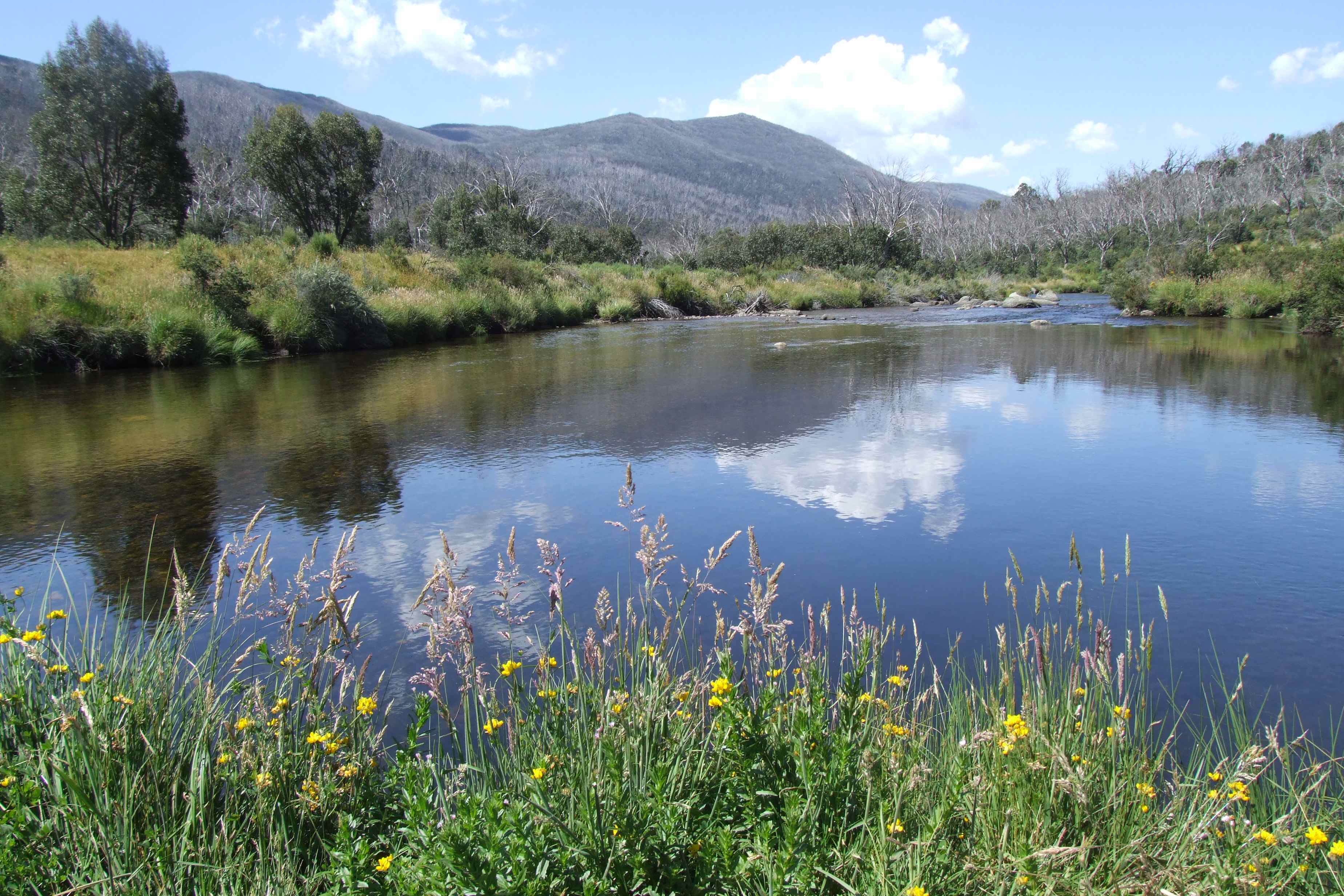
Thredbo River, Kosciuszko National Park
Thredbo River (on a nice day), Kosciuszko National Park)

Went to the police court, but could hear nothing of him, so that the last hope of his safety was now quite destroyed. Sat down to dinner, and had hardly done so when the lost man made his appearance in a most deplorable condition, having been without food and clothes for some time. My conjectures as to the route he had taken proved to be correct. Soon after leaving us on Mt Kosciusko, he endeavoured to return but missed the track to the camp and descended into the valley of the Thredbo River. For two days he wandered on, with scarcely anything to eat, until he fell in with some diggers in a lonely valley, who behaved most kindly to him and assisted him in making his way to Kiandra. … I cannot quit this most annoying affair without expressing my appreciation of Edward’s courageous behaviour, after separating from our party, and of the skill and care he bestowed upon the instruments entrusted to his charge; for the fine mountain barometer Fortin II did not receive the least injury during the whole of this rough and perilous journey.

I love that Neumayer seems to have cared both about Brinkmann AND his instruments!

Carl Merrison and Hakea Hustler, Black cockatoo (#BookReview)

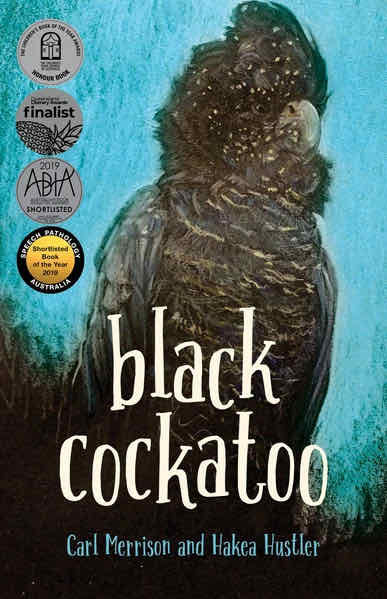
Black cockatoo is a young adult novel written by Indigenous Australian author, Carl Merrison, and his non-Indigenous collaborator, Hakea Hustler, and illustrated by Indigenous Australian illustrator, Dub Leffler. It is a beautiful, little (in size, not value) book that made quite a splash when it was published. It was shortlisted for several children’s literature awards in 2019, including those by the Children’s Book Council of Australia, Readings, the Australian Book Industry Association, and the Queensland Literary Awards. However, it is not the sort of book that I would normally post on here, so I plan to keep this review short.

I say this for a few reasons. For a start, children’s and young adult literature are not my main interest, though I do occasionally make exceptions, as I am making here. My main reason, however, is that not only am I not the typical age demographic for this book, but I am also the wrong cultural demographic, which makes me two steps removed from its target audience. But, I ordered this book from Magabala because I was intrigued about what was being written for young Indigenous readers, and it is on that basis that I’m posting on the book.

The story is set in a remote community in Australia’s Kimberley region, and focuses on 13-year-old Mia. She is disturbed to see her 15-year-old brother, Jy, becoming increasingly alienated from his community and culture, but feels powerless to do anything about it. In the book’s first chapter she rescues a young black cockatoo (dirrarn) which had been injured by Jy who had been target practising with his shanghai. The dirrarn is her totem animal.

What makes this book interesting for someone like me to read is the way it conveys the issues that I, an outsider, am aware of through my reading. One of these is the issue of family breakdown in Indigenous communities. Mia and her brother are being raised by their mother and grandparents, and haven’t seen their father or his family for many years. It’s clear that this is a tough gig for the grandparents. Mia overhears her grandfather (her jawiji) tell her grandmother that he’s “just tired”, and that:

I’m not sure I have it in me to teach him the right ways anymore. He’s just so headstrong.

In one way, of course, Jy is a typical teenager – stubborn and defiant – but concern about this behaviour is magnified in Indigenous communities where disconnection from culture can leave young people, young men in particular, highly vulnerable. In this story, the grandparents, like many in Indigenous communities, do their best to inculcate knowledge of and respect for culture, while also supporting their grandchildren’s need to make their way in a world they don’t know themselves.

This brings me to the main subject of this story, Mia. Her angst stems not only from her concern about her brother, but from having to make a decision about whether to take up her place at “a fancy school down south”. She’s confronting that conundrum faced by young Indigenous people that I’ve also gleaned through my reading, the challenge of straddling two cultures. There is a lovely sense here of Mia being supported and encouraged by her family, but also of her having some agency in what she does:

“You live in both worlds,” her grandmother added. “You will be strong in both ways.”

Black cockatoo is a short story but Merrison and Hustler pack a lot in here about the warmth and humour within extended Indigenous families, which lightens the more serious concerns they confront. The tone is not heavy, which is appropriate given the aim of this book being presumably to support young Indigenous people in making good choices rather than to demoralise them with the challenges they face!

The book is illustrated by Dub Leffler, with stylish, sometimes realistic sometimes more subtle, black-and-white images opening each chapter. Words from Jaru language are lightly scattered through the text:

It had been a proper long barranga dry weather, so to hunt we didn’t have to travel far to find big fat bin.girrjaru bush turkey.

There are two small glossaries at the end, one of Jaru words, and the other of Aboriginal English/Kriol words, that are used in the text.

While not all issues are resolved by the end, as you would expect, the novel’s conclusion, as you would also expect, is positive, with Mia coming to realise both her own inner strength and that she has the ongoing support of family and culture. It’s a good message in an accessible book, it seems to me, but the real proof is whether it works for its target readers, and that, of course, I don’t know.

Challenge logo

Carl Merrison and Hakea Hustler
Dub Leffler (illus.)
Black cockatoo
Broome: Magabala Books, 2018
62pp.
ISBN: 9781925360707

Craig Cormick and Harold Ludwick, On a barbarous coast (“BookReview)

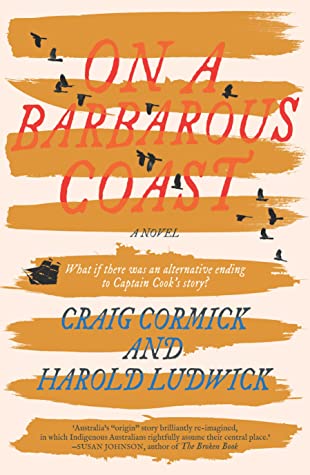
Craig Cormick is a Canberra-based writer whom I’ve seen at various literary events around town, but not read until now, so I was especially glad when Allen & Unwin sent me this book to review. Titled On a barbarous coast, it was written collaboratively with Harold Ludwick, “a Bulgun Warra man whose traditional lands lie west of Cooktown”.

On a barbarous coast offers something a bit different for reviewers. Besides its collaborative nature, there’s its form or genre, which is that sub-genre of historical fiction called alternate (or alternative) history. In this case, it involves looking at a period of Australian history and asking “what if things had happened differently?” Those things, for Cormick and Ludwick, relate to Captain Cook’s exploration of Australia.

The story springs, then, from Captain Cook’s 1768-1771 voyage to Australia to observe the Transit of Venus. During that expedition, in late 1770, the Endeavour was seriously damaged around the Great Barrier Reef, but managed to limp on to Batavia. However, Cormick and Ludwick posit a different scenario, suggesting that the Endeavour was shipwrecked and that only a small number of the crew survived – including Cook, though he remains comatose though much of the story. The survivors make their way to land, and … the question is, as the cover states, “What if there was an alternative ending to Captain Cook’s story?” Would Australia’s history have been different, and how?

While I’ve not read many, I do quite like alternative histories. They encourage us to look at the past from different angles, which can illuminate the implications of decisions made and actions taken.

So, this is how it goes …

The story is told in two alternating first-person voices, Cormick’s being that of American Midshipman James Magra, and Ludwick’s being the young Indigenous boy, Garrgiil.

Magra chronicles the actions and fates of the shipwreck survivors, who very quickly break into two antagonistic camps, while Ludwick shares the thoughts and actions of the local Guugu Yimidhirr people. For the bulk of the narrative, the two cultures remain apart. There is quite a bit of humour in watching Garrgiil’s people trying to decide whether these strange “spirit things” are ancestors or just men. Initially, they feel they must be ancestors, but the way they stumble around, starving while “walking past food every day”, not to mention behaving incorrectly in sacred or special areas, suggests that this may not be the case.

… their presence gives our people great stories of their stupidity and clumsiness to tell around the fire at night. Like the one who stood in the river and let Gandhaar [crocodile] eat him …

Meanwhile, we watch Magra and his co-survivors bickering amongst themselves, trying to plan a solution to their predicament, and sensing the “natives” are out there but not seeing them. The stage is set for a meeting. The question is: how will it go? You will have to read the book for yourselves to find out.

So, how does it all come together?

Magra gets the lion’s share of the story, which could be seen as giving the invaders the upper-hand (yet again) in story-telling. However, I’m going to assume that this was all discussed and agreed between the two authors. Also, I think we could argue that the unequal number of physical pages doesn’t necessarily mean that the emotional impact of the two narratives is similarly unequal. Garrgiil’s voice is strong enough, and compelling enough, to be in our minds, even when he’s not centre-stage.

In the Authors’ Note at the end, Cormick says they “tried to stay as close to known history as possible, both within the known and imagined paths of the story”, which requires a bit of mind-bending but I get what they mean. They drew upon “many existing knowledges” including several journals, such as those of James Cook, Joseph Banks, Sydney Parkinson, and an anonymous journal believed to have been written by James Mario Magra, whom Cormick uses as his narrator. They also looked at the work of Indigenous and non-Indigenous historians, journalists and academics, and at historical accounts of several shipwrecked individuals who had lived with Indigenous people. Cormick notes that while their story divides easily into the two narratives, “it is not so easy to unpick how each of us influenced each other’s work”.

Ludwick adds that his aim was to pull readers into “the world of Guugu Yimidhirr language (which was first recorded in 1770 by Sydney Parkinson and Joseph Banks)”. He says that many of the practices and knowledge he describes in the book are still used by his people. He also says that he wove Dreamtime stories into his narrative to help readers understand his people’s traditional explanations of how the land became what we see today.

The end result is the sort of book I like to read, one that entertains me with its story, while also engaging my mind as I consider what the authors (plural, in this case) were trying to do, how they were trying to do it, and whether they pulled it off. It is an earnest book. Sometimes this comes a bit close to the surface when we are “told” things to make sure we get it (such as “I know the Captain controlled how the stories of our journey would be told”). This – and the strange though interesting little “magical realism” interludes where Magra talks to Gandhaar, the crocodile – creates a little unevenness in the narrative. Also, the use of parenthesis to translate the local language used by Garrgiil felt clunky. Yet, I applaud the book’s extensive use of this language. We need more of it in contemporary Australian literature. As Gandhaar tells Magra:

You create the landscape in your own words. If you don’t know the right words, you will never know the land properly.

But these are minor “picky” things. Cormick and Ludwick have attempted something significant in terms of story, intent, and process, and they pulled it off in a way that engaged me, right through to their considered ending which suggests possibilities, while being realistic about probabilities. Without irony, we could call this book “a grand endeavour”. It is certainly exciting to see such Indigenous-non-Indigenous collaborations happening in our literary sphere.

Lisa (ANZLitLovers) also found this book intriguing.

Craig Cormick and Harold Ludwick
On a barbarous coast
Crows Nest: Allen & Unwin, 2020
309pp.
ISBN: 9781760877347

(Review copy courtesy Allen & Unwin)

Julie Janson, Benevolence (#BookReview)

In a rather curious synchronicity, the last three books I’ve read have all had single word, multiple-meaning, titles, all relating to the colonial settlement of Australia – Gay Lynch’s historical fiction Unsettled (my review), John Kinsella’s memoir Displaced (my review), and now Julie Janson’s historical fiction Benevolence whose title drips with irony.

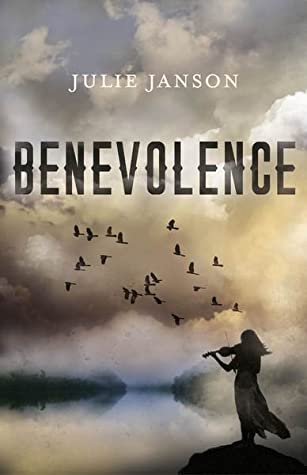
Recently, I commented that it would be good to see an Indigenous Australian novel responding to Kate Grenville’s The secret river. Well, it appears that Benevolence is that novel. In her Acknowledgements, Janson, of the Darug Nation, writes that Benevolence is “a work of fiction based on historical events of the early years [1816-1842] of the British invasion and settlement around the Hawkesbury River in Western Sydney, New South Wales”. Protagonist Muraging, renamed Mary by the colonisers, is based on the author’s ancestor, Mary Ann Thomas, just as Grenville’s novel, set around the same place and time, was inspired by, though not exactly based on, her ancestor, Solomon Wiseman. There, of course, the similarity ends, because while Grenville’s protagonist becomes a “big” man in colonial Sydney, Muraging’s experience is very different.

Benevolence starts in 1816, when the motherless Muraging is “about 12 years old” and handed over by her father to the British to be taught English at the Parramatta Native Institution. She is, says her father (naively we now know), “to be an important part of helping their people and she must learn their language and their ways”. Thus begins Muraging’s life of being caught between two cultures. Early on “she thinks she can be in two worlds and not have to choose”. However, she is never properly accepted by the British (of course) and, while accepted by her own Darug people, it is clear very early that Indigenous culture is being dismantled by dispossession, dispersal and death (through disease, murder and massacre), resulting in Indigenous people’s lives (already) becoming one of survival rather than of living fully.

And so, as the novel progresses through the years, we follow Muraging as she leaves or escapes the British settlement to find comfort, support and/or protection within Indigenous communities, only to return for one reason or another to the settlement, with the cycle starting all over again. Each time she returns to the settlement, the brutality and humiliations ratchet up. It’s a terrible story, but a credible one based on Janson’s detailed research, part of it done while she worked as a senior researcher for Professor Peter Read at the University of Sydney. This research resulted in the creation of the History of Aboriginal Sydney website.

However, this book is not history but historical fiction, so the characters are inspired by a mixture of historical fact and Janson’s imagination – and it is her imagination that brings these characters to life as authentic beings, particularly Muraging, her mixed-up friend Mercy, the weak-if-well-meaning reverend Henry Smythe, and to a lesser degree Captain Woodrow. The grotesque reverend Masters is another matter altogether.

Muraging is established from the start as a person with agency. She does not want to be a “servant” or “a fine maid”. Rather, she wants, she says, to ‘”improve my situation” … but she is ignored’. She never gives up her search for an independent life, and, though she makes poor decisions at times, she behaves courageously, loyally (sometimes at great risk to herself), and in a way determined to be true to herself and her people.

“You have no home” (Masters)

While the personal implications of colonialism and dispossession are conveyed through Muraging’s story, Janson reinforces this with historical fact, including references to documented massacres, discussions between characters about current events, and the occasional appearance of a governor (like Macquarie, like Gipps.) Janson also opens selected chapters with specific historical information. Chapter 4 (“1818: White people things”), for example, begins with an excerpt from the Sydney Gazette reporting massacres from, of course, the settler perspective. Chapter 20 (“1835: Deerubbin, The Hawkesbury River”) commences with a statement about Governor Bourke passing “the Proclamation of terra nullius”. And so on. These occasional documentary facts anchor Muraging’s story in the historical timeline.

The biggest villain of the piece is the appropriately named Reverend Masters. He represents the worst of British power, conveying or enacting British policy with little thought for the humanity of those he deals with. Like a certain world leader today, it’s all about him.

And this brings me to the writing. Janson’s descriptions are beautifully lyrical, though not always simply so. The novel opens with:

The grey-green eucalypts clatter with the sound of cicadas. Magpies and currawongs warble across the morning sky as the sun’s heat streams down. It is eaglehawk time …

Almost idyllic Australia, except “eaglehawk” time suggests the idea of violence … of hunter and prey!

There are also wry ironic touches, such as Captain Woodrow’s comment, “I have fought savages on the Indian frontier and I know that no honour exists among savages”. Hmm, who are the savages without honour here? Or, good guy ex-convict Ferdinand, with his Darug wife, defying Masters with “This is my land. My grant.” Whose land? In such ways, Janson encourages us to think behind the words of waibala people.

I also like the way Janson used local Indigenous language throughout the novel, enough to convey (and promote) local culture and language, but not so much as to impede understanding.

I was less comfortable, however, with the writing about actions and events. It can be quite cut-and-dried, with a disjointed or staccato feel that, for me, broke the flow of my reading. Maybe this was intended, as Lisa (ANZLitLovers) has suggested, to convey the violence – or, at least, the instability – of that world. I can see that, though I’m not sure it fully worked that way for me.

And finally, of course, there’s that powerful title. Who thinks they are benevolent, who pretends to be benevolent, who really is benevolent, not to mention what is benevolence anyhow, are the questions that confront us on every page of this timely novel.

“You won’t win, you know” (Masters)

Benevolence, then, is a compelling and worthwhile read. The history is good, offering First Nations readers something that more closely accords with their understanding of what happened, and non-Indigenous readers a corrective to the history we’ve been fed most of our lives. The story is engaging, with Janson treading a fine line between utter negativity and unrealistic hopefulness. I particularly liked the tone struck by the ending, but that’s for you to find out!

We need more books like this …

Challenge logo

Julie Janson
Benevolence
Broome: Magabala Books, 2020
345pp.
ISBN: 9781925936636

(Revieve copy courtesy Magabala Books)

Monday musings on Australian literature: “Returning novels”

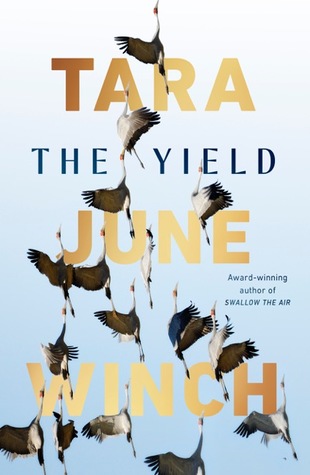
Book cover

In his review of Tara June Winch’s The yield (my review), Jonathan Shaw (Me fail? I fly!) writes that “Ellen van Neerven, in a review in the Australian Book Review, describes The Yield as a ‘returning novel’”. I loved this way of framing the novel, so I checked the review.

Van Neerven, who has featured several times on this blog, goes on to say that:

In contemporary Aboriginal fiction, a common theme is ‘returning’ – returning to Country, family, language, and culture, all of them intertwined.

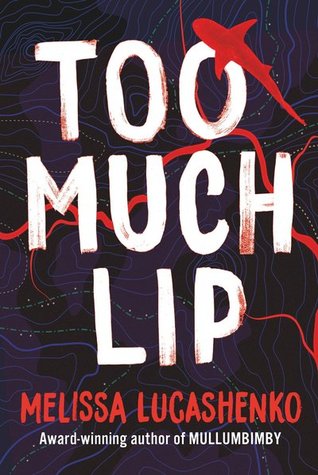
Melissa Lucashenko, Too Much Lip

She’s right, I think. Melissa Lucashenko’s Too much lip (my review) is another example, with Kerry returning to her family, like Winch’s August, due to the death of her grandfather. In both novels, the returning protagonist finds herself embroiled in the family’s challenges and starts to reconnect in a meaningful way with the family she’d intentionally escaped. This sort of “returning” also happens in Indigenous Australian non-fiction, like Marie Munkara’s memoir Of ashes and rivers that run to the sea (my review) in which Munkara, who had been fostered by a white family, returns to the Tiwi Islands to understand her Indigenous family and roots.

However, and I hope this is not inappropriately appropriating van Neerven’s idea, “returning novels” are not limited to Indigenous Australian literature. After all, returning stories – think Homer’s Odyssey or the Bible’s prodigal son – are not new. Van Neerven’s point, though, is that “returning” in Indigenous culture has very specific drivers, impacts and outcomes.

Anyhow, now inspired by this idea, I thought I’d take the opportunity to look at some other Australian returning novels. What are returning stories about? The Odyssey was as much about the journey as about the return, while of course the prodigal son story is all about the return.

The novels I’m thinking about tend to be more about the return than the journey, though not exclusively so. They include returns from war, returns home after long times away, and returns after (or for) a major situation or event (like a death). Like Indigenous Australian stories, these can have their different trajectories.

Post-war

Post-war returning novels are a very specific subset. In these novels, the return is usually attended by the issue of resettling – physically and emotionally – and, in many cases, by the returnee suffering from some level of war trauma. War trauma is often the driver for these novels.

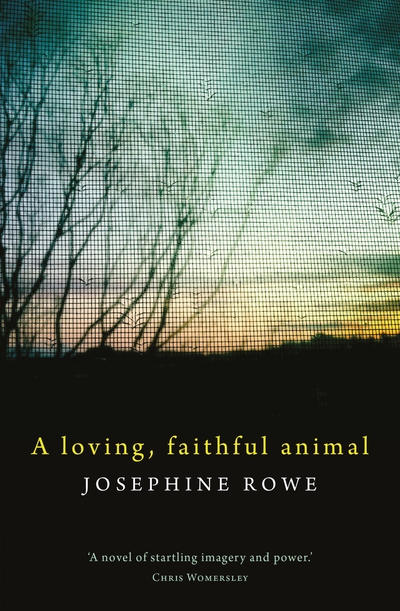
Josephine Rowe’s A loving faithful animal (my review) and Rodney Hall’s A stolen season (my review) are recent war-return stories.

Josephine Rowe, A loving faithful animal

Rowe’s novel explores the devastating impact on a family of the husband/father’s ongoing trauma (PTSD) following his Vietnam War experience. In Hall’s novel, on the other hand, the husband has returned from the war in Iraq so severely physically damaged that he can only live by means of a “Contraption” that is activated and controlled by his brain.

Slightly different examples are Angela Thirkell’s Trooper to the Southern Cross (my review) which chronicles the trip home of an Australian soldier with his English wife, after World War 1, and Geoff Page’s verse novel, The scarring (my review), telling the story of a couple from the 1910s to the 1980s, from their youth and courtship through to old age. Thirkell’s novel is mostly about the journey, but there is much here about the cultural issues that the Australian husband and English bride will face in returning to the husband’s home. Page’s novel may look like a family saga, but it’s what happens after the husband’s return from World War 2 that drives the novel.

After a long time away

Novels about older people returning after a long time away are, of course, different. They tend to be contemplative, and are often (though not always) about the returning person resolving the issues that they were escaping in the first place.

In Jessica Anderson’s Tirra lirra by the river, which I read long before blogging, Nora, who, as a young woman, had escaped the narrow confines of her life in Brisbane, returns at the age of 70, to rediscover and reassess the life she had left.

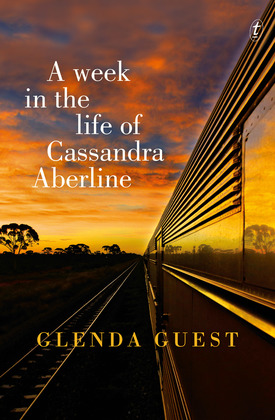
Glenda Guest, A week in the life of Cassandra Aberline

Glenda Guest’s A week in the life of Cassandra Aberline (my review) is about a woman who left home somewhat suddenly, 45 years before the novel opens, for a reason that’s not clear but is clearly unresolved. Now, 60 and with an early Alzheimer’s diagnosis, she wants to be sure she was right to leave, and if not, she wants to “make amends”.

A different sort of return occurs in Eleanor Limprecht’s The passengers (my review). Here, Australian war-bride Sarah is returning to Australia (with grand-daughter Hannah) from the USA where she’d gone with American soldier husband. This “returning” trip provides the opportunity for her to contemplate her choices and decisions.

Other returns

There are all sorts of “returns” though, besides the big two described above!

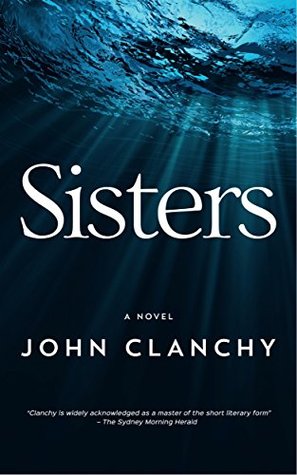
John Clanchy, Sisters

In John Clanchy’s Sisters (my review), sister Sarah calls her other two sisters, all of them in their 60s, to spend a month together at the family home, for an undisclosed reason. Not surprisingly, it is about resolving something that happened in the past, a common driver for “returning novels”.

David Malouf’s Remembering Babylon, another that I read long before blogging. It’s about a white man in 1840s Australia who returns to “white” culture, having spent 16 years with the Aboriginal people who took him in after he survived a shipwreck. He, and the people he “returns” to, are challenged by his readjustment. Bill has reviewed it, and touches on the issue about white writers writing about Indigenous people.

“Returning novels” then are highly varied. Most deal with the past in some way, but for Indigenous people the overriding issues are cultural and political (as well as personal), while in non-Indigenous Australian stories, the driving issues tend to be personal. This is, though, a broad generalisation.

Anyhow, these are just a few examples of the “returning novels” I’ve read. There are many more … I’d love to hear about some you’ve read.

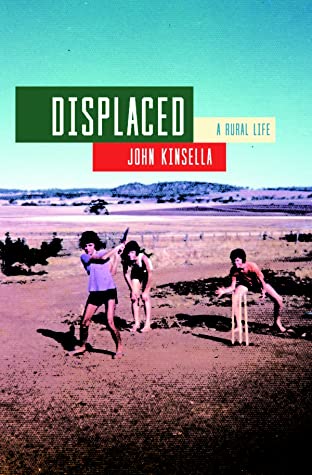
John Kinsella, Displaced: A rural life (#BookReview)

John Kinsella, Displaced

I haven’t talked about reading synchronicities for some time, but when I started reading John Kinsella’s memoir, Displaced, I couldn’t help but think of the book I had just finished, Gay Lynch’s historical novel Unsettled (my review). Both have one word titles which play with opposites; in both cases, those opposites refer to physical meanings and more abstract, intellectual, social and/or emotional ones; and, in both, these meanings draw significantly from the colonial act of settling Australia and displacing its original inhabitants. I enjoy such wordplay that forces us to consider multiple, and sometimes conflicting meanings because it encourages a deeper engagement with the ideas being explored.

Notwithstanding this, reading Displaced was a labour of love, because it is a demanding, and often confronting read. However, I wanted to know about this man who is one of Australia’s leading contemporary poets, so I persevered. My assessment? If you are interested in how one might live life as ethically as possible with regard to justice and the exploitation – of First Nations people and the environment – that is encompassed in the long tail of colonialism, Kinsella’s book is a good place to start.

This leads me, as I’m wont to do, to a consideration of form or genre. Displaced is characterised in promotions as a memoir, but I see it more as a manifesto with memoir elements. Events in Kinsella’s life underpin the book, including his stints in Ohio, Schull and Cambridge, but they are not the focus. Instead, they are used to explicate and exemplify his ethical beliefs and, more, to explore the paradoxes we all live with. These paradoxes provide the book’s main thread. They are expressed in such terms as “belonging and unbelonging”, finding a meaning for “home” that recognises Indigenous “dispossession” and doesn’t encompass the exploitative ideas of “ownership”, and feeling “displaced” while very definitely being in a place. He characterises this as “the ethics of presence”. It’s difficult to get your head around while also being very simple really. In other words, the idea is simple, but the living of it, not so!

Two-thirds through the book, Kinsella talks about conducting peace readings, and says that:

A poet has a job to do – art in itself is meaningless if it does not jolt us into self and collective action.

He then describes a sculpture in the British Museum comprising bits of AK-47s welded together. “The artwork,” he says, “jolts one out of apathy, if not out of complicity”.

For Kinsella then, art is not just for art’s sake. And so, here, this work of art, his “memoir”, has a very specific goal, to raise our consciousness regarding the lives we are living and how colonialism, and the accompanying capitalism, continue to damage both colonisers and colonised. He calls himself an “anarchist”, but not one who subscribes to chaos and disorder. His anarchism, he says, has

the social angle, it has the respect for individual difference. I do not attempt to tell people what to believe, but I do attempt to draw attention to the damage being done.

So now, let me return to my opening comment regarding the title and its multiple meanings. Early in the book, Kinsella talks about growing up in the Western Australian wheatbelt, and about the paradoxical, hypocritical love of nature and place he espoused. “Something didn’t add up”, he says, between the way he “felt about the world” and the way he “acted in it”, his actions drawing from “outdoorsmen activities and the attendant crisis of masculinity.” The things he did – farming, hunting, and so on – were counter to the things he loved. The book chronicles his realisation that

I was part of a colonial invasion force, and I belonged nowhere. What could I do about it? I wandered, displaced as an addict [literally as well as spiritually], and as someone trying to undo my own identity.

Learning a new way of being (“unbecoming what I was, becoming what I might be”) became his lifelong project, one he shares with his wife, the poet Tracy Ryan, and their son Tim. Kinsella puts this thinking into his work – in his writing (as mentioned above) and in his role as Professor of Literature and Environment at Curtin University. He speaks in the book of trying to create a new way of writing about place, “a system for working through the contradictions of presence, of time and space and catastrophe and catastrophising, of the failure of modernity and the consequences of colonial modes and modalities of presence”. That’s a mouthful, but it explains his wish to find a way of expressing how colonialism has negatively infiltrated our lives physically, spiritually and linguistically.

To explain his beliefs, he wanders between childhood, youth and adulthood, amongst relationships with other writers and thinkers, and between his current home, Jam Tree Gully back in the Wheatbelt, and those places he’s lived in overseas. Because – I think – of this to-and-fro structure, there is a lot of repetition of ideas and experiences, and these repetitions did become a little tedious at times. I get it John, I get it, I felt like saying a few times as I read. The other challenge for Kinsella was to not preach or virtue signal. He does come close, at times, but he makes clear that he understands the nuances – how does someone like him, for example, deal with feral cats or weed pests? “There’s plenty of mea culpa in my life”, he says.

In the end, this earnest, frank book is full of heart and commitment. One of the things I’ve taken away from it is a heightened awareness of how “colonialism” has infiltrated our language. Take, for example, an interpretive sign we recently saw on a bushwalk that described a tree trunk as providing “high rise living”. Or, a Wiradjuri country rural town’s proud sign promoting its “170 years of heritage”. Just 170 years? On its website, the Blayney Shire speaks more on this (colonial) heritage, and then mentions its natural environment and Aboriginal heritage. “Aboriginal relics and artefacts”, it explains, “are primarily protected under the provisions of the National Parks and Wildlife Act, 1974. Listed heritage in the Shire is mainly European in nature”. This sort of demarcation in thinking about heritage needs to change.

We can’t turn back the clock, which Indigenous Australians accept, I believe. However, they want and warrant the respect due any human being, recognition of their sovereignty and of their dispossession, and for us to listen to their wisdom and knowledge.

Kinsella, who believes that “poems can stop bulldozers”, includes many in this book. They make good reading. But I’ll end here on a positive note from halfway through the book:

The land is constantly being rewritten. We don’t have to be stuck with the damage. It can be undone.

John Kinsella
Displaced: A rural life
Melbourne: Transit Lounge, 2020
329pp.
ISBN: 9781925760477

Review copy courtesy Transit Lounge, via Scott Eathorne of Quikmark Media

Monday musings on Australian literature: “You don’t walk away until the work is done”

Book cover

This is a different type of Monday Musings, but its relevance will become apparent, I promise you! It’s inspired by Julia Baird’s Phosphorescence which I read a couple of weeks ago. In my review, I mentioned that one of the book’s four main sections is devoted to failure and imperfection, but I didn’t share much about this section, which is titled “We are all wiggly”.

Its opening chapter, after her usual intro, is called “The activist’s attic”. In it she tells of 9 boxes of papers she’s carried around with her for decades. They relate to her “spectacularly unsuccessful endeavour”, when a young woman, to win ordination for women in Sydney’s Anglican church. It’s a failure that has hung heavily on her, and that brought her to ask, in this book, “how to think of these years of effort?”

She shares the stories of other activists, like William Wilberforce who fought against the slave trade for forty-six years, and Nelson Mandela “who spent much of his life, including twenty-seven years in prison, fighting apartheid … “

And then she talks about climate change:

… think of all the scientists who have been warning of the dangers of extreme climate change since the 1960s, and of all the criticism of their work and the dismissal of anything resembling agitation and or activism as the lunatic alarmism of the left. The public burying – or attempts to discredit – the crucial findings of thousands of our finest climate scholars will prove to be one of the greatest (if not the greatest) acts of political and intellectual corruptions of our age.

But then comes the paragraph that is the focus of this post, because this week is NAIDOC Week, and in her book – in this Activist chapter – Baird also writes about Indigenous Australians’ long fight for recognition:

And what of the Indigenous people of Australia seeking constitutional recognition, truth-telling and a voice to parliament, those people who have been mistreated, stymied, rejected, ignored and discriminated against and who continue to ask non-indigenous Australians to walk with them in a makarrata, a Yolngu word meaning peace-making, a coming together after a struggle? The grace of this approach after more than two hundred years of suffering racism, along with their patience, strength and resilience, is astonishing.

The lesson is: you don’t walk away until the work is done.

I should explain here that NAIDOC Week is usually held in July, but it was deferred this year to protect, wrote the Committee, “our elders and those in our communities with chronic health issues from the disastrous impacts of COVID19. I post most years for this Week, and did write two posts back in July, anyhow, to align with Lisa’s ANZLitLovers’ Indigenous Literature Week. But, I wanted to also honour this year’s actual week, so decided to let Baird be my inspiration.

Finally, this year’s theme is “Always was, always will be”, which recognises that “First Nations people have occupied and cared for this continent for over 65,000 years”. It also asks

all Australians to celebrate that we have the oldest continuing cultures on the planet and to recognise that our sovereignty was never ceded. 

C’mon, Aussies … let’s get this thing done!

Delicious descriptions: Gay Lynch on place, in colonial South Australia

Book cover

In my recent post on Gay Lynch’s historical fiction novel, Unsettled, I spent so much time writing about it, that I didn’t share any quotes as I usually do, so I’m using a Delicious Descriptions post to share just a couple of descriptions of the setting, which is around Gambierton/Mt Gambier in South Australia.

In one scene, Rosanna is looking for a lost child – a deft use by Lynch of the “lost child” motif common in colonial Australian literature – and comes across “a formidable rock-face … pigface flowers rioting across its surface.”

Her head spins when she finally looks down, searching the red rings like the contours of cut gum that encircle the unbroken walls of the crater. A wagtail aggravates a flock of swallows, resting on their tails and diving off, riding invisible currents over the startling void. Not a flutter of childish frilly clothing. Father Woods and Skelly have long conversations about the Pleistocene period when molten lava cooled forming the solid parts of the south-east landscape and great seas retreated, leaving behind corals and small crustacaens. Moorecke has told Rosanna Booandik stories about giant Craitbul’s cooking mound, for that is what she calls it.

In this little excerpt Lynch not only describes the physical landscape, but she conveys Western and Indigenous understandings of it. She doesn’t presume to tell Indigenous stories but she lets us know that other stories about the land exist. She also conveys here the relationship Father Julian Tenison-Woods (a real historical character) and Rosanna’s brother, Skelly, have concerning exploring and documenting the natural environment.

My second choice describes a ride Rosanna takes, with Moorecke, to the shipwrecked Admella (which many of you know was also featured in Jane Rawson’s 2017 novel From the wreck):

Moorecke directs Rosanna due west. Up to his girth in water, skirting sinkholes, Lucifer crosses deep bogs. They pass through long grasses, scrub and stands of black-wood. He takes logs in his stride with Moorecke jolting like a post office package, hands on his haunches, and Rosanna standing on the balls of her toes in the stirrups. They curve their backs against the stiff salt wind like crooked trees–like carratum, Moorecke says. A swamp harrier drops before them and screams as it rises, a scrabbling creature dangling from its talons.

White mist settles like a ration-blanket around their shoulders. They approach the sea, making their way with caution past sink-holes and through limestone-littered clearings. Sea heath and spear grass cling to the dunes. Lucifer begins to flag. Fingers stiff with cold, Rosanna lengthens his reins. The hollow roar of the sea reminds her that she has seen these limestone cliffs undercut by ferocious waves on a ride with Edwin. ‘I know this place. There is a spring.’

‘No stopping here.’ Moorecke lifts Rosanna’s hair to bellow in her ear. ‘Blackfellas’ caves’.

Once again the landscape is described, but Lynch imbues it with a disturbing sense to prepare us for the horror they are about to confront. Again, too, there is reference to Indigenous culture, and the implication that some places are sacred and should not be visited. In such ways do historical novelists show rather than didactically tell the things they want us to understand.

Any thoughts?

Gay Lynch, Unsettled, ligatu.re, 2019.

Archie Roach, Tell me why: The story of my life and my music (#BookReview)

Book coverGood things come to those who wait! At least, I hope so, because Lisa has had to wait a long time for a review from me for this year’s Indigenous Literature Week. Finally, though, I finished the main book I chose for this year’s challenge, Archie Roach’s memoir, Tell me why: The story of my life and my music.

Most Australians will know who Archie Roach is, but international readers here may not. A member of the Stolen Generations, Archie Roach is an indigenous Australian singer, songwriter, guitarist, and political activist. The story he tells in his memoir, Tell me why, is not an unusual one in terms of people of his background and generation, but that doesn’t mean it isn’t worth reading, because not everyone can tell this story in the way that Roach can. Perhaps this is because he’s a songwriter, or perhaps, more correctly, he’s a songwriter because he can tell stories.

Roach starts his story with a Prologue set in 1970. He is 14 years old, and receives a letter from one of his birth sisters telling him that his birth mother had died. This is a surprise, because his adoptive parents had been told his parents had died in a fire. He then flashes back in Chapter 1 to tell us about his life, as he knew it, up to 1970. This life involved being stolen from his parents, and being placed in two foster homes, one abusive, before being placed, in 1961, with the Melbourne-based Coxes with whom he was still living in 1970. In Chapter 2 he picks up that point in 1970 when he received the letter, and tells his story chronologically from then on, with some flashbacks to fill in his family’s early life as he learns it himself.

Although Roach had had a good life with the Coxes, who had loved him and whom he loved, the discovery that members of his birth family were still alive brought with it a desire to learn who he was, and he left home. He managed to make contact with his family, but before that he was introduced to drinking (having “a charge”) and life on the streets. Not surprisingly, his story, like those of many young indigenous people who have lost contact with their culture and thus with their bearings, involves alcoholism and related illnesses, run-ins with the police, prison, unemployment, and all-round instability. Archie would obtain work, would be appreciated as a worker, but the demons would return and down he’d plummet again. It’s a common cycle.

However, Archie had a couple of big pluses in his corner. There was Ruby Hunter, whom he met while still a teen and who became the love of his life. It’s not that her appearance resulted in a miraculous turnaround. Real life is rarely like that. But she became the supportive base to whom he would return and who, eventually, did provide the stability that enabled him to turn his life around and become the success he now is. The other plus was music, to which he was first introduced by the Coxes, particularly Dad Cox who loved to sing and who gave him his first guitar. While the stories about his drinking life were distressing to read, the story about how music “saved” him, and how he gradually came to realise that he could tell stories through music, was moving and inspiring.

This brings me back to my opening comment that “not everyone can tell this story in the way that Roach can”. The memoir is beautifully constructed, from the Prologue that vividly takes us into the classroom where Roach receives the letter about his mother, to the use of song lyrics, most of them Roach’s own, to introduce each chapter. Roach uses foreshadowing at the end of several chapters to move the story on, such as this at the end of the chapter in which he arrives in Adelaide – “This would be the last hours before finding Ruby Hunter”. And this one at the end of the chapter where Jill Shelton is recommended to him as a manager – “Jill would end up saving my life at a time when I didn’t see there was any point in saving it.”

Roach also mixes up the narrative, commencing some chapters with the next part of the story, while others he introduces with something more reflective. I particularly liked the opening to the chapter in which Ruby dies:

Some people see time as a river with a steady current. Some people say we get in and move with that current, all of us ageing uniformly. I don’t believe that’s true, though. I’ve seen people age years overnight.

It happens to a lot of our people, and it happens to an awful lot of us drinkers. It doesn’t just happen while we’re drinking, either; we could’ve been years off the stuff and then something might change. We might lose a sister or a brother, and suddenly we have age in our face and in our step.

Sometimes it happens for no reason. Someone will be living their life and all of a sudden time will heap years on their shoulders.

Of course, Roach also talks about politics, about Indigenous opposition to the 1988 Bicentenary, about John Howard’s  opposition to a national apology and his criticism of the “black armband view” of Australian history, about Aboriginal deaths in custody, about the stolen generations, and more. It’s all told through the prism of his own personal experience or through his involvement in political action. Most readers will know these issues, but the personal stamp offered by books like this helps keep the issues real and in front of us. Roach, like so many Indigenous people, amazes me by walking that fine line between anger at what has happened to his people and generosity towards the rest of us.

In the end, Roach’s message is an inclusive one. His songs, he has found, speak to non-Indigenous people too, with many telling him that “that’s what happened to me”. Consequently, his songwriting, he says, now “feels more inclusive, more universal” because “it’s about all of us – you can’t write about yourself without including everyone.”

He writes:

For so long we have been divided by ‘isms’ – racism, sexism, fundamentalism, individualism – but when we come back to the place of fire, I believe we will discover there’s far more that connects us than separates us. I believe we will be one humanity again, that we will find release, healing and true freedom.

I love the hope in this but, let’s be clear, Roach is not letting us off the hook. That is, he doesn’t believe we are there yet. He is, though, choosing an aspirational path, and for that I thank him.

ANZ LitLovers logoArchie Roach
Tell me why: The story of my life and my music
London: Simon & Schuster, 2019
378pp.
ISBN: 9781760850166