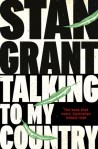
 History is, in a way, the main subject of my reading group’s October book, Stan Grant’s Talking to my country. I’m consequently somewhat nervous about writing this post, because discussions of history in Australia are apt to generate more emotion than rational discussion. I will, though, discuss it – through my interested lay historian’s eyes.
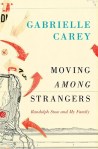
However, before we get to that, I’d like to briefly discuss the book’s form. Firstly, it’s a hybrid book, that is, it combines forms and/or genres. In the non-fiction arena, this often involves combining elements of memoir with something else, like biography, as in Gabrielle Carey’s Moving among strangers (my review). In Grant’s case, he combines memoir with something more polemical – an interrogation of Australian history, and how the stories we tell about our past inform who we are and how we relate to each other.
Secondly, and probably because it’s not a straight memoir – Grant wrote his memoir, The tears of strangers, in 2002 – the book is structured more thematically than chronologically, though a loose chronology underlies it. For example, his discussion of the lives of his grandparents and parents doesn’t happen until Part 3, and then in Part 4 he discusses the government’s policies for handling “the ‘Aboriginal problem'”, particularly that of assimilation (or, more accurately, “absorption”.) This structure enables him to focus the narrative on his theme, so let’s now get to that.
The book opens with an introductory chapter titled, simply, My country: Australia. In it, Grant sets out why he wrote the book, which is to convey to non-indigenous Australians just what life is like for indigenous people, to explain that although history is largely ignored it still “plagues” indigenous people, and to tell us that the impetus for him to finally write the book was the booing of indigenous football player Adam Goodes in 2015. And here, in very simple terms, Grant states his thesis:
This wasn’t about sport; this was about our shared history and our failure to recognise it.
He goes on to explain that while some tried to deny or excuse it, his people knew where that booing came from. From my point of view, it’s pretty clear too.
“the gulf of our history”
Now, I’m not going to summarise all his arguments – or the stories of his and other indigenous people’s experiences – but I do want to share some of his comments about history. As Grant is clearly aware – and what Australian isn’t – history is politicised, sometimes consciously, sometimes unconsciously. My generation, the baby-boomers, grew up learning that Captain Cook discovered Australia and that Governor Phillip established the first settlement. If Aboriginal people were mentioned, it tended to be in passing. They were merely a side-bar to the main story. We may have learnt about the missions (and the “great” work they were doing) and we may have learnt in later years of schooling that many indigenous people lived in poverty, but we weren’t told about the massacres and violence that occurred, and nor was it ever suggested that we* had invaded an already occupied land. However, as we now know, these things we weren’t told are incontrovertible facts, supported by evidence.
Some, unfortunately, still ignore these facts and some try to interpret them differently, while the rest of us accept them but feel helpless about how to proceed. And this leads directly to Grant’s underpinning point, which is that we – black and white Australians – meet across “the contested space of our shared past”. Elsewhere he states it a little less strongly as “the gulf of our history”. I love the clarity of these phrases. They explain perfectly why discourse in Australia regarding indigenous Australians can be so contentious and so often futile. Grant’s point is that we can’t progress as a unified nation until this space is no longer contested, until the gulf is closed or bridged.
Grant puts forward a strong case based on experience, anecdote and hard facts (such as the terrible, the embarrassing, statistics regarding indigenous Australians’ health outcomes, incarceration rates, etc) to encourage all Australians, “my country” as the title says, to understand why, for example, when we sing the national anthem – “Australians all, let us rejoice” – indigenous people don’t feel much like joining in. What do they have to rejoice about? Where is their “wealth for toil”.
Suffice it to say that I found this a powerful book. While in one sense, it didn’t teach me anything new, in another it conceptualised the current state of play for me in a different way, a way that has given me new language with which to frame my own thoughts.
By now, if you haven’t read the book, you’ll be thinking that it’s a completely negative rant. But this is not so. It’s certainly “in your face” but Grant’s tone is, despite his admitting to anger, more generous. His aim is to encourage us white Australians to walk for a while in the shoes of our indigenous compatriots and thus understand for ourselves what our history, to date, has created. He believes that good relationships do exist, that there is generosity and goodwill but that, as the Adam Goodes episode made clear, bigotry and racism still divide us.
Late in the book Grant discusses the obvious fact that this land is now home to us all, that many of us have been here for generations and “can be from nowhere else”. Rather than rejecting “our” claims to love this place, he writes that this should make it easier for us to understand indigenous people’s profound connection to country. He writes:
I would like to think that with a sense of place comes a sense of history; an acceptance that what has happened here has happened to us all and that to turn from it or hide from it diminishes us.
And so, rather than telling indigenous people that “the past is past” and “to get over it”, it would be far better, far more honest, far more helpful, for us non-indigenous people to say, “Yes, we accept what we did and understand its consequences. Now, how should we proceed?” Is this really too hard?
Stan Grant
Talking to my country
Sydney: HarperCollinsPublishers, 2016
230pp.
ISBN: 9781460751978
* And by “we”, I mean, as Robert Manne explains it, not “we” as individuals, but as the nation.










 Whispering Gums