Monday musings on Australian literature: Supporting locals in 1927

Back in 2014 I wrote two Monday Musings posts on a plebiscite held in 1927. It involved readers of Melbourne’s The Argus newspaper naming those they deemed “the six leading poets and the six foremost writers of fiction of Australia and New Zealand”. You can see the results in my first post, and some post-plebiscite commentary in the second post.

“to change the slackness and indifference of the mass”

In this post, I’m returning to that plebiscite via one particular response from Tasmania’s Burnie-based Advocate newspaper. Published on 31 August 1927, the article has a plus ça change feel to it. Here is the article’s opening few sentences:

Singularly remiss are Australians in according patronage to Australian productions, which suggests that we are still a long way from achieving nationhood. It is not the making of a choice in favor of local works which animates the majority with what might be expected to be a bias towards the products of the country, “other things being equal,” but it is safe to say that the country of origin never enters into the calculations of the ordinary purchaser. Whether the goods are Australian matters not at all. This will have to be altered before our people can claim to be patriotic, and to change the slackness and indifference of the mass is the objective of various drives of late.

The “various drives of late” included an Australasian Authors Week to be held in the September. It was partly for this week that the plebiscite had been held. Now, ignoring the problematic issue of patriotism, I believe that we all should read, see, listen to the products of our own creators. As Heather Rose wrote in Bruny (my review), the arts are critical to maintaining a strong culture, and maintaining a strong culture is critical to a country’s independence and sovereignty. If we don’t know who we are, if we don’t know what we believe in and stand for, how can we defend ourselves against the incursions of other cultures? Moreover, how can we improve?

Book coverSo, back in 1927 the Advocate took on this issue of supporting local writers. The article refers to the plebiscite, and says of the winning prose writer, Marcus Clarke:

Marcus Clarke is placed first, probably on account of the attention which is being devoted at the moment to that powerful story which has been adapted for the screen. Many regard “His Natural Life” as a classic, and if that be disputed still it is a great book, containing many artistic faults as all books do, but preaching a powerful lesson to humanity and setting forth with a realism unsurpassed in the language what purports to be the brutal happenings of a brutal age.

I like the recognition that even if not everyone agrees that the book is a classic, it is still “a great book”.

Anyhow, the article then shares the top prose and poetry writers from the plebiscite, and follows up with this:

Some of these writers are not even known to many, no doubt, which indicates how unjustly obscure is the Australian man and woman of letters in their own country. No two discriminating readers will probably agree that the placements above indicate the true merits of the respective writers, it is largely a matter of fancy, as well as of judgment in what literature should express, but the list is of value, as stimulating thought and directing attention to some of the immortals of the pen which Australia has produced.

I’ve bolded the points of interest – to me, anyhow. I agree that such lists have value, even if (and perhaps, sometimes, because) you don’t agree with the choices.

“a plea for later writers”

The Advocate then moves on to argue for not just reading writers from the past, like Clarke and Boldrewood, but reading current writers “who are still in the flesh and endeavoring to woo the attention of their own countrymen and women”.

Being a Tasmanian paper, it mentions some Tasmanians. One is Roy Bridges, on whom, the Advocate says, “Tasmania has a claim”. (The University of Tasmania goes further describing him as “Tasmania’s most prolific novelist”.) He “is wonderfully prolific, and his Dead men’s gold and Vats of Tyre will repay perusal”. Also mentioned is woman writer Marie (Bjelke) Petersen, who was also well-known as a physical culture teacher. She, says the Advocate,

has done well with her novels on the other side of the world, like so many others who are criticised in their own land. It has been urged that her stories are lacking in sincerity as pictures of Tasmanian life, but they compensate for this in the fresh treatment of conventional subjects she is capable of and her unusually facile style.
Book coverThe Advocate also suggests Bernard Cronin, describing him as “amongst the leaders of Australian fiction”, and naming two of his popular works, Red Dawson and Salvage. I have devoted a Monday Musings to him. Although Cronin has disappeared from popular view it sounds like he was the real deal. He was, in fact, the seventh ranked author in the plebiscite. The other author recommended is A. G. Hales, “an industrious writer”, whose McGlusky series, the paper says, “have enjoyed a wide vogue”. He died in 1936, at the age of 66. A brief death notice in the Warwick Daily News says he was ‘popularly known as “Smiler” Hales’ and describes him as “the well-known Australian journalist, war correspondent, author and lecturer”. I feel another author-dedicated Monday Musings coming on!

Has anyone read any of these later writers?
Heather Rose, Bruny (#BookReview)

Book coverIf The yield (my review) was Tara June Winch’s passion project, I’d say Bruny is Heather Rose’s. It’s a very different book to her previous novel The museum of modern love (my review). Not only is it a strongly plot-driven novel, but it’s about something that is clearly dear to her heart, the future of Tasmania and, perhaps more generally, of liberal democracy.

Bruny could be described as a genre-bender. Part political thriller, part romance, verging even towards dystopian fiction, the novel tracks the fate of a bridge being built to join the main island of Tasmania with Bruny Island. In it, New York-based UN conflict resolution specialist, and twin sister of Tasmania’s premier, Astrid Coleman returns home at the behest of her twin brother to ensure that the bridge is completed on time after a bomb had nearly destroyed it. It’s not long, however, before she smells a rat. Just what that rat is, who’s behind it and why, is what keeps us turning the pages.

Now, as this is a plot-driven book – and one underpinned by political intrigue – I am fearful of giving too much away. However, fortunately, it’s not all plot, because the plot serves a purpose. The book reminds me in a way – though I’m not sure Rose will appreciate this – of Richard Flanagan’s The unknown terrorist (which I read long before blogging.) It too is a strongly plot-driven novel from a literary fiction author, and it too was inspired by a clearly passionate political concern. In Flanagan’s case it was how government and the media were handling the terrorism threat, engendering fear and consequently facilitating the scapegoating of people with little or no evidence.

Anyhow, back to Bruny. In the Bruny teaser on her website, Rose describes her book as a “political thriller”, “satire”, “love story”, and “family saga”, which, fundamentally, is questioning the “new world order”. Now, Rose has done something clever, I think, in setting her book just into the future. The American president isn’t named in the novel, but the description Rose provides leaves us in no doubt as to the timing of her novel, which would be around 2022. Astrid says:

‘Right now, America has an isolationist, neo-conservative president who doesn’t believe in American strength being used to stabilise the world. Quite the opposite. He considers it the chief weapon to exert dominance. And he’s in his second term. He’s turned his back on American’s allies because he doesn’t believe in that framework. Now we’re seeing the fallout of that approach and it’s crippling international relations, the global economy, the American economy.’

I say the dating is clever because, being just into the future, we can’t say “that didn’t happen”, but Rose can say “this is what might happen”. Readers, of course, have to decide for themselves whether they agree that what Rose proposes could happen, but I must say she was uncomfortably prescient about cruise ships!

It made the whole front page of the newspaper. BIO-SCANDAL! The whole fiasco of cruise ships and no policing, no ability to quarantine sick passengers and get medical help to them on board. The risk of an epidemic, if they were allowed into our hospitals.

So, what are Rose’s concerns? She is concerned that, with America withdrawing from the field, another power – in this case, China – can step in. She sets up a Macchiavellian plot based on this supposition, but this is as far as I’ll go about that. She is concerned more broadly about the increasing conservatism of governments, on their focus on money (“jobs and growth”) over people (“health and education”). She is worried that unimpeded progress – which is already a concern in Tasmania – will be detrimental to community, to society. She sees the destruction of the arts as weakening our culture and laying us open to outside influence. Government official Edward tells Astrid:

‘ … This government, at a state and a federal level, they’ve hammered the arts for years. They’ve eviscerated it … Every theatre company or film production company in this country – unless it’s making a Marvel movie – has been defunded. That’s our cultural expression, and if we don’t have that, it weakens everything. It’s a bit like leaching. We’re wilting with cultural anaemia…’

Ok, so now you might be thinking this is a preachy novel – as political novels can be – and it is to a degree. There are times when the explanations threaten to take over, but Rose manages not to bog it down too much. The story gradually builds up pace, with most of the messages carried through dialogue. Being told first person helps, too, because we don’t have an omniscient third person telling us like it is, but Astrid sharing her thoughts, concerns, and ponderings with us. Is there something, though, that she’s not telling us? How reliable is she? That little niggle also keeps us reading.

And then there are the characters. Astrid’s family is not exactly your typical one. Her endearing but stroke-affected father says little except to – rather perspicaciously – quote Shakespeare at his family; her prickly mother has terminal cancer; and her half-sister, Max, is the Labor leader of the opposition. Her brother, as I’ve already said, is the state premier, while his wife Stephanie has a warmth and intelligence that belies her supportive political wife demeanour. There is also a love interest for 54-year-old divorced Astrid down there on Bruny! The relationships between all these characters not only move the story and ideas on, but they also provide a little human respite from the machinations. Respite also comes from little touches of humour, much of it drawing from Rose’s deep understanding of Tasmania and Tasmanians. You have to laugh, for example, at the plethora of activist groups, like the Pythonesque Bruny Friends Group, Bruny in Action, and the Bruny Progress Society!

Concluding the above-mentioned Bruny teaser, Rose says “I hope you are entertained by this novel; I hope that you are intrigued by it; and I hope that it also makes you think?” She achieves all of this. The plot and the strongly delineated characters, as befits her satire, make it both intriguing and entertaining to read, while the politics certainly make you think. The Chinese government – together with neo-conservative governments – are the villains of the piece. This makes for uncomfortable reading, and not just because of the truth of the issue but because naming villains this way, as we know, can lead to wrong and dangerous assumptions. The Chinese government is not all Chinese people, just like a certain American president does not stand for all Americans. It behoves thinking readers to make that distinction.

And finally, there’s the ending. Without giving it away, I will say that there’s a certain question of the ends justifying the means, of those believing they are right taking matters into their own hands. It makes you think! Bruny, then, is more than an engaging political thriller. It is a book intended to challenge us to think about the world we are making for ourselves, and to consider what we can do about it.

Lisa (ANZLitLovers) enjoyed the novel; Bill (The Australian Legend) also enjoyed it, with some reservations.

Challenge logoHeather Rose
Bruny
Crows Nest: Allen & Unwin, 2019
ISBN: 9781760875169
408pp.

Monday musings on Australian literature: Writing WA

Time for a change from COVID-19 inspired Monday Musings, methinks, so I’m returning to something more straightforward like continuing my little trip around Australia’s writers centres. Today, we travel west to look at Writers WA.

Unfortunately, I cannot find anything on the Writing WA website about its history. I do find it disappointing when organisations don’t provide a basic history of themselves on their sites. I did, though, find under Some Highlights from 2019 a reference to a “new brand identity”. How much change did this involve? A name change like several other writers centres have done in the last few years?

Dervla McTiernan, The ruin, book coverThe Writing WA About page is brief, starting very nicely with an Acknowledgement of Country, followed by a quote by the successful author Dearbhla (Dervla) McTiernan in support of the Centre. This is followed by a vision or mission statement, though it’s not labelled as such:

Writing WA is working between the lines and behind the scenes to build a state of opportunity in Western Australia for writers, publishers and other practitioners in the writing sector – not just for the benefit of practitioners themselves, but for the immense social value that great writing brings to individuals and communities.

It’s a lovely aspiration, but not exactly punchy. The About Page’s banner is punchier with its “We’re working to build a state of opportunity”. However, this could be pretty much any organisation?

Oh dear, I’m sounding a bit critical, and this is not the aim of my writers centre series at all, so let’s move on … because, despite what I’ve said, the site is clean, clear and easy to navigate.

2019 Highlights

I enjoyed reading about the centre’s highlights for last year, which included:

  • launching two writers festivals, both (sensibly) in partnership with other organisations: Confluence Festival (Mandurah), partnering with the producers of the Jaipur Literature Festival, and Quantum Words Perth, partnering with Writing NSW.
  • publication of an anthology of short stories from Singapore and Australia, In this desert, there were seeds. Conceived and funding by Writing WA, it’s the result of an international co-publication between Margaret River Press and Ethos Books.

For Readers and Writers

A lovely clear thing about the website is the way it distinguishes between services for Readers and for Writers. If you know which one you are you can find what you want pretty quickly!

For Readers

The banner at the top of this page is, appropriately, “We love to read local”. Their main service here is to support book clubs. They offer a free monthly Love to Read Local Book Club e-newsletter that people can subscribe to. Each issue contains “detailed information about our selected ‘Book of the Month’ with accompanying notes to prompt discussion in your group!”

Donna Mazza, Fauna, book coverUnderneath this is the current Book of the Month, with a link to more information suited to reading groups, complete with discussion questions and “if you like this book…” suggestions. Check out the info for the March book, Donna Mazza’s Fauna, if you are interested.
Following the book of the month are a number of “What we are reading” books, with links to brief reviews. Below these is a “more book reviews” link which brings up the first of many pages of books reviewed. There is a search box in the side-bar and a broad genre list (biography, children’s, crime, etc) that will help those with specific interests. I wonder how many readers use this resource?

For Writers

The resources for writers are divided into five areas:

  • Find your people: this helps writers find writing groups and workshops (though it doesn’t actually list workshops being offered)
  • About publishing: explains in simple, straightforward language, the main publishing options available to writers.
  • Resources for writers: the say, here, that “Great books are the product of successful collaborations at every stage of the process, requiring effort and expertise from the writer, the editor, the publisher, the book designer, the printer and, eventually, the bookseller and librarian.” This section contains commissioned articles helping writers understand these. Clicking on I want to know about competitions, awards and other professional opportunities will take writers to the Noticeboad, which is also visible on the Home page. Here is where you find the guts of the Centre’s programs – the workshops, masterclasses and other events (most of which, if you look now, are of course cancelled due to COVID-19 – but they look varied and interesing)
  • Other resources for writers: a list of links to all sorts of relevant organisations including other writers centres; organisations providing say, legal or copyright information; and organisations supporting Indigenous and CALD writers
  • Rates of pay: a general statement about advocacy on payment for writers.

COVID-19

Not surprisingly – but pleasingly given not all organisations are doing this – the site has a tab on the Home Page for COVID-19 information. Clicking here will take members (and others) to a wealth of information including government policy, ways to keep working and reaching readers, and ways to stay healthy. Really nice to see.

And that’s about it for Writing WA. It’s probably not the best time to highlight an organisation in terms of showing off what it does, but the link is now here for anyone to follow up whenever they like!

Writers Centres covered to date: the ACT, New South Wales, the Northern Territory, Queensland, South Australia, Tasmania and Victoria.

Julie Thorndyke, Mrs Rickaby’s lullaby (#BookReview)

Book coverQuaint title, eh? I really didn’t know what to expect when I accepted this book for review, but accept I did because the publisher is a quality little press and because the author, Julie Thorndyke, although unknown to me, has a track record as a writer, particularly of tanka. Mrs Rickaby’s lullaby, however, is her first novel.
In addition, I was intrigued by the advance description of the protagonist as a “semi-retired botanical illustrator … with a penchant for Mozart”. Well, I love botanical illustrations and I’m a fan of Mozart. Who isn’t? And finally, there was the fact that the novel is set in a “peaceful retirement village”. Being of an age that is eligible for retirement village living, that was a bit of a drawcard too.

So far so good, but what sort of book is it? Well, the back cover blurb provides a hint when it says that Mrs Rickaby’s “tranquility is disturbed when close friend and neighbour brings home a twice-widowed younger man of dubious character, and introduces him as her future husband. Petty theft, vandalism and violence disrupt the peaceful retirement village. How can Mrs Rickaby protect her friend from this con-man lover?”

Now we are getting closer. I think the best way to describe this novel is “cosy crime”, which Wikipedia describes as “a subgenre of crime fiction in which sex and violence are downplayed or treated humorously, and the crime and detection take place in a small, socially intimate community.” This is not really my genre, any more than any crime is, but Mrs Rickaby’s lullaby turned out to be a light enjoyable read.

The story is told in Mrs Rickaby’s first person voice. She is in her early 70s and had moved to the retirement village after losing her much loved husband. She has two children who, at the start of the novel, are both living overseas, so her most important social contacts are her friends at the village, particularly her neighbour Irene, plus her cat Missy.

It’s a curious book, because it doesn’t, I’d say, perfectly conform to the “cosy crime” genre. Much of it reads like a story about contemporary life, and the challenges of ageing, of losing your partner and having to make a new life for yourself. All this Mrs Rickaby does. Her days are occupied by spending time with Missy, by her involvement in the local Orchid Society, by her free-lance botanical illustration commissions, and by socialising with her friends in the village. It’s only gradually that the crime aspect comes into view as her early suspicions about Irene’s new man, Ralph, start to seem valid. Gradually, the mystery aspect hots up as Mrs Rickaby and another friend from the village, Annette, start nosing around about Ralph in their effort to protect Irene from making a bad, and potentially dangerous, mistake.

I enjoyed reading about Mrs Rickaby’s relationships with family and friends, albeit they were generally easier relationships than those in Charlotte Wood’s The weekend (my review). This is not surprising, perhaps, as most of Mrs Rickaby’s friends are new, and thus free of the years of baggage carried by Wood’s friends who are, coincidentally, in the same early 70s age range. My only demur regarding the characters concerns Irene, “a skilled surgeon” who was still volunteering for Doctors Without Borders”. Could such a person be taken in by such a con man? My initial reaction was not, but perhaps I’m naive? Anyhow …

The narrative is framed by Mrs Rickaby’s love of music. The ten chapters all have musical titles, like Nocturne, Misterioso, Counterpoint, Agitato, and Danse macabre. You can see, by these, how the chapter titles might reflect their content. Threading through all this is one particular song, a favourite of Mrs Rickaby’s, the lullaby “Weigenleid”, which is also the title of the final chapter. Once ascribed to Mozart modern research now suggests otherwise. It is a piece of music that is at once calming and melancholic, making it suited, Mrs Rickaby suggests, to contemplating the end of one’s life …

As you would expect with the “cosy” style, the novel has a light humorous touch. It also has some reflections worth pondering, such as this on loneliness:

It is quite amazing to me how easily habits, both good ones and bad, are formed. The single glass of chardonnay in the evening can easily become a bottle, and then two; one spoon of tiramisu becomes a bowlful; an attentive man becomes a lover to a lonely woman, then her husband, whether or not she wanted or needed one, in her rational mind. But loneliness does odd things to one, and even the simplest of pleasures can become a habit, a need, a necessity.

And this on life from Annette who reassesses her realisation in her forties that “life is short” to:

“Well, now I realise that it’s actually too long … too long and too lonely. The evenings,” she whispers. “Just too many and too long.”

And, this important one:

Investments in friendship are the most vulnerable and irredeemable of assets.

Mrs Rickaby’s lullaby is probably not a book for everyone – then again, what is – but is perfectly suited to those looking for something gentle and reflective, but spiced-up with just a little page-turning twist as well.

Challenge logoJulie Thorndyke
Mrs Rickaby’s lullaby
Port Adelaide: Ginninderra Press, 2019
183pp.
ISBN: 9781760417093

(Review copy courtesy the author)

Stella Prize 2020 Winner announced

Well, a very different announcement “party” for the announcement of the 2020 Stella Prize winner but one that was exciting for those of us not in Melbourne, because we could attend!

It was a beautifully conceived and smoothly produced program, with words from each of the shortlisted writers and each of the judges, plus a powerful “keynote” address by Julia Gillard. Stella executive director Jaclyn Booton provided the necessary official overview and emcee/presenter Patricia Karvelas held it all together in her isolated studio!

I enjoyed seeing (and hearing) the passion for the role literature can play in our lives, with some speakers specifically referring to our current pandemic times. For example:

  • Caro Llewellyn spoke of how books can enable us “to dig deep and really explore what’s happened … show us the joy in the world”
  • Tara June Winch hoped people would pick up her book and “not be ashamed to look at our collective past”; she saw her book as one of hope, saying “in the horror there is ultimately the truth, and the truth is a beautiful thing”
  • Charlotte Wood talked, among other things, of turning “to writers to help us stay calm in terrible times”.
  • Ex-Prime Minister Julia Gillard said how these pandemic times “bolstered the power of literature”, including that literature can offer both ”escape” and “comfort”. But, and this relates to a question I asked in a recent post, she also said that we will rely on writers and artists in the future to distil the deeper truths of what we are experiencing now.

Julia Gillard spoke at length, and eloquently as you’d expect, about gender equity, about the need to accelerate the rate of change, but she also made clear that the issue is complex and multi-layered. She also spoke specifically about literature, saying that it is crucial to address gender bias in the literary world. She, herself, she said, had lived a different life than she may have because of books she’d read when young, like Margaret Atwood’s The handmaid’s tale and Anne Summers’ Damned whores and God’s police. These books shaped her, she said, rather like Germaine Greer’s The female eunuch, in particular, shaped me.

Finally, though, the point she made that particularly interested me concerned the fact that the Stella Count had shown improvement in many of the areas counted, such as the percentage of books written by women reviewed in significant papers and journals. What interested me was that her point was not so much about the improvement itself, but that the improvement shows that “targets work”, that “what we choose to count matters”. That’s an important message I think because it’s hard to change things if you don’t have the data.

Before I announce the winner, which most of you will have heard by now anyhow, here is a quick recap:

  • the longlist was announced on 6 February; and
  • the shortlist was announced on 6 March (not International Women’s Day as has been tradition for some years): Jess Hill’s See what you made me do (nonfiction); Caro Llewellyn’s Diving into glass (memoir); Favel Parrett’s There was still love (novel); Josephine Rowe’s Here until August (short stories); Tara June Winch’s The yield (novel); Charlotte Wood’s The weekend (novel).

Jess Hill See What You Made Me DoAnd the winner, from around 170 books submitted, is Jess Hill’s See what you made me do: Power, control and domestic abuse. It is the fourth non-fiction book to win the award in eight years, confirming yet again Stella’s aim to be broad in the forms it encompasses. The previous three were Vicki Laveau-Harvie’s The erratics (2019, my review), Alexis Wright’s collective biography, Tracker (2017), and Clare Wright’s history The forgotten rebels of Eureka (2014, my review).

Jess Hill making her Stella Prize Winner's speechJess Hill’s winner’s speech was articulate, convincing, engaging and oh so passionate about her subject and the book. Commissioned by Aviva Tuffield, it was some four years or so in the making, and was clearly (and not surprisingly) a very demanding book to write. Although I’m interested in its subject, I had not necessarily planned to read the book, but now I feel I must!
The winner receives $50,000, and each long and shortlisted author also receive monetary prizes.

If you have any comments on the winner, please share them with us.

Monday musings on Australian literature: Armchair travelling

Over at The Resident Judge of Port Phillip, Janine is publishing a series of travel posts on My non-trip in the year of coronavirus. You see, as she writes in her first post, published on April 3, she would, that day, have been “folding up the laptop, packing my case and taking up my passport all ready for a trip to Peru” that evening. She was grumpy, as other people I know, about the missed trip, the lost payments, and so on – but she found a silver lining: she could armchair travel, so she is posting each day on what she might, or would, have been doing on those days.

We are all, of course, wondering about what our post-COVID-19 world is going to look like. Will we – the lucky we who can afford it that is – jump back into overseas travel as soon as countries open up again, or will we be a little more cautious. Will we stick to home for a while? It is regarding this latter, that I’m writing today’s post – with, of course, “home” for me being Australia. I have written several posts on travel writing. Not all are about Australian travel, and some are about historical travellers, but if you are interested, my travel writing tag will take you to them.

Two of the posts so tagged are Monday Musings: Some Australian travel writing, which includes Australians writing about places other than Australia, but also Robyn Davidson’s classic Tracks, and Travel writers on Australia, which includes non-Australians writing about Australia, like Bruce Chatwin’s Songlines and Bill Bryson’s Down Under aka In a sunburnt country.

And now, having scoured the Internet, leaving no Google search unturned, I bring you the following random and uncurated selection of travel-related books about Australia published this century. Please note that these are not tour guides (though Marcia Langton’s book probably comes close) but writing about places and travel.

  • City Series published by NewSouth: Alice Springs by Eleanor Hogan; Adelaide by Kerryn Goldsworthy; Brisbane by Matthew Condon; Canberra by Paul Daley; Darwin by Tessa Lea; Hobart by Peter Timms; Melbourne by Sophie Cunningham; Perth by David Whish-Wilson; Sydney by Delia Falconer. Here is what Philippa McGuinness, from NewSouth Publishing, says:

I wanted to ask some of our best novelists and writers to write non-fiction about the cities they lived in – or have adopted – in a way that would evoke intense sense memories for people who are familiar with them and give those who aren’t a sense of what it’s like to live in Brisbane or Adelaide or wherever.

There are some other well-known series where famous writers have tackled Paris or Prague, but they’re usually not locals. They’re temporary visitors. I wanted writers who have a stake in a city to write about it, which is why we first billed them as ‘travel books where no one leaves home’.

  • Bill King, King of the Outback, CoverBill King, King of the Outback: Tales from an off-road adventurer (2012): stories from the founder of AAT Kings tour company.
  • Marcia Langton, Welcome to country (2018): “a curated guidebook to Indigenous Australia and the Torres Strait Islands. Author Professor Marcia Langton offers fascinating insights into Indigenous languages and customs, history, native title, art and dance, storytelling, and cultural awareness and etiquette for visitors.”
  • Michael McGirr, Bypass: The story of a road (2004): the story of the Hume Highway, the main road thoroughfare from Sydney to Melbourne.
  • Evan McHugh, Birdsville: My year in the Back of Beyond (2010): Penguin quotes a review from The Age:

McHugh is a clever mixture of curious outsider and eager participant… Written in a simple but elegant style where honesty and thoughtfulness build an accurate picture of the richness of life in one of Australia’s most famous outback towns.

  • David Marks, Australian photographic gallery: Road trips (2015): a coffee table book containing “offbeat” images taken with a Polaroid and Diana camera.
  • David Mason, Walk across Australia: The first solo crossing (2014): a memoir of Mason’s 4,000+km walk in 1998 from Australia’s eastern-most town, Byron Bay, to the western most point near Shark Bay, Western Australia.
  • Graham Seal, Great Australian journeys (2018): a collection of some of Australia’s most dramatic journeys from the 19th and early 20th century collected by Seal who is Professor of Folklore at Curtin University.
  • Nicholas Shakespeare, In Tasmania: Adventures at the end of the world (2005): The Guardian’s review describes this as “a mixture of history, genealogy, travelogue and journalism”. The book was apparently inspired by Shakespeare’s distant relation Anthony Fenn Kemp, whom the reviewer describes as “cruel, pompous and unpleasant bootlegger”! Hmm…

Marcia Langton, Welcome to country, CoverThese books range from the popular to the serious. I’ve only heard of a few of them, and only have a couple in my TBR pile, Paul Daley’s Canberra and Marcia Langton’s Welcome to country.
I note though that, with the exception of the City series and Marcia Langton’s Welcome to country, all these authors are male (white male, I presume). And this brings me to an article (or blog post) in Overland titled “A short history of the dangers of travel writing”. It’s worth a read for its discussion of what travel literature encompasses and the limited voices we are seeing.

Anyhow, you know what I’m going to ask. Do you have any favourite works of travel literature that you can recommend to the rest of us for some armchair travelling in this time of COVID-19?

Tara June Winch, The yield (#BookReview)

Book coverTara June Winch’s novel, The yield, follows her impressive – and David Unaipon award-winning – debut novel Swallow the air (my review). Ten years in the making, The yield could be described as her “passion project”. It makes a powerful plea for Indigenous agency and culture.
I wrote about The yield’s genesis last year, but will repeat it here. It was inspired by a short course Winch did in Wiradjuri language run by Uncle Stan Grant Sr (father of Stan Grant whom I’ve reviewed here a couple of times). Discovering language was, she said, transformative, but turning her passion into a book proved tricky. She started with too broad a canvas, until her mentor, Nigerian Nobel Laureate Wole Soyinka, encouraged her to focus on 500 acres of land, telling her she could tell her story through that lens. So, she found her 500 acres on the Murrumbidgee, created fictional places – the Murrumby River, and the towns, Massacre Plains and Broken – and her novel started to take shape.

“that unhandsome truth”

But my, what a shape it takes. It has three, roughly alternating, narrative strands, each quite different in style but each reflecting or enhancing the other two. They are:

  • Poppy Albert Gondiwindi, dictionary writer, first person narrator. He is dying but is also a time-traveller, so, Winch said, his story has elements of magical realism. It’s told through the words in his dictionary, starting at the end of the alphabet, “a nod to the backwards whitefella world I grew up in”. “The dictionary”, Poppy says, “is not just words – there are little stories in those pages too.” There sure are. Through them Poppy tells the story of his and his people’s lives; he passes on as much of their culture as he has learnt and can tell; and he shares his hopes and values:

respectyindyamarra I think I’ve come to realise that with some things, you cannot receive them unless you give them too. Unless you’ve even got the opportunity to give and receive. Only equals can share respect, otherwise it’s a game of masters and slaves – someone always has the upper hand when they are demanding respect. But yindyamarra is another thing too, it’s a way of life – a life of kindness, gentleness and respect at once. That seems like a good thing to share, our yindyamarra.

  • August Gondiwindi, Poppy’s grand-daughter, third person voice. She tells a contemporary story of the 500 acres where the Gondiwindis live, and the challenges faced, including from mining and river degradation. Her story is about finding her place after living overseas for ten years. It’s a quest story, in a way, a little like that of Swallow the air’s protagonist. We meet her in Chapter 2 as she hears of the death of Poppy:

She knew that she had once known the beloved land where the sun slapped the barren earth with an open palm and knew too that she would return for the funeral … go back and try to find all the things she couldn’t find so many thousands of kilometres away.

(“Where the sun slapped the barren earth with an open palm”. Winch’s language throughout is gorgeous.)

  • Reverend Ferdinand Greenleaf, Lutheran missionary, first person voice. Winch created him, she said, to “round” out the story. He’s her villain, but she gives some balance, humanity, to him by sharing his own experience of loss of home and mother tongue. His story is told through the letter he writes in 1915 to Dr George Cross of the British Society of Ethnography about his experiences running a mission from the 1880s. The first instalment ends with why he is writing it:

To tell how wrongs became accepted as rights. … I will tell that unhandsome truth, even if it will amount to last words. The circumstances and the times demand it.

His story is the most problematic for readers because he, with good intentions, established the ironically named mission, Prosperous House, near the non-ironically named town of Massacre Plains. Indeed, Poppy writes in his dictionary that the Reverend was “the only good white gudyi” he’d known, gudyi meaning medicine man, priest, conjuror. Greenleaf’s heart is in the right place – having seen the “the vile inhumanity practised by the white-skinned Christian on his dark-skinned brother in order to obtain land and residence, for ‘peaceful acquisition'” – but of course he is a man of his times and his paternalistic actions have their own consequences. August sees the paradox in his “trying to protect those ancestors at the same time as punishing them”, while her aunt Missy takes a harsher stance.

These three stories span over 100 years from the late nineteenth century to the present, with Poppy Albert’s dictionary providing the novel’s backbone, spiritually, culturally, and plot-wise. August’s story, on the other hand, provides its emotional heart, while Greenleaf’s provides important historical context.

The stories don’t, then, just meander along side by side for their own sakes. Each contributes to an overall plot which concerns a proposed mine, and efforts to stop it – a story that is broadly reminiscent of non-Indigenous Australian author Madelaine Dickie’s Red can origami (my review). In both stories the Indigenous people need to invoke Native Title if they are to have a chance of stopping the mine, and in both stories competing interests and loyalties, not to mention a helping of skulduggery, work to prevent the Indigenous owners from progressing their claim.

In Winch’s story, Poppy’s dictionary, which documents not only language but his people’s ongoing connection to the land, together with a collection of artefacts that had been donated to a museum by local rich landowners, and the information in Reverend Greenleaf’s letter, are critical to the Native Title claim. August and her family’s challenge is to realise the relevance of and/or discover and locate these “proofs”, while others try to foil them. It’s the oft-repeated story across Australia when traditional owners, protestors and landowners, with competing or criss-crossing interests, confront development, particularly mines.

Threading through all this is the novel’s heart, August’s journey to find herself and her place of belonging, as she navigates her people’s painful history of being “torn apart”, of massacres and dispossession, of racism, of incarceration, and of abuse from both within and without her culture. These are stories we’ve heard before. However, Winch keeps them fresh and urgent by engaging with contemporary thought (concerning, for example, Indigenous agricultural practice and the idea of slavery) and by creating characters who feel real and authentic, who are complicated like those in Melissa Lucashenko’s Too much lip (my review), rather than simple mouthpieces for ideology.

For all the anger and sadness in the book, it is also a positive – perhaps even hopeful – one. Early on, Poppy’s wife and August’s grandmother, Elsie, tells her, “Please don’t be a victim”. This is, I’d say, Winch’s plea to her people, and is reinforced by Poppy’s dictionary words at the end in which he says the time for shame is over. It is time, in other words, to heal, to be proud, to embrace country with confidence.

The yield is a rewarding read. Its three very different voices challenge our minds to think carefully about what we are reading, while its plot and characters engage our hearts. I would be happy to see it win the Stella Prize next week.

Challenge logoLisa (ANZLitLovers) also loved the book and includes examples from Poppy’s dictionary.

Tara June Winch
The yield
Hamish Hamilton, 2019
344pp.
ISBN: 9780143785750

Monday musings on Australian literature: Spanish flu

COVID-19, history tells us, is a one in 100 year event, the last such event being the Spanish flu of 1918 to 1920. This week, I thought I’d share some references to the Spanish flu from Trove – not news reports about the course of the flu itself, but some random references that indicate the flu’s legacy in various ways over the succeeding decade.

Jokes at the time …

Just like we are seeing now. Here is one from the Fitzroy City Press of 3 January 1920:

GETTING EVEN.

It was in the Spanish ‘flu period, and old Oppigar lay at death’s door. The priest came and told him he must forgive his enemies. Oppigar promised to do so with the single exception of Peter Svingen, against whom he had a very special grudge. But the priest insisted that even Peter must be forgiven. “All right then,” said Oppigar, ” I will forgive Peter also – but if I get well I’ll have it out with the old scoundrel!”

References in the following years …

In 1925, Perth’s Sunday Times of 31 May 1925 ran a story about the new cross-word craze that was sweeping the world, even reaching places like France and Italy. The article, ascribed to Twilight, is titled “The cross-word flu”. It takes the form of a conversation between a cynic, a cynosure (how many newspaper readers today would know that word), and others about the cross-word craze. The cynic starts it off:

“It was hardly to be expected,” re-marked our cynic, “that France would embrace the cross-word puzzle. France has suffered too many cross-purposes, double-crosses, and heard too many cross-words because she cannot forget the myriad crosses that dot, like forests, her fair provinces, to become enamored of a game whose name re-minds her of the bitterest things.”

To which the cynosure replies:

“True,” replied the cynosure, “France has puzzles enough at home, and the crosses that everywhere make memorial of her infinite sacrifice in the cause of the world’s liberty are at the same time mute warnings of what lurks threatening at her northern border; and further north in the land of the Bear. The marriage of the Bear with the Monkey has provided too big and perturbing a problem, without the importation of play puzzles from America.”

And here the cynic refers to the Spanish flu:

“As dangerous as Spanish ‘flu,” re-joined the cynic, “is the label French journalists have tagged to ‘cross-words.’ They warn the people to keep away from the new trans-Atlantic craze. One paper reminds its readers of a Frenchman who, before he died in a lunatic asylum, used to carry a paper, and pencil in his pocket and at parties would say, “Help me, my dear. I have lost my appetite and sleep because I cannot solve this problem.'”

I love the idea of cross-words being so popular, so engrossing, they were “as dangerous as the Spanish ‘flu“. The article goes on at some length discussing the craze. “A big tea-room proprietor” suggests “that nowadays all of us had mental worries enough without manufacturing new ones and calling them games”. It’s an entertaining piece – but interesting too with its references to the political situation, to the just-finished war, and also for its discussion about whether cross-words improve your mind or are just fun! Sounds exactly like current discussions about whether doing cross-words and sudokus ward off dementia, or just make you better at doing them!

As the years wore on, other references were made to the ‘flu, including by Canadian-American humorist and poet Walt Mason, whose pieces were published in Australian papers. On 24 April 1927, Brisbane’s Sunday Mail ran a piece of his called “No certainty”,

No man can with safety wager that the luck he knows to-day,
be it minor luck or major will not wilt and blow away.
None can say with show of reason that disease will pass him by,
that he won’t be, for a season, on a sick bed high and dry.
None can say what passing motor may assault and knock him flat,
flatter than a Yarmouth bloater, ruining his Sunday hat.
When we’re feeling strong and nifty, fit to struggle and to win,
it seems folly to be thrifty; better blow the money in.
We feel sure the future’s holding every blessing we desire,
and the wise man’s constant scolding only fills our breasts with ire.
But, behold, we faint and sicken as our labors we pursue,
and our pulses throb and quicken, and we’re down with Spanish flu.
Or perchance an auto climbs us where the hoaking lizzies fly,
and an undertaker times us, figuring on when we’ll die.
Then for weeks we loll and languish, wearing plasters night and day,
thinking in the deepest anguish of the bills we cannot pay.
While the torment racks and rages we resolve, if we get well,
we will listen to the sages and the shining truths they tell.

I’ve quoted the lot because Mason died in 1939 which I believe puts this out of copyright.

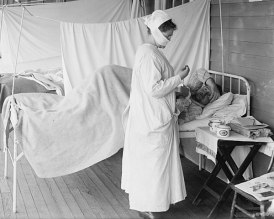
Walter Reed Hospital Flu Ward, 1918-19, Harris & Ewing photographers, via Library of Congress, Public Domain

Two years later, and about a decade after the flu, The Port Macquarie News and Hastings River Advocate published another piece by Walt Mason called “After the ‘flu” (21 September 1929). I found this also-rhyming piece in multiple Australian papers. Only some were attributed to Mason; others had no attribution at all.

The piece starts:

I had nine kinds of Spanish ‘flu, with sundry German brands thrown in; all day I coughed and said, ‘Ker-choo!’, all night I coughed and sneezed like sin.

The doctor said, as at my side he mixed up pills to feed my face, ‘The wonder is you have not died! I never saw so bad a case. I’ve seen a hundred taken down, I’ve seen them like the ripe grain fall; a thousand men are sick in town, but you are sicker than them all. It is a feather in my cap that I have pulled you through the strife; that you still loiter on the map, and breathe the well-known breath of life.’

And on it goes, describing what a wonder it is that he survived. Pronounced cured, he wants to brag to his friends:

There is no sense in being ill unless it gives you an excuse to talk about the doctor’s bill, and boast of pain to beat the deuce.

But they show no interest, calling his sickness fake, or telling him

You have your gall to talk of pain! A tin-horn ailment like the ‘flu. Your talk is frivolous and vain. Just wait until you have the gout, your toe swelled bigger than a brick! Then you may prance around, old scout, and claim that you really have been sick!

Our poor narrator concludes:

Alas, no matter what I do, my friends will never let me brag; in vain I hoped my siege of ‘flu would give a chance to chew the rag.

Simple humour by today’s standards, but interesting to see the lighthearted – but gently moralising – take on what was a terrible scourge at the time. Some describe Mason as a poet-philosopher.

Will we be writing about COVID-19 in similar tones over the next decade?

Rick Morton, One hundred years of dirt (#BookReview)

Book coverWay back in the early 1970s when I was an undergraduate university student, I did some sociology, and one of our set books was The myth of equality by Tom Roper. It, and the courses around it, have informed ever since my understanding of how our society operates. Morton’s book One hundred years of dirt would have been perfect recommended reading for these studies. At the end of his first chapter he says this:
the single experience of my sister’s road to this point detonates the argument that equality of opportunity is stitched into our nationhood.

One hundred years of dirt, in other words, is not a simple memoir, as it might initially appear, but is, rather, a cry to Australians to see that the ideas, the myths we hold dear, are just that, myths.

But now, back to the beginning. Rick Morton, a thirty-something journalist, grew up tough. Born on a remote outback cattle station to a family of violent men, he experienced more than his share of trauma. Besides the intergenerational violence, he saw, when he was 7 years old, his older brother nearly burn to death and then, while his mother was away with that brother in hospital, saw his father carry on an affair with the governess. Not surprisingly, this caused a family breakdown, resulting in his mother leaving with her three children and no financial support. Poverty was theirs from then on. Morton speaks eloquently of the struggle to make ends meet, making it clear that families like theirs have no time to consider issues of the day, like climate change, when even a mooted $7 Medicare co-payment “could be the difference between eating or not for a person on the poverty line.”

Time, in fact, is an interesting issue – and one that resonated with me, too, as a feminist. Time is a commodity and how we choose to spend it – or are able to spend it – is political. Like hours at the hairdresser for example. (I know I am treading on sensitive toes here, but so be it.) Anyhow, as Morton says, “only some people have the time” to be “woke”. Just “living for so many people in Australia is exhausting“.

So, on the surface, One hundred years of dirt could be seen as your standard misery memoir: Boy from poor and violent background struggles against the odds to make it good as a journalist and successful author, with the help of a loving mother. It is that, superficially, but it’s much more too.

There is a general chronological movement to the story. It starts in the present, when that point quoted above about “equality of opportunity” is made. It then flashes back to the family’s origins on huge cattle properties in southwest Queensland, focusing particularly on grandfather George Morton and his hard, violent ways. From here, Morton moves more or less chronologically through his life, but each chapter is framed around a theme, so the chronology is not exact. The chapters, in fact, could be read as individual essays on their specific topic, such as drug (ice) addiction, mental health, being gay, class, and otherness or outsiderness. For some readers – as some in my bookgroup found I think – this departure from a more typical narrative flow may make the book feel disjointed. However, for me, the clear heralding in the first chapter that One hundred years of dirt was about more than one life had me engaged and ready, perhaps, for anything!

That anything turned out to be a personal exploration of how inequality plays out in contemporary Australia, supported by smatterings of socioeconomic data. Morton is, after all, a journalist, and so he brings his journalistic nose for facts to bear on his and his family’s personal experiences. In doing so, he provides example after example of how out of touch the knowledge class or “commentariat” is with the lives of those at the bottom end of the income stream. He discusses, for example, unpaid internships and the incomprehension that there are people who just can’t afford to take advantage of them. Journalism, which is rife with unpaid internships as a pathway in, has become one of “the most exclusive middle-class professions of the 21st century”. Morton describes the complete ignorance many in the middle-class have about their privilege:

There are those who have had the good fortune to never have felt other than the silkiness of privilege, their bubbles so perfect they cannot feel the gravel underneath.

He also writes:

As a nation, we have convinced ourselves that all of us has the same standing start, but this is neither true for the working class whites from broken families nor for those with black or brown skin. It’s not true for those without a proper education nor for those who were abused.

However, this book is not just bitter medicine. It has a spoonful of sugar. There are some genuinely funny moments – some of them black of course – and there are Morton’s wonderful turns of phrase which illustrate his meaning beautifully. He talks, for example, about working in a workplace surrounded by colleagues from “moderately wealthy and upper class families”:

… my colleagues [whom he did see as “dear friends”] could not fathom the life I had led. There were frequent attempts at empathy but it sounded a lot like people who were reading pre-prepared lines. Imagine a fish turning up to discover her psychologist is a Very Concerned sea eagle.

Love the fish analogy, but ouch, really, ouch! I feel I have a good understanding of inequality of opportunity and the ways in which it underpins disadvantage in Australia, but finding the right language in face-to-face encounters is not easy.

I have probably made this book sound like a sociological thesis or polemic. There is that, but it is still, at heart, a memoir. It’s simply that I have focused on what I see as the book’s main message. However, this message is wrapped up in a story about human beings, and particularly about Rick and his dearly loved mother Deb. He describes her as “the hero of this piece”, the mother who

sees boy as special, tells him he was sent here from that big night sky by beings unknown to report back on what he sees. She invented the aliens because she couldn’t see herself as the protagonist. She outsourced the explanation for her own success as a mother to the aliens out there.

Lovely Deb; thoughtful, provocative Rick. This is a powerful read.

Rick Morton
One hundred years of dirt
Carlton: Melbourne University Press, 2018
191pp.
ISBN: 9780522873153

Monday musings on Australian literature: Authors respond to COVID-19

In last week’s Monday Musings I wrote more generally about COVID-19 and its impact on the Arts. Like that post, this one is not aiming to be a formal comprehensive one either; news and ideas are coming far too quickly. And, anyhow, as I also said last week, most if not all of you are well enough connected to be receiving news and notifications yourselves. You just need to be social-media-connected in some way to your favourite arts organisation, bookshops, publishers, and so on, to see a whole range of ideas and initiatives popping up to keep authors in our field of view.

To give just one example of what formal or organised culture is doing, the National Library of Australia held its first Digital Book Launch on 27 March, featuring our lovely local author Karen Viggers in conversation with Felicity Volk to launch Volk’s new book Desire lines.

The NLA is not, of course, the only organisation finding ways of keeping culture alive. From social media, I see that digital launches, in particular, using a variety of platforms, are quickly becoming popular.

However, what I want to do today is something a bit different, which is share three recent social media posts by individual authors, in which they respond – in their own way – to COVID-19. They are different authors at different stages in their lives and careers, so their response and/or needs are also different. Oh, and it’s coincidental that they are all women writers.

Sara Dowse has appeared in my blog several times, including a reference to her memoir piece about the time she spent as a child with Ava Gardner, which was included in The invisible thread anthology. Since 15 March, she has been daily posting on Facebook an excerpt from her unpublished memoir. She figures she’s never going to bring it to publication, so why not share it for people to read now, when so many of us are at home. Dowse is a thoughtful and intelligent writer, so having access to this is quite a treat for us, I’d say. At the end of the first except, the American-born Dowse introduces her memoir by pondering her complicated family background and falling in love with an Australian:

Was my infatuation an escape from this? It’s frightening to admit that it might have been so, just as it is to contemplate that escaping from difficult situations I hadn’t the sense not to get into in the first place was to become an indelible facet of my nature. An admirable capacity for survival, or a shameful weakness? Perhaps it’s the Hollywood influence that makes me think that you can shift the meaning of almost any story simply by changing the angle of the lens.”

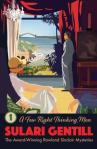
Sulari Gentill, A fete right thinking men

Those who know me will know that I love this idea that you can shift the meaning of stories by changing the perspective.

Sulari Gentill, the historical crime fiction writer who lives in a rural area only a couple of hours from where I live, made me laugh with her homeschooling Instagram post. There was picture of her 14-year-old son reading her novel A few right thinking men. Her caption starts with:

Homeschooling … I’ve decided to cover English and History by making Atticus read my books. It may be the only time I have this power … And it means I can actually discuss both the literary and historical aspects of the novel with him sensibly, as well as be assured that his critiques will be robust (though perhaps a little blunt). It’s not exactly on the curriculum but we can deal with that later …

I loved this so much. You go Sulari! (I have written about a Canberra Writers Festival panel including Gentill, here.)

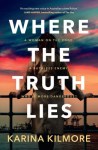
Debut crime author Karina Kilmore wrote (and tweeted) a blog post on the Sisters in Crime site. Her post is titled “Writing in the times of corona”. She talks about having her book tour and promotion activities cancelled. She talks of why she writes, which is to share her stories, but then ponders

But the reality for me as a writer has never seemed more stark. Those dystopian novels, those science fiction scenarios, those terrible crimes by people in desperate situations are no longer pure works of fiction. We have all seen the footage of people fighting each other in supermarkets, hoarders taking more than their fair share and people risking other peoples’ lives by not following the restrictions. This type of realistic crime makes writing my second novel harder.

She also says that while cancelling her book tour was the right decision, the impact is to “somehow” make her doubt herself. You can feel her uncertainty and pain.

(Kilmore’s book, Where the truth lies, is published by Simon and Schuster. It was shortlisted for the Unpublished Manuscript Award in the 2017 Victorian Premier’s Literary Awards.)

I hope you’ve enjoyed these little snippets.

Meanwhile, as I wrote last week, take care and be safe my blog friends.

Do you have any interesting author stories to share?