Monday musings on Australian literature: Let’s get physical – The High Country

From the top of Mt Kosciuszko

From the top of Mt Kosciuszko

This, my third Let’s Get Physical post, is once again about a region that’s not too far from me – the Australian High Country. When most people think of Australia, they think – at least I believe they do – of deserts and beaches, of red earth and golden sand. But, Australia does have a high country, albeit a fairly low one. Our highest mountain, Mt Kosciuszko, is only 2,228 metres (7,310 ft) high. It is so low that it doesn’t feature in any serious lists of “highest mountains” except highest in Australia! But this is beside the point. We do have (relatively) high country, we do have blues and greens, and we have life and literature associated with them.

This high country – the Australian Alps – is part of the Great Dividing Range which runs down pretty much the entire length of the east coast of Australia, some 3,500 kilometres (2,175 mi). It represented a significant barrier for the first white settlers who didn’t cross it until 25 years after they arrived … and this was north, near Sydney, where the highest point is half that of Kosciuszko!

Being (albeit low) high country, this is not a region of high permanent population – so not many writers call (or have called it) home. However, that doesn’t mean it doesn’t feature in Australian literature. Probably the most famous literary work associated with the high country is Banjo Paterson‘s  famous poem “The Man from Snowy River”, a ballad that romanticises high country bravery and horse-riding skills. Clancy (from Paterson’s poem “Clancy of the Overflow”) describes the man from Snowy River:

He hails from Snowy River, up by Kosciusko’s* side,
Where the hills are twice as steep and twice as rough,
Where a horse’s hoofs strike firelight from the flint stones every stride,
The man that holds his own is good enough.
And the Snowy River riders on the mountains make their home,
Where the river runs those giant hills between;
I have seen full many horsemen since I first commenced to roam,
But nowhere yet such horsemen have I seen.

The ride chronicled in the poem takes place north of the Snowy. Its aim is to retrieve a colt which has joined “the wild bush horses”, that is, the brumbies. And this brings me Elyne Mitchell who set her famous The silver brumby series of children’s books in the high country. Mitchell, who apparently won the Canadian downhill skiing championship in 1938, ran a property in the Mountains with her husband. She wrote many books, fiction and non-fiction, about the high country. “The Man from Snowy River” and The silver brumby have spawned multiple adaptations and merchandising galore.

Much of the literature associated with the high country though has been written by writers who live elsewhere. Australian environmental poet, Mark O’Connor, has written many poems about the region, including a collection devoted to it, Tilting at Snowgums: Australia’s High Country in Poetry and Photos. The collection includes his poem, “The New Ballad of The Man from Snowy River”, which “updates” Paterson’s original. Cleverly referencing this original, it takes a realistic, satiric look at “the romance” of the Snowy, addressing many issues including indigenous rights and environmental concerns. It is well worth a read.

The high country is a particularly popular setting for genre authors like Tony Parsons, Judy Nunn and Jennifer Scoullar.
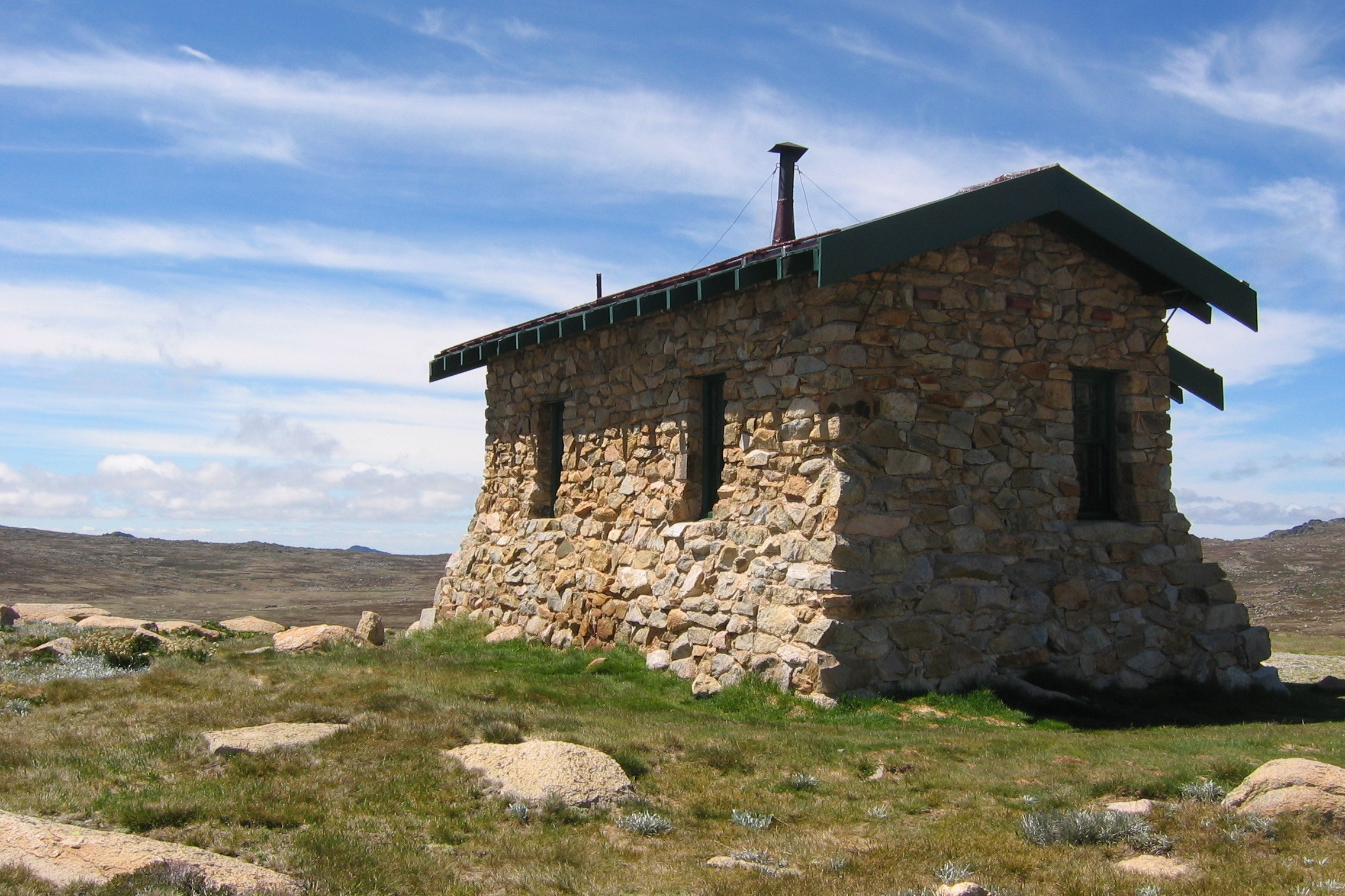
Seaman's Hut

Seaman’s Hut, near Mt Kosciuszko

Besides the mountains, rivers and brumbies – not to mention the snow gums – the high country is noted for its huts. Klaus Hueneke, local historian and high country expert, has written several books about the region including Huts of the High Country and Huts of the Victorian Alps.  When touring the Victorian section of the High Country last year, I was rather entertained to read in the notes for The Huts Walk at Mt Hotham, that one of the huts you pass is the Silver Brumby Hut. This hut is, they say, the 2006-7 replica of the original. By original they mean the 1992 one built as a temporary prop for the film, The Silver Brumby. Ah well, I guess it’s part of history too!

For those interested in film, two unforgettable movies are set in the high country: Jindabyne, which was inspired, intriguingly, by a Raymond Carver short story, and Somersault.

* NOTE: When I went to school, we spelt the mountain “Kosciusko”, as Paterson spells it, but the “Kosciuszko” spelling was officially adopted in 1991 because that more accurately reflects the name’s origin.

Monday musings on Australian literature: Let’s get physical – The Monaro

For my second Let’s Get Physical post, I thought I’d stay in my local region. The Monaro is a large region in southeastern New South Wales, extending from the southern and eastern boundaries of Canberra down to the Victorian border, and bounded on the east and west by mountain ranges. Much of it is treeless plain, but there are also rolling hills, rocky outcrops and jagged mountains. In summer it takes on a golden hue and I love it, I love the sense of clarity, openness and freedom I feel when we drive through it on our annual trip to the Snowy Mountains for some summer bushwalking.

Monaro Region, NSW

Not at its best, but you get the picture

As its main agricultural use is sheep and beef, I used to think, like many people, that its treelessness came from clearing for grazing and/or overgrazing, but in fact the first white people in the area found it in that state. The Austrian naturalist and artist, John Lhotsky described it in 1835:

The scene all around was composed of undulating downs, long projected hills among them, covered with very few trees.

Lhotsky, though, wasn’t the first white man to write about the region. In his book Discovering Monaro: A study of man’s impact on his environment, which is excerpted in Canberra’s centenary anthology, The invisible thread, historian Keith Hancock quotes English naval officer, Captain Mark John Currie. In 1823, Currie also saw, as Hancock describes it, “open, undulating, ‘downy’ country”. It was Currie who learnt the name of the region from the indigenous Australian inhabitants. He wrote:

Passed through a chain of clear downs to some very extensive ones, where we met a tribe of natives, who fled at our approach, never (as we learned afterwards) having seen Europeans before … by degrees we ultimately became good friends … From these natives we learned that the clear country before us was called Monaroo, which they described as very extensive …

Currie and his party, though, decided to call it Brisbane Downs after the Governor of the time. Hancock continues:

Mercifully, that new name did not stick. The white settlers, as they moved in, called the country Monaroo, Monera, Maneiro, Meneiro, Meneru, Miniera, Monera, and – in the fullness of time – Monaro.

What’s in a name, eh? One of the things I love about the region is, in fact, its names. The towns include Nimmitabel, Adaminaby, Bombala, Michelago; and the rivers include the Murrumbidgee and the Goodradigbee. I love how they roll off the tongue.

The Monaro is well represented in Australian literature. It is where  Miles Franklin was born and set some of her novels; the poet David Campbell was sometimes called “The man from the Monaro” and poet Judith Wright lived for many years in the region. Current authors associated with the region include Roger McDonald whose historical Miles Franklin Award winning novel, The ballad of Desmond Kale, is set in the region. When that book came out, he said

In my adult life I always wanted to live back in the country and I was able to do that from about 1980 onwards when I bought a farm in Braidwood [in the Monaro]. I’m never completely myself unless I’m in the Australian countryside. It’s my vocabulary of self somehow … I think it’s in all my books.

I rather know what he means. I live in a city, but its nickname is “the bush capital”. The countryside is never too far away – and I like it that way.

Back to Braidwood though. It seems to be a bit of a mecca for artists. This is where Judith Wright lived for many years, and it’s also where Julian Davies, author, potter and painter has lived for over three decades. He wrote about it Meanjin’s Canberra edition, which I reviewed earlier this year. In his piece, “Out of town”, he describes how he built his hut and established a semi-self-sufficient life there. “The irony” in this, he says, “is self-evident”:

the stubbon pursuit of a relatively isolated life has been an attempt to marry what might be irreconcilable: I moved to the forest because of exactly what it is, but tried to bring a level of comfort and civilisation with me.

If you’d like to know more about Braidwood, and its little corner of the Monaro, do read author Nigel Featherstone’s piece, “Naturally inspired”, in which he considers whether a place can be “creative”. Or read Irma Gold’s post on and interview with Roger McDonald for The invisible thread.

Finally, just in case I haven’t convinced you of the significance of the region, I should add that it has a car named after it, the rather dashing Holden Monaro!

Monday Musings on Australian Literature Special: Book Giveaway Winners

Two weeks ago I announced my first blog giveaway, courtesy the generosity of Irma Gold, editor of the Canberra Centenary anthology, The invisible thread. Irma offered me two copies to give away, both signed by most of the authors represented in the anthology – and who are still living of course! Entries closed midnight, AEST, on 31August.

The invisible thread, by Irma Gold

Cover (Courtesy: Irma Gold and Halstead Press)

So, here are the winners, chosen using an Internet-based random number generator:

  • AUSTRALIAN ADDRESS winner is Rosemary, the lucky last Aussie to throw her hat in the ring; and the
  • OVERSEAS ADDRESS winner is Glenda in Switzerland

Congratulations Rosemary and Glenda … And commiserations to all you others. Thankyou though for showing interest. It’s a shame everyone can’t be winners.

Here is the deal, Rosemary and Glenda. You need to email me, at wg1775[at]gmail.com, your postal address by midnight AEST 7 September, 2013. I will redraw a new winner if I don’t have your address by that deadline.

Once again, a big thank you to Irma for offering this giveaway. … it is a real booklover’s treat.

Oh, and the book can be bought from Fishpond so all is not completely lost.

Reminder: a Book Giveaway

Time is running out to win one of the multiply signed copies of The invisible thread. Anyone from anywhere can enter as the editor and donor of the copies, Irma Gold, and I have agreed to quarantine one copy for an overseas address, and the other for an Australian address.

The invisible thread, by Irma Gold

Cover (Courtesy: Irma Gold and Halstead Press)

To read more about the book – gorgeous centenary anthology, The invisible thread, edited by Irma Gold – click on the following links to see my post on its launch, my review, or my description of the beautiful Woven Words event inspired by it.

So to recap the giveaway:

Eligibility:  The giveaway will be open to Australian and international readers, with ONE copy to go to an international reader, and ONE to an Australian reader. I will use a random number generator to identify the winners.

How to enter: Leave a Comment on this post, and state which country you live in so I can place in the right giveaway group. I’d love to hear why you’d like to have the book – but it’s not essential.

The fine print: Entries will close at midnight AEST on 31 August. If you win, you must email me with a postal address by the deadline that I advise in the post announcing the winners. I will redraw a new winner if the deadline isn’t met.

I can’t thank Irma enough for this offer … and hope those of you who lurk here won’t be too shy to enter.  This is a booklover’s treat that doesn’t come around often.

Monday musings on Australian literature: Let’s get physical – Canberra

Today’s post is the first in a little sub-series of occasional posts containing physical descriptions of places in Australia. This series is not going to be analytical or comprehensive but is intended simply to share descriptions that I like, that make me laugh, or that I think are interesting. My plan is to keep commentary to a minimum and let the descriptions speak for themselves.

I’m going to start with my home, Canberra. The first comes from Dymphna Cusack‘s A window in the dark, which I reviewed in July.

I arrived in Canberra at the beginning of spring, surely its loveliest season. It is the only city in Australia where you enjoy what is taken for granted in the northern hemisphere. Oh, the incredibly lovely decidiuous trees in their fine veil of green. The flowering cherries in their clouds of white and pink. The tulips! All in that magnificent rim of indigo hills, olive green under a variety of eucalypts and wattle. The city that Burley Griffin had designed then carried out much on the lines of his original plans, however much they were altered later, was beautiful.

[…]

Canberra was one of the loveliest places I have lived in and still is, its beauty enhanced by a picturesque lake. Today spreading suburbs have taken the place of the green undulating hills over which we wandered. One of my treasured memories is of sitting on the grass on a hillside looking right across the city to the smoky blue hills surrounding it.

The second comes from Bill Bryson‘s Down under (published in the US as A sunburnt country).

It’s a very strange city, in that it’s not really a city at all, but rather an extremely large park with a city hidden in it. It’s all lawns and trees and hedges and a big ornamental lake – all very agreeable, just a little unexpected.

Isaacs Ridge, Canberra

Park anyone? There be suburbs among the trees.

Both Bryson and Cusack trot out some of the usual criticisms of Canberra: it’s boring, it’s artificial (Bryson) or it’s snobby (Cusack). In its defence – after all it’s my place – I should add that Canberra has changed a lot since both wrote their pieces, Cusack c. 1976 and Bryson in 2000. Like Cusack, though, Bryson concludes on a positive note. He writes of looking out over Canberra:

It was impossible to believe that 330,000 people were tucked into that view and it was this thought – startling when it hit me – that made me change my perception of Canberra completely. I had been scorning it for what was in fact its most admirable achievement. This was a place that had, without a twitch of evident stress, multiplied by a factor of ten since the late 1950s and yet was still a park.

Monday Musings on Australian Literature Special: a Book Giveaway

Actually, the exciting thing is that this is not A book giveaway, as I have TWO books to give away. And, not only are there two books, but the books are signed by multiple authors! Intrigued? Then read on …

The invisible thread, by Irma Gold

Cover (Courtesy: Irma Gold and Halstead Press)

As many of you know this year is Canberra’s centenary. And, if you’ve been reading this blog, you are sure to have seen a mention or two (or more) of the gorgeous centenary anthology, The invisible thread, edited by Irma Gold. If, however, you don’t know what I’m talking about, click on the following links to see my post on its launch, my review, or my description of the beautiful Woven Words event inspired by it.

Hands up if you’d like a copy. Well, now’s your chance. The gorgeous, generous Irma has two copies of the book that have been signed by over 30 of the (still living) authors as well as by the editor (Gold) and the illustrator (Judy Horacek) … and has apparently been wondering what to do with them. To my astonishment, she asked me whether I would like to run a giveaway through my blog. Would I what?

The give-away is being timed to coincide with the last of the many events Irma has organised to promote the book – AN EVENING OF READINGS at the Paperchain Bookstore here in Canberra on Wednesday 28 August. It’s free but RSVPs are requested. Do consider going if you are in town. It will be great.

So to the giveaway:

Eligibility:  The giveaway will be open to Australian and international readers, with ONE copy to go to an international reader, and ONE to an Australian reader. I will use a random number generator to identify the winners.

How to enter: Leave a Comment on this post, and state which country you live in so I can place you in the right giveaway group. I’d love to hear why you’d like to have the book – but it’s not essential.

The fine print: Entries will close at midnight AEST on 31 August. If you win, you must email me with a postal address by the deadline that I advise in the post announcing the winners. I will redraw a new winner if the deadline isn’t met.

I can’t thank Irma enough for this offer … and hope those of you who lurk here won’t be too shy to enter.  This is a booklover’s treat that doesn’t come around often.

Monday musings on Australian literature: Writing the Australian landscape (2)

In this week’s Monday Musings*, I plan to continue last week’s discussion of some of the ideas that arose from the National Library of Australia’s Writing the Australian Landscape conference.

But first, I’ll recap the two questions posed by the keynote speakers:

  • Day 1, author Murray Bail suggested that only when we are at ease with ourselves will our need to discuss place (or landscape) fall away.
  • Day 2, historian Bill Gammage asked How long must we continue to write our landscape as outsiders?

Thinking about these over the past week, I’ve come to the notion that these could (almost) be seen as two sides of the same coin. That is, as I understood him, Bail wasn’t so much suggesting that we’ll end up not discussing place or landscape but that we won’t “need” to focus on it to prove our Australianness, to confirm our identity. Landscape would then become part of the background, it would be part of us, and we would no longer be outsiders to it. Does this make sense or am I twisting their words, I wonder?

The meaning of place

Several “place” related concepts were discussed over the weekend, sometimes with clear definitions, and sometimes more loosely. Many speakers talked about the relationship between Landscape, Place, Country and Culture. Landscape was not seen as purely physical but as something that we relate to and/or that impacts on us. Gammage argued that it takes time and memory to translate “landscape” to “country” or “culture”. Historian Matthew Higgins talked about “place memory” and suggested that when we talk about and remember place, “life is as important as the landscape”.

Gammage, and several other writers including Sue Woolfe, Charles Massy and Ros Moriarty, spoke of learning about indigenous Australians’ relationship to the land, a relationship in which the physicality of the land is inextricably entwined with spirituality. People, land and law are three aspects, he said, of the one thing.  While westerners objectify the land – as in, “isn’t it beautiful?” – indigenous Australians see their ancestors in it. Landcare is the business of life. Climate change activist, Anna Rose, and Adrian Hyland, who wrote Kinglake 350 about the Black Saturday fires, would agree, albeit from a different perspective.

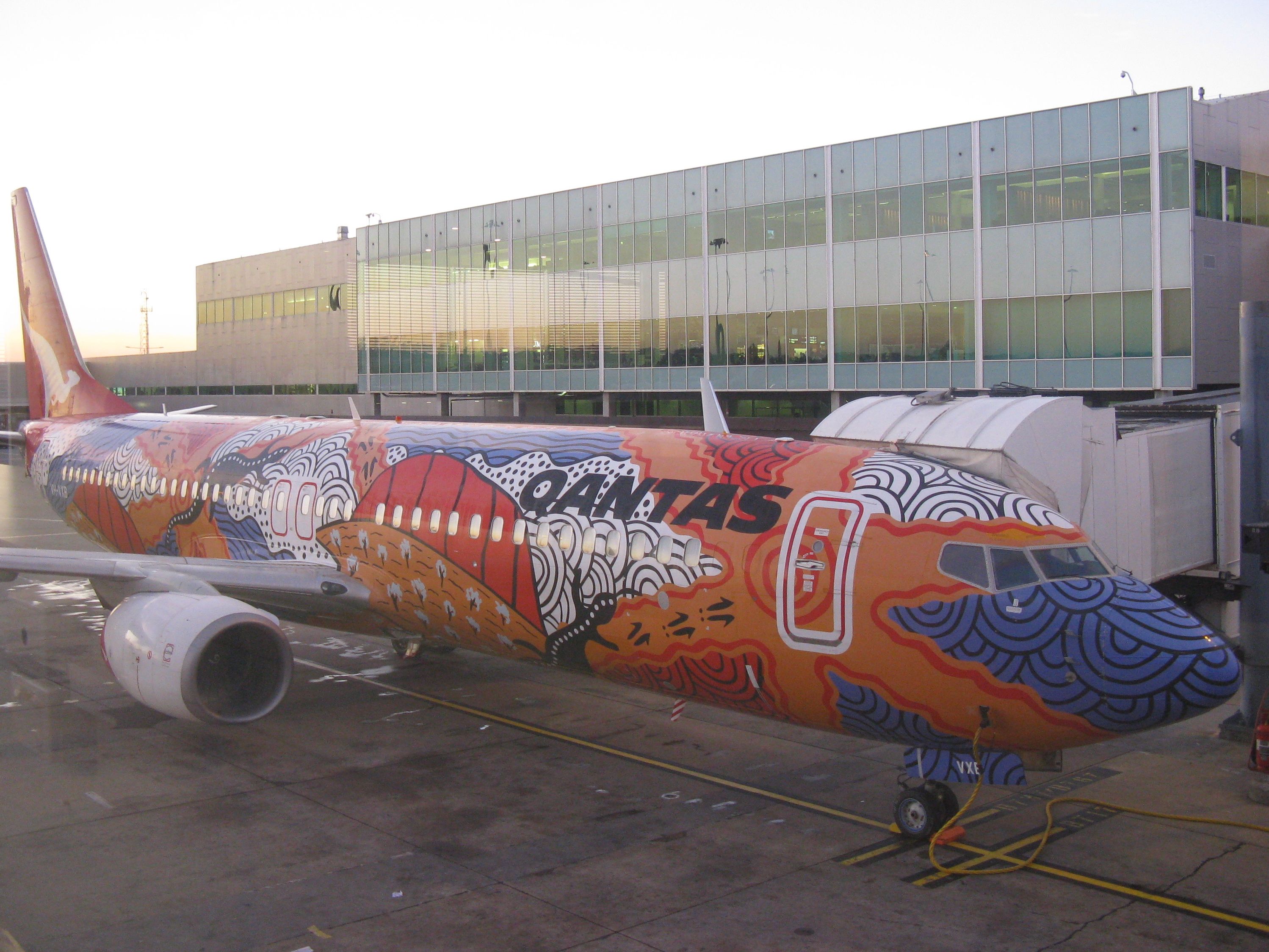
John Moriarty Qantas Plane

John Moriarty Qantas Plane

Non-indigenous woman Ros Moriarty, who is married to indigenous Australian John Moriarty, said:

Australians have no idea that the singing of the continent continues. We sip at the edge of its physicality when we could gulp from the well of its spirit.

This message, reiterated slightly differently by many of the speakers, was the most powerful message (for me, anyhow) of the weekend. It wasn’t a new concept to many of us I think, but the strength and clarity of its communication was moving and inspiring.

… And then, late in the conference came …

Jeanine Leane

I’m singling out Jeanine Leane because she was, as far as I’m aware, the only indigenous writer to speak at the conference. I have read and reviewed Leane’s gently powerful Purple threads, and was looking forward to seeing her in the flesh. She had a big task, but she was up for the challenge. She reiterated the points made by other speakers regarding country and its meaning for indigenous Australians but she, of course, spoke from the experience of having walked the talk. She knew intimately whereof she spoke and showed how much we westerners, albeit with a lot of goodwill, stumble around in our understanding.

For example, she spoke of the notion of Australian “classics”. She argued that the works of writers like Xavier Herbert, Patrick White, David Malouf, and Kate Grenville, which are regularly identified as “classics”, are classics of the settler quest written for settler readers. Within the concept of “classic”, she argued, is the question, “Whose classic?” Leane pushed the point further by referencing Alexis Wright, author of Carpentaria (my review). Western (white) critics, she said, see magical realism in Wright’s work. (Ouch!) But the notion of “magic”, she argued, is used by settler critics for things they can’t understand. For Wright, though, the point is that “if you can’t see that tree behaving strangely, that’s your problem”.

Leane seemed, however, more optimistic than angry, for all the strength of her argument. She said that there is a proliferation of Aboriginal writing across genres, and that this writing expresses not only the “generational story of loss and longing” but also people’s aspirations. I hope she’s right, but even more, I hope more of it is taught is Australian schools and read by Australians of all backgrounds.

And this brings me back to Bail and Gammage. How should we “settler” Australians proceed? How do we relate to the “place” in which we live in a way that isn’t superficial or tokenistic but that doesn’t (arrogantly) presume a connection that we don’t have?  We have a way to go yet.

* There is more to say, but this will be the last post for the moment. I may share more again later, perhaps after the papers become available on the NLA’s website.

Romy Ash, The basin (Review)

Romy Ash has made quite a splash with her debut novel, Floundering. It was shortlisted for the Stella Prize and the Miles Franklin Literary Award, among others. I  haven’t read it yet, but I have read a couple of her short stories that have appeared in the Griffth Review, one of which is “The basin”.

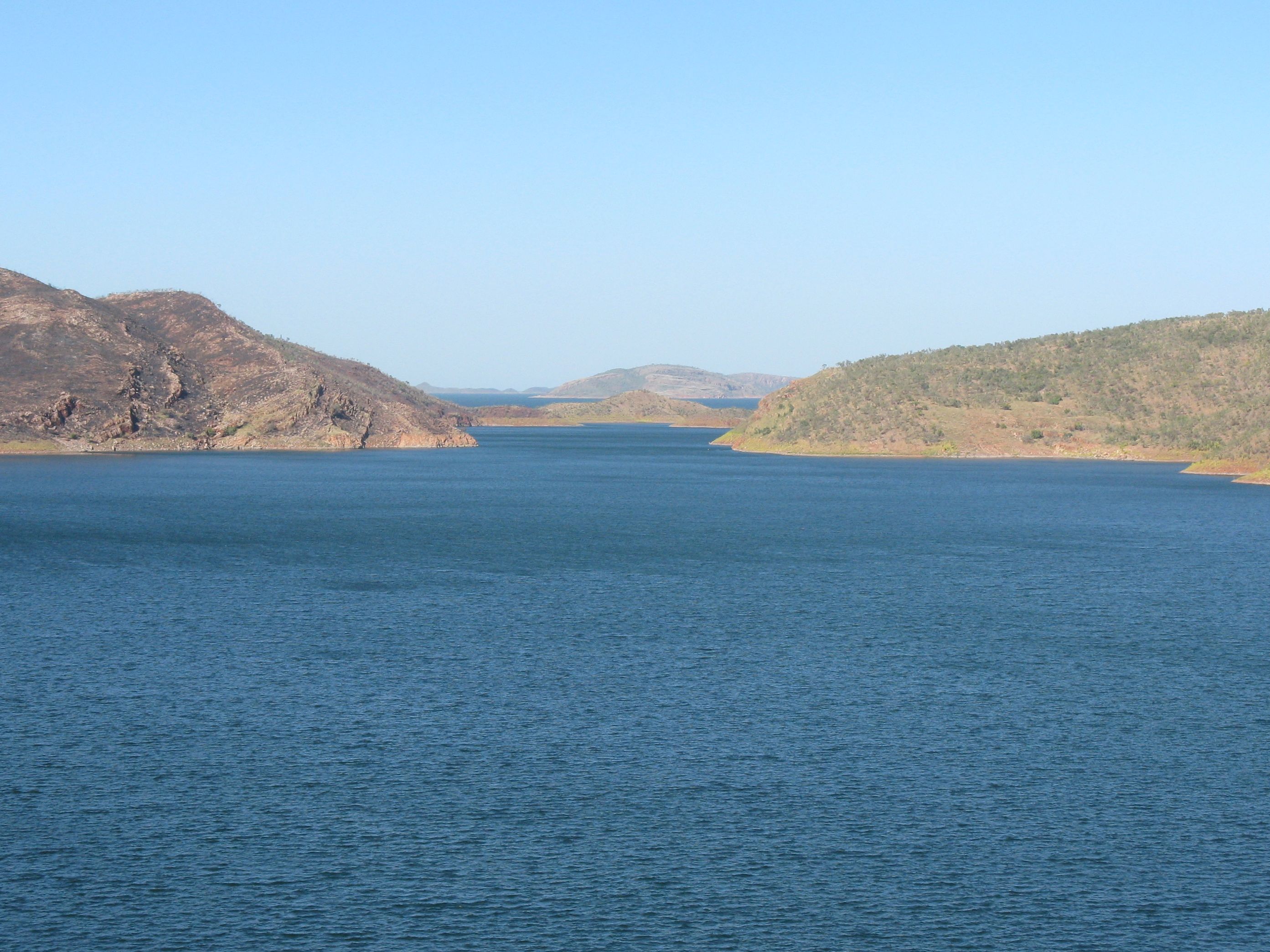
Lake Argyle

A tiny section of Lake Argyle

For those who don’t know, the Griffith Review is published quarterly, with each issue focusing on a particular theme. The issue “The basin” appears in is titled “What is Australia” which is rather apposite given my Monday Musings post this week on Writing the Australian landscape. Ash doesn’t identify the “place” in which the story is set, beyond telling us that there’s a dam which is described in a pamphlet as “the biggest inland body of water in Australia”. Well, that gives it away. It is clearly inspired by Lake Argyle in the Kimberley region of northern Australia. The lake – an artificial one created by damming the Ord River – is huge. I’ve never seen a lake (in Australia anyhow) quite like it.

Ash’s story is about Jess who has come to the region with her husband, Max, and their daughter, Frankie. Jess is not happy, something that is physically represented by her increasing weight: “every bit of her wobbled”, “Sitting there Jess felt fatter”, “her thighs rubbed together”, and so on. “You were skinny, before”, an old farmer tells her.

Max, however, is happy. “We’ve never done so well”, he tells her. But all is not well in this man-made Eden (there are sly references to “apples”) and not all men are happy. It’s not normal for this “dry country” to have so much water. A farmer tells them:

The most beautiful country you’ve ever seen, gone. Them gums, they’re drowned under there. Ever heard a gum drown?  They creak. All the animals. It’s not like fire – them animals can’t sense it coming – they was drowned, sure enough. The surface of the water was just insects. Snakes curled and died. They washed up at the sides. It didn’t look like it does now. It was putrid.

Putrid perhaps, but natural is the implication. I have written about the drowning of this landscape before in my post on Mary Durack’s poem “Lament for a drowned country”. The Duracks’ own homestead was drowned to create Lake Argyle.

Australian Women Writers ChallengeAsh uses feminising imagery to tell her story – with many references to the colour “pink” (galahs, inside of mouths, sunrise, hams) and to the “basin” of the title. Water, often a literary device associated with life, is a complex image in Ash’s story. People are told not to swim in the dam because it’s the town water. Jess and Frankie do, but then Jess will only drink bottled water, refusing to drink the town water. Understandably! A different sort of water features in the story’s resolution.

Although Ash doesn’t explore it, she reminds us of indigenous people’s association with the land when she says that “after the flooding the town had been renamed Burrngburrng-nga, an Indigenous name. Every time she heard someone say it they pronounced it differently and quietly, unsure.” Google tells me that it means “The water boiled” in the Wagiman language (from Katherine in the Northern Territory).

This is a story about the costs – personal and environmental – of mankind’s belief in its ability to control nature. It’s about values, and whether making money is enough to sustain happiness. It’s about the unhappiness that can result when people are dislocated from their roots – either because they move or because their place has been changed beyond recognition. Place – it has such a complex relationship with our physical, emotional and/or spiritual well-being, doesn’t it?

It’s not a particularly dramatic story, but it is a quietly effective one that I can see fitting nicely into a volume intended to encourage us to think about “What is Australia”.

Romy Ash
“The basin”
Published in the Griffith Review, Edition 36, Winter 2012
Available: Online at the Griffith Review

Monday musings on Australian literature: Writing the Australian landscape

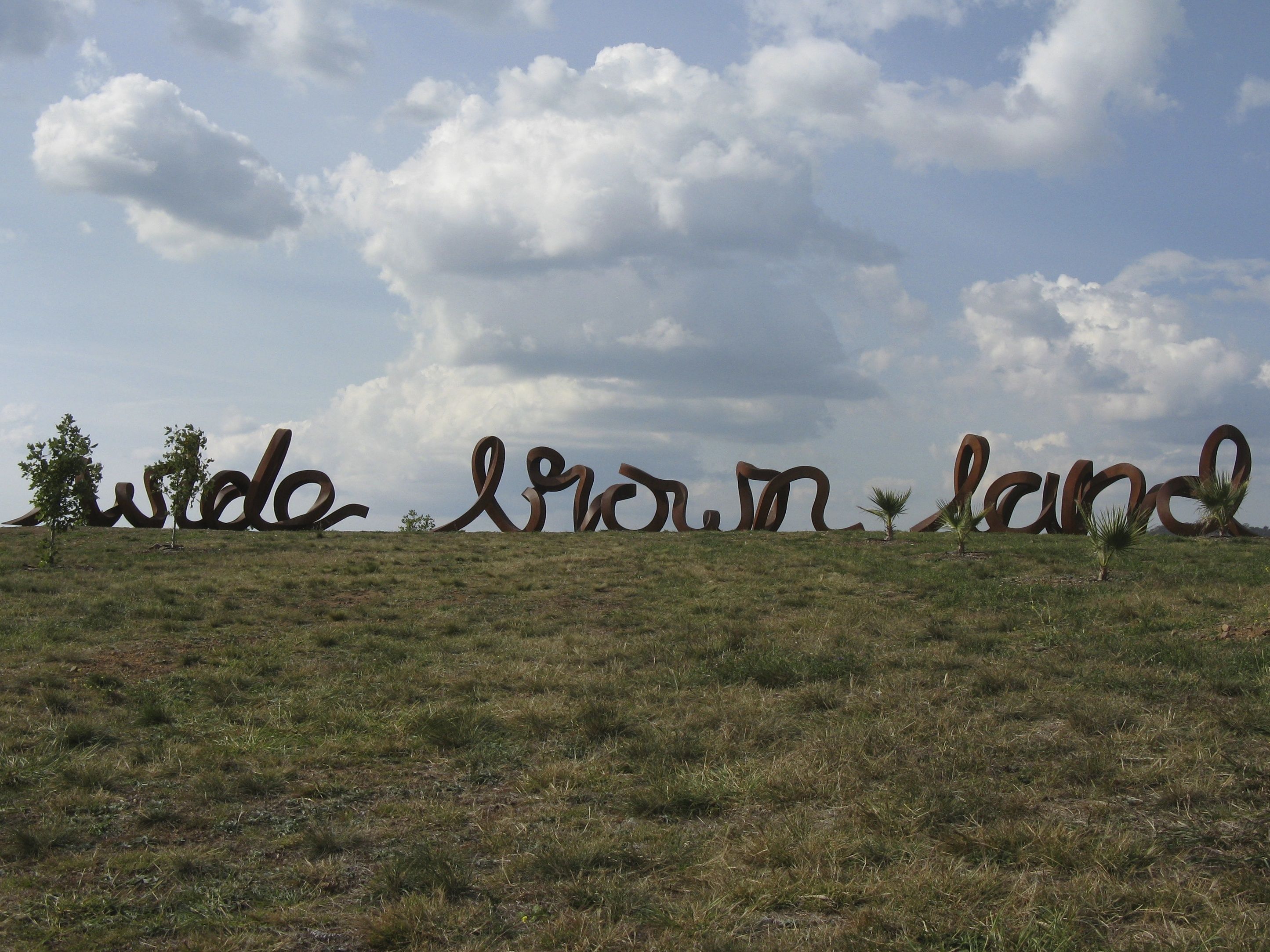
Wide Brown Land sculpture

Wide Brown Land (National Arboretum)

This weekend just gone I had the privilege – well, I paid to go, but still it was a privilege – to attend a conference at the National Library of Australia titled Writing the Australian landscape. You can see why I had to go … wild brumbies couldn’t keep me away.

But if, perchance, the topic hadn’t attracted me, the line-up of speakers sure would have. They included:

There wasn’t a boring one among them. (The full list of speakers, and chairs, is available online) Kudos to the National Library* for putting together an excellent program and to the speakers who had all taken the topic seriously and offered much for the audience to think about. I think I can speak for all who attended when I say that we laughed, cried and winced (though perhaps not always at the same things.)

All that’s by way of introduction. Now I’d better do the hard yakka and share some thoughts and ideas, but that’s not going to be easy.

I’ll start with a little manifesto, if I can call it that. The way I see it, to be a white (non-indigenous) Australian today is to feel a little uncomfortable. Many of us love being Australian, love the land or country we call home, and yet are aware of the cost to others of our being here, of the dispossession we brought to others. But, we can’t be ashamed of being western**. That’s our heritage, that’s what informed our thought processes. However, we can be ashamed of assuming that others think the way we do and, worse, of assuming that others want to think the way we do (or be the way we are). My – our – challenge is to be open to other ways of thinking, to respect them and to learn what we can from them. While almost all the conference speakers were non-indigenous, there was a lot of goodwill amongst the speakers and the audience in the room, a lot of willingness to open our eyes. Please read my notes on the conference with this in mind.

Why write (about) the landscape?

And so, I really do have to start now. The conference got off to a rather provocative start with Miles Franklin award-winning author Murray Bail giving the Kenneth Binns lecture. Speaking from his western-writer standpoint, Bail was concerned that we were even having the conversation. Other western literatures, he argued, are not preoccupied as we are with landscape and, related to that in his mind, with national distinctiveness. Did Tolstoy, he asked, worry about his “Russianness”? No, he said, we read Tolstoy for the moral questions he explores, to learn how to live, be happy, be wise. For Bail, landscape is a New World concern, which that quintessential New World country the USA has now shaken.

Bail suggested that only when we are at ease with ourselves will our need to discuss place (or landscape) fall away. I found this a fascinating idea and will be thinking about it for a long time:

  • Is our fascination with landscape a bad thing?
  • Is our landscape so different, so forbidding, that it will always play on us? (But then, aren’t other landscapes, such as the Siberian desert forbidding?).
  • Does our particular history of occupation and dispossession mean that place and landscape will for a long time yet be a fraught issue?
  • Will the fact that for indigenous Australians morality is tied to the land, to country, mean that considering landscape will always be part of our literature?

What does (the) landscape mean?

Historian Bill Gammage gave the keynote address on the second day. His focus was very much on indigenous relationship to land, to country, which is the subject of his most recent multiple award-winning book The biggest estate on earth. His argument was that “country” is not about nature (about landscape) but about culture, and that non-indigenous Australians could learn a lot about our country by learning from indigenous Australians what they know and are able, within their laws, to tell us. I loved his glass-half-full statement that the point is not how much knowledge indigenous Australians have lost but how much they still know. Gammage, like Bail, recognised we are challenged by our landscape, but his conclusion was not that we should aim to stop writing about it but How long must we continue to write our landscape as outsiders?

I will share more from the weekend – including Jeanine Leane’s powerful paper – but for now these two keynote papers nicely encapsulate the weekend in which we explored the progression from Landscape to Place to Country to Culture.

* I understand audio and printed versions of the talks will be available on the NLA’s website. I’ll provide a link when they become available.

** * Yes, I know, not all non-indigenous Australians are western but I’m using this partly by way of comparison, and partly because it’s my heritage. And yes, we can be ashamed of things westerners have done but not, I think, of being who we are.

Michelle de Kretser on the benefits – hmm – of travel

I could write posts and posts sharing gems from Michelle de Kretser’s Questions of travel, and who knows, maybe I will. Right now, though, I’ll just share one of the many commenting on how travel has infiltrated the way we live:

Laura Fraser belonged to an age and a place where an amazing thing was taken for granted: for the first time in history, ordinary people could raid the past and the planet to decorate their homes. Her eye was accustomed to ecumenical style, to African masks hanging beside industrial signage, to a witty postmodern aesthetic that refused to distinguish between designer and detritus, kitsch and cool.

Travel souvenirs

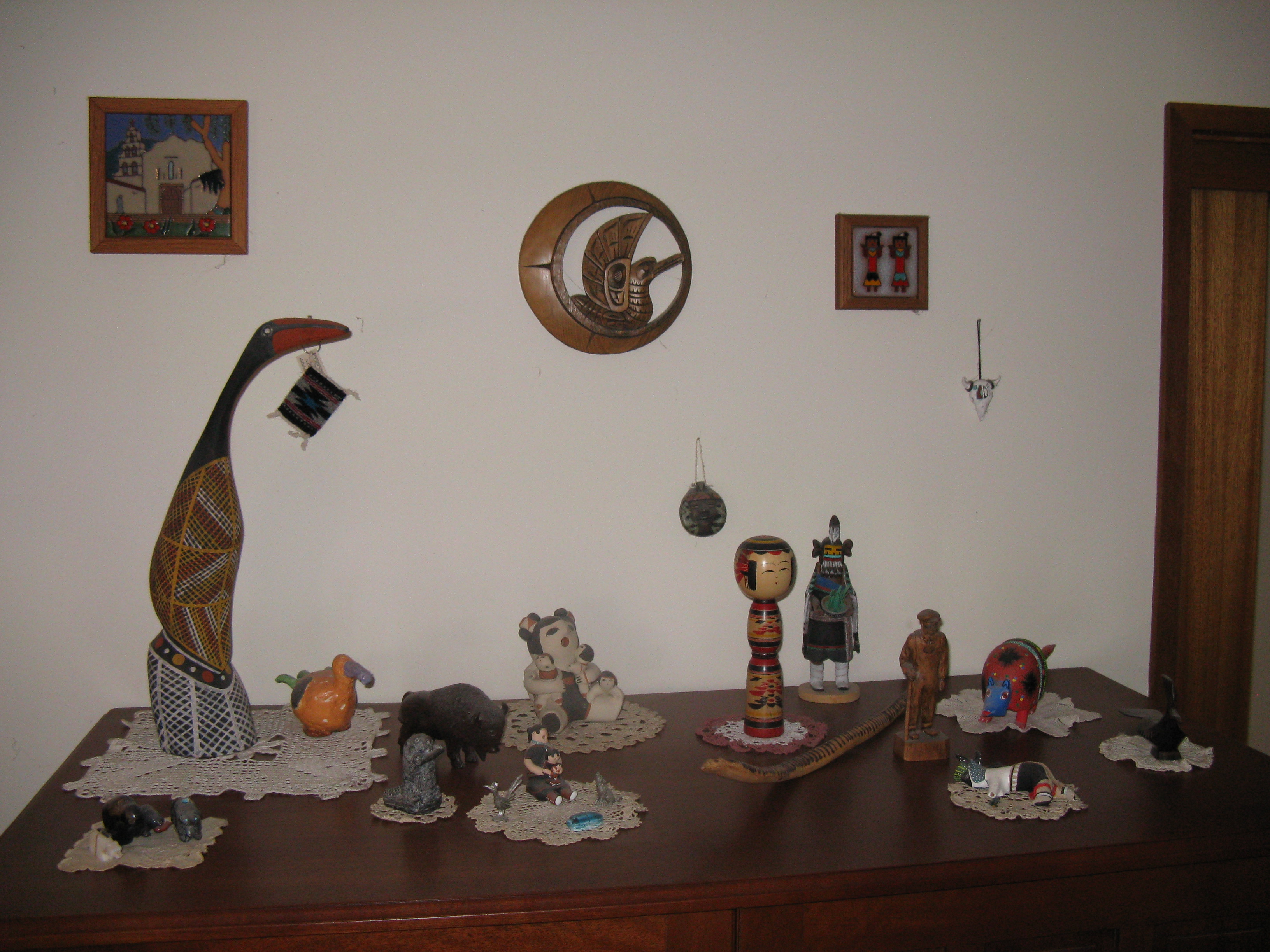
Tiwi meets Hopi meets Japan meets Navajo meets Quebec meets … hmm, guilty as charged