Monday musings on Australian literature: Short story awards

You all know by now that I really enjoy short stories. I have not, though, paid much attention here to short story awards, partly because, despite a few recent posts on awards, awards are not a major focus on my blog. However, I was down at New South Wales’ beautiful south coast a few weekends ago and, as I like to do, picked up the local rag, The Triangle to check out the local scene. In it I read about the establishment of a new award, the Olga Masters Short Story Award.

Olga Masters (1919-1986) was one of the leading lights in the wonderful flourishing of women’s writing that occurred here in the 1980s-1990s. Being one of our late-bloomers, she died too early in her fiction writing career, but not before she received critical acclaim for both her novels and her short stories. She was born in Pambula, on the south coast, so it’s fitting that this award has been established in that region. It has prompted me to do a little post on short story awards, albeit a highly selective post because over the years I’ve become aware of a plethora of short story awards. It’s great to see such support of this rather undervalued form of writing, but it would be impossible in the time I have to track them all down. So, as in my other posts on specialised awards, I’ll just focus on a few.

  • ABR Elizabeth Jolley Short Story Prize. Established in 2010. Awarded to a single-authored, not previously-pulbished story of between 2000 and words. As of 2014, there is no nationality requirement but the story must be in English. Offers $8000, though first prize seems to be $5000. The inaugural winner was Maria Takolander, whose book The double is currently on my TBR.
  • The Age Short Story Award. Established in 1979 and currently run in conjunction with International PEN. Awarded to a previously unpublished short story of under 3000 words. Offers cash prizes of $2000, $1000 and $500 and publication in The Age for the top three stories.
  • Aurealis Award for Excellence in Speculative Fiction. Established in 1995, and covers both novels and short stories. Awarded to short stories by Australian writers in several categories: Fantasy, Horror, Science Fiction, and Young Adult. Awarded to published works by an Australian author. This is an excellent example of a well-regarded set of awards in genre fiction.
  • Margaret River Short Story Competition. Established in 2011/12 by the the small family press, Margaret River Press. Offers several prizes, and all winners together with a number of other stories selected from the competition, are published in an annual anthology. Last year I reviewed the 2013 anthology, Knitting, and other stories.
  • Olga Masters Short Story Award. Established in 2014 by south coast residents, a local benefactor and Well thumbed Books. Awarded for “the best 2000-5000 word short story dealing with aspects of family life in rural Australia” written by an Australian citizen or permanent resident. Offers $1500 to the winner aged over 21 years old, and $500 encouragement award to the best story by a writer under 21.
  • The Overland Victoria University Short Story Prize for New and Emerging Writers. Established in 2012 by Overland magazine and Victoria University. Designed to encourage and support new writing. Offers a first prize of $6000 and two runners-up prizes of $1000, and I believe publication in Overland.

These are just a few of the Australian awards on offer for short stories, but there are many more, not only in Australia but also overseas which writers can enter.

Australian Women Writers 2014 Challenge completed

awwchallenge2014Regular readers here know by now that I only do one challenge, and that’s the Australian Women Writer’s Challenge. As in previous years, I signed up for the top level: Franklin-fantastic. This required me to read 10 books and review at least 6. I have now exceeded this. I will continue to add to the challenge, as I’ve done in previous years. However, one of the requirements of completing the challenge is to write a completed challenge post. Here is that post.

I have, so far, contributed 14 reviews to the challenge.

Here’s my list in alphabetical order, with the links on the titles being to my reviews:

Only two of these – Baynton and Anderson – are for non-recent works. I would like in the second half of the year to read more backlist, more classics. Let’s see what happens when I write my end-of-year post for the challenge.


Monday musings on Australian literature: Emerging or debut writer awards

Almost as important for emerging writers as the unpublished manuscript awards, about which I wrote recently, are the awards devoted to new, mostly defined as debut, writers. That is, these awards are for writers lucky enough to have been published – and who knows, some may have won an unpublished manuscript award to get published – but are just starting their careers, and may not be quite as polished as the Tim Wintons and Kate Grenvilles of the world. New writer awards must surely help get them and their books noticed.

These awards too can vary in their intentions and therefore their eligibility rules. Here are the main ones I found:

  • Dobbie Award: Established in 1994. Awarded to a first published fiction or non-fiction work by a female writer that can be described as ‘life writing’. Offers $5,000. Recent winners include works which went on to be shortlisted for the other awards such as Favel Parret’s Past the shallows, and Deborah Forster’s The book of Emmett. Tara June Winch, who’d won the David Unaipon unpublished manuscript award went on to win this award with the published version, Swallow the air.
  • FAW Anne Elder Award for first book of poetry: Awarded to a first book of poetry of at least 20 pages, not previously published locally or overseas, and containing contributions from between 1 and 4 poets. Offers $1,000. (National and state Fellowship of Australian Writers groups support a large number of awards in a wide variety of forms and genres, and with all sorts of eligibility conditions. I’ve listed this one as an example.)
  • New South Wales Premier’s Literary Awards UTS Glenda Adams Award for New Writing: Established in 2005.  Awarded to a book of fiction by an author who has not previously published a booklength work of fiction. Offers $5,000. Tara June Winch also won this with Swallow the air, as did Andrew Coome’s Document Z (my review) and Michael Sala’s The last thread (my review).
  • Readings New Australian Writing Award: Established in 2014 by the Readings independent bookshop in Melbourne. Awarded to a the first or second published work of fiction by an Australian author. Offers $4,000.

There aren’t so many of these which is probably not surprising. I’d be interested to hear, though, of any others that you know are currently being offered/awarded.

Kirsten Krauth, just_a_girl (Review)

Kirst Krauth, Just a girl

Courtesy: UWA Publishing

If you’ve already heard about Kirsten Krauth’s debut novel just_a_girl, you’ll know something about its confronting nature – and it is confronting, though perhaps not quite in the way I expected. It was both more and less, if that makes sense.

However, if you’re not Australian, you may not have heard about this novel. Essentially a coming-of-age story, just_a_girl is told in three voices. Two are first person – Layla, a 14 to 15 year-old-girl, and Margot, her mother – and the other is, interestingly, told third person, Tadashi, a lonely Japanese man. The main voice, though, is Layla. She opens and closes the novel, which is set around 2008 in Sydney and the Blue Mountains.

Layla typifies the modern knowing teenage daughter that parents worry they may have. She’s sexually precocious and is acutely aware of her effect on men. She’s what many would call “a tease”. She tells us, though, that she’s a virgin (technically, anyhow, because she’s done pretty much everything else). She wants, she says, to wait until she’s 16:

Fifteen just seems too skanky. You tell your kids you lost your virginity at 15. They’ll just want to do it even younger.

This tells us something more about Layla – her street-wise wisdom. It’s believable because Layla has had to grow up fast. Her parents separated when she was in primary school because her father finally admitted his homosexuality. Her mother, prone to depression, turned to an evangelical church. Layla has learnt to navigate these waters with smart talking, and by using all the weapons at her disposal including personal attributes and modern technology. With studied insouciance, she tells us about her relationships, with her mother, her friend, her father, and various boys and men. She is not innocent, but she is also abused in several ways, by old and young, through the novel.

Meanwhile, her mother Margot struggles with depression, a sense of rejection and failure, and consequent inability to properly relate to her daughter. She has turned to God, but unfortunately the church she has chosen, with its hypocritical leader, is unlikely to be her salvation. You see how easily relationships can go awry during these turbulent years if family members are not strong and confident in themselves. But, Krauth keeps it real. This is not melodramatic. There are no over-the-top mother-daughter scenes, just lack of real communication leading to distance and lack of mutual support where both need it. By the end of the novel both have learnt something and are starting to see each other as people, rather than simply as roles. In other words, it’s not only Layla who needs to grow in this contemporary coming-of-age novel.

Into this mix is added a third voice, Tadashi. He often travels on the same train as Layla, and on one occasion rescues her from a risky situation. Like Margot, he’s lonely, used to relying on a mother who has now gone. In scenes reminiscent of the bitter-sweet movie Lars and the Real Girl he orders and takes possession of a sex (or love) doll which he sees as “a person” who will alleviate his loneliness. In some ways it’s an odd inclusion in the story but, besides his probably not essential role as rescuer, he adds another angle to the exploration of loneliness and relationships, and the use and misuse of sex to address gaps in people’s lives.

In her “Sources and permissions” note, Krauth tells us about her sources for “love dolls” and other ideas or events in the novel. She also explains that some of Layla’s comments have been inspired by teenagers who have appeared on SBS’s Insight program. She has listened well, because from my experience of similar programs I felt very comfortable (if one can call it that!) with Layla’s voice. She’s so fresh, so funny, so knowing, that you can’t help liking her and worrying about her vulnerability, while also being horrified.  Here’s a short example:

Mum says I have to be careful now that I’m in year 9. Because men will start looking at me in a new way. Fuckadoodle, they’ve been looking at me like that for years. Especially when I eat Chupa Chups on the train.

I was going to share the Chupa Chups (“I have a favourite game on the train trip home from school”) episode with you, but I reckon you should read it yourselves. It would be funny if it weren’t so disturbing. It’s a fine piece of writing about a sexualised young girl who “knows” too much. Talk about playing with fire!

Margot’s voice is quite different – the long run-on sentences versus Layla’s short ones convey her anxiety and uncertainty well. Here she is, for example:

When is this soul-searching going to end, I mean, I knew coming off the meds would be hard as I’ve tried it a few times before but it’s like I’ve sunk into a bog, and it’s been a horrendous week because of that film Layla hired, Brokeback Mountain, you know she loves Heath Ledger and was completely devastated when he died last year and everyone thought … [and on she goes for several more lines]

I feared at times that Krauth was trying to pack too much in – single mother, gay father, hypocritical evangelical church, breast cancer scare, viral you-tube, sex doll, workplace sexual harassment, and so on – but no, she made it work. They are treated as things that happen. She doesn’t trivialise, but neither does she labour. Instead, she keeps her focus on the main game, which is how we, and particularly young people and their parents, must navigate the modern digital world with its potential for serious ill, and how in such a world might we still forge meaningful relationships. A thoroughly modern book for a thoroughly modern audience. It will be interesting to see what Krauth does next.

Lisa at ANZLitLovers also liked the book.

awwchallenge2014Kirsten Krauth
just_a_girl
Crawley: UWA Publishing, 2013
265pp.
ISBN: 9781742584959

(Review copy supplied by UWA Publishing)

Monday musings on Australian literature: Juvenilia Press

Literature enthusiasts are often not happy to just read their favourite authors’ novels. They (we) want to read everything written by our favourites. This can include letters, diaries and juvenilia. I have written before about Jane Austen’s Juvenilia, including a review of her story Love and freindship (sic). Her early works provide a wonderful insight into the development of her craft – both her style and her ideas.

Yesterday, I attended the excellent Mansfield Park Symposium at the Jane Austen Festival of Australia, about which I plan to post later. During the tea-break I browsed the little sales area and came across a collection of Jane Austen juvenilia works published by the Juvenilia Press. Naturally I bought a couple of their publications. What, you are probably wondering by now, does this have to do with Australian Literature? Read on …

Juvenilia Press was founded in 1994 at the University of Alberta, but moved in 2001 to the University of New South Wales. It is a non-profit international initiative managed by the School of the Arts and Media in the University’s Faculty of Arts and Social Sciences. It is, as I understand it, a teaching press. Students are involved in “editing, annotating, designing and illustrating, under the supervision of established scholars from Britain, Canada, Japan, New Zealand, Spain, Switzerland, the United States, and Australia”. It is, in other words, also a scholarly undertaking. The publications are peer-reviewed, are reviewed in scholarly journals, and have been recognised by the Times Literary Supplement.

The Press defines juvenilia as early writings by children and adolescents up to around 20 years of age. It has published works by Jane Austen, Margaret Atwood, Charlotte Brontë, Lewis Carroll, Charles Dickens, Philip Larkin,  Margaret Laurence and …

Mary Grant Bruce, Early Tales

Courtesy: Juvenilia Press

Here’s the exciting part … Australian authors. Those published to date, are:

  • Mary Grant Bruce’s The early tales
  • Eleanor Dark’s Juvenilia
  • Dorothy Hewett’s The gipsy dancer and early poems
  • Ethel Turner’s Tales from the Parthenon

These gorgeous little books are priced around $12-15. As well as containing the author’s text, they include “light-hearted illustration, scholarly annotation, and an introduction that relates this work to the author’s mature writing”. The writers of these pieces are credited on the title page, as is the overall editor. For example, Jane Austen’s men, which contains four short pieces by her about men, such as “The adventure of Mr Harley”, was “edited by Sylvia Hunt and the students of ENGL3116 (English Romantic Literature) of Laurentian University at Georgian College”. The names of those who produced the introduction, annotations and illustrations are identified below that. Looks to me like a wonderful example of pedagogy in practice, with serious scholarship providing the backbone.

I have ordered the four Australian books I’ve listed here, and plan to write them up over the coming months as I manage to read them. If you would like to order any of the books, you need to print the form and mail it to the Press. Sounds like they need to get some IT or Accounting students involved to organise on-line ordering and payment!

It is in Jane Austen’s juvenilia piece, Catharine, or the bower, that we find her oft-quoted statement:

but for my own part, if a book is well-written, I always find it too short.

Juvenilia pieces are usually short, for pretty obvious reasons, but in their case, that’s usually part of their charm.

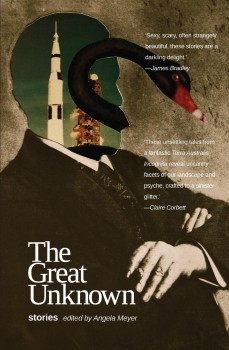
Angela Meyer (ed), The great unknown (Review)

Angela Meyer, The great unknown

Courtesy: Spineless Wonders

The great unknown is a mind-bending collection of short stories which explores, as editor Angela Meyer says, “the unknown, the mysterious, or even just the slightly off.” I was, in fact, expecting more horror, thriller even, which are genres that don’t really interest me, but this collection is not that. There are some truly scary scenes – so if that’s your bag then you’ll appreciate this collection – but many are more subtly mysterious, giving the collection a broader appeal.

There are nineteen stories, most of which are the result of Meyer’s direct invitation to some favourite authors. Six, though, come from the shortlist for the Carmel Bird Short Fiction Award, 2013, of which Meyer was the judge. The invited authors were given the same brief as that for the competition, which was to write a story inspired by the “fifth dimension”, that is, the world found in shows like The Twilight Zone and The X-Files where inexplicable things happen. The result is a collection of stories that vary greatly in setting, voice, subject matter – and even tone. Some are funny, some sad, most are disconcerting and some, of course, are scary.

The collection starts in a suitably creepy way with Krissy Kneen’s “Sleepwalk” in which the protagonist, Brendan, wakes up in the middle of the night to find his partner, Emily – the sleepwalker of the title – missing from their bed. This doesn’t sound particularly unusual, except that upon investigation Brendan discovers Emily intently taking photos – and not with a modern digital camera, but one requiring “real” film. When developing the photos, they see a blurry grey figure. Who is it? What does it mean? To find out you’ll have to read the story – but I can say that it provides a perfect opener to a collection of stories in which the relationship between a couple is a common springboard. After all, where better to explore the inexplicable but in that closest of human relationships, the one in which love and hate, trust and fear, so often collide.

Several of the stories confront contemporary dilemmas. One of my favourites, and winner of the Carmel Bird Award, is Alexander Cothren’s “A Cure”, a truly disturbing Twlight-Zone-like story about a treatment, the appropriately named MindFi, for compassion fatigue. Another TZ-like story I enjoyed is Guy Salvidge’s “A Void”, which is also futuristic and drops us into a world of “Seekers” and experimental drugs. I’m not sure why I enjoyed these TZ-like stories because it was a Twilight Zone episode that set off the most distressing period of my childhood. I’m sure it was that show that turned me off horror for life – quite the opposite reaction to Angela Meyer’s it seems!

Another clever story, and one with an unexpected narrative point of view, is Mark O’Flynn’s “Bluey and Myrtle” about a caged bird and his old mistress. Both have lost their loves and are lonely, but it’s the self-aware bird who takes things into his own hands. Growing older is also the theme of Susan Yardley’s “Significance” in which a woman’s sense of invisibility and irrelevance manifests itself physically. As a woman of a certain age, I can relate to that (though fortunately not within my own family). This story reminded me of Anne Tyler’s novel Ladder of years, except that Tyler explores her theme without resorting to the “fifth dimension”.

Before I stop picking out favourite stories, of which there are several more, I’ll just mention PM Newton’s “The Local” which perfectly captures life in a remote country town and the dangers that lie within. There are of course stories that I didn’t like as much. For me, the writing in Chris Flynn’s “Sealer’s Cove” was too self-conscious and the time-travel story didn’t grab. And Ali Alizadeh’s satire on the Oprah Winfrey-Lance Armstrong interview in “Truth and reconciliation” was a good idea and funny to a point but a little too heavy-handed for my tastes. Satire is like that, I suppose.

An important part of editing a collection is ordering the contents. Meyer has done a neat job of placing the stories in an order that seems natural and thereby enhances our reading. For example, two outback stories featuring missing people, PM Newton’s “The Local” and Rhys Tate’s “The Koala Motel”, one set in a pub and the other a motel, are placed together. And Paddy O’Reilly’s “Reality TV” is followed by the TV-set show, Alizadeh’s “Truth and reconciliation”. It, in turn, is followed by Guy Salvidge’s “A Void” in which drugs feature. Three stories in a row – by Marion Halligan, Susan Yardley and AS Patrìc – feature missing or disappearing women. Put this way, it sounds a little mechanistic but in fact it provides a subtle underlying coherence to what is a highly varied collection.

Meyer concludes the collection with Ryan O’Neill’s “Sticks and Stones” in which a reader, who smugly comments that “characters in ghost stories behaved as if they’d never read ghost stories”, becomes haunted, hounded even, by words. They move, follow and curse him … words, indeed, are dangerous. Be afraid, be very afraid – but don’t let that put you off reading this book! It’s well worth the odd heart palpitation.

awwchallenge2014Angela Meyer (ed)
The great unknown
Strawberry Hills: Spineless Wonders, 2013
177pp.
ISBN: 9780987447937

(Review copy supplied by Spineless Wonders, via Angela Meyer)

Monday musings on Australian literature : University of Canberra Book of the Year, 2014

Last year I wrote about the University of Canberra’s Book of the Year initiative in which they required each new student to read and be prepared to discuss the chosen book for the year. The book was provided gratis to all beginning students, and teaching staff was expected to incorporate the book somewhere in their programs. Last year’s book was the Western Australian writer Craig Silvey’s novel, Jasper Jones.

I finally got around to checking out whether they decided to continue the initiative this year, and I’m pleased to report that they have. Just to refresh your memory, here is how they describe their aims:

The objective of the UC Book Project is to introduce commencing undergraduate students to intellectual life before their studies officially begin, encouraging early engagement with UC on-line resources, informal learning and sharing among all new students, closer connections between staff and students and greater inclusion of the University’s associations, adjuncts and UC Schools.

This year’s book is Emma Donoghue’s award-winning book, Room. It’s an interesting choice. I haven’t read it but from what I’ve heard of it, it’s a book likely to engage people in discussion. However, I do wonder why an Australian book wasn’t chosen. That might sound a little nationalistic I suppose, but I’d like to think that an Australian university saw the promotion of our own literature as one of its roles. It’s not as though there’s nothing suitable for the purpose – surely.

Room was chosen by the panel from a shortlist of five titles, none of which are Australian. The site doesn’t say how the shortlist was chosen. Here it is:

  • Chinaman, by Shehan Karunatilaka (Commonwealth Book Prize Overall winner, 2012, from Sri Lanka)
  • The dubious salvation of Jack V, by Jacques Strauss (Commonwealth Book Prize African Regional winner, 2012)
  • The memory of love, by Aminatta Forna (Commonwealth Writers’ Prize Overall winner, 2011, from Sierra Leone)
  • Room, by Emma Donoghue (Commonwealth Writers’ Prize Canadian Regional winner, 2011)
  • The town that drowned, by Riel Nason (Commonwealth Book Prize Canadian Regional winner, 2012)

Do you detect a theme here? I guess it’s a fair strategy to look at this set of awards for a shortlist. But what about winners from the Pacific region, which includes Australia? The 2011 winner for our region was Kim Scott’s That deadman dance, which is a wonderful book but is probably too literary for the more generalist audience the University of Canberra needs to engage. The 2012 Pacific Regional prize was Cory Taylor’s* Me and Mr Booker. It’s a coming-of-age novel, as was Jasper Jones and some of the books in the 2014 shortlist. It might have been a good candidate for the shortlist.

And now, recognising that I haven’t read Donoghue or Taylor, I’m going to raise a question. Last year’s selected novel was written by a male and this year’s by a female, but in both the narrator is male. Could there be a belief that male students are more likely to read a novel told from a male point of view? Women do appear in the novels, and in Room the mother is a major character, but still … In fact, four of the five shortlisted novels have male narrators or protagonists. Riel Nason’s The town that drowned is the exception. I have, in recent years, read suggestions that (perceived or real?) male student preferences might take priority when choosing reading matter for study on the assumption that female students will read more widely. (Whether this might be because female students want to do so or because they are more likely to comply is an interesting question.)

But this is all conjecture of the sort that we readers like to engage in when we see lists of books. The important thing is that the project – which can’t be cheap – has continued into a second year. An executive summary of a report of the first year is available on-line. I’d love to read the full report.

*Cory Taylor’s My beautiful enemy has been longlisted for this year’s Miles Franklin award.

Delicious descriptions: Jessica Anderson and urban life

I didn’t quote much from Jessica Anderson’s One of the wattle birds in my recent review, which is unusual for me – so I decided a Delicious Descriptions post was in order. I had trouble however choosing which excerpt to quote. My first thought was to share an example of the book’s wonderful – and often very funny – dialogue, but each example I looked at seemed to need too much explanation to make it work out of context. So, I’ve gone with some internal reflection instead, partly because it also demonstrates something Anderson was known for, her urban/suburban setting.

This excerpt occurs early in the book when Cec has turned up unannounced at her Uncle and Aunt’s place in Turramurra* to ask her uncle for the umpteenth time about her mother’s decisions. (See my review linked above if you need to be refreshed on this central issue in the book).

I’ve chosen it for a few reasons. It gives insight into Cec’s confused mental and emotional state, and her values. It also shows the way Anderson uses rhythm to convey that state, and it gives us a glimpse of her satirical humour.

The RIVERLAND orange isn’t bad for this time of year, and as I eat it I look through the big glass doors into the living room. The fortress look hasn’t extended to this part of the house, and I can see on the other side the twins huddled over the phone talking to Amy. It’s a big room with high ceilings and pale thick sculpted-looking curtains and polished floorboards with rugs and altogether that well-known look of peaceful opulence that Katie and I used to say was the dread and horror of our lives. But now, because at Annandale our yellow cotton blinds are sun-streaked with greyish-white, and there is dust on the tops of our paper moons, and the fronts of our Ikea drawers keep popping out like little awnings and have to be kicked back into alignment, and because I ought to be studying like mad so that one day I’ll have a wonderful steady job, and earn enough money to have a room equivalent to that (and then what?) and because I feel sorry for Wil being hampered with someone like me, I feel generally very depressed and hopeless, and wonder if I really want to ask Uncle Nick any questions, or whether I just want him to hug me and massage my scrawny little hands in his.

Phew, that last sentence is long! I like the way this excerpt conveys self-knowledge alongside her uncertainty. I like the youthful rejection of an older generation’s values alongside a recognition of that being the likely progression of things. Cec comes across as a young woman in pain but with a good head on her shoulders. We feel that she will get through this … but how, and with what further insights, is the interesting question.

* I’ve added the location for those who know Sydney. Turramurra is a beautiful, leafy suburb in the affluent upper North Shore.

Miles Franklin Award 2014 Longlist

Earlier today Miles Franklin Literary Award’s Trust Company announced the longlist for this year’s award. As usual, it includes the full gamut – expected titles, along some surprise inclusions and omissions. One of the interesting exclusions would have to be, I think, Christos Tsiolkas’ Barracuda (my review). It certainly deals with “Australian life in any of its phases” but, like most of Tsiolkas’ work, it has strong supporters and just as strong critics.

Expected inclusions would be Flanagan’s The narrow road to the true north, which I’m hearing is many people’s favourite for the award, Winton’s Eyrie and Wright’s The swan book. These three are all on my current TBR pile. Indeed, my reading group is doing Eyrie this month, but unfortunately I’m missing that meeting. I’m thrilled to see Wyld’s All the birds singing in the list, and Lucashenko’s Mullumbimby, which is also in my sights as I’ve not read it but have read a short story drawn from it (my review). I’ve been reading a bit about McGregor’s The night guest lately in my role as Lit Classic reporter for the Australian Women Writers’ Challenge so am happy to see it here. And I have heard good things about the novels by Farr, Hay and Taylor. I must admit, though, that I’ve not heard of Rothwell’s Belomar and Shearston’s Game, so must check those out.

Anyhow, here is the long list (in alphabetical order by author) – an unusual number of 11!

  • Tracy Farr, The life And loves of Lena Gaunt
  • Richard Flanagan, The narrow road to the deep north
  • Ashley Hay, The railwayman’s wife
  • Melissa Lucashenko, Mullumbimby
  • Fiona McFarlane, The night guest
  • Nicolas Rothwell, Belomor
  • Trevor Shearston, Game
  • Cory Taylor, My beautiful enemy
  • Tim Winton, Eyrie
  • Alexis Wright, The swan book
  • Evie Wyld, All the birds singing (my review)

The prize is currently worth $60,000. The shortlist will be announced at the State Library of NSW on May 15, with the winner being announced on June 26. Meanwhile, congratulations to the long listed authors – and good luck to them for the next round.

Jessica Anderson, One of the wattle birds (Review)

I have finally read Jessica Anderson’s final novel, One of the wattle birds, which has been sitting in my beside cabinet since my parents gave it to me in 1998! Never let it be said that I don’t read books given to me – though, on reflection, I’d prefer you didn’t hold me to that! I have many many books in my TBR pile and most of them are not in the bedside cabinet. For a start, they wouldn’t fit. Anderson, though, has stayed there because she really was high priority, as I do like her. What finally prompted me to read this novel was Lisa Hill (ANZLitLovers) who recently reviewed Anderson’s penultimate novel, Taking shelter. She suggested that we swap books, when I’d read mine. When I suggested that it might take me some time, she sneakily said, “I’ll send mine up to you and then you will feel guilty if you don’t do it.” That was mean, don’t you think?

And so, being the responsible person that I am, I read One of the wattle birds and am glad of that little nudge (but don’t tell Lisa!). It is a deceptively simple book. When I started reading it, I wondered whether I was really interested in the first-person story of a 19-year-old female university student and her boyfriend. I thought I knew what it would be about, but how wrong I was. Set in Sydney, it describes three days in the life of the narrator, Cecily Ambruss, the only child of a single-parent family. Cecily’s mother, we discover, had died of breast cancer the previous year while Cecily was overseas with her boyfriend, Wil, and two other couples. Not surprisingly, Cecily is grieving deeply. Her grief is not helped by her inability to understand two things: why did her mother let her go overseas without telling her about the terminal illness and, what’s more, refuse to let her be called back, even for the funeral; and why did her (unmarried) mother stipulate that Cec must marry before she can inherit. Interesting, n’est-ce pas?

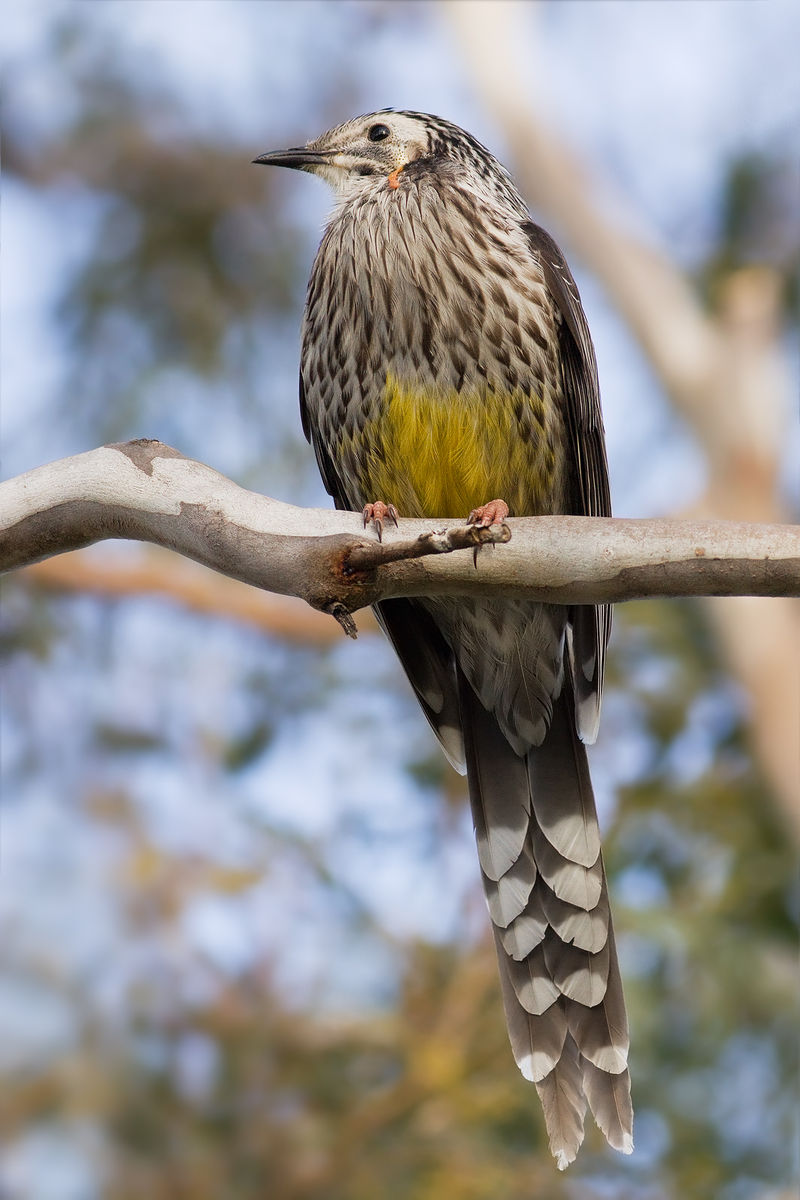
Red Wattlebird (Photo: JJ Harrison, using CC-BY-SA 3.0, via Wikipedia)

Red Wattlebird (Photo: JJ Harrison, using CC-BY-SA 3.0, via Wikipedia)

The three days over which the story takes place happen to be part of stu-vac, but while Wil – good, decent, conscientious law-student Wil – is taking his study seriously, arts student Cec is distracted. She cannot get her questions out of her mind. She has given up bothering Wil about them as he’s tired of her talking about her mother. And yet, grief is like that, particularly grief after unexpected deaths. You talk and mull, and mull and talk, over and over and over.

This brings me to the birds. There is, of course, the wattle bird. Cec calls it the DOIK*, for its sound, or “no-comment bird”, because it seems to be drowned out by other birds, reflecting, presumably, Cec’s feeling of inconsequence.  In another reference to birds, Cec says :

I feel like one of those raggedy birds you see trying to feed their remorseless young. And among the gaping beaks, that one gapes widest. And among the chorus of cheeps, that one cheeps loudest.

The beaks and cheeps are the insistent questions that the bird tries to quieten with answers she’s gathered from others, such as her mother’s friends, her uncle and aunt, and even her counsellor. But they don’t satisfy, so she keeps searching – and eventually comes to her father, a man who had professed to have no interest in her and whom, therefore, she had long ago decided she didn’t want to meet.

Alongside this search for answers, Cec does do the occasional study – and what she’s studying is Malory’s story of King Arthur which is, appropriately enough, a quest story. But, it raises other issues for Cec too, such as how much magic versus Arthur’s “own hands” played in his achievements. I suspect this has something to do with Cec learning that not everything has a clear, logical answer.

While all this is interesting, much of the delight in reading the novel comes from the interactions between characters. They are, generally, exquisite. The often prickly Cec has wonderful exchanges, for example, with her Aunt-by-marriage Gail, her Gran, and her father who tries his best to help her see where her mother may have been coming from. These characters aren’t paragons, but neither are they malign. They are, simply, human. My only quibble with Anderson’s characterisation is that Cec and her friends – all around 19 years old I assume – seem at times a little improbable. How many 19-year-olds – particularly university students – talk about mortgages and the like?

Anyhow, by now you must be wondering about Cec’s mother. Without spoiling anything, there’s nothing to suggest they had a difficult relationship – and the answers to Cec’s questions are probably pretty mundane. The point of the novel is, in other words, not so much Cec’s relationship with her mother but her coming to terms with her grief, her identity, and her relationship with Wil.

This novel is not easily categorised. Part quest, part comedy-of-manners, part family drama, it has some laugh out-loud moments as well as reflective ones. It explores many of the themes common to Anderson’s work. One is money and power. Cec’s family has money – “fruit and veg have been good for us” – and money is used both subtly and not so, as a means of control. Another is deceit and concealment. As the novel progresses, Cec starts to tell Will less and less. At first she justifies it because it’s all too complicated to explain – and he does tend to brush her emotional concerns off –  but, by the third day, there are many things she doesn’t tell him. “I foresee no end to the things I won’t tell Wil”, she says. And another, as the surprising last paragraph makes clear, has to do with the act of creation or, perhaps more correctly, with living life creatively.

One of the wattle birds is a tight, cleverly conceived “concoction” that makes, I’d say, a fitting conclusion to Anderson’s literary life. Has anyone else read it?

Jessica Anderson
One of the wattle birds
Ringwood: Penguin Books, 1994
Cover design: Joanna Hunt
192pp.
ISBN: 9780140240320

*A not very tuneful bird. We have a resident Red Wattlebird in the tree outside our bedroom. It squawks us awake every morning.