Monday musings on Australian literature: Meanjin’s Tournament of Books

Henry Handel Richardson in 1945, a year before...

Henry Handel Richardson, 1945 (Presumed Public Domain. Courtesy: Wikipedia)

Many Monday musings ago I wrote about the reduced visibility of women writers in Australia. I wasn’t the only one concerned and things have been afoot to up the ante for women writers. For example, a new award targeting women writers, the Stella Prize, was announced earlier this year. And now Meanjin, a longstanding literary magazine, is emulating the Morning News’ Tournament of Books (to which a favourite blogger, Hungry like the Woolf, introduced me a couple of years ago) by conducting a tournament comprising books by Australian women writers.

Meanjin describes the tournament as follows:

The way it works is this: 16 books are chosen … and then divided into pairs. A judge is given a pair, reads them both, writes up their decision process and announces which of the pair they deem the better book. That book then progresses into the next match to go up against a winner from a previous round. It’s a sporting tournament for people who don’t like sport.

This year, in light of the discussion around women’s writing and literary prizes, we’ve selected a short list of novels exclusively by Australian women. The list has been chosen by us, and is incomplete, capricious and arbitrary. That’s ok. There’s no way you could do Australian women authors justice in 16 books…

Fair enough … and being this upfront about their selection makes it hard for us to complain, doesn’t it? And really, I wouldn’t want to, because I can’t imagine we’d ever get universal agreement on 16 books, anyhow.

The tournament schedule can be viewed at the Meanjin site so I won’t detail it here, but I will list* the 16 books, partly because it’s a useful list, despite its arbitrariness, for those interested in Aussie women’s lit:

Regular readers of my blog will recognise some of my favourite and oft-mentioned authors here. Interestingly, a couple of young adult/children’s novels (those by Carmody and Marchetta) have been included – one of their “capricious” decisions, perhaps! Not that I have anything against such novels – I thoroughly enjoyed Marchetta’s Looking for Alibrandi – but I wonder whether they have the weight to beat a Stead or an Astley, a Wright or a Jolley, for example. Well, keep reading …

Round 1 results

  • Match 1, Gilgamesh beat The lost dog. Both are interesting books but Gilgamesh is a beautiful one. I would have chosen it too.
  • Match 2, The children’s Bach beat Mr Scobie’s riddle. This is harder. I love The children’s Bach but have not read Mr Scobie’s riddle. I’m not sure it’s the Jolley I’d have chosen … but, oops, I said I wasn’t going to go there, so let me just say that this match is a tricky one – the judge thought so too – and I’m glad I wasn’t asked to call it!
  • Match 3, My brilliant career beat Tirra lirra by the river. Another hard one, but My brilliant career would have to be the sentimental favourite in this pairing. And, anyhow, how could I not agree with a book the judge called “chick-lit amongst the gums” and “Austen in an Akubra with a broad Australian twang and some permanent sun damage”?
  • Match 4, Looking for Alibrandi beat Harp in the south. Interesting decision. A main criterion for the judge seemed to be the ability to stand the test of time … but, but, I argue, Looking for Alibrandi is only 20 years old while Harp in the south has already stood the test of time. And, I’m not sure that Alibrandi reaches adult audiences in the same way that Harp does. Still, perhaps I should read Alibrandi again to be sure.
  • Match 5, The secret river beat A kindness cup. Both good books, and a very hard choice … one the judge clearly found hard too. It seems as though it was Astley’s more dystopian view that was the deciding factor. That seems a bit of a cop out to me!
  • Match 6, The man who loved children beat Obernewtyn. Now this must surely have been a no-brainer and the judge agrees, explaining why they were (mis)matched in the first place. I’ll say no more.
  • Match 7, The fortunes of Richard Mahony beat Of a boy. Another pretty obvious choice, really. While I do think a short novel or novella can beat a hefty tome, this is probably not the hefty tome to be up against!
  • Match 8, The world beneath beat Carpentaria. Now this does surprise me. The latter won the Miles Franklin award while The world beneath was not shortlisted. I don’t think we should give excessive credence to awards but it seems the judge gave the match to The world beneath because he found Carpentaria “difficult”. Is this fair or right, I cry into cyberspace? No, but at least the judge admits to being “covered in the stench of subjectivity”, so all one can do is vote Carpentaria back in the zombie round.

Plot, humour  and readability seemed high on the various judges’ agendas. They would not be my top criteria but, as this tournament is mainly about promotion of women writers and having some fun, I’ll say no more, except that I’ll report again on the tournament after the second round has been played …

* The two linked titles are to reviews on this blog. I’ve read many of the books listed, but mostly long before I started this blog.

Monday musings on Australian literature: Ada Cambridge

Photograph of Ada Cambridge by Spencer Shier c...

Ada Cambridge, c. 1920, by Spencer Shier (Public domain, from National Library of Australia, via Wikipedia)

It’s time, methinks, for another Monday Musings post highlighting a specific writer – and this time I’ve chosen Ada Cambridge. I discovered Cambridge back in the late 1980s when there was a resurgence (in Australia anyhow) in recognition of women writers. What was great about this resurgence was that it not only saw increased publication of contemporary women writers, but also the republication of past writers. I sussed out and read quite a few of these older, oft-forgotten writers, including, obviously, Ada Cambridge (1844-1926) who was, in fact, one of Australia’s best-known writers in her time.

She was a fascinating woman. Born in England, she married the Reverend George Cross in 1870 and a few weeks later emigrated with him to Australia for his work. They lived in several towns in Victoria until 1913 when they returned to England. Cambridge came back to Australia in 1917, on Cross’s death, and remained here for the rest of her life. Like many clergymen’s wives she worked hard supporting her husband. She suffered her share of sadness, including losing children to illness, and shocked her husband by writing of her experience of religious doubt and marital trials.

Cambridge was a prolific writer but, as is the common lot of women writers, her role as wife and mother came first. She wrote in her memoir*, Thirty years in Australia, that “housework has all along been the business of life; novels have been squeezed into the odd times” and in those days housework was far more onerous than it is today. She must have been a wonderful time manager! I have read only two of her novels: A woman’s friendship (1889), which was published as part of the Colonial Texts series edited by, surprisingly, the Australian Defence Force Academy, and Sisters (1904), which was published by Penguin in their Penguin Australian Women’s Library series.

While Cambridge’s first writings were religious in nature, she moved on to tackle more controversial subjects, particularly relating to women and their relationships. It’s many years since I read these two books but I remember my surprise at their content. These are not traditional women’s romantic novels. They confront, instead, the dual constraints women faced in terms of class and gender, particularly regarding the desire for independence and the physical and intellectual impositions of marriage.

A woman’s friendship explores the friendship that develops between two women (both married, one to a journalist and the other to a squatter) and a man through The Reform Club, of which they are the only members. It toys with the fine balance between marital responsibility, sexual attraction and the desire for intellectual companionship – and Cambridge is pretty up-front about the sexual tensions and jealousies that can lie just below the surface of friendships like this. Pretty interesting stuff for that time – and it makes me think a little of Edith Wharton. However, I think Wharton focused more on the notion of entrapment and was rather bitter, whereas Cambridge was more pragmatic about human nature and consequently less tragic.

In Sisters, according to the notes on the back of my edition, Ada Cambridge “dispenses with conventional romantic notions about marriage”. And this, as I recollect, is pretty right. She explores the marriage fortunes (or misfortunes) of four well-to-do sisters – what they decide (do they marry for love, for money, or not at all) and the implications of their decisions. Cambridge is unsentimental (cynical even) about the idea of “happily ever after” showing rather that “I do” is just the beginning. Indeed, as Cambridge writes of one lover who doesn’t win his girl:

He did not know what a highly favoured mortal he really was, in that his beautiful love story was never to be spoiled by a happy ending.

I couldn’t resist quoting that, but it doesn’t represent the totality of Cambridge’s attitude to marriage. A review from The Argus, in 1907, of a later novel, A happy marriage, suggests:

Mrs Cross [aka Ada Cambridge] apparently is no idealist in the matter of marriage. She looks for disillusionment and expects differences of opinion. But she recognises the possibility of ultimate happiness in spite of some incompatibility. Perhaps after all, this is the wisest view and it is more wholesome not to glorify what is not infrequently inglorious. It is, besides, the highest optimism to be able to forecast a happy future from an unhappy present. In any case our authoress is quite impartial in her distribution of blame and very sane in her judgments of men and women.

Cambridge was, for me, a wonderful find … and one day I’ll read more of her work. Meanwhile, if you’d like to read her, you can access some of her work (particularly Sisters) at the following websites:

* As reported in The Sydney Morning Herald, 31 July 1926.

Monday musings on Australian literature: Are short stories on the rise?

Today I’ll dip my toes into the muddy waters that comprise short stories. Regular readers of this blog know that I’m rather partial to short stories. Why, I wonder, are they still pretty much the second class citizen of the literary world? Marion Halligan said, on the release of her latest collection, Shooting the fox, that her agent’s initial reaction to receiving the collection was:

Oh, Marion, short stories?

Marion says, though, that while publishers have traditionally not liked short stories, “they may be changing their minds”.

And so, today, I’ll talk a little about short stories. I’ve wanted to write on them for a while but the subject is so vast I’ve kept putting it off. Should I talk about short story awards? Or favourite short stories? Or favourite short story writers? Or collections? Or? I will probably visit some of those topics in future posts, but today I’ll just talk a little about Halligan’s belief (or is it simply hope) that “they may be changing their minds”.

Is there any evidence? Well, there may be (though I don’t have the statistics to prove that what I say here represents real change or just a continuation of the status quo).

Short story collections

There have been some critically successful collections of short stories published in recent years, of which the best known is probably Nam Le‘s The boat. It’s a beautifully diverse and accomplished collection which I read not long before I started this blog. Not only was it was shortlisted for awards, but it won some significant ones, that is, it won awards that were not specifically targeted to short stories, including, in 2009, the Prime Minister’ Literary Award for fiction and the New South Wales Premier’s Literary Awards Book of the Year. Tim Winton’s collection of somewhat connected short stories, The turning, won the New South Wales Premier’s Christina Stead Prize for Fiction in 2005. But then, Helen Garner won for Postcards from Surfers in 1986, and Beverley Farmer for Milk in 1984. So, is there anything new to celebrate? Perhaps, because the exciting thing about Nam Le is that The boat is his first book … a first book of short stories that won major awards! Change afoot? Or an anomaly?

Irma Gold in an article on short stories in Overland suggests that more short story collections are being shortlisted for awards, and cites this year’s Queensland Premier’s Literary Awards as evidence. She also notes that the publishers of these shortlisted works are mostly small – Black Inc, Salt Publishing, Black Pepper and Affirm Press. Are small publishers the only ones willing to take a risk on short story collections – like Affirm Press’s gorgeous Long Story Shorts – by emerging and lesser known writers? Whatever the answer, thank goodness for small publishers!

Short story anthologies

Short stories continue to be published in literary magazines, large and small, but their success as a genre feels (rightly or wrongly) more solid if they are published in books which readers are willing to buy. And there does seem to be quite a lot (my best scientific measure) of anthologies being published.

There are annual editions by such (small, again) publishers as Black Inc, Scribe (which has done two anthologies now) and the Griffith Review. In her Editor’s Note for Scribe’s New Australian Stories 2 , Aviva Tuffield writes:

Those dwindling opportunities for single-author collections concern me, both as an editor and as a reader. Many of the foremost novelists in Australia today – Gail Jones, Kate Grenville, Peter Carey, Joan London, Peter Goldsworthy – began their publishing career with story collections, but this trajectory no longer seems available. Yet short stories are vital training grounds for our writers …

Two points. First, Tuffield doesn’t seem to agree with Halligan that things might be changing, and second, are short stories only to be valued as “a training ground”? If that’s how we see them, then they will remain second-class citizens – won’t they? I suspect Tuffield does like short stories in themselves too … but I wonder whether this “training ground” idea is held by many readers?

Then there are anthologies compiled by an editor, often on a theme, such as Families (ed. Barry Oakley, 2008, in Five Mile Press’s series of “topic” oriented short story collections) and Brothers and sisters (ed. Charlotte Wood, 2009). These anthologies are (I’m guessing) the bread and butter of short story publishing: they are clearly easier to market. They have been around for a long time (and I’ve read many over the years), but they tend, in my experience, to focus on works by established writers (and often, though not always, use stories previously written and published). Good stories, usually, and good reading, but probably a less useful indicator of the health of short story writing and publishing in Australia.

So, where does all this leave me (us)? Nowhere, really, I think, in terms of resolving whether Halligan is right or not – but at least I have finally written a post on short stories. There will be more.

In the meantime, what do you think of short stories and their health (here or in your country)?

Monday musings on Australian literature: Australian literary couples

Elizabeth Barrett Browning and Robert Browning

Elizabeth Barrett and Robert Browning (Unknown date and photographer, Public Domain, via Wikipedia)

Are you fascinated, like I am, by literary couples? It seems so romantic to share one’s calling with another … even if the reality is not always as idyllic or as successful as it sounds. We’ve all heard of Robert and Elizabeth Barrett Browning, Ted Hughes and Sylvia Plath, Virginia and Leonard Woolf, to name just a few famous couples. I’m guessing, though, that not many have heard of our Australian couples, but we do have them – and so this week I’m sharing five (from the past) with you.

Vance (1885-1959) and Nettie Palmer (1885-1964)

While Vance and Nettie Palmer are not particularly well-known now (at least to the best of my knowledge), they were extremely significant in their heyday, the 1920s-1950s, as writers, as proponents of Australian literature and as mentors for younger writers. Nettie in particular corresponded with and supported many women writers, including Marjorie Barnard (1897-1987) and Flora Eldershaw (1897-1956). They were literary critics and essayists. Vance was also a novelist (I read his The passage many moons ago) and dramatist, while Nettie was also a poet. They were political – egalitarian, anti-Fascist, and tarred, as were many back then, with the “Communist” brush! Their relationship seems to have been a productive and supportive one.

George Johnston (1912-1970) and Charmian Clift (1923-1969)

This is one of those troubled pairings, and it ended in the suicide of Charmian when she was not quite 46. They met in Australia, lived together in England and Greece (where they tried to live on their writing), before returning to Australia with their three children in 1964. Johnston wrote the highly successful My brother Jack, which some see as a contender for the Great Australian Novel and which is the first in a semi-autobiographical trilogy. Charmian wrote two successful autobiographies, Mermaid singing and Peel me a lotus. Both wrote much more across a wide spectrum: novels, essays and other journalistic pieces, short stories, and so on. Theirs was, in the end, one of the more self-destructive rather than mutually supportive relationships. Sad.

Ruth Park (1917-2010) and D’Arcy Niland (1917-1967)

Ruth Park (born in New Zealand) and D’Arcy Niland were more than a literary couple. They created a literary family, with two of their five children, twin daughters Deborah and Kilmeny, becoming successful children’s book writers and illustrators. I have written about Ruth Park before. She and D’Arcy worked as free-lance writers and shared a concern in their writings for the battlers in Australia. They worked hard to survive on their writing, turning their hands to a wide range of forms and genres, including novels, short stories, plays and journalistic pieces. They were, like the Palmers, a successful and happy couple until D’Arcy’s early death.

Rosemary Dobson (b. 1920) and Alec Bolton (1926-1996)

Rosemary and Alec were a little different from the other couples I’ve chosen to discuss here, but I’ve chosen them because they lived in my city, and I (ta-da) met and worked for a few years in the office next door to Alec. Rosemary Dobson is a significant Australian poet who associated with other major Australian poets like A. D. Hope and David Campbell. She has published around 14 volumes of poetry, edited anthologies, and translated poetry from French and Russian. Her husband was not so much a writer as a publisher. According to the AustLit* website he “was a creative force in Australian publishing for almost half a century. After his war service he worked as an editor for Angus & Robertson and Ure Smith before establishing the publishing program at the National Library of Australia”. He established one of those wonderful small presses, Brindabella Press, in 1972 while still working at the Library, and then continued working on it after his retirement. It was a labour of love, and among the authors he published was, of course, his wife!

Dorothy Porter (1954-2008) and Andrea Goldsmith (b. 1950)

Dorothy Porter, whose last book The bee hut I have reviewed here, is (was) another Australian poet. She lived with her partner, the novelist Andrea Goldsmith, for 17 years before she died through cancer in 2008. Goldsmith, whose latest novel The reunion I’ve also reviewed here, said in an interview after Porter’s death that “I’ve always loved Dot’s work – indeed I fell for the poetry before I fell for the poet”. Porter, who also wrote several verse novels, was more prolific than Goldsmith, but both produced well-regarded work during the course of their relationship. Another productive and successful pairing.

Some time ago I read an article about literary couples and the challenges they face: financial (supporting themselves from writing), space (finding room for each to write), and the big one, jealousy or competitiveness. I’m impressed that, despite such issues, four of the five couples I’ve described seem to have been remarkably successful – and this is beautifully exemplified by Ruth Park’s words at the end of her autobiography, Fence around the cuckoo:

We lived together for twenty-five years less five weeks. We had many fiery disagreements but no quarrels, a great deal of shared and companionable literary work, and much love and constancy. Most of all I like to remember the laughter.

After sharing five children and a rather insecure career, that’s pretty impressive.

I’d love to hear about other literary couples – Australian or otherwise, past or present – that you have come across.

* I have not provided a link to this site since most of its content is available by subscription only.

Monday musings on Australian literature: Writers from Victoria

Coat of Arms of Victoria (Australia)

Victoria's Coat of Arms (Presumed Public Domain, via Wikipedia)

Over the course of these Monday musings have been occasional posts on writers from specific geographic locations in Australia – but I have not done our two most populous regions, the states of Victoria and New South Wales. The time has come to confront there two – and so, today, I present you Victoria.

Now Victoria is a special state – not only does Mr Gums Jr live there, but its capital Melbourne was the second city to be designated as a UNESCO City of Literature! That’s a pretty impressive achievement. I have written some literary road posts on Victoria, which have mostly focused on writers and works from the past, so in this post I will, as I have done in other regional posts, list (in no particular order) five of my favourite current writers from Victoria – some were born there, some migrated there.

Helen Garner

Garner is one of our most controversial writers – and has been, really, since the publication of her first novel, Monkey Grip, which some critics argued was simply her writing her own life. They meant by this that it had no creative merit, no literary value. This didn’t deter our Helen though, and she has gone on to become one of our significant writers – of both fiction and non-fiction. She has also written some successful screenplays. She writes about relationships and the things that cause disconnects between people, no matter how much they wish it might not be so. As regular readers of this blog will know, I don’t always agree with Garner, but I am always happy to read her because the woman has style. I’ve read too many of hers to list here, but if you’d like a recommendation, please ask!

Elliot Perlman

You may not have heard of Perlman, particularly if you are not Australian, because he is not particularly prolific. The first novel of his that I read was the multiple point of view Seven types of ambiguity (which makes a sly reference to literary theorist William Empson‘s book of the same name). It’s a good, thoughtful book about love and obsession, and the ambiguities therein! I then read Three dollars which explores the question of what happens “when bad things happen to good people” and how consumerism challenges (compromises) our values. It was adapted for film, starring the gorgeous David Wenham (aka Diver Dan if you are a Sea Change fan). Both these novels are set in Melbourne. According to Wikipedia he has a third novel out this year.

Arnold Zable

If you have been reading this blog recently, Arnold Zable will need no introduction. His focus is human rights, with a particular interest in the migrant experience. I’ve read two of his novels – Cafe Scheherazade and The sea of many returns – and will happily read more. His prose is lovely, his attitude warm and generous. I’m looking forward to reading his new novel, Violin lessons.

Beverley Farmer

I’m going to throw in a somewhat forgotten, I think, writer here. Way back in 1988 when my reading group started, we focussed on Australian writers, particularly Australian women writers. One of those was Beverley Farmer. We read her collection of short stories Milk and not long after I also read her second collection of short stories, Home time. Both these were published in the 1980s. She has also written novels, and one of those writers’ notebooks, A body of water, in which she documented her ideas and thoughts over a year, the books she was reading, the people she met. I was drawn to her because of the evocative way she conveyed her experience of being a young Australian wife in a Greek village. Like Perlman, she’s not prolific, but in 2009 she was awarded the Patrick White Award (for writers who “have made a substantial contribution to Australian literature but … may not have received adequate recognition for their work”) which says something about the quality of her work.

Peter Carey

I’ll conclude on another controversial writer. People, it seems, either love him or hate him – and I fall more in the first camp. He is one of only two writers to have won the Booker Prize twice. I have by no means read all of his books but I like the fact that he takes risks in his writing. I think his Oscar and Lucinda is a worthy contender for the Great Australian Novel (should we take that notion seriously). His True history of the Kelly Gang makes a significant contribution to the Ned Kelly myth by attempting to tell the story in Kelly’s voice. It is not all “true” in the factual sense, but it contains a “truth” that Carey thought worth exploring. His most recent novel, Parrot and Olivier in Americatook more risks – in voice and subject matter. Carey, as many of you will know, now lives in New York, but he was born in Victoria – and that’s good enough for this post!

So there you are, five Victorian writers. Now’s your chance to tell me what Victorian writers you like – or simply whether the writers I’ve listed here interest you.

Monday musings on Australian literature: Japanese poetry in Australia

Engraved writings by Suiin Emi, Onomichi

Haiku by Suiin Emi, along the Path of Literature in Onimichi, Japan

Papa Gums loves to give me clippings of obituaries that he knows will interest me. Last week, from his hospital bed, he gave me one for an Australian poet I’d never heard of, Janice Bostock. She was, according to the obituary in the Sydney Morning Herald, “one of Australia’s leading writers of Japanese poetic forms”, and won awards here and overseas. She particularly loved haiku.

Haiku, I must say, was the only form of Japanese poetry I had heard of until my first trip to Japan in 2006 when, on the railway station of our son’s tiny town of Tsugawa, we met an ex-teacher at his school who was heading off to her annual tanka conference. Tanka? Well, we discovered that tanka is an older Japanese verse form than haiku, and its basic structure is 5-7-5-7-7 “onji” (which we roughly translate to “syllables”). I guess most people reading this blog will know that haiku’s structure is 5-7-5. And here endeth the lesson on Japanese verse forms because the story is far more complicated than I’ve presented here, both in terms of these forms and other forms I haven’t mentioned. You can Google if you want to know more!

Bostock, who is briefly mentioned in the Wikipedia article on haiku in English, described haiku as “one-breath poems”, meaning that each poem “spans the length of one breath”. She also, and this was another new thing to me, practised a variation of haiku called “one line haiku”. Here is one quoted in her obituary:

no money for the busker I try not to listen

The obituary says that Bostock created the market for haiku in Australia by founding a journal called Tweed. She also wrote – and this of course appeals to me – The gum tree conversations. This was a series of articles aimed at showing “the relevance of haiku to the Australian landscape and experience”. Eventually her work led to the foundation of the Australian Haiku Society in 2000, of which she was patron at the time of her death. She was clearly a busy, engaged and passionate woman.

And so, haiku is alive and well in Australia … and it seems appropriately so. John Bird, who co-edited The first Australian Haiku Anthology with Bostock, has described haiku as follows: “a brief poem, built on sensory images from the environment. It evokes an insight into our world and its peoples.” As I understand it, haiku tends to involve the juxtaposition of two ideas or images in a way that a relationship is drawn between them. Australia, with its stark, dramatic environment, its odd vegetation and its strange creatures, must provide excellent subject matter for this sort of writing. Here is an Aussie haiku by E.A. Horne:

Brown paddock
Brown sheep
Blue bloody sky.

You can feel the pain of a farmer facing drought! It’s from an article first published in 2006 in the Australian poetry magazine, Five bells. Reeves, the author, says that “Contemporary haiku rarely consist of 17 syllables, may be written in one to four lines, and don’t have to be about the seasons. What they seek to retain is the brevity, clarity, immediacy and resonance of Japanese haiku and to record and share a moment of seeing”. I’m no expert in haiku, but it’s a form that appeals to me – because of this brevity that gives rise to a spareness, an attempt to pare to the essence of a thing. There’s no opportunity in haiku for effusive or loquacious explorations!

Tanka poems show a similar restraint and so, because it’s nicely appropriate, I’ll conclude with one of those:

our front yard gum
grown from a sapling
to a giant –
all those black cockatoos
fair exchange for a lawn

(Michael Thorley, Eucalypt Issue 1, 2006)

Are you familiar with – and do you like – these tiny poetic forms?

Monday musings on Australian literature: Late bloomers

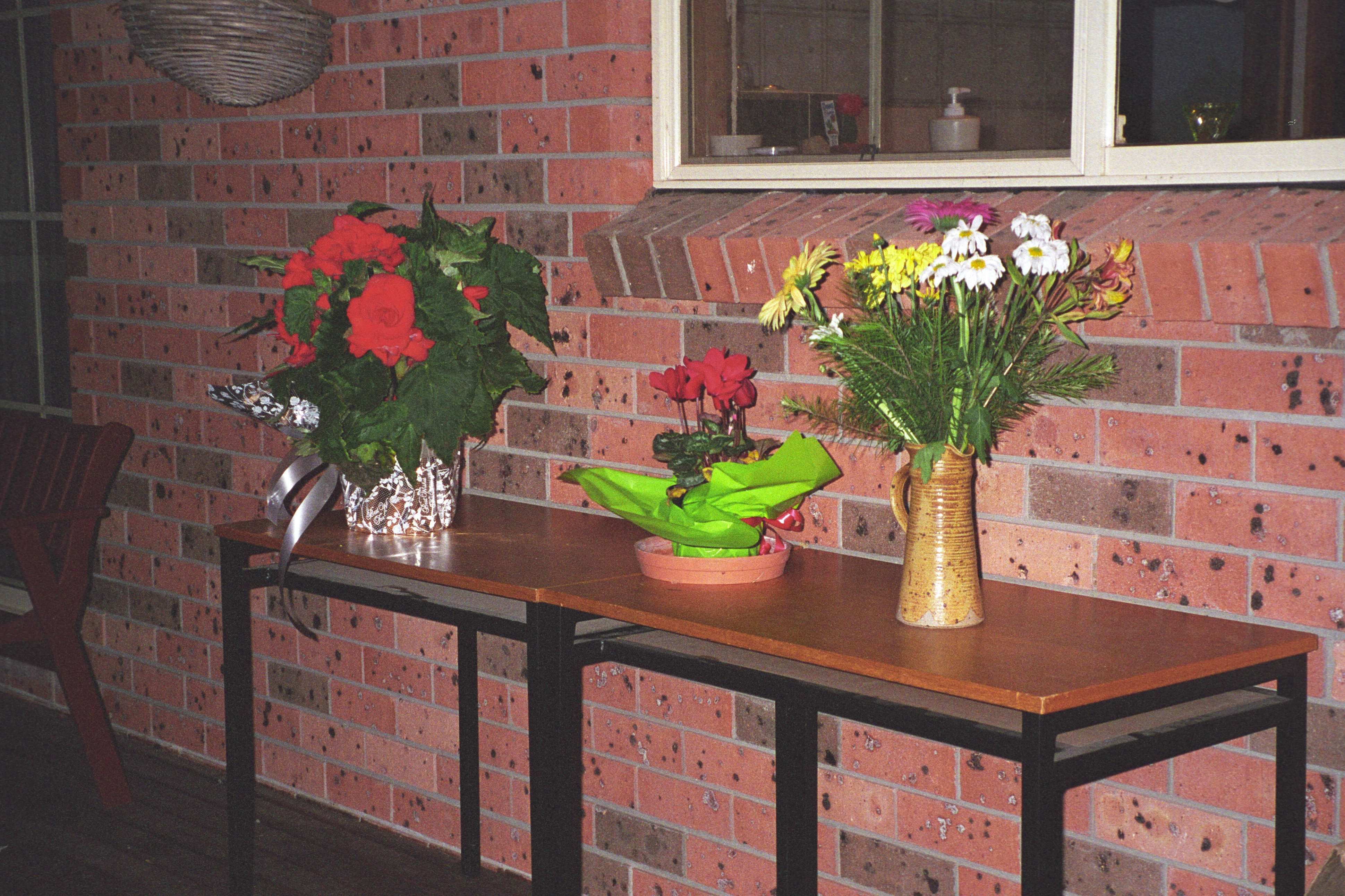
Bloomers (Flowers in vases and pots)

Bloomin' bloomers

I guess every country has them, the writers who aren’t recognised until their middle age. Australia certainly does, and many of them seem to be women. I’m not sure whether this apparent gender imbalance is a fact or simply reflects my biased interest in the lives of women writers. I wouldn’t be surprised if it were a fact, though, given that women often need to balance motherhood and wifehood with the rest of their lives. Anyhow, I thought I’d share five of my favourite late Australian bloomers. They are mostly my usual suspects and, like many people who seem to appear overnight, they  worked for a long time at their craft before they gained their much deserved recognition. I’m listing them in the order of their age when their first major writing was published.

Jessica Anderson (47, An ordinary lunacy in 1963)

Jessica Anderson wrote stories and plays, and adapted other works for radio before hitting big time with her novel An ordinary lunacy. I’ve only read two of hers – Tirra lirra by the river and her one piece of historical fiction, The commandant, which I reviewed last year. I have her last novel, One of the wattle birds, in my burgeoning TBR pile. Like many women writers, I suppose, her subject matter tends to be families. Even The commandant, which is ostensibly about the male head of the Norfolk Island penal colony, is really about the family relationships, and the reaction of the women (his wife and sister-in-law) to their circumstances in particular. According to Wikipedia, Tirra Lirra by the river, was reviewed well in the USA.

Marion Halligan (47, Self possession in 1987)

Marion Halligan was a member of the now legendary Canberra Seven or Seven Writers, a group of Canberra-based women writers who met regularly to read and discuss each other’s work. The group comprised: Dorothy Johnston, Margaret Barbalet, Sara Dowse, Suzanne Edgar, Marian Eldridge, Dorothy Horsfield and Marion Halligan . In 1988, Australia’s Bicentennial Year, they published an anthology titled Canberra Tales. It made quite a splash on the literary scene at the time. Halligan had just published her first novel then, but the first of hers that I read was Lovers’ knots which won several awards. I have gone on to read several of her novels, including the gorgeous Valley of Grace which I reviewed last year. Halligan wrote one of my favourite quotes about reading: “Read a wise book and lay its balm on your soul”. Really, how beautiful is that!

Elizabeth Jolley (53, Five acre virgin and other stories in 1976)

Jolley was the subject of my second favourite writers post. She began writing in her twenties, and did have individual short stories published in the 1960s, but she also suffered rejection after rejection after rejection. However, she kept on and became a much lauded novelist, and a successful creative writing teacher. After all, Tim Winton was one of her students! She is recorded as saying that her eventual success was partly due to “the 1980s awareness of ‘women’s writing'”, an awareness that I fear we have lost again! Anyhow, she made up for lost time, and published 15 novels in about 20 years, as well as short story collections. I’ve read half of the novels and love the way she gets into the dark parts of our souls, into those areas where we feel alone or alienated, while being funny (albeit in a black way) at the same time.

Amy Witting (59, The visit in 1977)

Amy Witting is probably the least well-known of the five I’ve listed here. Her real name was Joan Austral Fraser. According to Wikipedia she met Thea Astley when they both taught at the same school and Astley encouraged her to submit a story for publication. It was published in The New Yorker in 1965, but it would be 12 more years before her first novel was published. I’ve read two of her novels, I for Isobel and A change in the lighting, and would happily read more. Again she deals with families, and often with the challenges middle-aged and older women face in navigating a society which is not necessarily friendly to them. She also published several collections of short stories.

Olga Masters (63, Home girls short stories in 1982)

Olga Masters was a journalist for a long time before she finally had a novel published. She was also mother to seven children, many of whom are well-known in their various fields (but you can read about all that at Wikipedia). She died in 1986, just four years after her book was published, and so her output was small, just a few novels and a couple of short story collections. Her first novel Loving daughters is still vivid in my mind, though I read it over twenty years ago. It’s set in a small coastal town in New South Wales in the 1920s and is about two sisters of marriageable age, Enid the pragmatic home-maker, and Una, the romantic, restless one. Which one will catch the eligible clergyman who comes into town, and does he make the right choice? It’s a wonderful book about character and choice. As you’ve probably assumed, she too focused primarily on the domestic. I can’t help thinking that this focus is another reason why women writers found (find, in fact) it hard to be published.

There is of course something reassuring about late bloomers. They remind us it is never too late. It may be too late at 50 years old to represent your country in the sprint at the Olympics or win Wimbledon, but it’s not too late to write a novel if that’s your passion. I’d love to hear of late bloomers you love (yourself maybe?), Australian or otherwise.

Monday musings on Australian literature: Bookseller turns publisher

Book Stack

Books anyone? (Courtesy: OCAL, from clker.com)

Bookseller-as-publisher (and vice versa) is not an original idea but, in our digital environment with its plethora of production and distribution technologies, this combination clearly offers new possibilities – one that the Australian bookchain, Dymocks, has announced it is going to try. Its aim? To “support Australians with stories to tell” … and, of course, “grow the book industry”.

Dymocks is calling its new publishing arm D Publishing. (Original eh?) Chief executive Don Grover said they do not see it

as building an operation to compete with standard publishers, and he said the systems and service it offered would separate it from other self-publishing companies.

These services include “editing, design, production and printing of finished books”. It’s not, in other words, big-end-of-town publishing, nor is it exactly self-publishing, but something in between …

The service is expected to start in October. According to the news report in Bookseller and Publisher, it is web-based and will work like this. Writers will:

  • upload their manuscript online
  • choose features for their book, including cover design, editing and typesetting
  • decide how to publish: print version using a print-on-demand option and/or e-book

It’s not clear how much input there’ll be from experts in, for example, this editing and design aspect. And there is a bit of a catch. Distribution. Grover does not guarantee that books published through this arm will be sold by Dymocks, and sees it all still as a bit of a work in progress:

It’s something that will evolve over time [and] will start as a tool for people who have a story to tell. As far as distribution is concerned we will wait to see what the market brings forward.

So, what say you? It all depends on the economics, of course, but I can see possibilities for local authors publishing local histories for their communities, family historians producing family histories, schools and local writers’ groups producing collections of writing … as well as of course the novelist or poet (or other writer) trying to break into the market. It sounds exciting but history tells us that it’s not that easy. To what extent will this new model with its more immediate technology make the whole business of getting your story out there easier? Time will, I suppose, tell.

For more on this, read blogger Megan Burke who got to talk to Grover and ask him some questions.

Monday musings on Australian literature: Project Gutenberg Australia

I don’t imagine Project Gutenberg needs any introduction to bloggers and blog readers, but I’m not sure how many are aware of the Australian sister site, Project Gutenberg Australia. This site is not formally connected with the original Project Gutenberg but, like the original, it provides access to international texts that are in public domain – specifically, in public domain in Australia. This means you’ll find George Orwell‘s Animal farm here, F Scott Fitzgerald’s The great Gatsby, and so on. But, due to different copyright legislations (prior to the US-Australia Free Trade Agreement), it also means that you’ll find some texts not yet available via Project Gutenberg, such as Margaret Mitchell’s Gone with the wind,.

However, Project Gutenberg Australia’s main value is that it provides an entrée to Australian material, through various pages (sections) which organise the content by subject/type. One of these sections is the Library of Australiana containing:

ebooks by Australian writers, or books about Australia. There is a diverse range; from the journals of the land and sea explorers; to the early accounts of white settlement in Australia; to the fiction of ‘Banjo’ Paterson, Henry Lawson and many other Australian writers.

It is an excellent resource.  Some of the explorers whose journals are available include Gregory Blaxland (who, with Wentworth and Lawson, found a way over the mountains west of Sydney in 1813), William Bligh (famous, or is it infamous, for the Mutiny on the Bounty), and James Cook (who claimed our Great South Land for England back in 1770).

But, my main reason for writing this post today is that for readers here who find it hard to locate classic Australian fiction it’s a treasure trove. Some of the writers and works available are:

Coastal view south of Bermagui

South of Bermagui

The Library of Australiana also includes books by foreign authors but set in Australia, such as DH Lawrence‘s Kangaroo. Lawrence completed this novel while living in Thirroul, on the south coast of New South Wales. This is the coast nearest to my inland city, so I’ll conclude with an excerpt from another foreign writer on this coast, Zane Grey:  

It seems, as the years go by, that every camp I pitch in places far from home grows more beautiful and romantic. The setting of the one at Bermagui bore this out in the extreme. From the village a gradual ascent up a green wooded slope led to a jutting promontory that opened out above the sea. The bluff was bold and precipitous. A ragged rock-bound shoreline was never quiet. At all times I seemed aware of the insatiate crawling sea. The waves broke with a thundering crash and roar, and the swells roared to seething ruin upon the rocks. Looking north across a wide blue bay, we could see a long white beach. And behind it dense green forest, “bush,” leading to a bold mountain range, and the dim calling purple of interior Australia. (American angler in Australia)

Grey captures perfectly the reason I, whose preference is for mountains over coasts and who has no interest in fishing, love the south coast. It’s beautiful. And so is Project Gutenberg Australia (in function, if not in look!). Try it next time you are looking for something Australian that is in public domain. There’s a good chance you’ll find it.

Monday musings on Australian literature: Reading about Australian women writers

Books about Australian women writers

Some favourite books about Aussie women writers

In the 1980s my interest in Australian literature, which had been initially kindled by my parents and school, was renewed.  In the 1980s, too, women writers started to flourish again. Consequently, this second wave interest of mine was drawn particularly to these women.

I read their books of course (I’m thinking particularly of Elizabeth Jolley, Olga Masters, Beverley Farmer, Jessica Anderson, Thea Astley, Kate Grenville and Helen Garner), I attended talks where I could, and I read books about them and their predecessors. I loved the books about them! Not all of these books will still be available for purchase but they will be in libraries (in Oz anyhow) and so I thought this week I’d share some of my favourites, listed in their order of publication.

  • Drusilla Modjeska‘s Exiles at home: Australian women writers 1925-1945 (1981) is the one I don’t have, but I have borrowed it a few times from the library. She looks at the challenges confronting the women writing in the earlier part of the twentieth century. I have reviewed and/or mentioned a few of these women in past posts. They include: Miles Franklin,  Marjorie Barnard and Flora Eldershaw (who also wrote jointly under the name M. Barnard Eldershaw), Eleanor Dark, Jean Devanny, Dymphna Cusack and Katharine Susannah Prichard. Most of these women were politically engaged, with Prichard (for one) specifically identifying herself as Communist.
  • Jennifer Ellison’s Rooms of their own (1986) which of course takes its title from Virginia Woolf’s wonderful, pleading book on behalf of women creators. This book comprises interviews Ellison conducted with significant writers at the time. I still dip into it every now and then. She interviews: Blanche d’Alpuget, Jessica Anderson, Thea Astley, Jean Bedford, Sara Dowse, Beverley Farmer, Helen Garner, Kate Grenville, Elizabeth Jolley, Gabrielle Lord, Olga Masters, and Georgia Savage. Naturally, the gender issue is explored, but other issues relating to writing, publishing and the role of writers in society are also discussed.
  • Debra Adelaide‘s A bright and fiery troop: Australian women writers of the nineteenth century (1988). The great thing about this book is that it shows us the depth of women’s writing in Australia. It comprises essays by literary experts, most dealing with specific writers like Louisa Atkinson, Catherine Helen Spence and Ada Cambridge. It also includes an essay by Elizabeth Webby on nineteenth century women poets.
  • Debra Adelaide’s Australian women writers: a bibliographic guide (1988) was published, appropriately, by Pandora Press. It’s the driest of the books I’m listing as it is a bibliography – but it is lightly annotated with a brief description of each writer. In the mid 2000s, I used this book to help populate Wikipedia’s listing of Australian women writers. I thank Debra Adelaide for making that task so easy!
  • Gillian Whitlock’s Eight voices of the eighties: Stories, journalism and criticism by Australian women writers (1989). This one is, really, an anthology of selected writings by the writers included but there’s a good  introductory essay and a brief introduction to each of the writers. The writers are, well, pretty much the usual suspects: Kate Grenville, Elizabeth Jolley, Barbara Hanrahan, Jessica Anderson, Beverley Farmer, Thea Astley, and Helen Garner. In her introduction, Whitlock quotes Jolley as describing the 1980s as “a moment of glory” for the woman writer, a time when as Whitlock writes, “women writers and readers … entered the mainstream”. What a shame it is that in terms of writers, at least, things seem to have slipped backwards (yet again).

There are more books and bibliographies on the topic – many dealing with individual writers. Just do a Trove (National Library of Australia) search on “Women authors, Australian” or “Australian Literature – Women authors” or similar keywords and you’ll retrieve a goodly list. Meanwhile, the books keep coming. The most recent addition to my little collection is Susan Sheridan’s Nine lives which was published this year and covers post-war writing by women in AustraliaI haven’t read it all yet but you will probably see a review in the future.

Do you like to read about writers and writing, and if so do you have any favourites?