Monday musings on Australian literature: Coming up in 2013

In a first for Whispering Gums, I have decided to post about coming attractions. It seemed an appropriate first Monday Musings for the year. But, how to do it? As I can’t possibly list them all, I’m going to make a selection and group them in sets that make sense to me. So here, as you’ve heard me say before, goes. Remember, this is just a selection reflecting the sorts of books I’d like to read. Whether or not I actually manage to read them all is another thing entirely.

John Maxwell Coetzee

Coetzee, 2006 (Courtesy: Mariusz Kubik, via Wikipedia)

Fiction from authors I’ve read before

  • J.M. Coetzee, The childhood of Jesus (March 2013 from Text Publishing): It’s been over 5 years since Coetzee’s last piece of fiction, Diary of a bad year (my review). I look forward to seeing whether Coetzee plays further with the novelistic form, as he has in recent outings, in this new offering.
  • Richard Flanagan, The narrow road to the deep north (August 2013 from Random House): Similarly it’s been over 4 years since Flanagan’s Wanting (which I read before starting this blog). This new novel, I gather, moves from Australia where his previous novels have been set to the Burma-Siam death camps.
  • Andrea Goldsmith, The memory trap (May 2013 from Fourth Estate): Goldsmith’s last novel Reunion (my review) was not my favourite Goldsmith, but she’s well worth watching.
  • Joan London (November 2013 from Random House): I don’t know the title of London’s next book, but I can’t wait to see it, as her Gilgamesh (which I virtually gifted to Stu) is one of my favourite Australian novels. My review of her most recent novel, The good parents (2008), was one of my first reviews on this blog.
  • Alexis Wright, The swan book (August 2013 from Giramondo): It’s been nearly 7 years since Indigenous author Wright’s last novel, Carpentaria (my review). It won the Miles Franklin award in 2007 so a new one from her is long-awaited.

Fiction from authors I’ve been meaning to read

  • Georgia Blain, The secret lives of men (April 2013 from Scribe): A collection of short stories and you know how I like short stories.
  • Fiona Capp, Gotland (July 2013 from Fourth Estate): Apparently about a reluctant Prime Minister’s wife, but this article written by Capp in 2009 might throw some light on the title.
  • Steven Carroll, A world of other people (May 2013 Fourth Estate): A Miles Franklin Award winning author I haven’t read. Boo me!
  • Robert Gott, The holiday murders (February 2013 from Scribe): OK, I’m lying with this one. Gott is not an author I’ve been meaning to read. In fact, I’d never heard of him. He has written children’s books, crime (not my genre), and a newspaper cartoon. Why then you are probably asking am I including him? Well, he, like PL Travers of Mary Poppins fame, was born in the same not-well-known town that I was, Maryborough in Queensland. And that’s good enough in my mind to give him a nod!
  • Chris Womersley, Cairo (September 2013 from Scribe): I’m still hoping to find time to read Womersley’s second and well-reviewed novel, Bereft, but if I don’t, this might well be my introduction to him.

Debut fiction

  • Balli Kaur Jaswal, Inheritance (February 2013 from Sleepers)
  • Lesley Jørgensen, Cat & fiddle (February 2013 from Scribe)
  • Maurilia Meehan, Madame Bovary’s haberdashery (April 2013 from Transit Lounge): Described as quirky crime novel, so I might just be interested.

Non-fiction

  • Anna Goldsworthy, Quarterly Essay (June 2013 from Black Inc): I’ve reviewed a couple of Quarterly Essays (by Krien and Flannery) and am interested in this one which will apparently be on misogyny/feminism in Australian politics.
  • Anna Krien, Night games (May 2013 from Back Inc): I’ve reviewed Krien’s Into the woods about forestry in Tasmania (my review) and her Quarterly Essay (see above). I enjoy her style and perspective. This book is apparently about the rape trial of a footballer.
  • John Safran, Murder in Mississippi (July 2013 from Penguin): This intrigues me – an Australian writing about the murder of a white supremacist in the American south – but then Safran has made somewhat of a career of investigating religion and related issues around the world.
  • Helen Trinca, Madeleine (April 2013 from Text): I’ve reviewed one of Madeleine St John’s novels, The women in black (my review), and know a little of her life. She was apparently the first Australian women to be shortlisted for the Booker Prize. She’s also a peer of Australian expat intellectuals, Germaine Greer, Robert Hughes, Clive James and filmmaker Bruce Beresford who, many years ago, optioned The women in black for film. I’d love to read this biography.

For more information about these or other books coming out in 2013, you might like to check the publishers’ websites:

Monday musings on Australian literature: Australian Women Writers’ Challenge 2012 Round-up

Australian Women Writers Challenge 2012 Badge

(Design: Book’dout – Shelleyrae)

It seems fitting that my last Monday musings for 2012 be devoted to the Australian Women Writers Challenge, partly because it turned out to be quite a significant event in Australia’s literary calendar for the year, and partly because I introduced it in my first Monday musings of the year. The challenge was instigated by Elizabeth Lhuede in response to growing concern in Australian literary circles about lack of recognition* for women writers here. This concern resulted in several tangible actions, besides this challenge, including the creation of the Stella Prize and the first Meanjin Tournament of Books being dedicated to novels by Australian women.

Elizabeth, I know, had no comprehension when she started the challenge of just how successful it would be. Not only did it end the year with around 350 participants, who wrote around 1500 reviews for over 550 authors, but it received significant recognition from multiple quarters, including:

  • Huffington Post, for which Elizabeth was asked to write an article
  • ABC Radio National, on which the challenge was mentioned at least once
  • The National Year of Reading, 2012, which recognised it as an activity in their program
  • Many bookshops, libraries and authors (too many to list), who got behind the challenge and promoted it on their blogs/sites

The challenge has infiltrated social media. It can be found on Facebook, Twitter (@auswomenwriters), and GoodReads, as well as on its dedicated website and blog. It has built up such momentum that it will continue in 2013, with a team to help Elizabeth manage it. I have agreed to be part of that team, with responsibility for the “Literary” area. If it sounds like the sort of challenge for you, please sign up here: Australian Women Writers Challenge 2013.

As I explained in yesterday’s highlights post, this is my first ever challenge. I’ve discovered that it is normal to do a round-up post at the end of a challenge, so here’s mine. I signed up for the Franklin-fantastic Dabbler level, that is, that I’d read (and review) at least 10 books by Australian women writers in more than one genre. I’m therefore listing them by category/genre (but please understand that the groupings are very loose and pretty arbitrary! They are indicative only).

CONTEMPORARY FICTION

HISTORICAL FICTION

CLASSIC FICTION

NON-FICTION

ESSAYS

SHORT STORIES AND POETRY

What did I learn from the challenge? Principally that there’s a whole world of Aussie women writers out there that I knew little or nothing about. They are beavering away in genres I tend not to read and they have big followings, many of whom posted their reviews on the challenge site. The existence of this band of writers was one of the reasons Elizabeth started the challenge, because she knew they were scarcely known outside their specialised fields. I suppose this is the case with all reading categories: we tend not to know what’s going on outside our sphere of interest. But, I’m glad to have had my eyes opened, even if I’m unlikely to greatly change my reading habits. So much to read … and all that, eh?

* Somewhat ironically, this year two books by Australian women – Anna Funder’s All that I am and Gillian Mears’ Foal’s bread – pretty well scooped our top literary awards. While I like to see awards spread around a bit because there’s a lot of quality out there, it was good to see these two wonderful writers receive such clear recognition.

Finally …

A big thanks to all you readers who add so much to my blogging experience. I truly appreciate the encouragement you give me by visiting, by “liking”, and best of all by commenting. I hope you have all had a satisfying 2012 and wish you every good thing, bookish and otherwise, for 2013.

Monday Musings on Australian Literature: A challenge or two

Since this week’s Monday Musings falls on Christmas Eve I’m departing a little from the intention of this series. In fact, today’s post is not about Australian literature at all – though you can make it so if you’d like! Instead, I’m going to suggest a couple of literary challenges that you might like to wrap your heads around – individually or collectively – over the holiday season. Just for fun. Here goes …

Help Books Clker.com

(Courtesy OCAL, via clker.com)

The Novel Sentence Game

This is best played with a defined number of titles – such as your top ten of the year, or the last ten or so books you read with your reading group, or a literary prize shortlist, or some other set you’d like to come up with. My reading group has played this a couple of times at our end-of-year Christmas do, using the books we’d read that year. It goes like this: Write a single sentence using all the titles of the set of books you define. The winner – if you want to go that far – is the one who manages to make a comprehensible sentence with as few additional words as possible. It can be fun, but is definitely a challenge – so much so that the rebel members of our group made up new rules to suit themselves! Anything goes as long as you have fun …

Haiku Review

This game was inspired by the book that came out a few years ago – One hundred great books in haiku. The idea, if you haven’t worked out already, is to write a review (or simply summarise the plot) of a book in haiku form. A haiku, as most of you know I expect, is essentially a three line poem comprising 5-7-5 syllables.

Here, for example, is the haiku I wrote on Lloyd JonesMr Pip:

Matilda reads Pip
And has great expectations.
Life has other plans.

5-word Review

Even harder, perhaps, is this challenge inspired (a few years ago) by the Australian television show, the First Tuesday Book Club. The challenge is self-evident. Here is one from their website back in 2008 for Louis de Berniere’s Birds without wings: “Despite the title, it soars”.

I can think of other challenges, such as writing a drabble review or trying a lipogram, but this’ll do for now … However, if you have some literary challenges to share, I, and I’m sure others here, would love to hear them.

Meanwhile, I have cooking and gift-wrapping to do. Christmas waits for no women. Before I go, though, I’d like to wish all those who stop by here a very merry Christmas. May you all receive many wonderful books to read and the time to read them …

Monday musings on Australian literature: Last minute Aussie lit shopping ideas

Wrapped Gift (Courtesy OCAL, via clker.com)

Wrapped Gift (Courtesy OCAL, via clker.com)

This is not my post on 2012 reading highlights … that will come at the end of the year … but, with Christmas just a week away, I thought I’d offer up some Aussie lit suggestions for your lovers-of-literature friends. Some of these may be tricky to find at this short notice – and these are by no means the only great bookish gift ideas – but I’m throwing them out there anyhow, so here goes.

For the Patrick White lover (or the Patrick White virgin): Patrick White’s Happy Valley. Published for the first time since its original publication, as part of the new Text Classics series, this is a treasure. I haven’t finished it yet, and it will be a little while before I get to write up a review, but nearly halfway in I can see why Grahame Greene described is as “one of the most mature first novels in recent years”. As I’m reading it, I’m pondering what is it that makes great writing, writing that makes you go “ah, how can something so simple sound so good”. I haven’t worked it out yet, but I’m enjoying the challenge … This is a book that belies the fear that White is hard. He’s not, not really … and for a Patrick White virgin Happy Valley is a highly accessible read and a good introduction to White’s concerns.

For a gift that will last all year: a subscription to the new-ish literary magazine, Kill Your Darlings. This is a gorgeous publication to hold, easy to carry around to read in those spare moments, and is also available in electronic version. This is just one of several Australian literary magazines around, and others would do the job I’m sure, but I am partial to this little publication.

For the person who’s a little scared of poetry: Suzanne Edgar’s Love procession from Gininderra Press. Poet Melinda Smith has said that “If a poem can’t speak to a person of ordinary intelligence without the help of a literature academic, the poet isn’t doing a proper job.” I defy anyone to argue that Edgar, in this often wry sometimes sad collection, isn’t doing her job.

For the indie supporting reader: a book from one of our wonderful SPUNC publishers, such as a Nigel Featherstone novella from Blemish books, or a “long story short” collection like Irma Gold’s Two steps forward from Affirm Press, or Francesca Rendle-Short’s Bite your tongue from Spinifex Press, or … well, if you want more ideas, just go to the SPUNC site and see what you can find.

For the non-fiction reader: Anna Funder’s Stasiland. A few years old now, I admit, and there has been some great non-fiction published this year. But it took me a long time to get to read Stasiland and now I have I’m like a born-again! I want everyone to read it! And, you never know, if you’re on a budget and are happy to give a secondhand book, then this could be a goer.

And last, but definitely not least …

For the gift-giver running out of time: think electronic! Many of the ideas I’ve listed above can be acquired in electronic version because this seems to be the year that Australian publishers – of journals and of books – embraced electronic publishing big time. Australian works can be found through a range of outlets – both local (online bookshops and publisher’s own sites) and international (like Amazon).

So, it’s not too late to wow someone in your circle with a great piece of Australian literature … but it will be soon if you don’t get onto it now. Happy shopping!

Monday musings on Australian Literature: Social micro-story telling on Drabbl.es

Have you heard of a Drabble? Besides Margaret that is? It is, according to Wikipedia, “an extremely short [but complete] work of fiction of exactly one hundred words in length”. The concept was developed in the UK science fiction and fan fiction communities in the 1980s, with the word itself coming from a Monty Python sketch. Where else I suppose?

There are, I’ve discovered, websites out there for drabblers* (is that what you call the person who writes a “drabble”) but the reason for this post is a new Australian site – drabbl.es – which was recently launched in Canberra by writer Ellen Harvey. The site is in alpha testing phase so looks a little unfinished, particularly in terms of the Home Page and its navigation, but it looks like fun.

Harvey developed the site because she believes that

the idea of humans being storytellers is cemented in history, when cavemen told stories around fires. It’s part of our DNA to do this.

Her concept is a little more relaxed than the official definition. Her drabbles can be “up to” rather than “exactly” 100 words. She describes it thus:

Our site provides users the ability to write creative stories, document and record memories, create a life-stream, and participate in storytelling and creative challenges. Each story (which has a maximum of 100 words) is called a drabble.

As with other drabble communities, the site hosts challenges. For example, she recently asked contributors to write about anger. The project has other aspects too. She wants to encourage people to share and comment on each other’s writing. Authors, she says, have posted snippets of their novels, including works in progress. She is also developing a children’s app and would like to attract promoters to offer prizes to challenge winners.

In another departure from the tradition, entrepreneur Harvey is encouraging non-fiction drabbles. “Perhaps use it [the website] as a blog that gives you a 100-word limit”, she suggests. In fact, on the Home Page (today, anyhow) is a review of Melina Marchetta’s fantasy novel Finnikin of the rock. Now here’s an idea for we litbloggers: write a 100-word review and free up more time for reading. Or, will compressing our ideas into 100 words take as much time as writing an 800 word review? Somehow I think it might.

Regardless, all hail to 22-year-old Harvey I say … it’s exciting to see social media being harnessed in such a creative way.

Have you heard of drabbles before? Have you written one? (I considered writing this post as a drabble but decided I needed more words!)

* Just search on “drabbles” – unless you are already well across the form – and you’ll see what I mean.

Monday musings on Australian literature: ACT Writers Showcase

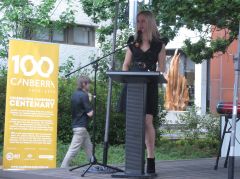
It’s been a good week for literature in the ACT. Not only was the UC Book Project announced but on Thursday, our centenary anthology The invisible thread was launched.

Irma Gold, The invisible thread

Irma Gold, editor, at the launch of The invisible Thread

The launch was a well-organised event: it found the perfect balance between formality and informality, and didn’t run too long! The book was launched by writer Felicity Packard, best known as one of the award winning writers on the Underbelly series. She spoke entertainingly about the invisible threads – people, places, events – between her and the book. It was nicely and appropriately done. She was followed by four readings from the book, three by authors Blanche d’Alpuget, Adrian Caesar and Francesca Rendle-Short, and one by Meredith McKinney, daughter of Judith Wright. Being of a certain age, I related to the fact that Wright’s and Caesar’s poems both dealt in some way with age. Editor Irma Gold concluded the launch with the usual thanks … and the whole was emceed by local radio announcer Alex Sloan. The venue – the New Acton courtyard – was perfect for the warm spring evening. It was a treat to be present.

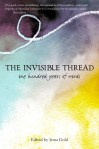
The invisible thread, by Irma Gold

Cover (Courtesy: Irma Gold and Halstead Press)

Irma has also been interviewing many of the still-living authors included in the anthology. The interviews – and the stylish book trailer – can be seen on her You Tube channel. Well worth checking out during those hazy lazy post-Christmas days if you don’t have time now. Nigel Featherstone whom I’ve reviewed is there, as is the exciting poet and rap artist Omar Musa, as is the new-to-me poet Melinda Smith, as is … well you get the point. More interviews are to be added weekly over the next couple of months.

But, these are not, really, the point of today’s post. At the launch Irma announced another initiative associated with the book – wow, that woman has worked hard. It’s the ACT Writers Showcase, a website dedicated to, obviously, showcasing writers from the ACT. Irma explained at the launch that the anthology includes only 70 of the 100 plus writers considered for it. The showcase is an attempt to ensure that all writers are noticed, promoted and, most importantly, receive the due they deserve. Irma, herself, for example, is not in the book – but she is in the showcase.

Authors can be located via the search box or the writers’ index. There is a brief bio and list of publications for each author, and an excerpt of their work. I’m told this is a pretty unique site – but, whether it is or not, it’s not only a great resource for readers but also makes a significant contribution to documenting “all that’s past and what’s to come”* in ACT literary culture.

Are you aware of any similar initiatives in your corner of the world?

* from “A Valediction”, by Adrian Caesar

Monday musings on Australian literature: Writing across the fiction-nonfiction divide

Last week, a conference called the NonfictioNow Confence 2012 was held in Melbourne. It went for four days! It sounds right up my alley but I didn’t get to it. Fortunately the site says that panel discussions will be online in 2013.

Anyhow, it got me thinking about writers who write both fiction and non-fiction because, while I mainly read fiction, I enjoy non-fiction immensely and would read more if I could find the time. I started to wonder whether this phenomenon of writers spanning both forms was a new one that was somehow indicative of new ways of thinking about fiction and non-fiction, about writing from the imagination versus from reality. (Is this – has it ever been – a real dichotomy?). But, I quickly realised that it has been ever thus, that while there have always been writers who specialise in one form, there have also always been those who dabble (and I don’t mean that pejoratively) across multiple forms and genres. Think Charles Dickens, for example, or George Orwell.

For some writers, I suspect, writing like that was (still is) about making a living. Novelists, for example, might write journalism and/or other non-fiction to survive. But, for others, it’s a matter of the right form for the right subject. I’ve written in this blog about Kate Grenville and her decision to write The secret river as fiction, when her plan had been to write a non-fiction work about her ancestor. And, I’ve written about Anna Funder, who had planned to write Stasiland as fiction but changed her mind and wrote it as non-fiction. Grenville and Funder had well-articulated reasons for their decisions and these reasons had something to do with being “true” to the subject matter they’d chosen.

Funder said that having interviewed people for Stasiland, she felt it would dishonour them and their lives to turn their stories to fiction. So, she wrote a non-fictional work, but one with a certain novelistic sensibility. She is a “character” in the book providing a narrative coherence to the stories being told, and the book is structured in such a way that it can almost be said to have a plot. Funder then went on to write a novel, All that I am, which, like Stasiland, has been nominated for and/or won multiple awards. Her decision regarding form clearly seems to be about aesthetics and ethics, rather than about practicalities.

As a blogger for NonfictioNow wrote, Helen Garner who has written across almost all forms*, is the Australian poster girl for talking about “the similarities, differences, cross-overs and relationships between fiction and non-fiction writing”. Her fiction – particularly her first novel Monkey Grip and her most recent The spare room – has been panned by some for being “just” about her life as if, somehow, that wasn’t valid. But, as Garner said at the time of her first novel, whether it is about her life or not, she still had to select and frame the story and think about the language she would use to convey her feelings and ideas. Writer Tegan Bennet Daylight recently visited Garner in The Australian. She wrote of Monkey grip:

For me, at least, Garner had cracked narrative open. She had written, in a way, the kind of fiction Virginia Woolf had aspired to in novels such as The Waves and, indeed, achieved in her own diaries. She had followed a consciousness that did not bend easily into the more traditional shape of a novel. She had written a women’s novel.

Ah … I don’t think I’ll go there right now – there’s too much to unpack in terms of “the narrative” and “a woman’s novel” though I’d love to ask Daylight whether she means a novel written for women or in a style that speaks to some sort of women’s view of the world.

I’ll simply say, because I haven’t time to write more, that there seems to be a flourishing of Australian writers – particularly, it seems, women – writing – and writing successfully – across the divide. They include, in addition to Garner and Funder, Chloe Hooper and Charlotte Wood. While, as I said at the beginning, this is not a new phenomenon, my sense is that many of these writers are in fact forging a new way of writing non-fiction and, conversely, a new approach to fiction.

Do you read much non-fiction? Are you seeing new ways of writing non-fiction that seems to be informed by the techniques, and aesthetic even, of fiction – and do you think this is risky business?

* Garner has written novels, short stories, film/play scripts, essays and non-fiction books.

Monday musings on Australian literature: Literary Awards for Short Stories

Since we’ve been currently talking about short stories – or, at least, I have been doing so here in my little corner of the litblog world – I though it might be a good time to list some of the literary awards dedicated to short stories in Australia. It’s a bit of a lazy post I know, but we are getting to that time of the year and life is getting busy.

There are, in fact, a goodly number of opportunities in Australia for short story writers to win awards, so in this post I am just going to list the ones that seem best known or that have a reasonably broad coverage. Most of the competitions define short stories as those 3,000 words or less. Here goes:

  • The Age Short Story Award has been awarded since 1979. I believe it was the award that kick-started Elliot Perlman’s writing career when he won in 1994. It has also been won by some of Australia’s currently best regarded short story writers like Cate Kennedy and Paddy O’Reilly.
  • Steele Rudd Award for Australian Short Story Collection was part of the recently cancelled Queensland Premier’s Literary Award and was continued this year in the Queensland Literary Awards when it was won by a favourite writer of mine, Janette Turner Hospital, for her collection Forecast: Turbulence.
  • Elizabeth Jolley Short Story Prize, which started life as the Australian Book Review award, has been offered under its new name since 2010. It honours the late Australian author, Elizabeth Jolley, who is one of my favourite writers and to whom I was introduced back in 1988 via her short story “Five acre virgin”.
  • Hal Porter Short Story Competition which in 2012 is in its 19th year, and which commemorates the Australian novelist, poet, short story writer and playwright.
  • Awards for short stories offered by state chapters of the Fellowship of Australian Writers, including the Marjorie Barnard Award from NSW (commemorating Barnard whose collection The persimmon tree and other stories* is one of my favourites) and the Henry Savery National Short Story Award from Tasmania (commemorating Savery who wrote the first “Australian-made” novel)
  • Locally offered awards such as the Alan Marshall Short Story Award, the Margaret River Short Story Competition, and the Stringybark suite of short story awards.
  • Genre-based awards for short stories, such as the Aurealis Awards for speculative fiction which include awards for short stories in fantasy, horror, science fiction and young adult; and the Scarlett Stiletto awards for crime and mystery short stories written by women. Cate Kennedy won the first Scarlett Stiletto in 1994.
  • And, of course, the Commonwealth Short Story Prize, which is part of the Commonwealth group of literary prizes and is open to all members of the (British) Commonwealth.

There are many more awards, but this list indicates that the short story is pretty well supported down under. However, short stories can always do with more recognition because, despite all the awards, they are still under-recognised and, I think, under-appreciated. I have heard chat around various traps that electronic publishing may be raising the profile of short stories with new audiences … I’ll be watching with interest.

Meanwhile, I’ll close with Australian novelist and short story writer Jennifer Mills who was a regional winner in the Commonwealth Short Story Prize in 2008. In an interview on the Spineless Wonders website, she explained why she likes the short story form:

It’s very flexible. I love its capture of pivot points, its nearly mathematical tidiness, and its risk. I can pull off imaginative feats in short stories which I would struggle to hold together in a novel. I like the adaptability of short fiction to different delivery modes, like podcasting. As a novelist, I like the gratification: the end of the job is in sight.

Are you aware of short story competitions in your neck of the world?

* I was thrilled when Tony of Tony’s Book World reviewed this collection a few years ago.

Monday musings on Australian literature: What’s in a street name?

Street names may be an unusual topic for a post on literature, but I think it could be argued that names of things are part of our wider literary culture. It can certainly be argued so for my city because street names here are serious business. None of your 5th Avenues and 61st Streets for us! I know, I know, New York’s a great place, and very easy to navigate compared to Canberra with its reputation for going round in circles, but we have our reasons …

I was inspired to write this post because this past weekend Prince Charles and the Duchess of Cornwall were in town as part of their Diamond Jubilee Tour downunder. One of their duties was to take part in the renaming of Parkes Place to Queen Elizabeth Terrace. This has special meaning for me because the address of my first library employer was Parkes Place, which was named for Henry Parkes, the “father” of our Federation. Queen Elizabeth now joins Queen Victoria, King Edward, and King George in being commemorated by a street in what we call our Parliamentary Triangle. I’m pleased to say that poor old Henry is not being completely brushed aside: the little roads that circle Old Parliament House will now be called Parkes Place.

Enough about my inspiration though, and back to the main point, which is that in 1928 the Canberra National Memorials Committee of the Australian Parliament presented a “Report in Regard to the Naming of Canberra’s Streets and Suburbs” which laid down principles for Canberra’s official nomenclature. Early in the document comes this:

… the commission divided the Canberra City District into 23 divisions. It devolved upon the National Memorials Committee to find names for these divisions, which will eventually become the suburbs of the capital. It was felt by the Committee that patriotic and national sentiment would be best met if the names of those men who have contributed most to Australia’s existence as a unified nation, be used in the most important places, that is, for the names of the divisions or suburbs of Canberra.

The patriotism of a nation is often expressed by memorials to its benefactors, so it is deserving and right that the names of those great statesmen who laboured in the cause of the federation of the Commonwealth should be perpetuated as place names to be used in the mother-tongue by all Australians for all time.

A map of inner Canberra showing the Parliament...

Inner Canberra early suburb names. (Photo credit: Martyman, using CC-BY-SA 3.0, via Wikipedia)

Now isn’t that a great piece of bureaucratic literature! I particularly love the reference to “mother-tongue” after the preceding references to “men” and “statesmen”. It then lists the names of these men, and explains that “a suffix has been added, similar to some of the Anglo-Saxon names of towns in Great Britain, where the name is thought not to be very euphonious”. So, while Braddon gave rise to the suburb of Braddon, and Barton Barton, Lyne became Lyneham and Fysh Fyshwick. Ingenius eh?

The Report then goes on to note that other suburbs would be based on names connected with Canberra’s early days and its pioneers, and that “the use of aboriginal names has not been overlooked.” They stated that much knowledge of indigenous naming in the Canberra region had been lost but those known would be retained, and so they are – with most rolling off the tongue beautifully (euphoniously, even), like Narrabundah, Yarralumla, Pialligo, Jerrabomberra, Mugga, and Canberra itself.

All this is probably pretty common in cities elsewhere but the committee went on to set down principles for the naming of streets:

The Committee has adopted the idea of grouping together various classes of names in separate areas. Sections of the City have therefore been set apart for Governors, Explorers, Navigators, Scientists and others, Foresters and others, Pioneers and others, Founders of the Constitution, and euphonious Aboriginal words.

I wonder whether the names of the scientists, foresters, “and others” had to be “euphonious”?

I won’t go on with more of the report, but I will say that this plan has continued to the present. One of our newest suburbs, still in the making, is Wright – named for the poet Judith Wright. Yes, we do now have a handful of suburbs named for women, including the writers Miles Franklin, Dame Mary Gilmore and Henry Handel Richardson. Moreover, some of our street names, says ACTPLA, our current planning authority, are named for “quiet achievers”. Things do change in the corridors of government – eventually. As for the theme for Wright’s streets, it’s a somewhat diverse one, “Environment, Poets and Butterflies”. Maybe there’s a connection there; Wright was a poet and a conservationist so perhaps the latter covers the “environment” and the “butterflies”!

I like that fact that such thought has been put into Canberra’s urban (or is it suburban) nomenclature, and I’m glad that while the spirit of the early planners has remained our nomenclature has broadened to encompass women, quiet achievers, the arts and increasing usage of indigenous names. The end result is, for we capital residents, a fascinating literature of suburb and street names. Do you have such literature where you live?

Monday musings on Australian literature: Guest post from Nigel of Under the counter or a flutter in the dovecot

This is embarrassing but I really can’t remember how and when I first met Nigel. Actually let me rephrase that: I do remember when I met him in person because I’ve only met him once (at a literary event earlier this year), but who stumbled across whose blog first I have no idea. I’m glad we did though, because in Nigel I’ve discovered not only a lovely writer (see my review of his novella Fall on me) but an active supporter of Australian literature through such activities as the online creative arts journal VerityLa and the arts forum, the Childers Group. I also enjoy his reflective blog, Under the counter or a flutter in the dovecot. And so I was thrilled when he said yes without apparent demur to my request for a guest post. Thanks Nigel …

Real or imagined, raising children makes a great story

The game now finished and the speeches in full swing, the camera panned left to take in the players who were standing off to one side and looked worn-out and knocked around, a few with mud on their faces, a bit of blood too, but smile they did because they’d won and were elated. After a moment, the camera went back to whoever it was that hadn’t yet finished his speech (why is it that a man with a microphone will always go on too long?). For the first time in my life I was grateful when the TV channel cut to an ad break.

When the NRL grand final coverage resumed – I’d not watched the actual game, and had only stumbled on the closing minutes of the concluding celebrations by lazy accident – the victorious players were wandering around the field, or ‘paddock’ as it’s apparently called, many with their young children in hand. It’s this that struck me: rugby league boofheads wanting to be with their kids in these lingering moments of sports elation.

It looked – it felt – amazingly non-sensical.

I’m not one for children; never have been, never will be. I am, in fact, the least paternal person on Earth. At no point in my life have I ever wanted children. Which is, now I examine my life with precision (the process of writing does that), a bit of a lie. I remember that as a teenager I did have day-dreams of raising children, except in those day-dreams my wife was always absent, to be accurate she was dead, which left me to be a hip young single father, and I was very good at fathering, and my kids adored me and I adored them back. Once I was old enough to understand why my wife was always cactus, my mind – my conscious mind – turned to things closer at hand, and much more real. Which is why, aged forty-four, I’m blissfully childless. When on the rare occasions something good happens to me (though for some reason these events are never televised), I reach for a bottle of nicely chilled verdelho and a slice of blue cheese on a cracker.

Not having children, not wanting children – now that I have a fine appreciation of the opportunities and constraints of my life, I desire children as much as I desire the idea of a car-alarm going off in the middle of the night, and if ever I find myself day-dreaming, which is, I should say, a lot, it’s about having a crumbling hut in some far-flung place that you can only access by barging a rusty old four-wheel-drive across seven creek-crossings – is problematic for someone like me, a writer of all things, that ridiculous trade that’s getting more and more ridiculous as each day goes by. For family is the guts of the contemporary Australian story – it is, to throw into the mix some suitably highfalutin French, its raison d’etre.

I’ve just finished having a private Australian literature festival, reading some blisteringly powerful novels by our nation’s finest (who too don’t get to parade their children in front of TV cameras). Kate Grenville’s Sarah Thornhill, Craig Silvey’s Jasper Jones and Gillian Mears’ highly distressing but remarkable Foal’s Bread. All three novels explore family and the impacts on children, but also the desire for children, that procreating is the usual path, the standard, the predictable, how it is just what you do. How the desire to continue your bloodline is simultaneously overwhelming and underwhelming. It is refreshing that both Foal’s Bread, which is largely set between the world wars, and Sarah Thornhill, which has as its backdrop our morally bankrupt colonial times, explore women who aren’t just mothers, whose dreams are bigger and wider and deeper.

*

In my own writing, my own attempts at making words come to life on the page – it always seemed so easy as a boy: you wrote what happened and that was that – I too explore family. My main characters are usually men and women (always a good start!) who have children, who want to be parents, who struggle to cope, who feel the pressure of internal and external expectation, who fail and fall into a heap but pat themselves down and have another crack at it.

Featherstone, Fall on me

Fall on me bookcover (Courtesy: Blemish Books)

My novella Fall on Me (Blemish Books, 2011) is about a single father who has to cope with his precocious seventeen-year-old son who insists on turning his naked body into an art exhibition. Lou and Luke: how through writing their story I’ve gotten to know them well, so well, despite everything how they created a family for themselves, and the addition to that family, Anna Denman, their housemate who became much more. To the point that I still think about them. And it’s always gratifying – and humbling – when readers say they think about them too.

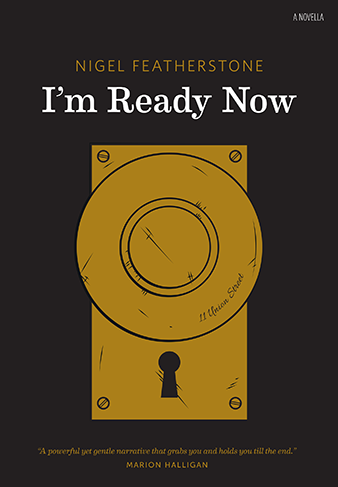
In my forthcoming novella, I’m Ready Now, to be launched in Canberra on 22 November by Blemish Books, I write about a very different family. The story is a simple one, but it’s told from two points of view: a mother’s and a son’s. Lynne Gleeson is a fifty-year-old ‘corporate wife’ (that’s how she describes herself) whose husband Eddie, a man who inherited his family’s property-development business, has died of a heart-attack. Theirs was a perfectly functional if not loving relationship, one of considerable wealth and privilege – the family home is a daunting historic mansion called Gleeson House in Battery Point, Hobart. Now that Lynne is alone, she has decided to sell this property, and the family’s other houses, including an architect-designed getaway on Magnetic Island, Queensland. Effectively homeless, she leaves Tasmania to spend a fortnight in Sydney, staying with her son Gordon. But Lynne has plans. Big plans.

Nigel Featherstone, I'm ready now

Cover (Courtesy: Blemish Books)

Meanwhile Gordon, a professional freelance photographer, is thirty now, and despite being in a relationship of five years’ standing, is having what is described as a ‘Year of Living Ridiculously’ – it involves spending his weekends out in Sydney’s bars and clubs, taking drugs, and having promiscuous sex. For his thirtieth birthday, which his step-father’s death prevented the family from celebrating, Gordon has secretly arranged ‘The Ultimate’, which threatens to tear everything and everyone apart. It sounds heavy, it sounds grim, but it’s just about family. So it’s the truth. And, yes, I really think I can say that: the truth.

Family: there are plenty of other things to write about. Fighting wars amongst far-flung stars. Cornering yellow-teethed bad-guys. Hacking up zombies. Sex, which as I know better than anyone, doesn’t always have to result in something altogether gruesome nine months later. But still it’s family that I write about, the desire to raise someone in your own likeness, to have your best go at doing a decent job of it, to leave something worthwhile behind. All I’m going to leave behind is a handful of stories in the flickering fluorescent-light basement of the National Library of Australia.

*

Last month my older brother and his fourteen-year-old son dropped in on their way to the snow-fields. We went down to a café in the mainstreet for lunch and caught up on all that was happening in our various worlds. An hour later it was time for them to continue on their way south. The day was cold and blustery, the sort that makes my hands turn blue and my mood turn a similar colour. Dust was being flung around and as my brother and his son got into their brand-new four-wheel-drive I began to cough and splutter wildly.

My nephew, who’s not big on conversation and his favourite thing ever is his skateboard, wound down the window and stared at me fair-square in the face and said, ‘Are you sick?’ He looked genuinely concerned. ‘No,’ I said, ‘there’s a typhoon going on out here and it’s hit the back of my throat.’ His eyes brightened right up and he laughed. As my brother drove the two of them away, I sent my nephew a text message: ‘Have a great time on the slopes.’ He wrote back: ‘Have a good week.’ When was the last time someone had wished me a good week? I couldn’t remember. But I loved those words. They moved me. And they still do.

If I have a motivation to write, it’s to move people.

So, despite everything I know about myself, after forty-four years of determined self-direction, to the point that I’m now, to put a twist on something Quentin Crisp once said, one of the stately homos of Goulburn, I watch the dying moments of a rugby league season and can’t take my eyes off the men – proud, probably even gentle men (when they need to be) – who lead their children around a football field; it’s not the men who fascinate me, but the big hands holding the little hands. And I read great Australian novels about family and generations and personal history amongst the maelstrom that is the bigger political and social context. And I write stories about people who do their utmost to raise the best of kids. And I keep in my mind a simple text-message from my nephew.

But I also recall something the US poet and civil rights activist June Jordan once wrote: ‘In the name of motherhood and fatherhood…we threaten and suffocate and bind and ensnare and bribe and trick children into wholesale emulation of our ways.’ My unborn children should be grateful that they had me as a father. Hopefully the ones that live on the page are much more optimistic about their chances in the world.