I wasn’t sure whether to call this “an Australian’s thoughts on e-publishing” or “thoughts on e-publishing in Australia” or the title I ended up choosing. There are subtle differences but almost too subtle for me to tease out here, so I decided to use the shortest title.
I was inspired to write this post by Nigel Featherstone’s blog post a week or so ago about a special offer for his novella, Fall on me (my review). The deal is that you can buy the e-book version and “pay whatever you like”! Apparently, as some of you probably know, Radiohead tried something similar many years ago – and 60% chose to pay nothing. I certainly hope that’s not what happens to Nigel Featherstone and his publisher, Blemish Books. Featherstone writes of the Radiohead experiment that:
At the time, Radiohead’s approach was considered ground-breaking, but over the years there’s been debate about its impact on the music industry in general; even Thom Yorke, the band’s free-thinking frontman, said that the strategy may have been a mistake, as it played into the prevailing internet culture that everything should be free.
I certainly don’t think everything on the internet should be free. After all, everyone has to eat and if the internet is the best way to distribute the results of one’s work then one should get paid. And yet, when I first acquired my Kindle around three years ago now, my idea was that I’d only use it for free classics (such as those from Project Gutenberg)! I wasn’t, I thought, going to spend real money on a virtual book!
But, with experience has come some change of mind. Here is what I do now:
-
Reading the classics
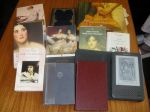
Classics: I will still acquire free classics if that’s the only way I can acquire them but if, as with say Jane Austen’s novels, they can be bought I will pay for them. This is because, really, “you get what you pay for”. With a bought classic you can usually choose a version with an introduction by an academic or critic you respect or want to read, and the edition is less likely to have editing/proofreading errors and other conniptions (as my last free classic did – it just seized up at a certain chapter and that was it. I could have investigated – re-downloaded perhaps – but it was easier to pay a couple of dollars for a commercially published edition).
- Journals: I have discovered that I quite like reading literary journals on my Kindle. I do miss the lovely physicality of many journals – some are just gorgeous (like Kill Your Darlings) and some contain pictorial content that aren’t easily reproduced (like Griffith Review) – but journal articles are perfect for spare moments when I’m out and about, and e-versions are convenient.
- Newspapers: I also like to read the newspaper in e-format, particularly since my app also supports crosswords! So far our local newspaper app is free, as they are still ironing out bugs etc, but at the prices being charged for other metropolitan newspaper apps, I’d be happy to pay for ours here in e-format, when they decide to charge. It’s so easy to select the articles I want to read, and I can read it when travelling.
- Contemporary literature: I have finally started acquiring contemporary literature – both fiction and non-fiction – on my Kindle. I still prefer print versions for this sort of reading but am teaching myself to enjoy e-versions. It is lovely to hear of a book, decide you want it right away, and be able to get it – particularly when it isn’t immediately available in my favourite bookshop (as I discovered recently with Courtney Collins’ The burial. “We can order it for you”, the salesperson helpfully said, but that can take two weeks or more and, being a child of the twenty-first century, I wanted it now!). I want to pay less for an e-version, but there are costs – including payment to the author – that are independent of the publishing platform, so we have to pay something. Right?
So, how reflective are my reading habits of e-publishing in Australia? Clearly, journals and newspapers are actively moving into e-formats. I don’t know how readers are responding to this, but anecdotal evidence tells me that people are increasingly interested in receiving their newspapers and journals electronically. However, the situation seems to me to be a little different when it comes to books. Again speaking anecdotally, there’s some resistance among my literary fiction cohorts to reading “whole” books electronically, with most still preferring print, even where, like me, they have e-book devices. I think there might be a bigger uptake among genre readers?
An article in The Australian earlier this year suggests that e-Books represent about 10% of book purchases here, which is less than in the US (20%) and the UK (16%). Publishers recognise that the e-book is here to stay but also believe that print will continue side-by-side (for some time to come, anyhow). Sensibly, publishers are starting to look more carefully at what they publish in what format when. Digital-first and digital-only publishing is now part of the business model. Penguin Australia, for example, has introduced its digital only Penguin Specials collection, with wonderful sounding fiction and non-fiction titles by the likes of Elizabeth Jolley, Gideon Haigh, and Orhan Pamuk. Ooh, I want to read them …
Also in The Australian article, the HarperCollins spokesperson said that:
Fiction readers, in particular, have responded enthusiastically to the e-reading experience and we have seen a significant upsurge of sales of backlist titles as people ‘discover’ a new author and then buy all previous books by them.
Great, eh? The Blemish Books initiative which inspired this post is, really, about backlist. I hope it goes well. It isn’t easy being a small publisher – or one of its authors!






 Whispering Gums