Monday musings on Australian literature: The Conversation launches its Arts + Culture Section

I think I’ve mentioned The Conversation before. It’s a blog produced by a consortium of Australian academic institutions. The posts are written by writers who are academics, and each post has a disclosure statement regarding whether the writer has affiliations with/receives funding from organisations that could “benefit” from their article. It’s a good source of thoughtful commentary.

They have “sections” such as Politics + Policy, Business + Economy, and Education. Today they launched their newest section, Arts + Culture. That’s exciting because while there have been articles before on arts-related topics, they’ve been scattered. I was a bit disappointed, though, I must admit, to see that on this launch day there are no articles (as they call their posts) devoted to literature but I suppose that’s the luck of the draw. There are articles on Visual Arts, Music, Film, TV and Gaming. I’ll be watching out for Literature.

Julian Meyrick, Professor of Strategic Arts at Flinders University, wrote the new section’s foundation essay, “Does Australia get culture“. He suggests we don’t. He says:

We are a country not without culture but without a sense of culture. That distinction is crucial. Australia does not lack art, artists or audiences. But as a nation we find it hard to see culture in any but consumerist terms.

He suggests two reasons for this – the fact that our language is English makes it easy to “free-ride the cultural goods and services” of the UK and USA, and that our history is ‘peaceful’. ‘Our cultural consciousness’, he says, ‘has never been pushed into sharp awareness by invasion or forced colonisation … unless you are indigenous of course’. Funnily enough, I read a similar point in my current novel, Christina Stead‘s For love alone. In it, an American character keeps describing an Australian character as English, and in terms of her Englishness. I was starting to wonder about this when he says, “She’s not English but Australian of course, but it’s the English race unadulterated by any revolution”!

But, that’s a bit by the by. The article is interesting but a little odd. For example, the author suggests that Australia doesn’t have a written constitution? Huh? What about this? But, I guess my main question to Meyrick is what does he mean by “culture”? It’s a rather nebulous term that can range from something quite narrow to something that encompasses pretty well everything about how we live. It’s not clearly defined in the article. I assume he’s focussing on “the arts”. And I think by “sense of culture” he is concerned about something that seems to have been crossing my reading quite a bit lately, the “Australian identity” – or what he calls “the internal order of value that allows us to articulate who we are”. Since “the arts” are the prime means by which we explore and present who we are, Meyrick’s “culture”, as I read him, is the exploration and presentation of the who we are via “the arts”.

At least I think that’s at the bottom of what he is saying, but I could very well be putting my own spin on it. Regardless, his concern is that these arts are constantly being frustrated, by a

situation whereby commercial imperatives block artistic ones because the internal order of value that should keep them in productive tension is not present to the needed degree.

I’m not sure that Meyrick completely explains what he means by this but I think I get his point. He concludes that Australia is good, however, at strong and bold cultural policy, and that all we need is good leadership from the centre. What do you think?

Monday musings on Australian literature: Reading Australia

You know how when you go to a conference you pick up all sorts of pamphlets and brochures advertising this and that? Well, at the Writing the Australian landscape conference I attended back in August, just before I went overseas, I picked up an interesting leaflet from Australia’s Copyright Agency. The leaflet is titled: Reading Australia: Sharing great Australian stories. I decided then that it should be a Monday Musings topic so, here I am, nearly three months later telling you about it.

Reading Australia’s aim is “to promote the study of Australian works in the classroom”. It has kicked off with “the First 200” works selected by the Australian Society of Authors. The selection includes

stories from Indigenous Australians, from the colonial past and rural epics through to the cosmopolitan melting pot of the cities … classes and new favourites

The list, which is available on the Copyright Agency’s website, covers fiction and non-fiction, drama and poetry, and includes selections for primary and secondary schools. From these they have selected a subset of 20 – split 50-50 for secondary and primary schools – and created teacher resources which they say will be trialled “later in the year” (which must presumably be now).

English: Chloe Hooper.

Chloe Hooper. (Photo credit: Ottre, released to Public Domain via Wikipedia)

The selection for secondary students, which is the area that most interests me, is nicely diverse, and is not dumbed-down. It includes the major forms (fiction, non-fiction, poetry, drama, short stories), classics and contemporary titles, and works representing indigenous and multicultural Australia. The ten are:

The project is an initiative of the Cultural Fund of the Australian Copyright Agency, with the Australian Society of Authors and the Association for the Study of Australian Literature as partners.

I was disappointed by the dearth of Australian literature taught to my children at school and so am delighted to see this initiative.  I don’t know, however, how well it is being promoted, how easy it will be for teachers to incorporate into their existing curricula, whether schools can resource providing the books, but I do hope it gains traction.

Monday musings on Australian literature: Writing the Australian landscape (3)

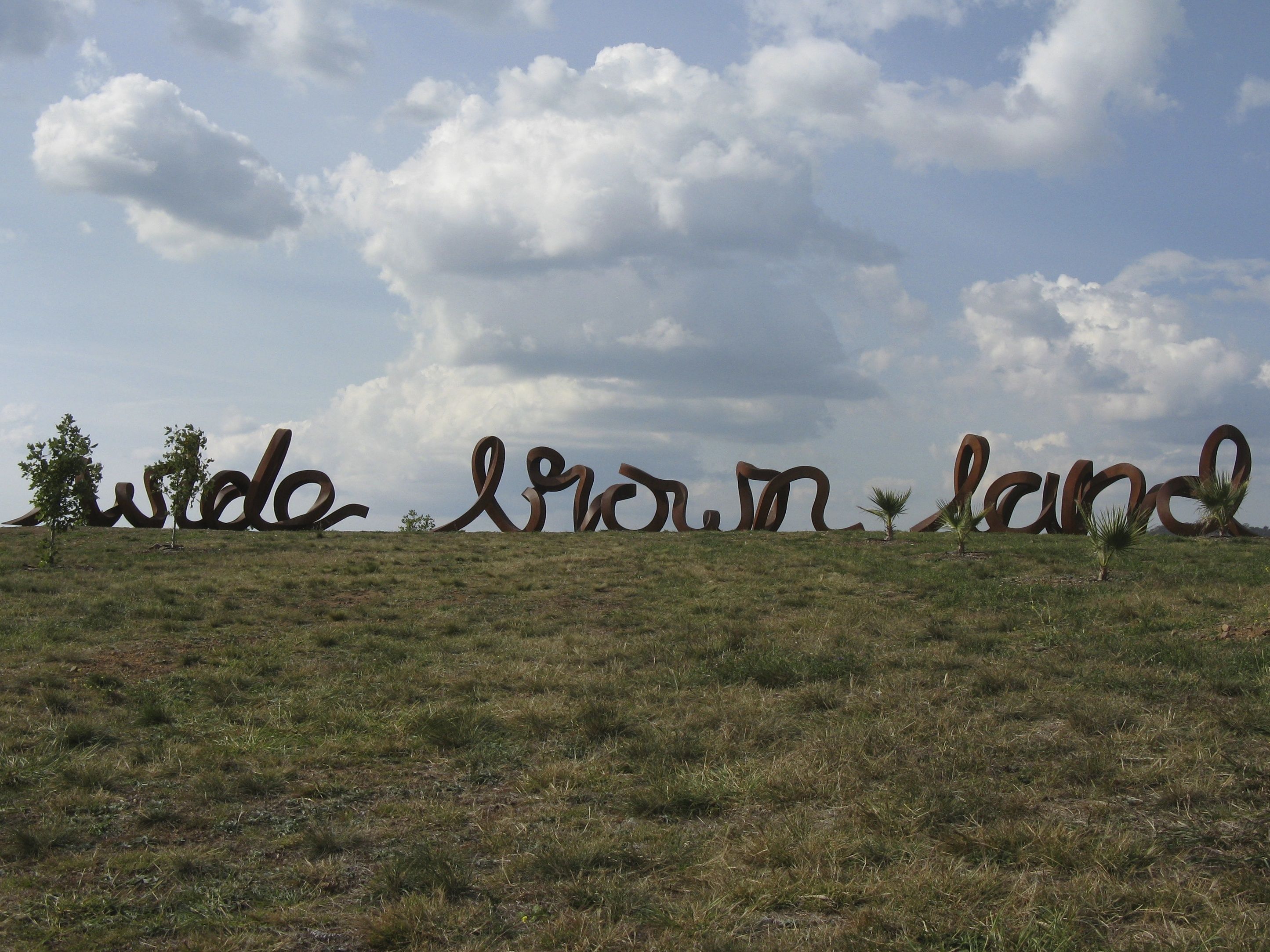
Wide Brown Land sculpture

Wide Brown Land (National Arboretum)

Back in August I wrote two posts (here and here) about the National Library of Australia’s conference, Writing the Australian landscape. At the time I said that I would provide a link when the talks became available on-line.

Well, they apparently went on-line a month or so ago and the NLA very kindly tweeted the fact to me. However, I was overseas at the time and having a semi-break from constant on-line connection – and have consequently only caught up with the tweet now. Better late than never eh?

So, if you are still interested in checking out any of the wonderful talks I discussed in my posts, here is the link.

As you may remember from my posts, I found it all excellent, but if I had to recommend some to you, these would be the ones:

  • Murray Bail‘s keynote address on day 1, which was provocative about what he sees as our (Australian) need to define ourselves by our landscape. He concluded by asking readers to be “explorers” and open to new ways of writing, to not expect “landscape” to be the way into Australianness.
  • Bill Gammage‘s keynote address on day 2, which was provocative in a different way, arguing that there is a progression from notions of “landscape” and “place” to “country” which, in indigenous terms, is synonymous with “culture”. He argued that we still “view” the land as outsiders, rather than seeking to relate to it in a more spiritual, organic way, and challenged us to be willing to learn from indigenous Australians.
  • Jeanine Leane’s paper which, among other things, confronted us with our (that is, white/non-indigenous) preconceived notions about what we define as Australian classics. Now I have the paper I can quote directly. It was powerful. She said:

Through Xavier Herbert, Patrick White, David Malouf & more recently Kate Grenville who among others have been hailed as nation writers & what I saw and still see to some extent in Australian literature to date is a continuous over-writing of settler foundation stories which overwrite Aboriginal experience and knowledge. Settlers are always re-settling and Australian literature really reflects this and the critics and scholars write of such works as if everyone reading it is also a settler reader.

It is very hard, Leane showed us, to step outside our own world-view … but that’s why we read, talk about reading, and listen to readers and writers isn’t it? I certainly found my world-view shifting as we went through the weekend. How do I, as a non-indigenous Australian, need and want to relate to this land I also call home. It would be presumptuous to try to relate to it as an indigenous person does. But we are lucky here to have people with such a deep knowledge of and relationship with the land. We can learn a lot from them: practical things about how to care for the land, and, perhaps more importantly, what a true relationship with the land really means and the responsibility accompanying that.

Anyhow, I’m very glad to be able to share the link to the papers, and would love to hear from you if you do read any of them.

Monday musings on Australian literature: GenreCon

I returned from seven weeks of gallivanting abroad to several emails* about something called GenreCon, which will take place next week from October 11 to 13 at the State Library of Queensland. I hadn’t heard of this before, which is probably not surprising as it seems to be a new event. As you’ve probably guessed from the title, GenreCon is, as the website puts it:

… a three-day convention for Australian fans and professionals working within the fields of romance, mystery, science fiction, crime, fantasy, horror, thrillers, and more. One part party, one part celebration, one part professional development: GenreCon is the place to be if you’re an aspiring or established writer with a penchant for the types of fiction that get relegated to their own corner of the bookstore.

Readers here know that genre fiction is not my speciality, but that doesn’t mean I never read it, or that I’m not interested in keeping an eye on what’s happening to it, particularly in Australia. In fact, I’ve become far more aware and (generally) knowledgeable about genre fiction since my involvement with the Australian Women Writers’ Challenge – and that, I think, is a good thing. I have read and reviewed a few books this year that would fall under the genre hat, such as Anita Heiss‘s Paris dreaming (my review), Krissy Kneen‘s Steeplechase (my review), and Courtney Collins’ The burial (my review), and I’ve enjoyed each one, for different reasons.

As is usual at these sorts of events, there will be a number of international and national guests, some “author” and some “industry” as they put it. Australian author guests include she-who-needs-no-introduction-here Anita Heiss (my, she’s a hard-working woman), thriller writer Kathryn Fox, jack-of-all-trades writer John Birmingham, and romance writer Anne Gracie. Industry guests include reviewers, editors, and publishers. And again, like many conferences, there will be program streams: “the craft of genre writing, business and industry awareness, and researching for fiction”.

In the run-up to the conference, AustLit (about which I wrote a few months ago) has been sending out regular emails suggesting how its scholarly database reflects, or can be used to research, Australian genre fiction. For example:

  • AustLit has developed, since 2009, the Australian Popular Medievalism dataset, which lists Australian-written works (published between 1995-2010) featuring medieval ideas/settings. It’s currently a research project, but let’s hope the time-period is extended to cover all-time so that it can become a useful resource.
  • you can search on such topics as fairytales appearing in Australian genre fiction, or norse and germanic myths, or, presumably, a wide range of other topics, but these are the examples AustLit gives because they relate to conference topics.
  • media tie-in fiction (that is, fiction inspired by other media such as films, television, games) is an active segment of the genre world, but has attracted somewhat uneven scholarly attention to date.

In other words, while genre fiction may be at the lighter more fun end of the reading spectrum, it is nonetheless worthy of serious analysis and research. After all, if you want to know how people lived, what they thought, what influenced them, in a particular time, popular culture is a critical place to start. It’s important therefore that data be collected now … and so I’ve enjoyed AustLit’s taking up the gauntlet and demonstrating its contribution to the genre discussion.

I hope the convention goes well, and look forward to reading some reports of it after the event.

* Yes, I know I can read emails while I’m away but life was pretty busy on the road, and so I limited my reading to emails from family and friends. Consequently, I returned to a gazillion emails in my inbox waiting my rapt attention. Ha!

Monday musings on Australian literature: Qantas flight-length book deal

Some of you have probably sussed that Whispering Gums is not at her usual desk – and you’d be right. I’ve been travelling since mid-August, mostly in Europe, and will be back home in early October. I had hoped to read some books and write reviews while on the road, but somehow the reviews haven’t happened. One review is nearly ready though!

However, here’s something interesting I read just before I left Australia in AustLit news. It was about a Qantas initiative involving commissioning, from Hachette, a series of paperback books “timed to be read during 10 of Qantas’s main flying routes”. The series is called “A Story for Every Journey” and, AustLit reports, will be offered to Qantas’ platinum Frequent Flyers.

The books will cover popular fiction and non-fiction genres  –  the ones we often call “airport books”. The book lengths are based on average reading speeds, taking into consideration time for napping and eating – or so I read in an article at goodereader.com. It quoted Mr Nobay, spokesperson for Hachette’s partner Droga5, as saying that

According to our literary friends at Hachette, the average reader consumes between 200 and 300 words per minute, which equates to about a page per minute.

This spokesperson also said that

for the longer flights, we accommodated some napping time and meals … After a few hours with a fine Qantas in-flight meal with Australian Shiraz, most people need a break from reading.

(Don’t you love the marketing?!)

AustLit said that one of the ten books – sounds like the initial plan is for ten – will be Kimberley Freeman’s Wildflower Hill which “has been suggested as the perfect read for travellers on the Sydney to Dubai route”. What a shame I didn’t have it when I flew that route a few weeks ago! I’ve never heard of Kimberley Freeman, which is apparently the nom de plume of Brisbane writer and academic Dr Kim Wilkins. Other authors include popular actor and author William McInnes, popular non-fiction writer Peter FitzSimmons and novelist Lian Hearn.

Anyhow, as goodereader comments

If this concept in reading takes off (pun intended) and if lawmakers insist on holding to strict regulations on the use of mobile devices during air travel, there is potential for a surge in not only print-reading, but also a shift towards more books being written with an intentional audience already in mind.

On my first reading of the initiative, I thought it was about commissioning books to be written for the purpose, but it sounds like it’s about identifying existing books that suit the criteria and re-packaging them for a new market. It may, of course, lead to books being written specifically for the market, as goodereader wonders.

I’m not sure I need to have books specially targeted to a set reading period, but I love the creative thinking behind this initiative. What do you think? Have you heard of anything similar?

Monday musings on Australian literature: Let’s get physical – The High Country

From the top of Mt Kosciuszko

From the top of Mt Kosciuszko

This, my third Let’s Get Physical post, is once again about a region that’s not too far from me – the Australian High Country. When most people think of Australia, they think – at least I believe they do – of deserts and beaches, of red earth and golden sand. But, Australia does have a high country, albeit a fairly low one. Our highest mountain, Mt Kosciuszko, is only 2,228 metres (7,310 ft) high. It is so low that it doesn’t feature in any serious lists of “highest mountains” except highest in Australia! But this is beside the point. We do have (relatively) high country, we do have blues and greens, and we have life and literature associated with them.

This high country – the Australian Alps – is part of the Great Dividing Range which runs down pretty much the entire length of the east coast of Australia, some 3,500 kilometres (2,175 mi). It represented a significant barrier for the first white settlers who didn’t cross it until 25 years after they arrived … and this was north, near Sydney, where the highest point is half that of Kosciuszko!

Being (albeit low) high country, this is not a region of high permanent population – so not many writers call (or have called it) home. However, that doesn’t mean it doesn’t feature in Australian literature. Probably the most famous literary work associated with the high country is Banjo Paterson‘s  famous poem “The Man from Snowy River”, a ballad that romanticises high country bravery and horse-riding skills. Clancy (from Paterson’s poem “Clancy of the Overflow”) describes the man from Snowy River:

He hails from Snowy River, up by Kosciusko’s* side,
Where the hills are twice as steep and twice as rough,
Where a horse’s hoofs strike firelight from the flint stones every stride,
The man that holds his own is good enough.
And the Snowy River riders on the mountains make their home,
Where the river runs those giant hills between;
I have seen full many horsemen since I first commenced to roam,
But nowhere yet such horsemen have I seen.

The ride chronicled in the poem takes place north of the Snowy. Its aim is to retrieve a colt which has joined “the wild bush horses”, that is, the brumbies. And this brings me Elyne Mitchell who set her famous The silver brumby series of children’s books in the high country. Mitchell, who apparently won the Canadian downhill skiing championship in 1938, ran a property in the Mountains with her husband. She wrote many books, fiction and non-fiction, about the high country. “The Man from Snowy River” and The silver brumby have spawned multiple adaptations and merchandising galore.

Much of the literature associated with the high country though has been written by writers who live elsewhere. Australian environmental poet, Mark O’Connor, has written many poems about the region, including a collection devoted to it, Tilting at Snowgums: Australia’s High Country in Poetry and Photos. The collection includes his poem, “The New Ballad of The Man from Snowy River”, which “updates” Paterson’s original. Cleverly referencing this original, it takes a realistic, satiric look at “the romance” of the Snowy, addressing many issues including indigenous rights and environmental concerns. It is well worth a read.

The high country is a particularly popular setting for genre authors like Tony Parsons, Judy Nunn and Jennifer Scoullar.

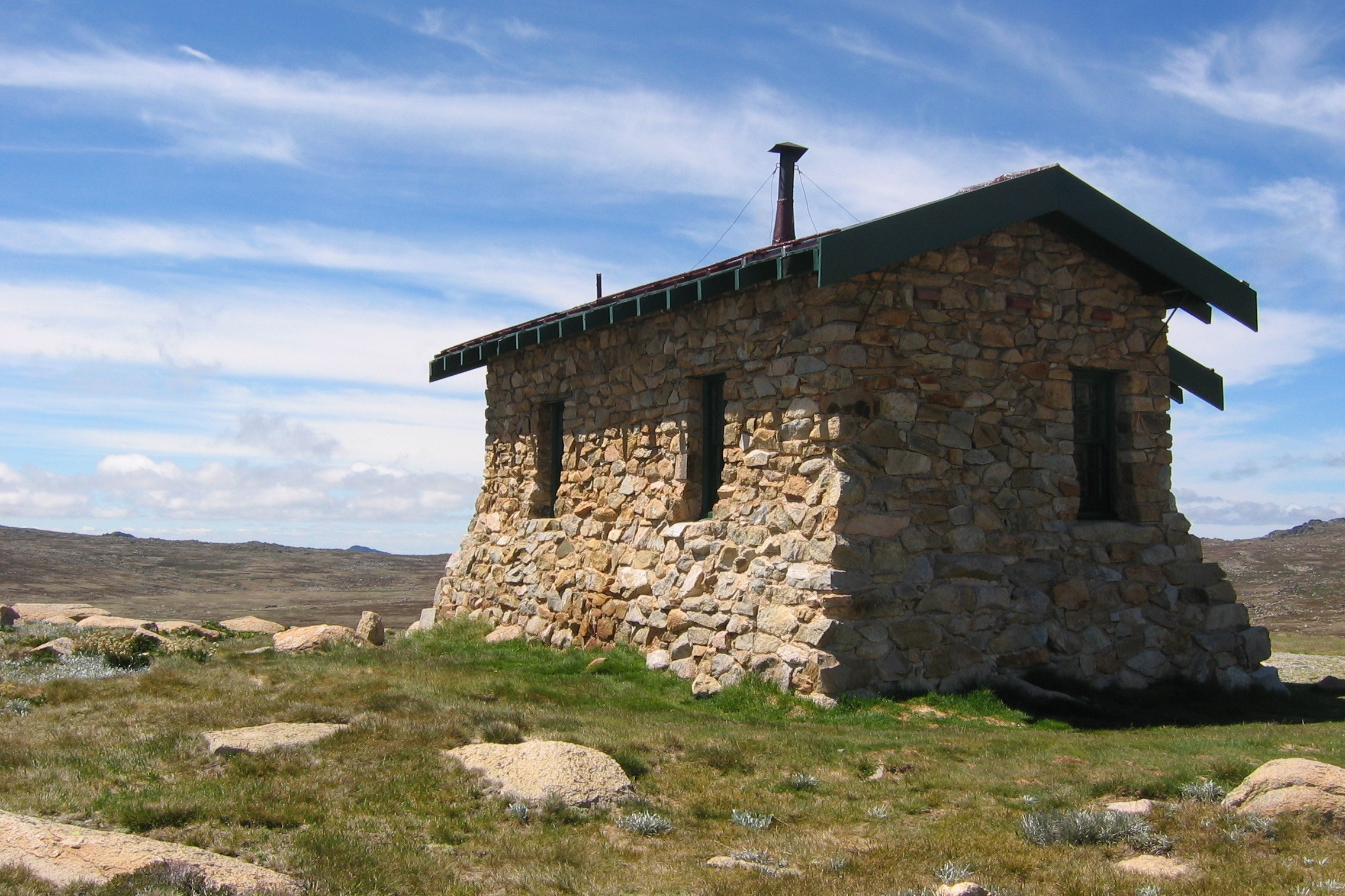
Seaman's Hut

Seaman’s Hut, near Mt Kosciuszko

Besides the mountains, rivers and brumbies – not to mention the snow gums – the high country is noted for its huts. Klaus Hueneke, local historian and high country expert, has written several books about the region including Huts of the High Country and Huts of the Victorian Alps.  When touring the Victorian section of the High Country last year, I was rather entertained to read in the notes for The Huts Walk at Mt Hotham, that one of the huts you pass is the Silver Brumby Hut. This hut is, they say, the 2006-7 replica of the original. By original they mean the 1992 one built as a temporary prop for the film, The Silver Brumby. Ah well, I guess it’s part of history too!

For those interested in film, two unforgettable movies are set in the high country: Jindabyne, which was inspired, intriguingly, by a Raymond Carver short story, and Somersault.

* NOTE: When I went to school, we spelt the mountain “Kosciusko”, as Paterson spells it, but the “Kosciuszko” spelling was officially adopted in 1991 because that more accurately reflects the name’s origin.

Monday musings on Australian literature: Let’s get physical – The Monaro

For my second Let’s Get Physical post, I thought I’d stay in my local region. The Monaro is a large region in southeastern New South Wales, extending from the southern and eastern boundaries of Canberra down to the Victorian border, and bounded on the east and west by mountain ranges. Much of it is treeless plain, but there are also rolling hills, rocky outcrops and jagged mountains. In summer it takes on a golden hue and I love it, I love the sense of clarity, openness and freedom I feel when we drive through it on our annual trip to the Snowy Mountains for some summer bushwalking.

Monaro Region, NSW

Not at its best, but you get the picture

As its main agricultural use is sheep and beef, I used to think, like many people, that its treelessness came from clearing for grazing and/or overgrazing, but in fact the first white people in the area found it in that state. The Austrian naturalist and artist, John Lhotsky described it in 1835:

The scene all around was composed of undulating downs, long projected hills among them, covered with very few trees.

Lhotsky, though, wasn’t the first white man to write about the region. In his book Discovering Monaro: A study of man’s impact on his environment, which is excerpted in Canberra’s centenary anthology, The invisible thread, historian Keith Hancock quotes English naval officer, Captain Mark John Currie. In 1823, Currie also saw, as Hancock describes it, “open, undulating, ‘downy’ country”. It was Currie who learnt the name of the region from the indigenous Australian inhabitants. He wrote:

Passed through a chain of clear downs to some very extensive ones, where we met a tribe of natives, who fled at our approach, never (as we learned afterwards) having seen Europeans before … by degrees we ultimately became good friends … From these natives we learned that the clear country before us was called Monaroo, which they described as very extensive …

Currie and his party, though, decided to call it Brisbane Downs after the Governor of the time. Hancock continues:

Mercifully, that new name did not stick. The white settlers, as they moved in, called the country Monaroo, Monera, Maneiro, Meneiro, Meneru, Miniera, Monera, and – in the fullness of time – Monaro.

What’s in a name, eh? One of the things I love about the region is, in fact, its names. The towns include Nimmitabel, Adaminaby, Bombala, Michelago; and the rivers include the Murrumbidgee and the Goodradigbee. I love how they roll off the tongue.

The Monaro is well represented in Australian literature. It is where  Miles Franklin was born and set some of her novels; the poet David Campbell was sometimes called “The man from the Monaro” and poet Judith Wright lived for many years in the region. Current authors associated with the region include Roger McDonald whose historical Miles Franklin Award winning novel, The ballad of Desmond Kale, is set in the region. When that book came out, he said

In my adult life I always wanted to live back in the country and I was able to do that from about 1980 onwards when I bought a farm in Braidwood [in the Monaro]. I’m never completely myself unless I’m in the Australian countryside. It’s my vocabulary of self somehow … I think it’s in all my books.

I rather know what he means. I live in a city, but its nickname is “the bush capital”. The countryside is never too far away – and I like it that way.

Back to Braidwood though. It seems to be a bit of a mecca for artists. This is where Judith Wright lived for many years, and it’s also where Julian Davies, author, potter and painter has lived for over three decades. He wrote about it Meanjin’s Canberra edition, which I reviewed earlier this year. In his piece, “Out of town”, he describes how he built his hut and established a semi-self-sufficient life there. “The irony” in this, he says, “is self-evident”:

the stubbon pursuit of a relatively isolated life has been an attempt to marry what might be irreconcilable: I moved to the forest because of exactly what it is, but tried to bring a level of comfort and civilisation with me.

If you’d like to know more about Braidwood, and its little corner of the Monaro, do read author Nigel Featherstone’s piece, “Naturally inspired”, in which he considers whether a place can be “creative”. Or read Irma Gold’s post on and interview with Roger McDonald for The invisible thread.

Finally, just in case I haven’t convinced you of the significance of the region, I should add that it has a car named after it, the rather dashing Holden Monaro!

Monday Musings on Australian Literature Special: Book Giveaway Winners

Two weeks ago I announced my first blog giveaway, courtesy the generosity of Irma Gold, editor of the Canberra Centenary anthology, The invisible thread. Irma offered me two copies to give away, both signed by most of the authors represented in the anthology – and who are still living of course! Entries closed midnight, AEST, on 31August.

The invisible thread, by Irma Gold

Cover (Courtesy: Irma Gold and Halstead Press)

So, here are the winners, chosen using an Internet-based random number generator:

  • AUSTRALIAN ADDRESS winner is Rosemary, the lucky last Aussie to throw her hat in the ring; and the
  • OVERSEAS ADDRESS winner is Glenda in Switzerland

Congratulations Rosemary and Glenda … And commiserations to all you others. Thankyou though for showing interest. It’s a shame everyone can’t be winners.

Here is the deal, Rosemary and Glenda. You need to email me, at wg1775[at]gmail.com, your postal address by midnight AEST 7 September, 2013. I will redraw a new winner if I don’t have your address by that deadline.

Once again, a big thank you to Irma for offering this giveaway. … it is a real booklover’s treat.

Oh, and the book can be bought from Fishpond so all is not completely lost.

Monday musings on Australian literature: Let’s get physical – Canberra

Today’s post is the first in a little sub-series of occasional posts containing physical descriptions of places in Australia. This series is not going to be analytical or comprehensive but is intended simply to share descriptions that I like, that make me laugh, or that I think are interesting. My plan is to keep commentary to a minimum and let the descriptions speak for themselves.

I’m going to start with my home, Canberra. The first comes from Dymphna Cusack‘s A window in the dark, which I reviewed in July.

I arrived in Canberra at the beginning of spring, surely its loveliest season. It is the only city in Australia where you enjoy what is taken for granted in the northern hemisphere. Oh, the incredibly lovely decidiuous trees in their fine veil of green. The flowering cherries in their clouds of white and pink. The tulips! All in that magnificent rim of indigo hills, olive green under a variety of eucalypts and wattle. The city that Burley Griffin had designed then carried out much on the lines of his original plans, however much they were altered later, was beautiful.

[…]

Canberra was one of the loveliest places I have lived in and still is, its beauty enhanced by a picturesque lake. Today spreading suburbs have taken the place of the green undulating hills over which we wandered. One of my treasured memories is of sitting on the grass on a hillside looking right across the city to the smoky blue hills surrounding it.

The second comes from Bill Bryson‘s Down under (published in the US as A sunburnt country).

It’s a very strange city, in that it’s not really a city at all, but rather an extremely large park with a city hidden in it. It’s all lawns and trees and hedges and a big ornamental lake – all very agreeable, just a little unexpected.

Isaacs Ridge, Canberra

Park anyone? There be suburbs among the trees.

Both Bryson and Cusack trot out some of the usual criticisms of Canberra: it’s boring, it’s artificial (Bryson) or it’s snobby (Cusack). In its defence – after all it’s my place – I should add that Canberra has changed a lot since both wrote their pieces, Cusack c. 1976 and Bryson in 2000. Like Cusack, though, Bryson concludes on a positive note. He writes of looking out over Canberra:

It was impossible to believe that 330,000 people were tucked into that view and it was this thought – startling when it hit me – that made me change my perception of Canberra completely. I had been scorning it for what was in fact its most admirable achievement. This was a place that had, without a twitch of evident stress, multiplied by a factor of ten since the late 1950s and yet was still a park.

Monday Musings on Australian Literature Special: a Book Giveaway

Actually, the exciting thing is that this is not A book giveaway, as I have TWO books to give away. And, not only are there two books, but the books are signed by multiple authors! Intrigued? Then read on …

The invisible thread, by Irma Gold

Cover (Courtesy: Irma Gold and Halstead Press)

As many of you know this year is Canberra’s centenary. And, if you’ve been reading this blog, you are sure to have seen a mention or two (or more) of the gorgeous centenary anthology, The invisible thread, edited by Irma Gold. If, however, you don’t know what I’m talking about, click on the following links to see my post on its launch, my review, or my description of the beautiful Woven Words event inspired by it.

Hands up if you’d like a copy. Well, now’s your chance. The gorgeous, generous Irma has two copies of the book that have been signed by over 30 of the (still living) authors as well as by the editor (Gold) and the illustrator (Judy Horacek) … and has apparently been wondering what to do with them. To my astonishment, she asked me whether I would like to run a giveaway through my blog. Would I what?

The give-away is being timed to coincide with the last of the many events Irma has organised to promote the book – AN EVENING OF READINGS at the Paperchain Bookstore here in Canberra on Wednesday 28 August. It’s free but RSVPs are requested. Do consider going if you are in town. It will be great.

So to the giveaway:

Eligibility:  The giveaway will be open to Australian and international readers, with ONE copy to go to an international reader, and ONE to an Australian reader. I will use a random number generator to identify the winners.

How to enter: Leave a Comment on this post, and state which country you live in so I can place you in the right giveaway group. I’d love to hear why you’d like to have the book – but it’s not essential.

The fine print: Entries will close at midnight AEST on 31 August. If you win, you must email me with a postal address by the deadline that I advise in the post announcing the winners. I will redraw a new winner if the deadline isn’t met.

I can’t thank Irma enough for this offer … and hope those of you who lurk here won’t be too shy to enter.  This is a booklover’s treat that doesn’t come around often.