Monday musings on Australian literature: Australia’s most successful writer, ever

The obvious question to ask when someone makes a “best ever” claim is by what criteria? The easiest way to justify “best” is with numbers. And so it is here, as it’s with numbers that Australian publisher Allen & Unwin’s blog, Things Made From Letters, suggests that Morris West is “Australia’s most successful writer, ever.” The numbers are sales of course. According to Allen & Unwin (A&U), West’s books have sold over 70 million* copies around the world – more, apparently, than any other Australian author.
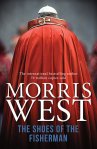
Morris West, The shoes of the fishermanAnd yet, I wonder how many readers here know – or have read – Morris West. He wrote nearly 30 novels, not to mention radio serials, plays and non-fiction, and his work was translated into 28 languages. His most famous novels were The devil’s advocate  (1959), which made him an international best-seller, and The shoes of the fisherman (1963). These, and a few others, were adapted to film.

West was born in Melbourne in 1916, and died in 1999. The Oxford companion to Australian literature says that he was a member of the Christian Brothers order for 12 years, but that he left in 1940 before taking his final vows. This is relevant because he was known for writing about the Roman Catholic Church, particularly regarding its role in international affairs. During World War 2 he worked as a cipher officer and was briefly private secretary to ex-PM Billy Hughes. After the war, he worked in radio, and founded, in fact, Australian Radio Productions.

However, as the A&U blog says, he “was determined to build a career as a writer, and as for so many artists, musicians and writers before the 1980s, the only way to do that was to move overseas.” And so he did, living in Europe and the USA from 1955 to 1980. He clearly maintained contact with Australia during this time because in the early 1960s, he helped found the Australian Society of Authors. The A&U blogger is particularly interested to know why such an apparently successful writer is barely known today, indeed completely unknown to her “younger colleagues”. She offers a few reasons. One is that except for a couple of early novels, all his books are set overseas. “Is Australian literary culture reluctant to acknowledge a novelist who doesn’t write about Australia?”, she asks. Or is it that “an increasingly secular Australia is now uncomfortable reading fiction which takes religion seriously?” Even though he wrote this fiction with a critical eye?

But then there’s the issue of “literary” quality. The A&U blogger quotes the AustLit database as stating that his fiction “has not received a great deal of literary attention.” Kerryn Goldsworthy, writing about Australian fiction from 1900 to 1970 in The Cambridge companion to Australian literature, names West, along with Ion L. Idriess and Jon Cleary, as writers who were very popular in their time but who “tended to be dismissed by their ‘serious’ peers and by later literary historians as middle-brow.”  She describes his books as looking at public institutions, usually political or religious ones, on the international stage and dealing with “the moral dilemmas they pose for the individual”. These three writers are probably the equivalent of my generation’s Colleen McCullough and Bryce Courtenay?
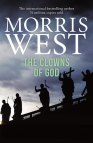
Morris West, The clowns of GodSo, why the interest now? Well, you may not be surprised to hear that Allen & Unwin is re-publishing most of his work – in print and e-version. (The book covers here are from this new series). Author Simon Caterson writing in The Monthly refers to this reissue and asks what West has to offer contemporary readers. Good question. He talks about the subject matter, suggesting that the “fascination with church politics and influence” is of continuing interest. Books keep coming out dealing with these, he says, just think The Da Vinci Code!

What makes West worth reissuing is, he suggests, West’s ability “to turn the intellectual and emotional struggles within his faith – his own and that of others – into gripping melodrama.” Moreover, he says that

it makes commercial sense to bring back the books of Morris West, whose big themes – conscience versus power, the individual versus the institution – are as relatable to the struggles of secular – as much as religious – life.

And finally, there’s the writing. Caterson sums it up this way:

It is also important to note that West could not have sold tens of millions of copies of his books without knowing how to make the pages turn. The prose may sometimes be prolix and the endings not always satisfying, but his writing is always full blooded and, for the most part, remarkably fluent.

Middle-brow perhaps, but a good read it seems. And as someone who loves seeing older Australian writers being read again – even those who didn’t write about Australia! – I’m happy to see this blast from my past being published again. Good on Allen & Unwin. I hope, just as I continue to hope for Text Classics, that they do well.

* Wikipedia says 60 million, but I think that might be based on figures around the time of his death.

Monday musings on Australian literature: Jane Austen and the Stolen Generations

Yes, you read right, this very brief Monday Musings post is about what Jane Austen might have said – did say in her way – about the Stolen Generations.

What makes great literature great is its timelessness. By this I mean the fact that what is said in, say 1815, is still relevant in, say, 2018. It is this timelessness, in particular, that makes me love Jane Austen. She is so right, so often, about human nature and human behaviour. So, while the quote I’m planning to share comes from British not Australian literature, and from 1815 not 2018, it relates closely to an issue that is currently very important to Australians, the Stolen Generations.

Here’s the quote:

There is something so shocking in a child’s being taken away from his parents and natural home. (Emma, ch. 11: Mrs John Knightley on Frank Churchill being removed from his home after his mother’s death)

“Something so shocking”. There’s nothing much more to say, is there … except that …

… when I drafted and scheduled this on February 7 for posting on Monday February 12, I hadn’t remembered that the next day, February 13, was the tenth anniversary of the Australian Government’s Apology to the Stolen Generations. How freaky – but how appropriate – is that? It’s also rather concerning because, as Reconciliation Victoria says:

As we approach the anniversary of the historic Apology we know that Aboriginal and Torres Strait Islander peoples are still grossly over-represented in our prisons, in out-of-home care, are still dying in custody and are still subjected to racism on a regular basis. There is still much work to do.

It’s a continuing blight on our government, on all of us, that we have achieved (are achieving) so little by most measurable standards.

For those who would like to hear the speech PM Rudd made in the Australian Parliament, here is the YouTube link.

Monday musings on Australian literature: AusLit Women Academics on Colonial Women Writers

Over January, some of us Australian litbloggers – as the result of Bill’s (The Australian Legend) AWW Gen 1 Week – have been talking about early Australian women writers. It’s a topic of great interest to me, ever since the 1980s when I became interested in these writers. There seemed to be a flurry, at that time, of academics and researchers writing in this area – and this work has continued. For my benefit – and hopefully for others – I thought I’d document some of those who pioneered this research (in my time anyhow.)

Debra Adelaide

Adelaide (1958-) is probably best known now as a novelist, and I’ve reviewed her most recent novel, The women’s pages, here.  But I first knew of her as a researcher and writer about our older Aussie women writers. I bought both of her books on this topic back when they came out. One is A bright and fiery troop: Australian women writers of the nineteenth century (1988), which is a collection of essays she edited, covering writers like Louisa Atkinson, Catherine Helen Spence, Ada Cambridge and Tasma. (Adelaide acknowledges two woman in my list below, Dale Spender and Elizabeth Webby.) The other, which was published the same year, is Australian women writers: a bibliographic guide (1988). It is a comprehensive list (to the best of her research by the late 1980s) of all Aussie women writers. It includes a brief description of and a list of works by each writer. A wonderful resource.

Patricia Clarke

Clarke (1926-) is a historian focusing on women in nineteenth century Australia, including writers of all forms/genres. her books include Pen portraits: women writers and journalists in nineteenth century Australia (1988), The governesses: Letters from the colonies, 1862-1882 (1989), Pioneer writer: the life of Louisa Atkinson, novelist, journalist, naturalist (1990), Tasma: The life of Jessie Couvreur (1994), and Rosa! Rosa!: a life of Rosa Praed, novelist and spiritualist (1999). With Dale Spender (see below), she also published Life lines: Australian women’s letters and diaries 1788-1840 (1992). I love that these books look at writing beyond fiction – as important as that is – to letters, diaries, and journalism.

Joy Hooton

Hooton (1935-), an academic, is perhaps a bit of a ring-in to this group. She co-authored both The Oxford companion to Australian literature (1986) and the Annals of Australia literature (both of which I have). She is also an authority on autobiographic writing, and has published an anthology of autobiographical writing from the convict era to the present day, Australian lives: an Oxford anthology (1998). Most of the early writers, here, though, are male. However, I’ve included her because her works, particularly the Oxford companion and the Annals, are useful sources for researchers. And because just to be a woman academic, particularly one born pre-WW2, would not have been easy.

Elizabeth Morrison

Morrison (1936-) is another historian of colonial times, but her speciality is the role of the Australian newspaper press as publisher of serial fiction, particularly in the colonial era. She edited two of Ada Cambridge ‘newspaper novels’,  A Woman’s Friendship and A Black Sheep, which were published by UNSW Press, but she has also written many academic articles and given lectures on the subject. I have her edition of A woman’s friendship (republished 1995, orig, 1889), which was published in the Colonial Texts Series series, by UNSW Press (through, surprisingly, the Australian Defence Force Academy where Morrison was based).

Dale Spender

Spender (1943-) is an academic and feminist who has spread her wings wider than “just” Australian women, but her Australian credentials include being founding editor of Pandora Press (which published several of the older Aussie women authors I read in the 1980s, including Rosa Praed’s The bond of wedlock) and a commissioning editor of the Penguin Australian Women’s Library (whose books I also read, including Ada Cambridge’s Sisters). She also wrote Writing a new world: Two centuries of Australian women writers (1988). (Thanks Bill, for the reminder!)

Spender’s wider interests include early British women writers, and in this area her books include Mothers of the novel: 100 good women writers before Jane Austen (1986)You can see why I’m interested in her! I have this book on my Kindle!

You might like to check out her website. I do like her definition of “himitator”.

Elizabeth Webby

You may remember Webby (1942-), because my last two Monday Musings drew from a lecture of hers – but I didn’t say much about her except that she’s a retired academic. She was Professor of Australian Literature at the University of Sydney for nearly 20 years, and has been editor of the literary journal Southerly. She researched both colonial and modern Australian (women’s and men’s) literature, and perhaps her main legacy, publication-wise, is as editor of the Cambridge companion to English literature (2000), which I have. She has written numerous articles and given lectures on colonial literature, including an article on colonial women poets in Adelaide’s A bright and fiery troop. She has also published a bibliography about our early Australian poets, Early Australian poetry: an annotated bibliography of original poems published in Australian newspapers, magazines and almanacs before 1850. Bibliographies make for pretty dry reading, but how important they are!

I thank these, and all the other academics, who thought researching Aussie women writers was an important thing to do. I’m sure it wasn’t always easy.

I’ve only selected a few, of course – those that have been particularly relevant and useful to me – but if you have some favourites in this sphere that you’d like to share, I’d love to hear about them.

Monday musings on Australian literature: Reading aloud in colonial Australia

At the end of last week’s Monday Musings post on literary culture in colonial Australia, I commented that author Elizabeth Webby had also discussed the practice of reading aloud, and that I might do a future post on that. Well, not only might I, but I’ve decided to do it this week because I was fascinated. (Just to recap, last week’s post drew from Webby’s lecture titled “Reading in colonial Australia”, which is available online). And, would you believe, February 1 is World Read Aloud Day!

So, I’ll start briefly with Webby’s discussion and then move on to some of my own research, from Trove of course. She starts by saying that reading aloud remained popular throughout the nineteenth century alongside a rise in silent, individual reading. She writes:

Those worried about the excessive reading of fiction by women and young people were particularly keen to encourage the domestic practice of reading aloud. A father reading aloud to his family in the evening formed an ideal Victorian domestic scene: he could monitor what was being consumed by his wife, sons and daughters; they had the advantage of his company and attention.

(There’s that gender issue again!) She shares information gleaned from diaries. One mother, for example, would not allow Shakespeare while another was very happy to read from Dumas’ 8-volume Celebrated crimes (1839-1841). Webby says this “reminds us that individual readers have always been free to set their own rules about what should be read, ignoring the more restrictive norms of their times.” She also discusses the encouragement of reading aloud for women (“as an alternative to idle gossip as they sewed or carried out other more sedentary household jobs”) and bush-workers (“as a more profitable alternative to gambling and yarning”), and the ongoing concern about what was read (but I discussed some of that last week.)

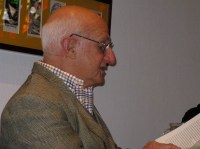
A modern author reading: Malouf reading from Ransom, NLA, 16/8/2009

Webby then describes the rise of “penny reading” in the second half of the nineteenth century. This is the practice of attending public readings for the cost of a penny. While Dickens never toured Australia, as he had Britain and the USA, readings from his books were popular at these penny readings, which were apparently popular in Victoria. There were also “philanthropic” souls who read, free-of-charge, to hospital patients and prison inmates. Webby suggests that regarding readings for prisoners, the authorities would have seen them as having value as “cheap entertainment combined with a controlled use of fiction as a means of moral reformation”. There was, she says, a strong continuing belief in “the humanising value of literature”.

What I found in Trove*

Having read Webby’s discussion, I was keen to see if the topic was discussed in newspapers of the time – and my, was it! It seemed particularly popular in papers of the later nineteenth century, with much of the commentary I found coming from the 1870s. It was generally earnest, and had two main threads: the importance of reading aloud well; and the value of reading aloud (along with a concern that people weren’t doing enough of it).

A long article by Sarah Ellis in the Sydney Morning Herald on 21 January 1870 starts with:

Amongst the accomplishments which belong to education of the highest order, reading aloud ought certainly to hold a prominent place – that is, the art of reading aloud so as to give the full meaning of what is read, and at the same time to charm the ear of those who listen.

She then discusses how reading aloud is so often unsatisfactory, how people adopt a voice that doesn’t change or adapt to the meaning of what they are reading. She suggests that one of the causes is the reduction of reading aloud in the home. Poor education is another cause but an article in the Mount Alexander Mail (25 October 1878) reports on a lecture by Mr T.P. Hill, a well-known elocutionist of the time, who discusses the finding of school inspectors “that this neglected, but important branch of elementary education was moving forward in the right direction”. Unfortunately, though, “in a few districts … complaints were made of the monotonous and sing-song manner in which the voice was allowed to degenerate”.

My final example regarding the issue of reading aloud well, raises again the gender issue. It comes from the Avoca Mail (26 June 1877):

It is much to be regretted that the charming accomplishment of reading aloud is not more cultivated by ladies. … To do this well, a certain amount of study is requisite. First of all, it is necessary to acquire a habit of sustaining the voice; then one must learn to modulate the tones, to attend to the punctuation, and, above all, the reader must have a fair appreciation of the author’s meaning. This involves a study of English literature, which is so sadly needed by most young ladies who are supposed to have a finished education.

Oh dear, those “young ladies”, eh? Gender also comes up in the aforementioned Sarah Ellis’s article, and here I shift into the issue of why people should read aloud. Reading aloud, she says, can “increase the number of our innocent enjoyments”, “make the social hours of life glide pleasantly along”, and “prevent them from becoming vapid or wearisome”. She then separately identifies the value for women and men:

Amongst women, this accomplishment might go far to help them in filling their homes with interest; amongst men, it would help them on all public occasions, when called upon to speak or read.

Oh well, that was then – a woman’s place was in the home. We wouldn’t expect anything different, would we? I should add that Ellis spends some time discussing the best book to read aloud, the Bible, which Webby says would have been the “most-read” book in colonial Australia.

So, reading aloud was seen as good for family togetherness, for entertainment, for education, and for usefulness in the outside world. Indeed, in terms of the latter, the writer in the Ovens and Murray Advertiser (13 October 1877), reporting on another lecture by Mr T.P. Hill, describes it as “an art which at the Bar might save lives, which in the Senate might save nations, and which in the Pulpit might save souls”. Meanwhile, in terms of the former more recreational value, Ellis overlays a moral value, describing it as a “counter charm of a social and intelligent nature to take the place of pleasures which are purely sensational”!

I will end, though, with another reason which you mightn’t have seen coming. It’s from the Queenslander (6 February 1897):

The late Sir Henry Holland says in his ‘”Medical Notes” that persons who have a tendency to pulmonary disease should methodically practice “those actions of the body through which the chest is in part filled or emptied of air.” He advises that those whose chests are weak should read aloud at stated intervals …

World Read Aloud Day 2018See, reading aloud really is good for you!

Do you have any experience of reading aloud as an adult, either reading or listening (besides, that is, reading to children), and if so, I’d love to hear about it? Audiobooks? Live reading?

* Note that when I say Trove, I mean its digitised newspapers subset, because Trove, in fact, currently covers over 560 million “Australian and online resources: books, images, historic newspapers, maps, music, archives and more”. Note, too, that many of the articles I found appeared in many newspapers around the country.

Monday musings on Australian literature: Literary culture in colonial Australia

National Library of Australia
National Library of Australia, from the other side of Lake Burley Griffin

Bill of The Australian Legend’s AWW Gen 1 Week, which has just finished, focused on the authors and the books they wrote about colonial Australia. However, what about the readers? I’ve been planning to write a post on literary culture in colonial Australia for some time, and today seems to be just the right time! My post draws heavily on retired academic Elizabeth Webby’s 2011 John Alexander Ferguson Memorial Lecture titled “Reading in colonial Australia” which was published in the Journal of the Royal Australian Historical Society (vol. 97, pt. 2) in December 2011 (available online). Webby starts by recognising the work done by lawyer-book collector-bibliographer Ferguson whose much-researched collection is at the National Library of Australia and who is commemorated there by the Ferguson Room.

It’s a fascinating lecture, for the content and for the discussion of the information sources Webby used to discover who read what in colonial Australia (1788 to 1901). (I’m always interested in the research process.) There are letters, of course, from colonists back to home, asking for books. Then there are advertisements listing personal libraries for sale. Early explorer George Bass’s library for example contained mostly books on medicine, science, law, theology plus classical authors like Horace, Virgil and Homer. A library typical of “gentlemen’s libraries of the period”. It contained very little fiction.

Another explorer, a couple of decades later, was John Oxley. His library was sold in 1828, and, Webby writes, it

displayed a decidedly stronger taste for fiction, indicating the shift towards novels as the main form of recreational reading which began in this period, although still deplored by many. When John Oxley’s library was sold by auction in Sydney in August 1828 about half of the 330 or so lots listed in the catalogue were works of fiction. They included such recent publications as Sir Walter Scott’s Tales of the Crusaders (1825), the American novelist Fenimore Cooper’s The Prairie (1827), as well as Gothic thrillers like Anne Radcliffe’s Gaston de Blondeville (1826) and Mary Shelley’s early science fiction tale Last Man (1826). Oxley clearly was a regular purchaser of the latest English books.

Later in the article, discussing attitudes to women readers, she refers to the sale of “a lady’s library” in 1833. While she didn’t see a list, it was described as comprising ‘upwards of six hundred volumes, chiefly standard Works, by the most esteemed ancient and modern authors, forming altogether a collection of English Literature rarely to be met with out of Europe'”. She uses this to counter the belief that women only read fiction!

Another fascinating source of information about what people were reading are advertisements for missing books. Fascinating. Besides providing information about what people had in their libraries, they also tell us how precious books were. In some of the ads she found, people threatened legal action or offered rewards. So, of course, I went to Trove to see what I could find. I found some of those Webby describes, but I also found one from June 1830 that seemed to be about recalling books that had been lent out and were now needed back for an estate auction. The list is fairly long, and looks like one of those aforesaid typical “gentlemen’s collections”. It has classics, sermons, theological works, essays, dictionaries and so on, but very little fiction, except for Sir Walter Scott, who’ll appear again later! The list ends with the statement that “The Public are also informed, that this extensive and valuable Library will in a short time be sold by Public Auction, of which due notice will be given. As Mr. HOWE’S Library is well known, it would be useless to make further comments at this time.” Clearly they expected the books to be returned, but I wonder what sort of comments it was useless to make?

Webby also explores lending libraries. They varied greatly. Some were set up by churches, and focused on morality and religion, with “frivolous” or “pernicious” publications being excluded. Some were created for “the colonial elite”, such as the Hobart Town Book Society and Sydney’s Australian Subscription Library. And some were set up to provide reading matter for working people. These were the Mechanics’ Institutes and Schools of Arts whose buildings are still familiar sights in Australian country towns. The short-lived Hobart Town Mechanics Institute was founded in 1827, and Sydney had established its Sydney Mechanics’ School of Arts in 1833. By 1834, it had “upwards of five hundred volumes … consisting of works on science, history and general literature, chiefly contributed by the liberal donations and loans of members and friends.” Indeed, Webby makes several references to people being asked to donate books from their own libraries to, for example, make them available to “the enquiring mechanic, who can find time to dive into their contents.” In truth, though, mechanics did not comprise the main memberships of these organisations.

And here is a good point to discuss what Webby calls the fiction debate. Those of you interested in the history of reading will know that novels were disparaged for a long time. I’ve written before about Jane Austen’s famous defence of the novel in Northanger Abbey, in which she described them as works

in which the greatest powers of the mind are displayed, in which the most thorough knowledge of human nature, the happiest delineation of its varieties, the liveliest effusions of wit and humour, are conveyed to the world in the best–chosen language.

Northanger Abbey was published in 1817 so Austen’s defence is contemporaneous with the period we are discussing. Webby quotes James Ross, editor of the Hobart Town Courier, as supporting novel-reading in 1831. He defended the so-called “frivolous” reading tastes of members, arguing that recreational reading was valid after the “toil of a long day in some official, public or private arduous operation.” He also argued that reading English novels was, as Webby puts it, “almost a patriotic duty”, because these books

keep alive in no small degree that amor patriae, that attachment to our mother country and that familiarity with the manners and relish for the habits of our countrymen which is at all times so desirable.

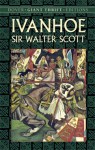
Sir Walter Scott, Ivanhoe
Ivanhoe, first published 1819.

Webby identifies some of the fiction that was being read – including Jane Austen, Charles Dickens and Bulwer Lytton – but the author who pops up most frequently in her survey of the early to mid-nineteenth century is Sir Walter Scott. The first book order from the 1826-established Australian Subscription Library, for example, included only one novelist, Scott.

And the 1836 report of the Sydney Mechanics’ School of Arts defended the inclusion of novels in its library, with the argument, you’ll see, that is still used to defend, for example, the reading of comics. The report says:

… it ought to be remembered, that a taste for reading has to be formed before works of a more philosophical character will be relished or appreciated, and that if any book is likely to accomplish this more speedily than another, it is the works of Scott–containing, as they do, a vast fund of historical information, mixed up, in an agreeable shape, with the manners and customs of different periods.

Webby discusses much more, including the role of periodicals and newspapers in reading culture. She also writes about “reading aloud”, but I might save that for another post.

It’s clear from Webby’s lecture that the information available was scattered and incomplete. She praises Evandale Subscription Library in Tasmania which “stands out for the completeness of its records”. Please note this any of you who are currently involved in organisations, such as reading groups: keep your records! One day, some researcher will want them!

Monday musings on Australian literature: Tasma (aka Jessie Couvreur)

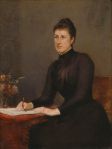
Tasma, c. 1890. (Public Domain, from the State Library of Victoria, via Wikipedia)

This week Bill (of The Australian Legend) is running an Australian Women Writers Gen 1 Week, through which he plans to highlight Australian women writers from our first generation of writers, which he defines as “those writers who came before the 1890s and the Sydney Bulletin ‘Bush Realism’ school, although many of them continued writing into the first part of the 20th century.” These women, several of whom I read before blogging, include Louisa Atkinson, Ada Cambridge, Rosa Praed, Catherine Helen Spence, and Tasma. I have written about some of these writers before, particularly Louisa Atkinson and Ada Cambridge, so today I’ve decided to highlight Bill’s week by writing on another, Tasma, whose book Uncle Piper of Piper’s Hill I’ve promised to contribute to his project.

Who was Tasma?

Born Jessie Huybers in London in 1848, Tasma (as she later styled herself) came to Hobart, Australia, with her parents in 1852. Her family was apparently among the more prominent in Hobart, with their friends including successful author Louisa Meredith (1812-1895) and her husband Charles. In 1867 Tasma married the 25-year-old Charles Fraser moving to Melbourne with him. However, the marriage was troubled and Tasma returned to Hobart in 1872, leaving her debt-ridden husband behind. The following year she sailed to England with her mother and youngest siblings, and spent the next couple of years soaking up European culture with her family. Returning to Melbourne and her husband in 1875, she discovered that he’d had a child with a servant. With divorce, particularly initiated by women, rare, they remained married but lived mostly separate lives.

She started writing in 1877, taking the pseudonym Tasma to honour the colony of her youth, and in 1878 her first articles were published. In 1879 she returned to Europe with her mother and some siblings, determined to earn her living as a writer. This also marked the final break with Charles, and they were divorced in 1883.

And here I’ll quote biographer Patricia Clarke (see below):

Tasma’s life deserves to be much better known, and not only because of her now almost forgotten fame as a novelist. Just as interesting and more gender-defying, she was also an acclaimed public lecturer in Europe, and a foreign correspondent for the London Times, both roles that contradicted the perception of women as solely home­bound. In her personal life also, Tasma defied all the stereotypes of the nineteenth-century woman by separating from, and divorcing, her first husband.

DPAC’s article (see below) describes her as “a celebrity lecturer” on the “geography, history, industries, culture and social progress of Australia” and says that her lectures were reported in French, Belgian and other newspapers. She met the eminent and more compatible, albeit significantly older, Auguste Couvreur in 1881, and married him in 1885, but before that, writes Clarke:

For six years before her second marriage, Tasma lived the life of a ‘New Woman’, the independent woman then beginning to appear both in real life and in fiction. From her base in Paris she earned her own living and was involved in the radical issues of the day. An interviewer wrote, ‘She was not a woman to hide the light of her militant radicalism under a bushel. When pressed to talk about her method of writing, she spoke instead of the latest developments in collectivism, and made an impassioned plea for the poor’.

Sadly, Jessie Couvreur died in 1897 of coronary heart disease, just before her 49th birthday. Way too young for someone who clearly gave a lot to her times.

What did she write?

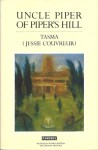
Tasma, Uncle Piper of Piper's Hill

During her life, Tasma wrote, according to the DPAC article, 7 novels, 20 short stories (several set in Tasmania) and over 36 articles on a variety of subjects. Uncle Piper of Piper’s Hill, her first novel, was published in 1889, and her last, A fiery ordeal, was published, posthumously, in 1897, the year she died.

In her chapter in Debra Adelaide’s A bright and fiery troop, Margaret Harris quotes 20th century poet and novelist Winifred Birkett’s claiming Tasma as Australian

… in spite of her Dutch-French parentage, English birth, Belgian marriage, and long continental residence and professional career! She has been called by people who cannot get away from systems of category and comparison, “the Australian Jane Austen” and “the Australian George Eliot”, but without bringing her under the patent of any other writer’s name we may remember her simply as the “Tasma” of her own titling, and Australian enough by such an implication.

Interesting! Of course, I did my own bit of research in Trove and found some similar references from her 19th century contemporaries. One article in Tasmanian News (11 August 1892) reported on an interview conducted for a “Celebrity at Home” column in The World journal, writing that “Her interviewer credits her with much of the spirit of Thackeray and George Eliot, which, in combination with marked originality, is the secret of her success.” And an article from the year before in Tasmania’s Mercury (21 January 1891) writes that

The favourite Christmas book of 1888 [Uncle Piper] went through three editions before January, 1890. The success of her last two works has been equally marked, and Mr. Edmund Yates, the most competent of judges, regards her as a story writer of extraordinary power. “Uncle Piper” may very likely live as long as “Charles O’Malley,” and it is not impossible that one of “Tasma’s” literary efforts in the Chaussée de Vleugrat [sic] may yet attain the immortality of “Villette.”

Tasma, The penance of Portia James

Strong praise, eh! I’ve only read 20% (on my Kindle) of Uncle Piper to date, and, while the style owes more to late Victorian than to Jane Austen’s Regency/Georgian era, I can see the comparison in some of the cheekiness I’m reading. To see Eliot, Thackeray and/or Bronte, I think I’ll need to read more!

I won’t say more about her writing, except to share a comment made by Clarke regarding her descent into obscurity:

The usual explanation for her obscurity is that, like other Australian women writers who wrote about love, marriage and domestic relationships and whose main characters were women, her reputation has been overtaken and submerged by the Bulletin school of almost exclusively male writers who emerged in the 1890s. These writers glorified the traditions of mateship and the bush to establish what came to be seen as the authentic picture of Australia. Perhaps Tasma’s later obscurity was influenced by the fact that she died at a relatively young age, that for the second half of her life she lived in Europe, and that she had no direct descendants to keep her memory alive. Other nineteenth-century Australian women writers, such as Ada Cambridge and Rosa Praed, lived much longer, the former in Australia and survived by children, but this has not saved them from a similar, if perhaps less marked, obscurity.

If you’d like to know more, check out the sources below and/or watch for my post later this week …

Sources

Beilby, Raymond. ‘Couvreur, Jessie Catherine (1848–1897)’, Australian Dictionary of Biography, National Centre of Biography, Australian National University, published first in hardcopy 1969.

Clarke, Patricia. ‘In the steps of Rosa Praed and Tasma: Biographical details: A lecture by Harold White Fellow, Patricia Clarke‘, National Library of Australia, Canberra, 1993

‘Couvreur, Jessie Catherine (1848–1897)’, Obituaries Australia, National Centre of Biography, Australian National University. Also available in the original form at Trove, titled “The late ‘Tasma’ Courvreur”, The Mercury, 27 October 1897.

Harris, Margaret. ‘The writing of Tasma, the work of Jessie Couvreur’, in A bright and fiery troop (ed. by Debra Adelaide), Ringwood, Penguin Books, 1988.

‘Tasma (Jessie Couvreur nee Huybers)’, in Signifiant Tasmanian Women, Department of Premier and Cabinet (DPAC) (Tasmania). (Entry based on Patricia Clarke’s Tasma: The life of Jessie Couvreur, 1994)

Monday musings on Australian literature: Some New Releases in 2018

This, you may be pleased to know, is the last of my set of end-of-year-beginning-of-year posts. And, as is obvious from the post title, it’s about books that will be published this year. As in previous years, I’ll just be sharing a selection of those that interest me (though listing them doesn’t mean that I expect to read them all, just that they interest me!!) A quick scan of last year’s list shows that I read about 20% of what I listed, though a few more are on the TBR pile, so you never know.

My list, as in previous years, is mostly drawn from Jane Sullivan’s article in the Sydney Morning Herald. And, because this is a Monday musings on Australian literature post, my list will focus on Australian authors – and will be listed alphabetically by author.

Fiction

  • Jenny Ackland’s Little Gods (Allen & Unwin, April)
  • Stephanie Bishop’s Man out of time (Hachette, September)
  • John Clanchy’s Sisters (La Muse Books, early 2018)
  • Ceridwen Dovey’s In the garden of the fugitives (Hamish Hamilton, March)
  • Justine Ettler’s Bohemia Beach (Transit Lounge, April). I admit that I hadn’t even heard of her until Bill (The Australian Legend) posted on her recently.
  • Rodney Hall’s A stolen season (Pan Macmillan, April)
  • Rosalie Ham’s The year of the farmer (Pan Macmillan, no date but later in the year)
  • Gail Jones’ The death of Noah Glass (Text, April). I have yet to read Jones. Maybe this will be it.
  • Thomas Keneally’s Two old men dying (Vintage, October) seems to be inspired by Mungo Man, whose story I’ve researched in the past.
  • Eleanor Limprecht’s The passengers (Allen & Unwin, March) which interests me given I enjoyed her historical novel, Long Bay (my review)
  • Melissa Lucashenko’s Too much lip (UQP, August) which I’d love to read, as I’ve reviewed short stories and essays by her here, but not a novel.
  • Kristina Olsson’s Shell (Scribner, October)
  • Avan Judd Stallard’s Spinifex and sunflowers (Fremantle Press, February) is inspired by the author’s experience while working in a refugee detention centre.
  • Tim Winton’s The shepherd’s hut (Hamish Hamilton, March) apparently has “an anti-hero who will break your heart”.

Short stories

Yes, I know these are fiction too, but they deserve a special section!

  • Robert Drewe’s The true colour of the sea (Hamish Hamilton, September). Another Drewe book title inspired by the sea, like The bodysurfers, The drowner, The rip and Sharknet!
  • Anna Krien’s Act of grace (Black Inc, September) is a debut collection from an established non-fiction writer whom I’ve reviewed here a few times.
  • Gerald Murnane’s collection of short fiction from the last 30 years (Giramondo, April): I’ve reviewed a couple of his works to date.

Non-fiction

Sullivan provides a rather long list of new non-fiction books, including several memoirs, so I’m going to be very selective here (which will give away my interests – but you know them already so it won’t really surprise you!)

  • Behrouz Boochani’s Manus (Pan Macmillan, June): memoir by journalist and detained asylum seeker, written on a smuggled cell phone
  • Danielle Clode’s The wasp and the orchid (Pan Macmillan, April): biography of Australian naturalist Edith Coleman
  • Anita Heiss’s Growing up Aboriginal in Australia (Black Inc, April): an essay anthology
  • Kon Karapanagiotidis’ The Power of Hope (HarperCollins, July)refugee memoir by the founder of the Asylum Seeker Resource Centre
  • Hung Lee’s The Crappiest Refugee (Affirm Press, March): memoir by comedian, the title clearly satirising Anh Do’s 2010 memoir, The happiest refugee!
  • Michelle Scott Tucker’s Elizabeth Macarthur: A life at the edge of the world: biography by the delightful blogger MST (Adventures in Biography) whom I met early-ish in this book’s journey. Check out her blog for the fascinating story of its genesis
  • Anne Summers’ Becoming (Allen & Unwin, no date): memoir by one of Australia’s best-known feminists
  • Gillian Triggs’ Speaking up (UQP, October): memoir
  • Majok Tulba’s When elephants fight (Hamish Hamilton, August): memoir, by Sudanese refugee, a follow-up to his Beneath the darkening sky
  • Maria Tumarkin’s Axiomatic (Brow Books, May): described as “part-cultural history, part-essay, and part-memoir [on] how we look at the past”
  • Fiona Wright’s second essay collection (Giramondo, September), which I look forward to, having liked her Small acts of disappearance in 2016.

Do you actively look out for coming releases, or just wait until they appear and you read or hear about them?

Monday musings on Australian literature: Australian Women Writers Challenge 2017

aww2017 badgeAs has become tradition, I’m devoting my last Monday Musings of the year to the Australian Women Writers Challenge*. But, this time, my last Monday Musings also coincides with Christmas Day, so I wish a happy, peaceful holiday season to all my readers here who celebrate this time of year, however or whatever you celebrate.

Now, on with the show … This year has been an active one at the Challenge with a significantly increased number of reviews, in my area at least. We’ve also, with the help of new Challenge volunteer Theresa Smith (of Theresa Smith writes), published a large number of interviews with authors in our Spotlight series and, through connections made by Challenge founder Elizabeth Lhuede, published several posts on classic Australian women writers. In other words, we are extending the content on the blog to make it a broader resource beyond our round-ups and the reviews database which is, of course, the backbone of the challenge. The database now contains reviews for over 4,400 books across all forms and genres of Australian women’s writing, from all periods. This represents an increase of over 20% on last year’s total. Another good achievement.

Once again the Challenge ran some special events during the year, achieved some milestones, and introduced some new initiatives. These include:

  • Spotlights: Throughout the year we posted a variety of Spotlights – Saturday and Sunday Spotlights comprised author interviews (of which I did two, with Sara Dowse and Dorothy Johnston), Small Press Spotlights in which we featured some of Australia’s small publishing houses), and spotlights on classic women authors, like Ada Cambridge.
  • Facebook Page: Our Facebook Page – Reading Australian Women Writers – which was created last year, continues to attract readers wanting to share their latest Aussie women writers’ reads.
  • Bingo: We ran our second Bingo challenge – two in fact, one general, one classic – but I let it slip. Next year I will try a reminder system, although I’m not keen to overfill my blog with non-review content.
  • New releases: We are playing with how to capture and promote upcoming releases. We haven’t settled on the perfect process yet. Watch the blog for more on this.
  • Diversity: Once again author and researcher Jessica White coordinated a series of guest posts by “diverse” writers. There were posts by writers living with mental illness, by lesbian/queer writers, and others. These sorts of posts help make the AWW blog stand out from the crowd.

My personal round-up for the year

Let’s start with the facts, followed by some commentary. By the end of the year I will have posted 30 reviews for the challenge, the same as last year. Here they are, with links to my reviews:

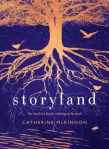
Catherine McKinnon, StorylandFICTION

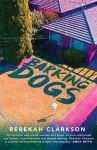
Rebekah Clarkson, Barking dogsSHORT STORIES

POETRY and VERSE NOVELS

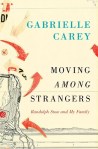
Gabrielle Carey, Moving among strangersNON-FICTION

I’ve noticed an interesting trend over the last three years in my Aussie women’s reading – a noticeable decrease in the proportion of novels:  48% in 2015, 40% in 2016, and just 34% this year. I’m not sure why this is, but I have been aware of reading more non-fiction this year – more by accident than on purpose. The types of novels I read changed from last year too, with very few debut novels this year as against nearly half last year, and two classics as against none last year!

Indigenous writers represented 10% of my total, with two books by Ali Cobby Eckermann and one by Ellen van Neerven. And memoir featured significantly – again – in my non-fiction reading, though they weren’t all your traditional memoir, one being an essay anthology, and two being what I would call “hybrids”. Overall, I’m reasonably satisfied with the diversity of my contribution – though I could always do better.

Anyhow, if you’d like to know more, check out the challenge here. The 2018 sign up form is ready, so do consider joining us. All readers are welcome. I’ll be there again (this being my sign-up post).  The challenge is also on Facebook, Twitter (@auswomenwriters), GoodReads and Google+.

Finally, a big thanks to Theresa, Elizabeth and the rest of the team – including my longtime online bookgroup friend Janine Rizzetti (Resident Judge of Port Phillip), who joined us this year. Once again it has been a positive experience, which is a credit to the willingness and flexibility of those involved. See you in 2018.

* This challenge was instigated by Elizabeth Lhuede in 2012 in response to concerns in Australian literary circles about the lack of recognition for women writers. I am one of the challenge’s volunteers – with responsibility for the Literary and Classics area.

Monday musings on Australian literature: Pulp fiction, 1940s to 1970s

This post was inspired by the Pulp Fiction exhibition* at the Canberra Museum and Art Gallery that ran from August to October this year. The exhibition used materials from two collectors, Graeme Flanagan (d. 2015) and James Doig, who also wrote the accompanying booklet. Doig says that Flanagan “amassed one of the most significant collections of Australian pulp fiction paperbacks”. He also collected original cover art, and in 1994 wrote Australian vintage paperback guide, which was apparently the first detailed book about Australian pulp fiction and is still an authority on the subject.

Most of you probably know what pulp fiction is, but if you don’t, it encompasses cheaply produced “mass market paperbacks and digests” in popular genres such as Westerns, crime, romance, adventure, science fiction and horror. Printed on “pulp” paper, they were not made to last and were poorly regarded by the literati of the time. But, of course, they were part of Australia’s reading culture and are now being recognised for the cultural objects they are. Because of their cheap production and disposability, however, they can be tricky to find – and, says, Doig, even Australia’s legal deposit libraries don’t hold complete collections.

Doig starts by referring to an article in the Tribune titled “I spent a week in a literary sewer” by journalist Rex Chiplin who wrote about the “muck” – “the pornography, sex, sadism, brutality and illiteracy” – being sold weekly on Australian newsstands. He wanted to find out where it all came from – but I wanted to find out who Rex Chiplin was. Well, I found out, via a blog called Ethical Martini, that he was a communist, which is not surprising because, as most Australians would know, the Tribune was the Communist Party of Australia’s newspaper.

Apparently Chiplin was called before Australia’s version of the USA’s McCarthy hearings, the Royal Commission on Espionage (1954-55), but the tidbit I want to share is Ethical Martini’s quoting another communist journalist, David McKnight, on Chiplin. McKnight wrote:

One unusual piece of exposure journalism was the pamphlet, “Facts Behind the Liquor Commission”, printed by the Communist Party of Australia at its underground printery which set out to expose capitalism in the shape of the ‘brewery barons’. Written by a journalist (probably Rex Chiplin) who had a racy turn of phrase (‘Bottled beer was as rare as a bankrupt Vice Squad sergeant’) the pamphlet incidentally exposed corruption in the labour movement…

It’s the “racy turn of phrase” that caught my attention, because it is certainly in evidence in the “sewer article” where he describes, for example, the directors of a magazine publishing company, American-Australasian, as “all North Shore pukka sahibs.” A little further on he describes a magazine called Action Detective Stories as “good wholesome literature for homicidal maniacs and similar unfortunates”. He criticises these “sewer” magazines’ forays into political commentary about the Korean War and Soviet behaviour in southeast Asia – but, I’m getting offtrack, so let me just share what he writes about Consolidated Press:

Consolidated Press, Frank Packer’s organisation … publishes a host of crime, sex and violence comics and the Phantom and Star paper-covered novels. Phantoms and Stars are direct reprints, lurid covers and all, of American gutter novelettes which are churned out by the score in “pulp factories.”

By reprinting they apparently circumvented import restrictions. Doig says that “Phantom Books … reprinted more than 300 of the best American crime novels between 1953 and 1961 and is a highly desirable series.”

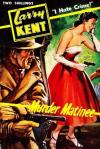
Larry Kent, Murder MatineeAnother company named and shamed by Chiplin was Cleveland, which our mate Doig says is the only pulp publisher still active (in Australia) today – focusing these days on westerns. Cleveland was also known for the Larry Kent I hate crime series which “was named after a 1950s Sydney radio show [preserved at the National Film and Sound Archive] about a hard-boiled New York detective”. The radio series commenced in 1950, and its popularity inspired, says The Thrilling Detective website, Cleveland “to try their hand at some Larry Kent novels”. They were written by American expat Don Haring through “an arrangement” with the radio producer. The first series of these monthly novelettes commenced in April 1954.

The Thrilling Detective explains that:

over 400 Larry Kent novels and novelettes were pumped out under the Larry Kent byline in the next thirty years, and supposedly, as late as the 1990s, the series was still being produced in Scandinavia. The covers usually featured paintings of leggy, full-figured babes and sported such snappy (and often exclamation mark-endowed) titles as Kill Me a Little!, This Way, Sucker!, Cute Heat!, Dig Me a Dame! and Stand Up and Die! Add on the 150 or so radio shows, and our Larry turns out to be one of the hardest working eyes around…

If you, like me, ever give pulp fiction a thought, it is probably for these covers, “lurid” though Chiplin thought they were. As The Thrilling Detective says:

Although the books were decidedly hokey pulp affairs, and by no means great literature, the covers themselves have a gorgeously cheesy flavour, and are now quite collectible. In fact, most of the web sites featuring Kent deal as much with the covers than the contents of the books.

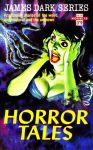
Horror tales, illustrated by Frank Benier

Illus. Frank Benier

Doig says that selling these books, which happened at stalls and newsagents on street corners and railway stations, was a competitive business. So “the cover was all important, the more colourful and garish the better.” He names some of the illustrators who did these covers – Stan Pitt and Walter Stackpoole (for Cleveland), and Col Cameron and cartoonist Frank Benier (for Horwitz). It is these covers as much as anything which now make these books highly sought after – and highly exhibitable!

Have you ever read any pulp fiction – or, even, are you a collector? I’d love to know.

* Images from the exhibition can be seen on Pinterest.

Monday musings on Australian literature: ABC RN presenters name their 2017 summer picks

Well, folks, it’s getting to the time of year when people start producing lists, and so, as last year, I’ll be joining the fray, starting this week with books recommended by ABC Radio National’s presenters – the bookworms amongst them, anyhow – for us to read over the coming summer.

However, as last year, not all chose Aussie books, but this post is in my Monday Musings on Australian Literature series, so what to do? Last year I decided to share them all, starting with the Aussie reads, and I’ve decided to do the same this year. After all, the things Aussies read form part of our literary culture don’t they?

Notwithstanding the above, I was disappointed last year when only two (TWO!) of the 18 presenters chose books by Australian authors. (The two books were Stan Grant’s Talking to my country and Helen Garner’s Everywhere I look, both of which I’ve read)I’m consequently thrilled that the number is far greater this year, with SIX (that is, nearly half) of the 14 presenters choosing Australian authors. Here they are:

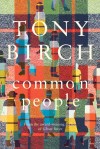
  • Tony Birch, Common peopleMichael Cathcart (Books and Arts): Tony Birch’s Common people. Birch recently won the Patrick White Award, and his novels Blood and Ghost River were both shortlisted for significant Australian literary awards. Common people, however, is his (latest) collection of short stories. Cathcart says that the stories “take us into the lives of very ordinary people — often people who are doing it tough — and open up the pain, the wit and the twinkle of their worlds. Tony’s wisdom and goodwill are beyond politics. His prose breathes with humanity”. How I love short stories, and this sounds like another great collection.
  • Andrew Ford (Music Show): Ashley Hay’s A hundred small lessons. This is Hay’s third novel, her second The railwayman’s wife having won or been nominated for several literary awards.) Ford says that Hay’s writing “is so simple and precise, at first you fail to notice how powerful it is” and says that “the main character in the book is Brisbane — actually, two Brisbanes, 50 years apart, culturally different in so many ways, yet both sticky, subtropical, and prone to flooding”.
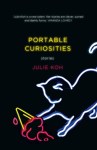
  • Ann Jones (Off Track): Julie Koh’s Portable curiosities. Koh is a critically well-regarded short story writer, and this, her first full collection, has received many accolades including her being named a 2017 Sydney Morning Herald Best Young Australian Novelist (though the “novelist” nomenclature is a bit weird.) Jones makes the collection sound great, when she says “The stories are dark and make fun of hipsters. In fact, in gorgeous and believable flow, Koh unleashes a portmanteau of fables, which take on body image, racism, father-son relationships and cat cafes.”
  • Sarah Kanowski (Books and Arts): Tex Perkins’ (with Stuart Coupe) Tex. Unlike many of the presenters it seems – see my summation below – Kanowski took the “summer read” recommendation seriously in choosing this memoir of Australian rock musician Tex Perkins. She said “In Tex, he is self-deprecating but not apologetic: yes he’s drunk too much, been an idiot, sabotaged his chances of commercial success, but he has also made great music and, above all, had fun. There are nobler aims in life and wiser books, but if you’re sitting on a beach towel with a beer this summer Tex will serve you brilliantly.”
  • Amanda Smith (Life Matters)Sarah Krasnostein’s The trauma cleaner. This is a biography of an amazing – but ordinary – person, Sandra Pankhurst, who was born a boy, “was adopted into an abusive family”, and then married, as a man, before deciding to live as a woman. It just so happens she also works as a trauma cleaner, that is, one who “cleans up crime scenes after the police have finished” and who  “also sorts things out after ‘unattended deaths’.” Smith says that not only is the book a “tribute to a life-force” is “a story told more beautifully than you can possibly imagine.”
  • Julia Barid, Victoria the queenRobyn Williams (Science Show and Ockham’s Razor): Julia Baird’s Victoria the Queen. Williams noted that in 2017 he’d mostly read books by women, with this biography of Queen Victoria being his best book of the year. He bought it because he loves Julia Baird’s journalism, is “impressed by her range, deep learning and clarity”. He says that this biography “surprises, informs with real scholarship and tells a huge story with a light touch. When I finished I felt as if my brain had grown an extra layer.” I wouldn’t mind an extra layer in my brain, I must say!

Four chose British authors:

  • Joe Gelonesi (Philosopher’s Zone): Stephen Mumford’s Glimpse of light: New meditations on first philosophy (non-fiction)
  • Patricia Karvelas (RN Drive, and the The Party Room podcast): Natalie Haynes’ The children of Jocasta (fiction, Greek myths retold through the women characters)
  • Keri Phillips (Rear Vision): Tim Harford’s Fifty things that made the modern economy (non-fiction)
  • Andrew West (Religion and Ethics Report): David Goodhart’s The road to somewhere: The populist revolt and the future of politics (non-fiction)

And four chose American authors:

  • Kate Evans (Books and Arts): Jennifer Egan’s Manhattan Beach (novel)
  • Antony Funnell (Future Tense): Sarah Sentilles’ Draw your weapons (non-fiction)
  • Natasha Mitchell (Science Friction): Oliver Sacks’ The river of consciousness (non-fiction, collection of essays)
  • Scott Stephens (The Minefield: Noah Feldman’s The three lives of James Madison (non-fiction).

Julie Koh, Portable curiositiesSo, a more even spread than last year’s, but still oh-so-very Western-based. Last year, only ONE presenter chose a non-Western book, with all the rest choosing, as this year, Australian, British and American. This year there’s not even one non-Western book. However, both years, an indigenous author was chosen – just one, but that’s something. And, the choice of Julie Koh provides some nod to diversity too, as she’s the Australian-born daughter of Chinese-Malaysian parents.

The biggest difference this year, besides the significant increase in Aussie picks, is in the fiction-non-fiction ratio. Last year NINE (that is 50%) of the choices were for fiction (all novels), but this year only FIVE (35%) are, and of these, two are novels, two are short story collections, and one a collection of myths. This sort of selection is probably not what most readers might expect when looking for summer reads, but our ABC RN presenters are clearly a serious lot!

What ONE book would you recommend from your 2017 reads for, let’s be inclusive and say holiday, not summer, reading?