I started my post on Tech noir with the comment that the genres and sub-genres just keep on coming, and I have another one that I’ve been saving up for you – quarry noir. I read about it some months ago – in The Conversation – and have been saving it up. Its time has now come. The article was a Friday essay titled Australia’s ‘quarry noir’ mines our anxiety about our biggest industry, and was by Meg Brayshaw, who lectures in Australian literature at the University of Sydney.
Brayshaw opens with:
A geologist is bludgeoned to death with his own hammer. An opal prospector is murdered, his body found crucified down a mine shaft. An entire family disappears, apparently dragged down into the mined-out spaces below an abandoned gold rush town. These are just some of the crimes in a growing body of contemporary Australian crime fiction that combines the nation’s most profitable industry, mining, and its most profitable literary genre, crime.
And then says that 2025 was a boom year with eight Australian novels in the genre, including Last one out by Jane Harper of “outback noir” fame. I’ve said it before, and I’ll say it again, crime is not my thing, but, I do read some – and, anyhow, I don’t think we have to read avidly in an area to be interested in it. Crime is a good example, because the genre can, and very often does, address contemporary issues, hence rural/outback noir, tech noir and quarry noir, to name just some examples of recent trends and interests.
Definition
I’ll start with a definition. In her article Brayshaw says that she divides most of the mining crime novels she cites into two categories: extractive crime fiction and quarry noir. In the former, she says, “the mining town is simply a convenient backdrop for the now-familiar beats of the rural crime narrative”. These novels do not engage in “sustained consideration of the social, political, economic or environmental aspects of the mining industry” which she sees as defining quarry noir. In other words, quarry noir
uses crime fiction to engage in more complex ways with mining and its role in shaping Australian environments, communities and politics. The term “noir” draws on definitions that emphasise an anxious, ambiguous tone, generated by engagement with what we both desire and despise. (Think: the classic noir femme fatale.)
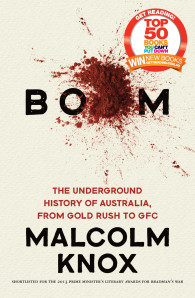
She quotes journalist Malcolm Knox (whose novel Bluebird I’ve reviewed) as arguing ‘that Australia suffers from a “national anxiety” about mining’:
Mining has given a way of life to generations. Mining has made Australia not only viable but rich. Mining has also left a trail of death, environmental destruction and the dispossession of traditional owners. For every great mining entrepreneur and nation-builder, it has created a hundred ratbags, frauds, liars and victims. (from Knox’s 2013 book, Boom: The underground history of Australia, from Gold Rush to GFC)
Quarry noir, then, says Brayshaw, reflects the paradox that mining is “seemingly necessary to Australia’s prosperity and way of life” while simultaneously being “environmentally and socially destructive”. It encompasses an almost unreconcilable tension that leads to “the politically ambiguous ending typical of noir”. The sub-genre “attempts to address real concerns about the social, environmental and political impacts of Australia’s reliance on mining”. In doing so, as you would expect, it “connects these issues to the darker aspects of the industry’s history and its uncertain future”. There is something more complex here, in other words, than in crime set in or around mining towns, that might focus on violence or corruption but that doesn’t engage with these inherent sociopolitical contractions and tensions.
Mining, perhaps more than any other industry, is positioned to embody tensions in Australian culture and politics. It is central to conflict between settler assumptions about rights to land when that land already had (has) owners; it is implicated in climate change; its boom-and-bust cycles are central to our worst behaviours in terms of corporate greed and corruption; and so on.
Some Australian Quarry Noir
Brayshaw says she found “almost 40 mining crime novels published in a roughly 25-year period (1999–2025), set in every state except Lutruwita (Tasmania)”. They cover “all of Australia’s major modes of mineral extraction, from alluvial gold mining to open-cut iron ore and coal”, drawing their “requisite victims, red herrings, suspects, perpetrators and twists” from our mining places and culture. Most, she found, were adult contemporary-set novels, but she also found historical mining crime novels and young adult mining crime. She discusses examples of both quarry noir and extractive crime fiction, but my focus here is quarry noir.
Brayshaw groups her selected novels thematically, but, while The Conversation’s Creative Commons licence is generous, I don’t want to simply repeat her work here, so I will include just a few titles alphabetically by author, and suggest you read the article for her analysis.
Selected Australian quarry noir novels:

- Alan Carter, Prime Cut (2011, reviewed by Bill and Kim): one of three novels Brayshaw selects to represent “the promises and perils of mining booms”, it “considers the social cost of mining on small communities [and …] the mining industry’s overlap with economic exploitation and racial violence”.
- Chris Hammer, Treasure and dirt (2021): this novel starts, says Brayshaw, as extractive fiction and ends as quarry noir. The crime, the murder of an opal prospector, “is eventually linked to a rare earth minerals mining venture” which references Australia’s “positioning itself as a major exporter of these minerals” that are vital to renewable energy projects. But, Hammer’s novel “suggests the future of mining will look a lot like its violent past”.
- Philip McLaren, Lightning Mine (1999): Brayshaw identifies this novel, written by a Kamilaroi man, as the earliest quarry noir she found; involves a First Nations lawyer and an American mining surveyor being drawn into ‘intrigue when a global company locates the “largest iron ore deposit in the world”, on land held by Native Title’. Also references uranium mining and illegal dumping of waste on Aboriginal lands.
- Andrew Sarre, Ecstasy Lake (2016): deals with the issue of Native Title and First Nations’ rights to mining profits, and seems “to suggest the possibility of a mining industry built on productive, equal partnerships between well-meaning settlers and Aboriginal communities”, thus embodying some idea of justice. However its ambivalent ending “epitomises the politicised, irreconcilable anxiety of quarry noir”.
I hoped to adde a book or two to those identified by Brayshaw, but those I found didn’t really meet the brief!
Five years ago, I wrote a Monday Musings on Mining in Australian fiction. It was broader than crime, but for those interested, it might provide a companion to this post. Just saying!
Meg Brayshaw’s article for The Conversation was based, I believe, on her open access paper, “Quarry noir: Settler anxiety and the politics of mining in contemporary Australian crime fiction”, in the Journal of Postcolonial Writing, 61 (5): 634–647, 2025. It offers a more extended discussion of the topic, starting with reference to the “goldfields mysteries” in nineteenth century Australian fiction.
So, over to you. Have you read any books that fit into the”quarry noir” definition? And if so, I’d love to hear your thoughts and your favourites?


The earliest mining murder mystery I can think of is Fergus Hume’s Madame Midas (1888). Noir? I’m not sure. But how about For the Term of his Natural Life (1874)? Lots of quarrying going on there.
Glad you’ve put your thinking cap on Bill, but I’m not sure about Term. It’s not really a crime novel is it? And, the point about quarry noir, versus general mining crime, is that it captures the sociopolitical/socioeconomic tensions and conflicts within the mining industry and what it does and is about, things that embody something bigger about Australia?
Dashiell Hammett’s Red Harvest might fit the definition, as set in a copper mining town; though most of the bloodshed isn’t really related to the mines. Jack London’s story, “All Gold Canyon” might count also.
A fair percentage have to do with conflicts between labor and capital (as in the background of Red Harvest). There is at least one novel about the Molly Maguires, Irish miners in the hard coal region of NE Pennsylvania, who were not above shooting troublesome managers, but who came out the worst. There is John Sayles’s movie Matewan, about the violence around coal mining in Mingo County, West Virginia. And there is Wallace Stegner’s novel Joe Hill. Of these, I’ve seen the movie but haven’t read the books.
Thanks George. At least some of these sound like they could be candidates, where they reflect or grapple with larger societal issues that the novel itself can’t resolve. I haven’t heard of Stegner’s Joe Hill, and Wikipedia only lists it but doesn’t have a page on it. Is there are bigger focus on mining in it?
I have not read the novel. Hill was head of the International Workers of the World (IWW) until convicted of murder in Utah and executed. The IWW did not solely organize mineworkers, but mining was the preeminent industry in the western half of the US then.
Ah, I thought I recognised the name … perhaps even from a song. Joan Baez?
Well, that’s a new genre on me… but makes total sense. I find that living in WA, most people are obsessed with mining and are proud of the sector. So many people work in the industry and West Perth, where I work (in a different industry), is dotted with mining companies of all sizes and persuasions. It’s like a peculiarly WA religion.
It made me think about the books I’ve read that could be classified as “quarry genre” and the first one that sprang to mind is Lisa Ellery’s Hot Ground, a recent crime novel set in the WA goldfields: https://readingmattersblog.com/2025/09/28/hot-ground-by-lisa-ellery/
Thanks Kimbofo … I’ll check that out.
I can understand ‘It’s like a peculiarly WA religion’. I lived in a mining town for three years as a child and it’s an experience for which I am truly grateful. The mine was more important than the government, really. A state is different again but I understand this point.
Yes, there is a song, long preceding Joan Baez, though she may well have sung it.
I searched after writing my comment and found. As you said, that there is a song and much older but Baez’s performance is one of the best known. I think she performed it at Woodstock. Anyhow, hers is the one I know from my protest music enthusiast youth!!
I was going to ask you if you think there’s a point to people developing all these sub-sub genres. For instance, does it matter that this genre has a name? My next thought was, it definitely doesn’t matter because there’s no bookshelf in a bookstore or library that’s called quarry crime. And then I realized that because the internet is so massive, by having a name for it, interested readers are more likely to encounter what it is that they’re looking for. So, I guess the breakdown of subgenres is important in terms of getting the right books into the hands of readers.
I think you’ve answered the question! Also I think from an academic/literary critic point of view it can help identify trends. In other words I think discussing the trend is more interesting or significant than actually naming a sub genre. This trend for example seems to be capturing something about Aussies’ love-hate relationship with mining and how it is playing out in the current environment.
I agree that one needn’t read avidly in a genre, or sub-sub genre lol, to find it interesting. For a reading challenge, recently I was struggling to choose a book from a “genre you don’t usually read”, and I finally settled on a cosy mystery (which I’ve not read for probably twenty years, but it’s not like I disapprove of them or don’t enjoy them… I’ve just been very busy reading other kinds of stories). Right now I’m having fun imagining whether someone could write a cosy mystery that’s also quarry crime (I’m thinking ‘maybe’ the ‘noir’ bit is where the combo would break down).