Evelyn Araluen, Maxine Beneba Clarke and Omar Musa with Jacqui Malins
The program described the session as follows:
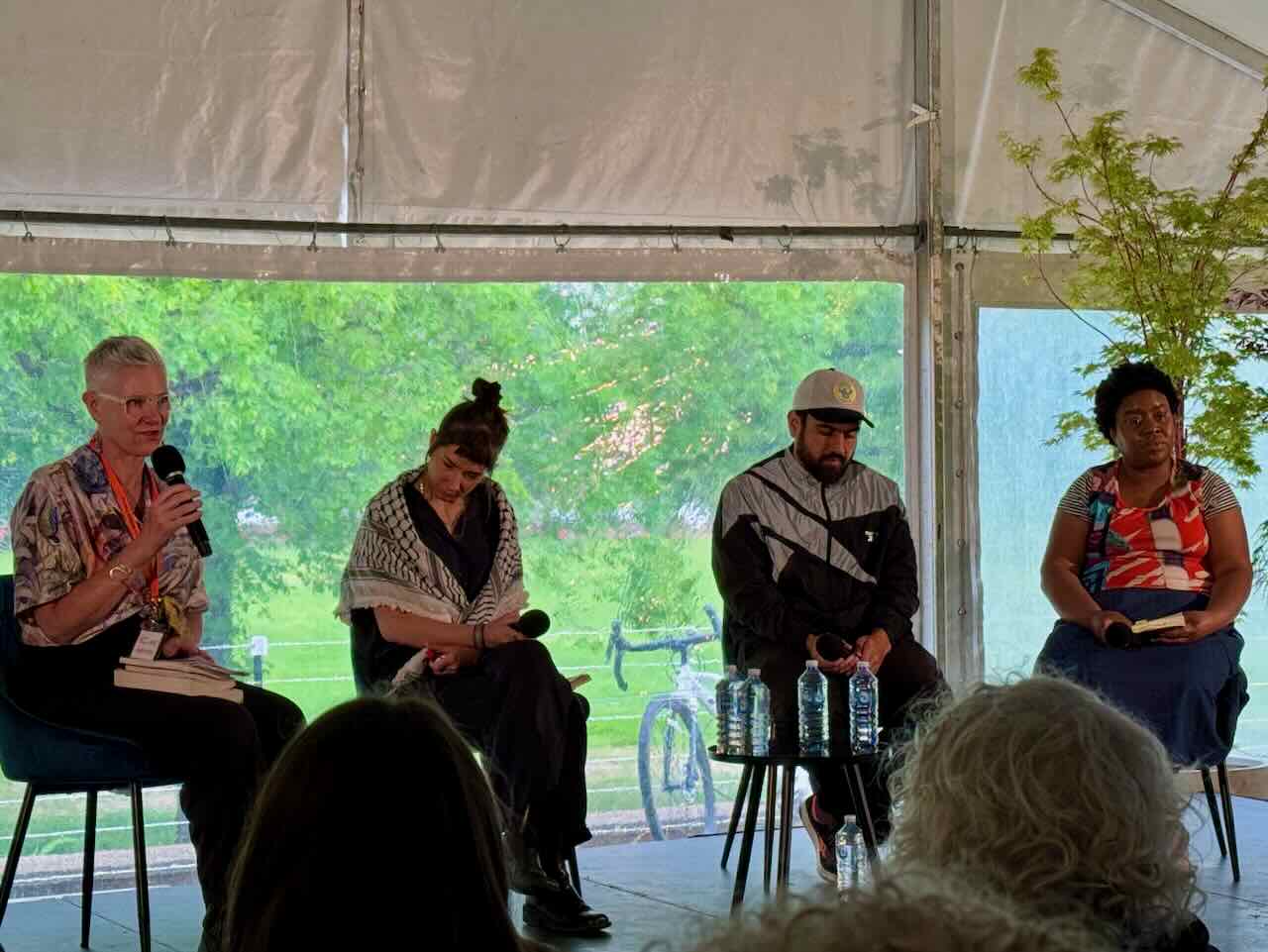
An electrifying highlight of this year’s program, our poetry panel features some of Australia’s most acclaimed and innovative poets putting love and rage on the page. Overland Poetry Prize winner Evelyn Araluen (The Rot) joins Maxine Beneba Clarke with Beautiful Changelings, and hometown spoken word artist Omar Musa. This session delves into the power of love, and the ongoing fight against oppression in its many forms. Don’t miss this powerful event. Moderated by Canberra author, artist and performance poet, Jacqui Malins.
For this event, we hardy festival attendees had to leave the warmth of the National Library building (or whatever building we’d previously been in), and walk through a little rain to a marquis on the Patrick White Lawns. It was worth the effort. Actually, it wasn’t that cold and wet, and the venue, with chairs on the grass and some lovely potted trees, made for a nice change.
As this session included poetry reading and performance, your scribe had a bit of a break from intense scribbling, but the notes I took have still ballooned. After acknowledging country, Jacqui asked each of the poets to choose a poem to read (or perform) that explores rage.
On rage
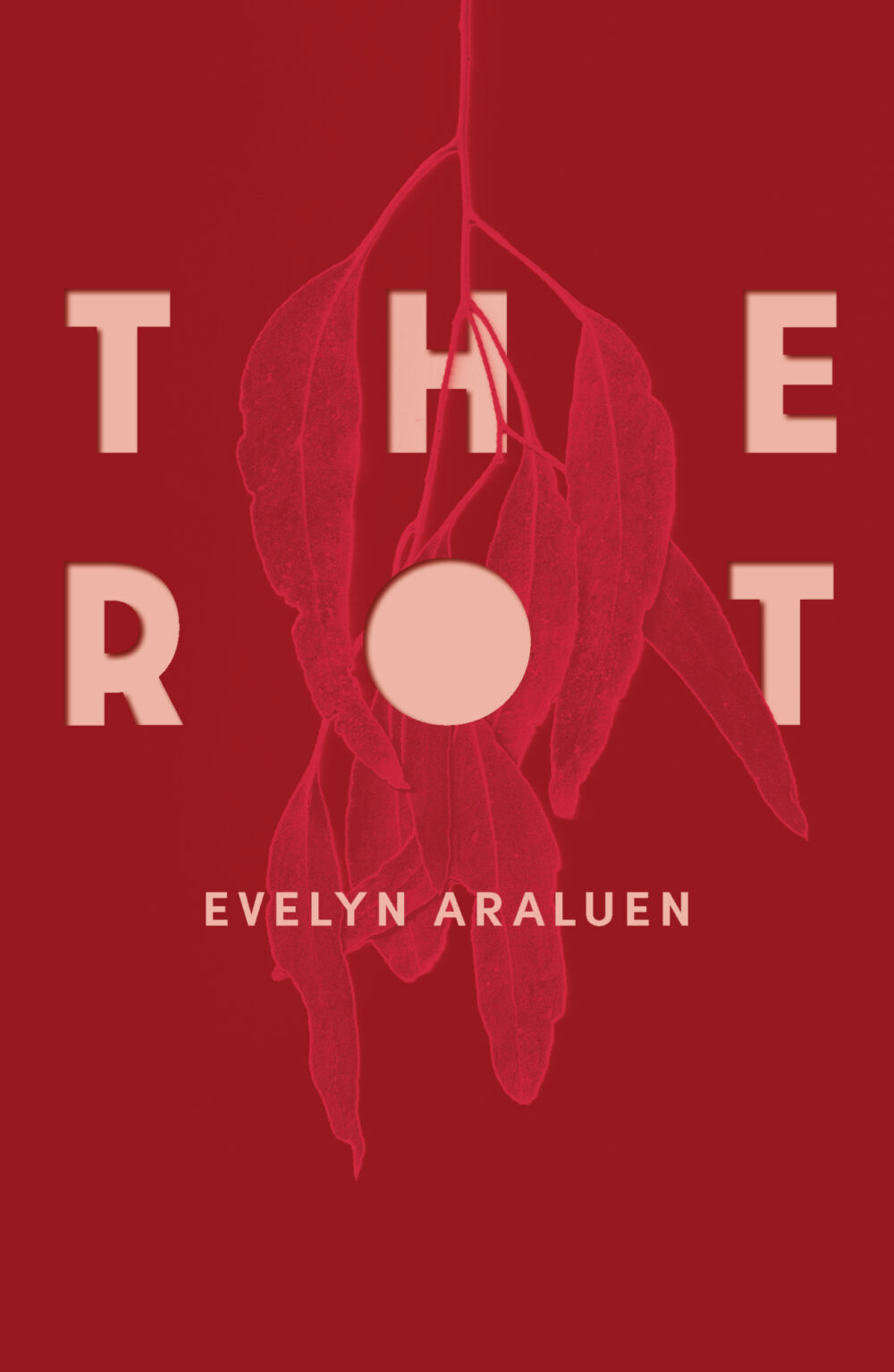
Evelyn explained that her collection is all love and rage, that it was written in the context of love of communities, network and solidarity, but informed by rage, by the futility of witnessing genocide from our phones while the government continues to provide material for weapons. She was thinking specifically about global capitalism. She read her poem “Girl work” from The rot. As I’m sure you all know, there’s something special about hearing a poem read by the poet. They know what nuances and rhythms they intended for their words. This is a deeply satiric and ironic poem about girls and work, girls and girly aspirations, set against “the machine” that will swallow them up. It’s confronting (“girly, you glisten in your soft tailoring … your coolgirl cleangirl chic”) and confrontational (“o girly, lift your head…”). The words are cleverly angry.
Jacqui commented on its exploration of how to live in the face of the onslaught while also trying to live day-to-day. She likes the thread in the collection of what to do with our hands, the twitching to act.

Omar, poet, novelist, musician and artist from Queanbeyan, “Palace of the Palarang, Venice of the Eden Monaro”, has published four books of poetry (the last being Killernova, see my post on its launch). A performance poet, he performed rather than read two poems, “To burning” (which you can see on YouTube performed with music by his wife Mariel Roberts) and an older one I’ve heard before, “UnAustralia” (on YouTube too). He too is enraged by politics which cares more about money than people (particularly brown, Muslim, and “other”) and the environment.
As Jacqui said, his poems contained an “extensive catalogue of rage” that hasn’t changed over the years since they were written.
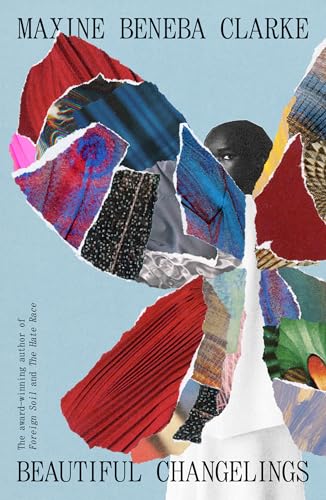
Maxine, reading from her just published book, Beautiful changelings, took us to somewhat different places. Like Araluen’s book, her focus is women. Araluen’s is described as a “liturgy for girlhood in the dying days of late-stage capitalism” while Clarke’s is about “ageing, womanhood, motherhood” with “wrecking-ball revisitings of the myths, mantras and fairy tales fed to girls” (from back covers and promotional materials). The first poem she read, “A good wait”, was inspired by her role as chauffeur for teenage children. It is more humorous than overtly angry, but has a layer of anger all the same for parents, particularly women, who are expected to put their needs – including their work/careers – second to those of their children.
She then read a section from a longer poem, “Major complications”, which explores rifts in contemporary feminism. It was inspired by feminist witch t-shirts and the Salem witch-hunts, and draws on the story of Tituba, “the witch that would not burn”. I loved the line – I think I got it right – “Tituba made sure they got the complication they asked for”.
On writing poetry inspired by rage
Omar grew up angry. Ppoetry was is pressure relief valve. He talked about his Malaysian inheritance and a way of expressing yourself that alchemically transforms rage to a different state, that enables you to legitimate anger. (I missed the details because I didn’t catch the Malaysian word.) It’s reductive to delegitimise rage.
For Evelyn, rage was explicit to her project. Referring to the success of Dropbear (my review), she said what an enormous privilege it is for a poet to be read. It’s unusual. Her book is in schools, and she hears from teenage girls. This made her think about her responsibility to her audience. She feared she could be immobilising girls into despair. She was inspired by Revolutionary letters, a poetry collection by Beat poet Diane di Prima, who turned practical things into revolutionary action.
Maxine (whose memoir, The hate race – my review – is also in schools) related to this audience idea. She talked about being a woman and getting older, and the rage that brings. There’s poetry and reaching for poetry. Bigots, she said, aren’t going to pick up poetry. Further, more than with prose, people come to poetry with openness. An interesting point. How, she said, does she make sure that her rage is poetry.
Jacqui wondered about rage turning into polemic, and love into sentimentality. Are these risks ?
Omar said not necessarily. “UnAustralia” is a polemic poem. He hopes poems can work on different levels, such as rallying the base and educating others. Poets use their tools to smash open the door, using different weapons for different battles. Jacqui agreed that preaching to the converted has a role.
Evelyn commented that “people like shitting on sincerity”, that the elite will say they “hate slam poetry” but don’t go into those rooms and see the work. This is “cringe culture”, at work. We have a bad relationship with sincerity. (This idea spoke to me.) Performance offers a strong introduction to poetry, performance poets put their whole heart into their work. What is it that brings people through the door? How much affect is effective? Research suggests that the most significant trigger for engaging people is to activate emotional sensibilities.
Maxine added that in 2025 earnestness is not cool, but then people will perform emotions on Instagram!
On love
Jacqui asked the poets to end with a poem written through the lens of love. Maxine read her tribute to being an aging woman, her love letter to growing older, “I want to grow old”. It mentioned several older women models, like the late Toni Morrison, and included lines like “speaking slow and exact and only sense” and “I want to grow old spectacularly”. Omar read two poems, one to his cellist wife, and one to a childhood friend (noting that friendship can be our greatest love affair.) Evelyn, who at first feared she didn’t have one, read the last poem in her collection, “I will love”.
This event was in a small venue, but had a decent-sized audience. Poetry always moves me a little out of my comfort zone, but I’m glad I took the risk!
Postscript: It was notable that the three poets were people of colour, albeit from very different backgrounds. Interestingly, of the 7 sessions session I attended, five comprised only white (I believe) participants, and two comprised all people of colour. I did, however, only attend 7 of a large number of sessions, so mine may not be a good sample. Nonetheless, shaking it all up a bit – people’s backgrounds, genres, forms, and so on – could energise discussions.
Canberra Writers Festival, 2025
Poems of love and rage
Sunday 26 October 2025, 12-1pm
 Whispering Gums
Marquis? We all did better when the typewriter didn’t contribute to our writing. I’m not sure not attending slam poetry makes me an elite, rather the opposite probably.
You know I read very little poetry, but I do have Dropbear and should make more of an effort to read it.
Oh dear Bill … thanks! You are right re the typewriter. I have fixed that typo!
I agree with you re elite but I understood the point she was making too. Dropbear is worth your reading … for its looking at FN dispossession partly through the lens of literary colonisation.
What an incredible line up, Sue. I heard Evelyn read from The Rot recently but to have Maxine and Omar alongside her is an embarrassment of riches. I’m at a stage where I want to listen to poetry, rather than read it. I’ll be seeking out more opportunities.
Thanks Angela… listening to poetry is so much more enjoyable isn’t it, and often makes it more accessible.
Patrick White Lawns? How nice! I don’t think there are Margaret Atwood or Robertson Davies Lawns, but wouldn’t that also be nice!
Interesting to read about his belief that rage should not be delegitimised. It reminds me of the enduring conversation about how/whether women writers should express their anger, whether anyone wants to read about angry narrators. Well, sometimes there are most excellent reasons for being angry: who can argue with that. (But, of course, people do make that argument.)
Do you have a clear preference for venues: indoor or outdoor?
It is nice, Marcie. At one stage the lawns were used for public car parking, which I must say was appreciated, but it is good that they are now lawns again. I’m not sure how many Canberrans are aware of them, but they are marked, and are used for various events. Maybe Margaret Atwood will have to die first because she gets some lawns!! Haha, I love your discussion about the validity of being angry. I guess anger (like any emotion really) is useful if it’s well channelled, otherwise it can get in the way of real communication. In other words, if you rant and rave with little structure, you are not going to achieve anything, but if you challenge your rage or anger – as I think Charlotte Wood did in The natural way of things – you might achieve something. She felt I think that her experience as a writer enabled her to channel that anger effectively, though I think not everyone agreed. I think she did however! (Was Margaret Atwood angry when she wrote The handmaid’s tale? And am I digressing too much now?)
Perhaps lawns are a posthumous recognition. Ahem.
I’m reminded of a 2013 novel by Claire Messud (not sure how well known she is there) wherein the entire literary discussion shifted to the main character’s anger. Ironically, it’s set in Cambridge which, I believe, is where MA was inspired by the uni dormitories that appear in the opening of Handmaid’s (which was written in Berlin though). Chanelled anger would seem to play a role in a telling of a book like Handmaid’s, but the style is so spare and controlled that perhaps it’s not as easy to spot, as in Messud’s novel.
Is that The woman upstairs? I wanted to read that one. Claire Messsud is not well-known here I think, but she is known. I read her The Emperor’s children. As I was writing this post, I did think about The handmaid’s tale and anger. I agree of course that a good writer can channel anger, and I think Charlotte Wood achieved that although I’m not sure everyone agreed.