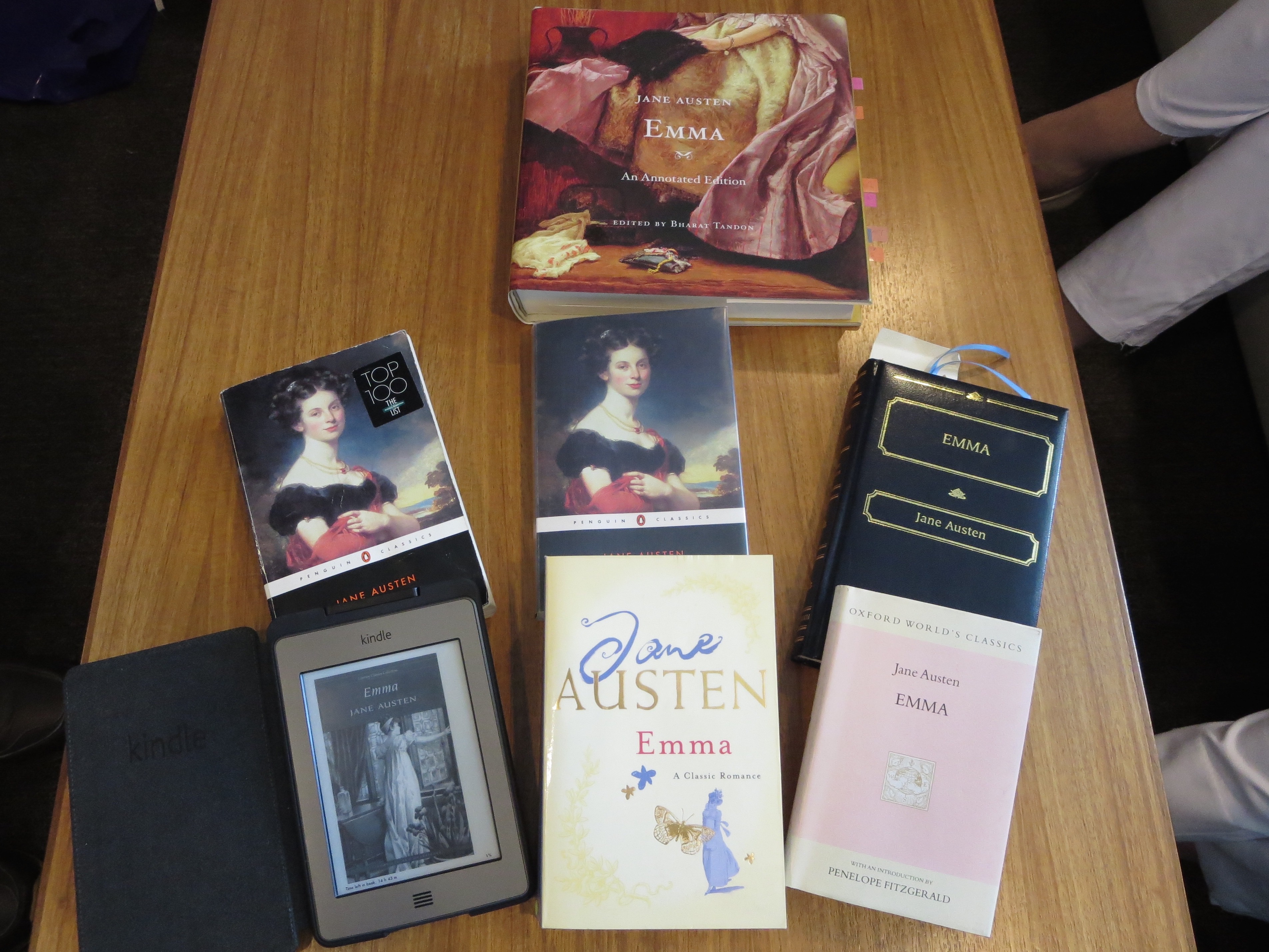
In April, I wrote a post on Volume 1 of Emma, sharing the thoughts that had come to me during my Jane Austen’s group’s current slow read of the novel. This month, I’m sharing some ideas that Volume 2 raised for me.
I wrote in my Volume 1 post that, during this read, what popped out for me was the idea of young people lacking guidance. It relates to issues like character development and to themes like parenting (which Austen regularly explores in her novels.) The question with these slow reads always is, will an idea that pops up in one Volume continue in the next? Well, in this case my answer is yes and no.
What I mean by this is that this notion expanded for me in Volume 2 to encompass the idea of “nature versus nurture”. Now, I’m not saying that Austen was specifically engaging in that debate, but that she has a lot to say about both aspects of our character. Before I continue, I will just share that I did wonder when the “nature versus nurture” debate started?
My searches, including via Wikipedia and two AI services, revealed that while ideas about innate (nature) vs. learned traits (nurture) can be traced back to ancient philosophy, the “nature versus nurture” debate, as a formal concept, began in the mid-1800s with Francis Galton, a cousin of Charles Darwin, who coined the term in his 1874 publication, “English Men of Science: Their Nature and Nurture”. In case you are interested, Chat GPT advised that philosophers like Plato and Aristotle debated discussed the role of “heredity and environment in shaping individuals” with Plato leaning towards nature (“innate knowledge”) and Aristotle towards nurture (“experience and environment”). And Wikipedia identifies Chen Seng having asked a similar question in 209 BCE. These aren’t the only people to have thought about the question, and Wikipedia’s article is useful if you are interested. But I’ll move on as the history of the debate is not my focus here.
What kept popping up for me – as I looked to see how my guidance-of-young-people theme was developing – were various comments Austen was making about nature and nurture. I’ll share just a few.
The first one to come to my attention in Volume 2, concerned Jane Fairfax, who was orphaned as a toddler and brought up, at first, by her grandmother, Mrs Bates, and aunt, Miss Bates. Austen describes her as a three-year-old
“her being taught only what very limited means could command, and growing up with no advantages of connection or improvement to be engrafted on what nature had given her in a pleasing person, good understanding, and warm-hearted, well-meaning relations.”
So, “nature had given her” a good start, and her relations had nurtured her as best they could with their “very limited means”. However, soon after, the Campbells (the family of a friend) had taken her in:
“She had fallen into good hands, known nothing but kindness from the Campbells, and been given an excellent education. Living constantly with right-minded and well-informed people, her heart and understanding had received every advantage of discipline and culture”.
And then, Austen seems to make the point that Jane Fairfax’s innate character, her disposition, was such that good nurturing had found fertile opportunity: “Her disposition and abilities were equally worthy of all that friendship could do…” Unfortunately, with no money, her destiny looked likely to be governessing, which the Campbells knew and did their best to prepare her for, but that’s another story …
As for Frank Churchill, in my last post regarding guidance, I noted that Austen suggests that, with his guardian family (his aunt and uncle at Enscombe), he had been left to his own devices with little guidance other than “his own comfort”. In this volume, Austen says more about his nature
“He seemed to have all the life and spirit, cheerful feelings, and social inclinations of his father, and nothing of the pride or reserve of Enscombe.”
It seems that at least some of the Churchills’ nature had not been nurtured into Frank. Ironically, it’s Emma’s father, Mr Woodhouse, who identifies some flaws in his behaviour, calling him “not quite the thing”, though his reasons are fussy.
And then there’s the third character whom we meet in Volume 2, Mrs Elton. These are Emma’s thoughts, and she is a snob, but nonetheless, she hones in on some points relevant to my thinking:
and the quarter of an hour quite convinced her that Mrs. Elton was a vain woman, extremely well satisfied with herself, and thinking much of her own importance; that she meant to shine and be very superior, but with manners which had been formed in a bad school, pert and familiar; that all her notions were drawn from one set of people, and one style of living; that, if not foolish, she was ignorant, and that her society would certainly do Mr. Elton no good.
We don’t know how much of this comes from Mrs Elton’s nature, but Emma does lay a much blame for her behaviour and character on her nurture.
Then there’s sweet Harriet, whom we met in Volume 1, and whom Emma considered, then, “not clever, but she had a sweet, docile, grateful disposition” and only needed to be “guided by any one she looked up to”. In Volume 2, her nature is again referenced, in terms of “the many vacancies of Harriet’s mind”! Poor Harriet. What will happen to her? Wait for Volume 3!
Finally, it’s Emma’s brother-in-law Mr John Knightley, who shows particular sense, when he provides these instructions to Emma on caring for his sons while he’s away:
” .. Do not spoil them, and do not physic* them.”
“I rather hope to satisfy you both,” said Emma; “for I shall do all in my power to make them happy, which will be enough for Isabella; and happiness must preclude false indulgence and physic.”
[* Meaning, don’t medicate them as their mother, Emma’s sister, is wont to do.]
There’s no reference here to specific moral, or any other education, but we can infer from this, and our knowledge of the man, that he is well aware of the importance of good nurturing to his sons.
Of course, there were other issues that intrigued me in Volume 2, but these ideas are the ones I want to document this go round with Emma.
Any thoughts?
 Whispering Gums
When my brain is less foggy I will come back with more thoughts…I suspect you covered this in your MP posts, but Fanny Price and the Crawfords are another example of JA’s interest in nature and nurture.
Yes, I believe I did Brona because it’s an issue that has increasingly interested me this year.
Another example of your being able to draw out every thread in your reading; and what better piece of fabric than Austen ?! 🙂
Finally getting to my old posts MR now I’m back from roaming. Love your fabric metaphor.
It’s wonderful how many layers we can find via rereading. I can imagine enjoying the project of looking for a specific thread in Austen on a repeat visit. Your discussion of Jane Fairfax reminds me that, although I am slightly suspicious of retellings and/or continuations of favourite books, I was sorely tempted to read the Joan Aiken book (titled Jane Fairfax) when it was new because… well… Joan Aiken. IIRC, you aren’t necessarily inclined towards that type of story either, but I wonder if this one mightn’t have seemed an exception to the rule for you as well?
Thanks Marcie .. yes I have made exceptions for writers I think are good or interesting and would probably read a few more if I could squeeze out more reading time!
‘Pert and familiar’ seems to be a pet hate of JA’s. I can see how it might be annoying, but it ialso, as you say, implies that the observer is snobbish when familiar means failed to pay due deference.
I am conducting my own experiment re nature and nurture with three daughters variously fathered and brought up. My conclusion is that nurture is important but that nature will out.
Haha Bill re para two … the older I get the more I am inclined to agree re nature.
As for one, the meaning of pert, or, how it is perceived has changed hasn’t it. It’s a bit more benign now I think.
Really interesting! I think it is important to note that all the qualities of both nature and nurture are looked at through a very specific lens of upper middle class and wealthy society. Other milieus would require/expect something different. And Mrs. Elton is clearly a social climber which would make Emma and other family money sorts rather annoyed no matter what.
Yes true, Stefanie. I’m not really saying that Austen is formally engaging in the debate but I think she is observing what makes each individual who they are. But perspective is a big part of how we behave isn’t it. But, I suspect some of the non-moneyed mightn’t like Mrs E’s pretensions – or those of social climbers – either though that doesn’t come out much here?
Ah yes, Austen is a keen observer, that is certain!
Sometimes I’m surprised what my brain remembers, and for some reason, I knew nurture vs nature was related to Darwin. I think of nature as not so much innate tendencies but as environmental factors: access to food, pollution, etc.