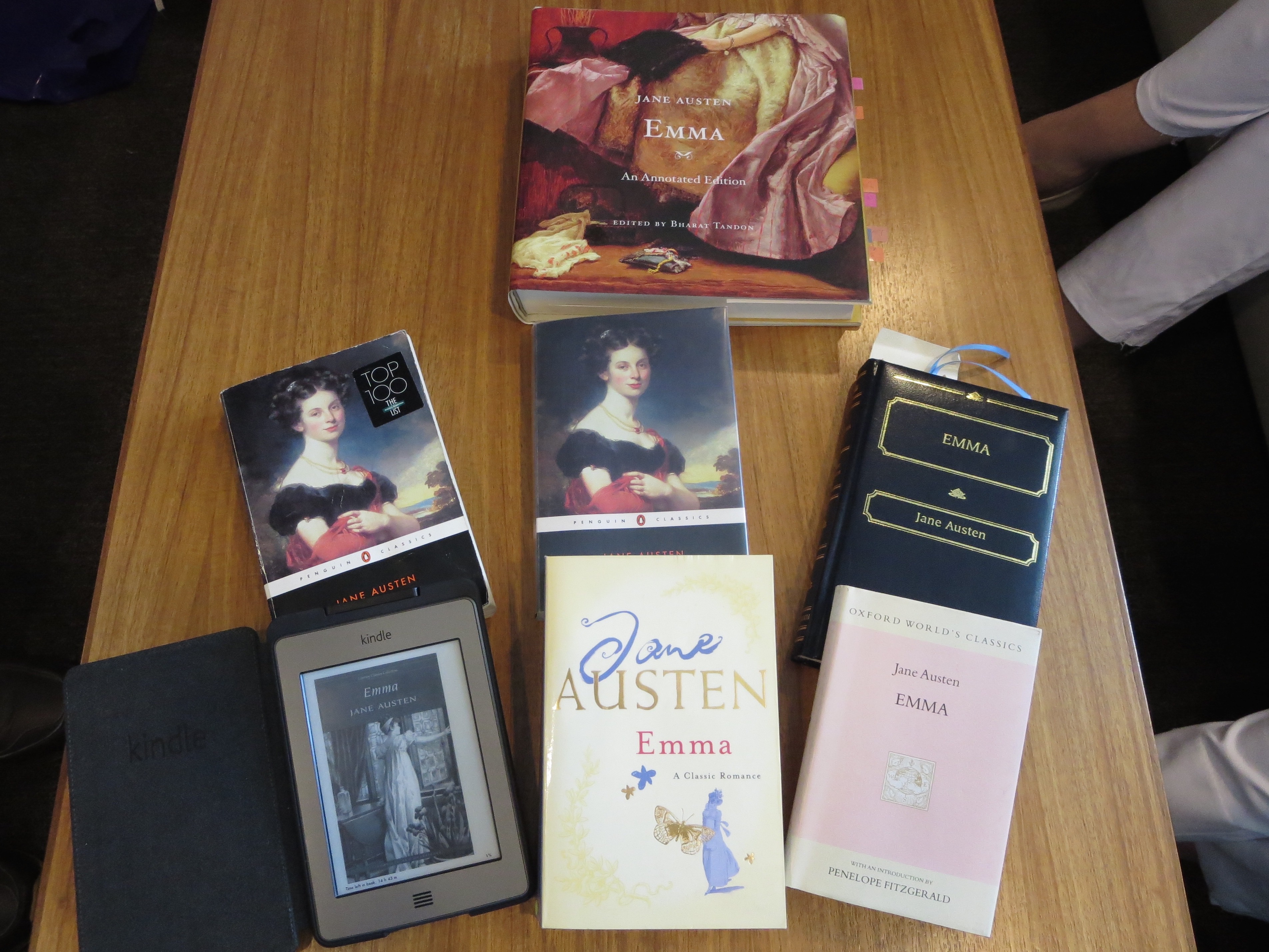
As long-time readers here will know, my Jane Austen group did a slow read of Austen’s novels over several years, starting in 2011. In 2022, we decided it was time to repeat the exercise, and are again reading them chronologically, one each year, making 2025 Emma’s turn.
Our slow reads involve reading and discussing the chosen novel, a volume at a time. We “try” to read as though we don’t know what happens next, to help us focus closely on what we think Austen is doing. Of course, we can’t read like a first-time reader, but it’s a useful discipline.
We always wonder whether this time, after so many reads, we will see anything new or fresh. But, we always do. Just the march of time, with its impact on our knowledge, experience and tastes, means we see the books differently. Take Emma, for example …
A few re-reads ago, what stood out for me was its beautiful plotting. There’s barely a word or action that doesn’t imply or lead to something telling, even if we are unaware at the time. From my last major re-read, in 2015, I noticed how often the word “friend” or the notion of “friendship” was appearing. The novel starts with Emma losing her governess-then-companion Miss Taylor to marriage. They’ll remain friends but Emma is left alone with her gentle but fussy father. So, she nurtures a friendship with the 17-year-old Harriet. In my post on rereading Volume 1, I explored the idea of friendship, and then watched in Volumes 2 and 3 to see whether the idea continued. It did. This is not to say that what we might identify in a slow read will overtake previous ideas, but that these re-reads enable us to tease out more of the details, which usually results in a deeper understanding of the whole.
So, what would I find this time? I did consider choosing something to look for, like the role of letters or music in the novel, but decided to just see what played out. Sure enough, something popped up, the idea of young people lacking guidance. It relates to issues like character development and to themes like parenting. And, I found it all there in the first few chapters.
The novel begins:
Emma Woodhouse, handsome, clever, and rich, with a comfortable home and happy disposition, seemed to unite some of the best blessings of existence; and had lived nearly twenty-one years in the world with very little to distress or vex her.
This can be teased out in many ways, but, remembering that “very little to distress or vex her”, I’m focusing on where Austen goes next. As explained above, the novel opens with Emma’s governess-then-companion Miss Taylor having just married, so Emma, who lost her mother when she was very young, is left alone with her “valetudinarian” father, “a nervous man, easily depressed”. She indulges him, as only a devoted daughter can, but otherwise, she is untrammelled. Austen describes her life, to this point, in the third and fourth paragraphs:
Emma doing just what she liked; highly esteeming Miss Taylor’s judgment, but directed chiefly by her own.
The real evils indeed of Emma’s situation were the power of having rather too much of her own way, and a disposition to think a little too well of herself.
And there it is, “directed chiefly by her own [judgement]”. Neither Emma’s “nervous” father nor the mildly-tempered Miss Taylor/Mrs Weston question or guide her. However, in the same chapter, we learn that there is one who does, her brother-in-law Mr Knightley, “a sensible man about seven or eight and twenty”. Austen writes that:
Mr. Knightley, in fact, was one of the few people who could see faults in Emma Woodhouse, and the only one who ever told her of them …
We see several examples of his chiding her in Volume 1, including about her interference in Harriet’s response to a marriage proposal. We also see him discussing Emma with Mrs Weston, telling her that she had been a good companion to Emma but had also been better at submitting her will to Emma than in giving Emma the “complete education” he thinks she needed.
Now, moving on to Chapter 2, we hear of another young person, the three or four and twenty, Frank Churchill. His mother, too, had died when he was very young, and, for a number of reasons, he
was given up to the care and the wealth of the Churchills [aunt and uncle], and he had only his own comfort to seek, and his own situation to improve as he could.
The implication here is that he too had been left to his own devices with little guidance other than “his own comfort”. It occurred to me, during this reading, that he is being set up as a parallel and perhaps eventual foil to Emma. But, hold that thought, because Frank does not physically appear in Volume 1. There is, however, a telling discussion at the end of the Volume about his not coming to Highbury to meet his father’s new wife, Mrs Weston. Mr Knightley – note, it’s him again – argues that while Frank’s aunt and uncle are given as the reason:
There is one thing, Emma, which a man can always do, if he chooses, and that is, his duty.
Frank simply needed to use the “tone of decision becoming a man”, and there would have been “no opposition”.
Finally, there is a third example, the aforementioned Harriet Smith, who is introduced in Chapter 4. She
certainly was not clever, but she had a sweet, docile, grateful disposition; was totally free from conceit; and only desiring to be guided by any one she looked up to.
The natural child of an unknown person who had paid for her schooling and now for her boarding at that school, Harriet has no parent to guide her, only school teachers – and now, the flawed Emma. By the end of Volume 1, it is not going well for Harriet, who has lost one real and one imagined suitor due to Emma’s guidance.
So, as Volume 1 progresses through its 18 chapters, we see some of the fallout of Emma’s being a law unto herself and ignoring the wisdom of others. I look forward to seeing if this idea is followed through in Volume 2. Is it important to Austen’s world view? Watch this space …
 Whispering Gums
Emma! Wonderful. Watch out for how many times “blunder” turns up 🙂
Ha Pamela … I’d better make that for my next reread! But I will also look from now on.
I did it as an exercise with a Year 12 class once. Even the Emma-haters enjoyed the hunt.
Oh that’s great Pamela. It must be a fascinating book to do with that age group. I did it in 5th or 6th form (showing my age) but can’t recollect much about the teaching. She wasn’t an inspired teacher but I loved Austen.
Austen is, even to me, a re-re- read author: we share a love of her writing – isn’t that nice, ST ? 🙂
But I will never approach a repeat read of any of her books with anything even remotely like your erudition. I just get a kick out of ’em, that’s all. 🙂
And that’s perfectly alright MR … I love that we share a love of Jane, however we read her.
I haven’t read Emma, but if I had a reading group to do a slow read with me, I might enjoy it. I know I liked reading Roots by Alex Haley with another blogger and doing short posts on our perceptions of what was going on over a period of several weeks.
Have you seen Clueless, Melanie. It is such a good riff on/retelling of Emma.
Oh, I forgot Cher’s story is a retelling of Emma! There were several ’90s movie retellings of classic literature, especially Shakespeare.
There were … and way back too before then too. Not all adaptations are great of course, but I think Clueless is good, and is liked even by many Austen purists, which says something! The challenge is to not think about the story so much as about the fundamental theme or idea driving the original, and then look at the story. Not all adaptations do this I think.
Now that you have highlighted this, it seems so obvious! And without jumping ahead too much, I suspect you will find something similar when Jane Fairfax makes her appearance.
I might Brona, but of course I haven’t read it before so it will be a surprise … haha. She is mentioned in Vol 1 but far more briefly than Frank is.
I think all of Jane Austen up to Persuasion is about young people and more especially young women needing guidance. We are distracted by the genius of her writing from just how juvenile her heroines are. They are all coming-of-ages for girls who have suffered from indifferent fathering.
I think there’s some truth in that Bill, but I don’t think it’s the whole story … I think the novels and their themes are more complex than simply coming-of-age?
What fun! I was just thinking the other day it might be time to start an Austen reread. Do you know how many times this is for you reading Emma?
Haha Stefanie … no, I’ve lost count but it would be less often than P&P, S&S and Persuasion. Maybe 8 – 10?
/giggles And I doubt it was our chatter that brought that possibility to mind, Stefanie!
The only two I’ve reread (I think) Mizz Gumz, are P&P and Emma (and at that time, Emma was my favourite), and years ago now, but I do enjoy rereading. I’m rereading Huck Finn so that I can more fully enjoy Percival Everett’s “retelling” James. Huck was a set-text at school, and I reread it for exams there, but not since.
I love it WG! And here I thought I was doing pretty good having read Emma 3 times 😀
Heh Marcie, totally related to our conversation–no not really, coincidence! But you may want to read Persuasion sometime. I love P&P and Emma is really good too though I am forever creeped out by the age difference between Emma and Mr. Knightley, but Persuasion is my fav 🙂
I think the only book I’ve read that many times is L.M. Montgomery’s Anne of Green Gables (I just mentioned this on Bron’s post about rereading Austen too).
Persuasion isn’t any more/less a favourite for me although I do remember enjoying a film version of that one quite a bit. I think my reason for rereading P&P was a bookgroup and I think I reread Emma because of a BBC series I especially liked. But I did also find my Montgomery preferences shift over time, from Anne to Emily (of New Moon) despite all my rereading of Anne, so I can imagine how you (Stef) might have loved P&P or Emma but felt Persuasion was your favourite in the end.
Thanks for these thoughts Marcie … it’s interesting how that shift occurs as we become more experienced I think, isn’t it. Many of us will always enjoy the “sparkliness” of P&P, but start to appreciate more the characters who have suffered in some way, including Anne Elliot, and interestingly, Elinor from Austen’s first book.
Well, I do belong to a JA group Stefanie, and I had a JA fan as a mum.
I know a few people are creeped out by the age difference in Emma. It was discussed a bit in my group – as it often is – but it was one of the issues we discussed regarding Austen’s time and ours. Was it as unusual then as it is now? Of course that’s not to say it was right, but I think the fact that Austen wants us to see it as a good thing, I believe, suggests that it wasn’t that creepy, and so I see it in that light. It’s not like Mr K was a Grey Fox out there going through women. He was in a small community where there were few options. He could presumably have gone to London to find a wife, but would she have wanted to leave the “lights” for such a small and quite claustrophobic place? It is interesting to try to read these books with the eyes of her times, particularly when we can only guess from what we are able to glean from history etc what those eyes were like.
Oh good for you Marcie. My reading group is doing James in May. I will miss the meeting, but I will read it. However, I don’t think I’ll read Huck Finn. I really can’t remember whether I’ve read it or not, but I think not! I’ve probably read excerpts, and a lot about it in my youth, but not actually read the whole lot.