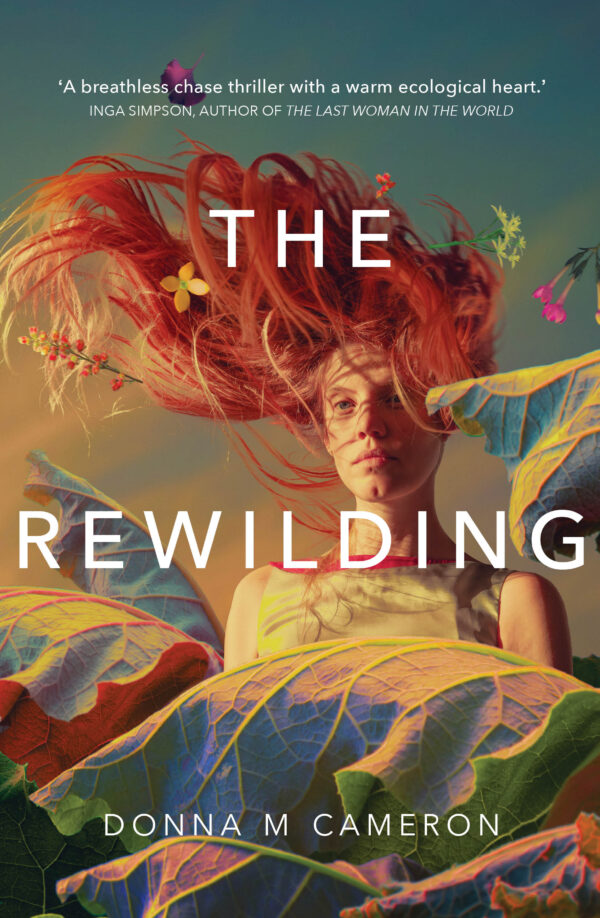
Quite coincidentally, earlier this month, I read and posted on Willa Cather’s short story “The bookkeeper’s wife” which commences with a young man, Percy Bixby, sitting in his office deciding to do something in order to keep his flashy fiancée Stella. That was published in 1916. I have now just finished Donna M. Cameron’s novel, The rewilding, which was published in 2024. It commences with another young man, Jagger Eckerman, is sitting in his office deciding to do something that will lose him his flashy fiancée Lola. Both young men are caught up in fraud, Percy of his own making, Jagger unwittingly, though that doesn’t make him entirely blameless. From here the stories part company, so we will leave Percy, whose story I’ve already told, and look at 27-year-old Jagger.
Jagger has been living the high life. Caught up in his own privileged lifestyle, he’s been carelessly signing documents he shouldn’t, until finally the penny drops and he wakes “up to the fact that every aspect of his life is a farce”. So, he clicks Send on his whistle-blowing email and scarpers. The problem is that the only place he can think to scarper to is a cave in a national park south of Sydney, and when he gets there he finds someone else already holed up in the same spot, the 24-year-old “feral” eco-warrior, Nia Moretti. As the accompanying publicity sheet says, it is hatred at first sight, but they soon realise they need each other, whether they like it or not.
The rewilding starts with a bang and barely lets up for the length of its 300 pages. It’s a genre-bending work of eco-literature that combines thriller, road story and romance. The central thriller-driven plot is not my favourite type of story – I’m not much interested in watching or reading about chases, violence and suspense – but Cameron handles her material confidently, creating a book that I enjoyed reading despite myself. I just hurried through the bits that were less interesting to me. Why I was happy to read it is what I want to focus on here.
First, there’s the genre-bending aspect. Cameron balances the thriller components with more reflective and tender sections, with moments of interpersonal tension, with touches of humour, gorgeous natural descriptions, and serious themes. Second, the story is well-paced, and the writing fresh but accessible. It is primarily told third person through Jagger’s perspective, but this is occasionally interspersed with short chapters in Nia’s voice, in which she speaks to a mysterious “you”. These provide additional insights into Nia that Jagger can’t know, while also increasing the mystery. Who is this “you”? What has happened to Nia? Third, the two main characters are nicely developed. Jagger is on the run, scared and uncertain about what his future holds. Still grieving his mother’s death and the mistakes he’s made, he is fundamentally decent and an optimist. Nia, on the other hand, is an uncompromising idealist, and pessimistic, but reveals a softer side. Gradually, as is typical of the romance genre, the antagonism between them is relaxed, although not, of course, without setbacks.
“a capitalist suit” versus “the feral”
And finally, there are the themes. For me, a good story isn’t enough. I need some meat, some ideas that make the time I put into reading worthwhile, and this book has meat – personal and political. In the personal realm, Jagger is a young man who had lost his way but, when some truths become clear to him – when he realises his relationship had been built on a lie and his workplace was engaging in a waste removal scam – his better self, the one his recently dead mother had so carefully tried to engender in him, comes to the fore. In his suit and fancy shoes, he surprises Nia with his deep knowledge of and love for nature. Likewise, Nia is struggling with a personal loss. She is resentful of the “capitalist suit” who comes into her cave, and finds ways of using him – and his money – to her own ends but, despite her toughness, she has a heart. So, on the personal level, The rewilding is a novel about values, about the lines you draw, about the life you choose to live and what that means personally and …
politically, because this is also a novel about climate activism. Nia and her radical Earth Rebellion mates, the Lorax, are determined to save the planet. Their focus is a mining operation in northern Queensland which is about to proceed without permission. First, though, she has something to do in disaster-struck, flooded Brisbane, something that puts her and Jagger’s lives at risk. On the run, and being followed by hit men, he has no option but to go along with the only person who can help him. It is at this point, before the final dramatic confrontation at the mine, that Nia starts to unbend a little towards Jagger and his perspective.
“Why be scared of change?”
The rewilding is a wild, dramatic novel. It does push the boundaries of credibility at times, but probably no more than you expect in a thriller. Ultimately, through her characters and their fierce, lively conversations, and through her fast-paced plot which offers a few scenarios, Cameron explores the critical issues confronting us and asks the big questions we are asking, without resorting to overt didacticism.
Climate change novels can be bleak, but many authors, even those writing the bleakest of stories, talk at writers festivals about wanting to leave their readers with some hope. That this was Cameron’s intention is foreshadowed in the epigraph from Tolkien’s The lord of the rings, “Where there’s life, there’s hope”. So, at the end, certain rapprochements are achieved, but the conclusion is real rather than simplistic. It recognises that life is messy and change is hard but that it’s worth keeping on trying. The rewilding is a worthy addition to Australia’s eco-literature field.
Donna M. Cameron
The rewilding
Melbourne: Transit Lounge, 2024
309pp.
ISBN: 9781923023062
(Review copy courtesy Transit Lounge, via publicist Scott Eathorne of Quikmark Media)
 Whispering Gums
I don’t read action novels at all if I can help it, and skip the action sequences in otherwise interesting novels (Tim Winton and Richard Flanagan both have novels with completely gratuitous car chases, though my memory is that Wright’s Carpentaria has some Qld mining eco action and anti-eco action sequences, which I totally accepted).
Just in passing, there are enough bad mines that the government totally allows, without making up illegal ones.
As you can guess I’m sure, Bill, same with me. I know exactly what you mean with those two examples you give as I felt the same. Carpentaria is different- there was a different energy – how else to say it – to the action.
I’m not sure about your final point. This is fiction but the fact that we recognise the situation, that this has happened before, means she can make up one we believe without people questioning some trivial fact about it and then detail or other.
i had this out of the library but didn’t find time to read it before I had to return it. I loved her previous novel Beneath the Mother Tree so I will definitely be getting this out again.
I remember her first novel Claire, but never got around to reading it. I have no idea how close this is to that one, but if you liked her writing my guess it’s you’d like this.
Not your usual ST fare, I told myself …
And then I had to work out why that was my first reaction. But all I was able to come up with was that it’s a review of a thriller. ST’s reviewed thrillers before, surely ? [checks categories …]
Don’t find so narrow a heading. Lots of novels. Give up.
Anyway. This review surprised me !
Haha MR, no I don’t categorise my books to detailed genres, particularly those I don’t read much – I do have Historical Fiction, Speculative Fiction, and Crime I think. I have reviewed a few books with thriller elements, but this one probably has more than others I’ve read. I really read it because it also falls into the eco literature “genre” and that does interest me. Is it one you’d be interested in listening to do you think?
You’ll be disgusted to learn that I’m in a sort of hiatus re audiobooks, ST: these evenings I’m doing my crochet in peace and quiet. Hoping not to hear my tummy rumble, as that will tell me I haven’t eaten enough (having difficulty managing this transitioning).
I would have, though, to say ‘probably not’. Don’t know why.
Enjoyed your review, howsomever – very rarely don’t.
Not disgusted … I can understand wanting quiet. That’s why I like reading… haha! Sorry, couldn’t resist that.
I hope the transitioning settles down soon … poor you!
Even though I think they’re very different styles (based on how you’ve described this novel), the bit you mention about being caught up in action because of theme and style reminds me of my experience reading The Luminaries. It wasn’t the outcome of that story that made me persist-it was all the other elements combined and the author’s authority-but the more thrilling aspects of the plot offered a throughline that I imagine did suit many other readers very well (and, as it turned out, it held me close too).
Ah, interesting point about The luminaries. I’m not sure it was that which kept me going. Certainly it was what put me off the miniseries. We started watching it and I thought I just can’t be bothered following this plot again. I’ve just checked my post on that novel and I see I’ve led it with this point!
An action book with someone trying to do a good deed works just fine for me, though I did grow up watching Indiana Jones, so maybe that has influenced my understanding of what a good deed or fighting for a good cause looks like. Actually, much sent me a meme today in which someone wrote that their friends are complaining about Harrison Ford being 80 years old and still playing Indiana Jones. The writer, however, noted that an 80-year-old professor who won’t retire is the most realistic part of the entire film. 🤣
This book sounds good, and the cover is lovely. I’m not sure it’s in the States yet.
Thanks Melanie… yes good point about the good deed aspect. And haha re the 80-year-old professor.
“a meme today in which someone wrote that their friends are complaining about Harrison Ford being 80 years old and still playing Indiana Jones. The writer, however, noted that an 80-year-old professor who won’t retire is the most realistic part of the entire film”
OMG Melanie! this cracked me up because it’s so incredibly true!
Why won’t people retire? It’s more often older men here who seem to have nothing else in their lives. That said I know many retired academics … they often have offices at their universities but they have retired so younger academics can move in, so to speak! But I don’t know how many haven’t retired. I think Australia has a stronger expectation that people will retire than the USA has, though this is breaking down somewhat … as people live longer, and economic needs change.
SO TRUE. I had a colleague who left the college after students reported this person’s bizarre behavior. It turns out this individual had dementia AND tenure.
Oh wow … It shouldn’t have been up to students – who were presumably paying big fees for an education – to identify that this person wasn’t up to it.
This sounds like a fun read! Climate fiction tends to suffer from doom and gloom so an action type story about trying to do the right thing seems a bit different. Plus the cover is really pretty 🙂 Too new to be published in the US yet, but hopefully it will make it here.
Thanks Stefanie … yes it is, about ways of doing the right thing, and about how you emotionally deal with it. There’s a lovely segment about our eco warrior’s parents who live off the grid. Interesting about the cover. A few have commented but for some reason it doesn’t really grab me. I don’t dislike it but it just feels busy.
enjoying the fast pace of a thriller and delighted to have the added extra of the detail of plants,birds and landscape.
So glad you like this book minervacuttagee – it’s a good read.