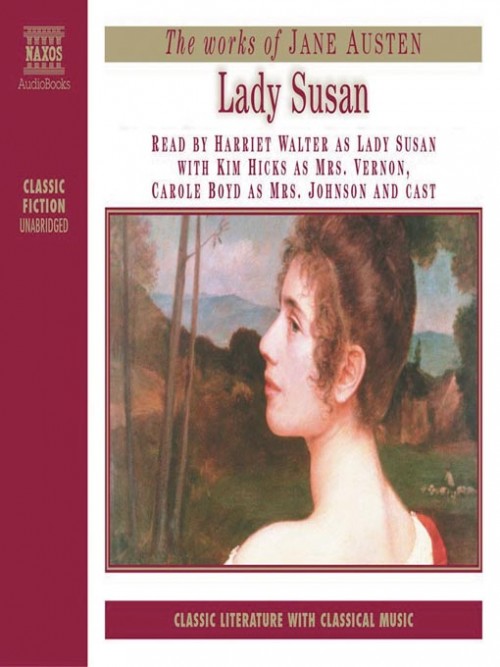
I have read Jane Austen’s Lady Susan several times, including with my local Jane Austen group in 2014 (my review). That now being ten years ago, we decided it was time to read – and consider – it again. However, as my time was tight, I decided to try an audiobook version, and found a Naxos edition in my library. Mr Gums and I listened to it on our 650+ km drive home from Melbourne, and found it excellent.
For those of you unfamiliar with Austen’s minor works, Lady Susan is, as far as we know, the first novel (novella) that Austen completed, but it was not published during her life-time, for the simple fact that she never sent it to a publisher. Written, scholars believe, in 1793/94, when she was still a teen, it was not published until 1871, decades after her death, when her nephew James Edward Austen-Leigh included it in his memoir of her. It has since been adapted to film, television, stage and book. The best known of these is probably the 2016 film, which was titled Love & friendship, a strange decision given that is the title of another work of Austen juvenilia (my post).
I gave a brief plot summary in my previous post, but will again here. Lady Susan is a bewitching, 35-year-old widow of four months, who is already on the prowl for a new, wealthy husband. The novel opens with her needing to leave Langford, where she’d been staying with the Manwarings, because she was having an affair with the married man of the house, and had seduced his daughter’s suitor, Sir James Martin. She goes to stay with her brother-in-law Charles Vernon and his wife Catherine, whom she’d done her best to dissuade him from marrying. She’s not long there before Reginald, Catherine’s brother, arrives to check her out because, from what he’s heard,
Lady Susan possesses a degree of captivating deceit which must be pleasing to witness and detect.
After all, she is “the most accomplished coquette in England”! Of course, the inevitable happens and the artful Lady Susan captivates him. Meanwhile, Lady Susan wants her shy, 16-year-old daughter, Frederica, to marry Sir James, the man she’d seduced away from Miss Manwaring – but sweet, sensible Frederica wants none of this weak “rattle” of a man. And so it continues …
Lady Susan, then, is a fairly simple tale, containing the deceits and silliness common to its 18th century genre, but also showing restraint and innovation which hint of the novelist to come – her wit and irony, her commentary on human nature, and her themes. I wrote about this too in my last post and don’t plan to repeat it here. There are many angles from which the book can be considered, and this time I’m interested in another, its form as an epistolary novel.
The epistolary novel was common in the eighteenth century. It’s something Austen tried again with Elinor and Marianne, which she wrote around 1795 to 1797, but later rewrote in her famous third person omniscient voice. Retitled Sense and sensibility, it became her first published novel in 1811. Pride and prejudice’s precursor, First impressions, may also have started as an epistolary novel. It’s interesting, then, that although she made a “fair copy” of Lady Susan in 1805 she didn’t rewrite it too. Why she didn’t is one of the many mysteries of Austen’s life. Perhaps it was the subject matter, because this is not Austen’s usual fare. Lady Susan belongs more to the 18th century tradition of wickedness, lasciviousness and adultery, forced marriages, and moralistic resolutions. Characters tend to be types rather than complex beings, and the novels are racily written, with a broad brush rather than a fine pen. This is true of Lady Susan, but there are departures. For a start it’s a novella not one of those 18th century tomes!
I might be going out on a limb here, because, while I have read a couple of 18th century epistolary novels, including Samuel Richardson’s, my memory has faded somewhat. However, Wikipedia helps me out a bit. Its article on the epistolary form says that there are three main types: monophonic (comprising the letters of only one character); dialogic (using letters of two characters); and polyphonic (which has three or more letter-writing characters). Lady Susan is an example of the last one. The main letter writers are Lady Susan (mostly to her friend Alicia Johnson in London) and her sister-in-law Catherine Vernon (mostly to her mother Lady De Courcy), but we also see some letters back from these correspondents, making four letter writers. But wait, there’s more! There are also letters – albeit just one in two cases – from others, namely Reginald De Courcy, his father Sir Reginald De Courcy, and Lady Susan’s daughter Frederica.
So, in this short book, we have 7 letter writers. But wait, there’s even more. To conclude the novel, Austen discards the epistolary-form and writes a first person denouement, which includes commentary like this:
Whether Lady Susan was or was not happy in her second Choice — I do not see how it can ever be ascertained — for who would take her assurance of it on either side of the question? The World must judge from Probability; she had nothing against her but her Husband & her Conscience.
The thing that intrigued me most as I was “reading” Lady Susan this time was the form. Austen used it for Love and Freindship, Lady Susan, Elinor and Marianne, and perhaps First impressions. But she abandoned it for the style for which she is recognised as a significant innovator – a third person narrative characterised by free indirect discourse, meaning the narrator’s voice embodies the perspectives of the characters. As John Mullan, writing primarily about Emma, explains: “Before Austen, novelists chose between first-person narrative (letting us into the mind of a character, but limiting us to his or her understanding) and third-person narrative (allowing us a God-like view of all the characters, but making them pieces in an authorial game). Austen miraculously combined the internal and the external”.
So, my thinking is that she started by using a form with which she was familiar as a reader and which was popular with readers of the day, but whose limitations she soon started to feel. Her using a relatively large number of letter writers, enabling us to see Lady Susan in particular from different perspectives, and her turning to an over-arching first person narrator for her conclusion, suggests that she understood the limitations of writing a novel-in-letters in terms of developing complex realistic characters, of managing plot, and of incorporating narratorial commentary. The rest, as they say, is history.
Thoughts anyone?
Jane Austen
Lady Susan (Classic Literature with Classic Music)
Naxos Audiobook, 2005
Duration: 2hrs 30mins
Available in e-text.
 Whispering Gums
I like Lady Susan and yes, I saw the L&F movie version, which was ok except for the name. What strikes me when I read it, which I haven’t done for a while, is the plot which is so clear the way you set it out, has to be teased out from all the letters each with its own agenda.
By comparison, Fanny Burney with Evelina tells her story pretty straight and the letters are just the frame. If we say Austen began writing Lady Susan in 1790, then Burney by then had written Evelina and Cecilia (which I haven’t read).
Thanks Bill. I haven’t read Fanny Burney’s Evelina, though I know I should. You are fairly right about the plot though I think it’s pretty clear early on what’s going to happen, though exactly who will end up with whom, and whether Lady Susan will get her comeuppance you don’t know of course. Do you agree that Austen was frustrated by the epistolary form?
Austen was a Burney fan, I really think you should read Evelina. Anyway, it’s a good story, well told and says some really non-JA things about middle class morals (Evelina goes very close to being raped at least twice).
I think that teenage Austen was very, very good at epistolary – she makes you read between the lines as you would if you were making sense of a handful of related letters. But I like your idea, that she saw how to advance 3rd person narration.
Incidentally, without much evidence I think that her decision not to publish Lady Susan was a moral one. Her (published) heroines are all good, decent upper middle class country women, as she was herself.
Yes, I know I should! Maybe I will one day.
And yes I agree she was good at the form, at wresting as much as she could from it as you say. I greatly enjoyed noticing that in particular on this read which is what got me thinking about what she might have been thinking.
You are not alone about the moral reason. Others think so too, including biographer Claire Tomalin.
But here we go again … I don’t think all her heroines were upper middle class women. Middle class yes, but not all upper. And I certainly don’t think Austen was upper middle class. I think there has to be money as well as values and lifestyle to be upper middle class. Upper middle class women would not be homeless in the way Austen, her sister and mother were for a few years. Brother Edward though. He was upper!
Sue, my first thought was, this lady is a total tart and I’m going to read this book! But then what Bill wrote has me interested even more. You’ve laid out the plot clearly for us, but we need to read the letters and infer what is going on. I love all that; I’m going to add this book to my TBR.
Haha … Melanie … she is. I’d love to hear what you thought of you ever got around to her.
There’s a tart in my future!
Haha, there is!
My sole reading of any kind of epistolary writing is the opening chapter/s of <i>Busman’s Honeymoon</i> by Dorothy L. Sayers – a pretty far cry from Austen. But it does provide an example of the style wherein the reader is given a whole shitload of information in a relatively short number of par.s ! I found it to work really well; so as I really love the best-known Austen works, I’m sure <i>Lady Susan</i> utilizes epistolary writing excellently.
Thanks MR. I haven’t read Dorothy L Sayers, but I remember her being around. I like your understanding of what Sayers achieved by using that style. I think you would find Lady Susan a hoot. The Naxos audiobook is fun to listen to too. Some in my group listened to another version, but it doesn’t sound like it was as entertaining as mine.
I’d mistakenly thought this was incomplete rather than simply immature (or early would perhaps be a better term). I’m delighted to find I have an unread Austen, even if a lesser one. Thank you!
Great Max, I’m pleased but I can understand the confusion. Penguin, in one edition, packages it with the two unfinished novels, The Watsons and Sanditon.
Hi WG, yes, Lady Susan is so striking a work of juvenilia that the protagonist, in particular, has often been thought to have been inspired from real life, and various candidates have been suggested (as I wrote about here). I’d just add that most viewers of Whit Stillman’s 2016 film, Love & Friendship, don’t realise that in conjunction with it, he also released an important work of Austen fan-fiction: a novella which purports to ‘vindicate’ the narrator’s aunt, Lady Susan Vernon, from the aspersions cast by a ‘spinster Authoress.’ A forthcoming collection, available here for pre-order, includes my chapter on the Stillman project. Apologies for barrow-pushing, but Lady Susan has been much on my mind in recent years and there have at least been some tangible results!
Thanks Judith. No need to apologise. Glad to know about these. We talked about Mrs Craven at the meeting so you’ll see that mentioned briefly in the report which I nearly posted last night … but now I’ll add your Mrs Craven link to it. I’ll be interested in that retelling collection too!
I’ve been meaning to reread this one for awhile (in fact, I think since I saw the 2016 film version, which I remember enjoying).
Oddly enough, I had set this one as the #6degrees starter book a couple of months ago, and at the last minute realised that we had already used it as the starter a couple of years ago.
Another fan. Love it Kate. I remember enjoying the film too, but am hoping to watch it again in the next week or so.
Was it a starter book recently? Sanditon was, I think, but I don’t see Lady Susan having been so since I started doing Six degrees several years ago? But of course, if you did it any time, it’s not sensible to do it again.
I’m not sure if teenage JA would have read Les Liaisons dangereuses (1782) or not (given that it was pretty racy), but Lady Susan certainly brings Pierre Choderlos de Laclos epistolary novel to mind.
He manages to tell a pretty complex morality tale via letters, although my understanding of the characters was formed by the wonderful (1988) movie first. I cannot read the book without seeing the interpretation that Glenn Close, John Malkovich, Michelle Pfeiffer et al gave each of the characters, so perhaps I read more into the book than is really there?
Haha, thanks Brona.
You are not the first to suggest Le’s Liaisons dangereuses as an influence. I think we also discussed it first time we discussed this book. We know some of what she read and she clearly wasn’t prudish so who knows!
I love epistolary novels but have never come across those definitions to distinguish the three types: very interesting! Even though I understand the complaints against them, and I do sometimes feel a degree of superficiality (nothing different from the stilted dialogue in some detective shows/films that relay necessary information to the audience in a way that’s completely unnatural in discourse but essential in crime productions), I appreciate the sense of intimacy and often the complexity that arises when you must consider what’s left out of the letters. (A favourite collection from the real world is ecologist and writer Rachel Carson’s letters to Dorothy Freeman, so beautiful and both erudite and loving.)
Thanks Marcie. No I hadn’t heard that definition either but loved it because this read of Lady Susan had me thinking about her use of multiple writers – so I loved fndng this description – and of when she chose to give us the to-and-fro letters and when she just had a correspondent referring to a letter that we are not given. The form can be used well I agree, and I have read some, too. And you make a good point about stilted dialogue in more ”traditionally” written novels.
Thanks for the recommendation re Rachel Carson’s letters.
I like your theory but there’s no way of knowing for sure. Still, speculation is fun! Though I enjoy all the letters in Lady Susan because as the reader I get to know so much more than the characters and there is a certain thrill to that. Have you seen the movie that was made from the book in 2016? They called it Love & Friendship, but it’s based on Lady Susan and really well done I think.
Thanks Stefanie … yes, no way we’ll know. If only she’d written more about her writing!
Yes I did see the movie … silly me, I mentioned in the post but didn’t say I’d seen it! I liked it too, but am planning to see it again soon to see what I think this time after this read!
What a fascinating piece! The Whit Stillman film is a favourite of mine, so I really ought to read the book – and the epistolary form really appeals. Many thanks for writing about this!
Thanks Jacqui… it’s worth reading the books, remembering it was written by a circa 19-year-old. I’m looking forward to seeing the film again … before the current reading of the book fades!