
National Poetry Month – in Australia – is now four years old, and once again it is spearheaded by Red Room Poetry, which is described by ArtsHub as “Australia’s leading organisation that commissions poets and produces live poetry events nationally”. ArtsHub adds that this Month is “a festival that celebrates emerging and established writers, as well as public figures with an unexpected passion for poetry”. I don’t know how successful it is at reaching its goal of increasing “access, awareness and visibility of poetry in all its forms and for all audiences” but something must be working. I was thrilled to not only hear the month mentioned on our national ABC radio station but to hear that the ABC would be featuring poems during the month.
Red Room is running similar events and activities to those they’ve run before – their 30in30 daily writing competition with prompts from Red Room commissioned poets, poetry ambassadors, online workshops, showcases, a community calendar, and more. And this year, “more” includes something new which is that they are closing out the month with “the UK’s biggest poetry and performance festival, Contains Strong Language” in Sydney from August 28-31.
Poetry is beyond time. It’s a way of bringing together the countless generations of humanity. It’s a means of connecting past and present. It’s a way of imagining the future. ~ L-Fresh the Lion (via Red Room Poetry).
National Poetry Gala … and more
This year their National Poetry Month Gala, if I read the website correctly, will happen in Sydney on 29 August at the State Library of New South Wales. It will be hosted by Chika Ikogwe (an award-winning Nigerian born actor and writer) and will feature Julia Baird, Ali Cobby Eckermann, Lorna Munro, Felicity Plunkett, Hasib Hourani, Rob Waters, Dan Hogan and Pascalle Burton, plus guests from the UK, Simon Armitage (their current Poet Laureate) and Princess Arinola Adegbite, and live music from Paul Kelly.
Contains Strong Language is a four-day festival in which local poets and spoken word artists will appear on stage alongside visiting UK poets including Simon Armitage. It’s the first time this annual broadcast festival, founded by the BBC in 2017, has left Britain. Events will be held across Gadigal and Dharug land in Greater Sydney (including one in the Blue Mountains) and will also be broadcast to Australia and around the world, through the BBC and ABC. The events include “performances, masterclasses, panels, galas, slams, live and online workshops, and international writing collaborations featuring 70+ artists”. Sounds like a real coup. The program, which includes free and paid events, can be found here.
Line Break is a new podcast from Red Room Poetry, and is presented in partnership with the Community Radio Network. It will include, over August, their daily 30in30 poetry commissions and writing prompts, plus various special series hosted by our Red Room producers. Some of Australia’s poetry-loving favourite public figures will apparently also share their ‘gateway’ poems. Who are they, and what will they share?
If you would like to know what is happening through the month – in various locations, including online – this Showcase page is a good place to start (or Red Room’s main site which I’ve linked in the opening paragraph).
And, I’ll just add that this might be a good month to check out – on your preferred music streaming service – the Hell Herons’ debut spoken word (poetry and music) album, The Wreck Event, about which I posted recently.
Musica Viva, the Choir of Kings College Cambridge, and a Poem
On Saturday night, we attended the Canberra Concert of the Kings College Choir of Cambridge’s current Musica Viva Australian tour. As regularly happens when this choir comes to Canberra, Llewellyn Hall was packed. It was a wonderful program which included some different programming decisions, but my focus here is the commissioned piece they performed*.
This piece was a setting to music of a prose-poem by, coincidentally, the Canberra-based poet and visual artist, Judith Nangala Crispin, who traces her ancestry to the Bpangerang people of North-Eastern Victoria and the NSW Riverina, as well as to Ghana, the Ivory Coast, France, Ireland and Scotland. Titled On finding Charlotte in the anthropological record, the poem won the Blake Poetry Prize in 2020 – read it online here – and was set to music by composer Daniel Barbeler. He says, in the program, that the poem captures “the real-life experiences and reflections” which came from Crispin’s “20-year search through paper records and via physical travels” to find information about her Indigenous Australian heritage. She eventually found “a solitary photograph of her great-great-grandmother, Charlotte”.
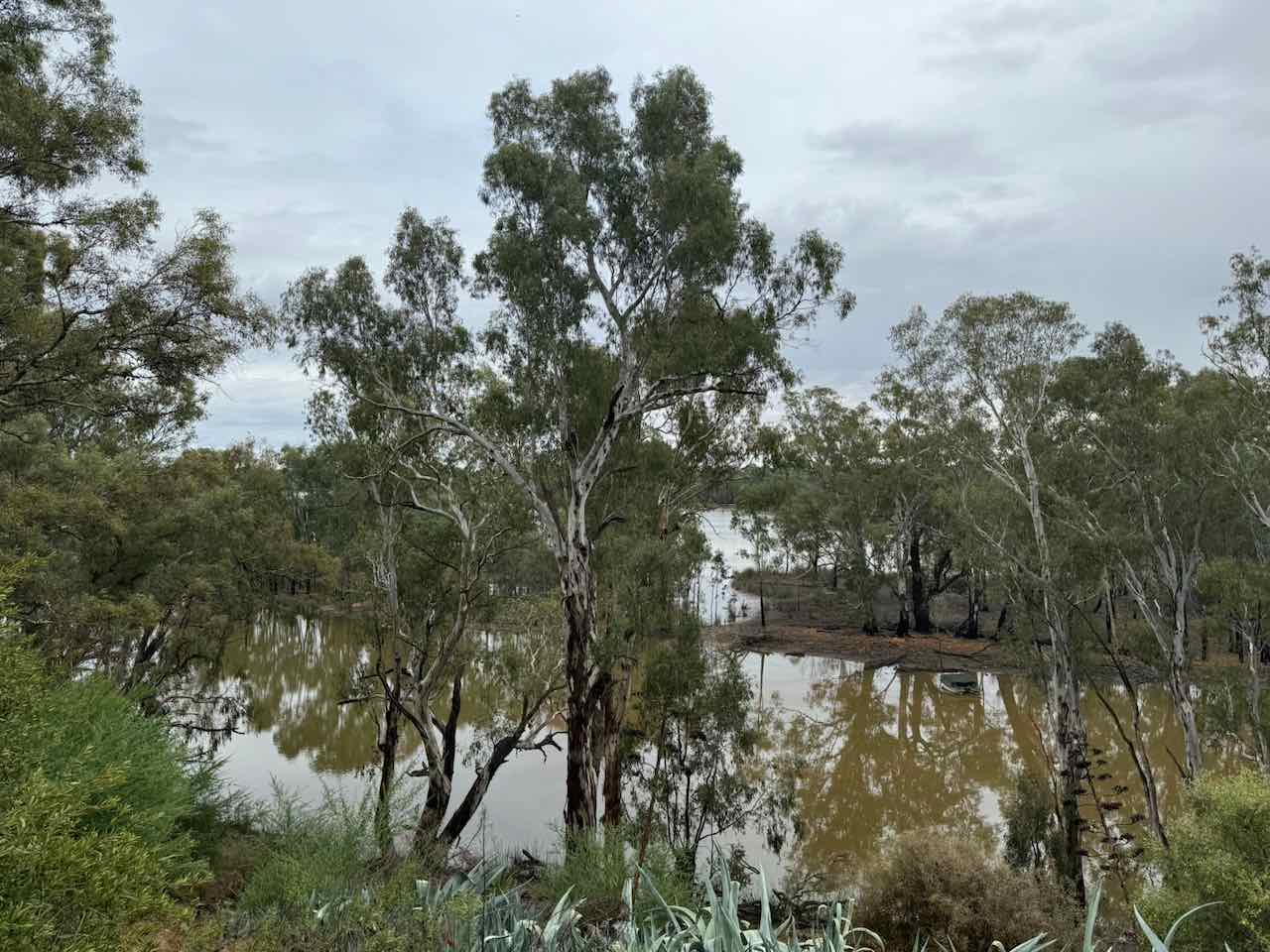
Among other things, Barbeler says his music captures the Australian landscape, specifically Lake Moodemere (pictured) in Northern Victoria where it’s likely Charlotte was born and died. Barbeler describes this part of the country as “peaceful but haunting” and, having visited this lake a few times (including earlier this year), I concur. The poem is certainly haunting, and one particular line from it – “Charlotte is a map of a Country stained by massacres: Skull Creek, Poison Well, Black Gin’s Leap” – is repeated a few times in the musical version. I wondered what these (some very) young British choristers made of it. (You can listen to the piece via music streaming services, as a single under the Choir of Kings College Cambridge.)
* A special thing about Musica Viva concerts is that they regularly commission new Australian pieces for the visiting international artists to perform in their program.
Image: I assume Red Room Poetry is happy for their Poetry Month banner to be used in articles and posts about the month.
Thinking about the Line Break program, I’d love to know if you have a “gateway” poem, and what it is.
 Whispering Gums
Poetry.
I know you’re a big fan, ST, and I wish I could enthusiastically concur with your opinion. But it’s too much like hard work for me – today’s poetry, that is.
Now, when it comes to reading, say,
“The wind was a torrent of darkness among the gusty trees.
The moon was a ghostly galleon tossed upon cloudy seas.
The road was a ribbon of moonlight over the purple moor,”
I’m as enthusiastic as anyone could wish: not only all those wonderful images that fill the mind’s eye (Horatio), but it rhymes !!!
🙂
I’m a fan MR though I wouldn’t call me a big one given how little I actually read! Also I wouldn’t necessarily make a distinction between old and modern. I think there are easy and difficult poems through time? There are many modern satirical poems in particular, that I think are as comprehensible as anything. And some early poetry can be just as obscure (to me) as some more modern ones. The more abstract/imagistic/symbolic they get the more challenging regardless of era? All this said, I agree that evocative, narrative poems like the one you’ve quoted make great reading.
(Wow, I responded to your comment MR on my JetPack app only to find it standing alone here on my laptop. Where was your comment? I thought I was going mad. Then I found it in Spam? But Spam comments don’t usually come through the notification route. Oh well, we are back on rack now.)
Wot is goink on is simple – WORDPRESS.
I have spoken.
[grin]
And I think you are right!
I love reading about little poetry presses, very DIY, rough-and-tumble kind of folks, who publish poetry for the working class in the US. Basically, I started liking poetry when some motley folks pried it out of academia. Otherwise, I am absolutely with you.
Not a gateway poem but a gateway poet: Mary Oliver.
She was not my personal gateway poet, that was Adrienne Rich, but I find Oliver is a good recommendation for people who don’t read poetry.
Well, Stefanie, I replied to this on my phone’s Jetpack App, which even says “you’ve replied to this comment” but is it there or here? Nope. Then, I replied to a comment of MR’s in which she quoted from The Highwayman but my reply is here on my laptop but not her comment. WHAT IS GOING ON?
Anyhow, I said that I like your gateway poet idea – both your recommendation, and reason for recommending her!
I think my gateway was my parents reading poems to me out loud. But when I got to college, I discovered the poetry of Wallace Stevens and that was it, I was in all the way.
Yes that was my gateway too Jeanne, probably AA Milne… then late years of high school was probably where I got my first adult gateway poems … and I have to put poems by TS Eliot and GM Hopkins as my Gateway. I still love AA Milne!
James James
Morrison Morrison
Weatherby George Dupree
Took great
Care of his Mother,
Though he was only three.
EVERYONE should have read every poem AA Milne wrote !
Don’t you love that poem? I’m starting g to read some Milne to our grandchildren … I think they enjoy it!
Of course they do ! – because you read them with all the rhythm and fun, ST !!! 😀
Yes! I still have a lot of bits memorized!
I suspect many of us do!
Excellent stuffing for the brain !! 😀
My kids got AA Milne, and Dr Seuss. But for one of my grandsons I came across Banjo Paterson’s Mulga Bill’s Bicycle as an illustrated book for kids, and it worked really well.
Oh yes, thanks Bill … Dr Seuss too for our kids, and I have read that Paterson. I’ll remember that for the grand kiddies.
Pingback: Poetry & the Microphone | George Orwell – This Reading Life
When I was a girl, the poetry books in the “stacks” were one of the few sections that appealed (with the fairy tales and mythology) in the non-fiction part of the library (mostly I stayed in the fiction, also true now, despite a concerted effort); I’m not sure exactly when I started to believe that poetry was more intimidating than enjoyable (studies, I suppose, or maybe poems that contained fewer winds of torrent and darkness and galleons tossed on seas and fewer rhymes in general). I love the idea of Contains Strong Language as the name for a literary event!
Again, I relate to a lot of what you say Marcie, except I really wasn’t Interested in fairytales and mythology. I was a realist from the start I think! But I loved reading poetry to my kids, and loved buying kids anthologies that included accessible “adult” poems as well as those written specifically for kids. I have read a little with the grandkids but want to read more.