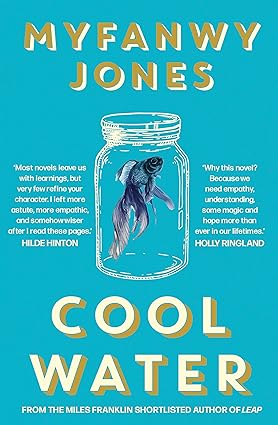
When I was a little girl, I was allowed to watch a limited amount of television, and what I loved – yes, you can laugh at me – were the singing cowboys, like Roy Rogers and Gene Autry. We are talking the 60s and I was constrained by what was on at the times I was allowed to watch, but still, I gave my heart and soul to these cool dudes. At least, they were to me. All this is a long way around to say I love that Myfyanwy Jones’ third novel, Cool water, features one of my favourite songs from that era, the titular “Cool water”, but I’ll return to that later.
Cool water is a strong, but thoughtful novel about fathers and sons, about what makes a good man, and, particularly, about family and what we inherit (whether we like it or not). I have read a few novels since blogging that explore manhood and fatherhood, including books by Christos Tsiolkas and Steve Toltz. This is another, and I found it absorbing. Set in tiny Tinaroo in Yidindji Country on the Atherton Tablelands of Queensland, Cool water is structured around two storylines, one, set in contemporary times, and the other set over 1955 and 1956 during the building of Tinaroo dam. Threading through these two time-frames are three men, Frank, his father Joe, and grandfather Victor.
“Life was an extreme sport” (Frank)
The novel opens with a Prologue, featuring Victor, the town butcher, appearing supremely confident at a town event. But immediately there is something a bit askew in the way he is described. Not only is he “imposing”, but he’s “horribly handsome”. We are introduced to many of the characters who will appear in the story to come, but the Prologue closes at “the end of the hall, where fatherly embrace has become stranglehold: Joe, white-faced now, wide-eyed and wheezing, as Victor Herbert uses the crook of his arm to apply an unrelenting pressure …”
From here, we jump to the present and Victor’s grandson Frank. His father, Joe, has died in the last year, and he, his wife Paula and daughter Lily have returned to Tinaroo for Lily’s wedding. But all is not well. Joe casts such a shadow over Frank that his relationship with Paula is suffering. They are drawing apart. The novel is told third person, but in the contemporary story, it is all from Frank’s perspective, whereas in the earlier story we switch between Victor, young Joe, and a woman named Evelyn who, unhappy in her marriage, catches the philandering Victor’s eye. Jones handles the storylines well, but it is Frank’s voice which carries the novel as he struggles to make sense of his complicated father and be the man, husband and father he wants to be:
… he feared all the men in his family were cursed. And that however hard he tried to be good, he would not be able to escape his shadow.
By contrast, Joe is the murkiest character. We see him as a young boy, caught in an adult drama between Victor and Evelyn that he doesn’t understand. A sensitive boy, he has promise as a human being, but is the youngest and least tough of Victor’s three sons and bears more than his share of Victor’s brutality. Unlike Victor and Frank whom we know as adults, we only know adult Joe through Frank’s eyes. This can feel frustrating because a strong sense of intergenerational trauma underpins the novel but the Joe Frank describes doesn’t match the child we’ve met. However, through seeing how his father treated him, and hearing Frank’s (and his sister’s) recollections, we gradually fill in the gaps to see a man who didn’t fully shake his father’s brutal volatility. As the story progresses, we realise that Joe’s dreams of a different life to that mapped out by his butcher father had not been realised. His death seems to Frank, “a measured suicide” through “deliberate self-neglect”. He is the saddest character in the story.
All this is told against the backdrop of the dam and its lake – first the building of the dam, and later as a drought-stricken recreational facility. This three-generation story could have been set anywhere, so why choose this? I had some ideas, but wanted to see if Jones had been interviewed about it, and I found she had, at Good Reading Magazine. Jones says that her novels “always seem to start with place”, and so it was a visit to Tinaroo Dam which inspired this novel. She says that, “in 2017, Tinaroo Dam was at 25 per cent capacity and full of blue-green algae; pieces of the old, submerged town of Kulara had begun to surface – an eerie manifestation of the ever-present past”.
And there you can see the inspiration. The dam is a powerful place, with a complicated history worth exploring but it also works as a useful metaphor for the “ever-present past” (and thus perfect for Jones’ exploration of intergenerational trauma). Dams and lakes, too, are intrinsically paradoxical, with dam-building representing violence and a desire to control, and lakes offering opportunities for beauty, peace and recreation. Jones uses this to full effect, including well-placed references to colonialism and First Nations dispossession, starting with subtle humour in the Prologue, where we are told that a visiting magician had “come a long way by ship (that said, so had most of the crowd, one way or another). In such ways can writers both truth-tell and decolonise our literature, without telling stories that are not their own.
As for the song, “Cool water”, lines from it appear a few times in the novel, always associated with Victor and always conveying some sense of menace, but also just a little perhaps of a lost soul, a war-damaged man who has lost his way. (In case you are interested, here is the version of “Cool water“, by Frankie Laine, that was popular in 1955 when the novel is set, but there are many versions out there which convey different senses of its meaning.)
Ultimately, Cool water is a hopeful novel, one that recognises and conveys unapologetically the very real damage that can happen in families, but that also sees, as Frank hopes early on, that “a different ending was always possible”. A sensitive novel that leaves much unanswered. I like that.
Myfanwy Jones
Cool water
Sydney: Hachette Australia, 2024
296pp.
ISBN: 9780733650024
(Review copy courtesy Hachette Australia)
 Whispering Gums
One of my favourite reads of 2024 so far. I liked this book so much, I went back and read Leap by Myfwanwy Jones, Which had been on my bookshelf for ages. Loved it too.
Oh thanks Angela. I can understand that. I hadn’t read her before though I had Leap on my virtual TBR after her Miles Franklin. (It has a great cover as I recollect.) I’m intrigued to read it even more now. I like the way she handled her timelines and characters in this novel.
Not that we had a tv to watch cowboys on, but I preferred Frank Ifield.
For some reason I don’t get on with father son stories, or guy stories generally. More grist for the therapy mill.
He was good too, Bill.
As for father son stories, reading can be therapy you know…
I can see why father-son stories would be complicated. On the one hand, my grandfather seemed to have legendary status, but he also did very little with his family, verbally telling us that we had to earn his love and never embarrass him with our appearances. That legendary status, I realized looking back, came from doing the bare minimum with his family and instead partying.
Fathers in my dad’s generation can also be complicated because if they do the tiniest things (e.g. “babysit” their own children or change your tire that one time), everyone applauds them and gives them the biggest portion at dinner. To say and do otherwise was blasphemous. I’m finally comfortable telling my dad, “I like you better now” because he’s changed.
Thanks Melanie… I enjoyed hearing your experiences. That grandfather sounds sad … for his family anyhow. How did his wife feel about all this, do you know. And was he your father’s father or was he the other side. In my family there was more balance I think but they still had a sense they were in charge I think.
Father’s father. Wife (grandma) is still alive. She said she would never speak to me again because I asked her to stop picking at Biscuit, which is one of her preferred pass times of the last 44-ish years.
This sounds better than I thought – Mr Books in particular enjoys stories “about what makes a good man”. And I also love old submerged towns in dams stories (Tristan Bancks has a great one for young teens called Scar Town).
I couldn’t see that any of my blogger friends had read it, Brona, but I do think it’s an engaging read. The Dam story made me think of the Snowy scheme of course which was happening around the same time in the early mid 50s (and the flooding of “old” Jindabyne), and the Ord River Scheme where Mary Durack’s home was flooded. Dam-building is a great backdrop as you say. I could have said more because it is a strong presence in the novel.
I started singing the song in my head the moment I read your title, ST.
But … it doesn’t seem madly relevant to the book, to be blunt. You know I have a passion for the ‘correctness’ of titles (meaning whether I reckon they work or not); and although this is nice, I can’t see this book as the place for it. This is probably because I know every word of the song, and quite often sing it to myself because I like the melody.
And Bill, I reckon it’s no mystery: blokes have opinions that are set in stone, and do not appreciate views that don’t match them. (5/6d, please !)
I love this song too MR, and I also know the words. I started singing them when I saw the title too. Anyhow, as I was reading it, I thought a lot about it and its application to the novel, as besides the general idea of water its relevance is not immediately, directly obvious. The song itself is, in some ways, obscure in what it is really trying to say, but it does have a tone that fits – “all day I face the barren waste without the taste of water …” However, I think the way certain lines are used with Victor does make sense.
In the Interview I read, Jones doesn’t say much about it, except that her family had an album with this song that they regularly listened to. The interviewer didn’t ask her about the title.
BTW I went to YouTube and listened to multiple versions of the song – the difference in delivery is quite astonishing – from very slow, lugubrious, melancholic ones to almost upbeat ones.
Regardless of Bill’s preference, there is only the one acceptable version, and it’s Frankie Laine’s !
I have spoken. [grin]
But which one MR, says she provocatively … apparently he did a different more “traditional” recording later.
Oh ! – this I didn’t know … I shall research !
Do, and let me know what you think.
I never would have pegged you as a singing cowboy fan! For some reason that little bit of information made me extremely happy. And the book sounds good too 🙂
Phew, I’m glad Stefanie that it didn’t lower your estimation.
And the book is a good read.
Ohhh, I hadn’t thought of it before, but the metaphorical potential of that setting is powerful indeed. It resonates with my memory of the 2003 film Northfork (which Wikipedia describes as having mixed reviews but which I absolutely loved) which I’ve been thinking about lately; I think that subtext exists there too.
There are some great settings with metaphorical potential, aren’t there Marcie. I haven’t heard of Northfork but you have me intrigued now.