How to title today’s post was my first challenge – and I hope the title I settled on covers it well enough. What I am wanting to cover here are those awards that don’t go to books (or manuscripts) or writers, but to those in the industry – people and organisations – that support writers and their books. The ABIAs, or, Australian Book Industry Awards, have been doing this for some years.
ABIAs
Established in 2006, these awards are, says Wikipedia, ‘publishers’ and literary awards held by the Australian Publishers Association annually in Sydney “to celebrate the achievements of authors and publishers in bringing Australian books to readers”‘. I have only written on them once before, and that was to highlight some of the winners in the 2019 awards that interested me. However, these awards also recognise others working in the industry. The categories change over the years, but since 2017 there have been awards for (listed with the winners in the years they were made):
- Book Retailer of the Year: Readings (2020); Readings (2021); Harry Hartog Bookseller, Burnside Village, Adelaide (2022); Big W (2023)
- Bookshop of the Year: Books Kinokuniya (2020); Avid Reader, Brisbane (2021); Avenue Bookstore, Albert Park, Melbourne (2022); Matilda Bookshop (2023); Fullers Bookshop, Hobart, Tasmania (2024)
- Commissioning editor of the Year: Jane Palfreyman (Allen & Unwin) (2023); Catherine Milne (HarperCollins Publishers) (2024)
- Independent Book Retailer of the Year: Readings Potts Point Bookshop (2017); Readings (2018); Mary Martin Bookshops (2019)
- Marketing Strategy of the Year: Bloomsbury for Johann Hari’s Stolen Focus (2023); Affirm Press for Pip Williams’ The Bookbinder of Jericho (2024)
- National Book Retailer of the Year: Booktopia (2017); Dymocks (2018); Booktopia (2019)
- Publisher of the Year: Pan Macmillan Australia) (2017); HarperCollins (2018); Pan Macmillan Australia (2019); Allen and Unwin (2020); Penguin Random House Australia (2021); Penguin Random House Australia (2022); Allen and Unwin (2023); Penguin Random House Australia (2024)
- Rising Star Award: Shalini Kunahlan, marketing manager at Text Publishing (2018); Ella Chapman, head of marketing communications at Hachette Australia (2019); Hazel Lam, senior book designer at HarperCollins (2020); Pooja Desai, head of design at Hardie Grant Children’s Publishing (2021); Emily Hart, Commissioning Editor, Hardie Grant Books (2022)
- Small Publisher of the Year: NewSouth (2017); Thames & Hudson Australia (2018); Affirm Press, with Honourable Mention to Magabala Books (2019); Magabala Books (2020); UQP (or University of Queensland Press) (2021); UQP (or University of Queensland Press) (2022); UQP (or University of Queensland Press) (2023); Magabala Books (2024)
As you can see, the categories move around a bit, but there are awards for publishing companies, booksellers, and book industry professionals. I like seeing designers, commissioning editors and marketers being recognised in what is an awards-rich field.
ABDAs
The Australian Book Design Awards aim to “showcase the best of the best in book design in this country”. They are open to books designed and first published in Australia, in the year preceding the awards. They are offered in multiple categories. In 2024, some 19 categories are in the mix, including Best Designed Commercial Fiction Cover, Best Designed Literary Fiction/Poetry Cover, Best Designed Non-fiction Cover, and so on. There are awards for covers only and for overall book design. I have written about them once, in the past, for the 2017 Shortlist.
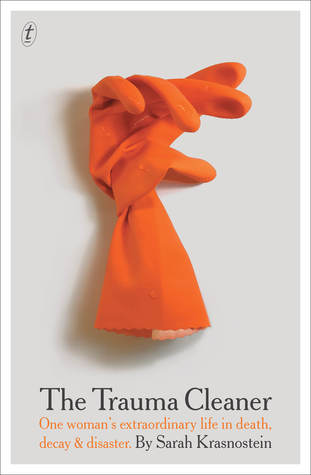
Their Awards Archive site takes a bit of navigation, and doesn’t always present the information in the most ideal way, but you can find some gorgeous covers there, including Sandy Cull’s award winning cover (2017) for Heather Rose’s The museum of modern love. Another award winner – cover and overall design (2018) – was W.H. Chong’s work on Sarah Krasnostein’s The trauma cleaner. Back in 2018, I attended and wrote up a Canberra Writers’ Festival event involving W.H. Chong.
Specialist Awards
There are also awards run by specialist or special interest publishers, like the Educational Publishing Awards Australia (or EPAAs). These were co-founded in 1993 by the APA (Australian Publishers Association) and the late Professor Mike Horsley, and are organised by the APA which also manages the ABIAs. Most of the award categories are for specific books/educational titles, but they also include Primary and Secondary Publisher of the Year, which, in 2023, were won by SevenSteps (Primary) and Cambridge University Press (Secondary). Publisher Jacaranda has been a regular winner of these awards.
Are you aware of these awards, or of similar awards in your location or area of interest? I’d love to hear about them.
 Whispering Gums
I’m reminded of how important book designs are – especially the covers. The impact on sales is often underrated, I think.
Thanks Karenlee … I used to think I wasn’t affected by covers and I’m not a lot as I usually go for specific authors. But if I’m looking for a gift and I’m looking at new books in displays covers will attract me to look at this book over that one. But interior design is also important isn’t it?
I missed responding to this. Yes, interior design is very important too IMO. Even something as simple as the choice of paper can make a difference. One of the difficulties for me with all my travelling is no longer being able to experience what I call ‘proper’ books. I am lucky to have my Kindle but, gosh, I miss the feel of the pages, the occasional raised dinkus, the smell … oh, the smell!
Haha, I go side-tracked!
Yes I know what you mean. E-books are so convenient but great book design can make reading of a physical book such a pleasure.
ABDAs: in truth, I believe the cover of ATLMD should feature in design awards. Yeah, the idea is basic, but my blogging community of that time really liked it, and so do I – even if it’s simple in its derivation.
Anyvays … these off-the-beaten-track awards are interesting, ST: where would we be without our publishers ?
It was a good cover MR I agree.
And exactly. Where would we be without them.
The Australian Booksellers Association – now known as BookPeople – also have an industry award for bookseller of the year, young bookseller of the year and children’s bookseller of the year – if you click on the title for each one in the link, you can see previous winners. I haven’t yet heard who won this year’s awards…
https://www.bookpeople.org.au/bookseller-events/awards
Oh thanks Brona. This didn’t come up in my searches. I will check their awards out.
But BookPeople? Why do organisations change from a perfectly clear name to something that could mean so many things? (I speak from experience of an organisation that did just this, but that after huge backlash changed back to its original name.)
I know right? All of us working in the industry still say ABA.
But I did find out that Matt Davis (from the bookshop Queenscliff) won bookseller of the year .
And Maddy Delaney from Fullers won young bookseller of the year.
Nice! And Fullers won the last ABIA for bookshop/bookseller, didn’t it, do makes sense!
I’m not surprised.
I don’t know that bookshop, but yh red n it’s decades since I’ve been to Queenscliff.
Good point: we tend to overlook these, don’t we. Other than the Association of Canadian Publishers (which is English-language only so, among others, work in the official language of French is not included), I’m not paying proper attention to these: https://publishers.ca/
Nice site Marcie, and nice to see all those acknowledgements of workers in the industry.
There are some independent presses in the US that I like to follow. For example, one of them is called Press 53, and all they publish are short story collections. Therefore, you kind of know what you’re going to get. None of the collections are super long, and so it’s just enough to satisfy you, but not so much that you feel like you’ve been reading the same short story collection forever. I hate that feeling when collections try to be too many things, so you don’t really feel like you’re reading a single genre or theme, but I also hate when a short story collection feels like you’re reading the same story or character over and over again. For a while there, Junot Diaz was the literary shirt story darling of the US, and all his stories featured the same guy with the same name and the same behavior. I haven’t heard much from him in a while because he was accused of forcing himself on one of his students during the #metoo movement.
This is interesting Melanie – “I hate that feeling when collections try to be too many things, so you don’t really feel like you’re reading a single genre or theme, but I also hate when a short story collection feels like you’re reading the same story or character over and over again.” I haven’t really thought about what you are saying here specifically, but I probably dislike your second type more than the first, particularly if the tone is the same. I mostly look for variety in tone – and that is often the result of variety in voice. Too much variety doesn’t bother me I think as monotony in tone.
I’ve read one short story by Diaz, but I hadn’t heard of that accusation (which is not surprising given he’s not well known here, as far as I know.)
I’ve read some collections that seem to have fantasy, science fiction, straight fiction, etc. They just seem all over the place, so my brain doesn’t quite know how to follow along.
Oh thanks… I think I’ve read some like that – not many though. I don’t think they’ve bothered me a lot. I think I like the variety as long as they are not so out there that I just don’t like them. In fact I probably prefer a few fantasy/SF ones squeezed between others then a whole book of them.