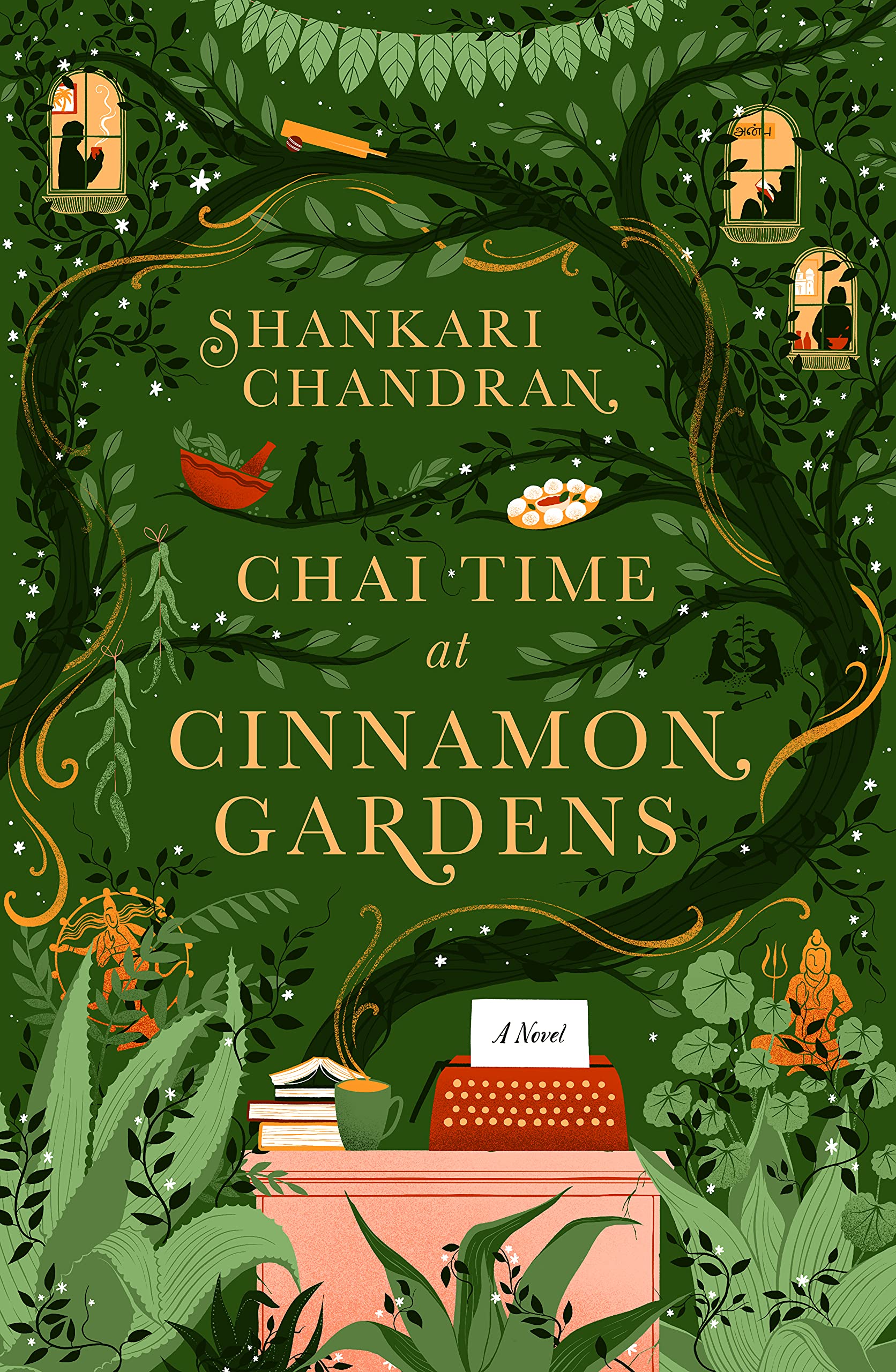
Shankari Chandran’s Miles Franklin Award winning novel, Chai time at Cinnamon Gardens, was my reading group’s March book. Unfortunately I was out of town at the time of the meeting, but of course I wanted to read it – and I did, finally!
Like many people, I think, when I first saw the book, I assumed it was one of those cosy crime novels set in a nursing home or retirement village. The title and the pretty cover certainly suggest that. Only a fraction of this first impression was right, though. It is set in a nursing home, and crimes do occur, but it is not a crime novel and nor is it cosy. Instead, it is a serious, thoughtful and immersive novel that covers many issues confronting modern multicultural Australia, but that also has one main driving idea – which I’ll get to soon.
First, though, I want to clear up another assumption I had, which was that Chandran is a Sri Lankan-Australian writer. Wikipedia told me otherwise. It describes her as a British-Australian writer, who was born in London to Tamil refugees from Sri Lanka. She grew up in Canberra, and studied law at the University of New South Wales, before working as a human rights lawyer in London for a decade. She now lives in Sydney. Chai time at Cinnamon Gardens is her third novel. GoodReads describes her first novel, Song of the Sun God (2017), as being “about three generations of Australian Tamil women and the choices they make to survive Sri Lanka’s civil war“. I don’t know what that novel’s overarching idea is, but Chai time at Cinnamon Gardens also draws from its main characters’ experiences during that civil war, and I do have a view on what drives it, so let’s get to the novel.
It is set in the Cinnamon Gardens Nursing Home in a fictional Sydney suburb called Westgrove, which situates it in Sydney’s multicultural western suburbs. The home is taken over in the early 1980s by Sri Lankan migrants, Cedric, Zakhir, and his wife Maya who wants to transform it to a place “where people will be valued”. The novel is told through multiple alternating voices, but starts with a Prologue which describes the home and which, if you read carefully, also prepares us for what’s to come:
Arabian jasmine climbs the wooden trellises staked in the garden beds. They are bold travellers, dark vines carrying white stars up the two-storey walls and around the windows of the residence. The plant grows obediently in the quiet suburb of Westgrove, Sydney, but its tropical ancestors are a wild breed, a vine that grows rampant in the villages of Sri Lanka, a home more familiar to many of the residents.
“Bold travellers”, “dark vines”, and “white stars” together with words like “obediently” and “wild” suggest a tension that we are going to explore.
We then start the narrative proper. It’s 2020, and Maya is now old and living as a resident in the home – albeit one who still holds many strings. Ruben is attending her, and we become aware that he bears fresh and old scars on his body. As the narrative progresses, we learn that the fresh scars come from recent racist attacks on him in the vicinity of the home, while the old scars relate to his experiences in Sri Lanka during the war. These scars more literally embody the tensions that pervade the novel.
From here, the rest of our narrators, all third person, are gradually introduced – Ruben; Maya’s daughter Anjali (Anji), who now manages the home; Anji’s old schoolfriend Nikki, who is the home’s geriatrician; and Nikki’s husband Gareth, who is white-Australian and a local councillor. There are other characters, including, most significantly, Anji’s also white-Australian husband, Nathan, and Maya’s aforementioned husband, Zakhir who disappeared, now presumed dead, ten years before the novel’s opening.
A strength of the novel is the way these characters inveigle their way into our hearts and minds so that we care about them, even the unappealing Gareth who, blinded by self-pity, rashly but unintentionally unleashes the dreadful drama that unfolds. It all hinges on racism. Chandran exposes the awful truth of how endemic racism is in Australian society and how, as a result, things can so quickly get out of hand. Interspersed with this present-day storyline are Maya’s, Ruben’s and Zakhir’s backstories, which explain why they had come to Australia – personally, in terms of what they had experienced during the civil war, and politically, in terms of their Tamil heritage and what that civil war was about.
I said at the beginning that the novel covers many issues which confront modern Australia, but that it also has one main driving idea. The issues include racism, colonialism, and multiculturalism; trauma, loss and grief; friendship, family and community; and the role played by the media, including social media, in fuelling emotions rather than encouraging reason. Underpinning these issues is the idea that drives the narrative – storytelling, and “the most powerful” of all stories, history. By framing her story within the Sri Lankan civil war and its battle over contested histories, Chandran makes her novel relevant to all cultures and societies where history has been used to oppress minorities resulting in violence, disempowerment and oppression, where distortion produces misinformation and confusion that can be manipulated to serve personal and political ends.
As grim and confronting as much of it is, Chai time at Cinnamon Gardens is not without hope. Alongside Chandran’s exploration of the misuse of history is a commitment to the positive value of story. To this end Maya, from the beginning, interviews all residents of the home, capturing their lives and their dreams in order to properly know and care for them. This provides the book with another underlying tension, that between histories that erase and stories that “must not be erased”.
Does it all work? Chandran holds a lot of balls in the air. Early on I felt caught in an awkward amalgam of a contemporary novel about middle class angst (husband versus wife, daughter versus mother, and so on) and one exploring critical political ideas. Also, there’s constant moving backwards and forwards in place and time, the plot felt a little contrived in places, and the main themes are hammered home. However, Chandran balances the tone well, mixing light humour and satire with sadness and tragedy, and the characters are vividly and sympathetically drawn. The end result is a book that reveals our essence, and asks us to consider how we might live together in respectful community. Consequently, despite some unevenness, I greatly enjoyed the read.
Shankari Chandran
Chai time at Cinnamon Gardens
Ultimo: Ultimo Press, 2022
360pp.
ISBN: 9781761151408
 Whispering Gums
Excellent review – terrific read – culturally diverse Australia! I enjoyed the novel when I read it some months back. Late last year? Jim
Thanks Jim … it is a great read isn’t it? Warm-hearted despite the serious issues.
I didn’t even know there’s an Ultimo Press ! – anything to do with UTS ?
(Your usual brilliant reviewing. It’s an art, and you’re on top of it.)
It’s a new press, MR, established just in 2020. No, not part of UTS.
Thanks re my review. I woke up this morning thinking of things I should have said!
Yeah; but I reckon you mostly do that ! 🙂
You are right … in that sense I suppose I am a writer!
Of course you are ! – whereas I am just an author. There’s a clear difference – not that either is the upper or the lower, oeuf coarse !!!
No “just”! It’s an immense achievement!!!
Interesting to see what you thought of it… I borrowed a copy from the library but didn’t finish it so I was looking to see if you had noted what it was that made me abandon it. And yes you had: “the plot felt a little contrived in places, and the main themes are hammered home.”
I rather guessed that’s why you might have abandoned it, Lisa, because I remembered that you had, but they were niggles for me rather than biggies. By the end I felt she had pulled it together well, with enough nuance (hate that word really) to make it a worthwhile exploration of some big issues.
Well, obviously the MF judges thought so too!
Ha ha, yes they did. I don’t recollect what it was up against so I won’t comment further on that.
The popular favourite was Limberlost…
Thanks … I’ve just looked up my list. I’d read two … Limberlost and Cold enough for snow. Both excellent reads. Now I’ve read three – all with my reading group as it turns out. I must ask next time which of those they’d have chosen.
I then looked at the 2022 list and I’ve still read none of them!
I’ve just looked up mine for 2022, and there’s still a good few on the longlist that I haven’t read (and, a-hem, don’t want to). That year I posted predictions (of which only one was nominated), which reaffirms once again that I am usually out of touch with the MF crowd, and happily so.
The points you raised were similar to what our book group raised. Especially yhe cover that looks so lovely. Evidently that was on purpose in order to get people to pick it up. However I appreciated the points it raised I did not enjoy it very much at all. I didn’t connect to all the characters and although Gareth.Garth? raised great points I couldn’t stand him. I didn’t like all the jumping around either. I do think it was an important book on many fronts.
Thanks Pam … I’m really sorry I missed my reading group’s discussion. From what I’ve heard, I think there were mixed feelings and they probably covered much of what yours did. I’m not sure what we mean by connecting with characters really, but I was interested in them and found myself starting to think about them when I wasn’t reading.
Excellent review of Chai Time, thnx. I like the books’s ambition.
Thanks Sean … yes, good point. I like its ambition too.
I own an Audible version, so I’ll get to it eventually. Though, it doesn’t sound like one I’d spend a credit on, so it must have been part of a bonus offer at some stage. I haven’t read anything about the Tamils in Sri Lanka except bits in the news, so I look forward to that aspect – I get the impression they were treated pretty harshly.
Pretty harshly is an understatement Bill if this book is anything to go by. I think it starts a bit weakly but overall turns into a good read.
One of the novels that’s made the shortlist of the Carol Shields Prize for Fiction tells the story of Tamils coping with persecution: V. V. Ganeshananthan’s Brotherless Night. It’s more character-driven than plot-driven, so I don’t know how it would work as an audiobook (probably would require too much focus for me as listening rather than reading), but if anyone is interested in the topic, it’s very informative and also has a lengthy reading recommendation section at the back (including Shyam Selvadurai’s Cinnamon Gardens, which is the book I initially thought your post was about, WG, at a quick glance).
Thanks Marcie. I guess “Cinnamon Gardens” is not an uncommon name for Sri Lanka, like say, Wattle Park might be in Australia? I agree with your assessment about what’s suitable for audio books.
This definitely sounds like one I’d like to read, so I let my eyes flit across your review so as to keep much of it undiscovered. I’m hopeful, given the prizelist-profile, that I’ll be able to find it over here.
I understand the flitting eyes, Marcie! I hope you get to read it.
My book group also had similiar responses – some quiblles about the writing and structure but commendation and a great chat about the topic and how she handled it.
Thanks Brona … I guess I’m not surprised!
I’m curious if the pandemic plays a role in this novel, given when it is set and where–an elderly folks home in 2020.
Good question Melanie … no it doesn’t. I can’t recollect when in 2020 it is but that’s an interesting point.