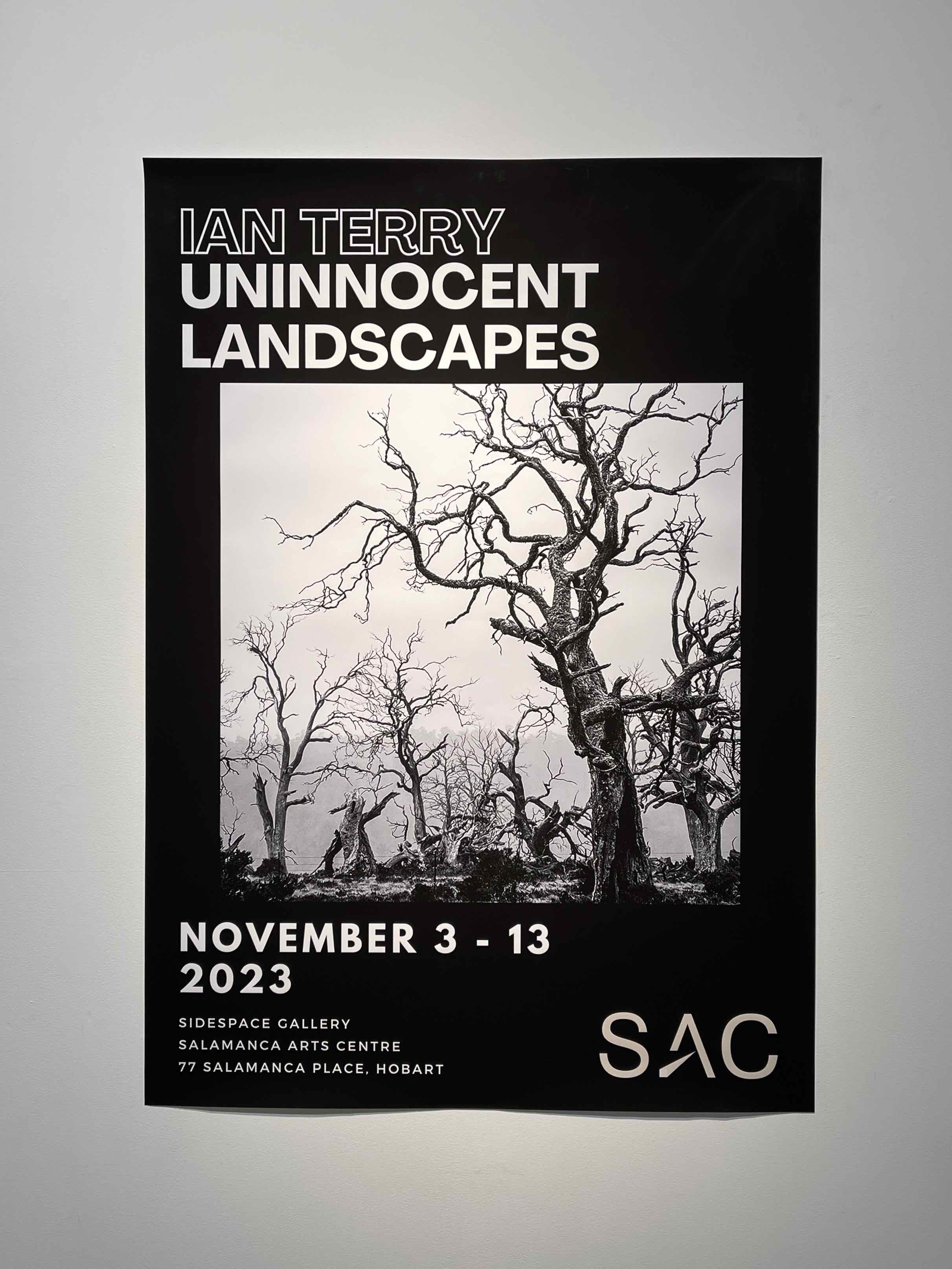
Those of you who know me on other social media will already have seen some of this, but I am keen to spread the message wherever I can about my brother’s wonderful, and significant, project. I introduced it back in September – and later in Nonfiction November I will review the book. That, however, will be after the exhibition has closed, and I want to encourage anyone who is in Tasmania to see it.
Uninnocent Landscapes – the exhibition and book – is the culmination of an idea Ian started thinking about a decade ago, but that he actively worked on over the last two to three years. It involved his following the journey taken by George Augustus Robinson on his 1831/32 Big River Mission, which was a poorly conceived attempt to conciliate between settler and Aboriginal Tasmanians. Needless to say it was a disaster, that effectively ended First People’s resistance in lutruwita/Tasmania (at the time anyhow!) For Ian, who has come to call lutruwita home, there is discomfort in reconciling his privileged life as a middle-class white man with the devastating impact of colonialism on Tasmania’s First Peoples. This is his truthtelling project, and he found a unique way to do it by combining the three big passions of his life (besides family) – history, photography and the bush.

I will write more about this when I review the book because what Ian has done feels original and exciting. Essentially, though, the book and the exhibition comprise photographs accompanied by excerpts from Robinson’s journal, resulting in an experience that is enlightening, engrossing, and sobering. The exhibition contains a selection of 11 from the book’s over 50 photographs.
The venue, Sidespace Gallery, is in a heritage building that dates back to the mid-1800s. This means two things – there are some restrictions on how items can be affixed, and the walls and floors are not what you would call square. However, Ian and his “crack instal team” did the research and, by the time I got there, were ready to go. The photographs – large-scale archival prints – were “hung” through a clever system of special Japanese tape (that doesn’t mark walls), double-sided tape, and magnets. I enjoyed being a little part of it all on the first day of installation, and loved meeting Ian’s delightful, hardworking team, Erica and Nikki, who made me feel so very welcome.
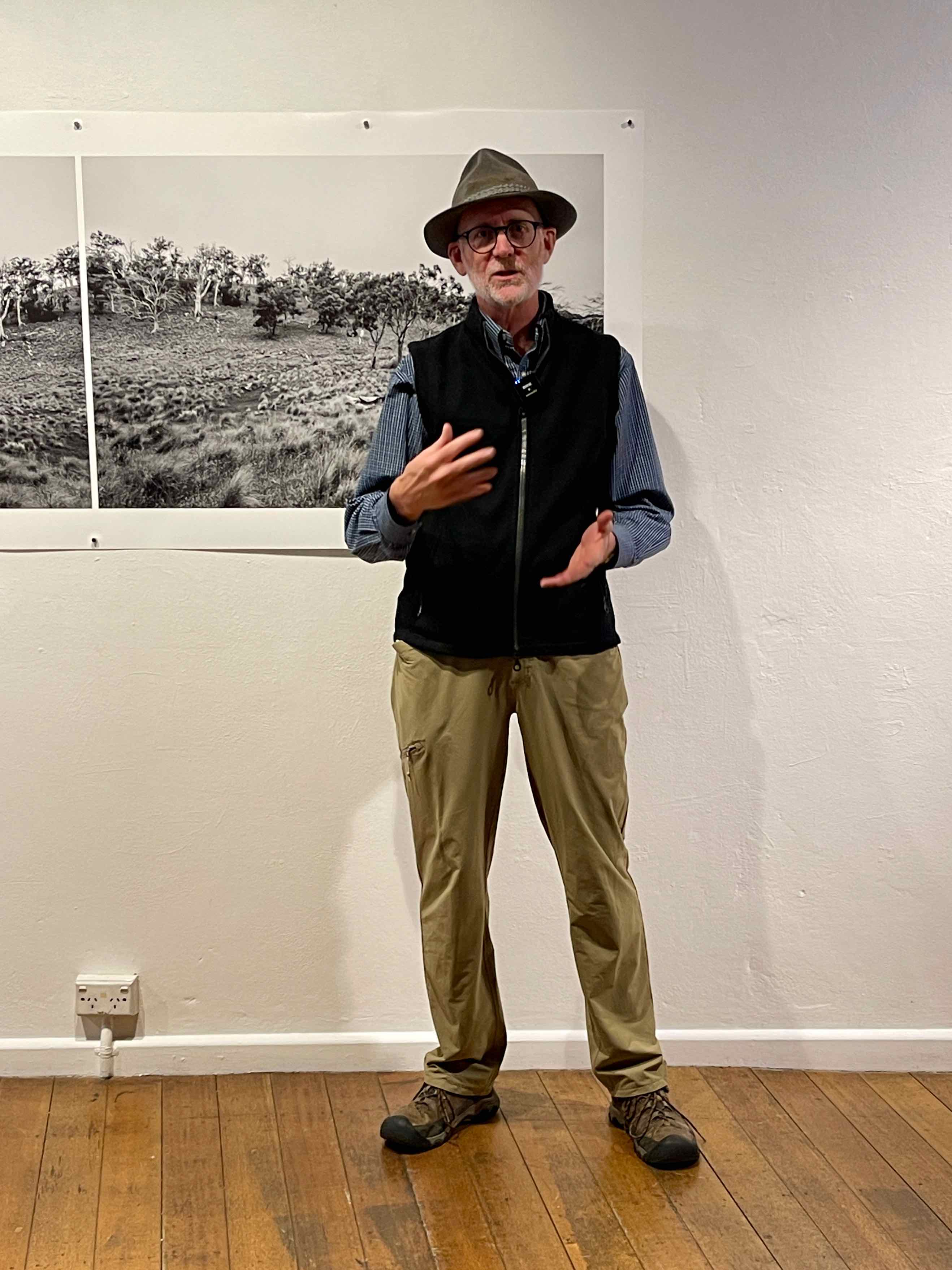
The opening (and book launch) went very well, with 50 or 60 in attendance. The MC was writer and researcher Steph Cahalan, and the exhibition was formally opened by Tony Brown, a First Nations man and museum colleague of my now-retired brother. Ian of course then spoke to his project, explaining, among other things, that he had discussed his project with many in the local Aboriginal community, and had made clear that he was not trying to tell their story, but his own. His good relationships with the community suggest that they accept this.
It was a warm-hearted event attended by historians, artists, museum professionals, bushies, activists, not to mention family and friends. I met and talked with so many interesting, thoughtful people who support Ian’s project and believe in what he is doing. I can’t name them all, but before it all started I had a great chat with the two women who designed and published the book. Our conversation ranged from technical issues like fonts to more personal ones like downsizing and philanthropy. It was truly a privilege to be there.

Ian calls Uninnocent Landscapes a photographic conversation. By this he means, I think – though I didn’t ask him while we were together – that he is using photography to reflect on (to interrogate, in fact) his relationship with the Tasmanian landscape he loves so much but which has been indelibly affected by over two centuries of colonialism. The idea of conversation, however, also encompasses something ongoing and inclusive, something inviting us all to join in as we engage with his photos and, for those of us living in colonised places, as we engage with “our” places. I will discuss this more, and talk about the title, in my review!

Uninnocent landscapes, the book, is published and distributed by OUTSIDE THE BOX / Earth Arts Rights under their imprint An Artist’s Own Book. It costs $65, and all proceeds are going to the Aboriginal Land Council of Tasmania’s Giving Land Back fund. You can order it here.
Ian Terry
Uninnocent Landscapes
Sidespace Galley, Salamanca Arts Centre
3 – 13 November, 2023
Admission is free
 Whispering Gums
This project, as you describe it, is utterly magnificent and ground-breaking. The history of invasion in lutruwita is one of the great sorrows of the world. Congratulations to Ian, and all who have assisted him. It is wonderful to see such vision and perseverance brought to fruition.
Thanks Carmel. I think it is. And he has gone about it quietly, thoughtfully, and with a great deal of heart.
Thank you for your kind words, Carmel.
I am actually in awe of what you have done. I believe your project is of great significance.
I’m so glad you say this Carmel because I wanted to but as sister I felt I could be accused of bias. I can now quote you.
A reply to your reply whisperinggums – I am biased in the direction of the First Peoples of lutruwita. I belong to the Invading Peoples, but from a very early age I somehow sensed there was a deeper darker history to be uncovered. Much has been done; much remains to be done; Ian’s work is a fresh new leap in the uncovering and exposure of something like the truth.
Thanks Carmel … I did think of you when I was down there because this comes across clearly in Tell-tale, for a start.
Response to whisperinggums comment re Telltale – yes, one of the purposes of Telltale was to document the ‘colonial’ history of lutruwita, and to foreground my own growing consciousness of the story of the island, a consciousness that began in early childhood.
Well, that consciousness did come across … I remember being interested in your awareness from a young child. It’s too easy to think all this awareness is very recent but it didn’t come out of nowhere, did it.
Thank you again, Carmel – having worked as a historian and museum curator for the last thirty years, with a particular interest in frontier history, this has been an important project for me.
Thank you, Carmel, I’m hoping that it will engender lots of conversations. I’ve had some great ones sitting in the gallery with my exhibition.
This is a very exciting time for the Terry family ! – and one that goes some way to indicating that they’re .. well .. kind of OK in the brains department.
A truly terrific project, conceived, worked on and mounted with all the right reasons.
Goodonyer, brother Ian: here’s hoping you’ve provided the world with more of your ilk for years to come, as has your sister ..
(“special Japanese tape (that doesn’t mark walls)” ?? – I WANT IT !) [grin]
Thanks MR … it is a truly excellent project.
And that tape is excellent!
Thank you MR. The tape is Japanese Washi tape, made by Dulux.
Whatta bloke !!!! – [bows gratefully]
You’re a gift to a renter, Ian ! 😀
😂😂
It sounds a fabulous project and outcome, and your brother sounds of the ilk who won’t rest on his laurels for long – next project?
Ha! In the wise words of Mr Curly, it is important to be restless – to rest more and do less …
Love it Ian!
Very droll. My diary has had a “fat” attack. I can’t see me being your kind of restless until at least 2024.
Know the feeling Gwendoline …
He does have one Gwendoline … but I’ll leave that for him to divulge if he wishes. But yes a great outcome for him and hopefully also for his aims.
Thank you Sue. I’m glad your enjoyed your stay and the exhibition.
How could I not! Great project and great city not to mention great brother.
I will get down there to see it. I shared the information with both of my photography clubs I’m in. Such a worthwhile project.
Oh great Pam … do say hello to Ian. He’ll be there most of the time (except Wed am when he is doing a talk).
I really don’t know much more about Tasmania’s Black War than I gathered from Robert Drewe’s The Savage Crows. I had thought Robinson’s journal, which Drewe references, was imagined, but I wonder now if the quotes from it were Robinson’s own words (it’s been a few years since I read it).
It’s a long time since I read Robert Drewe’s book, wadholloway, but I’d be fairly confident that he probably used direct quotes from Robinson’s journal. They were published in 1966 and have been a very important historic source ever since.
Thanks Ian, I was hoping you’d reply to Bill. The book came up in discussions last week – were you there? – but I haven’t read it so couldn’t respond with authority. I like Drewe so am intrigued.
I delayed answering this, Bill, hoping Ian would, and he did’. I like Drewe and would like to read this.
Knowing what I do of your parents through this blog, I think they would have been immensely proud of this project. Congratulations, Ian!
Thank you Lisa.
That’s what I told him Lisa! But always better coming from someone not your sister!
Your description of the launch makes me wish that I lived closer.
Warm-hearted and what a diverse group of attendees.
Bushies, there’s a term I didn’t know, which I’m sure applies up here as well.
Bushies… you made me think Marcie. So I looked it up for fun. this in the meaning I meant:”bushie (plural bushies) (Australia, colloquial) Someone who lives in or is familiar with the Australian outback; a bushman or bushwoman.”
BUT, I also found this: “noun INFORMAL•AUSTRALIAN
plural noun: bushies
a person who lives in the bush (as distinct from in a town), typically regarded as uncultured or unsophisticated.”
That’s not what I meant. I can imagine both terms being used in different contexts and can be used positively or negatively.
Even though it likely sounds cynical to say, it seems inevitable that the first, literal, meaning would devolve into the second, when one considers how quick many humans are to judge many other humans, particularly this enduring country/city divide. But I’m glad that you looked this up and shared the results, as I would have taken away the former definition and could have overlooked this other pejorative usage which you obviously didn’t intend either.
Cynical, but unfortunately true , eh? Thanks Marcie.
What a wonderful project. Thanks, WG, and thanks to brother Ian.
Hmm … what happened to my response? I was on my phone I think and clearly it didn’t work even though I did quite a few responses on my phone. Anyhow, thanks Sara. It is a project you would like.
I’m sure I would.
Thank you Sara
Congrats on a fantastic project, Ian. I wish I had been in Tassie to attend.
Wish you had too but, you know, Tasmania !
Thank you, fourtriplezed
Oh, how wonderful WG! You must be so proud of Ian. As you know, he was extremely helpful and selfless in responding to my questions when researching for my [still unpublished] manuscript a few years ago. His passion for history clearly showed through in his email correspondences. What a wonderful project he has undertaken with his photographic discussion. Bravo!
Thanks Karenlee. I am. And I had forgotten that connection. So nice to hear from you. What are you doing these days?
Still roaming the world, caring for pets, writing, loving life.
Oh great. Good for you. I admire the sense of adventure.
Thank you for your kind comments, Karenlee.
That is so mindful of him to give the money from the publication back to the Tasmanian first Nations peoples. We talk a lot in my interpreting classes about how when we enter Deaf spaces, we need to know that we are both guests, and part of the community. Thus, it is essential to give back as much as possible. Because we’re certainly taking.
Thank you Grab the Lapels, I think it is important to acknowledge, act as guests on the land and do yet more …
It sure is Melanie.