Which book you are presumably wondering? The session’s subtitle will give you a hint: Debra Dank in Conversation with Evelyn Araluen. The book, then, is Debra Dank’s We come with this place, which won a record four prizes in this year’s NSW Premier’s Literary Awards (as I described in my post).
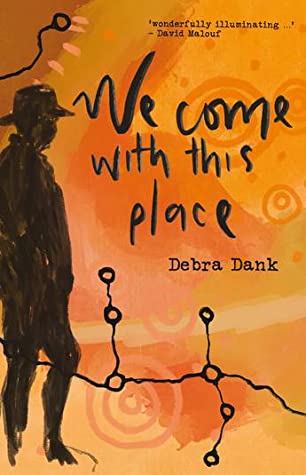
The session description commenced with:
We come with this place is deeply personal, a profound tribute to family and the Gudanji Country to which Debra Dank belongs, but it is much more than that. Here is Australia as it has been for countless generations, land and people in effortless balance, and Australia as it became, but also Australia as it could and should be…
It described Dank as “a Gudanji/Wakaja woman” and Araluen as “born and raised on Dharug country [and] a descendant of the Bundjalung Nation”. If you read my second CWF post from yesterday, you’ll see that I have already “met” Debra Dank and Evelyn Araluen. That whetted my appetite for this more focused one-on-one session.
The conversation

Oh my, what a session this was in terms of complex ideas that challenge western world views being presented in a respectful but unapologetic way. After all, why should they be apologetic.
Araluen started by introducing Dank from the formal bio, and ending with the fact that her book had won “incredibly significant accolades”. The session’s title, she explained, had come from Tara June Winch’s description of it as “a jewel of a book”.
The session discussed several issues, but a recurring one concerned the book’s narrative style and how it reflects “Indigenous narrative practices” as Dank framed it. I was keenly interested in this because I have been aware of First Nations Australian storytelling (oral and written) as being different but identifying the difference has not been so easy!
Dank said in response to Araluen’s opening question that she hadn’t set out to write a book, so she was still developing her relationship with it “as a book”. She wrote it for her kids, and saw it as essentially a conglomeration of stories and events. Araluen picked up on this and talked about how the book comprises an interweaving of language, memory, time, and place. Critics, she said, have been trying to find a way to describe Indigenous storytelling by using words like “interweaving”. Dank saw this sort of interweaving as integral to “Indigenous narrative practices”, to Indigenous storytelling.
Araluen commented on how well Dank conveys the “embodied physicality of Indigenous experience”. This captured some of what I felt I’d gleaned from the book, though I didn’t quite have the words for it. Araluen read an excerpt from early in the book in which Dank shares a childhood memory
The sparks rose in the air and danced there – in celebration of a whole lot of things, I imagined. The deep hot red glow in the little hearts with their flaring skirts of blackened edges held my eyes. The embers twirled above our heads, in a dance on a sigh of wind barely there, and as I gazed upwards into the darkening sky, the just-appearing stars spotlighted larger ashy flakes. The bright burning cinders, exuberant and light, then faded to tiny pieces of black falling char.
Araluen loved the way Dank was able to go back into memory and narrativise that little girl.
Dank talked about how she always had access to books, but that her “childhood aesthetic” was always about country. She would do all her week’s correspondence school work on Monday morning and then “be gone with Dad”.
Araluen described the book as a “precious gift” that intricately captures experience. She commented on Dank’s interrogation of history. There is “no gratuitous, voyeuristic depiction” of what her father went through, for example, but we are conscious of the impact of history on him. She wanted to know how Dank navigated this.
It was at this point that the other main thread of the session appeared – the lack of representation of Aboriginal people, of the contribution they have made over the last 200 years (let alone the previous tens of thousands of years). It really gets up her nostrils! In historical photos, non-Aboriginal people are always identified, but never the Aboriginal workers. “We are not represented, we are not seen to exist, to be valid”, she said.
We then returned to narrative practice. The book comes, she said, from the less significant part of her PhD, so she didn’t feel bound by the conventions of literature. It wrote itself, just evolved.
The discussion then turned to language, multi-lingualism, and Dank’s research into semiotics and narrative structure, and the limitations that she observes.
Dank said that the issue of limitations motivated her. She is constantly vigilant about how language works in education, how Aboriginal students can “seem” incapable, and experience deficit in their education. She told us about discovering Umberto Eco who talked about the ways communities make sense of their surroundings. This is the basis of semiotics. Aboriginal people have their own languages, and these work differently on a semiotic level. The problem is that Aboriginal communication has been framed by, viewed through the prism of, western theories, but “we’ve been doing narrative longer than anyone else in the world” and it works because “we are still here”.
Araluen then talked about Dank’s style and structure, describing it as “eco-lyrical”, as having an environmental, seasonal underpinning. How did Dank find her writing language? Dank replied that she had always been a reader, and named her diverse influences – Funk & Wagnalls’ books, the Bible, Slim Dusty, Emily Dickinson’s poetry, Greek stoics (which fitted with the Scottish Methodist part of her heritage), and Toni Morrison. Araluen interrupted here with her description of the “bone-deep legacy of Beloved“, how it conveys the “physicality of memory”. Dank described Beloved as an unimaginable gift of a book, and that she got it. (Beloved is nowhere near my experience but I felt got it too. If ever a book could convey the injustice of slavery and racism at the deepest, most visceral level, it’s Beloved.)
Dank the said that Australian colonial authors, like Xavier Herbert, were also influences, in that they conveyed for her the “invisibilisation of a people”. She got no sense of reality in what she was seeing. (This made sense to me. People talk about the importance of seeing themselves represented in culture – the arts, media, etc – which of course I understand, but Dank’s clarity about the implication of not seeing yourself, her sense that it’s not real to her experience, drove it home perfectly.)
Araluen talked about ecology, and how non-Aboriginal writers, going back to Lawson and Paterson, for example, have “f***ed up” representation of the land with their colonial and Gothic perspectives. Dank mentioned some “nice and convenient research” from the University of the Sunshine Coast which proves that Aboriginal stories document significant events on the land.
The conversation continued on how First Nations people understand country, on there being a “deep formal, absolute law around connection” to country, on understanding the earth and “our nonhuman kin”. Dank said that “country is not ever something I have the right to just wander casually across”. She talked about how we are “stuffing up ecosystems and habitats”, about mammal extinctions, and about fracking. Westerners do not understand how aquifers are connected, but the songlines do, she said. More Australians need to wake up to the urgency of the climate crisis. There was more, but I think you get the gist regarding the intense concern about what Araluen called “environmental violence”.
The formal part of the session ended with Dank reading from the beautiful “The business of feet” story in her book, which tells of her young son’s deep engagement with their country, and his awareness of the long history of that connection.
Q & A
- On what sort of writer she sees herself having now published the book: she now feels like a writer; that is, the book is causing her identity to shift. She is becoming aware of the practice and process of writing, and wants to protect her non-genre writing practice. We come with this place is not a memoir. Dank added that she should thank the early colonial writers, because they made her sit up and say, “hang on, that’s not the truth”.
- On what advice she would give to a Non-aboriginal teacher working with people from diverse linguistic backgrounds: start with the home language because that carries the student’s cultural being and it needs to be respected.
- On what sustains Dank in the face of trauma: the real privilege of being alive, getting on with the business of living. Awful things are still happening, but there are also many things to remind her of the privilege of drawing breath. First Nations people are 4% of the population, but “this will aways be our country. It made us”, she said.
- On what her perfect writing day would look like: a cup of Chai, and being on her own country with the aunties under a tree across the way being amazingly patient, then calling her when they think she’s written enough.
My wrap-up
This session might sound negative and critical of western culture, and it was in many ways, but Dank also admits to enjoying and drawing from both traditions. However, this book is about the culture that sustains her, the culture that she’s rightly passionate to see preserved and passed on, and that she believes can also offer something to the rest of us. This session was about how First Nations Australians are forging their own narrative practices, against a backdrop in which they have been invisible, unrepresented, for so long.
Canberra Writers Festival, 2023
A Jewel of a Book
Sunday 20 August 2023, 10.30-11.30am
 Whispering Gums
Such a comprehensive and appreciative precis, Sue. I’m sure the session would have been enriching and thought-provoking.
(BTW, I tried to post a comment on your Poetic Biographies post, but it seems to have got lost…??? WordPress insisted that I log in while I was trying to post, so that might have sent my text to the ether somehow…)
Here’s a tip, Glen, which works most of the time.
Sometimes, if somebody else posts a comment in between you starting and finishing yours, WP won’t let you post it. If you get a new screen telling you that, just use your back button to return to your comment (don’t refresh the page!) and it will usually let you post it.
Thanks for this Lisa. I’m not sure I’ve come across this situation, but I have been having a recurrence of the comment posting problem I was having months ago, so I will look out for this as being behind some of them.
Thanks Glen. Sometimes I think I write too much. I think, I’ll just more or less dot point this one, but then I get carried away with all the ideas and off I go. I still hope one day to be more succinct. But yes, it was enriching. Every bit more than I can understand where FN people are coming from is to the good I think.
Darn it about that comment. I hate missing out on them. I’m having trouble with commenting on WordPress blogs at the moment – different blogs behave differently though they are all WP. It’s driving me batty.
“In historical photos, non-Aboriginal people are always identified, but never the Aboriginal workers. “We are not represented, we are not seen to exist, to be valid”, she said.” Absolutely correct. Not naming means not acknowledging – not having to acknowledge. A kinsman went out to colonial service in Nigeria in 1927 – remaining beyond his retirement – until his death in 1972 as the result of a bus crash in upstate Nigeria on his way to a Art Gallery opening. He was in charge of antiquities – and of art education. He travelled all the country – recording the religious art – and the names of the artists (unusually) – not merely recording something such as: “Religious object – Igbo craftsman/Native craftsman” – while also saving such objects from destruction by Christian or Islamic missionaries. In fact rescued objects – later in other ways gathered or collected formed the basis of the National Art Museum which was opened around the time Nigeria came to Independence. Some years after Wole Soyinka won the Nobel Prize for Literature in 1986 – I wrote to him to ask if he had known my kinsman. He replied: An eccentric, rode a bicycle, lived a Spartan life, loved swimming. Seemed to me like an all right kind of chap. There’s more but not here relevant. But in a related kind of way stressing the importance of things not done here in our national and oftentimes dark and grim colonial past – that we need to know those names. And to make amends I contend for the things NOT done. Once again you have written an outstanding review of a writers’ fest conversation.
Thanks Jim, what an interesting story. Good on your kinsman.
I love Wole Soyinka’s memory of him as “the right kind of chap”. That would be a great epitaph.
“A kinsman went out”…that should tell you he was not Australian – he was English…of course
Ha, thanks Jim …
Lovley stuff, ST – but “narrativise” ??? [sighhhh]
And “invisibilisation”, MR. That one really made me sit up … my note taking app didn’t like it at all!
Probably the fault of the bloody Macquarie Dictionary !
Are you casting aspersions on my mother’s life work MR? We’ll not life work, but the career and job of her life that she didn’t start until her early 50s.
Hevvings NO !
Well, maybe ! [grin]
What I’ve occasionally detested about it is that it’s often added words I cannot bring myself to utter from the youthful phrase-book, that’s all.
And fair enough too … there’s that whole conversation re whether dictionaries are (should be) descriptive or prescriptive.
I will come back to read this post again after I’ve read the book for my book group Sue. There’s a lot to take in….