It’s been sometime since I’ve talked about bookshops. I missed this year’s National Bookshop Day (now called Love Your Bookshop Day). However, I have been thinking about bookshops. After a flurry of closures, particularly of bookshop chains, in our town, things seem to have settled down. My local mall, in fact, went from losing its two stores, several years ago, to now having two stores again. And, our independent stores around town seem to be holding their own. Is this indicative of something positive happening?
Well, I came across a recent article in The Conversation which suggested that things aren’t as desperate as we were feeling a decade ago. The article, by Nathan Hollier, the Director of Monash Publishing, is titled “Love of bookshops in a time of Amazon and populism”. It opens with the following sentence:
There was genuine positivity at this year’s Australian Booksellers’ Association Conference in Melbourne in June. The mood was one of camaraderie and optimism at the sharing of good news.
How nice, eh?
I’ll come back to the article, but of course I wanted to find out more about this year’s Australian Bookseller’s Conference. I didn’t find a lot of substance – in my brief Google search – but I did find some advance notification which listed some of the topics to be discussed:
a session on strategies for sustainability; the launch of National Bookshop Day 2017; a session on how small and independent publishers can work with bookstores to offer customers ‘something different’; a panel on children’s bookselling; and sessions on the state of the industry, ‘analogue marketing’, stock mix, and issues affecting small businesses.
Interesting, particularly given Hollier’s statement that children’s booksales are doing particularly well. He also says that “store numbers have steadied in recent years and, as was reported at the conference, both independent and chain or franchise booksellers are expanding”. Hmm … the number of stores is stable but these stores are expanding.

(Courtesy: OCAL, from clker.com)
However, as Hollier points out, there’s a new threat on the horizon, Amazon, which, as most Australian readers probably already know, has bought a big distribution site just outside of Melbourne. Local booksellers, says Hollier, will need to adjust (once again) in an environment “in which Amazon will likely reduce its delivery time and charges significantly. This will place downward pressure on book prices, and thus booksellers’ margins and capacity to survive.”
In the face of a megastore which can carry huge stock, local booksellers need, as they always have done, to carefully curate their holdings. They will also need to beef up extra services. “Community building will be the order of the day,” says Hollier. However, this curating is harder at a time when review pages in broadsheet newspapers are reducing, because these pages provide booksellers with “a degree of consensus as to what is important and valuable to read.” Certainly, in the heyday of newspaper review pages, our local bookshop would be inundated with requests for books which had been reviewed, particularly in the weekend lift-outs.
Hollier also discusses the challenge of lower prices, saying that:
The Productivity Commission doesn’t accept arguments in favour of maintaining price levels for some products in order to keep the costs of others down. But regulatory bodies have special challenges when confronted with large, diverse conglomerates, such as Amazon. It has the capacity to drop prices for products in one category (such as books) to maximise competitiveness, while the overall bottom line is propped up by more profitable parts of the business (such as Amazon Web Services).
He goes on to talk about the challenges for regulation when large firms follow “determined strategies of tax minimisation, aggressive use of IP and patent law, and sustained intransigence towards its workforce’s self-organisation and unionisation”.
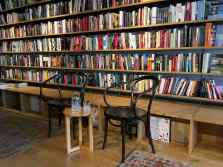
Muse bookshop (before an event)
So, what can local booksellers do? Well, mainly it must be to continue that age-old strategy of customer service. They can stock the books their readers want, “curate” their collections (with new release shelves, local author shelves, genre highlight shelves, and so on), and, as I’m seeing increasingly in my area, offer more author events and talks. While for some readers, the cheapest book is all that matters, for others of us (and perhaps we are the lucky ones who can afford it), the experience of browsing beautiful bookshelves and talking with the owner (or staff) is worth the extra few dollars the books might cost. It feels good to support a bricks-and-mortar shop.
Anyhow, Hollier says that the bottom line is for people to have the desire and time (oh yes) to read. This desire, he says,
rests most powerfully on the belief that what one knows and says matters; that democracy, its public sphere, and reason, evidence and logic are the driving forces of one’s society.
Oh boy, isn’t this true! In this sense, he concludes, we get “the books and bookshops we deserve”. If this is so, then it seems that readers are turning things around, are showing that it is real bookshops that we want. May the current apparently positive state-of-play continue and grow, eh?
Have you noticed changes in the bookshop landscape in your neck of the woods?







 Whispering Gums